
Chaitra S. Ujjani and Bruce D. Cheson
Chronic lymphocytic leukemia (CLL) is the most common form of leukemia in the western world. Major advances in the management of CLL over the past decade resulting in an improved patient outcome include more accurate diagnostic techniques, validated prognostic studies, better supportive care, and improved treatment regimens. This chapter will focus on CLL and include information on two other chronic lymphoid malignancies, prolymphocytic leukemia (PLL) and hairy cell leukemia (HCL).
PRESENTATION AND DIAGNOSIS
The estimated incidence of CLL in the United States for 2012 was 16,060 cases. It tends to be a disease of the elderly, with a median age at diagnosis of 70 years. The disease affects men twice as more frequently than women. Although about half of the patients present with an asymptomatic lymphocytosis, symptoms typically associated with disease include recurrent infections and constitutional symptoms such as fatigue, weight loss, fevers, chills, and night sweats. Other clinical features include nontender lymphadenopathy, splenomegaly, autoimmune hemolytic anemia (AIHA), pure red cell aplasia, or immune-mediated thrombocytopenia.
According to guidelines published by the National Cancer Institute-Sponsored Working Group (NCI-WG), diagnostic criteria for CLL include the following:
■Absolute lymphocytosis (≥5 × 10³/μL), with a morphologically mature appearance, often with smudge cells.
■Monoclonal B-cell phenotype by flow cytometry: CD19, CD23, and CD5 with low levels of CD20 and surface immunoglobulin. Expression of CD38 and Zeta-associated protein-70 (ZAP-70) is not diagnostic for CLL, but has prognostic implications.
■Molecular cytogenetics, although not necessary for diagnosis, can identify prognostic chromosomal abnormalities and help distinguish CLL from other lymphoid disorders.
■As flow cytometry can be performed on peripheral blood, a bone marrow biopsy is not necessary to make the diagnosis. If a bone marrow biopsy is performed, the degree of lymphocytic involvement should be greater than 30% in order to confirm the diagnosis. A bone marrow biopsy can be helpful in ascertaining the cause of cytopenias and should be considered in patients with anemia or thrombocytopenia. In addition, a bone marrow biopsy should be performed prior to and after treatment in order to evaluate for response.

STAGING AND PROGNOSIS
The most commonly used staging methods include the Rai, modified Rai, and the Binet staging systems. Prognosis based on the modified Rai staging system is outlined in Table 24.1. There are a number of prognostic factors for CLL. Those associated with an inferior outcome include the cytogenetic abnormalities detected by fluorescent in situ hybridization of deletion (del) 11q and del 17p, an elevated serum β-2-microglobulin level ≥4, unmutated immunoglobulin variable region heavy chain genes (IgVH), overexpression of the ZAP-70 >20%, expression of CD38 >30%, and advanced-stage disease. Trisomy 12 and normal cytogenetics are associated with an intermediate outcome, while del 13q is associated with a favorable outcome. The utility of these factors lies in prognosis and is usually not used to determine when to initiate treatment or the choice of regimen.
Computerized tomography (CT) is not required at diagnosis or for staging purposes, but may be useful to evaluate the presence of internal enlarged lymph nodes unable to be palpated by physical examination. Patients with clinical stage 0 disease, but stage I by CT, often behave more like the latter. Contrast-enhanced CT has a higher sensitivity of detecting CLL than PET/CT. At this time there is no role for positron emission tomography (PET) scanning in CLL, except to assess for a potential transformation to a high-grade lymphoma.
COMPLICATIONS
Patients with CLL can develop infections, high-grade transformation, and are at an increased risk for other malignancies. Hematologic complications include anemia or thrombocytopenia due to marrow involvement, treatment effect, splenic sequestration, AIHA, pure red cell aplasia, and immune-mediated thrombocytopenia. AIHA can be due to the CLL itself or to fludarabine, which is commonly used in the treatment of this disease. Pure red cell aplasia, although rare, is possibly caused by suppressor T cells. Cyclosporine may be effective with a reticulocyte response within a few weeks. Frequent infections, often sinopulmonary, are often related to immunosuppressive treatments, hypogammagobulinemia, inadequate humoral response, and impaired complement activation. Transformation to Richter syndrome (large B-cell lymphoma), PLL, ALL, and multiple myeloma occurs in 10% to 15% of cases. Patients are also at increased risk of developing other malignancies of sites such as the gastrointestinal tract, lung, and skin. Other chemotherapeutics, such as cyclophosphamide or chlorambucil, are associated with secondary malignancies such as AML and MDS.
TREATMENT
CLL often exhibits an indolent course, not requiring treatment at diagnosis. The indications for treatment of CLL per the NCI-Sponsored WG guidelines include the following:
■Significant and persistent fatigue
■Unintentional weight loss of ≥10% in previous 6 months
■Persistent fevers >100.5°F or 38.0°C for 2 or more weeks without evidence of infection
■Night sweats for more than 1 month without evidence of infection
■Autoimmune anemia or thrombocytopenia poorly responsive to steroids
■Progressive marrow failure with worsening or new anemia or thrombocytopenia
■Progressive splenomegaly (>6 cm below costal margin) or lymphadenopathy (>10 cm)
■Progressive lymphocytosis: Increase >50% in 2 months or doubling time <6 months
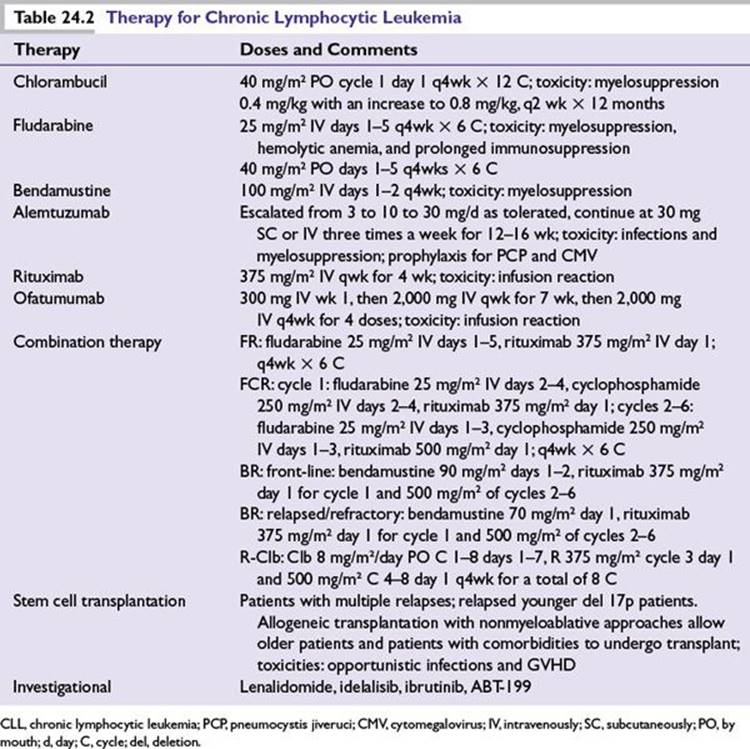
Chlorambucil was the mainstay of therapy for CLL until fludarabine (F) was found to be superior, with a survival advantage. Following demonstration of modest single-agent activity, combinations incorporating fludarabine with the chimeric anti-CD20 monoclonal antibody, rituximab (R) were developed with promising results. The combination of FR with or without cyclophosphamide (C) has demonstrated overall response rates (ORRs) of 90% to 95% (complete response [CR] 44% to 47%) with improved survival, and is a current standard of care for previously untreated CLL. The addition of cyclophosphamide appears to benefit the poor prognostic del 11q group; therefore, an alkylating agent should be incorporated into the treatment of these patients. Bendamustine was approved for the treatment of CLL based on superior response and progression-free survival (PFS) when compared to chlorambucil. A survival benefit was seen in patients who achieved a CR. The combination of bendamustine and rituximab (BR) in the front-line setting produced response rates similar to those previously reported with fludarabine-based regimens (ORR 88%, CR 23%), a more tolerable toxicity profile, and responses in traditionally poor-risk cytogenetic groups. The results of the GCLLSG CLL-10 study of BR versus FCR and the US Intergroup study of FR versus FCR versus FR followed by lenalidomide will help define the appropriate regimen for previously untreated patients. Chlorambucil alone or in combination with rituximab remains an option for patients who are unable to tolerate these regimens, producing responses in 31% to 37% with minimal toxicity. Single-agent rituximab is not recommended for CLL as it has minimal activity and a short duration of response.
In addition to rituximab, two other monoclonal antibodies are approved for the treatment of CLL. Alemtuzumab, a CD52 antibody, was approved based on results of a randomized phase III comparison to chlorambucil. In the front-line setting, alemtuzumab demonstrated an ORR of 83% (CR 24%) and median PFS of 14.6 months. Toxicities include severe opportunistic infections and infusion-related reactions, which are less severe with subcutaneous administration. Alemtuzumab is no longer commercially available. Ofatumumab is a CD20 antibody with a slightly different mechanism of action than rituximab. It was approved for fludarabine and alemtuzumab-refractory CLL based on an ORR of 58% (0% CR) and median OS of 14 months. Ofatumumab can be administered as a single agent or in combination with chemotherapy, but does not appear to provide an advantage over rituximab.
Despite the multiple effective treatment options for CLL, patients inevitably relapse and require additional therapy. Similar to indolent lymphomas, patients with relapsed CLL can be retreated with a prior regimen if a durable response was achieved. Selection of the optimal salvage treatment depends on age, performance status, prior treatment, adverse effects, duration of remission to prior therapy, and extent of disease. Options include purine nucleoside analogs, alkylating agents, monoclonal antibodies, stem cell transplantation, combination chemotherapy, and investigational treatments (Table 24.2). A number of biologic therapies have been designed to target the tumor microenvironment and intracellular signaling pathways that contribute to the pathogenesis of CLL. These include lenalidomide, an immunomodulatory agent, and several novel drugs that interfere with key pathways downstream from the activated B-cell receptor including ibrutinib (Bruton tyrosine kinase inhibitor), idelalisib (phosphatidylinositol 3-kinase inhibitor), and ABT-199 (selective BCL-2 inhibitor). At this time the only therapy that has been proven to be potentially curative in CLL is allogeneic stem cell transplantation. However, this is often not an option for the elderly population that CLL typically affects or patients with multiple comorbidities.
While receiving therapy patients with white blood cell counts >50,000/μL and/or bulky disease should receive tumor lysis prophylaxis with allopurinol and aggressive hydration. Patients receiving bendamustine should not receive allopurinol, given the risk of severe rash and Stevens-Johnson syndrome. Antimicrobial prophylaxis against pneumocystis jiveruci, varicella zoster, and fungi should be considered for each patient based on their functional immune status.
OTHER CHRONIC LYMPHOID LEUKEMIAS
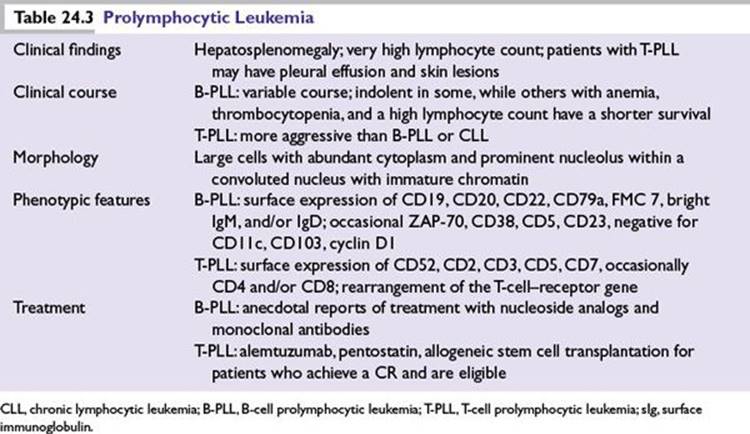
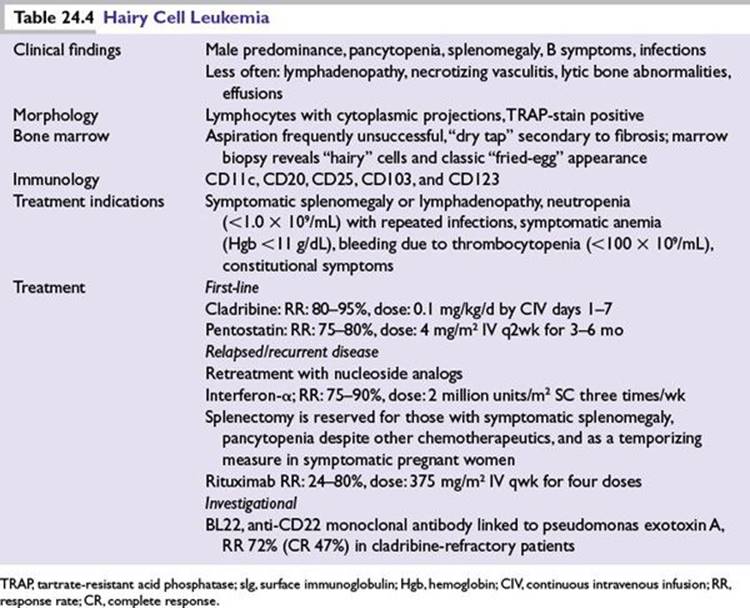
Other rare lymphoid malignancies include PLL (Table 24.3) and HCL (Table 24.4). PLL presents similarly to CLL, and can be of either T-cell or B-cell origin. PLL typically presents with >90% circulating prolymphocytes, whereas CLL has <55% prolymphocytes. PLL can occur de novo or rarely, from CLL, and has a poorer prognosis. HCL is a de novo process. It is highly treatable with cladribine, pentostatin, α-interferon, and rituximab.
REVIEW QUESTIONS
1.An 83-year-old gentleman presents to the emergency department at the direction of his primary care physician who noted abnormalities in his blood work on routine evaluation. He denies any fevers, night sweats, infections, fatigue, or bleeding. His labs are notable for a hemoglobin of 10 g/dL, platelet count of 120 × 103/mm3, and white blood cell count of 50 × 103/mm3 with 60% lymphocytes. His chemistry profile is normal, and his peripheral smear is notable for several small mature lymphocytes and scattered smudge cells. You suspect a diagnosis of CLL. Which of the following characteristics are associated with a favorable prognosis?
A.Expression of CD38
B.Unmutated immunoglobulin variable region heavy chain
C.Trisomy 12
D.Del 13q
2.A 55-year-old female with Rai stage I CLL whom you have been following with a watch and wait strategy for 2 years presents for a follow-up with complaints of increasing fatigue over the past month. She has no other medical problems and her vital signs are normal. She denies any bleeding and has no evidence of bruising or hematomas on examination. Her labs are notable for a hemoglobin of 7 g/dL, platelet count of 140 × 103/mm3, and white blood cell count of 75 × 103/mm3 with 50% lymphocytes. Her chemistry profile is normal except for an elevated indirect bilirubin and a mild increase in the LDH. What is the most appropriate treatment for this patient at this time?
A.Transfusion of packed red blood cells
B.Fludarabine-based chemotherapy regimen
C.Corticosteroid therapy
D.Single-agent rituximab
3.After completing six cycles of fludarabine, cyclophosphamide, and rituximab, your 50-year-old male patient with Rai stage III CLL (trisomy 12 positive) achieves a complete remission. Five years after completing therapy he develops worsening anemia and thrombocytopenia. His labs are notable for a white blood cell count of 8 × 10³/mm3, hemoglobin of 8 g/dL, and platelet count of 90 × 103/mm3. You perform a bone marrow biopsy for further investigation that reveals myelodysplastic syndrome. What is the most common cause of this complication in your patient?
A.Prior exposure to fludarabine
B.Prior exposure to cyclophosphamide
C.Prior exposure to rituximab
D.CLL which in itself is associated with other malignancies
Suggested Readings
1.Byrd J, Furman R, Coutre S, et al. The BTK inhibitor ibrutinib promotes high response rate, durable remissions, and is tolerable in treatment naïve and relapsed/refractory CLL or SLL patients including high-risk disease. Blood 2012; Abstract 189.
2.Chanan-Khan A, Miller KC, Lawrence D, et al. Tumor flare reaction associated with lenalidomide treatment in patients with CLL predicts clinical response. Cancer. 2011;117(10):2127-2135.
3.Cortes J, O’Brien S, Loscertales J, et al. Cyclosporin A for the treatment of cytopenia associated with chronic lymphocytic leukemia. Cancer. 2001;92:2016-2022.
4.Coutre S, Byrd C, Furman R, et al. Phase I study of CAL-101, an isoform-selective inhibitor of PI3K δ, in patients with previously treated CLL. J Clin Oncol. 2011;29:Abstract 6631.
5.Dearden CE, Matutes E, Cazin B, et al. High remission rate in T-cell PLL with Campath-1H. Blood 2001;98:1721-26.
6.Döhner H, Döhner H, Stilgenbauer S, Benner A, et al. Genomic aberrations and survival in CLL. N Engl J Med. 2000;343:1910-1916.
7.Dreger P, Döhner H, Ritgen M, et al. Allogeneic stem cell transplantation provides durable disease control in poor-risk CLL. Blood. 2010;116(14):2438-2447.
8.Else M, Dearden CE, Matutes E, et al. Long-term follow-up of 233 patients with HCL, treated initially with pentostatin or cladribine, at a median of 16 years from diagnosis. Br J Haematol. 2009;145(6):733-740.
9.Fischer K, Cramer P, Busch R, et al. Bendamustine in combination with rituximab for previously untreated patients with CLL (GCLLSG). J Clin Oncol. 2012;30(26):3209-3216.
10.Grever MR, Lozanski G. Modern strategies for HCL. J Clin Oncol. 2011;29(5):583-590.
11.Grever M, Kopecky K, Foucar M, et al. Randomized comparison of pentostatin versus interferon alfa-2a in previously untreated patients with HCL. J Clin Oncol. 1995;13:974-982.
12.Gidron A, Tallman MS. 2-CdA in the treatment of HCL. Leuk Lymphoma. 2006;47(11):2301-2307.
13.Hainsworth JD, Litchy S, Barton JH, et al. Single-agent rituximab as first-line and maintenance treatment for patients with CLL or SLL. J Clin Oncol. 2003;21:1746-1751.
14.Hallek M, Cheson BD, Catovsky D, et al. Guidelines for the diagnosis and treatment of CLL: a report from the IW-CLL updating the NCI-WG 1996 guidelines for CLL. Blood. 2008;111(12):5446-5456.
15.Hallek M, Fischer K, Fingerle-Rowson G, et al. Addition of rituximab to fludarabine and cyclophosphamide in patients with CLL: a randomised, open-label, phase 3 trial. Lancet. 2010;376(9747):1164-1174.
16.Hillmen P, Skotnicki AB, Robak T, et al. Alemtuzumab compared with chlorambucil as first-line therapy for CLL. J Clin Oncol. 2007;25:5616-5623.
17.Keating MJ, Flinn I, Jain V, et al. Therapeutic role of alemtuzumab (Campath-1H) in patients who have failed fludarabine. Blood. 2002;99:3554-3556.
18.Knauf WU, Lissitchkov T, Aldaoud A, et al. Bendamustine compared with chlorambucil in previously untreated patients with CLL. Br J Haematol. 2012;159(1):67-77.
19.Kreitman RJ, Stetler-Stevenson M, Margulies I, et al. Phase II trial of recombinant immunotoxin RFB4(dsFv)-PE38 (BL22) in patients with hairy cell leukemia. J Clin Oncol. 2009;27(18):2983-2990.
20.Maloisel F, Benboubker L, Gardembas M. et al. Long-term outcomes with pentostatin treatment in hairy cell leukemia patients. A French retrospective study of 238 patients. Leukemia. 2003;12:45-51.
21.Osterborg A, Foà R, Bezares RF, et al.: Management guidelines for the use of alemtuzumab in CLL. Leukemia. 2009;23(11):1980-1988.
22.Rai K, Peterson B, Appelbaum F, et al. Long-term survival analysis of the North American Intergroup Study C9011 comparing fludarabine and chlorambucil in previously untreated patients with CLL. Blood. 2009;114(22):Abstract 536.
23.Rai K, Sawitsky A, Cronkite EP, et al. Clinical staging of CLL. Blood. 1975;46:219-234.
24.Rassenti LZ, et al. Relative value of ZAP-70, CD38, and immunoglobulin mutation status in predicting aggressive disease in CLL. Blood. 2008;112(5):1923.
25.Seymour J, Davids M, Anderson M, A, et al. The BCL-2-Specific BH3-Mimetic ABT-199 (GDC-0199) Is Active and Well-Tolerated in Patients with Relapsed/Refractory Chronic Lymphocytic Leukemia: Interim Results of a Phase I First-in-Human Study. Blood2012;120:Abstract 3923.
26.Smith MR, Neuberg D, Flinn IW, et al. Incidence of therapy-related myeloid neoplasia after initial therapy for CLL with FC versus F: US Intergroup Study E2997. Blood. 2011;118(13):3525-3527.
27.Tam CS, O’Brien S, Wierda W, et al. Long-term results of the fludarabine, cyclophosphamide, and rituximab regimen as initial therapy of CLL. Blood. 2008;112(4):975-980.
28.Tsimberidou AM, Keating MJ. Richter syndrome: biology, incidence and therapeutic strategies. Cancer. 2005;103:216-228.
29.Wierda W, Kipps TJ, Mayer J, et al. Ofatumumab as single-agent CD20 immunotherapy in fludarabine-refractory CLL. J Clin Oncol. 2010;28(10):1749-1755.
30.Woyach JA, Ruppert AS, Heerema NA, et al. Chemoimmunotherapy with fludarabine and rituximab produces extended OS and PFS in CLL: CALGB study 9712. J Clin Oncol. 2011;29(10):1349-1355.