
Sairah Ahmed and Muzaffar H. Qazilbash
EPIDEMIOLOGY
Chronic myeloid leukemia accounts for 20% of newly diagnosed leukemia in adults, and was likely first described in Europe during the 1840s as reviewed by Geary and Deininger.9 The incidence of chronic myeloid leukemia (CML) is 1 to 2 cases per 100,000, with a median age at diagnosis of 65 years, although the disease can be seen in all age groups. The average person’s lifetime risk of being diagnosed with CML is about 1 in 625, and over half of cases are diagnosed in people 65 and older.
PATHOPHYSIOLOGY
CML is a clonal disorder of hematopoietic stem cells. The reciprocal translocation between the long arms of chromosomes 9 and 22 [t(9;22)], characterized as the Philadelphia (Ph) chromosome, is the hallmark of CML. This translocation results in the transfer of the Ableson (ABL) gene on chromosome 9 to an area of chromosome 22 termed the breakpoint cluster region, resulting in the BCR-ABL fusion gene. This fusion gene results in the expression of the constitutively active protein tyrosine kinase, BCR-ABL1, which plays the major role in the pathogenesis of CML. The Ph chromosome is present in more than 90% of CML patients, and the majority express the 210 kDa oncoprotein, while less than 10% express either the 190 kDa oncoprotein. The different-molecular-weight isoforms are generated due to different breakpoints and mRNA splicing. It is likely that clonal evolution plays a role in blastic progression and the most common gross cytogenetic abnormalities associated with CML blast crisis include duplication of the Ph chromosome, trisomy 8, and isochromosome 17.
DIAGNOSIS AND CLINICAL FEATURES
Symptoms and Signs
■Frequently patients in chronic phase (CP) are asymptomatic.
■Fatigue
■Anorexia and weight loss
■Sweats and low-grade fever
■Left upper quadrant discomfort/early satiety associated with splenomegaly
■Dyspnea on exertion
Laboratory Features
The diagnosis of CML may be accomplished with peripheral blood. An elevated white blood cell count with a left shift, basophilia, and thrombocytosis in up to 50% of patients is suggestive of CML. Although identification of Ph chromosome on cytogenetic analysis or the detection of BCR-ABL fusion transcript by polymerase chain reaction (PCR) in peripheral blood can be done, a bone marrow aspiration and cytogenetic analysis are necessary for staging of the disease as well as to identify clonal evolution at the time of diagnosis or in the future. The absolute value of the transcript level is not important in staging but it is essential for subsequent evaluation of response.
Differential Diagnosis
■Leukoerythroblastic reaction in response to infection, inflammation, or malignancy
■Chronic myelomonocytic leukemia
■Atypical CML
■Idiopathic myelofibrosis
■Essential thrombocytosis
■Polycythemia vera
STAGING AND PROGNOSTIC FACTORS
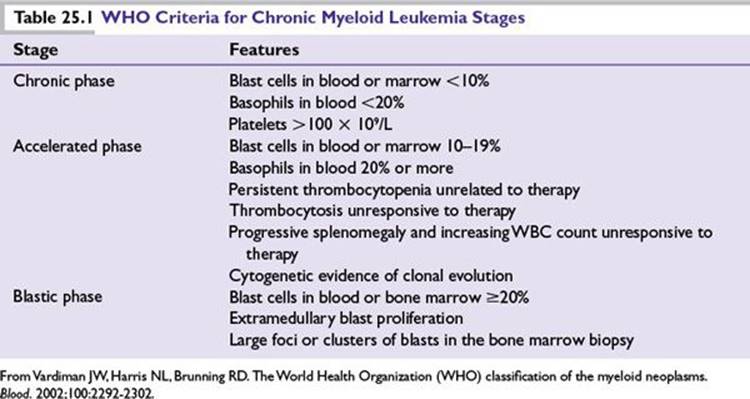
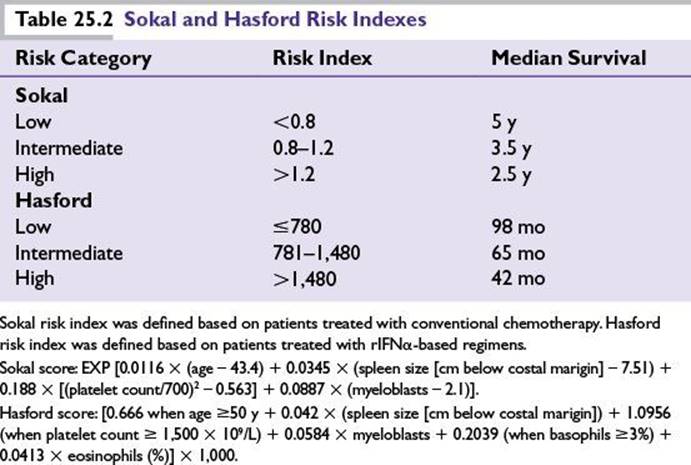
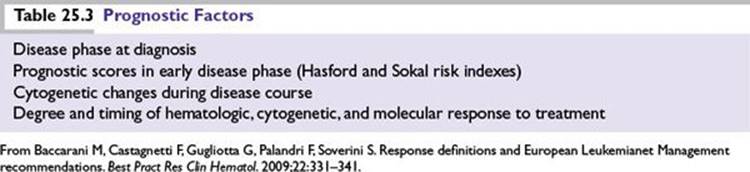
CML normally progresses through three distinct clinical phases (Table 25.1), and while 90% of patients are diagnosed in the more indolent period termed chronic phase (CP), it is followed by an accelerated phase (AP), and then an aggressive blastic phase (BP). Often this progression is over years but the period between phases can be extremely variable. Twenty to 25% of patients can progress directly from CP to BP, which is characterized by ≥30% blasts in the bone marrow or peripheral blood, or the development of extramedullary disease outside of the spleen. Risk stratification scores are commonly used for patients in CP. The Sokal and Hasford risk scores are derived from patients treated with conventional chemotherapy or recombinant interferon alpha (rIFNα), and use clinical and laboratory features at diagnosis such as age, spleen size, platelet count, and blast percentage in peripheral blood (Table 25.2). The Sokal score has been shown to correlate with response to imatinib mesylate (IM), with event-free survival (EFS) and has been shown to be more consistently predictive of outcome. According to the 5-year data from the IRIS trial (International Randomized Study of Interferon vs. STI571), overall survival (OS) at 54 months was 94%, 88%, and 81% for low, intermediate, and high Sokal risk patients, respectively (P < 0.01). More recently the EUTOS score has been developed based on spleen size and basophils; however, its significance has not been determined. Additional cytogenetic abnormalities develop in over 80% of patients in the accelerated and blast crisis phases, most commonly trisomy 8, trisomy 19, duplication of the Ph chromosome, and isochromosome 17q. The appearance of clonal evolution confers a worse prognosis (Table 25.3).
TREATMENT
In the past treatment options for CML included conventional cytotoxic chemotherapy with hydroxyurea
and busulfan, interferon α, with allogeneic hematopoietic stem cell transplantation being the only potentially curative option. In the last decade tyrosine kinase inhibitors (TKIs) have revolutionized the treatment of CML as well as changing treatment algorithms, treatment goals, monitoring tools, and the expectations of patients and physicians. The mainstay of CML therapy is now IM, and second-generation TKIs such as nilotinib and dasatinib, and more recently ponatinib. These newer agents can overcome genetic mutations that previously caused TKI resistance as well as lead to quicker and deeper molecular remission when compared to IM.4 Omacetaxine, a subcutaneously bioavailable semisynthetic form of homoharringtonine, was recently approved for treatment in TKI-resistant patients.
Hydroxyurea
Hydroxyurea is a cytotoxic antiproliferative agent that is administered orally and is used when a patient has an elevated white blood cell count (>80 × 109/L) to allow rapid control of blood counts. It induces hematologic responses in 50% to 80% of patients and is continued until confirmation of diagnosis; however, it does not alter disease course. Allopurinol may be added to prevent tumor lysis syndrome when starting hydroxyurea.
Interferon
Recombinant IFNα-based regimens were the standard therapy for chronic-phase CML before the discovery of IM, and while effective and even curative in some patients, they had significant adverse effects that greatly impaired quality of life and adherence to treatment. Follow-up for large studies of rIFNα showed 9- or 10-year OS between 27% and 53%.
Tyrosine Kinase Inhibitors
Imatinib Mesylate
With the advent of IM, CML set the bar for how malignancy could be effectively treated with targeted therapy, and ushered in a new era of research in this field. IM is a phenylaminopyrimidine derivative that inhibits the BCR-ABL tyrosine kinase by competitive binding at the ATP-binding site. Although active in all phases of CML, the most durable responses are seen in newly diagnosed patients in CP. Results of the pivotal IRIS trial established the superiority of IM, and at 8-year follow-up, the estimated EFS was 81%, freedom from progression to CML-AP or CML-BP 92%, and OS 85%. When only CML-related deaths were considered, OS reached 93%. An estimated 7% of patients progressed to accelerated-phase CML or blast crisis. As a result, IM 400 mg daily was established as the standard of care for patients with newly diagnosed chronic-phase CML. The most common adverse events seen with IM are skin rash, muscle cramps, myelosuppression, diarrhea, and liver function test abnormalities.
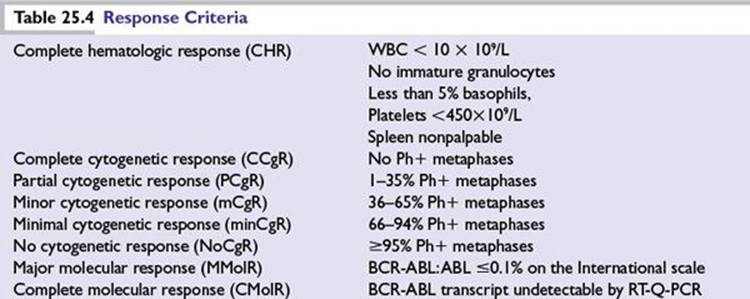
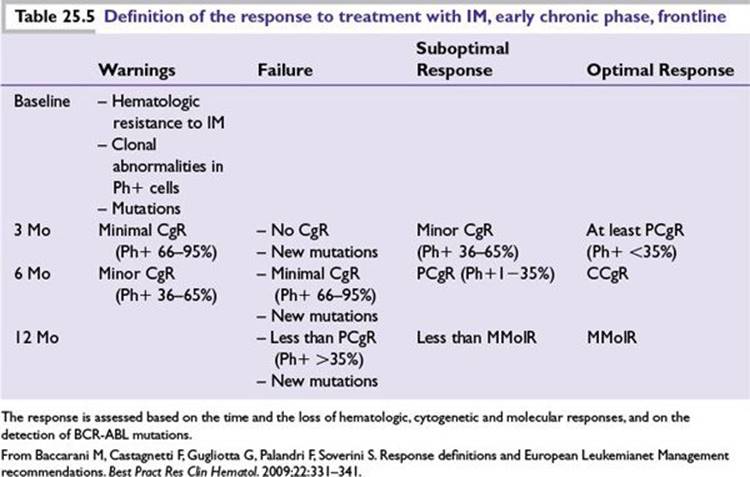
The high rate of complete cytogenetic response with IM has shifted the goal of therapy to achieving molecular responses measured by PCR. Response criteria are summarized in Table 25.4. Duration of remission and survival are related to the depth of clinical response achieved. As more information has become available, the responses to TKI therapy have become the most important marker of overall prognosis. This makes molecular monitoring an essential component of CML management. More recently monitoring schema have become available that help to determine when a second-generation TKI would be appropriate as well as timing to refer for allogeneic stem cell transplant. If there is suboptimal response to IM, then the options remaining are to increase IM dose, change to a second-generation TKI, or proceed to allogeneic transplant. At this time there are no data favoring one option over another although the failure of IM predicts for poorer prognosis. Most experts would refer patients for stem cell transplant evaluation after suboptimal response to 2 TKIs. The response schema proposed by Baccarani et al. is summarized in Table 25.5.
Second-Generation Tyrosine Kinase Inhibitors
Second-generation TKIs include dasatinib, nilotinib, and bosutinib that are more potent than IM. Dasatinib is approved by the U.S. Food and Drug Administration. Presently there are experts who would advocate starting therapy with a second-generation TKI as the rate of complete cytogenetic response is significantly improved, with rates of more than 90% and very low rates of transformation in the first 2 to 3 years, the years with the greatest risk of transformation. For patients who are diagnosed in AP or BP, a second-generation TKI followed by allogeneic transplant is the standard recommendation. There are several third-generation TKIs in the pipeline. These agents have activity against the BCR-ABL/T315I mutation that is mainly responsible for resistance to IM and second-generation TKIs. Recently ponatinib was approved by the FDA for use in patients failing second-generation TKIs or with the BCR-ABL/T315I mutation. As more information is gathered regarding mutational status, better decisions can be made on the optimal TKI selection for CP patients. Currently, mutational status is checked at the time of failure of initial TKI therapy; however, the argument can be made that ascertaining mutational status at diagnosis leads to a decreased rate of failure and hence a better durable response by choosing the right TKI while the disease is at its earliest stage. This is the topic of ongoing clinical trials.
Omacetaxine
Homoharringtonine is a natural alkaloid that is obtained from various Cephalotaxus species and its mechanism of action is through inhibition of protein synthesis and promotion of apoptosis. Its semisynthetic form, omacetaxine, has been shown to have benefit in IM-resistant CML as well as those patients who have the T315I mutation. In an open-label registration study, omacetaxine resulted in an overall hematologic response of 80% in CP patients, 45% in AP patients, and 13% in BP where all patients had failed at least 2 TKIs. The cytogenetic remission rate was 28% in CP patients with a median duration of response of >11 months. Its most frequent grade 3/4 toxicities were thrombocytopenia, neutropenia, anemia, and diarrhea. Ongoing studies will determine the activity of this agent in patients who have resistance to more than 1 TKI.
Allogeneic Stem Cell Transplantation
Allogeneic stem cell transplantation has been shown as a potentially curative treatment for CML and is still the most viable treatment option for patients diagnosed in AP, in BP, or with known resistance mutations against TKIs. CML is a disease in which graft versus leukemia plays an important role and there are extensive reports of the use of donor lymphocyte infusions leading to durable complete remissions. An analysis of the Center for International Blood and Marrow Transplant Research (CIBMTR) data reported outcomes on 2,444 patients who received myeloablative allogeneic stem cell transplant in first CP and survived in continuous complete remission for ≥5 years. OS for the entire patient population was 94% at 10 years and 87% at 15 years. Compared to a matched general population, these patients had a 2.5 times higher risk of death at 10 years due to complications such as organ failure, infection, graft versus host disease, relapsed disease, and secondary malignancies. However, mortality rates approached that of the general public at 15 years post–allogeneic transplant for those who survived. Goldman et al., J Clin Oncol. Relapse and late mortality in 5-year survivors of myeloablative allogeneic hematopoietic cell transplantation for chronic myeloid leukemia in first chronic phase. 2010 Apr 10;28(11):1888-95. doi: 10.1200/JCO.2009.26.7757.
Improvements in HLA typing, management of infections, supportive care, conditioning regimens, and immunosuppressive agents have contributed to a significant improvement in transplant outcomes. Reduced-intensity regimens have been safely used in older patients and patients with comorbidities. In the recent past, advances with alternative donor sources have made it possible to offer transplants to minorities that previously were unable to find a matched unrelated donor. Interestingly, patients who were resistant to TKIs prior to transplant have been found to be responsive posttransplant and a number of studies continue to look into how to incorporate TKIs into the transplant paradigm.
Summary
IM 400 mg daily is the standard treatment for newly diagnosed chronic-phase CML, if mutational status is unknown. If IM fails or response is less than optimal, dose escalation of IM, second-generation TKIs, allogeneic stem cell transplantation, or a clinical trial with investigational agents are alternatives. For patients with known T315I mutations, ponatinib should be the TKI of choice. For patients who present with accelerated-phase CML, starting treatment with second-generation TKIs followed by allogeneic stem cell transplantation, or clinical trials can be considered. Allogeneic stem cell transplantation after second-generation TKIs and induction chemotherapy or clinical trials can be considered for patients diagnosed in BP.
REVIEW QUESTIONS
A 37-year-old Hispanic gentleman presents to his physician with 25 lb weight loss, profound fatigue, and lower extremity edema. On labs he was found to have a white blood cell count of 500 K/µL with a normal hemoglobin and platelet count, and on examination he had significant splenomegaly. He was started on hydroxyurea for cytoreduction and bone marrow biopsy was done. His bone marrow was consistent with CML in CP with no blasts, and cytogenetics showed Ph chromosome in 10 metaphases. His BCR-ABL quantitative PCR was 12.12%. After 3 months of therapy his PCR was stable, he had hematologic response with normal counts, and his next bone marrow biopsy revealed CML in CP with no blasts, and cytogenetics showed trisomy 8 in a Ph-negative clone in 10 metaphases and Ph chromosome in 10 metaphases. Mutation analysis reveals a new T315I mutation.
1.Based on the Baccarani score what would his response be characterized as?
A.Optimal
B.Suboptimal
C.Failure
2.What is the next step in management?
A.Switch to dasatinib and check PCR in 1 month; if rising, then double the dose of dasatinib.
B.Switch to ponatinib and check PCR in 3 months, and check another bone marrow in 1 month.
C.Admit to inpatient service and start cytotoxic chemotherapy with idarubicin and cytarabine and check for potential donors in order to proceed to allogeneic stem cell transplant.
D.Switch to ponatinib and check PCR in 1 month and check for potential donors in order to proceed to allogeneic stem cell transplant.
Suggested Readings
1.Baccarani M, Castagnetti F, Gugliotta G, Palandri F, Soverini S. Response definitions and European Leukemianet Management recommendations. Best Pract Res Clin Hematol. 2009;22:331-341.
2.Baccarani M, Saglio G, Goldman J, et al. Evolving concepts in the management of chronic myeloid leukemia: recommendations from an expert panel on behalf of the European LeukemiaNet. Blood. 2006;108:1809-1820.
3.Branford S. Chronic myeloid leukemia: molecular monitoring in clinical practice. Hematology Am Soc Hematol Educ Program. 2007;2007:376-383.
4.Breccia M, Alimena G. How to treat CML patients in the tyrosine kinase inhibitors era? From imatinib standard dose to second generation drugs front-line: unmet needs, pitfalls and advantages. Cancer Lett. 2012;322(2):127-132.
5.Champlin R, de Lima M, Kebriaei P, et al. Nonmyeloablative allogeneic stem cell transplantation for chronic myelogenous leukemia in the imatinib era. Clin Lymphoma Myeloma. 2009;9(suppl 3):S261-S265.
6.Cortes J, Kantarjian H. How I treat newly diagnosed chronic phase CML. Blood. 2012;120(7):1390-1397.
7.Druker BJ, Guilhot F, O’Brien SG, et al. Five-year follow-up of patients receiving imatinib mesylate for chronic myeloid leukemia. N Engl J Med. 2006;355:2408-2417.
8.Druker BJ, Talpaz M, Resta DJ, et al. Efficacy and safety of a specific inhibitor of the BCR-ABL tyrosine kinase in chronic myeloid leukemia. N Engl J Med 2001;344:1031-1037.
9.Goldman JM. Initial treatment for patients with CML. Hematology Am Soc Hematol Educ Program. 2009:453-460.
10.Gratwohl A, Brand R, Apperley J, et al. Allogeneic hematopoietic stem cell transplantation for chronic myeloid leukemia in Europe 2006: transplant activity, long-term data and current results. An analysis by the Chronic Leukemia Working Party of the European Group for Blood and Marrow Transplantation (EBMT). Haematologica. 2006;91:513-521.
11.Hasford J, Pfirrmann M, Hehlmann R, et al. A new prognostic score for survival of patients with chronic myeloid leukemia treated with interferon alfa. Writing Committee for the Collaborative CML Prognostic Factors Project Group. J Natl Cancer Inst. 1998;90:850-858.
12.Hehlmann R, Hochhaus A, Baccarani M, European LeukemiaNet. Chronic myeloid leukaemia. Lancet. 2007;370:342-350.
13.Kebriaei P, Detry MA, Giralt S, et al. Long-term follow-up of allogeneic hematopoietic stem-cell transplantation with reduced-intensity conditioning for patients with chronic myeloid leukemia. Blood. 2007;110:3456-3462.
14.Rowley JD. A new consistent chromosomal abnormality in chronic myelogenous leukaemia identified by quinacrine fluorescence and Giemsa staining. Nature. 1973;243:290-293.
15.Sawyers CL. Chronic myeloid leukemia. N Engl J Med. 1999;340:1330-1340.
16.Shah NP. Medical management of CML. Hematology Am Soc Hematol Educ Program. 2007;2007:371-375.
17.Silver RT, Woolf SH, Hehlmann R, et al. An evidence-based analysis of the effect of busulfan, hydroxyurea, interferon, and allogeneic bone marrow transplantation in treating the chronic phase of chronic myeloid leukemia: developed for the American Society of Hematology. Blood. 1999;94:1517-1536.
18.Smith CC, Shah NP. Tyrosine kinase inhibitor therapy for chronic myeloid leukemia: approach to patients with treatment-naive or refractory chronic-phase disease. Hematology Am Soc Hematol Educ Program. 2011;2011:121-127.
19.Sokal JE. Prognosis in chronic myeloid leukaemia: biology of the disease vs. treatment. Baillieres Clin Haematol. 1987;1:907-929.