
Mark K. Doherty and Gregory D. Leonard
Esophageal cancer is the ninth most commonly occurring cancer worldwide and the sixth most common cause of cancer mortality. It is highly curable in its earliest stages; however, it usually presents with advanced disease. Recent years have seen many advances in the management of esophageal cancer including optimization of neoadjuvant strategies, nonsurgical treatment options in early-stage disease, and the introduction of biologics agents to the management of advanced disease.
EPIDEMIOLOGY
United States
■Esophageal cancer was estimated to account for 1% of all malignancies and 6% of all gastrointestinal malignancies in 2012. The age-adjusted incidence from 2000 to 2009 is 4.6 cases per 100,000 population (http://seer.cancer.gov/csr/1975_2009).
■Approximately 17,460 new cases and 15,010 deaths were estimated for 2012.
■The median age at diagnosis is 69 years. This cancer rarely occurs in patients younger than 25 years.
■Esophageal cancer is two to four times more frequent in men than in women. Siewert type 1 tumors (adenocarcinoma [ADC]) are eight to nine times more common in men than in women.
■Rates of occurrence of esophageal cancer are approximately threefold higher among blacks than among whites.
■Squamous cell carcinoma (SCC) is more common in black men; ADC is more common in white men.
■Five-year relative survival rates were 5% from 1975 to 1977, 10% from 1987 to 1989, and 19% from 2001 to 2007.
Rest of the World
■There are approximately 500,000 cases of esophageal cancer in the world, but there is marked geographic variation. Regions with clusters of high rates include China (e.g., Linxian), Iran, France, and South Africa.
■In the 1970s, approximately 90% of esophageal cancers were SCCs. The incidence of ADCs has increased dramatically and currently accounts for approximately 60% to 70% of new cases—a rate of acceleration greater than that of any other cancer in the United States.
ETIOLOGY
Adenocarcinoma
■Barrett’s esophagus
■Obesity
■Gastroesophageal reflux disease (GERD), which can be caused by obesity and might result in Barrett’s esophagus
Squamous Cell Carcinoma
■Tobacco
■Alcohol
■Predisposing conditions:
•Tylosis (SCC)
•Achalasia
•Esophageal diverticula and webs (SCC)
•Plummer-Vinson syndrome
•Human papillomavirus (HPV)
•Celiac disease
■Less significant causes include environmental exposure and dietary factors.
BARRETT’S ESOPHAGUS
Barrett’s esophagus, perhaps as a result of GERD, is the most important risk factor (100 times risk increase over other factors) for ADC.
Screening recommendations (no randomized trial data for surveillance practices) are as follows:
■For no dysplasia, endoscopy every 3 to 5 years
■For low-grade dysplasia, endoscopy every 6 months for 12 months and then yearly
■For high-grade dysplasia, 3-monthly endoscopy, esophagectomy, endomucosal resection, photodynamic therapy (PDT), or other ablative therapies
CLINICAL PRESENTATION
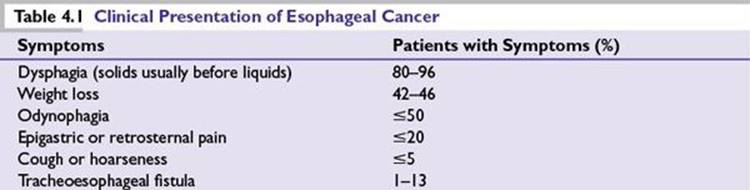
The most common clinical presentations of esophageal cancer are listed in Table 4.1 and are usually related to local compression or infiltration symptoms or generalized malaise and anorexia.
The classic triad for presentation of esophageal cancer is as follows:
■Asthenia
■Anorexia
■Analgesia (for dysphagia)
DIAGNOSIS
■Symptoms
•Dysphagia or odynophagia
•Hematemesis
•Dyspepsia
•Hoarseness
•Dyspnea
•Anorexia
■Signs (usually late presentation)
•Horner syndrome
•Left supraclavicular lymphadenopathy (Virchow’s node)
•Cachexia
•Hepatomegaly
•Bone metastases (rare, but paraneoplastic hypercalcemia can occur)
■Upper gastrointestinal endoscopy
•This diagnostic procedure is the gold standard. The combination of endoscopic biopsies and brush cytology has an accuracy of greater than 90% in making a tissue diagnosis of esophageal cancer.
■Barium contrast radiography
•This diagnostic procedure can document contour and motility abnormalities and unexpected airway fistula and may be useful when the entire esophagus has not been visualized endoscopically. However, a tissue diagnosis is needed for definitive diagnosis.
PATHOLOGY
■Most newly diagnosed patients have ADC, but there are contrasting reports on their relative prognosis. Less than 1% of esophageal tumors are lymphoma, melanoma, carcinosarcoma, or small cell carcinoma.
■Fifty percent of tumors arise in the lower one-third of the esophagus, 25% arise in the upper esophagus, and 25% of tumors occur in the middle one-third of the esophagus.
STAGING
The American Joint Commission for Cancer (AJCC) has designated staging of cancer by TNM classification, which defines the anatomic extent of disease. The most recent edition of this staging system proposes a distinction between T4a and T4b tumors—those that invade other structures but are resectable or unresectable, respectively. Other changes include staging based on histology and tumor grade, as well as N-staging based on the number of affected locoregional lymph nodes.
The Siewert classification subclassifies gastroesophageal junction tumors into three types according to their anatomic location: type I are distal esophagus tumors, type II are cardia tumors, and type III are subcardia gastric tumors.
Staging workup can include the following:
■Computerized tomography (CT) scan: CT scan of the chest and abdomen can demonstrate evidence of spread of tumors to lymph nodes or distant metastases to the liver (35%), lungs (20%), bone (9%), and adrenals (5%). CT scan may underestimate the depth of tumor invasion and peri-esophageal lymph node involvement in up to 50% of cases. Magnetic resonance imaging (MRI) provides similar results to CT.
■Endoscopic ultrasound (EUS): EUS may be helpful when metastases are not detected by CT or other imaging modalities. EUS is the optimal technique for locoregional staging. A meta-analysis demonstrated greater than 71% sensitivity in staging preoperative depth of invasion (T) and greater than 60% sensitivity for locoregional lymph nodes (N); specificity was greater than 67% and greater than 40%, respectively.
■Positron emission tomography (PET)/CT: PET/CT is useful when CT is negative for metastatic disease, and can change management of the disease in 25% to 40% of patients. It has limited utility in establishing T stage, and EUS is superior in establishing N stage, but PET/CT has a greater sensitivity for detecting distant metastatic disease than CT alone. PET/CT is currently being investigated for use in tailoring treatment based on metabolic response in the CALGB 80302 study.
■Bronchoscopy is required in tumors less than 25 cm from the incisors to exclude invasion of the posterior membranous trachea or tracheoesophageal fistula.
■Laparoscopy is sometimes performed for staging of EGJ tumors without evidence of metastatic disease, to rule out peritoneal dissemination.
TREATMENT
Surgery
■Surgery alone remains a recognized treatment for esophageal cancer with resectable local or locoregional disease. In 1993, surgery was used as a component of treatment in 34% of patients. Surgery alone was used in 18% of patients. In recent years, the improved survival seen with combined modality treatment has meant that surgery alone is generally only considered for patients with very early stage disease (T1-2N0M0).
■Endomucosal resection (EMR) with ablation is considered definitive treatment for patients with early T1a tumors, and may provide staging information for tumors with more advanced T stage.
■Recent improvements in staging techniques and patient selection have improved surgical morbidity and mortality. Operative mortality rates are now less than 5%. Surgical expertise is a major contributor to survival, with better outcomes in high-volume centers. Resection is possible in approximately 50% of patients. Five-year survival in patients with surgical resection is 5% to 25%.
■Surgical principles include a wide resection of the primary tumor with the goal of an R0 resection (no residual tumor), including more than 5 cm resection margins plus regional lymphadenectomy. Intraoperative frozen section can assess residual disease, which, if present, is considered an R1 (microscopic tumor) or R2 (macroscopic tumor) resection.
■In general, patients with cervical carcinoma of the esophagus (above the aortic arch) are not considered candidates for surgical resection; chemoradiation is favored in these patients. Other indicators of unresectable disease include T4 tumors or extensive nodal disease. Medical unresectability (due to comorbidities or poor performance status) is another common reason for patients not proceeding to esophagectomy.
■Surgical approaches include the following:
•Transthoracic resection: En bloc esophagectomy requires laparotomy and thoracotomy, for example, total thoracic or transthoracic (Lewis) procedures. A three-field lymph node dissection (extended lymphadenectomy) includes superior mediastinum and cervical lymphadenectomy. It is the treatment of choice in Japan, but is associated with increased toxicity and has a questionable survival advantage.
•Transhiatal esophagectomy: This includes laparotomy and cervical anastomosis. This technique avoids thoracotomy.
Chemoradiotherapy (Combined-Modality Approach)
Although no large prospective randomized trials have directly compared primary chemoradiation with surgery, definitive chemoradiation for locoregional carcinoma of the esophagus is considered an alternative to surgery.
Inoperable Disease
Definitive Chemoradiotherapy
■The Radiation Therapy Oncology Group (RTOG) 85-01 trial demonstrated a survival advantage (14 vs. 9 months median survival and 27% vs. 0% 5-year survival) in favor of chemoradiotherapy over radiotherapy alone. The study used a regimen of cisplatin and short-course infusional 5-FU in combination with 50 Gy radiotherapy, compared with 64 Gy radiotherapy alone. A number of randomized trials of chemoradiotherapy versus radiotherapy alone have failed to duplicate the results of RTOG 85-01; however, a Cochrane review has confirmed the superiority of chemoradiotherapy versus radiotherapy in fit, motivated patients.
■The cisplatin/fluorouracil regimen used in the RTOG study carries significant toxicity, and alternative regimens have been sought to allow for effective treatment with better safety profiles. The recently presented phase III PRODIGE-5/ACCORD-17 study demonstrated similar survival in patients treated with a fluorouracil/oxaliplatin (FOLFOX) regimen to those treated with the RTOG regimen, but with lower rates of death from toxicity (1.1% vs. 6.4%) or within 15 days from chemotherapy (1.1% vs. 3.2%).
Operable Disease
Definitive Chemoradiotherapy Direct comparisons of chemoradiotherapy versus surgery in resectable esophageal cancer are limited and the optimal approach is controversial. Two trials have provided evidence to support a nonsurgical approach in some patients:
■In the first trial, patients with locally advanced but resectable squamous tumors were treated with chemoradiotherapy, and patients with at least a partial response were randomized to continued chemoradiotherapy or surgery. There was an improvement in local control rates (64% vs. 41% at 2 years), but no difference in overall survival, and early mortality and length of hospital stay were less in the chemoradiotherapy arm (12.8% vs. 3.5%, P = 0.03)
■The second trial randomized patients with locally advanced squamous tumors to either definitive chemoradiotherapy or chemoradiotherapy (lower doses of radiation) and surgery. There was no significant difference in survival outcomes (17.7 vs. 19.3 months, respectively) between the two groups of patients.
Radiation dose escalation has not proved to be beneficial. A trial examining this approach was closed after an interim analysis indicated that there would be no advantage with higher doses of radiation.
Neoadjuvant Chemoradiotherapy (Trimodality Approach)
■The rationale for preoperative chemoradiotherapy was first studied by Leichman et al. in 21 patients with SCC. The patients were treated with 30 Gy of radiation and with two cycles of concurrent 5-fluorouracil (5-FU) and cisplatin. An additional 20 Gy of radiation was given postoperatively when a residual tumor was seen at surgery. The pathologic complete response was 37%, with a median survival of 18 months.
■A number of prospective randomized phase 3 trials have addressed the issue of whether preoperative chemoradiotherapy offers any benefit over surgery alone. Much debate exists over interpretation of these trials.
•Walsh et al. demonstrated a significant benefit in median survival (16 vs. 11 months; P = 0.01) and 3-year survival (32% vs. 6%; P = 0.01) for patients receiving preoperative chemoradiotherapy). However, limitations of this trial include poor surgical outcome, small numbers of patients studied, and the fact all patients had ADC.
•The Cancer and Leukemia Group B (CALGB) 9781 was a prospective randomized Intergroup trial of trimodality therapy versus surgery in 56 patients with stage I to III esophageal cancer. Median survival was 4.48 years versus 1.79 years (P = 0.002) in favor of trimodality therapy.
•The CROSS trial is the most recent study to investigate this issue. A preoperative regimen of weekly paclitaxel and carboplatin in combination with 41.4 Gy radiotherapy was compared with surgery alone. The neoadjuvant therapy was well tolerated. There was a higher rate of R0 resections in those who received preoperative treatment (92% vs. 69%), and a 29% complete response rate was observed. This translated to a survival benefit for those treated with the preoperative chemoradiotherapy (3-year survival 58% vs. 44%; HR 0.66; P = 0.003).
■In a meta-analysis of 12 randomized trials, the benefit of chemotherapy and surgery was observed over surgery alone. Overall survival in individual patient data from nine trials showed an absolute benefit of 4% (increased from 16% to 20%). The disease-free survival over 5 years showed an absolute benefit of 4% (increased from 6% to 10%). This meta-analysis showed a small but significant benefit for neoadjuvant chemotherapy over surgery alone (P = 0.03).
■Neoadjuvant chemoradiation has shown a trend toward superiority versus neoadjuvant chemotherapy alone in patients with locally advanced but resectable tumors. In one randomized trial that failed to meet accrual goals, patients received chemotherapy followed by surgery or chemotherapy followed by chemoradiation for 3 weeks, followed by surgery. A complete resection was possible in 77% versus 85% in arms A and B, respectively. Complete histologic response was 2.5% with chemotherapy and 17% after chemoradiation (P = 0.06). The median survival was 21.2 versus 32.8 months, and 3-year survival was 27% versus 43%, respectively (P = 0.14).
■A meta-analysis in 2007 clarified the benefits of neoadjuvant chemoradiation or chemotherapy versus surgery alone. The absolute difference in survival between neoadjuvant chemoradiation versus surgery alone was 13%, while absolute difference in survival between neoadjuvant chemotherapy versus surgery alone was 7% (P = 0.05).
Adjuvant Chemoradiotherapy There are few data available on the use of postoperative chemoradiotherapy in esophageal cancer.
■An Intergroup trial found a statistically significant survival advantage for postoperative chemoradiotherapy compared to surgery alone in gastroesophageal and gastric cancers. A recent CALGB study investigated the use of more intensive chemotherapy (ECF) given before and after postoperative radiotherapy with 5-FU, but found no improvement in survival compared with the 5-FU regimen used in the Intergroup trial. Based on these data, adjuvant chemoradiotherapy is an option for ADC tumors of the lower esophagus, though most clinicians favor preoperative treatment. It is possible that the survival benefit associated with the use of chemoradiotherapy results from reductions in local recurrences and thus compensates for inadequate surgery (only 10% of patients had the recommended D2 resection). The results of the CRITICS trial comparing postoperative ECC chemotherapy to postoperative cisplatin/capecitabine-based chemoradiotherapy are awaited.
Radiation Therapy
Radiation therapy alone is generally considered palliative and is used in patients who are unable to tolerate chemoradiotherapy. No prospective randomized trials of preoperative or postoperative single-modality radiotherapy have demonstrated a survival benefit in patients, although retrospective data do suggest benefit in those with node-positive tumors.
Chemotherapy
■Single-agent chemotherapy demonstrates response rates of 15% to 25%. Combination chemotherapy response rates are 25% to 45%.
■Cisplatin with 5-FU is a regimen for both combined-modality therapy in locoregional disease and systemic therapy for palliation.
■SCC may be more sensitive to chemotherapy, but there is no difference in long-term outcome between SCC and ADC.
Operable Disease
Adjuvant Chemotherapy
■The poor survival, even for patients with clinically localized carcinoma of the esophagus, suggests that occult metastases are present at diagnosis, thereby providing the impetus to add systemic therapy early during patient management.
■In the two largest trials examining preoperative chemotherapy, the Intergroup (INT 0113) trial showed no survival benefit, whereas the Medical Research Council (MRC) trial demonstrated a 3-month median survival advantage for chemotherapy over surgery alone.
■The following differences in the two studies may have contributed to their different outcomes:
•Chemotherapy was of longer duration and was with higher doses in INT 0113. This therapy may have been detrimental by delaying access to surgery and causing more toxicity.
•Surgery was performed in only 80% of the patients in the chemotherapy arm in INT 0113 compared to 92% in the MRC trial. Outcome for surgery alone was poor in the MRC trial, thereby possibly exaggerating the benefits of chemotherapy.
•Radiation therapy off protocol (equally distributed between treatment arms) was available in the MRC trial.
•A larger sample size in the MRC trial may have facilitated detection of a statistically significant result.
■One Japanese study suggests that neoadjuvant chemotherapy is highly superior to adjuvant chemotherapy (HR 0.64; P = 0.014).
■The MRC MAGIC trial published in 2006 assessed the use of perioperative epirubicin, cisplatin, and 5-FU (ECF) chemotherapy or surgery alone in esophagogastric adenocarcinoma. In 503 patients, 15% had esophagogastric cancer and 11% had esophageal cancer. Patients treated with chemotherapy had increased progression-free survival (HR 0.66; P < 0.001) and resectability rates, and a benefit in overall survival (HR 0.75; P = 0.009). As a result of this study, many patients with EGJ adenocarcinoma are treated with this approach.
Inoperable Disease
Palliative Chemotherapy Systemic therapy may be beneficial in patients with locally advanced or metastatic disease. Most data are extrapolated from trials in gastric cancer (see below).
Palliative Treatment
■Palliative options can be split into local or systemic options.
■Local therapies include external beam and brachytherapy radiation. This approach can palliate dysphagia in approximately 80% of patients. PDT has also been approved by the U.S. Food and Drug Administration (FDA) for this indication. For rapid palliation, laser or balloon dilatation and stenting is recommended. The placement of a gastrostomy or jejunostomy tube may improve the patient’s nutritional status.
■The systemic chemotherapy options in esophageal cancer are improving.
■Most data on chemotherapy in advanced esophageal cancer are extrapolated from trials in gastric cancer that often include gastroesophageal tumors.
■Cisplatin combined with 5-FU is a commonly used regimen, but this did not demonstrate a statistically significant benefit over cisplatin alone when tested in a randomized trial of patients with advanced SCC of the esophagus 5-FU with either oxaliplatin or irinotecan have shown equivalence to the cisplatin and 5-FU combination in studies of advanced esophagogastric cancer, and may have more favorable toxicity profiles.
■Docetaxel, cisplatin, and 5-FU (DCF) were also compared to cisplatin and 5-fluorouracil (CF). Time to disease progression improved from 3.7 months to 5.2 months, and median overall survival improved from 8.5 months to 10.2 months (P = 0.0053) in patients receiving DCF compared to those receiving CF. DCF in this trial had significant toxicity and doses have been altered in similar regimens.
■The REAL-2 trial evaluated capecitabine and oxaliplatin as alternatives to cisplatin and fluorouracil. In a two-by-two design, patients were randomly assigned to ECF (epirubicin/cisplatin/5-fluorouracil), ECX (epirubicin/cisplatin/capecitabine), EOF (epirubicin/oxaliplatin/5-fluorouracil), EOX (epirubicin/oxaliplatin/capecitabine). The median survival time was 9.9, 9.9, 9.3, and 11.2 months, respectively. Overall survival was highest with EOX (P = 0.02). EOX is now a standard of care in many institutions.
■S1 in combination with cisplatin, or with docetaxel, showed superiority compared to S1 in Asian studies. The FLAGS study in a western population showed equivalence of S1 cisplatin and 5-FU cisplatin in this setting.
New targeted therapies have been investigated in esophagogastric cancer with varying success:
■Trastuzumab has improved survival in combination with chemo. The ToGA trial demonstrated an improvement in response rate (47% vs. 35%) and survival (13.8 vs. 11 months) for patients with HER2-overexpressing tumors treated with trastuzumab in combination with cisplatin/5-FU chemotherapy compared with chemotherapy alone.
■EGFR inhibitors have not improved survival in combination with chemotherapy. In the REAL-3 study, panitumumab was used in combination with epirubicin, oxaliplatin, and capecitabine, and showed inferior survival to the same chemotherapy given alone (8.8 vs. 11.3 months). The panitumumab-containing arm used lower doses of chemotherapy which may account for the poor outcome in this group. A recent study investigating cetuximab in combination with capecitabine and cisplatin in this population showed similarly inferior survival (9.4 vs. 10.7 months).
■Antiangiogenesis therapy has shown some promise. The AVAGAST study evaluated the use of the anti-VEGF antibody bevacizumab in esophagogastric cancer, in combination with capecitabine and cisplatin. The addition of bevacizumab to chemotherapy improved response rates (46% vs. 37%), and progression-free survival (6.7 vs. 5.3 months), but failed to demonstrate an improvement in overall survival. Subgroup analysis suggested a benefit for patients enrolled in America. These results are provocative but further studies are required to define patients that may derive benefit from bevacizumab.
■Second-line therapy using docetaxel or irinotecan or the biologic agents ramucirumab or gefitinib have also improved survival compared to best supportive care.
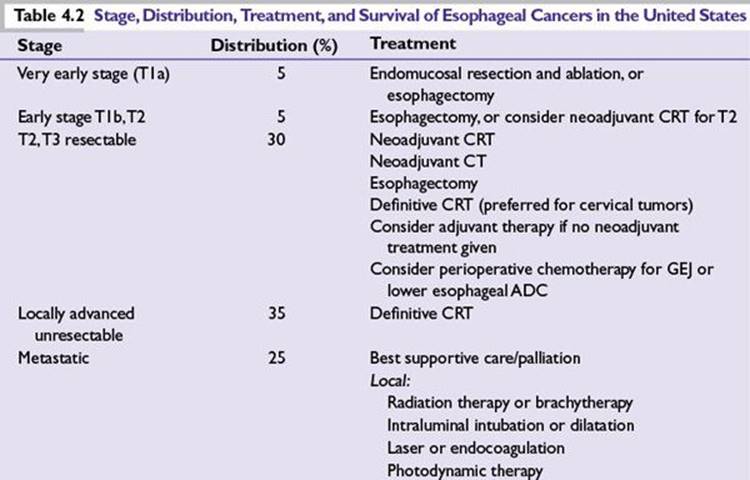
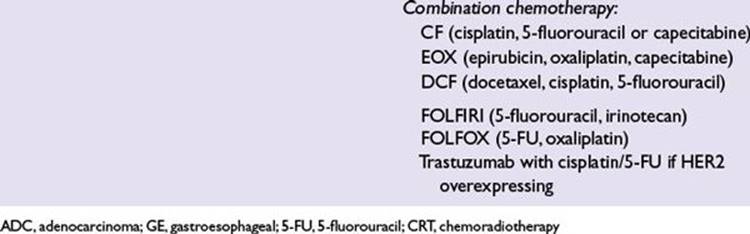
■The validated approaches for treating patients with esophageal cancer are given by stage in Table 4.2.
FOLLOW-UP FOR PATIENTS WITH LOCOREGIONAL DISEASE
There is no standard surveillance scheme.
■History and physical examination, complete blood count (CBC), urea, electrolytes, and liver function tests are recommended every 4 months for 1 year, every 6 months for 2 years, and then annually (www.nccn.org).
■Chest radiograph should be obtained as indicated.
■CT scans of the chest/abdomen should be obtained as clinically indicated.
■Upper gastrointestinal endoscopy should be performed as clinically indicated.
REVIEW QUESTIONS
1.A 65-year-old white male patient is referred to the oncology clinic after upper endoscopy has revealed a visible tumor at 30 cm in his esophagus. Pathologic examination of a biopsy from the tumor is consistent with a moderately differentiated adenocarcinoma. Computed tomography of his chest and abdomen shows thickening of the thoracic esophagus, but no evidence of metastatic disease. The patient has no major medical comorbidities, and has only mild dysphagia. The next most appropriate staging investigation for this patient would be
A.Laparoscopy
B.Endoscopic ultrasound
C.Positron emission tomography
D.Bronchoscopy
E.Barium swallow
2.A 75-year-old female patient, with a history of chronic obstructive airways disease, is investigated for dysphagia, weight loss, and chest pain. She is found to have a SCC of her upper thoracic esophagus, staged as T3N1 by endoscopic ultrasound. Whole-body PET/CT shows thickening of her esophagus with surrounding FDG-avid lymph nodes, but no evidence of distant metastatic disease. What treatment modality would be the optimal choice for this patient?
A.Esophagectomy
B.Neoadjuvant chemotherapy followed by esophagectomy
C.Esophagectomy followed by adjuvant chemoradiotherapy
D.Definitive chemoradiotherapy
E.Palliative chemotherapy
3.A 70-year-old male is admitted with progressive dysphagia, weight loss, and dyspepsia. He is found to have a large tumor at his esophago-gastric junction, which is causing partial obstruction. Computed tomography of his chest and abdomen shows thickening of his distal esophagus, as well as multiple low attenuation lesions in his liver, consistent with metastatic disease. Pathologic examination of the endoscopic biopsy reveals a moderately differentiated adenocarcinoma. He has an ECOG performance status of 1, and palliative chemotherapy with cisplatin and fluorouracil is planned. What further molecular marker can be used to guide this patient’s treatment?
A.Immunohistochemistry (IHC) for VEGFR
B.IHC for EGFR
C.EGFR mutational analysis
D.IHC and fluorescent in situ hybridization for HER2
E.IHC for ERCC1
Suggested Readings
1.Ajani JA, Van Cutsem E, Moiseyenko S, et al. Phase III study of docetaxel and cisplatin plus flurouracil compared with cisplatin and 5 flurouracil as first-line therapy for advanced gastric cancer. J Clin Oncol. 2006;31:4991-4997.
2.Ando N, Kato H, Shinoda M, et al. A randomized trial of postoperative adjuvant chemotherapy with cisplatin and 5-fluorouracil versus neoadjuvant chemotherapy for localized squamous cell carcinoma of the thoracic esophagus (JCOG 9907). Proc Gastrointestinal Cancers Sympos. 2008;74(abstract 10).
3.Bang YJ, Van Cutsem E, Kang YK, et al. Trastuzumab in combination with chemotherapy versus chemotherapy alone for treatment of HER2-positive advanced gastric or gastro-oesophageal junction cancer (ToGA): a phase 3, open-label, randomised controlled trial. Lancet. 2010;376(9742):687.
4.Bedenne L, Michel P, Bouche O, et al. Chemoradiation followed by surgery compared with chemoradiation alone in squamous cell cancer of esophagus. J Clin Oncol. 2007;25:1160-1168.
5.Bleiberg H, Conroy T, Paillot B, et al. Randomised phase two study of cisplatin and 5-flurouracil versus cisplatin alone in advanced squamous cell oesophageal cancer. Eur J Cancer. 1997;33:1216-1220.
6.Chatterton BE, Ho-Shon I, Lenzo N. Multi-center prospective assessment of accuracy and impact on management of PET in oesophageal and gastro-oesophageal junction cancer. Australian PET data collection project. Proc Am Soc Clin Oncol. 2007;25(abstract 4534).
7.Conroy T, Galais MP, Raoul JL, et al. Phase III randomized trial of definitive chemoradiotherapy (CRT) with FOLFOX or cisplatin and fluorouracil in esophageal cancer (EC): final results of the PRODIGE 5/ACCORD 17 trial. J Clin Oncol. 2012; 30(suppl; abstr LBA4003).
8.Cooper JS, Guo MD, Herskovic A, et al. Chemoradiotherapy of locally advanced esophageal cancer long-term follow-up of a prospective randomized trial (RTOG 85-01). JAMA. 1999;281:1623-1627.
9.Cunningham D, Allum WH, Stenning SP, et al. Perioperative chemotherapy versus surgery alone for resectable gastroesophageal cancer. N Engl J Med. 2006;355:11-20.
10.Cunningham D, Starling N, Rao S, et al. Capecitabine and oxaliplatin for advanced esophagogastric cancer. N Engl J Med. 2008;358:36-46.
11.Day NE, Varghese C. Oesophageal cancer. Cancer Surv. 1994;19220:43-54.
12.Gebski V, Burmeister B, Smithers BM, et al. Survival benefits from neoadjuvant chemoradiotherapy or chemotherapy in esophageal carcinoma. Australian gastrointestinal trial group. Lancet Oncol. 2007;8:226-234.
13.Kelly S, Harris KM, Berry E, et al. A systematic review of the staging performance of endoscopic ultrasound in gastro-oesophageal carcinoma. Gut. 2001;49:534-539.
14.Leichman L, Steiger Z, Seydel HG, et al. Preoperative chemotherapy and radiation therapy for patients with cancer of the esophagus: a potentially curative approach. J Clin Oncol. 1984;2:15-79.
15.MacDonald JS, Smalley SR, Benedetti J, et al. Chemoradiotherapy after surgery compared with surgery alone for adenocarcinoma of the stomach or gastroesophageal junction. N Engl J Med. 2001;345:725-730.
16.Medical Research Council Oesophageal Cancer Working Party. Surgical resection with or without preoperative chemotherapy in oesophageal cancer: a randomised controlled trial. Lancet. 2002;359:1727-1733.
17.Ohtsu A, Shah MA, Kang YK. Bevacizumab in combination with chemotherapy as first-line therapy in advanced gastric cancer: a randomized, double-blind, placebo-controlled phase III study. J Clin Oncol. 2011;29(30):3968.
18.Rebecca WO, Richard MA. Combined chemotherapy and radiotherapy (without surgery) compared with radiotherapy alone in localized carcinoma of the esophagus. Cochrane Database Syst Rev. 2003;(1):CD002092.
19.Rice TW, Blackstone EH, Rusch VW. 7th edition of the AJCC cancer staging manual: esophagus and esophagogastric junction. Ann Surg Oncol. 2010;17:1721-1724.
20.Siegal R, Naishadham D, Jemal A, et al. Cancer statistics, 2012. CA Cancer J Clin. 2012;62:10-29.
21.Stahl M, Stuschke M, Lehmann N, et al. Chemoradiation with and without surgery in patients with locally advanced squamous cell carcinoma of esophagus. J Clin Oncol. 2005;23:2310-2317.
22.Stahl M, Walz MK, Stuschke M, et al. Preoperative chemotherapy (CTX) versus preoperative chemoradiotherapy (CRTX) in locally advanced esophagogastric adenocarcinomas: first results of a randomized phase III trial. Proc Am Soc Clin Oncol. 2007;25(abstract 4511).
23.Stein HJ, Feith M, Siewert JR. Cancer of the esophagogastric junction. Surg Oncol. 2000;9:35-41.
24.Tepper JE, Krasna M, Niedzwiecki D, et al. Trial of trimodality therapy with cisplatin, flurouraci, radiotherapy and surgery compared with Surgery alone for Esophageal cancer. CALGB 9781. J Clin Oncol. 2008;26:1086-1092.
25.Thirion PG, Michiels S, Le Maitre A, et al. Individual patient data based meta-analysis assessing preoperative chemotherapy in resectable oesophageal carcinoma. Proc Am Soc Clin Oncol. 2007;25:200S (abstract 4512).
26.van Hagen P, Hulshof MC, van der Gaast A, et al. Preoperative chemoradiotherapy for esophageal or junctional cancer: Results from a multicenter randomized phase III trial. J Clin Oncol. 2010;28:s302.
27.Walsh TN, Nooman N, Hollywood D, et al. A comparison of multimodal therapy and surgery for esophageal adenocarcinoma. N Engl J Med. 1996;335:462-467.