
Anita Kumar and Heather J. Landau
Definition
• Systemic amyloidoses are characterized by presence of proteins w/c have changed conformation to form amyloid fibrils that form β-pleated sheets & deposit in tissues & lead to organ failure.
• At least 27 different protein precursors to amyloid fibrils have been identified. Most common subtype is 1° systemic light chain (AL) amyloidosis.

Primary Amyloidosis (AL):
• Rare, estimated at 1 case per 100000 person-y in Western countries but the exact incidence is unknown.
• Cellular basis is a clonal B cell disorder, 98% due to plasma cell disorders w/amyloid protein derived from Ig light chain fragments (ratio of κ-to-λ clones is 1:4). Can occur in context of MGUS or MM.
• 10–20% of pts w/MM develop AL in the course of disease
• 2% of cases, pathologic FLC is produced by LPL or other mature B-cell lymphomas.
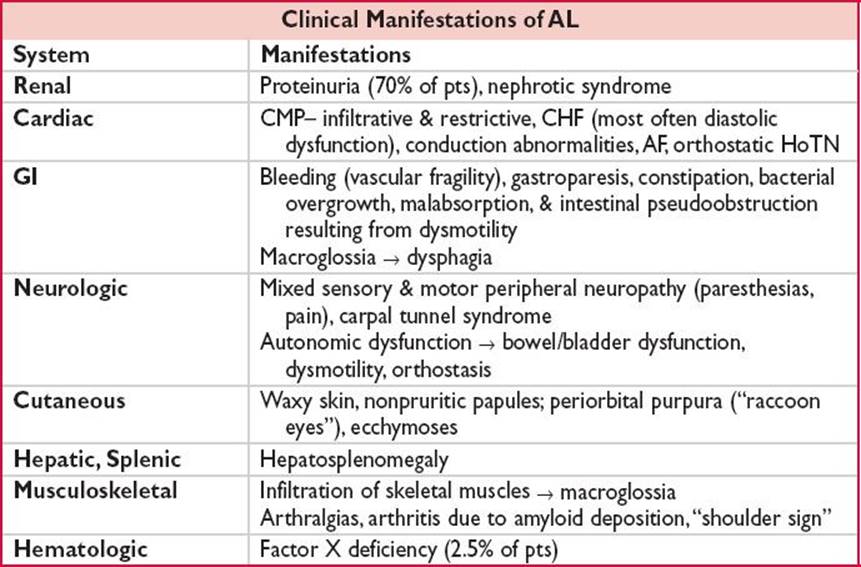
Diagnosis
• Evaluate for monoclonal protein: SPEP & UPEP & immunofixation, quantitative Ig, & serum FLC assay
• Fat pad bx or bx of involved organ: Demonstrates presence of characteristic β-pleated sheets by Congo-red staining w/classic apple-green birefringence under polarized light. Additional studies can be performed to identify amyloid subtype.
• Cardiac: NT-proBNP, Tn, EKG (low voltage, conduction abnormalities), ECHO (interventricular septal thickness > 12 mm, BiV thickening, biatrial enlargement, diastolic dysfunction, intracardiac thrombus)
• BM bx & aspirate (mildly ↑ clonal plasma cells, often 5–10%)
• Cytogenetic testing: Chromosomal abnormalities commonly seen include: t(11;14), del(13q14), & gain of 1q21.
• If hereditary subtype suspected, genetic testing (eg, TTR gene)
Diagnostic Criteria for AL Amyloidosis (Am. J. Hem 2011;86:57)
• Presence of an amyloid-related systemic syndrome
• Amyloid staining by Congo red in any tissue
• Evidence that amyloid is light-chain related by direct exam of the amyloid (ie, IHC, immunogold EM, laser microdissection/mass spectrometry) (Not required if evidence of monoclonal protein & no other type suspected)
• Evidence of a monoclonal plasma cell proliferative disorder
Cardiac Amyloid Staging and Prognosis (J Clin Oncol 2004;22:3751)
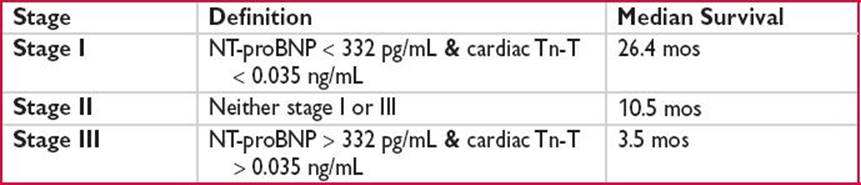
• Poorer prognosis a/w t(11,14), CCND1 (Clin Lymph Myel Leuk 2012;12:49) & other high-risk cytogenetic abnormalities: 17p, 1q.
• Most common cause of death is CV due to arrhythmia, progressive LV failure, or sudden death
Treatment
• Goal: Eliminate clonal plasma cells to ↓ production of Ig light chains
• No standard Rx. Consider clinical trial enrollment
• Melphalan & high-dose dexamethasone(Blood 2004;103:2936)
• High-dose melphalan & ASCT: In selected pts who are young w/limited organ dysfunction & good PS (Blood 1996;88:2801; Ann Intern Med 2001;134:746; Ann Intern Med 2004;140:85)
• Novel agents: Thalidomide, lenalidomide, & bortezomib
• Regimens: Bortezomib, cyclophosphamide, dexamethasone (CyBorD), bortezomib, melphalan, dexamethasone (BMDex), lenalidomide & dexamethasone (LenDex). Phase II studies demonstrated efficacy of these approaches.
• Treatment response: Measured by reduction in serum FLC (JCO 2012;30:4541). Reversal of organ damage can lag behind serologic response.