
Patrick W. Burke and M. Lia Palomba
Definition
B-cell malignancy w/BM infiltration by lymphoplasmacytic cells plus an IgM monoclonal gammopathy. May have extramedullary involvement (LNs, liver, spleen, kidney, etc.).
Considered a LPL per 2008 WHO Classification of Lymphoid Neoplasms.
Epidemiology
Overall Incidence: ∼3 per million persons per y.
1500 new cases diagnosed each y in the United States.
Strong familial predisposition: Most cases sporadic. Some reports ∼20%
WM pts have ≥1 first-degree relative w/B-cell neoplasm (Ann Oncol 2006;17:488; Clin Cancer Res 2007;13:5063; Blood 2008;112:3052).
HCV: Implicated in some studies, esp w/type II (mixed) cryoglobulinemia.
IgM MGUS: Confers 46-fold ↑ RR to develop WM (Blood 2010;115:4464).
Biology (Curr Opin Hematol 2011;18:260)
• B-cell arrested in germinal center, after somatic hypermutation, before terminal differentiation to PC.
VH gene somatic Mt. No isotype class switch.
• Del 6q: Most common cytogenetic abnormality (∼55%).
A/w worse prognostic signs: ↑ B2 MG, ↑ M-spike, anemia, & hypoalbuminemia.
BLIMP-1 (6q21) regulates PC differentiation.
• WM also a/w trisomy 4, trisomy 5, monosomy 8, & Del 20q.
• Evolving discovery MYD88 gene involvement on 3p22 locus.
MYD88 adaptor protein → mediates TLR-4 & IL-1 receptor signaling.
∼ 90–95% MYD88 exon 5 L265P Mt in WM (N Engl J Med 2012;367:826).
>90% MYD88 locus (3p22) involved in WM: L265P or 3p22 gain (Blood 2013).
→↑ IRAK-mediated NF-kB signaling & ↑ JAK/STAT3 signaling.
NF-kB chronic stimulation possibly earliest oncogenic event.
• Activation of PI3K/Akt/mTorr pathway w/o specific activating Mt.
• Likely strong role of external stimulation via BM microenvironment.
↑ Cytokine & chemokine upregulation in WM (BLyS, IL-6, CD40 ligand, BAFF, APRIL, & SDF-1).
• ↑ BM angiogenesis factors
• NF-KB inhibition by proteasome inhibitors has preclinical & clinical efficacy.
Disease Manifestations
• Related to WM neoplastic cell infiltration and/or physiochemical or immunologic properties of IgM.
• WM neoplastic cell burden mostly in BM. <15% p/w significant LAD or organomegaly. BM infiltration → cytopenias.
IgM physiochemical/immunologic properties (Blood 2009;114:2375).
Hyperviscosity: IgM pentameric structure → HAs, CN palsies/neurodeficits, blurred vision, retinal hemorrhages, epistaxis, ICH, AMS, LE cramping.
Peripheral neuropathy: IgM autoAb to (1) MAG, (2) GM1, or (3) nerve sheath sulfatide moieties → sensorimotor neuropathy, painful neuropathy, ataxic gait, foot drop.
Type I Cryoglobulinemia (up to 20%; 5% sx): IgM precipitation w/cooling → Raynaud phenomenon, acrocyanosis, digital ulcers, purpura, & cold urticaria.
Type II Cryoglobulinemia: IgM against IgG Fc → purpura, arthralgias, renal failure, & sensorimotor neuropathies.
Cold Agglutinins (∼10%): IgM against RBC Ag → AIHA, Raynaud phenomenon, acrocyanosis, & livedo reticularis.
Multiorgan Dysfunction: IgM amorphous aggregation & tissue deposition → Derm (bulli, papules, Schnitzler syndrome); GI (diarrhea, ↓ absorption, GIB); Renal (proteinuria, light chain deposition disease, renal failure).
Multiorgan Dysfunction: Amyloid deposition → fatigue, ↓ wt, edema, organomegaly, macroglossia, peripheral/autonomic neuropathy, CHF, cardiac dysrhythmias, proteinuria, renal failure, & liver dysfunction.
Other ROS (Blood 2009;114:2375).
Recurrent sinopulmonary infxn (↓ IgG & IgA).
Thrombosis (APLA syndrome).
Bruising/bleeding diathesis (↓ plats, acquired vWD).
Workup
• Essential: Hx & physical, CBC w/diff, metabolic panel + LFTs, quantitative Igs (IgM level under warm bath if cryoglobulin +), SPEP, SIF, SFLC, B2 MG, serum viscosity, Hepatitis B & C testing, unilateral BM aspirate & bx (aspirate heme-path review, flow cytometry, & cytogenetics), & CT C/A/P.
• Nonessential: Warranted/useful in certain circumstances → cryoglobulins, cold agglutinins, APLA syndrome Abs, Anti-MAG & Anti-GM1 abs, electromyelogram, neurology consult, retinal exam (if ↑ viscosity s/s), fat pad bx w/congo red stain or BM bx for amyloid, & MRI brain ± anti-Hu/anti-hsp 70 Abs (hearing loss).
Pathology
• Defined as IgM LPL. Clonally related lymphoplasmacytic cell population, located mostly in BM.
Small lymphocytes w/evidence of plasmacytoid/PC differentiation.
Secretes IgM M-protein. Most LPL are WM (IgM). <5% are IgA or IgG.
• Immunophenotype (IHC & flow cytometry): CD19+, CD20+, CD 22+, CD79+, sIgM+.
20% WM: CD5+, CD10+, or CD23+ (Clin Lymphoma 2005;5:246).
Staging
• Little use for Ann Arbor staging since BM involvement by definition.
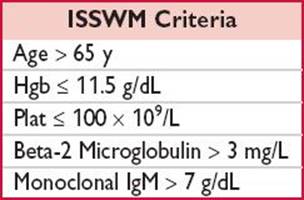
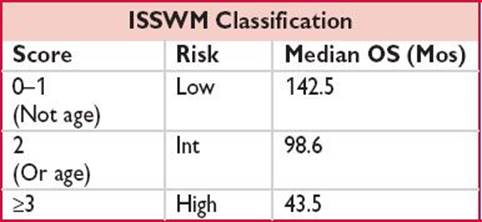
• ISSWM informs median survival & possibly trajectory of disease.
Not an independent determinant for tx (Blood 2009;113:4163).
Treatment
• WM is an indolent lymphoma→ tx indicated only if sxs present: Cytopenias, hyperviscosity, neuropathy, organomegaly, bulky LAD, cold agglutinin disease, cryoglobulinemia, amyloidosis.
• Not curable w/conventional therapies (CT or HDT → ASCR).
• Like other indolent lymphomas, possibly curable w/allogeneic HSCT. But not recommended outside clinical trial in WM for ↑ risk disease.
• ↑ Viscosity sxs, serum viscosity > 3.5 cP, or IgM > 5 g/dL → urgent plasmapheresis before CT (2–3 courses → ↓ IgM 30–60%).
• CT regimen choice first depends on if candidate for ASCR.
If ASCR candidate → avoid nucleoside analogs (difficulty w/stem cell collection & ↑ risk of MDS/AML/disease transformation) & oral alkylators.
• Anti-CD20 mAb (rituximab/ofatumumab) cornerstone most regimens. But → ↑ IgM transiently (IgM flare∼40–50%) → may ↑ sxs.
• Bortezomib → ↓ IgM incommensurate to actual ↓ neoplastic cell burden due to ↓ protein synthesis. Highly effective in combination regimen. Be wary of worsening neuropathy.
• R-CP, R-CVP, & R-CHOP → similar efficacy but ↓ tox w/R-CP (Clin Lymphoma Myeloma 2009;9:62). Bendamustine ↑ efficacy.
• HDT → ASCR: 45–65% DFS at 5 y. Not curative. Often used in chemosensitive, relapsed disease.
• Remarkable activity pathway inhibitors: Everolimus (mTorr inhibitor). Ibrutinib (BTK inhibitor).