
Justin M. Watts and Martin S. Tallman
Epidemiology
• Incidence: Estimated 13800 new cases in the United States in 2012 (10200 death)
• Most common myeloid malignancy in adults
• Median age of onset: ∼70 y
• RF: Cytotoxic chemotherapy, IR, benzene exposure, trisomy 21, rare congenital syndrome (eg, Fanconi anemia, Klinefelter, dyskeratosis congenita)
Disease Biology/Natural History
• Heterogeneous clonal disorder of hematopoietic stem cells (“blasts”)
• Many genotypic variants (many w/prognostic relevance)
• W/o Rx: ↑ blasts in BM & circulation & ↓ ANC/Hb/Plt; typically fatal in wks to mos d/t BM failure (infxn, bleeding) or organ infiltration
Clinical Presentation/Emergencies
• Presenting s/s reflect ↓ hematopoiesis: Most commonly fatigue and/or infxn
• Most pts are pancytopenic w/circulating blasts at dx → ∼50% have ↓ or nl WBC; ∼20% have WBC >100000/μL
• Leukostasis can occur if WBC >50000/μL → vascular occlusion/hemorrhage (esp. of microcirculation) → visual disturbance/retinopathy, dyspnea/pulm infiltrates, myocardial ischemia, TIA/CVA → Rx w/hydration, hydroxyurea, leukapheresis
• DIC: Very common in APL & frequent cause of early death (cerebral hemorrhage) → early admin. of ATRA critical at first suspicion of APL (ie, in the ER)
• Tumor lysis syndrome (TLS) (more common w/ALL but can occur in AML): Ppx w/IVF & allopurinol, Rx includes forced diuresis, rasburicase, HD if sev.
• CNS involvement in 2–3% of cases (RF: ↑ WBC, relapsed APL); w/u incl. eye exam, CT/MRI, usu defer LP until CR1 unless symptomatic (theoretical risk of CNS seeding)
Diagnosis
• BM aspirate & bx w/flow cytometry, cytogenetics, & molecular studies (KIT, FLT3, NPM1, CEBPA are standard)
• AML confirmed if ≥20% myeloblasts in BM or blood or recurrent cytogenetic abnormality
• R/o ALL → morphology (Auer rods are pathognomonic for AML; N:C ratio often higher in ALL); immunophenotyping by IHC/flow; cytogenetics/molecular genetic studies
• Common myeloid Ag: CD13, CD33, CD34, CD117, MPO
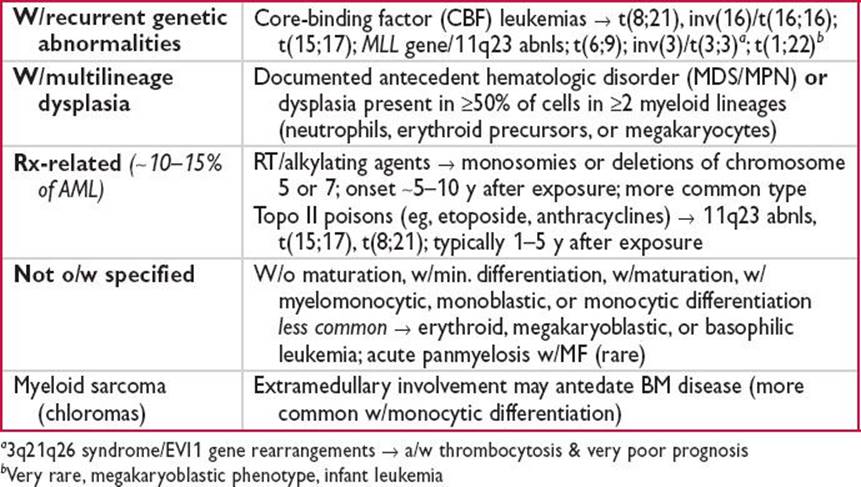
WHO Classification of AML (Blood 2009;114:937)
FAB classification no longer used
Prognosis
Determined primarily by age & cytogenetic/molecular risk
• Age >60 y is an independent poor-risk feature
• Poor PS, high presenting WBC, antecedent hematologic disorder, Rx-related AML → poor-risk
• Good-risk: APL (10–15% of all AML), +core binding factor (∼12%)
• Most pts have an intermediate or unfavorable risk at presentation
AML Genetics and Risk (Blood Rev 2004;18:115; Blood 2010;116:354)
∼45% pts have nl cytogenetics
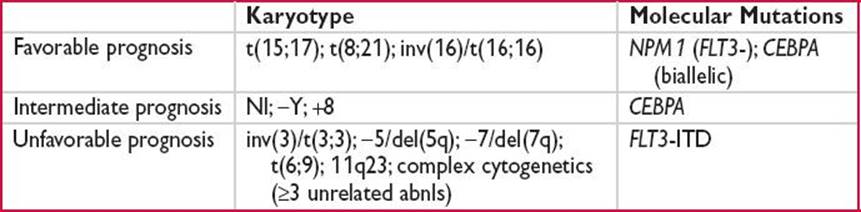
• Favorable karyotypic abnls are considered favorable regardless of other cytogenetic abnls
• c-KIT Mt portends less favorable prognosis in pts w/t(8;21) [but probably not in pts w/inv(16)/t(16;16)]
• Some data that NPM1 & IDH co-Mt may be very favorable, & that FLT3-ITD confers an esp poor prognosis in presence of other, newly discovered “poor-risk” Mt (eg, TET2, ASXL1, & DNMT3A) (NEJM2012;366:1079)
• A monosomal karyotype (≥2 monosomies or 1 w/other structural abnl) carries an extremely poor prognosis
Treatment
• Induction chemo (“7 + 3”): 7 d of infusional cytarabine & 3 d of dauno or idarubicin; RCTs confirmed high-dose dauno (90 mg/m2) superior (OS benefit) to standard dose (45 mg/m2) (NEJM 2009;361:1235); can use dauno 60 mg/m2in older pts w/good PS
• Confirm CR (<5% blasts) w/BM bx upon peripheral count recovery; persistent cytopenias >28 d after chemo → likely residual leukemia
• Can repeat 1 course of induction w/“5 + 2” or alternative regimen if no CR
• Postremission (consolidation) Rx: High-dose cytarabine (HiDAC) → optimal dose under debate → in younger pts current standard is 3 g/m2 × 6 doses for 3–4 cycles (cerebellar tox rare but potential SE; modify dose in older pts)
• No proven benefit to multiple courses of HiDAC, esp. in older pts & non-CBF leukemias
• Allogeneic HCT in appropriate pts (unfavorable prognosis, strongly consider if intermediate-risk) w/suitable donor (RIC for pts >50–60 y)
• Autologous HCT rarely used, though may benefit pts w/favorable or intermediate risk who received high-dose dauno (Blood 2011;117:5306)
• No proven role for maintenance chemotherapy in AML (despite numerous studies)
• If relapse → salvage chemo (eg, MEC → mitoxantrone, etoposide, cytarabine) vs. clinical trial → goal to achieve CR2 & consolidate w/alloHCT
• MUD & matched sibling donor (MRD) HCT now have similar outcomes; UCB has expanded donor pool (Blood 2010;116:4693)
• Hypomethylating agents (5-aza, decitabine) have benefit in older pts not candidates for intensive chemo (J Clin Oncol 2010;28:562)
• Supportive care: IVF, abx for FN, antimold antifungal ppx if prolonged neutropenia, TLS ppx w/allopurinol (rasburicase if ↑ UA & risk for tumor lysis), RBC & plt transfusions, hydroxyurea if ↑ WBCs (leukapheresis rarely needed)
Outcomes (Blood 2005;106:1154; J Clin Oncol 2009;27:61)
• ∼70–80% of younger pts (<60 y) & ∼40–50% of older pts (>60 y) will achieve CR w/induction chemo (+CR correlates w/survival)
• OS ∼35–40% in younger adults; better prognosis in APL & CBF leukemias
• Older pts have dismal prognosis (OS ∼10%), d/t medical comorbidities & underlying disease biology/genetics (eg, ↑ risk of antecedent MDS, monosomal karyotype)
Acute Promyelocytic Leukemia (APL)
• Unique subtype of AML w/excellent prognosis & distinct biology
• Characterized by atypical promyelocytes (w/c are blast “equivalents”)
• Driven/defined by translocation of RAR gene [t(15;17)] → aberrant fusion protein PML-RARα → blocks nl myeloid differentiation at promyelocyte stage
• High early mortality rate from characteristic DIC → start ATRA early & aggressively correct coagulopathy w/FFP & cryoprecipitate
• Most pts are now cured w/the differentiating agents ATRA & ATO → almost all pts achieve CR, OS ∼90%
• Standard Rx: Induction w/ATRA & idarubicin (or dauno + cytarabine) → consolidation w/ATRA & ATO → maintenance w/ATRA, 6-MP, oral MTX; autoHCT if relapse
• Pts treated w/ATRA/ATO only (no chemotherapy) also appear to have excellent outcomes → idarubicin still used if elevated WBC to prevent hyperleukocytosis, w/c ↑ induction mortality & risk of relapse (J Clin Oncol 2009;27:504)
• Differentiation syndrome: Fever, edema, serositis, ARDS, HoTN → Rx w/high-dose steroids & temporary cessation of ATRA/ATO (potentially life-threatening)