
Amanda L. Olson and Ellin Berman
Epidemiology
• MPN → dysregulated production & uncontrolled proliferation of mature & maturing granulocytes w/fairly nl differentiation
• 15–20% of adult leukemias, approx 5K new cases/y in the United States, median age 55–60, RF: Include exposure to IR
• Hallmark: Uncontrolled production of mature/maturing granulocytes
Pathology
• WBC > 100K/μL (50–70%), anemia (40–60%), Plt > 600K–700K/μL (15–30%)
• Peripheral smear: Full spectrum of myeloid forms, diff frequently shows absolute basophilia/absolute eosinophilia
• BM bx: Hypercellular, granulocytic hyperplasia, small megakaryocytes w/hypolobated nuclei, blasts
Clinical Features
• Presentation: Splenomegaly (early satiety), wt loss, bleeding/bruising
• Can progress through several phases in a triphasic or biphasic course

Biology
• Philadelphia (Ph) chromosome: BCR–ABL1 gene fusion, reciprocal translocation between chromosomes 9 (ABL1) & 22 t(9;22)(q34;q11) → encodes deregulated TK implicated in CML pathogenesis → progression to accelerated phase/blast crisis accompanied by acquisition of further molecular changes; TKI resistance frequently a/w point Mt in BCR–ABL1
• Two types of fusion proteins:
p210: Classic breakpoint (95% of pts)
p190: Alternate breakpoint, common in ALL (70% of Ph+)
• A minority of pts (<5%), may harbor a variant translocation → therefore test for cytogenetics & molecular (PCR)
Molecular Diagnostics
• BM bx: Advised at dx & at progression on TKIs
• Cytogenetics: For Ph chromosome (& to determine any additional chromosomal abnormalities), repeat if significant ↑ qPCR
• FISH: For BCR–ABL gene, obtain at dx then q3mo until major molecular response
• Quantitative PCR: Fusion mRNA product, q3mo when on TKI Rx
• Mutational analysis: Not at Dx, only if failure of TKI
Prognosis
• Stage of disease at dx: Strongest predictor
• Various scoring systems devised to predict outcomes:
Sokal score categories: Low vs. intermediate vs. high, calculated from % blasts in peripheral blood, plt count, spleen size, age (Blood 1984;63:789)
EUTOS score (categories: Low vs. high, 5-y PFS of 90% & 82% respectively, new system using data from pts treated w/imatinib, based on % basophils & spleen size)
Front-Line Therapy
• Majority of chronic phase CML pts: Excellent response to up-front TKIs, most achieving response w/in 1st y of Rx
Imatinib: 400 mg daily front-line tx → (may ↑ dose to 800 mg daily w/sub-optimal response but caution w/s/e) (NEJM 2003;348:994)
Nilotinib (NEJM 2010;362:2251) & dasatinib: May be used front-line or w/imatinib failure, result in faster cytogenetic response, avoid nilotinib in pts w/sev. DM/pancreatitis Hx, avoid dasatinib in pts w/COPD, CHF, HTN
Progressive Disease on TKI
• Check for BCR–ABL Mt
• Consider switching to a different TKI (can ↑ dose of imatinib to 800 mg but caution w/s/e)
• Newer TKIs: Bosutinib (JCO 2012;30:3486), ponatinib
• Allogeneic SCT: More widespread use prior to advent of imatinib, potentially curative tx, now used in the setting of TKI failures
Response Evaluation
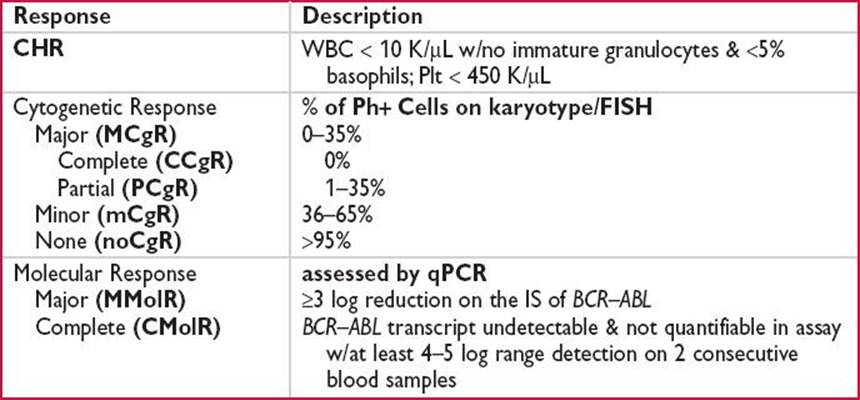
• Response types: Hematologic (CBC), cytogenetic (assessed by marrow & karyotype to evaluate Ph+), molecular(BCR–ABL assessed by qPCR in peripheral blood)
Recommendations for Follow-up Therapy
