
Chung-Han Lee
Cytogenetics
• Definition: The study of the structures of chromosomes as related to the structure & function of the cell
• Nl: 46 chromosomes, 22 pairs + XX vs. XY
Chromosomes numbered from largest to smallest chromosomes
Chromosome joined by central centromere
Short arm = p arm
Long arm = q arm
• Aneuploidy: Additions or deletions of entire chromosomes

Karyotyping
• The principle:
Cells are arrested in metaphase, while chromosomes are condensed
Cells/chromosomes are stained w/a dye
Images of the chromosomes are isolated & compared
• The observed info:
Differences in absolute size of chromosomes
Differences in position of the centromeres
Differences in relative size of the chromosomes
Differences in numbers of chromosomes
Differences in position & number of satellites
Differences in degree & distribution of heterochromatic regions
• Reciprocal translocations:
AKA balanced translocations
Rearrangement of part between nonhomologous chromosomes
No net loss of genetic data; however, genes may be disrupted at the translocation sites
At translocation sites, fusion genes created vs. genes prematurely terminated
• Unbalanced translocation:
AKA Robertsonian translocation
Fusion of two chromosomes near the centromere typically leading to loss of the p arms
Often occurring w/chromosomes 13, 14, 15, 21, 22
Fusions of 13 & 14 do not lead to loss of genetic material
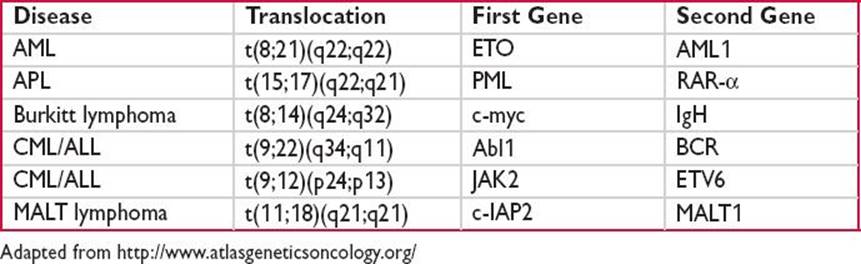
• Nomenclature more commonly seen in oncology:

Selected Translocations in Oncology
Fluorescent in Situ Hybridizations (FISH)
• Goal: Detection of the presence or absence of a specific seq of DNA
• The Principle:
Probes are generated that are complementary to the gene/seq of DNA of interest
Fluorophores are attached to the probes to allow for detection
Tissues or cells are fixed & permeablized
Probes are allowed to hybridize to the permeablized samples
Fluorescence is detected as a marker for the gene of interest
• Applications:
Gene amp
Gene deletions
Gene translocations
• Benefits:
Specific probes can be designed to detect multiple targets simultaneously
Multiple cells can be assayed simultaneously
Spatial organization of the genes can be assayed
• Limitations:
Detection of targets depends on design & quality of the probes
Target identities must be known in advance to design probes
• Select Targets for FISH in oncology

Therapeutic Application of Cytogenetics
Risk Stratification in AML (JCO 2011; 29:487)

Del(3p) in multiple solid tumors
87% breast CA, 97% lung CA (Cancer Res 2000;60:1949)
87% kidney CA (Nature 2010;463:360)
Congenital 3p loss: Low birth weight, microcephaly, trigonocephaly, hypotonia, intellectual disability, growth delay, ptosis of eye, micrognathia, polydactyly, renal/heart/GI/ear abnormalities
Sx depend on size of 3p deletion
Critical deletion @ 3p25
Multiple TSGs likely on 3p
3p loss-dependent pathogenesis in solid tumors remains to be determined