
James J. Harding and Eileen M. O’Reilly
Epidemiology
Incidence: ∼45000 new cases/y & ∼38000 D/y in US; 4th most common cause of CA death in US men & women
Acquired RFs: Age (peak incidence 7th & 8th decade), race, tobacco, EtOH, ↑ BMI, chronic pancreatitis, occupational exposure, DM
Hereditary RFs: ↑ Risk wFHx, ∼5–10% pts have genetic predisposition
Inherited susceptibility to pancreatic CA (NEJM 2008;359:2143)
Familial atypical multiple mole melanoma syn, CDKN2A (p16)
Hereditary breast CA syn, BRAC2 > BRAC1 > PALB2
LS, MSH2, & MLH1
Peutz–Jeghers syn, STK11
Ataxia-telangiectasia, ATM
Hereditary chronic pancreatitis syn, germline Mts in cationic trypsinogen (PRSS1) or secretory trypsin inhibitor (SPINK1)
Pathophysiology
Arises from ductal epithelial cells, most common histology = adenoca
Sequential progression from premalignant PanIN to invasive adenoca
PanIN ↑ in histological grade (1A/B → 2 → 3) & genetic complexity (K-RAS Mt & HER2/neu overexpression → p16 loss → p53 & BRAC2 loss)
Slow evolution to invasive disease, over decades (Nature 2010;467:1114)
Clinical Manifestations
Sx dependent on location of lesion, painless jaundice, biliary colic, vague abdominal pain, anorexia, wt loss, back pain (Retroperitoneal (RP) involvement, predictor of unresectable tumor; Surgery 1997;122:53)
New or worsening DM, pancreatitis or malabsorption (steatorrhea)
VTE or migratory thrombophlebitis (Trousseau sign)
Exam: Jaundice, hepatomegaly, ascites, abdominal mass, left supraclavicular LAD (Virchow node), periumbilical LAD (Sister Mary Joseph nodes)
Labs: Hyperglycemia, ↑ AST/ALT, ↑ conjugated bili., ↑ amylase/lipase, anemia, prolonged PT due to malabsorption of fat-soluble vitamins
Diagnostic Evaluations and Staging
Multiphase contrast-enhanced CT scan (arterial, venous, & parenchymal phase) or MRI/MRCP
If (+) pancreatic mass or stricture → EUS or ERCP for bx; if (+) cholangitis → temporary stent by ERCP + ABX; if (+) distant mets → bx
CA19-9 (↑ in biliary obstruction, not appropriate baseline until biliary decompression or surgery), CT-Chest, LFTs, is select cases staging laparotomy
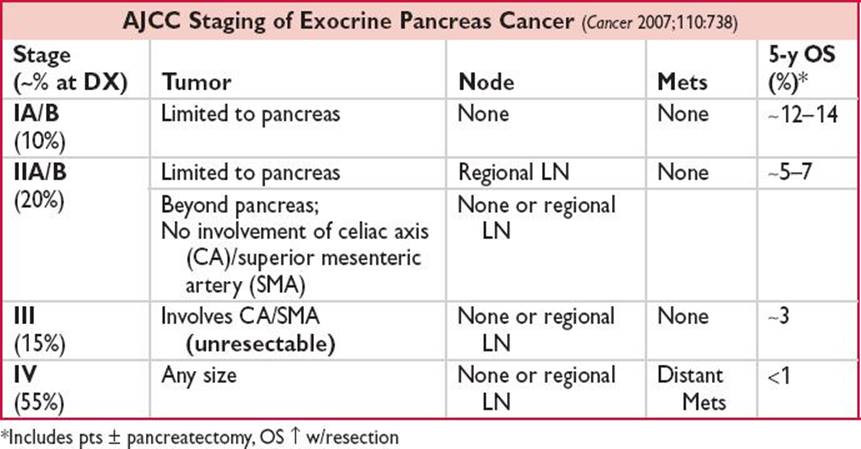
Surgical Treatment
Surgical resection is delivered w/curative intent; R0 resection is ideal.
5-y OS resected pts = 20% (Ann Surg 1997;225:621)
Definitions of resectability (Ann Surg Onc 2009;16:1727)
Resectable = clear fat planes around hepatic artery, celiac axis (CA) or superior mesenteric artery (SMA); no involvement or encasement of PV or SMV
Borderline = abutment/limited involvement of PV, SMV, or hepatic artery. May abut SMA by ≤180°
Unresectable = CA/SMA encasement
High-volume surgical centers = ↓ morbidity & mortality
Type of resection depends on size/location of tumor
Head = pancreatoduodenectomy (Whipple procedure)
Body or tail = distal or subtotal pancreatectomy ± splenectomy
Multifocal = total pancreatectomy
Other surgical considerations: Avoid regional lymphadenectomy (no improved OS); IP drains ↑ rate post-op sepsis, fluid collections & fistula (Ann Surg 2001;234:487); in resectable pt no benefit of preoperative biliary drainage unless other complicating issues (NEJM 2010;362:129)
Radiotherapy and Systemic Treatment
Adjuvant Rx: A standard approach is w/GEM × 6 mos ± 5-FU-based chemoRT (45–54 Gy), key clinical trials in the adjuvant setting:
GITSG: 5-FU + RT vs. obs; chemoRT ↑ OS (Arch Surg 1985:120:899)
CONKO-001: GEM vs. obs; GEM ↑ DFS/OS (JAMA 2007;297:267)
ESPAC-1: Bolus 5-FU + RT vs. 5-FU only vs. 5-FU + RT → 5-FU vs. obs; ↑ DFS/OS for adjuvant 5-FU;? benefit RT (NEJM 2004;350:1200)
ESPAC-3: GEM vs. 5-FU, no ΔDFS, OS, QoL (JAMA 2010;304:1073)
If chemotherapy only, GEM easier to administer & less tox than 5-FU
Neoadj/Conversion Rx: Limited prospective data, considered for borderline resectable tumors, restage prior to surgery as 15–25% will have POD,? improvement in surgical margins
Surveillance & Tx of Recurrence: Serial exam, CT-CAP, CA19-9 q3–6mos for 2 y than annually, if local recurrence → ChemoRT (if none prior) or chemo alone; if met see below
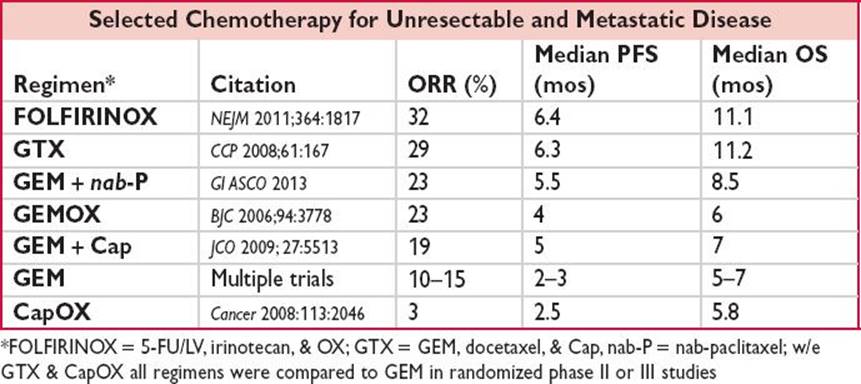
Tx for Unresectable & Met Disease
Rx not curative, designed to ↑ survival & ↓ sx
PS dictates Rx
If excellent PS → clinical trial, FOLFIRINOX or GEM-combo
If poor PS → GEM monotherapy or best supportive care
If locally adv disease w/SD or better on chemo → chemoRT
2nd line: Fluoropyrimidine-based if prior GEM-based & vice versa
Palliative & Supportive Measures
Biliary or gastric outlet obstruction → stent; pain → opioids, celiac plexus neurolysis, RT; Malabsorption → exocrine enzyme replacement; psychosocial support, early GOC discussion