
Definition (Neurology 2007;68:S7; Neurology 2008;70:344; Ann Neurol 2011;69:292; Ann Neurol. 2012; 72: 211)
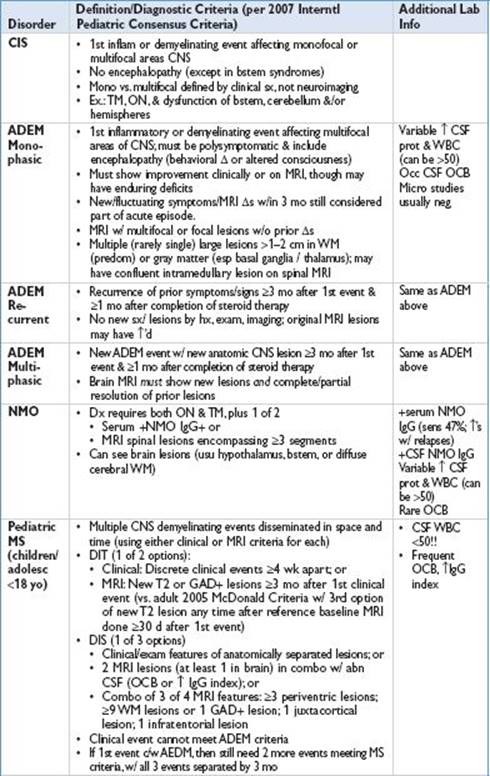
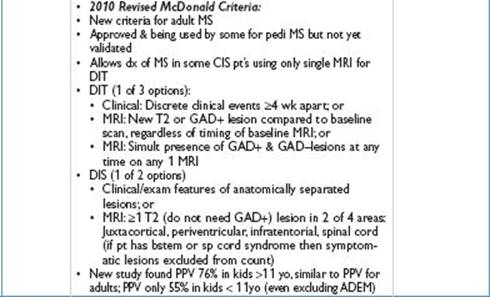
ADEM, Acute disseminated encephalomyelitis; DIS, dissemination in space; DIT, dissemination in time; GAD+, gadolinium enhancing; MS, multiple sclerosis; NMO, neuromyelitis optica; OCB, oligoclonal bands; ON, optic neuritis; TM, transverse myelitis; WM, white matter.
Epidemiology (Neurology 2007;68:S23; Neurology 2007;68:S37; Neurologist 2010;16:92)
• ADEM: More common in kids than adults; avg age: 5–8; no gender predom; seasonal (usually winter/spring); 70–77% report antecedent infection or vaccination
• MS: 2–5% of all MS pts w/ onset <16 yo;
• Avg onset 8–14 yo; female predominance, lower F:M ratio in younger kids
• Adult pattern: ↑ risk in Caucasians at ↑ distance from equator not proven in kids yet
Etiology/Pathophysiology (Lancet Neurol 2011;10:436; Neurology 2007;68:S23; Neurology 2007;68:S37)
• ADEM: Usually 2–21 d after infxn, may occur after vaccination
• 2/2 immune-mediated inflammation, not direct infection of CNS
• MS: Evidence of autoimmune mechanism and reaction to prior infection, esp EBV
• Risk likely inferred by interaction of genes and environment
• Recent study showed ↑ risk w/ HLA-DRB1*15, remote EBV inf, low Vit D level
Clinical Manifestations (Neurology 2007;68:S7; Neurology 2007;68:S23; Neurologist 2010;16:92)
• ADEM: Rapid onset of encephalopathy and multiple neuro deficits; progresses w/i hrs to max deficits w/i days; +/− prodrome fever, HA, N/V, malaise
• Kids more often w/ szrs and ongoing fever and HA; adults w/ sensory deficits & PNS
• MS: Present w/ sensory, motor & brainstem deficits; 0–50% w/ optic neuritis (uni- & bilateral); ataxia & szrs frequently in children <6 yo
Differential Diagnosis and Assessment (Neurology 2007;68:S13; Neurology 2007;68:S23)
• Minimum dx testing for 1st inflammatory demyelinating event:
• Brain and C-spine MRI w/ and w/o gadolinium; consider imaging entire spinal cord
• CBC/diff; ESR; ANA; CSF for cell count/diff, total protein oligoclonal bands, IgG index (simultaneous measurement of IgG and albumen in serum & CSF), cytology
• Consider extended testing according to presentation: MR angiography &
spectroscopy, B12, Vit D level, TSH, ACE, NMO, IgG (serum +/− CSF), ophtho eval for visual dysfxn, evoked potentials (visual, brainstem auditory, & somatosensory evoked potentials) Exclude other etiologies; esp if atypical MS features (e.g., PNS involve, encephalopathy, fever, ↑ ESR, ↑ WBC, lack of CSF oligoclonal bands, notable CSF pleocytosis)
• If acute encephalopathy, rule out acute infxn of CNS and begin empiric Abx. Check:
• CSF: GS/Cx, HSV, EBV, CMV, VZV, HHV-6, enterovirus, mycoplasma, Lyme, West Nile (seasonal)
• Serum: GS/Cx, HSV, EBV, CMV, VZV, HHV-6, HIV, mycoplasma, Lyme, West Nile
• Throat / nasal swab: Paraflu, RSV, influenza, mycoplasma, enterovirus
• Stool: Enterovirus, viral Cx
Treatment (Neurology 2007;68:S23; Neurology 2007;68:S54)
• ADEM: High-dose steroids (IV methylprednisolone 10–30 mg/kg/d to max of 1 g/d) for 3–5 d, then oral steroid taper for 4–6 wk; achieves 50–80% recovery rate
• Consider IVIG (1–2 g/kg single dose or divided over 3–5 d) alone or w/ steroids
• Plasmapheresis has been used w/ some success when above treatments fail
• MS:
• Relapse therapy: High-dose steroids (IV methylprednisolone 20–30 mg/kg/d) for 3–5 d, consider oral taper for ≤2–3 wk if incomplete res; IVIG(1 g/kg/d) for 2 d if steroids contraindicated; consider plasmapheresis or IVIG if freq attacks or steroid dependant
• Disease-modifying therapy (none FDA approved in kids, off-label MGH approach): 1st line are interferon β-1a and -1b and glatiramer acetate; 2nd-line natalizumab, fingolimod; 3rd-line cyclophosphamide, rituximab, mycophenolate, mitoxantrone, consider IVIG as alternative in ≤6 yo
• Symptomatic therapy for spasticity (e.g., baclofen), fatigue (e.g., modafinil), tremor, bladder dysfxn (e.g., straight cath, antichol), cognitive impairment (donepezil)
• NMO (Eur J Neurol 2010;17:1019)
• Relapse/acute therapy – high dose methylprednisolone as above; plasma exchange if fail steroids; IVIG not evaluated in NMO
• Disease-modifying therapy – immunosuppressants (azathioprine, rituximab,
cyclophosphamide, mitoxantrone, mycophenolate), interferon β ineffective for NMO
Outcome (Neurology 2007;68:S23; Neurology 2007;68:S37)
• ADEM: ⅔ recover completely w/o Rx, whereas Rx appears to speed recovery; 6–50% show behavioral or cognitive deficits
• NMO: Poor prognosis, mortality 20% in acute stage, 30–50% w/i first 5 yr
• MS:
• >90% w/ relapsing remitting course (RRMS); 2.3–7% pediatric pts w/ 1° progressive course (PPMS)
• Relapse rate ↑ in pediatric MS, sx more transitory & remit more quickly; most relapse w/i 1st yr of disease
• Very young display more aggressive form w/ irreversible psychomotor deficits
• Vs. adults, kids have lower disability scores, longer time to conversion to 2°
progressive course (SPMS) & ↓ probability of converting to SPMS
• Kids who do convert do so at a younger age & become disabled earlier
• Even if no physical disabilities, children display significant cognitive deficits