
Definition & Dx Criteria (Postgrad Med 2010:122;97; Postgrad Med 2008;120:48)
• Neurobiologic condition w/ hyperactivity, impulsivity and/or inattention
• 3 subtypes: Predominantly inattentive, predominantly hyperactive/impulsive,
combined types
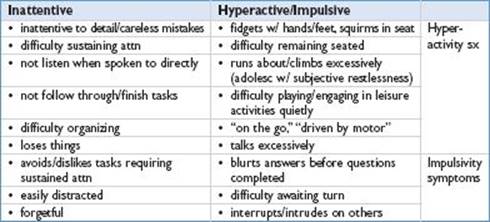
• DSM IV criteria: ≥6 of 9 inattentive and/or ≥6 of 9 hyperactive/impulsive sx
• Sx must persist for ≥6 mo; be maladaptive & inconsistent w/ developmental level; present in ≥2 settings (school, home, etc); present before 7 yo; cause significant impairment in social, academic or occupational fxn; not be attributable to another physical, situational, or mental disorder
• Might not be recognized until after 7 yo when school/work becomes more
challenging (esp in inattentive subtype)
• Anticipated DSM V will likely ↑ age limit for 1st symptoms from 7 yo to 12 yo
Epidemiology & Comorbidity (Annu Rev Med 2002;53:113)
• Most commonly dx’d pedi neurobehavioral do; 4–12% school-aged children
• Kids w/ male predominance; in adults M:F ratio equal
• Combined subtype 50–75%, inattentive 20–30%, hyperactive/impulsive <15%
• Combined subtype most severe, greatest risk of comborbidities
• Common comorbidities: Anxiety disorders, depression, bipolar, ODD, conduct
disorder, learning disabilities, substance abuse
Pathophysiology
• Heterogenous do w/ multiple contributing factors: Genetic, neuroanatomical,
neurochemical, environmental
Clinical Features
• DSM symptom cluster req’d but somewhat simplified description
• Variable executive function deficits: Response inhibition, planning & organizing, working memory, self-regulation, frustration tolerance, complex problem solving, intrinsic
motivation, goal-directed behavior (“procrastination”)
• May develop demoralization & low self esteem 2/2 persistent impairments of untreated ADHD; often mistaken for depression
Evaluation & Workup (J Am Acad Child Adolesc Psychiatry 2007;46:894)
• Current AAP & AACAP guidelines require DSM IV criteria be met for ADHD dx
• AAP recently expanded guidelines from 6–12 yo to include children 4–18 yo
• Complete Eval: Interview of pt & parent(s), DSM criteria, developmental hx, FHx & psychosocial hx, physical/neuro exam, ancillary reports (daycare/teacher/coaches reports, academic records), various sx rating scales for ADHD & comorbid disorders (e.g., ADHD rating scale, Vanderbilt parent & teacher scales, Conners’ rating scales–revised, Brown ADD rating scales, etc.)
• Screen for comorbid do: Psychiatric (anxiety/OCD, depression, ODD, CD,
bipolar), developmental (learning, language, other neurodevelopmental disorders), neurologic (tics, szrs, ALD in boys), medical/physical (sleep apnea, lead exposure)
Treatment (Pediatrics 2011;128:1007)
• Stimulants: Methylphenidate-based (MPH) & amphetamine-based (AMP)
• Side effects: ↓ appetite, insomnia, HA, abd discomfort, transient ↑ tics (not
contraindicated in tic do), rebound phenomena (irritability, lowered mood)
• CV effects: Rate sudden death in kids on stimulants not > base pop rate; obtain pt & FHx of CV dz (e.g., WPW, sudden death, HOCM, long Qt); if no significant hx, do not need screening EKG or echo
• 65–75% pt’s w/ clinical response; ↑ s to 85% if tried both MPH & AMP
• Linear dose-response curve to stimulants; ↑ sx reduction w/ ↑ ing doses:
• Start at lowest dose & titrate up every 3–7 d; long-acting preferred to short-acting for ease & ↑ adherence

• Non-stimulants: Often less effective than stimulants & delayed onset action; good if stimulant non-response/adverse effects or as adjunctive rx
• Atomoxetine: Selective NE reuptake inhib (NRI); start 0.5 mg/kg/day × 2 wk, then ↑ 1.2 mg/kg/day; consider for ADHD w/ anxiety, tics, substance abuse
• α-adrenergic agonists: Guanfacine ER (Intuniv) & clonidine ER (Kapvay); for ADHD w/ tics, anxiety, sleep disturbance, emotional dysreg, ODD
• Non-FDA approved but demonstrated benefit: Buproprion, TCAs (imipramine, nortriptyline), modafinil (for arousal/motivation), melatonin (for sleep)
• School- & home-based interventions: Medication often ineffective for many executive fxn deficits; school accommodations (504 plan or IEP), extended time on tests, preferential seating, organizers, daily progress reports, tutors, home/classroom behavioral interventions, social skills remediation
Outcome & Prognosis
• ADHD pts have ↑ risk/rates: Smoking & substance abuse (SA), w/ SA more severe & longer lasting; psychosocial deficits; hospitalizations for accidental injuries; teen pregnancies; driving problems; academic difficulties; employment & family/marital problems