
Sepsis/Meningitis
• Definition/Epidemiology
• Neonatal meningitis: Infection of meninges w/i 1st mo of life
• Incidence 0.25–1.0 per 1,000 live births
• Mortality high (20–50%) and neurodev morbidity is significant (often >50%)
• Neonatal sepsis: Systemic illness with bacteremia at <30 d of life
• Early onset: Defined as during 1st 7 d of life; majority p/within 1st 3 d of life
• 1–10 per 1,000 live births, but preterm <1,500 g have ∼2% incidence
• Assoc w/ high mortality (up to 35% in very preterm) and morbidity (↑ risk for IVH, RDS, CLD, PVL in preterm neonates) (Pediatrics 2000;105:21)
• Late onset: >7 d of life (Pediatrics 2002;110:285)
• Incidence usually < early onset for term neonates, but preterm neonates <1,500 g have up to 20% incidence.
• Mortality in preterm ∼20%, and pts at ↑ risk for PDA, NEC, BPD
• Risk factors
• Early-onset sepsis (vertical transmission): Prematurity, PPROM, GBS+, intrapartum maternal fever, meconium-stained amniotic fluid, chorio
• Late-onset sepsis (horizontal transmission): Endotracheal intubation, Foley, central lines (UAC/UVC), exposure to broad-spectrum Abx
• Meningitis: Similar as in sepsis; prematurity, VP shunts
• Clinical manifestations, diagnostic studies and management
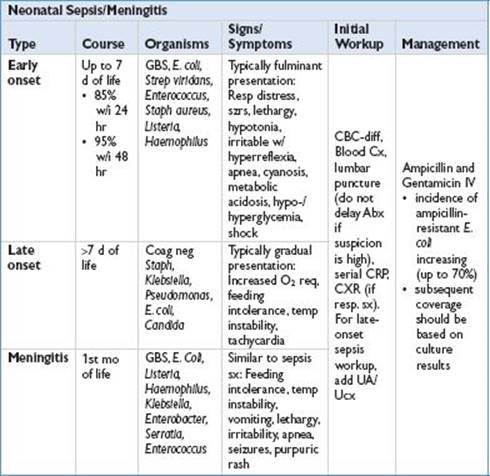
From Pediatrics 2000;105:21; Pediatrics 2002;110:285; Pediatrics 2002;110:e42; N Engl J Med 2002;347:240; NeoReviews 2008;9:e571; NeoReviews 2010;11:e426.
Hepatitis B Virus (HBV) (Pediatrics 2003;112:193; RedBook 2009: Hepatitis B – Summaries on Infectious Disease)
• Epidemiology
• Worldwide, 350 million people w/ chronic HBV; 1° transmission mother to child
• E antigen + moms, neonatal transmission rate up to 90% (BMJ 2006;332:328)
• In US, ∼20,000 neonates born to mothers w/ HBsAg+ (Pediatrics 2003;111:1192)
• Rates are highest among immigrant women, especially from Asia and Africa

HBsAg, surface antigen; HBIG, Hepatitis B immunoglobulin; HBsAb, surface antibody.
Herpes Simplex Virus (HSV)
• Epidemiology (Pediatrics 2001;108:223; Pediatrics 2011;127:e1)
• Prevalence 1–3/10,000 deliveries; most (75%) are a result of HSV-2 (genital)
• Most recent US data: 9.6 cases per 100,000 births, varies by region of US
• Since advent of acyclovir in the 1970s, mortality has improved greatly
• In 60% of cases, mother had no HSV symptoms at the time of delivery
• Mortality extremely high in untreated neonates (up to 80% in disseminated HSV)
• Pathophysiology
• Can be acquired while intrauterine, intrapartum (80% of cases), or postnatal
• Virus enters usually through the skin, eyes, mouth, respiratory tract
• Risk factors: Vag delivery, 1° HSV infxn in mom (up to 50% infxn to neonate vs. 5% w/ recurrent maternal infxn), high maternal # of sexual partners, low SES
Clinical Manifestations of Neonatal HSV
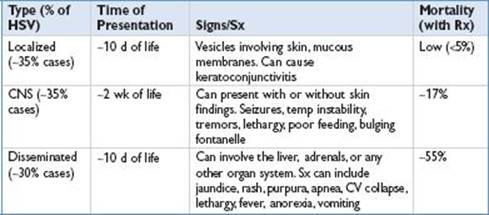
Adapted from Pediatrics 2001;108:223.
• Diagnosis
• HSV PCR on CSF and/or blood
• HSV DFA (Direct Fluorescent Antibody) of lesion
• HSV viral cultures of lesion, nasopharynx, conjunctiva, urine, CSF, rectum
• Avoid Tzanck smear as only 50% sensitive
• CT/MRI/EEG can also be useful for evaluation for CNS involvement
• Prevention: C-section shown to reduce neonatal HSV in 1° infection of mother; risk also reduced w/ dec usage of invasive fetal monitoring (JAMA 2003;289:203)
• Management
• IV acyclovir: 60 mg/kg/d × 21 d (Pediatrics 2001;108:230)
• Ocular HSV drug of choice is trifluridine; 2nd line is vidarabine
• Contact precautions; consider screening cultures
• If mother has 1° infection in asymptomatic neonate; culture and empirically treat
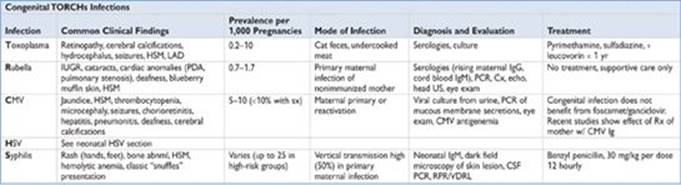
From Am Fam Physician 2003;67:2131; N Engl J Med 2005;353:1350; Pediatr Rev 2011;32:537.