
Definition (Pediatr Rev 2002;23:277; JAMA 2004;291:2746; Am Fam Phys 2009;80:692)
• Fluid deficit 2/2 imbalance btw fluid losses (nml or ↑) and fluid intake (nml or ↓)
• Dehydration is a leading cause of morbidity & mortality in kids, esp in the 3rd world
• Though often used interchangeably, strictly, dehydration ≠ hypovolemia
• Hypovolemia → ↑ ADH, susceptibility to hypoNa if repleted with hypotonic fluids/H2O
History and Exam (JAMA 2004;291:2746)
• Hx fever (insensible losses), ↓ oral intake, types of intake, freq of urination (↑ UOP w/ dehydration → diabetes insipidus), diarrhea (frequency), other sites or sources of loss (ostomies, biliary tubes, etc.)
• Assessment of weight loss via H&P as above or from actual documented weights
• Weight loss (kg) = fluid deficit (L); based on radio-labeled albumin experiments
• Inaccurate in setting of “3rd spaced fluids” (nephrotic syndrome, CHF, cirrhosis) where patient is intravascularly deplete but weight is up
• Capillary refill; compress and release superficial cap bed (palmar finger-tip w/ arm heart level), varies as fxn of temperature, site, lighting, meds, & autonomic Δ
• Skin turgor (ST); skin pinch at lateral abd wall at umbilical level. Less accurate w/ HyperNa (false nml) and w/ malnutrition (falsely prolonged). Complicated in 1° skin dz
• Can assess dehydration clinically based on history, exam, & assessment of weight loss

aTested for assessment of 5% dehydration.
• Most sens for dehydration are dry mucous memb & irritability/lethargy
• Most spec; poor CR, poor ST, hyperpnea (rapid deep breaths w/o evidence resp distress)
Diagnostic Studies (Pediatrics 2004;114:1227)
• Chem 7, U/A w/ spec grav, serum pH, anion gap (AG), serum Osm, urine Osm, urine electrolytes, stool culture can help clarify complex situations but not recommended in most uncomplicated cases
• One study showed HCO3 ≤ 13 mmol/L predicted admission in pts 6 mo–13 yo p/w acute gastroenteritis and dehydr receiving IVFs. (Ann Emerg Med 1996;28:318)
• Another study looked at lytes in pts 2 mo–9 yo w/ acute gastro & dehydr; 1/10 had abn labs affecting care. Bicarb did not affect need for admit
• Pts <1 yo had lower HCO3 than older pts w/ equiv dehyd (Pediatrics 2004;114:1227)
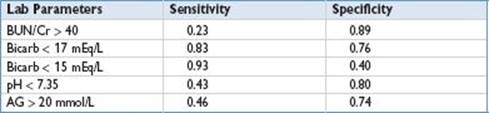
Adapted from: JAMA 2004;291:2746.
Management (Am Fam Physician 2009;80:692; Arch Dis Child 2007;92:546; MMWR 2003;52:RR-16; Pediatr Rev 2001;22:380)
• For severe dehydration, correct hemodynamics with 20 cc/kg boluses NS (or LR); repeat until stabilized (Crit Care Med 2009;37:666)
• If Hyper/HoNa, see mgmt sections on Hyper/HoNa below. In hypernatremic dehydration, intravascular volume is preserved, so degree of dehydration cannot reliably be estimated by physical signs. Therefore, correct fluid deficit as per HyperNa recs instead of per dehydration recs
• For mild/mod & for severe dehydration s/p NS or LR resuscitation, give aggressive ORT (50–100 cc/kg over 3–4 hr) followed by maintenance and replacement of ongoing losses
• PO ondansetron prior to ORT → ↑ cessation of vomiting, ↓ need for IVF, ↓ rate of immediate hospitalization (Cochrane Database 2011;9:CD005506)
• ORT promptly resolves [Na] abn; no need for IVF in 90% (Am J Clin Nutr 1980;33:637)
• ORT comparable to IVF, with lower rates of hospitalization (1/3 of ORT vs. ½ of IVF; Pediatr 2005;115:295) and acceptably low failure rates (4.9% PO vs. 1.3% IV; Cochrane Database 2006;3:CD004390)
• ORT used <30% of the time that it is indicated in U S
• Replacement of ongoing losses: For each emesis or diarrheal stool, give 60–120 mL ORS if pt weight <10 kg; 120–240 mL ORS if >10 kg
• Continue breastfeeding or routine (undiluted) infant formula during ORT
• ORT composition (Cochrane Database 2002;1:CD002847; Oral Rehydration Salts: Production of the new ORS. WHO/UNICEF, 2006)

• If ORT fails, remaining fluid deficit + maintenance given over 24 hr as D5 ½ NS (with 20 mEq KCl added once UOP established) using 1 of 2 approaches, below
Classic approach:
• Remaining deficit = Total volume deficit (% weight loss) − initial boluses
• Provide ½ of remaining deficit over first 8 hr + hourly maintenance rate
• If 5 kg pt w/ 10% wt loss, deficit = 500 cc, if given 20 cc/kg bolus, remaining deficit is 400 cc. Give 200 cc over 8 hr (25 cc/hr) + maintenance (4 cc/kg × 5 kg = 20 cc/hr); so 45 cc/hr for first 8 hr
• Provide other ½ of remaining deficit over next 16 hr + hourly maintenance
• For pt above, give remaining 200 cc over next 16 hr (12.5 cc/hr) + maintenance
(20 cc/hr); so 32.5 cc/hr (round to 33 cc/hr) for next 16 hr
Short hand approach:
• Remaining deficit calc as above, and all given over 1st 8 hr w/o maintenance
• For same pt above, give all 400 cc over 8 hr (50 cc/hr) and no added fluid for maintenance; so 50 cc/hr for first 8 hr
• Then give total 24 hr maintenance over remaining 16 hr (accounts for that not included for 1st 8 hr); equivalent to 1.5× maintenance for 16 hr
• So for same pt above, give 1.5× maintenance for next 16 hr (maintenance 20 cc/hr; 1.5 maintenance is 30 cc/hr); so 30 cc/hr for 16 hr
• Recent literature increasingly questions use of hypotonic IVF in gastroenteritis 2/2 ↑ risk of hypoNa (e.g., Pediatr Nephrol 2010;25:2303)
• Aggressive fluid resuscitation may increase risk of death in children with shock in the developing world (NEJM 2011;364:2483); use WHO recs or local guidelines