
Definition (Pediatr Rev 2002;23:371)
• Sodium concentration >145 mEq/L; seen in hospitalized pts w/o access to free water or receiving hypernatremic IVFs, can also be seen in infants unable to obtain free water
Pathophysiology (Rose & Post. Clinical Physiology of Acid-Base & Electrolyte Disorders 2001:746)
• HyperNa is 2/2 either inappropriate water loss (>Na loss) or Na retention
• Free water loss can occur from skin and respiratory tract or w/ dilute urine (diuretics or osmotic diuretic agents [glucose, mannitol]), diarrhea is variable in composition but can see excess water loss w/ osmotic or malabsorptive diarrhea
• Body attempts to correct HyperNa w/ inc ADH release → concentrated urine (occurs at POsm > 280 mOsm/L) & by driving thirst (rare for pt to be hypernatremic w/ access to H2O)
• HyperNa (w/ resultant hyperosmolality) → cellular dehydration, particularly at brain resulting in the symptoms assoc w/ HyperNa
• Acutely can be severe enough to cause subdural bleed or SAH (Pediatr Rev 1996;17:395)
• Subacute or chronic HyperNa allows brain cells to adapt by production of intracellular osmoles to balance gradient (w/i 1 hr); overrapid correction → cerebral edema
• Hypernatremia w/ [Na] >160 mEq/L has mortality of 10–15%
Epidemiology (Pediatr Rev 2002;23:371)
• High risk include debilitated pts w/ acute or chronic illness, infants, & particularly preterm (small mass: BSA ratio) and reliance on caretakers for fluids (ineffective breastfeeding)
Clinical Manifestations (Pediatr Rev 2002;23:371; Pediatr Nephrol 2005;20:1687)
• Assess patient’s access to free H2O, hx of polyuria (DI, DM, nephropathy), absence of thirst (in setting of HyperNa and inc POsm, this reflects hypothalamic lesion)
• Patients are generally irritable but can progress to lethargy, seizures, coma, or death
• Neurologic exam may reveal increased tone, brisk reflexes, or nuchal rigidity
• HyperNa can result in “doughy” skin texture; falsely normalizes ST
Etiologies and Diagnostic Studies
• Check basic electrolyte panel, U/A, serum Osm, urine Osm, urine sodium
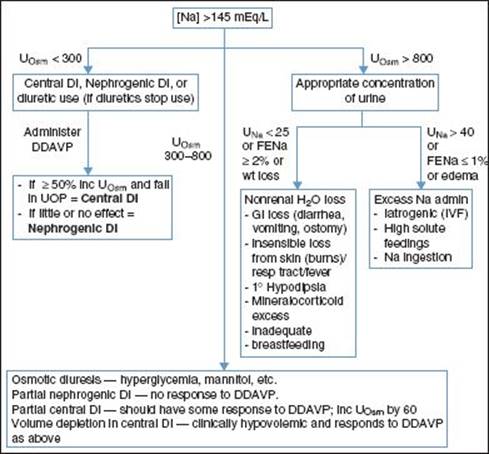
• Diabetes insipidus (Pediatr Clin N Am 2011;58:1271): Complete or partial failure in secretion of (central) or response to (nephrogenic) ADH
• Renal water absorption decreases, resulting in dilute urine
• P/w polyuria and polydipsia before developing HyperNa
• To establish diagnosis, do water deprivation test (fasting without fluids × 8–10 hr with regular monitoring of SNa, SOsm, Uvolume, UOsm). If SOsm > 300 mOsm/kg and UOsm < 300 mOsm/kg, pt has DI. Intermediate values may indicate partial DI. To distinguish central from nephrogenic DI, check AVP level then administer DDAVP (desmopressin) and monitor response in SNa, SOsm, Uvolume, UOsm
• Central DI (responds to DDAVP) can be idiopathic, 2/2 neurosurgery (transsphenoidal surg), neoplastic (craniopharyngioma), 2/2 hypoxic/ischemic encephalopathy (Sheehan syndrome, s/p arrest), congenital (2/2 hypothalamic/pituitary malformation or AVP-NPII gene mutation) or other (infectious, infiltrative or granulomatous diseases, anorexia nervosa, histiocytosis X)
• Nephrogenic DI (no/minimal resp to DDAVP): Congenital (mutations in AVPR2 or AQP2), drugs (Lithium, ifosfamide, demeclocycline), obstructive uropathy, sickle cell, pregnancy, 2/2 hyperCa or hypoK
• Dehydration may be difficult to differentiate from salt poisoning based on urine [Na] alone; also consider history, clinical appearance (edema? signs of dehydration?), and FENa (= [UNa][PCr]/[UCr][PNa]; BMJ 2003;326:157)
Management (Pediatr Rev 1996;17:395)
• Rapid correction of HyperNa can result in cerebral edema, seizures, permanent CNS sequelae, or death; unless pt is significantly symptomatic, correct slowly
• If pt hemodyn unstable 2/2 hypovolemia, rx w/ IV NS 20 cc/kg boluses until stable
• Maximum safe rate for lowering [Na] is 0.5 mEq/L/hr over 24 hr or 12 mEq/L/d
• If significant sx from HyperNa (seizing), lower sodium more rapidly until sx resolve (1.5–2 mEq/L/hr for 3–4 hr), then try not to lower >12 mEq/L/d over all
• Calculation of water deficit as follows:

• Total body water calculated as 0.4 (40%) of lean body weight (instead of usual 60%) as assumes pt somewhat dehydrated (water deplete)
• So for 25 kg pt w/ [Na] 160; water deficit is (0.4 × 25) × ((160/140) − 1) = 1.4 L H2O
• Assume correct 10 mEq/d; so needs to correct over 2 d; approx 30 cc/hr H2O
• Seizure may occur during correction (may reflect cerebral edema); if occurs, rate of correction should be slowed or administer hypertonic saline. Usually self-limited and not reflective of long-term sequelae (Pediatr Rev 2002;23:371)
• Make sure to account for insensible losses and maintenance as well
• A rough rule of thumb is that 4 cc/kg of free H2O will dec [Na] by 1 mEq/L
• Water deficit is the amount of positive water balance needed to correct sodium to 140
• Provide such that correction is <0.5 mEq/L/hr; ideal w/ change [Na] <10–12 mEq/d
• If patient has central DI, cannot correct [Na] w/o administration of DDAVP
• If nephro DI, mgmt involves use of thiazide diuretic and low Na and low-protein diet
• Breastfeeding infants require lactation support & judicious provision of supplemental fluids