Objectives
After completing this chapter, you will be able to:
1. Solve two-factor–given quantity to one-factor–wanted quantity medication problems involving a specific amount of medication ordered based on the weight of the patient.
2. Calculate medication problems requiring reconstitution of medications by using information from a nursing drug reference, label, or package insert.
3. Solve two-factor–given quantity to two-factor–wanted quantity medication problems involving a specific amount of fluid to be delivered over limited time using an intravenous pump delivering milliliters per hour (mL/hr).
4. Solve two-factor–given quantity to two-factor–wanted quantity medication problems involving a specific amount of fluid to be delivered over a limited time using different types of intravenous tubing that deliver drops per minute (gtt/min) based on a specific drop factor.
 MEDICATION PROBLEMS INVOLVING WEIGHT
When solving problems with dimensional analysis, you can use either the sequential method or the random method to calculate two-factor–given quantity medication problems. The given quantity (the physician's order) contains two parts including a numerator (dosage of medication) and a denominator (the weight of the patient). This type of medication problem is called a two-factor medication problem because the given quantity now contains two parts (a numerator and a denominator) instead of just one part (a numerator).
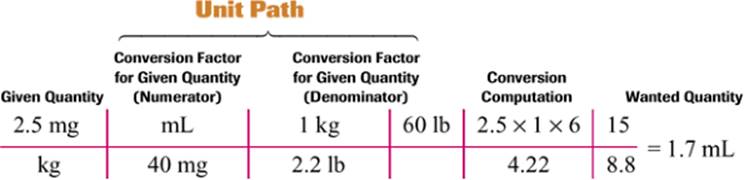
Below is an example of the problem-solving method showing placement of basic terms used in dimensional analysis, applied to a two-factor medication problem involving weight.
|
|
|
Figure. No caption available |
EXAMPLE 5.1

 THINKING IT THROUGH
The two-factor–given quantity has been set up with a numerator (2.5 mg) and a denominator (kg) leading across the unit path to a one-factor–wanted quantity with only a numerator (mL).
The dose on hand(40 mg/ mL) has been factored in to cancel out the preceding unwanted unit (mg). The wanted unit (mL) is in the numerator and corresponds with the one-factor–wanted quantity (mL).
A conversion factor (1 kg = 2.2 lb) is factored into the unit path to cancel out the preceding unwanted unit (kg).
The weight is finally factored in to cancel out the preceding unwanted unit (lb) in the denominator. All unwanted units are canceled and only the wanted unit (mL) remains and corresponds with the wanted quantity (mL). Multiply the numerators, multiply the denominators, and divide the product of the numerators by the product of the denominators to provide the numerical value.
 PREVENTING MEDICATION ERRORS
One of the most frequent medication errors is the error made with the conversion of weight.
The weight conversion [1 kg = 2.2 lb] is often incorrectly written [1 lb = 2.2 kg].
Remember that you would rather tell someone your weight in kilograms as it is a much smaller number [1 kg = 2.2 lb or, put in more realistic terms, 90.9 kg = 200 lb].
Exercise 5.1 Pediatric Medication Problems Involving Weight (See page 131 for answers)
1.
View Answer
2.
View Answer
3.

View Answer
4.
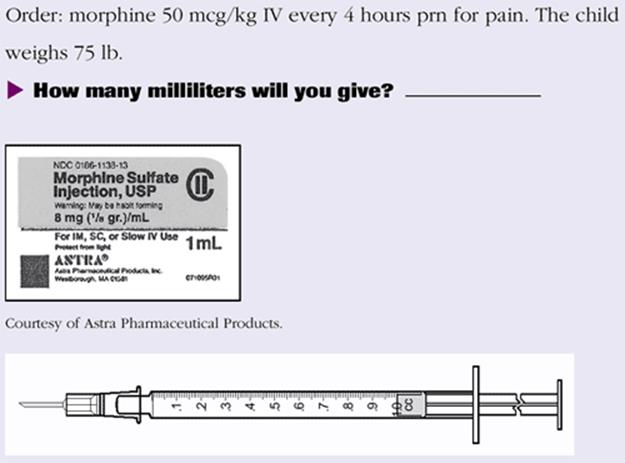
View Answer
5.
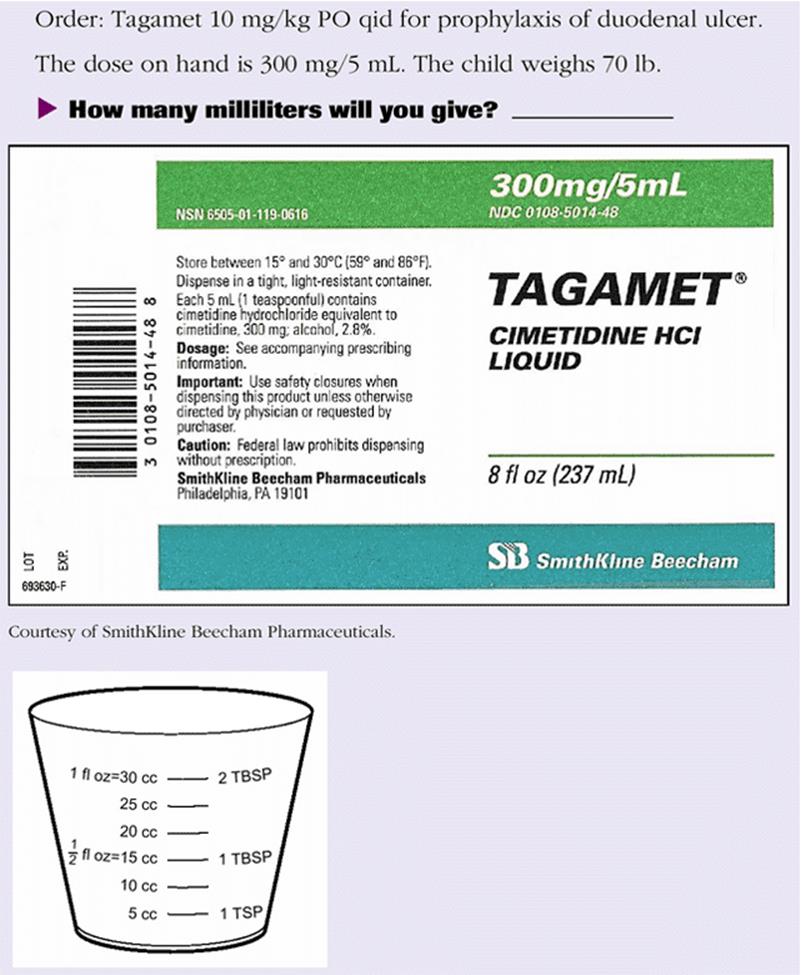
View Answer
MEDICATION PROBLEMS INVOLVING RECONSTITUTION
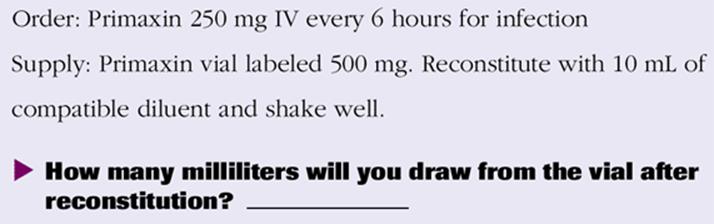
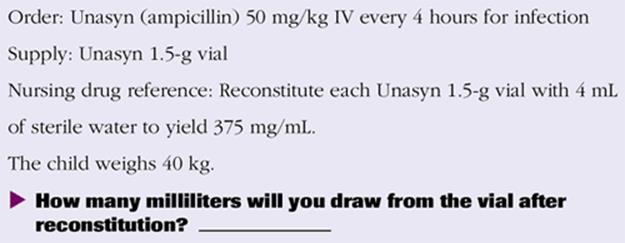
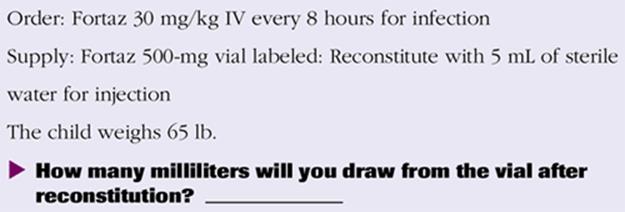
Some medications in vials are in a powder form and need reconstitution before administration. Reconstitution involves adding a specific amount of sterile solution (also called diluent) to the vial to change the powder to a liquid form. Information on how much diluent to add to the vial and what dosage of medication per milliliter will result after reconstitution (also called yield) can be obtained from a nursing drug reference, label, or package insert.
PREVENTING MEDICATION ERRORS
When reconstituting medication, always check a nursing drug reference to obtain information regarding the correct diluents and the correct amount of the diluents to be used to prevent medication errors.
EXAMPLE 5.2
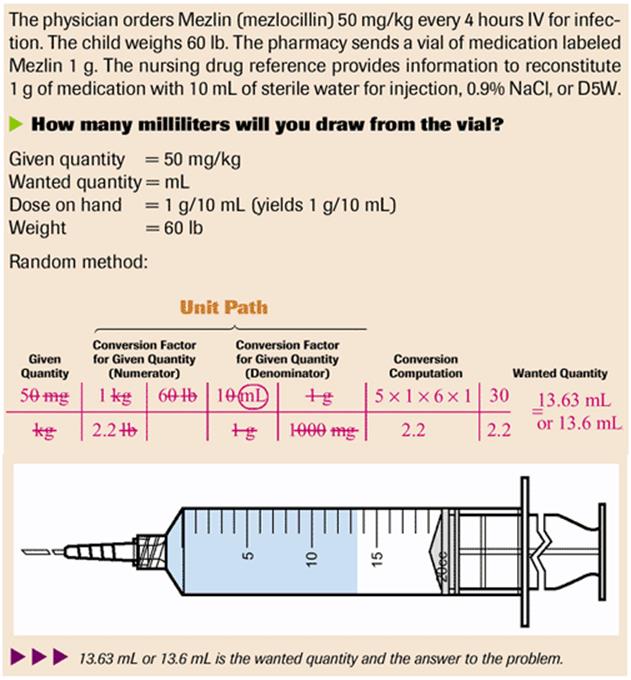
EXAMPLE 5.3

EXAMPLE 5.4
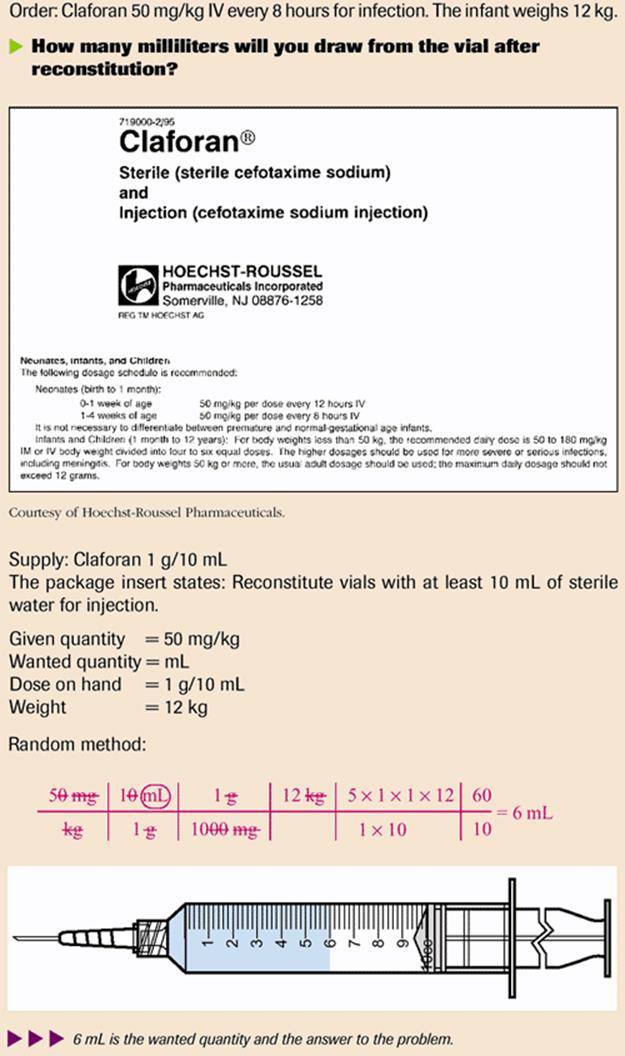
Exercise 5.2 Medication Problems Involving Reconstitution (See pages 131–132 for answers)
1.

View Answer
2.
View Answer
3.
View Answer
4.

View Answer
5.
View Answer
PREVENTING MEDICATION ERRORS
When administering IV medications and fluids, always check a nursing drug reference to obtain the correct information regarding how much medication or fluid can safely be administered to prevent medication errors.
It is the responsibility of the nurse to be familiar with the different types of IV pumps that are used to deliver IV medications or fluids. All medications delivered by the IV route should be delivered using an IV pump to ensure accuracy and safety of delivery.
MEDICATION PROBLEMS INVOLVING INTRAVENOUS PUMPS
IV medications are administered by drawing a specific amount of medication from a vial or ampule and inserting that medication into an existing IV line. All IV medications must be given with specific thought to exactly how much time it should take to administer the medication. Information regarding time may be obtained from a nursing drug reference, label, or package insert, or may be specifically ordered by the physician.
Although IV medications can be administered IV push, the time involved often requires the use of an IV pump. All IV pumps deliver milliliters per hour (mL/hr or cc/hr) but may vary in operational capacity or size.
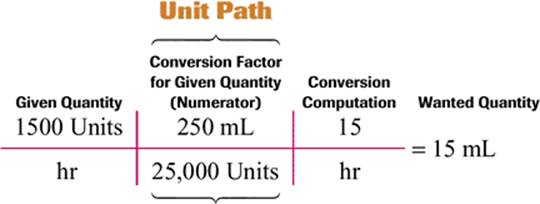
Below is an example of the dimensional analysis problem-solving method with basic terms applied to a medication problem involving an IV pump.
|
|
|
Figure. No caption available |
EXAMPLE 5.5

THINKING IT THROUGH
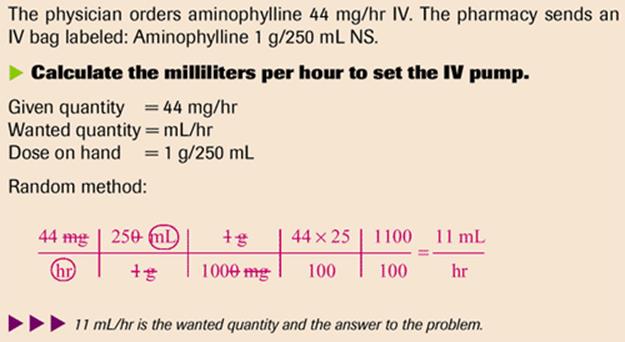
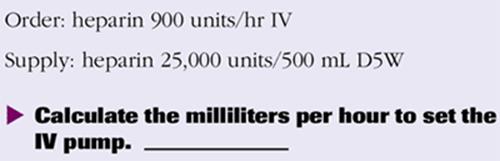
The two-factor–given quantity (the physician's order) contains a numerator (the dosage of medication) and a denominator (time). The wanted quantity (the answer to the problem) also contains a numerator (mL) and a denominator (time). This is called a two-factor–given quantity to a two-factor–wanted quantity medication problem. The denominator of the given quantity (hr) corresponds with the denominator of the wanted quantity (hr); therefore, only the numerator of the given quantity (units) needs to be canceled from the problem.
After factoring in the dose on hand, the unwanted unit (units) is canceled from the problem and the wanted unit (mL) remains in the numerator to correspond with the wanted quantity. The same number values are canceled from the numerator and denominator, leaving 15 mL/hr.
THINKING IT THROUGH
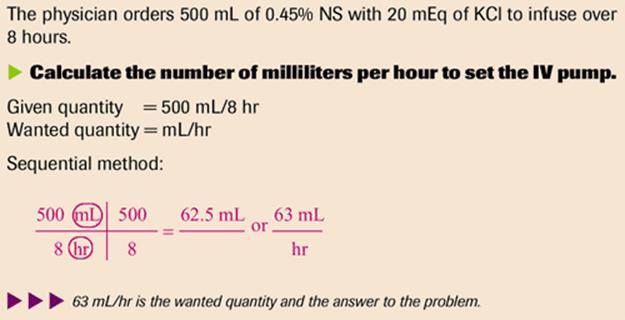
In this problem, the needed two factors are already identified in the given quantity and, therefore, require no additional conversions. The 20 mEq of KCl added to the IV bag is included as part of the 500 mL and is additional information for the nurse, but not part of the calculation.
THINKING IT THROUGH
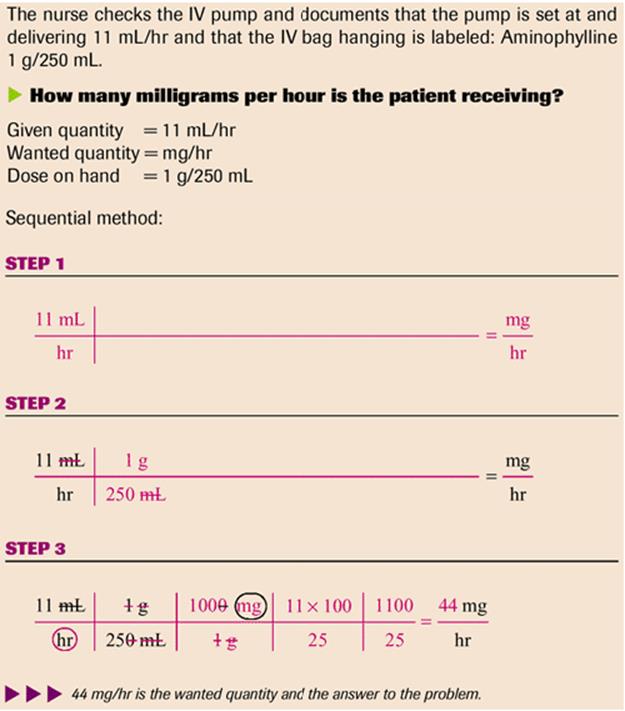
The given quantity has been identified as what the physician orders, but also can be information that the nurse has obtained. The nurse may know that the IV pump is set to deliver 11 mL/hr, but wants to know if the dosage of medication the patient is receiving is within a safe dosage range.
THINKING IT THROUGH
The dose on hand is factored in and allows the unwanted unit (mL) to be canceled.
EXAMPLE 5.6
EXAMPLE 5.7
EXAMPLE 5.8
Exercise 5.3 Medication Problems Involving Intravenous Pumps (See page 132 for answers)
1.
View Answer
2.

View Answer
3.
View Answer
4.

View Answer
5.
View Answer
MEDICATION PROBLEMS INVOLVING DROP FACTORS
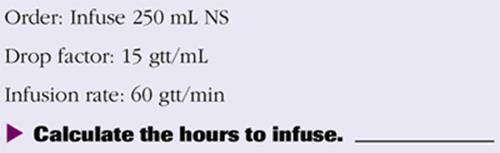
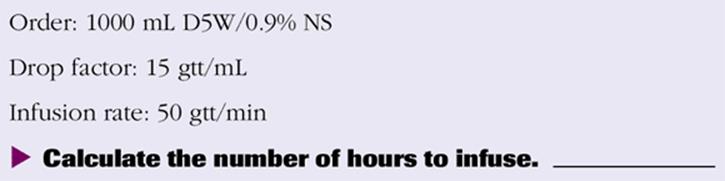
Although IV pumps are used whenever possible, there are situations (no IV pumps available) and circumstances (outpatient or home care) that arise when IV pumps are not available and IV fluids or medications might be administered using gravity flow. Gravity flow involves calculating the drops per minute (gtt/min) required to infuse IV fluids or medications. When IV fluids or medications are administered using gravity flow, it is important to know the drop factor for the IV tubing that is being used. Drop factor is the drops per milliliter (gtt/mL) that the IV tubing will produce. Two types of IV tubing are available for gravity flow. Macrotubing delivers a large drop and is available in 10 gtt/mL, 15 gtt/mL, and 20 gtt/mL (Table 5.1); and microtubing delivers a small drop and is available in 60 gtt/mL.
Regardless of the IV tubing used, the problem can be solved by dimensional analysis. Below is an example of a medication problem involving drop factors using the dimensional analysis method.
|
|
||||||||||
|
Figure. No caption available |
||||||||||
|
TABLE 5.1 Examples of Different Macrodrip Factors |
||||||||||
|
PREVENTING MEDICATION ERRORS
When IV fluids are administered by gravity (without the use of an IV pump), it is the responsibility of the nurse to investigate the history of each patient to ensure safe delivery of IV fluids.
IV fluids that flow by gravity need to be monitored closely because the flow of the fluids can change with the position of the hand or arm. Some patients with a history of congestive heart failure do not tolerate large volumes of IV fluids.
EXAMPLE 5.9
THINKING IT THROUGH
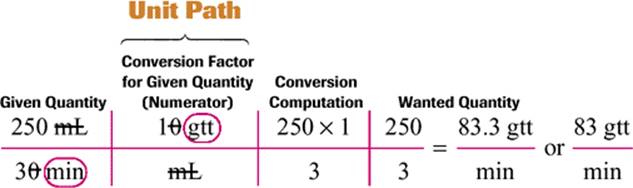
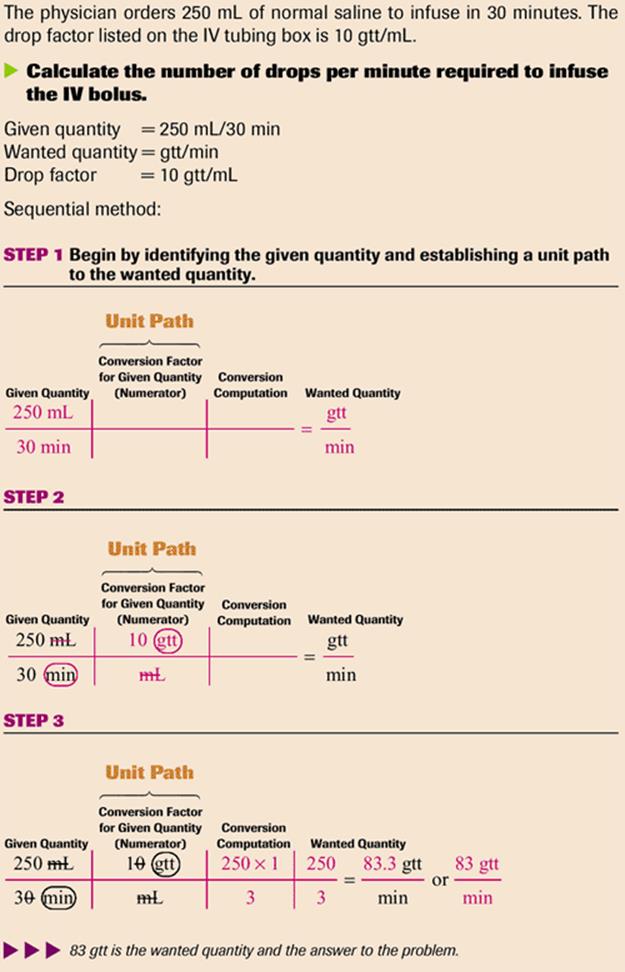
The given quantity and the wanted quantity both include two factors; therefore, this is a two-factor–given quantity to a two-factor–wanted quantity medication problem.
The denominators are the same (min). The numerator in the given quantity (mL) is an unwanted unit and needs to be canceled.
When the drop factor is factored in, the unwanted unit (mL) is canceled, and the wanted unit (gtt) is placed in the numerator to correspond with the wanted quantity.
After you cancel the unwanted units from the problem, multiply the numerators, multiply the denominators, and divide the product of the numerators by the product of the denominators to provide the wanted quantity.
EXAMPLE 5.10
THINKING IT THROUGH
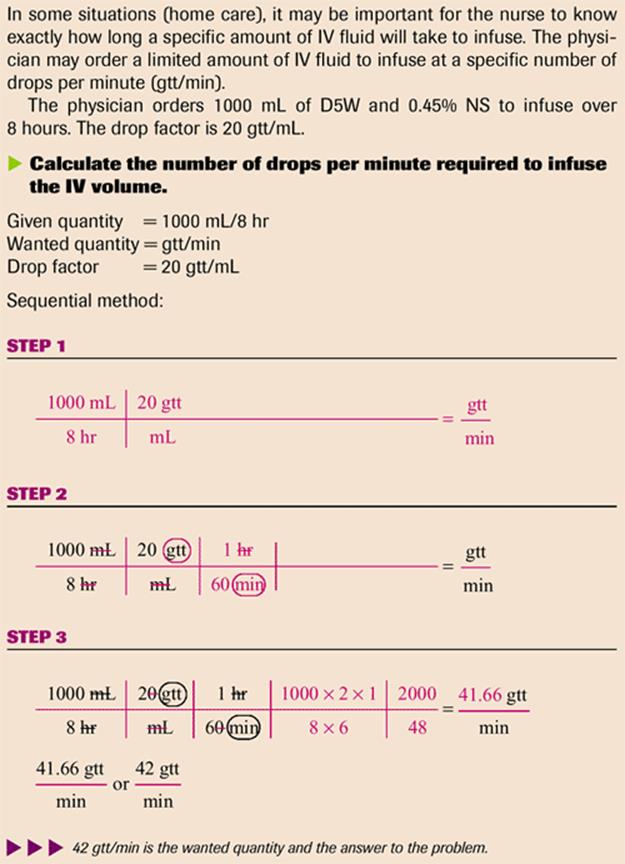
The unwanted unit (mL) is canceled, and the wanted unit (gtt) is placed in the numerator. Another unwanted unit (hr) needs to be canceled from the unit path.
The conversion factor (1 hr = 60 min) has been factored in to allow the unwanted unit (hr) to be canceled and the wanted unit (min) is placed in the denominator.
EXAMPLE 5.11
THINKING IT THROUGH
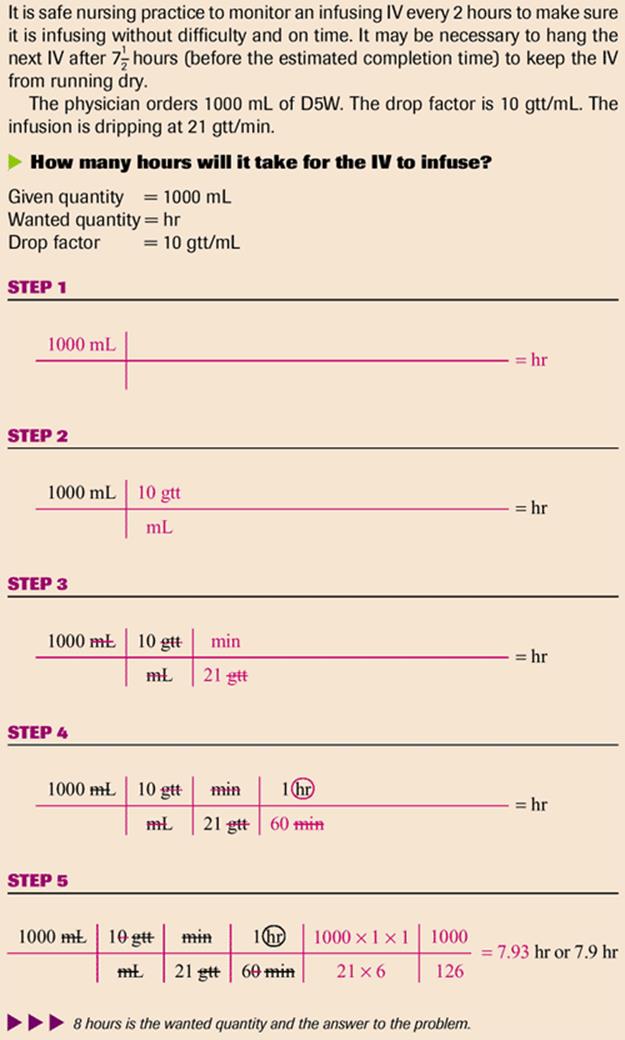
The given quantity and the wanted quantity have been identified and are both in the numerator; therefore, this is a one-factor–given quantity to a one-factor–wanted quantity medication problem.
The drop factor (10 gtt/mL) has been factored in using the sequential method to cancel the unwanted unit (mL).
The infusing rate of 21 gtt/min has now been factored in to cancel the unwanted unit (gtt).
The conversion factor (1 hr = 60 min) has been factored in to cancel the unwanted unit (min). The wanted unit (hr) remains in the numerator, which corresponds to the wanted quantity.
PREVENTING MEDICATION ERRORS
It is the responsibility of the nurse to ensure that an IV does not run dry and endanger the patient due to air in the IV line.
Check an IV bag infusing by gravity every 1 to 2 hours and/or instruct the patient to report when the IV has only a small amount (100 cc) left in the IV bag.
Exercise 5.4 Medication Problems Involving Drop Factors (See page 132 for answers)
1.

View Answer
2.
View Answer
3.

View Answer
4.
View Answer
5.

View Answer
MEDICATION PROBLEMS INVOLVING INTERMITTENT INFUSION
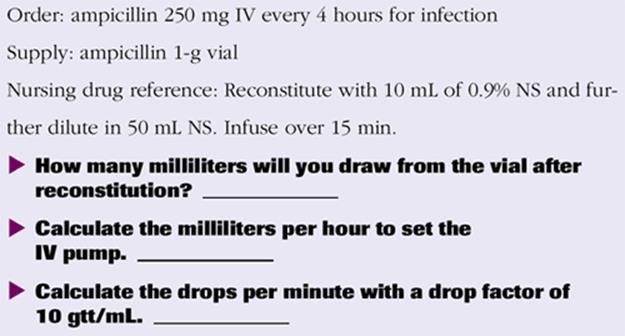
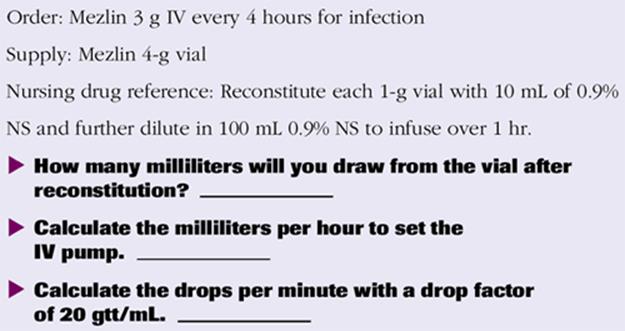
IV medications can be delivered over a specific amount of time by intermittent infusion. These medications require the use of an infusion pump. Some must be reconstituted and further diluted in a specific type and amount of IV fluid and delivered over a limited time. Others do not need to be reconstituted, but must be further diluted in a specific type and amount of IV fluid and delivered over a limited time.
PREVENTING MEDICATION ERRORS
When adding reconstituted medications to an IV solution, always check a nursing drug reference for compatibility of the solutions. To prevent precipitation and/or avoid extravasations, certain medications must be mixed in certain fluids and then further diluted.
Example: Dilantin® (phenytoin) must be reconstituted with normal saline (0.9% NaCl) and never administered into an IV line of dextrose in water (D5W). Dilantin may only be further diluted with normal saline (0.9% NaCl).
Example: Erythromycin must be reconstituted with sterile water and may be further diluted in normal saline (0.9% NaCl) or dextrose in water (D5W).
Example: Acyclovir must be reconstituted with sterile water and further diluted in varying strengths and combinations of normal saline (0.9% NaCl) and dextrose in water (D5W).
EXAMPLE 5.12

THINKING IT THROUGH
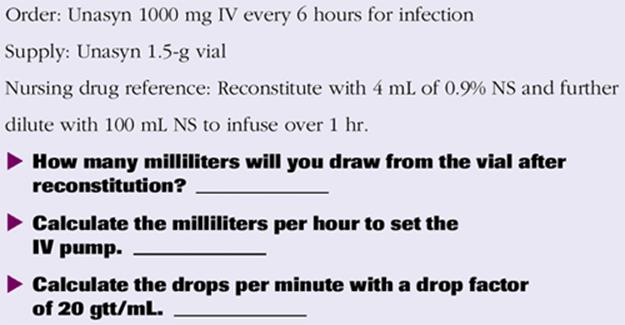
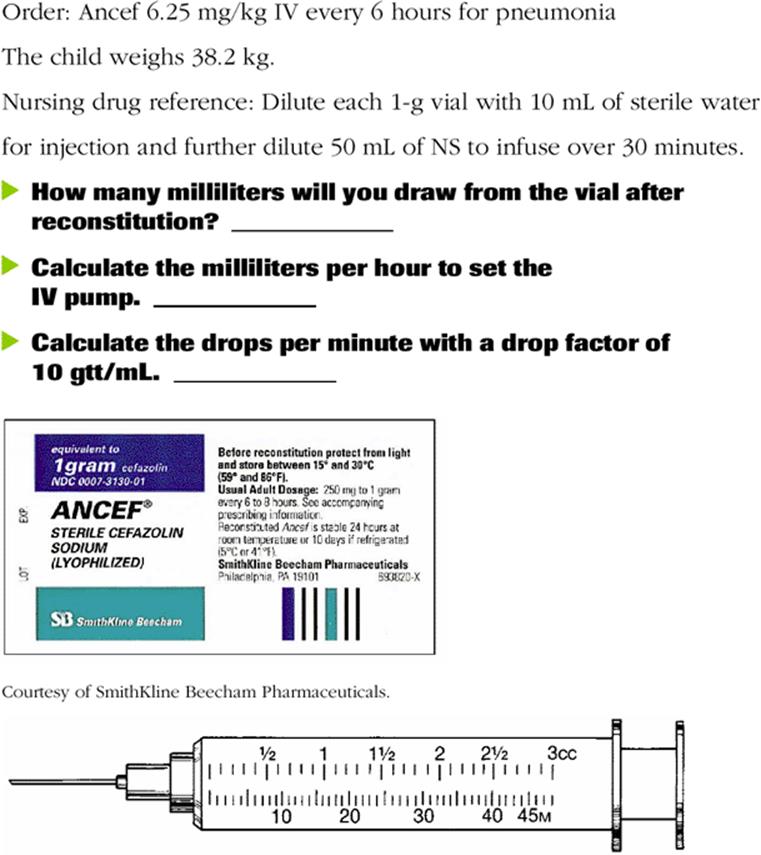
This order contains two problems. The first involves how many milliliters to draw from the vial after reconstitution, and the second involves how many milliliters per hour to set the IV pump.
Exercise 5.5 Medication Problems Involving Drop Factors (See pages 132–133 for answers)
1.
View Answer
2.

View Answer
3.
View Answer
4.
View Answer
5.
View Answer
SUMMARY
This chapter has taught you to calculate two-factor medication problems involving the weight of the patient, reconstitution of medications, and the amount of time over which medications and intravenous fluids can be safely administered. To demonstrate your ability to calculate medication problems accurately, complete the following practice problems.
Practice Problems for Chapter 5: Two-Factor Medication Problems (See pages 133–134 for answers)
1.

View Answer
2.

View Answer
3.
View Answer
4.
View Answer
5.
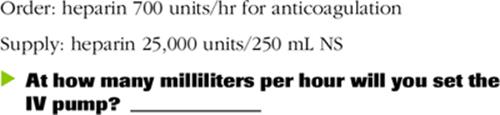
View Answer
6.

View Answer
7.

View Answer
8.
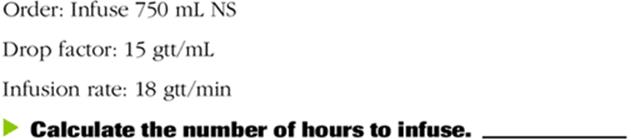
View Answer
9.
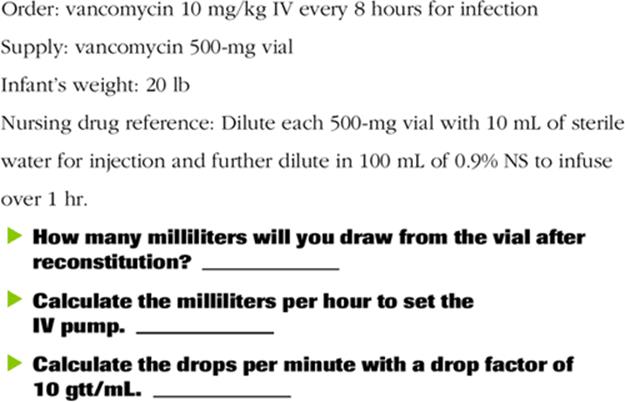
View Answer
10.

View Answer
Chapter 5 Post-Test: Two-Factor Medication Problems
Name _________________________________________________ Date ___________________________
1. 
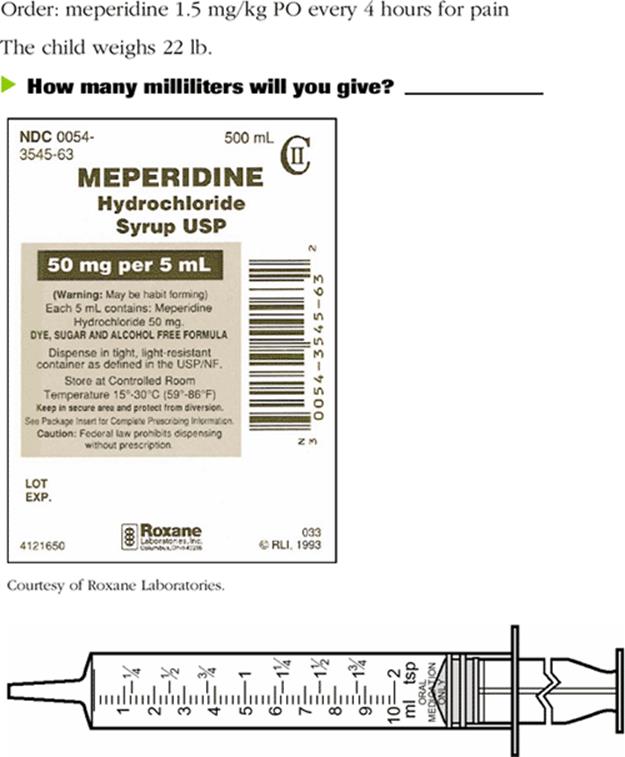
2. 
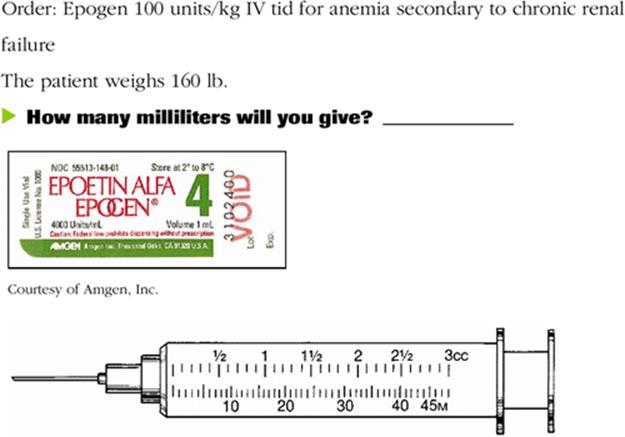
3. 
4. 
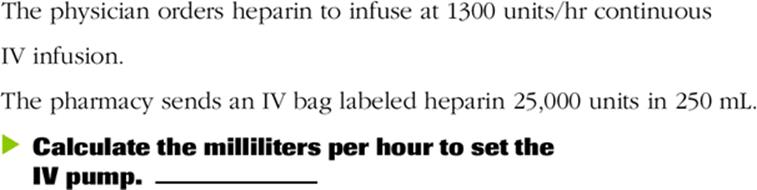
5. 
6. 
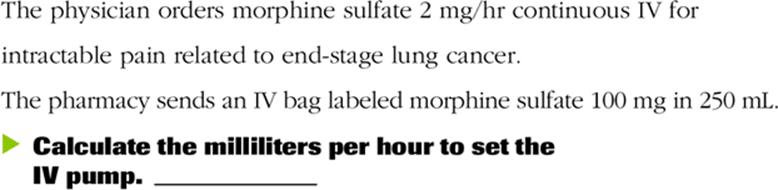
7. 
8. 
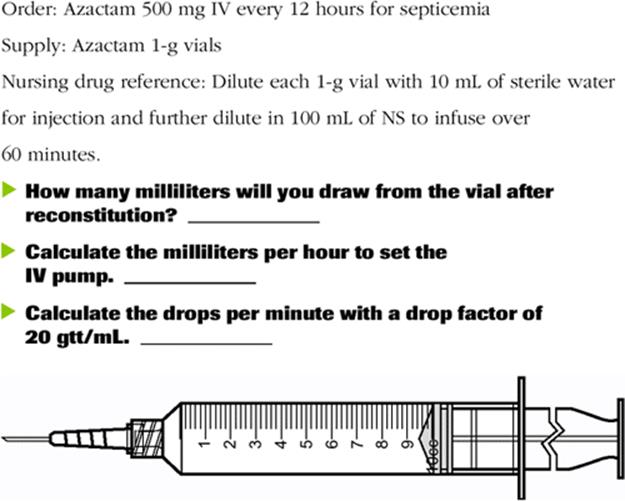
9. 
10. 
ANSWER KEY FOR CHAPTER 5: TWO-FACTOR MEDICATION PROBLEMS
|
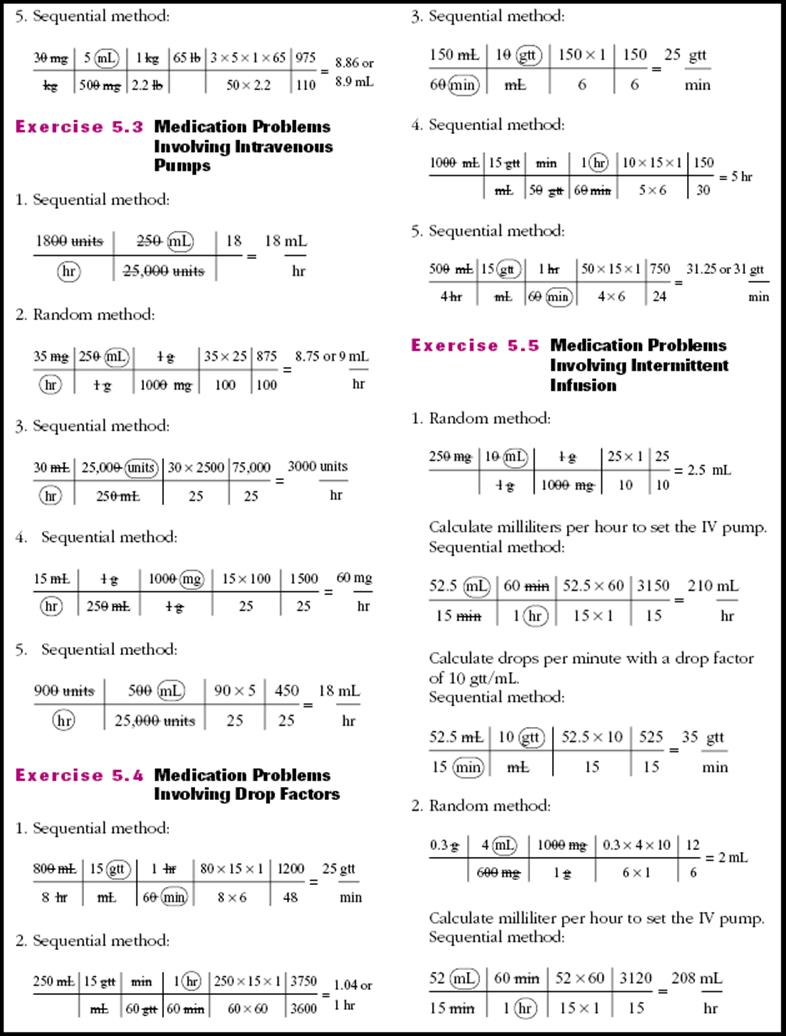
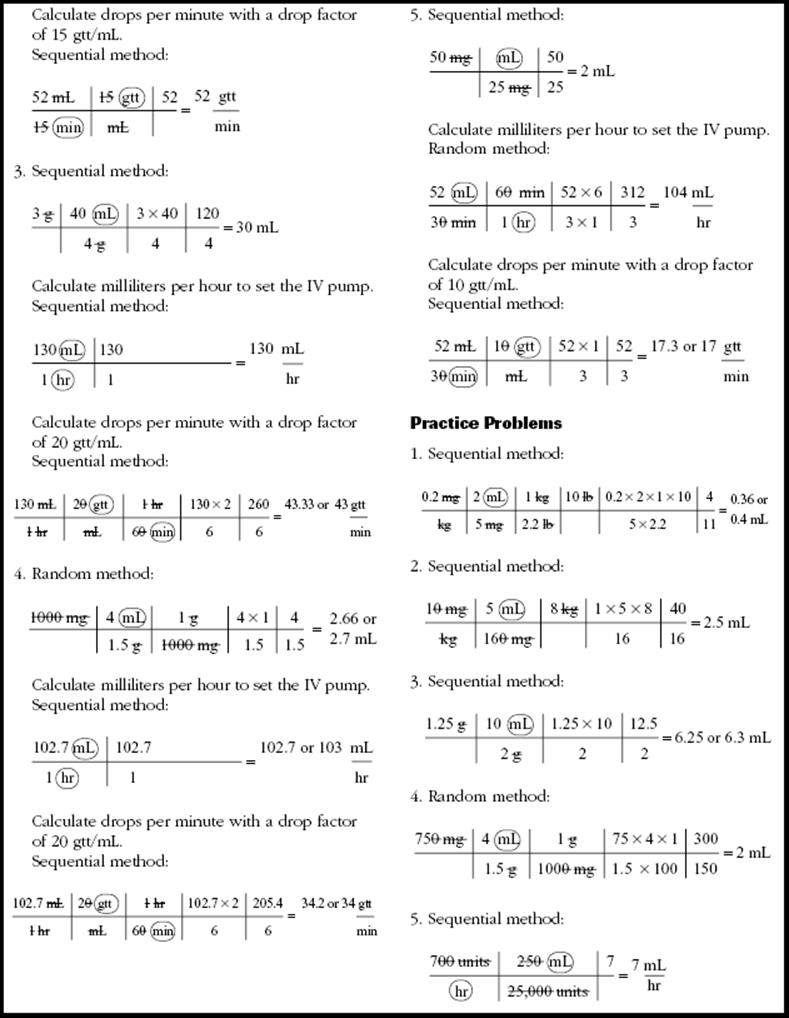
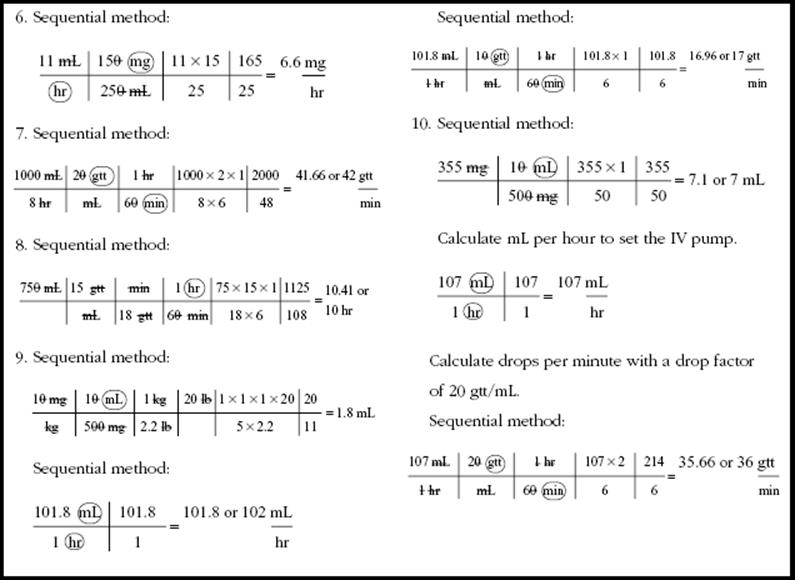
Figure. No caption available |