Objectives
After completing this chapter, you will be able to:
1. Interpret medication orders correctly, based on the five rights of medication administration.
2. Identify components from a drug label that are needed for accurate medication administration.
3. Describe the different routes of medication administration: tablets and capsules, liquids given by medicine cup or syringe, and parenteral injections using different types of syringes.
4. Calculate medication problems accurately from the one-factor–given quantity to the one-factor–wanted quantity using the sequential or random method of dimensional analysis.
 INTERPRETATION OF MEDICATION ORDERS
Physicians and nurse practitioners order medications using the five rights of medication administration including the:
1. Right patient
2. Right drug
3. Right dosage
4. Right route
5. Right time
 PREVENTING MEDICATION ERRORS
Medication errors can be prevented by carefully adhering to these five rights, understanding the important concepts that apply to each right, and utilizing a nursing drug reference to provide accurate information for each medication administered.
Once you are able to interpret the important components of a medication order, you can perform accurate calculations for the correct dosage using dimensional analysis. If you cannot correctly interpret the components of a medication order (illegible prescription order), call the physician or nurse practitioner for clarification to prevent medication errors.
Right Patient
Many medication errors can be prevented by correctly identifying the right patient. Patients in the hospital setting wear identification bands, whereas other facilities may use a photograph to identify the right patient.
Regardless of the identification method, the medication order must correspond to the identification of the patient. Checking identification and asking patients to state their names assists in reducing medication errors. It is also important to “listen” to the patient. If the patient states, “I don't take a blue pill,” go back and check the medication order for correctness.
Right Drug
Medications can be ordered using their trade name or generic name.
Examples:
1. Tagamet® or cimetidine
2. Cipro® or ciprofloxacin hydrochloride
It is the responsibility of the nurse to look up a medication before administration to ensure that the right drug is being administered.
It is the responsibility of the nurse to know the classification of the drug being administered and that the drug corresponds with the patient diagnosis. Many drugs have similar names.
Example:
1. Celebrex® (an anti-inflammatory)
2. Celexa® (an antidepressant)
It is also the responsibility of the nurse to know the side effects of the drug being administered. The nurse must be aware of any patient allergies before medication administration to ensure safety of the patient. Allergies should be clearly recorded on medication records or a patient should wear an allergy bracelet.
Because it is impossible to know all medications, the nurse can use a nursing drug reference to look up medications to ensure accuracy and prevent medication errors.
Right Dosage
Medications are available in different dosages. It is the responsibility of the nurse to ensure that the right dosage is administered. The pharmacy may supply the exact dosage ordered or the dosage may need to be converted using a common equivalent or calculated based on the weight of the patient. If the medication must be reconstituted, the correct diluent must be used for reconstitution. If a patient is to receive a tablet but has difficulty swallowing, the nurse must obtain an order to have the medication changed to an elixir. Medication orders are to be administered exactly in the dosage ordered. A nursing drug reference assists with preventing medication errors by supplying information regarding the dosages of medications that can be safely administered to a patient based on age and weight.
Right Route
Medications may be administered by different routes including oral (tablets, capsules, or liquid), parenteral (intradermal, subcutaneous, intramuscular, or intravenous), or cutaneous (skin and mucous membranes). Improper medication administration techniques (crushing an enteric-coated tablet, opening a capsule, or giving an injection using the wrong route) are considered medication errors. A nursing drug reference provides information regarding the routes that can be safely used to administer medication and eliminate medication errors. It is the responsibility of the nurse to use this information to safely administer the medication to the patient using the right route.
Right Time
Medications are ordered and need to be administered at specific times to ensure the effective absorption of the medication. Failure to administer a medication on time or failure to document the administration of a medication is a medication error of omission. Some medications are ordered before meals (ac), after meals (pc), or at bedtime (hs). Other medications may be ordered based on frequency of time (once a day [qd], twice a day [bid], three times a day [tid], or four times a day [qid]). A nursing drug reference provides the nurse with the appropriate information to ensure that the medication is effectively and safely administered to eliminate a medication error based on adsorption. Most facilities allow a window of administration that is usually 30 minutes before or 30 minutes after the prescribed time. It is the responsibility of the nurse to use this information to safely administer the medication to the patient at the right time.
Once you are able to interpret the important components of an order for medication, you can perform accurate calculations for the correct drug dosage by using dimensional analysis.
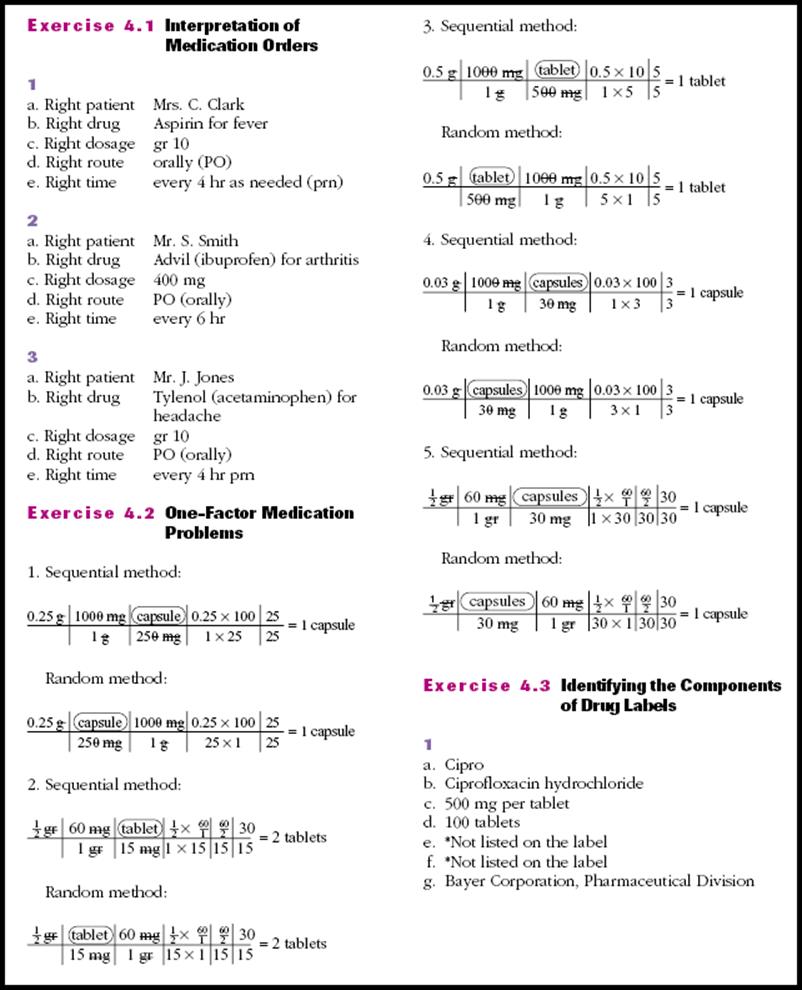
Exercise 4.1 Interpretation of Medication Orders (See page 97 for answers)
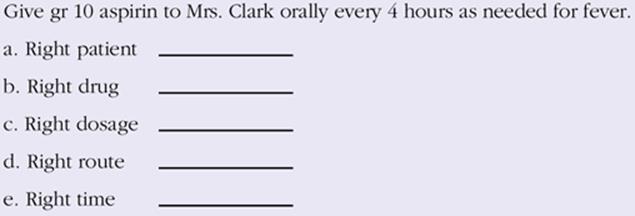
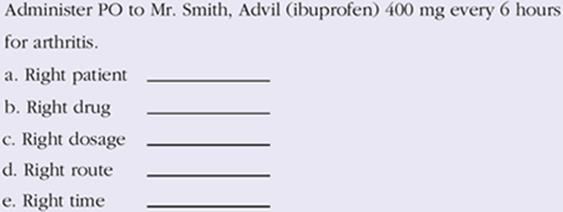
In the following medication orders, identify the five rights of medication administration.
1.
View Answer
2.
View Answer
3.

View Answer
PREVENTING MEDICATION ERRORS
Many believe that documentation should be the sixth “right of medication administration.” Documentation is an important concept that can prevent medication errors related to over- or undermedication. The general rule of documentation is “if you didn't chart it … you didn't do it.” Documentation should follow medication administration and include refusals, delays, and responses of medication administration.
ONE-FACTOR MEDICATION PROBLEMS
Medication problems can be easily solved using the five steps of dimensional analysis:
PREVENTING MEDICATION ERRORS
The given quantity is the doctor's order and should contain all five rights of the medication order.
· The first step in interpreting any physician's order for medication is to identify the given quantity or the exact dosage that the physician ordered.
· The second step is to identify the wanted quantity or the answer to the medication problem.
· The third step is to establish the unit path from the given quantity to the wanted quantity, using equivalents as conversion factors to complete the problem. Identification of the available dosage of medicine (dose on hand) is considered part of the unit path.
· The fourth step is to set up the problem to cancel out unwanted units.
· The fifth step is to multiply the numerators, multiply the denominators, and divide the product of the numerators by the product of the denominators to provide the numerical value of the wanted quantity or answer to the problem.
You may choose to implement either the sequential method or the random method of dimensional analysis.
The sequential method requires that conversion factors be factored into the unit path in a logical, sequential method to cancel out a preceding unit.
The random method allows random placement of conversion factors within the unit path. The focus is on the correct placement of the conversion factor (dose on hand) in the unit path to correspond with the answer (wanted quantity). If the wanted quantity is tablets, then tablets must be in the numerator position in the unit path with the dosage in the denominator position.
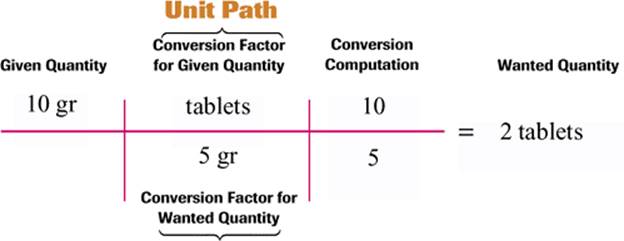
Below is an example of a one-factor problem showing the placement of components used in dimensional analysis.
|
|
|
Figure. No caption available |
EXAMPLE 4.1
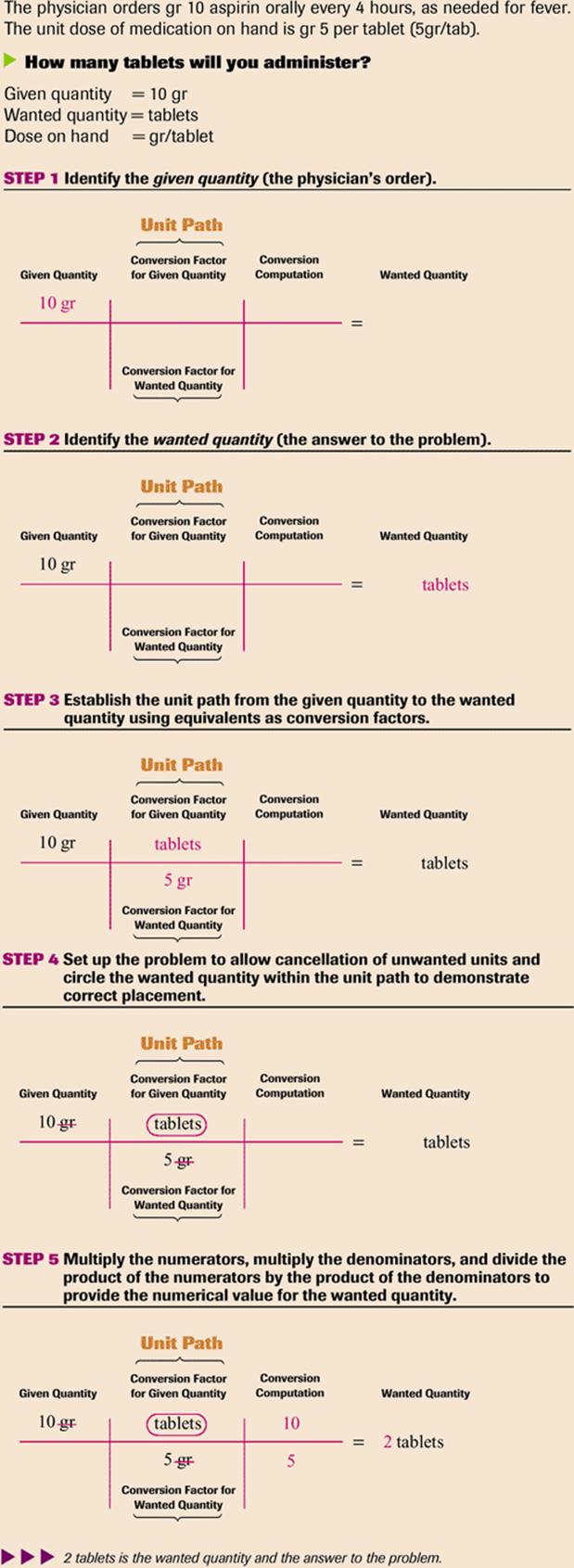
 THINKING IT THROUGH
Both 10 gr and tablets are numerators without a denominator. This is called a one-factor medication problem because the given quantity and the wanted quantity contain only numerators.
The dose on hand (5 gr/ tablet) is an equivalent that is used as a conversion factor and is factored into the unit path.
The unwanted units (gr) can be canceled from the problem leaving the wanted quantity (tablets) in the numerator.
The sequential method of dimensional analysis has been used to factor in the dose on hand, which allows the previous unit (given quantity) to be canceled. When using the sequential method, the conversion factor that is factored in always cancels out the preceding unit.
PREVENTING MEDICATION ERRORS
When preparing to administer more than two tablets or capsules to a patient, always recalculate the answer to ensure the correct answer and prevent medication errors. Rarely does a patient receive more than two tablets or capsules of a medication. If more than two tablets or capsules are being administered, a different dosage of the medication should be discussed with the pharmacist.
EXAMPLE 4.2
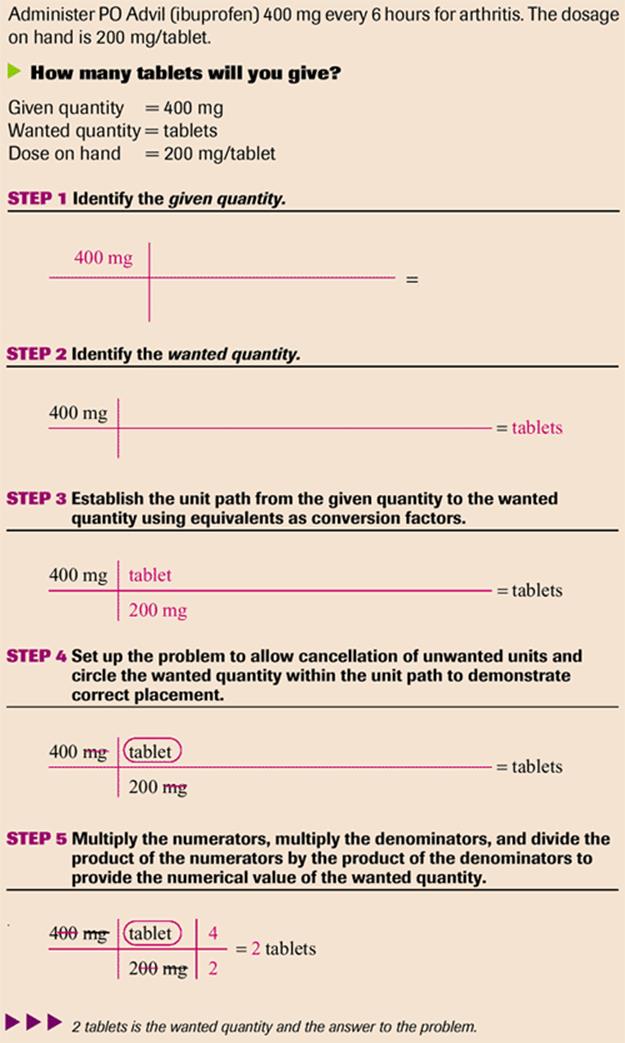
THINKING IT THROUGH
The sequential method of dimensional analysis has been used to set up the problem. The unwanted units (mg) have been canceled from the unit path by correctly factoring in the dose on hand (200 mg/tablet). The same number of zeroes has also been canceled from the numerator and denominator.
Principles of Rounding
If an answer does not result in a whole number, but instead a decimal in the tenths (4.7) or hundredths (4.75), the answer must be rounded up or down to allow for administration of the medication.
If the tablets are scored, a half of the tablet can be administered. If a tablet is not scored, a decision must be made by the nurse whether to give one or two tablets. If a liquid medication to be administered involves decimals, then the nurse must make a decision regarding the amount of medication to be given.
If the number following the decimal is 5 or greater, then the number is rounded up.
Example in the tenths: 4.7 → 5
Example in the hundredths: 4.75 → 4.8
If the number following the decimal is less than 5, then the number is rounded down.
Example in the tenths: 4.4 → 4
Example in the hundredths: 4.42 → 4.4
PREVENTING MEDICATION ERRORS
Understanding the principles of rounding will prevent over- or undermedication, both of which are classified as medication errors.
EXAMPLE 4.3
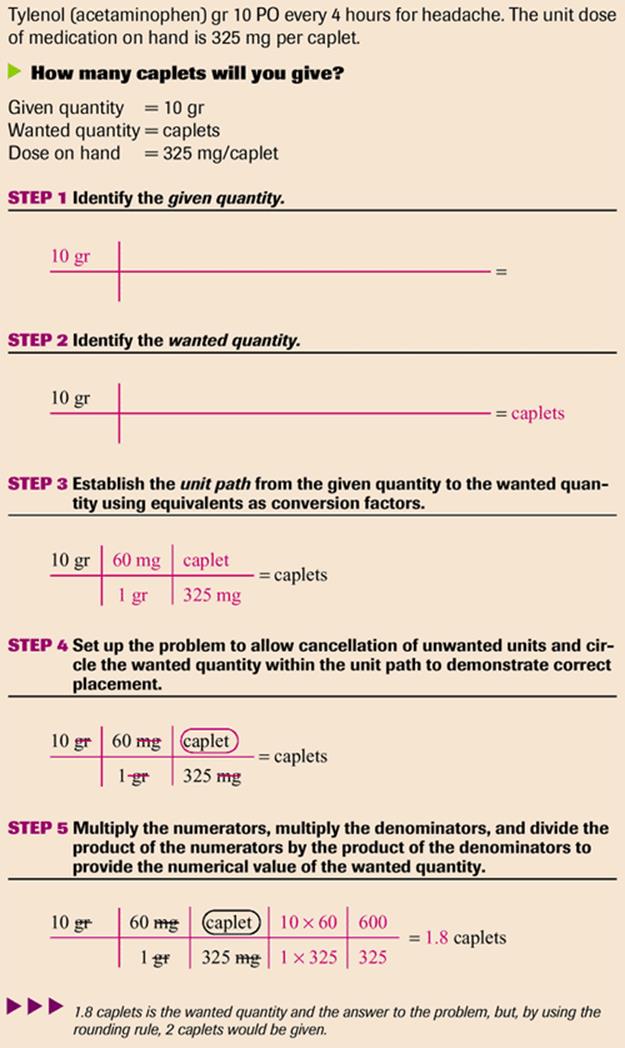
THINKING IT THROUGH
The sequential method of dimensional analysis has been used. The unwanted unit (gr) has been canceled by factoring in a conversion factor (1 gr = 60 mg).
The dose on hand (325 mg/caplet) is factored into the unit path, which allows the unwanted unit (mg) to be canceled.
The remaining unit (caplet) is in the numerator and correctly correlates with the wanted quantity in the numerator.
PREVENTING MEDICATION ERRORS
Following the principles of rounding, two caplets would be given as the correct dosage of medication.
Dimensional analysis is a problem-solving method that uses critical thinking, not a specific formula. Therefore, the important concept to remember is that all unwanted units must be canceled from the unit path. The random method of dimensional analysis can also be used when solving medication problems. When using the random method of dimensional analysis, the focus is on the correct placement of the conversion factor. It must correlate with the wanted quantity in the numerator portion of the unit path, without considering the preceding units.
EXAMPLE 4.4

THINKING IT THROUGH
When using the random method, the focus is on the correct placement of the conversion factor to correspond with the wanted quantity. The problem is set up correctly as long as the dose on hand (caplet) correlates with the wanted quantity (caplet), both in the numerator.
A conversion factor (1 gr = 60 mg) is factored into the problem to cancel out the unwanted units (gr and mg). The remaining unit (caplet) correlates with the wanted quantity.
Exercise 4.2 One-Factor Medication Problems (See page 97 for answers)
1.

View Answer
2.

View Answer
3.

View Answer
4.

View Answer
5.

View Answer
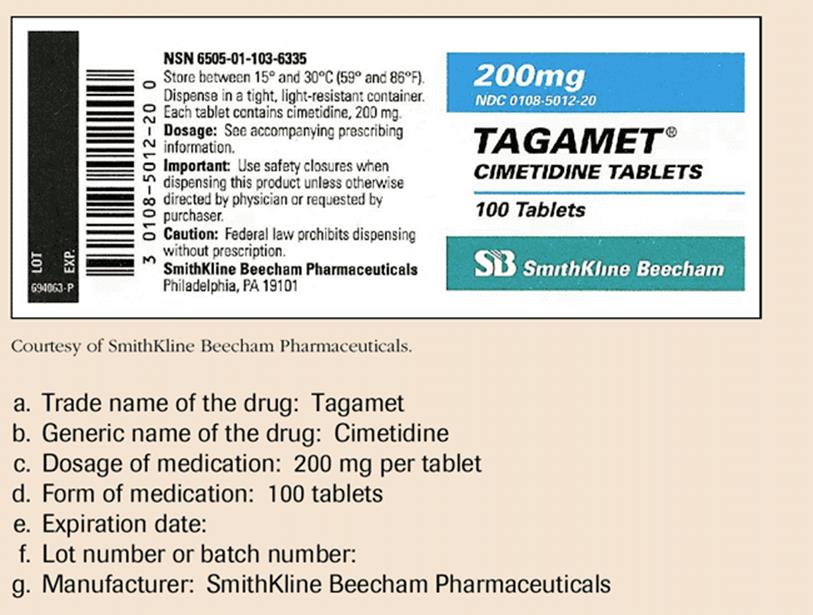
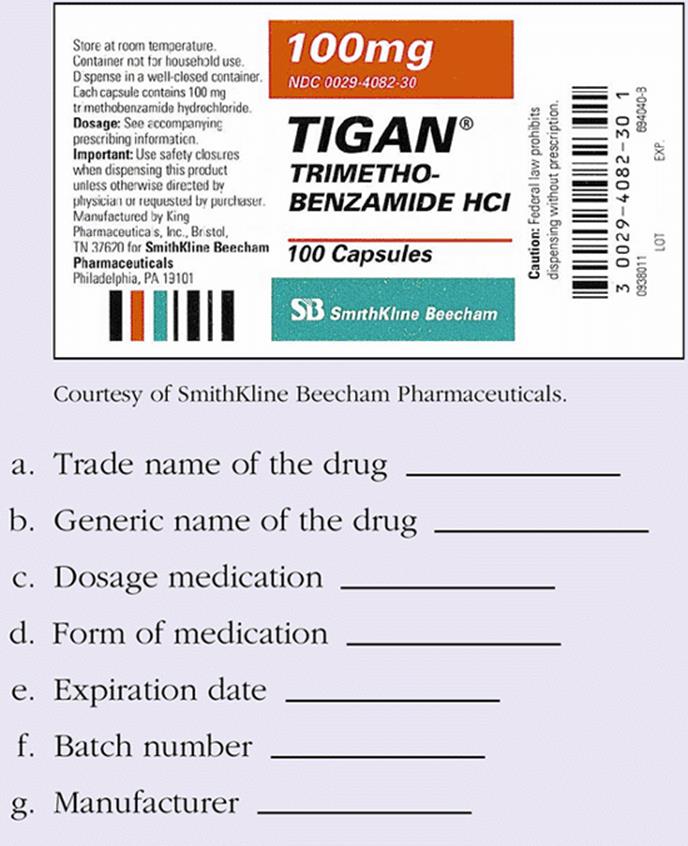
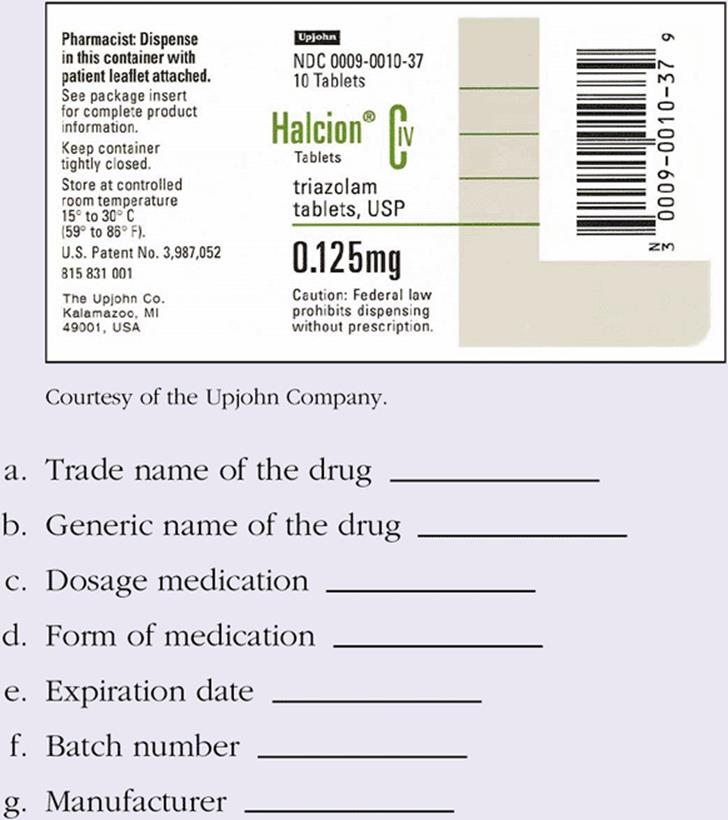
COMPONENTS OF A DRUG LABEL
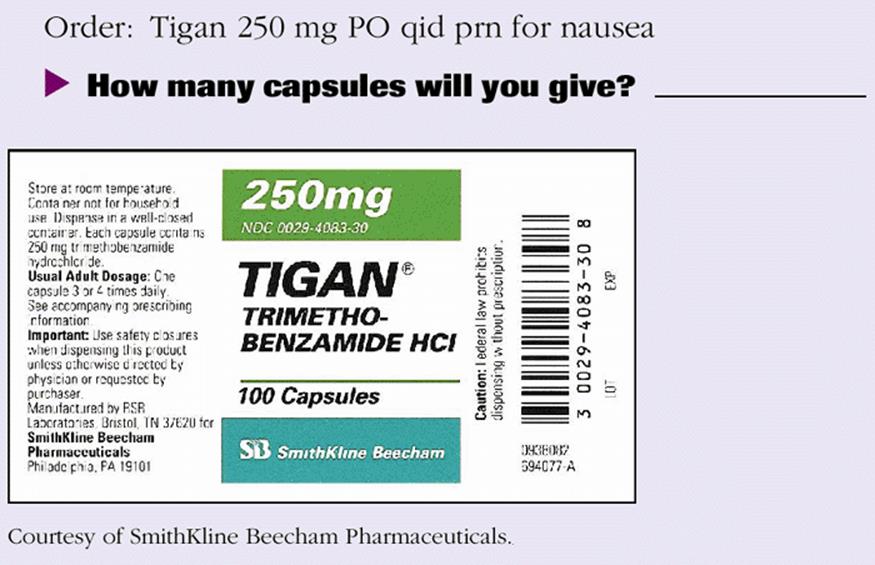
All medications (stock and unit dose) are labeled with a drug label that includes specific information to assist in the accurate administration of the medication.
Identifying the Components
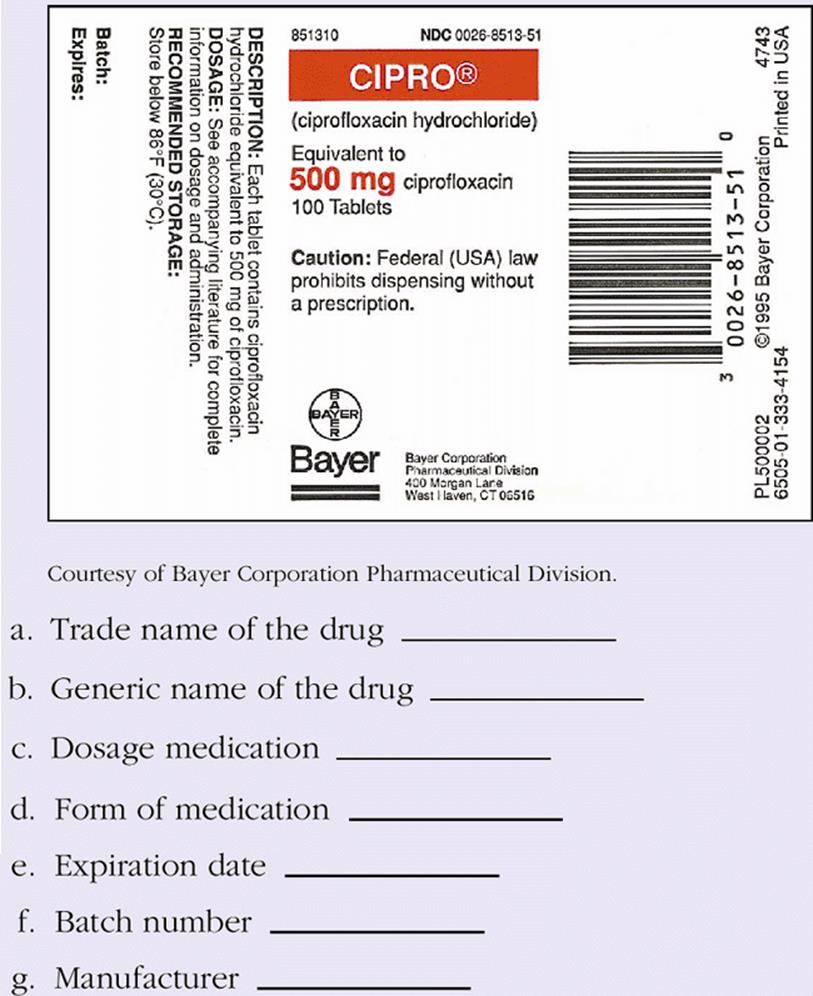
Information on the drug label includes:
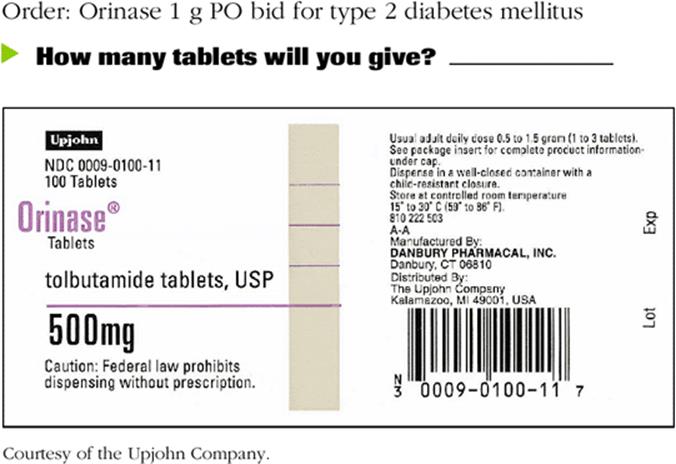
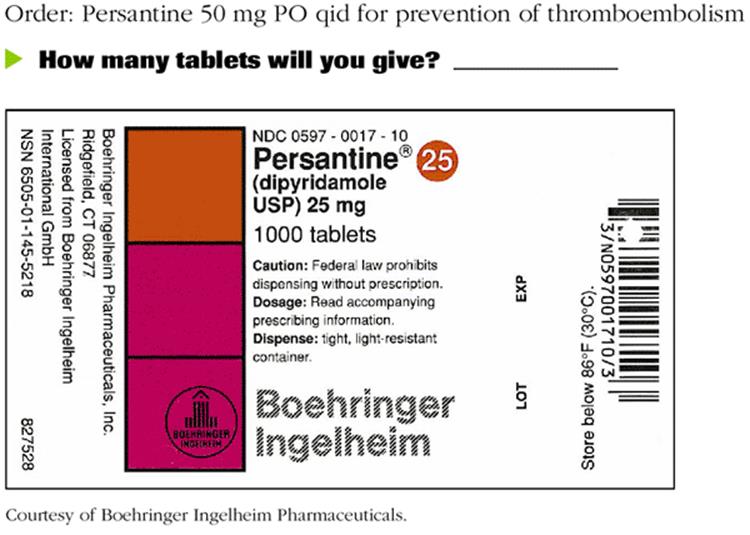
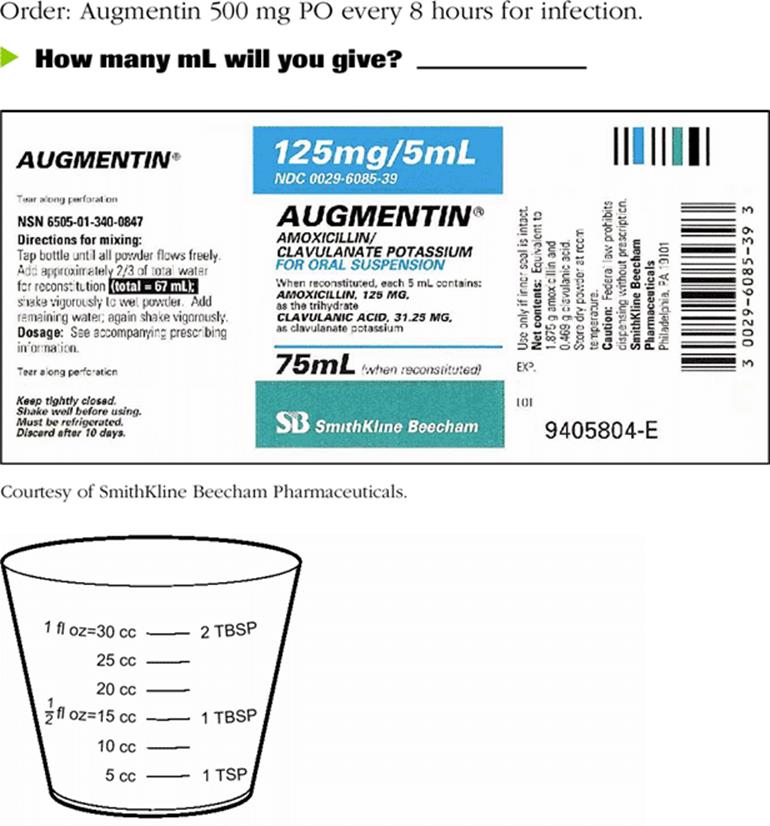
· Name of the drug, including the trade name (name given by the pharmaceutical company identified with a trademark symbol) and the generic name (chemical name given to the drug)
· Dosage of medication (the amount of medication in each tablet, capsule, or liquid)
· Form of medication (tablet, capsule, or liquid)
· Expiration date (how long the medication will remain stable and safe to administer)
· Lot number or batch number (the manufacturer's batch series for this medication)
· Manufacturer (the pharmaceutical company that produced the medication)
PREVENTING MEDICATION ERRORS
Before administering any medication, the nurse should check the expiration date on the label. Administering a medication that has expired would be considered a medication error.
EXAMPLE 4.5
Exercise 4.3 Identifying the Components of Drug Labels (See pages 97–98 for answers)
1.
View Answer
2.
View Answer
3.
View Answer
Solving Problems With Components of Drug Labels
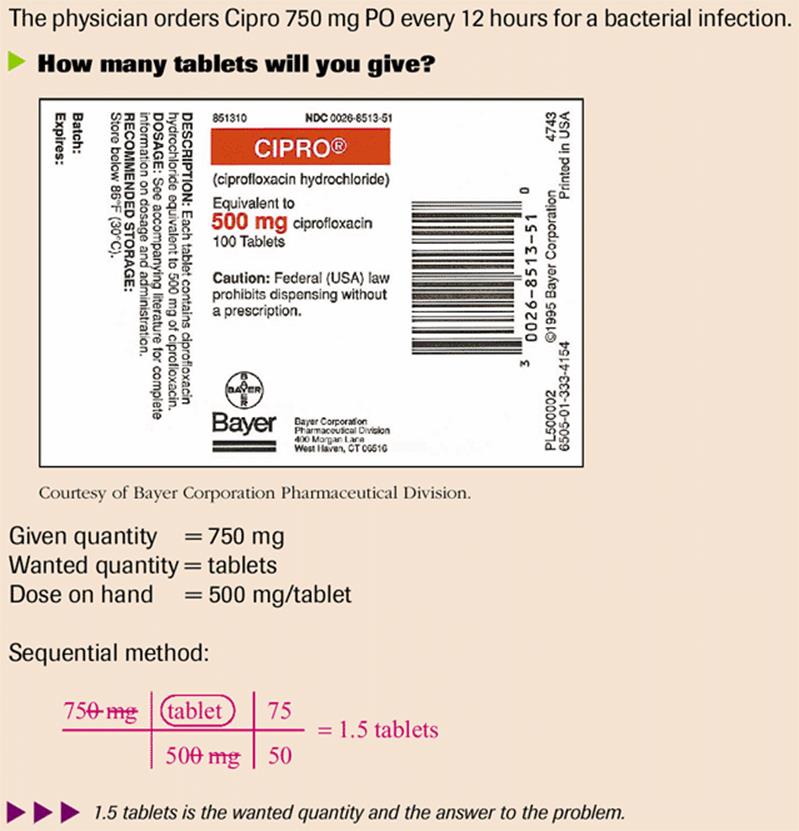
Once you are able to identify the components of a drug label, you can use critical thinking to solve problems with dimensional analysis.
PREVENTING MEDICATION ERRORS
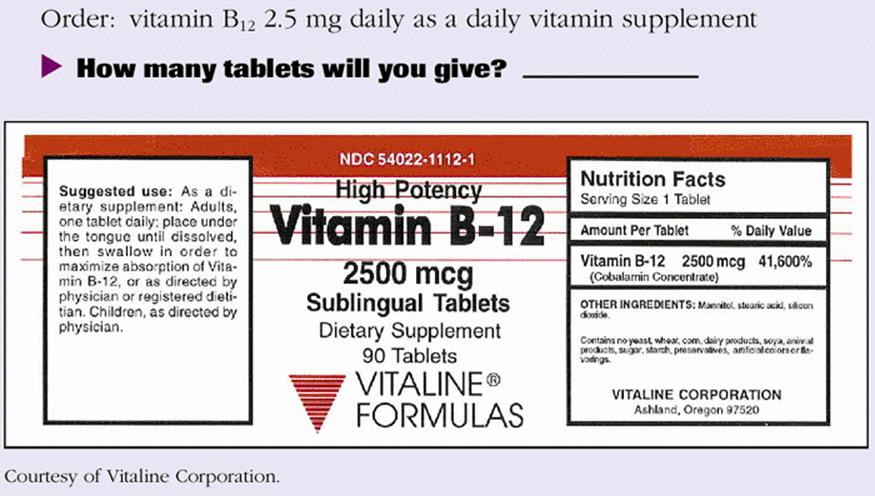
The wanted quantity and the answer to the problem is 1.5 tablets. A scored tablet can be cut in half allowing the exact dosage to be administered. To prevent medication errors, always check with a pharmacist before altering the form of any medication.
EXAMPLE 4.6
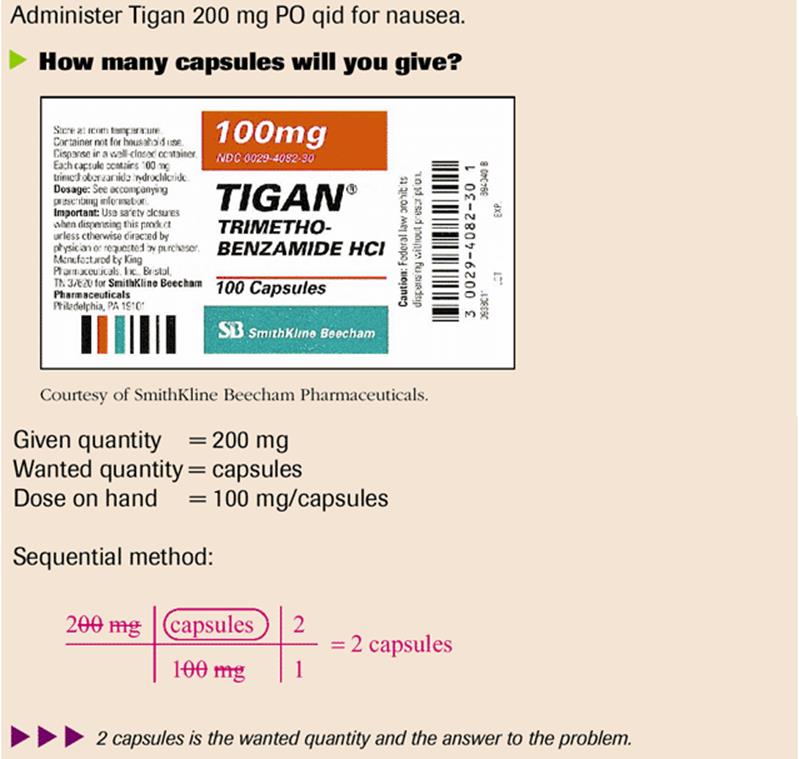
EXAMPLE 4.7
EXAMPLE 4.8
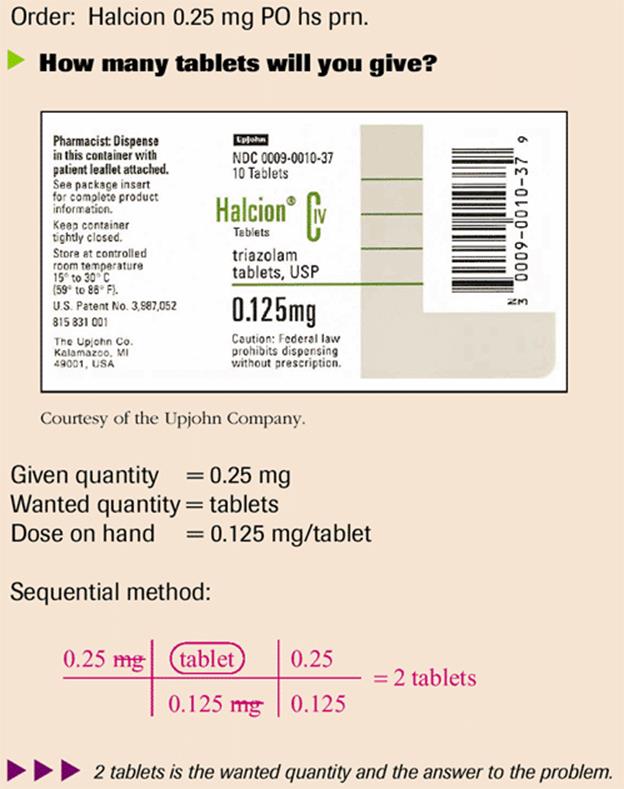
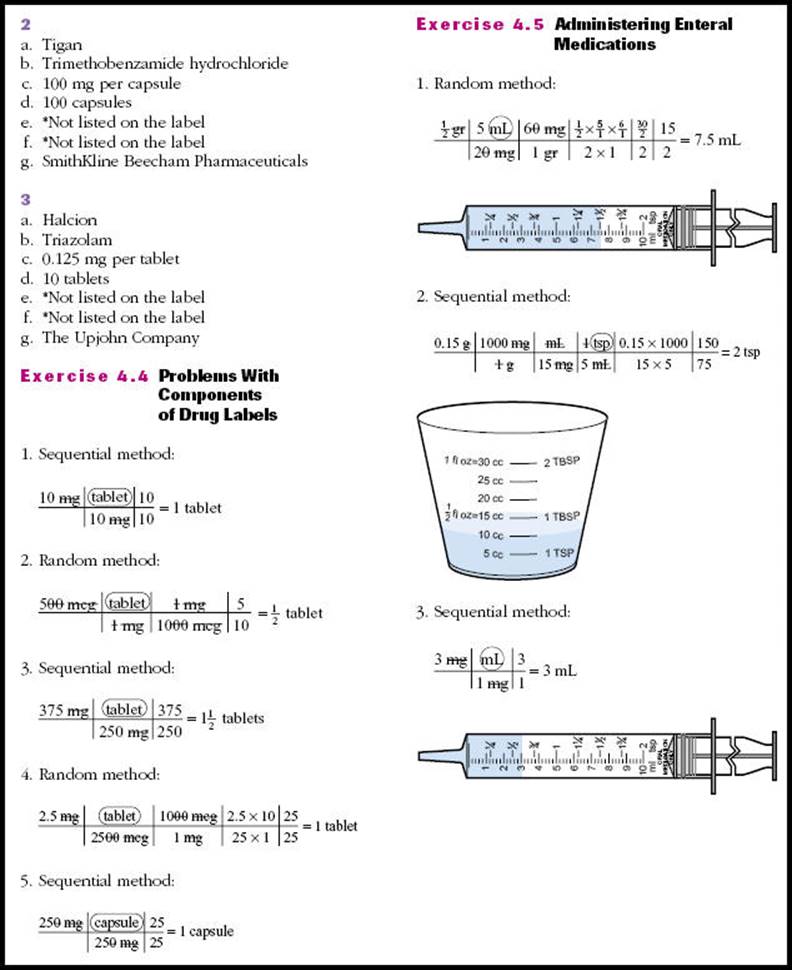
Exercise 4.4 Problems With Components of Drug Labels (See page 98 for answers)
1.
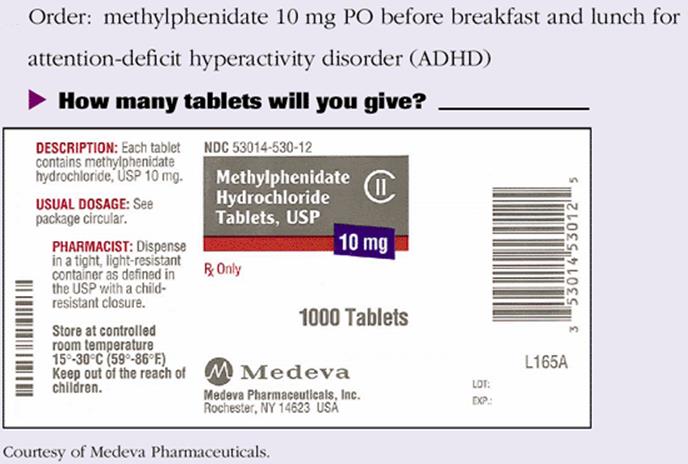
View Answer
2.
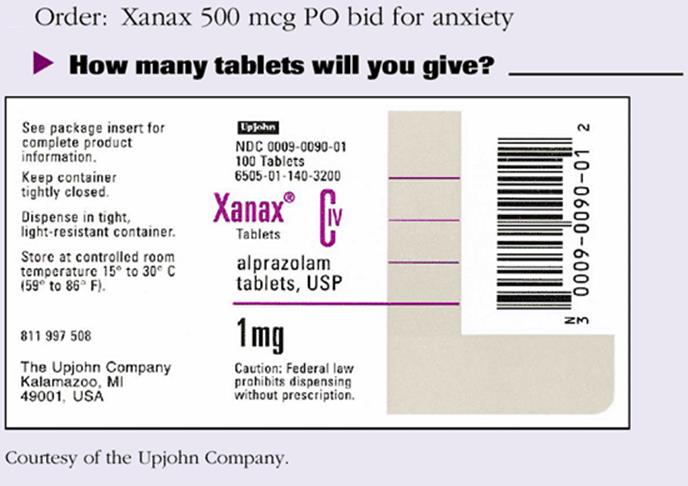
View Answer
3.
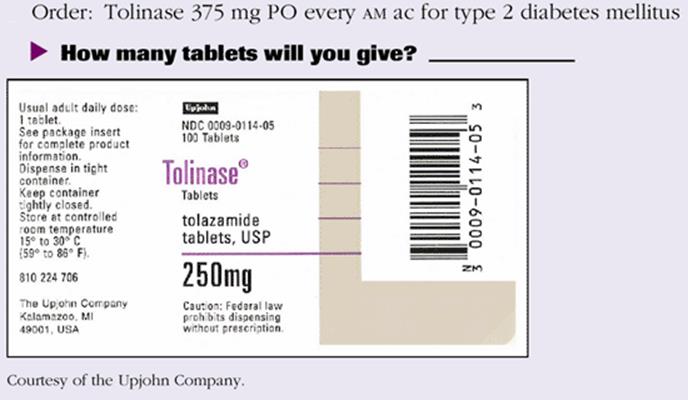
View Answer
4.
View Answer
5.
View Answer
 ADMINISTERING MEDICATION BY DIFFERENT ROUTES
Medication may be administered by various routes, including oral, parenteral, or intravenous, involving tablets, capsules, or liquid.
 PREVENTING MEDICATION ERRORS
Crushing enteric-coated tablets and caplets would be considered a medication error because the nurse did not administer the medication using the right route. The patient could suffer erosion of the esophagus or stomach resulting in a bleeding ulcer. Aspirin is an example of a medication that is enteric-coated to prevent erosion of gastrointestinal tissue.
Enteral Medications
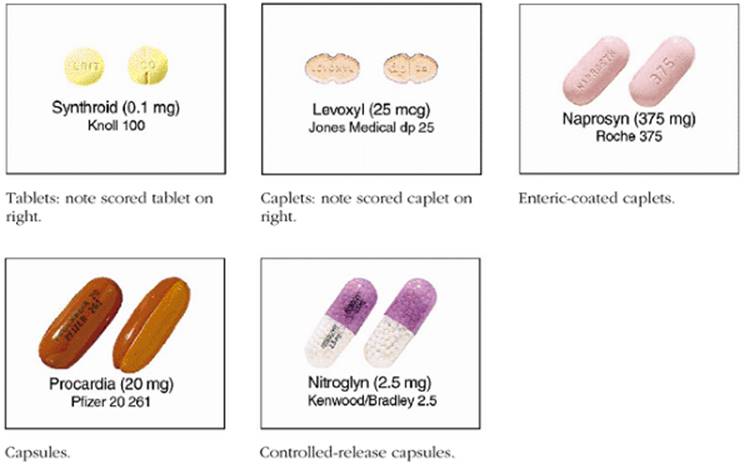
Oral (PO) medications are administered using tablets, caplets, capsules, or liquid. Tablets and caplets may be scored, which permits a more accurate administration when one fourth or one half of a tablet must be given.
Tablets and caplets may also be enteric coated, which allows the medication to bypass disintegration in the stomach to decrease irritation, and then later break down in the small intestine for absorption. Enteric-coated tablets and caplets should never be crushed, because such medications irritate the stomach.
Capsules are usually of the time-release type, and these should never be crushed or opened because the medication would be immediately released into the system, instead of being released slowly over time.
|
|
|
Figure. No caption available |
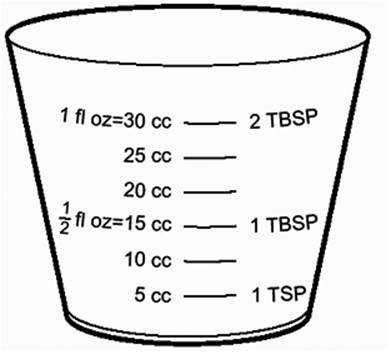
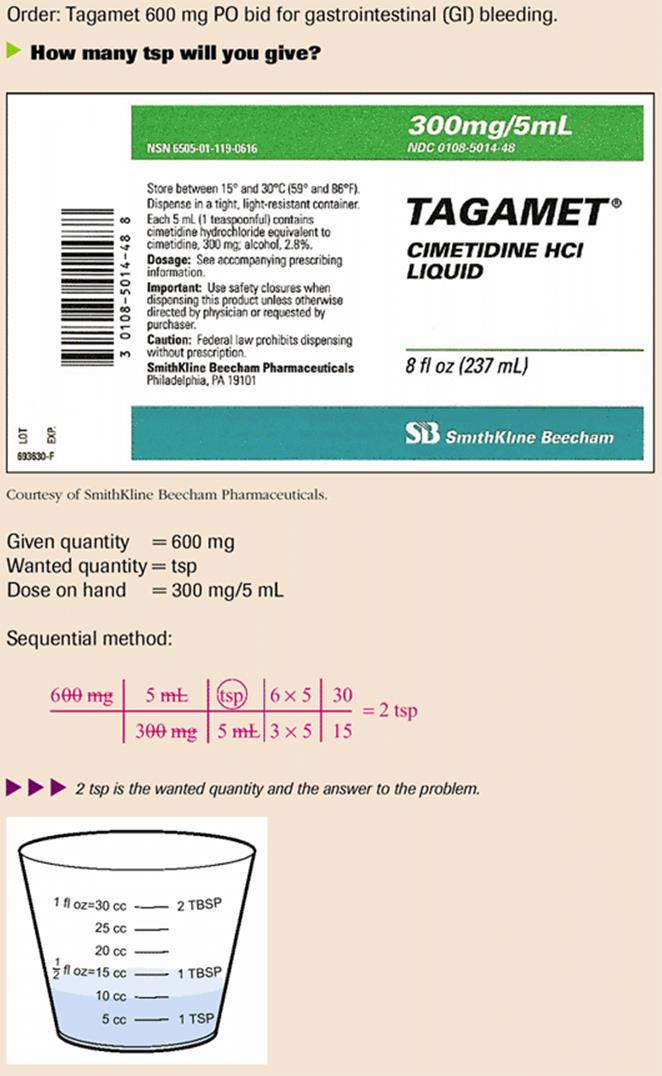
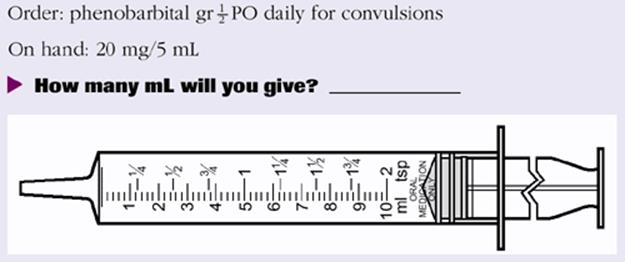
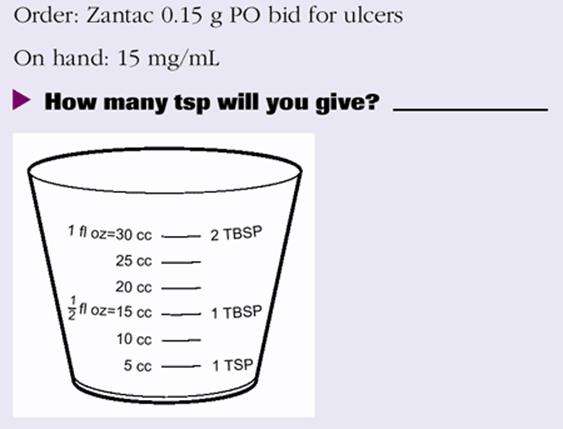
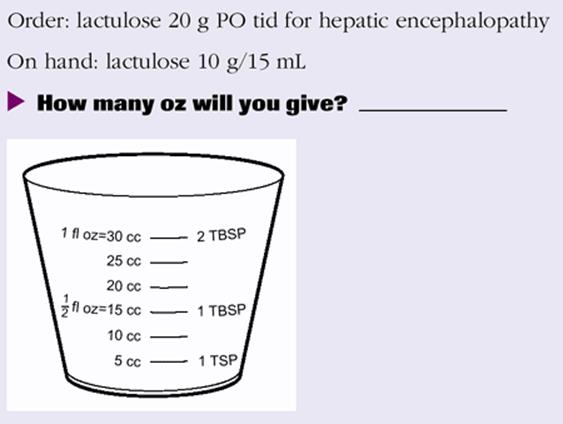
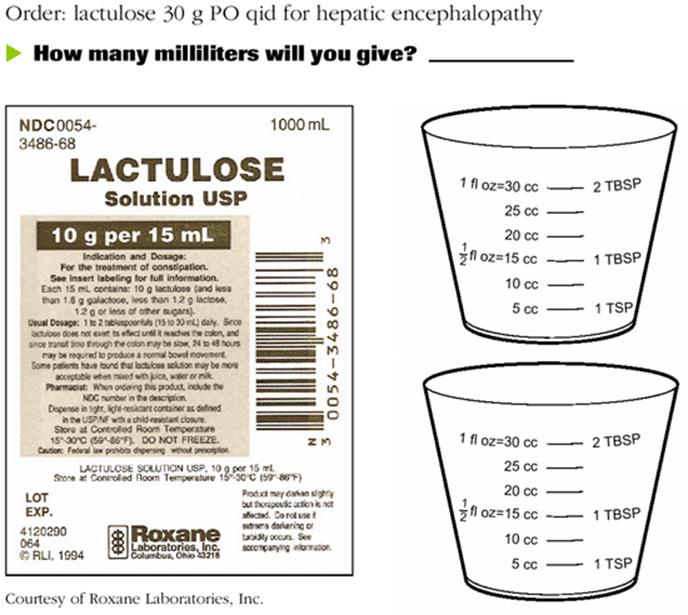
Liquid medication is accurately administered using a medication cup or medication syringe. The medication cup contains the common equivalents for the metric, apothecary, and household systems to permit adaptation of the medication's dosage for administration under various circumstances.
|
|
|
Figure. No caption available |
PREVENTING MEDICATION ERRORS
Opening capsules and adding the medication to applesauce or pudding would also be considered a medication error because the nurse did not administer the medication using the right route. The patient could receive an incorrect dosage of the medication as the medication quickly enters the gastrointestinal system.
EXAMPLE 4.9
EXAMPLE 4.10

EXAMPLE 4.11

Exercise 4.5 Administering Enteral Medications (See pages 98–99 for answers)
1.
View Answer
2.
View Answer
3.

View Answer
4.
View Answer
Parenteral Medications
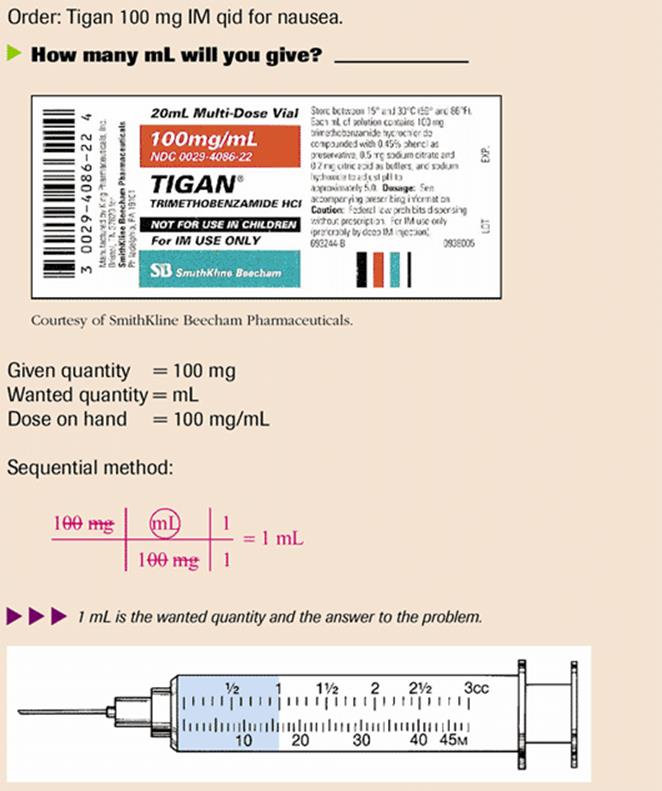
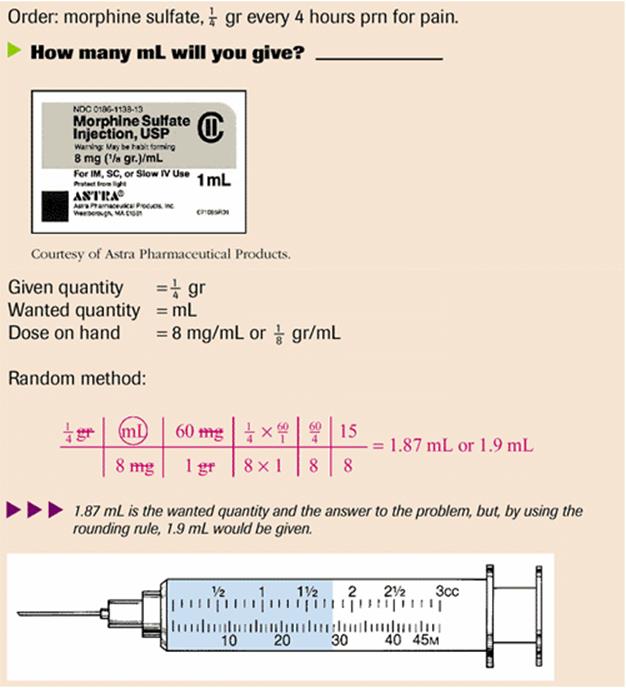
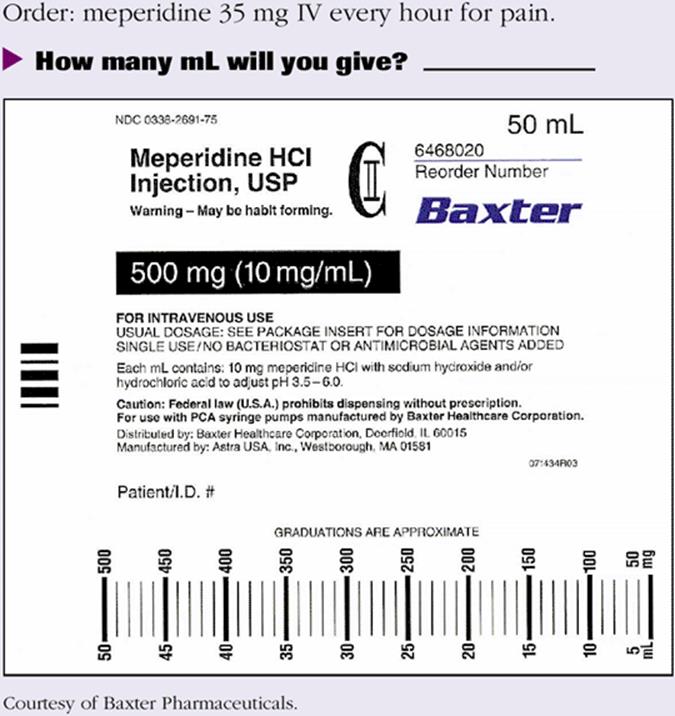
Medications may also be ordered by the physician for the parenteral route of administration, including subcutaneous (SQ), intramuscular (IM), and intravenous (IV). Parenteral medications are sterile solutions obtained from vials or ampules and are administered using a syringe or prefilled syringes. The three syringes most often used are:
 PREVENTING MEDICATION ERRORS
It is the responsibility of the nurse to choose the correct syringe when administering parenteral medications. The nurse can prevent medication errors by being knowledgeable about different types of syringes and when it is appropriate to use specific syringes.
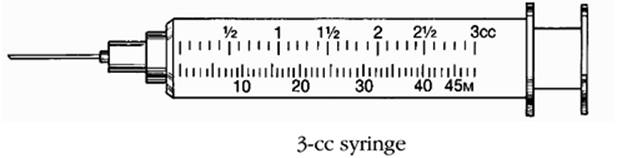
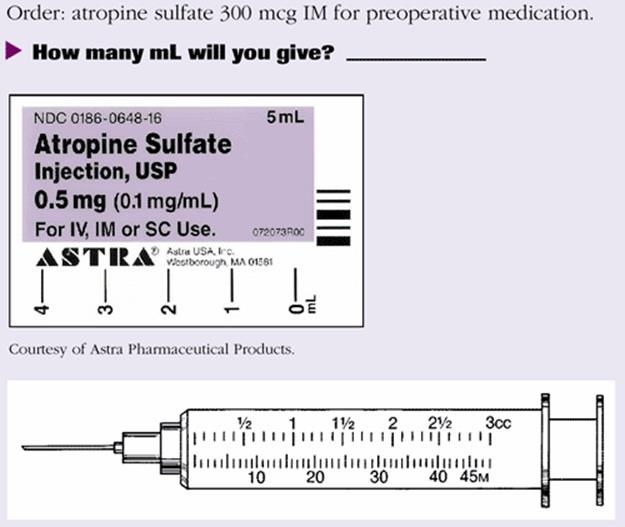
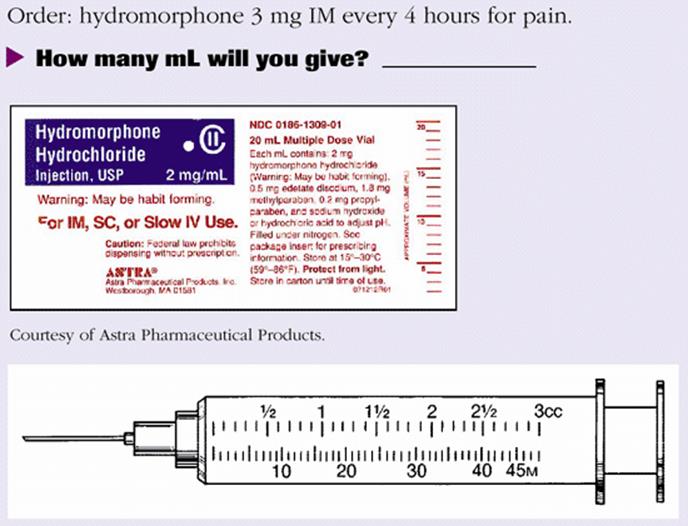
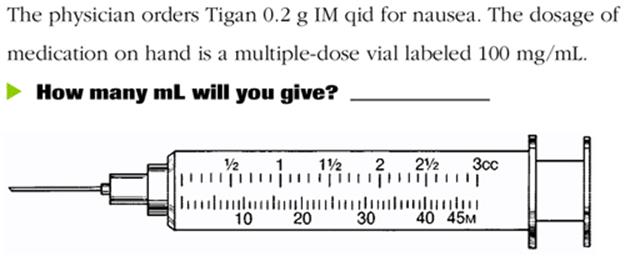
1. 3-cc syringe (used for a variety of medications requiring administration of doses from 0.2 to 3 cc).
|
|
|
Figure. No caption available |
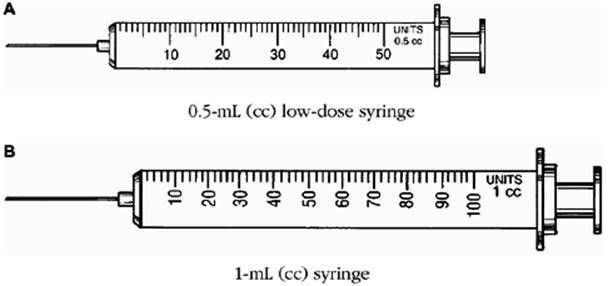
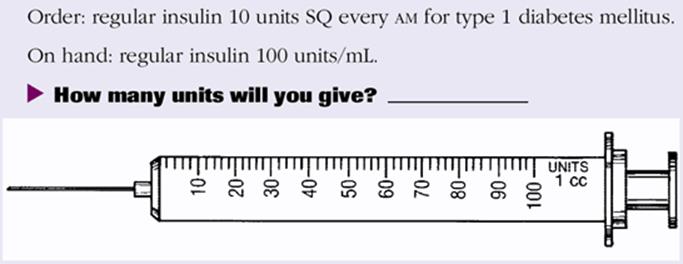
2. Insulin syringe (used specifically to administer insulin). Two types are illustrated below A. 0.5-mL (cc) low-dose syringe for U-100 insulin and B. 1-mL (cc) syringe for U-100 insulin.
|
|
|
Figure. No caption available |
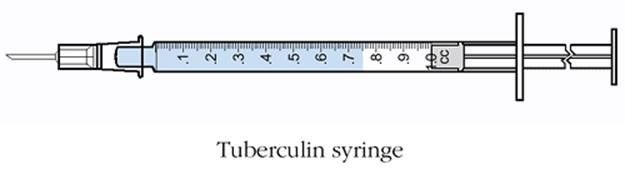
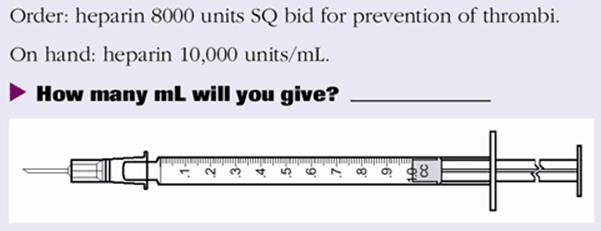
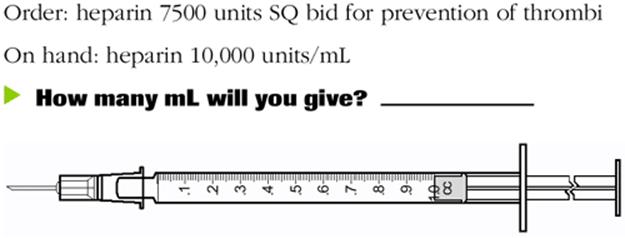
3. Tuberculin syringe (used for a variety of medications requiring administration of doses from 0.1 to 1 cc). Marked in hundredths to allow for rounding or exact dosage (eg, 0.75 mL).
|
|
|
Figure. No caption available |
EXAMPLE 4.12
EXAMPLE 4.13

EXAMPLE 4.14
EXAMPLE 4.15

PREVENTING MEDICATION ERRORS
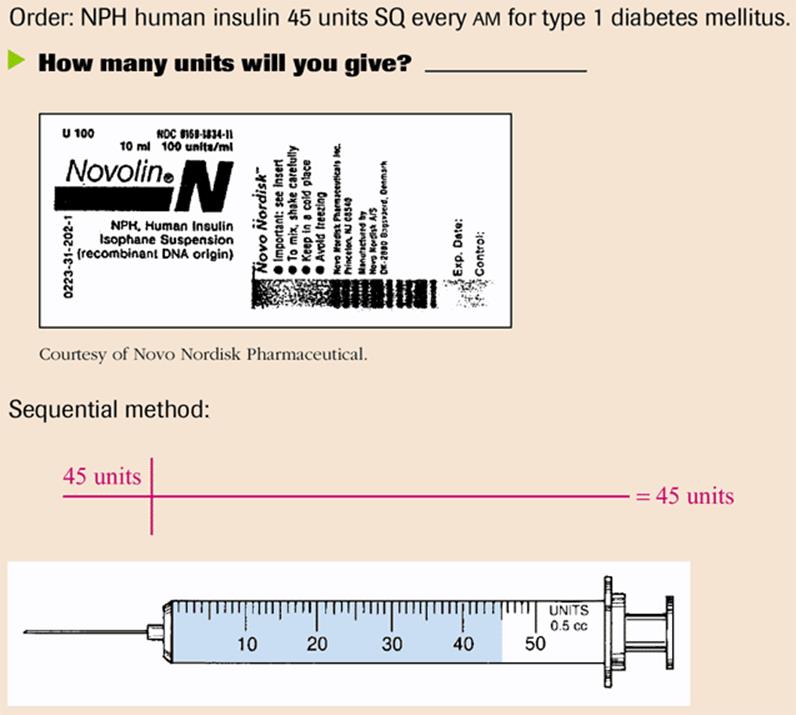
Insulin is manufactured in different strengths and a variety of types based on onset, peak, and duration. Lilly and Novo Nordisk are the primary providers of insulin. Insulin is classified as rapid-acting (Humalog and Novolog), short-acting (Regular Insulin), intermediate (NPH and Lente), and long-acting (Lantus and Ultralente). Some types of insulin must be administered in a single syringe, and other types of insulin can be mixed in a single syringe for administration.
Insulin is given with an insulin syringe that requires no calculation. The number of units of insulin ordered by the physician equals the number of units that the nurse draws using the correct insulin syringe: Low-dose or regular U-100.
PREVENTING MEDICATION ERRORS
It is the responsibility of the nurse to be familiar with the different types of insulin and to use a nursing drug reference to prevent medication errors associated with insulin administration. Every nurse should know the onset, peak, and duration of the insulin being administered as well as the signs and symptoms of hypoglycemia (pale, cool, clammy skin and hunger) and hyperglycemia (hot, red, dry skin and thirst).
EXAMPLE 4.16
EXAMPLE 4.17
PREVENTING MEDICATION ERRORS
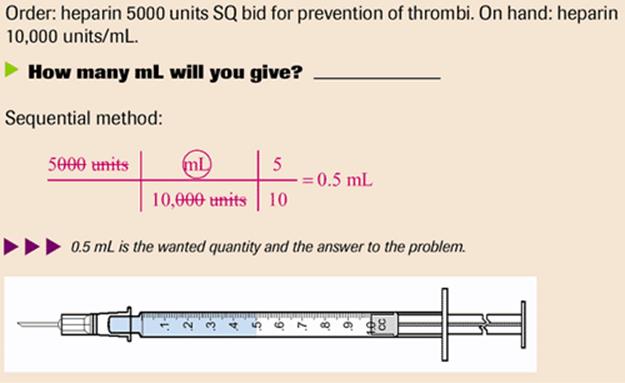
Heparin is an anticoagulant that is used to decrease the clotting ability of the blood and help prevent harmful clots from forming in the blood vessels. Although heparin is commonly referred to as a blood thinner, it does not dissolve blood clots that have already formed. Heparin may help prevent blood clots from becoming larger and causing more serious problems to the heart or lungs.
Heparin is administered using a tuberculin syringe, which is calibrated from 0.1 to 1 cc. This allows for more accurate administration of medication dosages of less than 1 cc.
PREVENTING MEDICATION ERRORS
It is also the responsibility of the nurse to be familiar with the different types of anticoagulants (heparin, Warfarin, and Coumadin) to ensure patient safety and prevent medication errors. The nurse needs to know which laboratory value to monitor (PT, PTT, INR) and which antidote (protamine sulfate or vitamin K) to have available for emergencies.
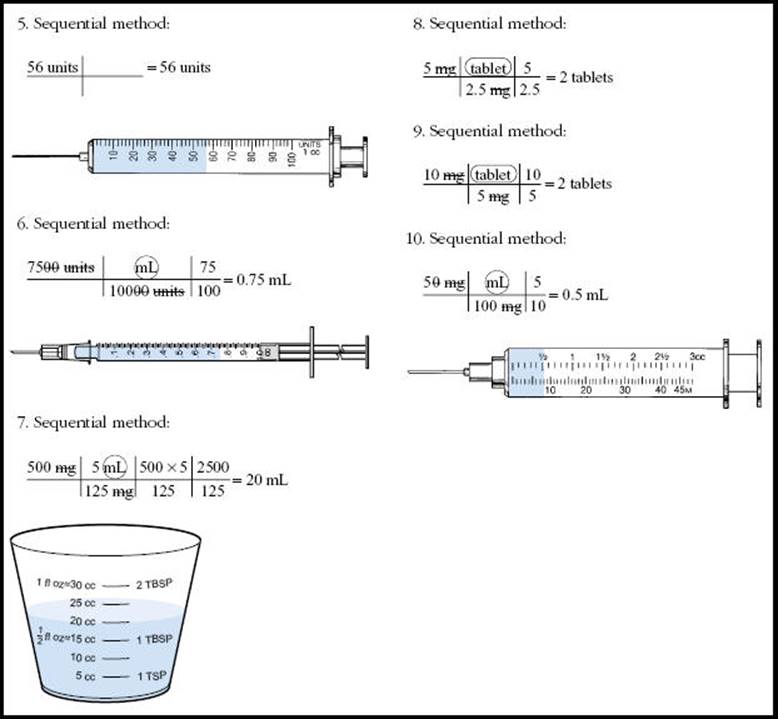
Exercise 4.6 Administering Parenteral Medications (See page 99 for answers)
1.
View Answer
2.
View Answer
3.
View Answer
4.
View Answer
5.
View Answer
SUMMARY
This chapter has taught you to interpret medication orders and drug labels and to calculate one-factor medication problems using dimensional analysis. To demonstrate your ability to interpret correctly and calculate accurately, complete the following practice problems.
Practice Problems for Chapter 4: One-Factor Medication Problems (See pages 99–100 for answers)
1.
View Answer
2.

View Answer
3.
View Answer
4.
View Answer
5.

View Answer
6.
View Answer
7.
View Answer
8.

View Answer
9.

View Answer
10.
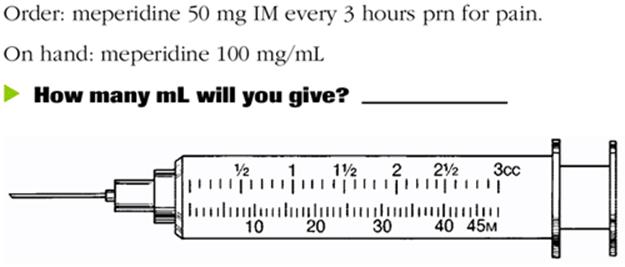
View Answer
Chapter 4 Post-Test: One-Factor Medication Problems
Name _____________________________ Date _______________________
1. 
2. 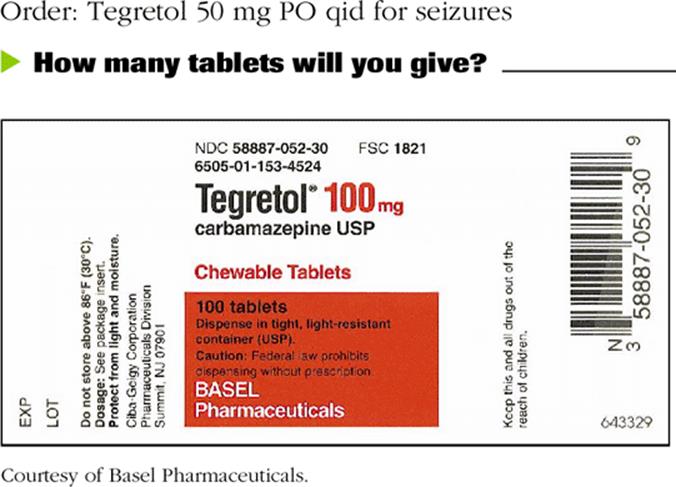
3. 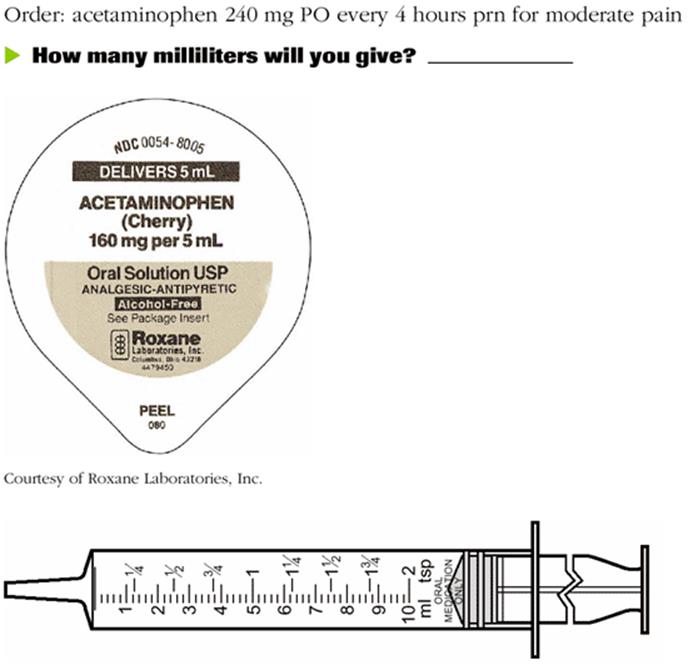
4. 
5. 
6. 
7. 
8. 
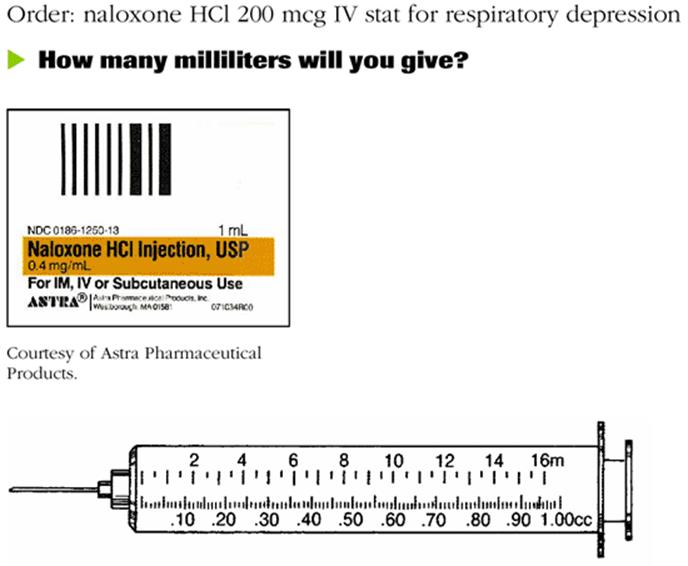
9. 
10. 
ANSWER KEY FOR CHAPTER 4: ONE-FACTOR MEDICATION PROBLEMS
|
Figure. No caption available |