
Goran Augustin1, 2
(1)
Department of Surgery Division of Gastrointestinal Surgery, University Hospital Center Zagreb, Zagreb, Croatia
(2)
School of Medicine University of Zagreb, Zagreb, Croatia
12.1 General Considerations
if a woman with child be bled, she will have an abortion, and this will be the more likely to happen, the larger the fetus
when a pregnant woman has a violent diarrhea, there is danger of her miscarrying
in a pregnant woman, if the breasts suddenly lose their fullness, she has a miscarriage
if, in a woman pregnant with twins, either of her breasts lose its fullness, she will part with one of her children; and if it be the right breast which becomes slender, it will be the male child, or if the left, the female
when women, in a moderate condition of body, miscarry in the second or third month, without any obvious cause, their cotyledons are filled with mucosity, and cannot support the weight of the fetus, but are broken asunder
in women that are about to miscarry, the breasts become slender; but if again they become hard, there will be pain, either in the breasts, or in the hip-joints, or in the eyes, or in the knees, and they will not miscarry
women with child who are seized with fevers, and who are greatly emaciated, without any (other?) obvious cause, have difficult and dangerous labors, and if they miscarry, they are in danger Hippocrates, 400 B.C.E
12.1.1 Introduction
Evaluation of a female patient in general and/or during pregnancy who presents with an acute abdominal pain must always include surgical and gynecologic disorders. Parsons in 1958 stated that 40 % of women in general population who present with symptoms of pain in the lower abdomen and pelvis do not have gynecologic disease [1].
The two general considerations in the surgical evaluation of these conditions are laparoscopic approach versus the traditional laparotomy and preservation of reproductive capability. Preservation of reproductive capability (childbearing, hormonal function and sexual health) has a major impact on the wellness of a woman. These important issues should be considered in surgical management of acute gynecologic problems.
12.2 Incidence
Depending on the method and definition of a clinically significant adnexal mass, the prevalence of pregnancies complicated by an adnexal mass varies, but has been reported to be between 1 and 4 % [2, 3]. A small percentage of these, approximately 5 %, will represent malignant tumors, making ovarian cancer the fifth most common cancer diagnosed during pregnancy [4].
Torsion of the adnexa accounted for 2.7 % of all surgical emergencies in one series of acute gynecologic complaints [5], and in pregnancy, adnexal masses have been noted to occur in up to 1 % [6]. The rate of torsion decreases as the gestational age increases. However, maternal ovarian torsion (OT) during pregnancy is a rare event, with a reported incidence of 1–10/10,000 spontaneous pregnancies [7, 8]. Adnexal torsion has been reported to occur in 7–28 % of all pregnancies complicated by adnexal masses [5, 9–13]. In one study of 12 years experience, 98 % of cases were elective with only one emergent operation for adnexal torsion preformed [14].
Although it is a relatively rare phenomenon, adnexal torsion should always be considered as part of the differential diagnosis of acute pelvic/abdominal pain in women, especially those with pelvic masses diagnosed by examination or ultrasonography. Early diagnosis is important because prompt surgical intervention can result in ovarian preservation by saving the ovary and adnexa from infarction.
The majority of adnexal torsions occur in the first or second trimester of pregnancy with only 10 % in the third trimester [15–17]. If cysts are found in pregnant women on sonography, these very rarely (3.8 %) result in torsion [18]. Bilateral torsion, either simultaneously or sequentially, is infrequent, with few cases reported in the literature [19, 20].
Eighty percent of torsions were found on the right side [17].
12.3 Risk Factors
12.3.1 Assisted Reproductive Technologies
The increased use of assisted reproductive technologies such as controlled ovarian hyperstimulation (COH), in vitro fertilization (IVF), and intracytoplasmic sperm injection (ICSI) has led to an increase in the risk of adnexal torsion, particularly in pregnant women or women with ovarian hyperstimulation syndrome (OHSS). Mashiach et al. studied adnexal torsion in 201 women with OHSS over a period of 10 years and reported an incidence of 2.3 % in nonpregnant women and an incidence of 16 % in pregnant women [15]. However, 12–25 % of all adnexal torsions occur in pregnant women, often in combination with assisted reproduction and its complications (OHSS). The reported incidence is low for oocyte donation cycles (0–0.2 %) and IVF cycles (0–0.13 %); however, the incidence increased to 6 % under stimulation for ART and to 16 % with OHSS [15, 18, 21–23]. But even when adnexal torsion occurs simultaneously with OHSS, the reported incidence varies between 1 and 33 % [19]. Seventy percent of torsions occur in multiple pregnancies [24]. The incidence in study by Spitzer et al. with 1,411 fresh embryo transfers in 1,007 patients was 0.35 % [17].
12.3.2 Pregnancy
Some authors found that pregnancy itself is a risk factor for recurrent torsion despite the method of conception, and gestational age at time of torsion but recurrent torsion is more frequent in multicystic ovaries [7, 25].
12.3.3 Ovarian Tumors
In an 80-year review of the world literature, Jubb [26] collected only 34 cases of ovarian cancer associated with pregnancy. In 1973, Munnell [27] also emphasized the infrequent association of ovarian cancer and pregnancy at 1/18,000 pregnancies. A more recent comprehensive report summarized the incidence of 0.179–1.1/10,000 pregnancies [28]. In the Dobashi et al. series, ovarian malignancies during pregnancy were estimated to occur in 0.8–2.8/10,000 pregnancies, which is slightly higher than the incidence discussed previously [29]. It is uncertain whether incidence of ovarian cancer associated with pregnancy is rising. However, since the age of childbearing among older women increases, the incidence of cancer is also likely to rise in pregnancy. In Dobashi et al. series, six cases of epithelial ovarian cancer with the median age of 32.5 years were presented [29], while it was 30 years in Jubb’s report [26] in 1963, suggesting the aging trend of this minor subset of patients.
The effect of pregnancy on mature cystic teratomas has also been evaluated, and one study noted increased complications. Torsion occurred in 19 % and rupture in 17 % of these cysts in pregnancy [30]. Because of the high incidence of adverse pregnancy outcomes in association with emergency surgery previously reported, some authors recommend elective removal of all masses that persist until 16 weeks and are 6 cm or greater regardless of appearance on imaging studies, unless it is suspected to be a leiomyoma [31]. Conversely, torsion occurred in only 1/139 conservatively managed patients in the study by Grimes et al. from 1954 [32].
12.3.4 Anatomic Variations of Adnexa
There are even cases of torsion of normal ovaries. The causes of torsion may be hypermobile ovarian ligaments, long ovarian ligaments, or other inherent ovarian mobility. Other factors may operate to cause torsion of normal adnexa during the second trimester of pregnancy [33]. The relative situation of the adnexa and the uterus (i.e., the ovaries emerging from the pelvis by the increasing size of the uterus) may predispose the ovaries to twist by allowing them a greater mobility [34].
The main histopathologic findings in both groups were cysts of the follicular or corpora lutea [35]. Although cysts and neoplasms account for over 90 % of all cases, torsion can occur in the normal-appearing ovary as well [36].
12.4 Clinical Presentation
The presenting complaint of adnexal torsion is pain that is often abrupt in nature, very severe, lateralized to the right or left lower quadrant of the abdomen, and usually causing nausea and vomiting. It is often described as sharp and “knifelike,” although it can be colicky in nature. The pain is proportional to the degree of circulatory obstruction; that is, complete obstruction interrupting venous return results in sudden severe pain with nausea and vomiting developing rapidly. The pain may radiate to back, flank, or groin. There may be a history of waxing and waning pain if the adnexa has been twisting and untwisting or has undergone partial torsion, causing vascular slowdown but not thrombosis [15, 37–39]. The infundibulopelvic ligament may twist and untwist by itself, reducing and increasing the pain. There may also be a history of some sort of jarring or movement that has caused the torsion, such as exercise prior to the onset of the pain or even just turning over in bed. Acute abdominal pain occurs in more than 80 % of cases, often starting suddenly at night and persisting for more than 24 h [15, 16, 40, 41]. Signs of peritoneal irritation, which are considered fundamental for the diagnosis, were present in 43 % of the pregnant women and 19 % of the nonpregnant women [7, 19, 42]. Low-grade temperature elevations may occur, but significant fevers are unlikely and, if present, may point to another cause of the pain.
Pelvic examination usually reveals a tender mass on the affected side. If the patient had normal adnexa prior to the torsion, she may not have a mass present until later in the course of the torsion when edema and swelling of the adnexa have set in. Therefore, serial examinations may be necessary in a patient suspected of torsion. Only rarely will patients have evidence of abdominal guarding or rebound tenderness on physical examination.
12.5 Diagnosis and Differential Diagnosis
12.5.1 Differential Diagnosis
The differential diagnosis, particularly for right-sided adnexal torsion, includes [41, 43]:
· Acute appendicitis
· Renal colic
· Renal or urethral calculi/obstruction
· Obstructive bowel disease
· Ectopic/heterotopic pregnancy
· Hemorrhagic cysts
· Corpus luteum cysts
· Ovarian hyperstimulation syndrome
The differential diagnosis of adnexal torsion is particularly difficult in combination with OHSS or pregnancy, as abdominal pain, nausea, and vomiting can be presenting symptoms of hyperstimulation or pregnancy itself because the abdomen is already distended and tender because of the enlarged cystic ovaries [38].
12.5.2 Diagnosis
12.5.2.1 Laboratory Findings
An elevation of the white blood cell (WBC) count may be present but is also not very predictive. Several authors have reported that patients had mild leukocytosis; however, while levels may be increased in nonpregnant women, levels may be within normal ranges for pregnant women [19, 40, 41]. Leukocytosis is also one of the laboratory indicators which may change with OHSS. If necrosis and infection of the twisted organ occur, then higher fever and leukocytosis may be present.
12.5.2.2 Transvaginal Ultrasound
When adnexal torsion is suspected, abdominal ultrasound is indicated. Transvaginal ultrasound may often show enlargement of the ovaries and polycystic changes without this being evidence of torsion. It is extremely rare for adnexal torsion to occur with a mass less than 5 cm in diameter [17, 44], and ultrasound almost always demonstrates an adnexal mass of this size. Nonetheless, sometimes a large mass might be missed in third trimester presentations, when the adnexa can be hidden by a large uterus. Because of varying degrees of ovarian arterial, venous, and lymphatic occlusion with torsion, the ovarian parenchyma is initially congested (Fig. 12.1), and hemorrhagic infarction occurs later [10, 45]. Sonographic findings associated with the diagnosis of adnexal torsion include a predominantly solid-appearing ovary, unilateral ovarian enlargement, ovarian peripheral cystic structures, and marked stromal edema and pelvic fluid [39, 45–49].
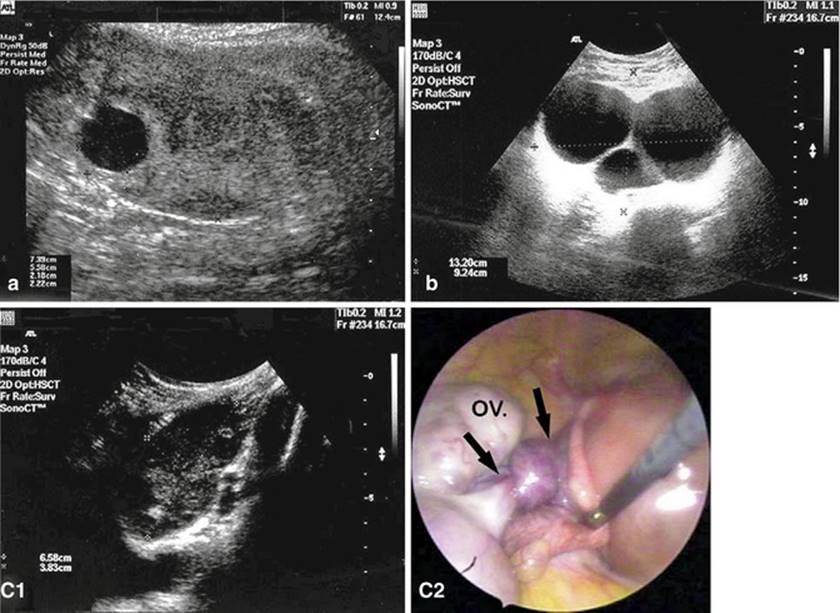
Fig. 12.1
Three different ultrasound images of twisted ovaries in pregnancy. (a) Transabdominal scan of an enlarged ovary with a 20 mm simple unilocular cyst. The ovarian parenchyma appears edematous; (b) transabdominal scan of an enlarged 130 × 92 mm ovary with multicystic components; (c1) transabdominal scan of an enlarged 65 mm ovary without cystic components. Again, the ovarian parenchyma appears edematous; (c2) laparoscopy of the same patient as in (c1). Arrowheads point to the twisted ovarian pedicle [34]
OHSS presents significant differential diagnostic problem. Twisted adnexa are usually characterized by a solid-appearing ovary on ultrasound, enlargement of the organ, ovarian peripheral cystic structures, and marked stromal edema and pelvic fluid. These characteristics are routinely present in a hyperstimulated ovary, and usually both adnexa are enlarged. Mild OHSS could be suspected in these patients, delaying the correct diagnosis and treatment. There is an overlap in the gray-scale appearance of ovaries in mild OHSS and OT. Ovaries in mild OHSS are enlarged, with prominent, heterogeneous stroma, and contain multiple 1–2 cm follicles, many containing hemorrhage. Torsed ovaries are also enlarged, with prominent, heterogeneous central stroma and with multiple, small, peripheral follicles [50]. In addition, in OHSS, both ovaries could be enlarged, and symmetry among them may be present contrary to the situation with adnexal torsion [41]. Although the absence of Doppler flow indicates venous and arterial occlusion and thus adnexal torsion (Fig. 12.2), the presence of flow should not exclude the diagnosis of torsion [46–49, 51, 52].
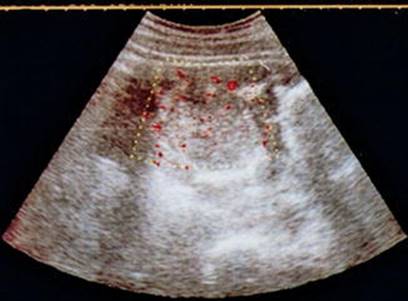
Fig. 12.2
Doppler mapping of the left adnexa showing absence of vascular flow [51]
With OHSS, ovaries often show an increase in diastolic blood flow; thus, decreased blood flow may indicate adnexal torsion in a patient with OHSS [52, 53]. Furthermore, the reduction in diastolic flow is diagnostic of OT in patients with OHSS. In the hyperstimulated ovary, the diastolic flow is usually increased [54]. However, a torsed ovary may demonstrate normal venous and arterial flow completely symmetric to the normal side [50]. Recent review of all surgically diagnosed OT cases showed that normal Doppler flow was found in 60 % of surgically diagnosed OT [7, 52]. Hasson et al. therefore recommended not to base the decision for surgical evaluation only on the results of Doppler flow investigation (as proposed by Arena et al.) but also to take past medical history, clinical appearance, and laboratory assessment into account [7, 41]. If there is a strong clinical suspicion for adnexal torsion, consultation with an obstetrician/gynecologist is mandatory.
12.5.2.3 Abdominal MRI
If the diagnosis cannot be established, especially in cases with OHSS, emergent MRI of the abdomen and pelvis can define the adnexal torsion. The MRI appearance of OT is well described [55]. Solid ovarian tissue appears enlarged and edematous (Fig. 12.3).
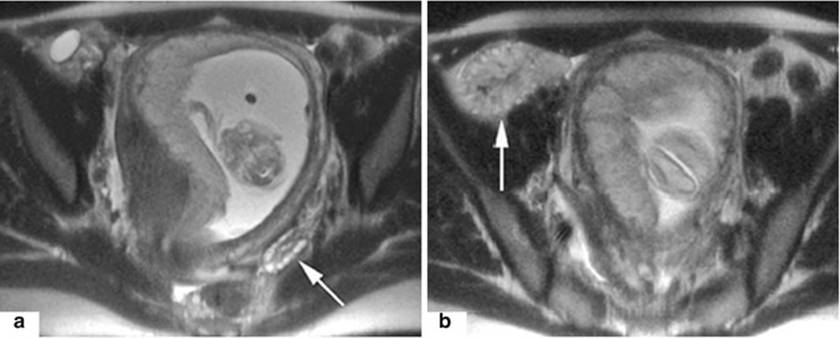
Fig. 12.3
A 30-year-old woman at 15 weeks’ gestation with sharp intermittent right lower quadrant pain. (a) Transverse image shows the normal left ovary with normal follicles and stroma (arrow); (b) transverse image shows enlarged and edematous right ovary (arrow), which is consistent with torsion [80]
Currently, the diagnosis of maternal adnexal torsion is missed in 15–35 % because of nonspecific clinical features and uncommon objective findings [5, 35, 56]. Probably more frequent use of MRI in doubtful cases could increase the preoperative diagnostic accuracy.
12.6 Treatment
12.6.1 Time Between Hospital Admission and Surgery
In the literature, the time between admission to hospital and surgery is in range of 6–15.5 h and may be even significantly shorter in the first trimester of pregnancy. However, several days may pass between the start of symptoms and surgery [15, 17, 34]. In the laparoscopic era, acute symptoms or persistence of complaint meant early surgery (less than 24 h in all cases), and treatment was still in time to preserve fertility [17]. Patients in the second and third trimesters were operated significantly later than those in the first trimester. This difference may be either due to a difficulty in assessing the ovaries on palpation and on ultrasound examination or because patients with suspected OT are more readily operated in early pregnancy when the risk from the (laparoscopic) surgery itself is minimal [34]. In one large study, 50 % of patients had surgery within 24 h, and 85 % received surgery within 72 h [56].
12.6.2 Procedures
Sometimes adnexal torsion produces no classic symptoms, and there are no definitive diagnostic tests or studies; surgical exploration of the pelvis is required for definitive diagnosis (Fig. 12.4). Traditionally, this was done by means of laparotomy; however, laparoscopy has become the preferred surgical approach for both diagnosis and management of adnexal torsion [57].
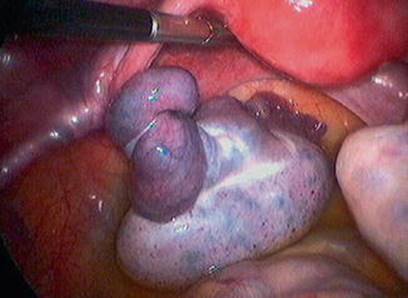
Fig. 12.4
Laparoscopic view of torsion of the enlarged left adnexa [17]
Traditionally, adnexal torsion was treated aggressively with salpingo-oophorectomy of the involved side; unwinding the torsion was condemned for fear of releasing a potentially fatal embolus [58, 59]. This was not confirmed and current conservative management involves unwinding the adnexa and assessing its viability. No emboli in general population have been noted in several series using this approach [12, 60]. An embolic complication could have been encountered when adnexal torsion was not treated promptly and twisted organs were found to be obviously gangrenous at laparotomy.
Once torsion is unwound, the adnexa show one of the following:
· No evidence of ischemia or mild ischemia with immediate and complete recovery
· Severe ischemia with a dark red or black tube and ovary and partial recovery after the pedicle is untwisted
· Gangrenous adnexa without recovery
Only the gangrenous adnexa needs complete removal of the adnexa; the first two situations can be conservatively treated with detorsion and preservation of the ovary, even after severe ischemia has occurred [12]. When an ovarian cyst is present, a complete ovarian cystectomy should be performed to obtain a histological diagnosis [60]. Infarction may make accurate diagnosis difficult; therefore, the cyst should be completely removed. This may also prevent recurrence. Routine ovariopexy after detorsion does not seem warranted because the risk of retorsion is very low when a cause is found and treated [60].
Despite the necrotic, hemorrhagic, or bluish-black appearance of a torsed ovary, detorsion saves over 90 % of these ovaries, and ovarian function recovers [10, 12, 13, 48, 61]. Taskin et al. [62] showed that even with complete ischemia gross appearance does not correlate with outcome and that detorsion within 24 h did not show an increase in free radical reperfusion injury. The importance of early diagnosis and surgical intervention in the case of adnexal torsion is highlighted by a report showing that the delay of intervention for 36 h resulted in significant congestion and necrosis [62]. Assessment of ovarian viability such as ultrasound visualization of follicular development, inspection during a subsequent procedure, observed response to stimulation during IVF, and documentation of fertilization of oocytes from the ovary has consistently shown that the ovary does recoup function after torsion and detorsion [10, 12, 13, 15, 61]. Furthermore, because an increased risk of thromboembolism has not been associated with detorsion procedures [10, 13], conservative management with detorsion is encouraged. In a study of 94 women with adnexal torsion, Zweizig et al. [63] showed an overall morbidity of 12 % in the group with salpingo-oophorectomy versus 3 % in the conservatively treated control group. In a study by Spitzer et al. adnexectomy was avoided in all cases, and therefore fertility was preserved [17]. After unwinding, aspiration of ovarian cysts, if present, is recommended [51].
Since the successful conservative management of adnexal torsion in general female population was described by Mage et al. in 1989 (laparoscopically) [60] and Bider et al. in pregnant population in 1991 [35], this technique has been extended for the management of such conditions during pregnancy. Laparoscopic detorsion of adnexal torsion is recommended as the first-line treatment and has been successfully performed during pregnancy mostly up to 20 weeks of gestation, first performed laparoscopically by Levy et al. in 1995 [64]. One large study shows 60 % of patients treated with laparoscopy with most of the women in the first trimester (75 %) [56]. The patients in that study who underwent laparoscopy had a significantly smaller ovarian mass and a shorter hospital stay than those undergoing laparotomy. Compared with laparotomy, laparoscopic procedures are associated with shorter hospitalizations, a lower rate of febrile morbidity, reduced consumption of narcotics, and greater patient comfort [10, 13]. After laparoscopic detorsion, 24 h of postoperative observation is recommended [65, 66]. Even a case of laparoscopic detorsion in the early third trimester of pregnancy has been published [51].
The operative procedures in one large study were as follows: detorsion followed by cystectomy in 80 %, oophorectomy in 10 % for masses larger than 12 cm, and simple detorsion in 10 % [56]. Smorgick et al. [34] performed detorsion in all their cases in their series of 33 pregnant women with OT, followed by cystectomy 12 % (4/33) and oophorectomy in one case with a 10 cm cystic teratoma. Of 20 patients who had OT in pregnancy in Bider et al.’s series [35], 85 % received detorsion, followed by biopsy, aspiration, and cystectomy in 45 % patients. In Hasson et al.’s study [7], all patients received detorsion and 55 % also undergoing an additional procedure(s).
12.6.3 Operative Technique
12.6.3.1 Laparoscopic Detorsion in the Third Trimester
A small incision of 2 cm is made in the left upper abdominal quadrant (Fig. 12.5) and a 10 mm trocar is introduced as open (Hasson) technique on the left side of the epigastrium. Pneumoperitoneum is induced with an insufflation volume of CO2 of 1 L/min and an intra-abdominal pressure of 10 mmHg. The patient is kept in a horizontal position. Secondary trocars are inserted at opposite sites, one in the right upper abdominal quadrant and the other on the extreme left of the middle abdominal quadrant. These secondary trocars are inserted under direct laparoscopic control. Two atraumatic probes are introduced into these trocars: one on the left side, allowing washing and gentle pressure on the uterus in a brief lateral Trendelenburg position, and with the other probe elevating the twisted adnexa, pushing it contralaterally to the direction of rotation. Serial manipulations achieve the unwinding of the adnexa. The lateral Trendelenburg position is then abandoned, and after abundant washing, the procedure is stopped for 10 min, with desufflation of the abdominal cavity. Once the procedure resumed, the pedicle of the ovary and the tube are carefully examined and an improvement in color and a decrease in edema should be noted. These signs establish the beginning of recovery of the adnexa, which should turn pink shortly after the procedure. Monitoring of the uterine contractions and fetal heartbeat should be carried out during the entire procedure [51].
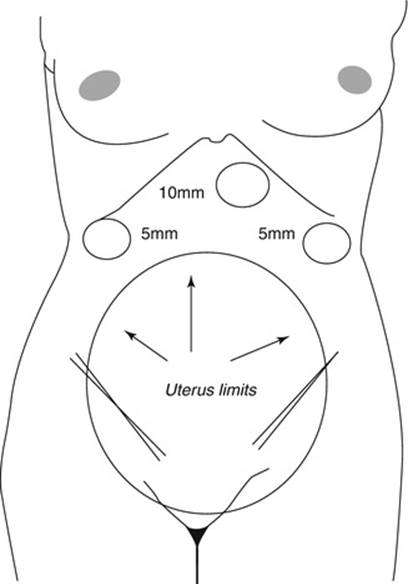
Fig. 12.5
Sites of trocar insertion in the third trimester of pregnancy for laparoscopic detorsion of adnexal torsion (circle marking upper limits of the uterus) [51]
12.6.3.2 Technique of Adnexal Unwinding
Unwinding of the affected adnexa is usually carried out by simply pushing the ovary contralaterally to the direction of the torsion. This can be performed with the aid of two probes without grasping the tissue, to avoid bleeding. The release of pressure ensures the normal positioning of the adnexa. After unwinding, aspiration of ovarian cysts, if present, is recommended. However, this is not always possible since cysts are often filled with clotted blood.
12.6.3.3 Ovariopexy
Surgical management to prevent recurrence has included “triplication” of utero-ovarian ligament by Germain et al. [67], where the ligament is plicated and shortened with a running stitch; ovariopexy, where the ovary is sutured to the posterior aspect of the uterus or to the lateral pelvic wall; and oophoropexy, where the utero-ovarian ligament is sutured either to the posterior aspect of the uterus or to the lateral pelvic wall (Fig. 12.6). Oophoropexy, although not evaluated in randomized trials, has been done in women of all ages as well as during pregnancy. Although not commonly done, oophoropexy has been performed laparoscopically with good results and has been recommended for childhood torsion and in women who have previously undergone an oophorectomy for prior OT [67–71].
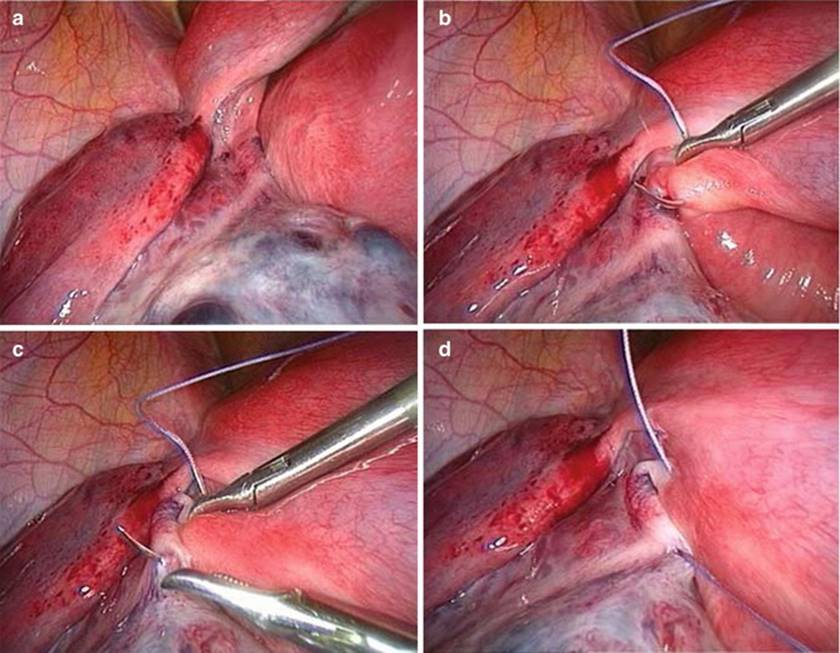
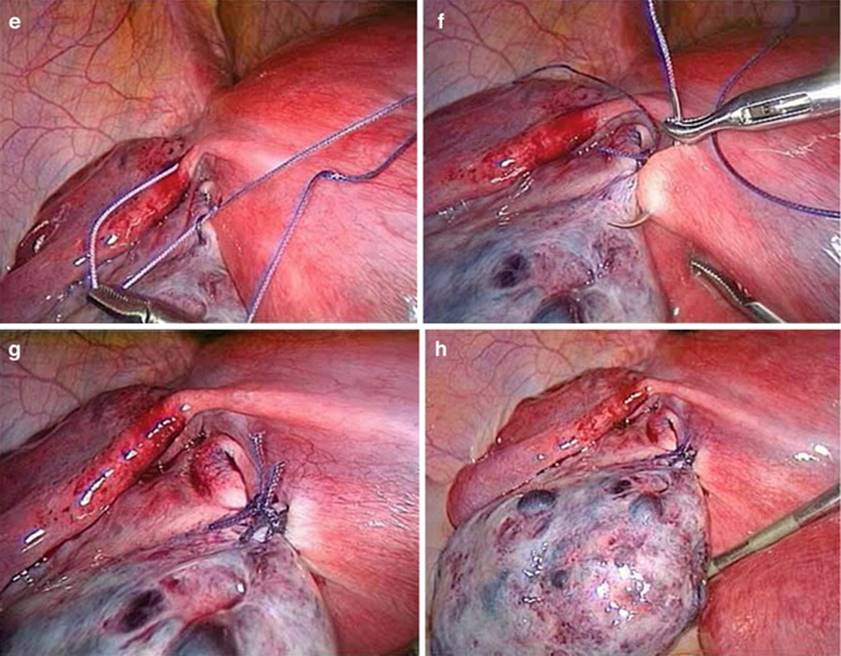
Fig. 12.6
Oophoropexy of the left ovary. (a) Intraoperative finding after ovarian detorsion. (b–e) Shortening of the proper ovarian ligament by suturing the distal and proximal end of the ligament for prevention of recurrent ovarian torsion in pregnancy. (f–h) Ovarian fixation for the remaining proper ovarian ligament [71]
Weitzman et al. described a unique form of treatment for the prevention of recurrent adnexal torsion. Although oophoropexy has been performed successfully in pregnant women, it was felt that the increased vascularity of the area precluded performing this procedure. Owing to the concern of yet another recurrence, and the length of the utero-ovarian ligament, the ligament is shortened. In this approach, a grasping forceps is passed through an Endoloop and then used to tent up the utero-ovarian ligament in the midsection. The pretied endoscopic knot (e.g., Endoloop Ligature, Ethicon, Johnson & Johnson) is then tightened, pulling the ovary close to the uterus and shortening the utero-ovarian ligament [20].
12.6.3.4 Laparotomy
In the presence of an ovarian cyst, a simple cystectomy can be performed in the absence of overt malignancy. When possible, the entire ovary is delivered from the abdominal cavity and surrounded by moist laparotomy pads to avoid intra-abdominal spillage of cyst contents if rupture occurs. The thin ovarian capsule is carefully incised, usually with a scalpel. Blunt dissection is used to separate the cyst from the ovarian tissue. Electrosurgery can be used on the internal ovarian surfaces for hemostasis but should not be used near the cyst wall to minimize the risk of cyst rupture [72].
Rupture is inevitable in some ovarian cysts, particularly in endometriomas and functional cysts, such as luteomas. If a dermoid is accidentally ruptured, every effort should be made to avoid spilling the very irritating sebaceous contents into the peritoneal cavity. If this occurs, prolonged peritoneal irrigation with warmed saline will prevent peritonitis. Likewise, if the “chocolate” contents of an endometrioma or the fluid content of a potentially malignant cyst spills within the peritoneal cavity, prolonged irrigation with warmed saline is judicious. It remains to be determined if these precautions avoid the detrimental effect of intraoperative rupture on stage I ovarian cancer [73].
Regardless of rupture, all cysts should be completely opened after removal and the internal surface of the cyst wall examined for excrescences. When present, microscopic examination of frozen sections can help determine if intraoperative staging is required. In all cases, definitive diagnosis must await careful examination of permanent sections.
The ovary does not require precise reconstruction as was thought in the past. Reapproximation with internal sutures may help subsequent reformation of the normal ovarian profile, but sutures on the external ovarian surface should be avoided to minimize the subsequent risk of adhesion formation [74].
12.6.4 Pathology
It is important to define the pathologic cause of the adnexal torsion. Table 12.1 shows pathology of adnexal masses causing torsion in pregnancy. If the mass is benign, there is no need for additional surgical or oncologic therapy.
Table 12.1
Pathological findings of ovarian torsion in pregnant women [56]
|
Pathological findinga |
(%) |
|
Teratoma |
30 |
|
Corpus luteum cyst |
20 |
|
Follicular cyst |
15 |
|
Serous cystadenoma |
15 |
|
Endometrioma |
10 |
|
Mucinous cystadenoma |
5 |
aTwo cases undergoing detorsion were without pathological results
12.6.5 Special Considerations
There are several cases of adnexal torsion and concomitant contralateral tubal ectopic pregnancy (Fig. 12.7) [75, 76]. In such cases, it is especially important to make early diagnosis and laparoscopic exploration to save the detorsed adnexa because salpingectomy or adnexectomy is indicated in the contralateral adnexa due to ectopic pregnancy. Such procedure preserves fertility.
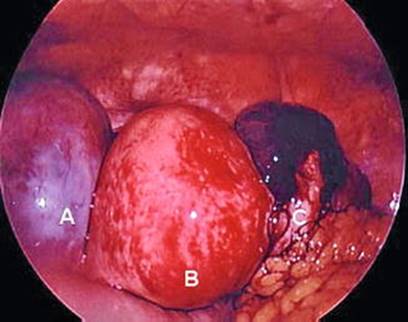
Fig. 12.7
Intraoperative photograph of (A) adnexal torsion and concomitant contralateral ectopic pregnancy (C). (B) Uterus [76]
12.6.6 Perioperative Management
12.6.6.1 Tocolysis
Prophylactic tocolysis are not routinely given, only administered if the patient experienced uterine contraction after surgery. The tocolytic protocol included oral or intramuscular administration of progesterone in the first trimester and oral or intravenous administration of ritodrine in the second and third trimesters [56].
12.7 Prognosis
Smith et al. reported a reduced fertilization rate (FR) of 40 % for oocytes aspirated from a detorsed ovary, while the FR for the unaffected ovary was 93 %. Seventy-five percent of oocytes from the unaffected side and 64 % of oocytes from the affected side developed into blastocysts. A reduced FR had been previously described in earlier reports in connection with reduced flow in the ovarian artery [77]. In a repeat IVF procedure, Oelsner et al. retrieved oocytes from laparoscopically detorsed ovaries in six patients, and these oocytes could be subsequently fertilized and therefore recommended detorsion as the procedure of choice for ischemic ovaries [13]. The subsequent course of a pregnancy after treatment for adnexal torsion is generally favorable; abortion rates of 8.3–16.6 % do not appear to be increased [7, 15]. In a study by Spitzer et al. 60 % (3/5) of pregnancies continued to term with the vaginal delivery of healthy children. One pregnancy was terminated in the 19th gestational week for medical reasons as ultrasound showed sirenomelia (mermaid syndrome). There was one case of missed abortion in a 40-year-old patient; however, 11 months later, this patient gave birth to a healthy child [17]. In one large study, there were 60 % term deliveries, 15 % preterm deliveries (at 31, 32, and 34 gestational weeks, respectively), 5 % missed abortion, and 20 % elective abortions in the first trimester, with patients citing fear of surgical and anesthetic risk inflicted on the fetus. There was no significant difference in pregnancy results between laparoscopy and laparotomy. Twenty-seven percent delivered by Cesarean section for common obstetric indications, and 73 % underwent vaginal deliveries [56]. Bider et al. [35] reported that 61 % patients delivered at term and one delivered prematurely at 26 gestational weeks; similarly, 83 % of pregnant women in Hasson et al.’s study [7] delivered healthy babies at term, and 8 % had preterm delivery. Pregnancy outcome in Smorgick et al.’s study [34] was also favorable, with 70 % term deliveries and 26 % preterm births.
12.7.1 Risk of Recurrence
Laparoscopic fixation of the adnexa (ovariopexy) or shortening of the utero-ovarian ligament can be done to avoid recurrence of adnexal torsion, but this should be the exception rather than the rule [19, 20, 69, 71]. In their retrospective case control study, Hasson et al. reported a recurrence rate of 19.5 % for pregnant women and 9.1 % for nonpregnant women; however, 73.2 % of pregnant women and 20.8 % of nonpregnant women had been treated with ART prior to torsion [7, 78]. There was no recurrence in a study by Spitzer et al. with five patients during the subsequent course of the pregnancy [17]. Torsion recurrence is higher in patients with OHSS [19, 79].
References
1.
Parsons L. Pelvic pain. Postgrad Med. 1958;23:252-8.
2.
Hill LM, Connors-Beatty DJ, Nowak A, et al. The role of ultrasonography in the detection and management of adnexal masses during the second and third trimesters of pregnancy. Am J Obstet Gynecol. 1998;179:703–7.PubMedCrossRef
3.
Bernhard LM, Klebba PK, Gray DL, et al. Predictors of persistence of adnexal masses in pregnancy. Obstet Gynecol. 1999;93:585–9.PubMedCrossRef
4.
Smith LH, Dalrymple JL, Leiserowitz GS, et al. Obstetrical deliveries associated with maternal malignancy in California, 1992 through 1997. Am J Obstet Gynecol. 2001;184:1504–12.PubMedCrossRef
5.
Hibbard LT. Adnexal torsion. Am J Obstet Gynecol. 1985;152:456–61.PubMedCrossRef
6.
Nelson MJ, Cavalieri R, Sanders RC. Cysts in pregnancy discovered by sonography. J Clin Ultrasound. 1986;14:509–12.PubMedCrossRef
7.
Hasson J, Tsafrir Z, Azem F, et al. Comparison of adnexal torsion between pregnant and nonpregnant women. Am J Obstet Gynecol. 2010;202:536.e1–e6.CrossRef
8.
Mancuso A, Broccio G, Angio L, et al. Adnexal torsion in pregnancy. Acta Obstet Gynecol Scand. 1997;76:83–4.PubMedCrossRef
9.
Whitecar P, Turner S, Higby K. Adnexal masses in pregnancy: a review of 130 cases undergoing surgical management. Am J Obstet Gynecol. 1999;181:19–24.PubMedCrossRef
10.
Cohen SB, Wattiez A, Seidman DS, et al. Laparoscopy versus laparotomy for detorsion and sparing of twisted ischemic adnexa. JSLS. 2003;7:295–9.PubMedCentralPubMed
11.
Govaerts I, Devreker F, Delbaere A, et al. Short-term medical complications of 1,500 oocyte retrievals for in vitro fertilization and embryo transfer. Eur J Obstet Gynecol Reprod Biol. 1998;77:239–43.PubMedCrossRef
12.
Oelsner G, Bider D, Goldenberg M, et al. Long-term follow-up of the twisted ischemic adnexa managed by detorsion. Fertil Steril. 1993;60:976–9.PubMed
13.
Oelsner G, Cohen SB, Soriano D, et al. Minimal surgery for the twisted ischaemic adnexa can preserve ovarian function. Hum Reprod. 2003;18:2599–602.PubMedCrossRef
14.
Sherard 3rd GB, Hodson CA, Williams HJ, et al. Adnexal masses and pregnancy: a 12-year experience. Am J Obstet Gynecol. 2003;189:358–62.PubMedCrossRef
15.
Mashiach S, Bider D, Moan O, et al. Adnexal torsion of hyperstimulated ovaries in pregnancies after gonadotropin therapy. Fertil Steril. 1990;53:76–80.PubMed
16.
Mashiach R, Bar-On S, Boyko V, et al. Sudden/nocturnal onset of acute abdominal pain, lasting less than a day and accompanied by vomiting: a tell-tale sign of ovarian torsion. Gynecol Surg. 2010;7:297–301.CrossRef
17.
Spitzer D, Wirleitner B, Steiner H, Zech NH. Adnexal torsion in pregnancy after assisted reproduction – case study and review of the literature. Geburtsh Frauenheilk. 2012;72:716–20.CrossRef
18.
Zanetta G, Mariani E, Lissoni A, et al. A prospective study of the role of ultrasound in the management of adnexal masses in pregnancy. Br J Obstet Gynecol. 2003;110:578–83.CrossRef
19.
Rackow B, Patrizio P. Successful pregnancy complicated by early and late adnexal torsion after in vitro fertilization. Fertil Steril. 2007;87:697–702.PubMedCrossRef
20.
Weitzman VN, DiLuigi AJ, Maier DB, Nulsen JC. Prevention of recurrent adnexal torsion. Fertil Steril. 2018;2008(90):e1–3.
21.
Sauer MV. Defining the incidence of serious complications experienced by oocyte donors: a review of 1,000 cases. Am J Obstet Gynecol. 2001;184:277–8.PubMedCrossRef
22.
Maxwell KN, Cholst IN, Rosenwaks Z. The incidence of both serious and minor complications in young women undergoing oocyte donation. Fertil Steril. 2008;90:2165–71.PubMedCrossRef
23.
Bodri D. Complications related to ovarian stimulation and oocyte retrieval in 4052 oocyte donor cycles. Reprod Biomed Online. 2008;17:237–43.PubMedCrossRef
24.
Wiser A, Levron J, Kreizer D, et al. Outcome of pregnancies complicated by severe ovarian hyperstimulation syndrome (OHSS): a follow-up beyond the second trimester. Hum Reprod. 2005;20:910–4.PubMedCrossRef
25.
Pansky M, Feingold M, Maymon R, et al. Maternal adnexal torsion in pregnancy is associated with significant risk of recurrence. J Minim Invasive Gynecol. 2009;16:551–3.PubMedCrossRef
26.
Jubb ED. Primary carcinoma in pregnancy. Am J Obstet Gynecol. 1963;85:345–54.PubMed
27.
Munnell EW. Primary ovarian cancer associated with pregnancy. Clin Obstet Gynecol. 1963;30:983–93.PubMedCrossRef
28.
Palmer J, Vatish M, Tidya J. Epithelial ovarian cancer in pregnancy: a review of the literature. Br J Obstet Gynecol. 2009;116:480–91.CrossRef
29.
Dobashi M, Isonishi S, Morikawa A, et al. Ovarian cancer complicated by pregnancy: analysis of 10 cases. Oncol Lett. 2012;3:577–80.PubMedCentralPubMed
30.
Peterson WF, Prevost EC, Edmunds FT, et al. Benign cystic teratomas of the ovary. Am J Obstet Gynecol. 1955;70:368–82.PubMed
31.
Hess LW, Peaceman A, O’Brien WF, et al. Adnexal mass occurring with intrauterine pregnancy: report of fifty-four patients requiring laparotomy for definitive management. Am J Obstet Gynecol. 1988;158:1029–34.PubMedCrossRef
32.
Grimes WH, Bartholomew RA, Colvin ED, et al. Ovarian cyst complicating pregnancy. Am J Obstet Gynecol. 1954;68:594–603.PubMed
33.
Pansky M, Smorgick N, Herman A, et al. Torsion of normal adnexa in postmenarchal women and risk of recurrence. Obstet Gynecol. 2007;109:355–9.PubMedCrossRef
34.
Smorgick N, Pansky M, Feingold M, et al. The clinical characteristics and sonographic findings of maternal ovarian torsion in pregnancy. Fertil Steril. 2009;92:1983–7.PubMedCrossRef
35.
Bider D, Mashiach S, Dulitzky M, et al. Clinical, surgical and pathologic findings of adnexal torsion in pregnant and nonpregnant women. Surg Gynecol Obstet. 1991;173:363–6.PubMed
36.
Growdon WB, Laufer MR. Ovarian torsion 2007, Version 15.3 Available at: http://www.utdol.com/utd/content/topic.do?topicKeyĽgyn_surg/5273&selectedTitleĽ1%7E18&sourceĽsearch_result.
37.
Mote WM, Ovankovich AD, Bienarz J, et al. Cardiovascular effects and acid-base and blood gas changes during laparoscopy. Am J Obstet Gynecol. 1973;115:1002–12.
38.
Pinto AB, Ratts VS, Williams DB, et al. Reduction of ovarian torsion 1 week after embryo transfer in a patient with bilateral hyperstimulated ovaries. Fertil Steril. 2001;76:403–6.PubMedCrossRef
39.
Gorkemli H, Camus M, Clasen K. Adnexal torsion after gonadotropin ovulation induction for IVF or ICSI and its conservative treatment. Arch Gynecol Obstet. 2002;267:4–6.PubMedCrossRef
40.
Smorgick N, Barel O, Halperin R, et al. Laparoscopic removal of adnexal cysts: is it possible to decrease inadvertent intraoperative rupture rate? Am J Obstet Gynecol. 2009;200:237.e1–3.CrossRef
41.
Arena S, Canonico S, Luzi G, et al. Ovarian torsion in in vitro fertilization induced twin pregnancy: combination of Doppler ultrasound and laparoscopy in diagnosis and treatment can quickly solve the case. Fertil Steril. 2009;92:1496.e9–13.CrossRef
42.
Bar-On S, Mashiach R, Stockheim D, et al. Emergency laparoscopy for suspected ovarian torsion: are we too hasty to operate? Fertil Steril. 2010;93:2012–5.PubMedCrossRef
43.
Djakovic A, Hönig A, Gross M, Dietl J. Adnexal torsion in a patient with bichorial twin pregnancy in the 21st week of gestation treated by open laparoscopy: a case report. Arch Gynecol Obstet. 2006;274:248–9.PubMedCrossRef
44.
Thornton JG, Wells M. Ovarian cysts in pregnancy: does ultrasound make traditional management inappropriate? Obstet Gynecol. 1987;69:717–21.PubMed
45.
Graif M, Shalev J, Strauss S, et al. Torsion of the ovary: sonographic features. Am J Roentgenol. 1984;143:1331–4.CrossRef
46.
Varras M, Tsikini A, Polyzos D, et al. Uterine adnexal torsion: pathologic and gray-scale ultrasonographic findings. Clin Exp Obstet Gynecol. 2004;31:34–8.PubMed
47.
Albayram F, Hamper UM. Ovarian and adnexal torsion: spectrum of sonographic findings with pathologic correlation. J Ultrasound Med. 2001;20:1083–9.PubMed
48.
Gordon JD, Hopkins KL, Jeffrey RB, Giudice LC. Adnexal torsion: color Doppler diagnosis and laparoscopic treatment. Fertil Steril. 1994;61:383–5.PubMed
49.
Villalba ML, Huynh B, So M, et al. An ovary with a twist: a case of interesting sonographic findings of ovarian torsion. J Emerg Med. 2005;29:443–6.PubMedCrossRef
50.
Cornfeld D, Scoutt L. Torsion of a hyperstimulated ovary during pregnancy: a potentially difficult diagnosis. Emerg Radiol. 2007;14:331–5.PubMedCrossRef
51.
Bassil S, Steinhart U, Donnez J. Successful laparoscopic management of adnexal torsion during week 25 of a twin pregnancy. Hum Reprod. 1999;14:855–7.PubMedCrossRef
52.
Pena JE, Ufberg D, Cooney N, Denis AL. Usefulness of Doppler sonography in the diagnosis of ovarian torsion. Fertil Steril. 2000;73:1047–50.PubMedCrossRef
53.
Fleischer AC. Ultrasound imaging – 2000: assessment of utero-ovarian blood flow with transvaginal color Doppler sonography; potential clinical applications in infertility. Fertil Steril. 1991;55:684–91.PubMed
54.
Rakow BW, Patrizio P. Successful pregnancy complicated by early and late adnexal torsion after in vitro fertilization. Fertil Steril. 2007;87:e9–12.
55.
Rha SE, Byun JY, Jung SE, et al. CT and MR imaging features of adnexal torsion. Radiographics. 2002;22:283–94.PubMedCrossRef
56.
Chang SD, Yen CF, Lo LM, et al. Surgical intervention for maternal ovarian torsion in pregnancy. Taiwan J Obstet Gynecol. 2011;50:458–62.PubMedCrossRef
57.
Nichols DH, Julian PI. Torsion of the adnexa. Clin Obstet Gynecol. 1985;28:375–80.PubMedCrossRef
58.
Kalchman GG, Meltzer RM. Interstitial pregnancy following homolateral salpingectomy: report of 2 cases and review of the literature. Am J Obstet Gynecol. 1966;96:1139–43.PubMed
59.
Powell JL, Foley FP, Llorens AS. Torsion of the fallopian tube in postmenopausal women. Am J Obstet Gynecol. 1972;113:115–8.PubMed
60.
Mage G, Canis M. Laparoscopic management of adnexal torsion. A review of 35 cases. J Reprod Med. 1989;34:520–4.PubMed
61.
Ben-Rafael Z, Bider D, Mashiach S. Laparoscopic unwinding of twisted ischemic hemorrhagic adnexum after in vitro fertilization. Fertil Steril. 1990;53:569–71.PubMed
62.
Taskin O, Birincioglu M, Aydin A, et al. The effects of twisted ischaemic adnexa managed by detorsion on ovarian viability and histology: an ischaemia-reperfusion rodent model. Hum Reprod. 1998;13:2823–7.PubMedCrossRef
63.
Zweizig S, Perron J, Grubb D, Mishell Jr DR. Conservative management of adnexal torsion. Am J Obstet Gynecol. 1993;168:1791–5.PubMedCrossRef
64.
Levy T, Dicker D, Shalev J, et al. Laparoscopic unwinding of hyperstimulated ischaemic ovaries during the second trimester of pregnancy. Hum Reprod. 1995;10:1478–80.PubMed
65.
Pryor RA, Wiczyk HP, O’Shea DL. Adnexal infarction after conservative surgical management of torsion of a hyperstimulated ovary. Fertil Steril. 1995;63:1344–6.PubMed
66.
Rody A, Jackisch C, Klockenbusch W, et al. The conservative management of adnexal torsion – a case-report and review of the literature. Eur J Obstet Gynecol Reprod Biol. 2002;101:83–6.PubMedCrossRef
67.
Germain M, Rarick T, Robins E. Management of intermittent ovarian torsion by laparoscopic oophoropexy. Obstet Gynecol. 1996;88:715–7.PubMedCrossRef
68.
Oelsner G, Shashar D. Adnexal torsion. Clin Obstet Gynecol. 2006;49:459–63.PubMedCrossRef
69.
Child TJ, Watson NR, Ledger WL. Sequential bilateral adnexal torsion after a single cycle of gonadotropin ovulation induction with intrauterine insemination. Fertil Steril. 1997;67:573–5.PubMedCrossRef
70.
Crouch NS, Gyampoh B, Cutner AS, Creighton SM. Ovarian torsion: to pex or not to pex? Case report and review of the literature. J Pediatr Adolesc Gynecol. 2003;16:381–4.PubMedCrossRef
71.
Djavadian D, Braendle W, Jaenicke F. Laparoscopic oophoropexy for the treatment of recurrent torsion of the adnexa in pregnancy: case report and review. Fertil Steril. 2004;82:933–6.PubMedCrossRef
72.
Ventolini G, Hunter L, Drollinger D, Hurd WW. Ovarian torsion during pregnancy. Resid Staff Physician. 2007;53.
73.
Vergote I, De Brabanter J, Fyles A, et al. Prognostic importance of degree of differentiation and cyst rupture in stage I invasive epithelial ovarian carcinoma. Lancet. 2001;357:176–82.PubMedCrossRef
74.
Hurd WW, Himebaugh KS, Cofer KF, et al. Etiology of closure related adhesion formation after wedge resection of the rabbit ovary. J Reprod Med. 1993;38:465–8.PubMed
75.
DeCherney AH, Eichhorn JH. Weekly clinicopathological exercises: case 3-1996: severe abdominal pain during early pregnancy in women with previous infertility. New Engl J Med. 1996;334:255–60.CrossRef
76.
DiLuigi AJ, Maier DB, Benadiva CA. Ruptured ectopic pregnancy with contralateral adnexal torsion after spontaneous conception. Fertil Steril. 2007;2008(90):e1–3.
77.
Smith LP, Oskowitz SP, Barrett B, et al. IVF and embryo development subsequent to ovarian torsion occurring during the resumption ofmeiosis. Reprod Biomed Online. 2010;21:418–21.PubMedCrossRef
78.
Osmanağaoğlu MA, Kesim M, Yuluğ E, et al. The effect of high dose methylprednisolone on experimental ovarian torsion/reperfusion injury in rats. Geburtsh Frauenheilk. 2012;72:70–4.CrossRef
79.
Morice P, Louis-Sylvestre C, Chapron C, Dubuisson JB. Laparoscopy for adnexal torsion in pregnant women. J Reprod Med. 1997;42:435–9.PubMed
80.
Birchard KR, Brown MA, Hyslop WB, et al. MRI of acute abdominal and pelvic pain in pregnant patients. Am J Radiol. 2005;184:452–8.