
Raul Artal, MD
Tracy Tomlinson, MD
All truly great thoughts are conceived while walking.
—Friedrich Nietzsche
Key Points
• American College of Obstetricians and Gynecologists (ACOG), American Diabetes Association (ADA), and American College of Sports Medicine (ACSM) endorse physical activities as an adjunctive intervention to prevent and manage gestational diabetes.
• Exercise involving large muscles increases glucose uptake 35- to 40-fold, resulting in three to four times increase in total body glucose uptake.
• To benefit from an exercise program, patients with gestational diabetes should engage in a daily routine of 30-45 minutes of moderate physical activity.
Industrialized countries are currently experiencing an epidemic of obesity and a rising incidence of diabetes. In the United States alone, it is estimated that more than one-half of the adults are either overweight or obese.1 Pregnancy has become a major contributor to this epidemics; sedentary lifestyle and obesity are key etiologic factors in the development of gestational and type 2 diabetes. The Diabetes Prevention Program (DPP) has demonstrated in nonpregnant adults and by now well established that a lifestyle intervention (exercise and diet) was more effective in preventing the development of type 2 diabetes than medical (metformin) intervention.2 Pregnancy is a unique time for behavior modification and a period during which women may be more prone to adapt healthy lifestyle habits that they may continue beyond pregnancy.3
Historically, diabetes was considered a contraindication to exercise in pregnancy. Many women with gestational diabetes mellitus (GDM) failed nutritional therapy and it was reported that 39% required insulin to optimize pregnancy outcome.4 In 1985, data were presented5 at the Second International WorkshopConference on gestational diabetes, which contributed to the first recommendation that mothers with GDM who maintain an active lifestyle may continue a program of moderate exercise under medical supervision.6 It was reported that, for most women with GDM, exercise is a safe and effective alternative therapeutic intervention, which precludes the need for medical therapy. However, only 15.8% of all pregnant women follow the ACOG physical activity guidelines7 and 61% participate in some form of exercise,8 slightly higher compared with 10% adults who meet the Physical Activity Guidelines for Americans in accordance with the National Health and Nutrition Examination Survey.9
Exercise has long been accepted as a complementary intervention in the prevention and management of diabetes in nonpregnant adults. The ADA recommends adults with diabetes engage in at least 150 min/wk of moderate-intensity aerobic activity (50%-70% of maximum heart rate by age) distributed over at least three days each week with no more than two consecutive days without exercise.10 Furthermore, for prevention of type 2 diabetes, the ADA recommends lifestyle changes that include weight loss (7% body weight) and regular physical activity (150 min/wk). Lifestyle interventions for the prevention or management of diabetes have also been endorsed, recommended, and reaffirmed by the ACOG, the ADA, and the ACSM.11,12 During pregnancy, in the absence of medical or obstetrical contraindications, ACOG recommends women engage in 30 minutes or more of moderate-intensity physical activity during most, if not all, days of the week. For women with gestational diabetes, AGOG and the ADA have endorsed exercise as “a helpful adjunctive therapy” in treatment of the disorder.13 However, exercise protocols for women with GDM are not widely prescribed despite the endorsement by these professional organizations.
A limited number of randomized controlled trials have been conducted to evaluate the effect of exercise on preventing GDM or as an adjunct intervention to manage GDM14; the results reported in the literature are mixed and the literature inconclusive; however, the potential short- and long-term benefits are well recognized.
Pregnancy has been characterized as a diabetogenic state brought about by changes in hormone levels (estrogen, prolactin, human chorionic somatommotropin, human placental lactogen [HPL] aka human chorionic somatomammotropin [HCS], cortisol, and progesterone) that lead to insulin resistance and increased insulin requirements in diabetic subjects. In pregnant women, catabolic stress hormones trigger an increase in fuel metabolism that results in wide glycemic shifts between the fasting state15 when glucose levels are lower and the fed state when they are higher. There is an increase in hepatic gluconeogenesis throughout gestation that is modulated by an increase in insulin secretion. However, despite counter-regulatory processes, patients with GDM have impaired insulin sensitivity that results in decreased glucose uptake by muscles and splanchnic organs. These patients experience adipocyte hypertrophy and increased fat storage (Figure 17-1).
Pregnancy-induced insulin resistance predisposes subjects who have risk factors, such as obesity, to the onset of pancreas β-cell dysfunction and gestational diabetes. As many as 60% of women with GDM will develop type 2 diabetes within four years after delivery.16 It is well established that exercise and weight loss improve insulin sensitivity and could prevent or reduce the risk of GDM. Increased glucose uptake by skeletal muscle is partly attributable to increased muscle perfusion during exercise. Exercise leads to beneficial alterations in body composition and biochemical, physiological, and morphological changes in skeletal muscles. Exercise in an obese woman leads to weight loss and the percentage of type 1 muscle fibers increases, resulting in increased muscle oxidative capacity.17,18 This capacity in turn allows to burn more fat throughout the day and improves weight control. In addition to these factors, exercise may relieve stress, reduce anxiety, and depression, and improve self-confidence and, in doing so, limit “emotional eating” that contributes to weight gain and insulin resistance. The metabolic relationship between exercise and nutrition is complimentary. Increased physical activity often leads to improvements in self-image and other factors that, in turn, support healthy life style.
After an exercise session, glucose tolerance is improved for variable periods depending on the mass of the muscle activated, duration, intensity, and insulin response.19 A large contracting skeletal muscle can increase the oxidative process by a factor of 50 and its glucose uptake 35- to 40-fold, leading to a total body glucose uptake that is up to four times higher. Essential to this process that results in improved insulin sensitivity and glucose uptake is the activation of particularly large muscles such as the quadriceps. Many exercise programs designed to achieve eugly- cemia fail because either large muscle groups were not activated or the duration or intensity of the exercise routine was too limited.

EXERCISE IN PREGNANCY
Historically and until the mid-1980s, diabetic pregnant patients were recommended to rest during pregnancy, and pregnancy was not considered an appropriate time for initiating an exercise program for any pregnant woman. There has long been concern that exercise during pregnancy may increase the risk of preterm delivery, fetal growth restriction, or fetal distress due to a decrease in the uterine blood flow during exercise that could affect the fetus and result in an abnormal fetal heart rate and other physiologic responses that may be harmful to the fetus or even result in fetal demise. In fact, there is no evidence to support these concerns, nor is there evidence that the hyperthermia that may occur during moderate-intensity exercise early in pregnancy is teratogenic.
For determining an exercise prescription, the ACSM recommended using VO2 max (maximal oxygen consumption) and most recently VO2R (VO2 Reserve). VO2 Reserve is obtained by subtracting resting VO2 from max VO2. In the clinical setup, this is not practical. In the nonpregnant woman, target heart rates were frequently used to prescribe exercise.
In regard to prescribing exercise intensity, however, it should be recognized that during pregnancy maximal maternal heart rate reserve decreases and resting heart rate increases. Target heart rate zones revised for pregnancy may be used to measure exercise intensity or it may be more practical in the clinical setup to use Borg's rating of perceived exertion (RPE). The Borg scale ranges from 6 (extremely light) to 20 (extremely hard). Pregnant women may begin exercise at a moderate RPE of 12-14 and increase the intensity of exercise to 15 or 16 with conditioning. The “talk test” may be more practical to use to avoid overexertion.20
Given the common pathophysiology of GDM and type 2 diabetes, it is logical that a higher level of physical activity prior to pregnancy and early in the gestation could decrease the risk of GDM.21 Exercise is beneficial for most pregnant women for the prevention of GDM, but it is particularly beneficial for overweight and obese women and those who have a prior history of GDM, a first-degree relative with diabetes, or other risk factors for the development of carbohydrate intolerance during pregnancy.20
While contact sports and heavy weight lifting are discouraged during pregnancy because of potential for injury, many activities could be safely continued in pregnancy.20 Physiologic changes that may alter a pregnant women's response to exercise should, however, be recognized. Just as prolonged fasting in pregnancy is discouraged because it may challenge glycogen energy reserves and result in deleterious effects on the growth and developing fetus,22 exercise that is excessive or coupled with inadequate nutrition has the potential to cause harm. In the nonpregnant state, there is a hypoglycemic response to sustained exercise. Prolonged exercise in pregnancy could also lead to hypoglycemia (Figure 17-2).23 With prolonged exercise free fatty acid and ketone levels rise as glucose levels fall. Hypoglycemia may also result when a pregnant woman exercises and her glucose level is depressed secondary to fasting or medication. The risk of hypoglycemia is greatest in early pregnancy, prior to the fall in insulin-mediated glucose disposal that occurs over the course of the second and third trimesters. In the presence of ketonuria, patients should not exercise. Diabetic patients who are also medically treated should measure blood glucose prior to exercise and increase carbohydrate following guidelines: For blood glucose below 120 mg/dL, ingest 15 g of carbohydrate prior to exercise and 30 g for every 60 minutes of exercise. For blood glucose of 120-130 mg/dL, ingest 30 g for 60 minutes of exercise.
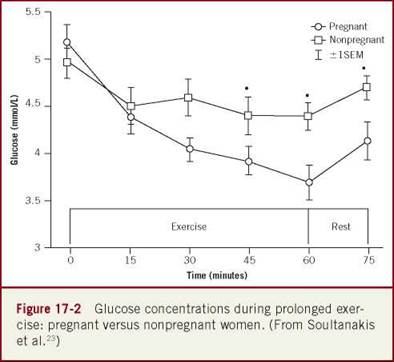
Over the past 30 years, our laboratory has conducted studies examining the impact of pregnancy on maternal and fetal responses to exercise, on the regulation of glucose homeostasis by glucagon, insulin, and catecholamines and other.5,22-26 The results of these studies led to the establishment of safe exercise regimens for both diabetic and nondiabetic pregnant women.24 At an intensity of 55% of maximal oxygen consumption (VO2 max), we observed a rapid reduction in both glucose and insulin concentrations with as little as 15 minutes of exercise (Figure 17-2). After 45 minutes, glucose concentration declined further, suggesting that at this point the potential risk of hypoglycemia with moderate-intensity continuous exercise may rise.23
When designing an exercise regimen for a pregnant woman, the baseline conditioning status should be taken into consideration (Table 17-1). Given that a sedentary lifestyle is a risk factor for diabetes and obesity, most women who have pregestational diabetes or develop GDM are deconditioned. Preexisting and pregnancy- induced low-back pain and joint pain are also common concerns. Pregnant women with these limitations may be more tolerant of nonweight-bearing exercise. We have demonstrated by indirect calorimetry that, when compared to weight-bearing exercise at submaximal levels, there is preferential carbohydrate use during nonweight-bearing exercise in pregnancy,25 primarily because of the ability to sustain more prolonged and sustained level of exercise. The ADA 2013 issued and reaffirmed recommendations for primary prevention of diabetes: “Among individuals at high risk for developing type 2 diabetes, structured programs that emphasize lifestyle changes that include moderate weight loss (7% body weight) and regular physical activity (150 min/wk).”27
PHYSICAL ACTIVITY AND GESTATIONAL WEIGHT GAIN
A 2013 systematic review and meta-analysis that included nine randomized controlled trials with nonpregnant patients at risk for diabetes concluded that comprehensive lifestyle interventions in nonpregnant studies, which include exercise and dietary interventions, result in weight loss and decrease in the incidence of type 2 diabetes in nonpregnant subjects at the end of intervention and up to 10 years.28 However, historically there was reluctance to limit weight gain in pregnancy.
There are few studies in pregnancy combining diet and exercise; however, evidence is emerging that both exercise and weight restrictions are safe interventions in overweight and obese pregnant women.
The 2009 Institute of Medicine (IOM) recommendations for weight gain in obese pregnant women have not been universally accepted and have come into questions since additional gestational weight gain as recommended to obese mothers further aggravates the preexisting obesity.29 Obesity and additional weight gain have been recognized as independent risk factors for maternal and fetal complications of pregnancy with significant life-long consequences.
In 2013, ACOG has published a committee opinion stating that “For an obese pregnant woman who is gaining less weight than recommended but has an appropriately growing fetus, no evidence exists that encouraging increased weight gain to conform with the update IOM guidelines will improve maternal or fetal outcomes.”30
Excessive gestational weight gain significantly increases the risk of GDM and a number of other adverse perinatal outcomes as well as the risk of postpartum weight retention and obesity.31 More than one-third of young (age 14-25), low-income, ethnic minority women move to a higher body mass index (BMI) category within one-year postpartum.32 Pregnancy is an opportune time to target weight management and address the rapidly increasing prevalence of obesity in the population. A triad of pregravid obesity, excessive gestational weight gain, and diabetes in pregnancy are often found in combination. Each of these factors independently increases the risk of fetal overgrowth and, in turn, childhood obe- sity.33 Excessive gestational weight gain thereby plays a vital role in the development of obesity and obesity-related complications in women and their offspring.
The IOM in 2009 has recommended that underweight women (BMI < 18.5 kg/m2) gain 28 to 40 lbs, normal weight women (BMI 18.5-24.9 kg/m2) 25 to 35 lbs, overweight women (BMI 25.0-29.9 kg/m2) 15-25 lbs, and obese women (BMI > 30.0 kg/ m2) 11-20 lbs in pregnancy. It did not make specific recommendations for individual obesity classes, and there has been considerable controversy over gestational weight gain targets for those with severe obesity. In our experience, minimally to no weight gain in obese women has no deleterious impact on the fetus and is beneficial to the mother in regard to her long-term weight loss goals.34,35 As for glycemic control in women with diabetes, we recommend adjusting physical activity and diet in relation to gestational weight gain.
TABLE 17-1 Exercise Prescription for Sedentary, Overweight, or Obese Women With GDM Who Are Unaccustomed to Exercise20
|
Previously Sedentary and/or Overweight/ Obese Pregnant Women |
% HRR |
% V02 R |
RPE |
Target Exercise Energy Expenditure (MET-h/wk) |
|
Weeks 1-3 of training (26 wk gestational age) |
35-39 |
40-45 |
12-14 |
>16 |
|
Weeks 3-6 of training (gestational age 29 wk) |
45-55 |
50-60 |
13-15 |
28 |
|
Weeks 6-9 of training (gestational age 32 wk) |
60 |
65 |
15-16 |
28 |
|
Weeks 1-3 of training (gestational age 35 wk) |
60 |
65 |
15-16 |
28 |
Abbreviations: GDM, gestational diabetes mellitus; MET, metabolic energy equivalent task; % HRR, heart rate reserve; % VO2 R, VO2 Reserve; RPE, rate of perceived exertion from 6 at rest to 20 at maximal exertion.
% HRR = %VO2 R is different for obese or pregnant subjects. It is higher by about 5% compared to % HRR until 70% VO2R, after which % VO2R and % HRR are about equal.
No studies have been conducted to compare limiting weight gain to exercise in pregnancy and determine which intervention is more effective in reducing GDM.
Many of the individual trials that have investigated the impact of physical activity on gestational weight gain have been limited by their small size and poor participant compliance. The modest nature of a number of the interventions studied and the relatively late timing of their initiation are other common factors that have likely limited the studies’ ability to find a significant reduction in gestational weight gain. Recognition of these limitations have prompted a 2011 meta-analysis of 12 physical activity intervention trials that collectively enrolled over a thousand women.36 All of the included trials reported gestational weight gain as a secondary outcome. The analysis uncovered a modest but statistically significant reduction in gestational weight gain among those exposed to various physical activity interventions. Although the 0.6 kg difference reported is of minimal clinical significance on the individual level, given the obesity and diabetes epidemic even a small reduction deserves notice from a population standpoint. As stated earlier for primary prevention of diabetes, the ADA27 recommends that among individuals at high risk for developing type 2 diabetes, structured programs that emphasize lifestyle changes that include moderate weight loss (7% body weight). In a 2013 population-based historical study of 66,010 obese pregnant women, we have found that for women who have gained <2 pounds (including weight loss), there was no significant risk of small-for-gestational-age infants, one of the historical concerns, and most significantly associated with a decreased risk for large-for-gestational-age infants, a common complication of gestational diabetes35; this findings reinforce that ACOG committee opinion that for an obese pregnant woman who is gaining less weight than recommended but has an appropriately growing fetus, no evidence exists that encouraging increased weight gain to conform with IOM guidelines will improve maternal for fetal outcomes.30
PHYSICAL ACTIVITY AS A LIFESTYLE INTERVENTION TO PREVENT GDM
For exercise to be effective in improving glycemic control, it is important that it involved activation of large muscle groups and is of sufficient duration and intensity.17 Energy expenditure for a given activity can be quantified using its metabolic energy equivalent task value. These values range from 0.9 for sleeping and 1.0 for being seated at rest to 23 for running at a speed of approximately 4 miles per hour. Dempsey et al. reported that compared with inactive women, women who participated in any physical activity during the year prior to pregnancy experienced a 56% GDM risk reduction. Women who spend more than 4.2 h/wk exercising experienced a 74% GDM risk reduction (Table 17-2). Women who engaged in physical activity during both time periods experienced a 69% GDM risk reductions.37
A 2011 meta-analysis of 7 prepregnancy and 5 early pregnancy studies included 34,929 and 4401 participants, respec- tively.38 Pooled odds ratios (ORs) were calculated by comparing the risk of GDM in those with the highest versus the lowest level of physical activity. Exercise in early pregnancy was associated with a 24% lower risk of GDM (pooled OR 0.76, 95% confidence interval [CI] 0.70-0.83) and exercise prior to pregnancy with a 55% lower risk (pooled OR 0.45, 95% CI 0.28-0.75). That meta-analysis included five prospective cohort, two retrospective case-control, and two cross-sectional studies. No randomized clinical trials meeting the authors’ inclusion/exclusion criteria were identified at that time.
In 2012, Stafne et al. reported the results of a randomized trial that included 855 women with normal BMIs.39 A 12-week exercise program that included weekly 1-hour group exercise sessions and a 45-minute twice-weekly home exercise program was initiated at 20 weeks of gestation. A similar percentage of women in the intervention and control groups developed GDM (7% and 6%, respectively), and no difference in insulin resistance was detected. This suggests that an exercise program, although beneficial to all is more effective in preventing gestational diabetes in overweight or obese women, rather than in normal weight women. This 2012 trial was the largest of six that were included in a recent meta-analysis40 that was limited to randomized trials that investigated the association between physical activity in pregnancy and GDM. The other five trials were initiated earlier in pregnancy but the majority if not all the various interventions were carried out in the second and third trimesters, and the power of the trials was limited by their small size, ranging from a total of 41 to 142 participants. No significant difference in the risk of GDM was detected. Only one of the studies included in this 2013 meta-analysis limited enrollment to obese pregnant women.
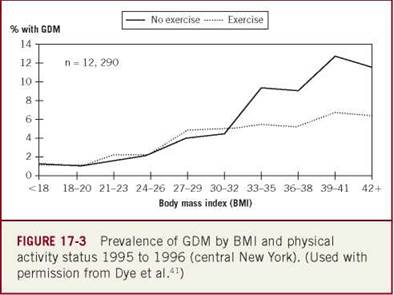
Utilizing a population-based birth registry in central New York from the mid-90s, we previously found lack of physical exercise to be associated with higher rates of GDM among women with a BMI > 33 (OR 1.9, 95% CI 1.2-3.1; Figure 17-3).
This study demonstrated that for obese pregnant women with BMI above 33 engaging in physical activities of any kind reduces the risk of GDM in half.41
Oostdam et al. attempted to investigate the impact of an exercise intervention program on the risk of GDM among women with a BMI greater than 25 and either a history of GDM or macrosomia or a first-degree relative with diabetes. The intervention involved twice weekly 60-minute aerobic and strength exercise sessions that began around 15 weeks of gestation. The number of women developing GDM in the exercise versus the control group was not significantly different but only 16% of the women in the intervention group attended at least half of the exercise sessions.42
Most women with type 1 diabetes in pregnancy have been managing their disease since childhood and are quite comfortable with their typical glycemic response to activity outside of pregnancy. It is crucial that they are adequately educated regarding their increased risk of exercise-induced hypoglycemia in pregnancy. That risk is largely due to decreased hypoglycemic awareness and counter-regulatory adaptations that may be altered by pregnancy-related augmentation of catecholamine and glucagon responses. For these women, even routine daily activity (household chores, shopping, etc.) can result in severe hypoglycemia if that activity is not accurately factored into insulin dosing and carbohydrate. These patients are also prone to ketoacidosis. The widespread use of insulin pump devices and growing popularity of continuous glucose sensors may facilitate and increase the safety of exercise for pregnant women with type 1 diabetes. Nonetheless, we recommend that these patients engage in moderate exercise limited to 30 minutes per session.

Although the risk of hypoglycemia with gestational and type 2 diabetes is substantially lower, these women often enter pregnancy obese and deconditioned and for this reason are at higher risk of exercise-related musculoskeletal injuries.
The type, intensity, and frequency of the exercise interventions studied in these trials may have been inadequate to improve perinatal outcomes. As demonstrated by Lesser et al., in a small randomized cross-over design study, one single bout of exercise session is insufficient to blunt the glycemic response to a mixed nutrient meal.43 A single bout of exercise and regular physical activity enhance insulin sensitivity. Insulin and exercise stimulate muscle glucose uptake. A single bout of exercise increases insulin sensitivity primarily in the muscles activated from hours to 48 hours.44 However, for both prevention and management of diabetes, these patients should engage in at least 150 minutes of exercise per week, at least 30 min/d preferably after meals. In our experience, an average of 7-10 days is required to achieve glyce- mic control among obese sedentary pregnant diabetic women.45
Despite the limited evidence outlined, for women with GDM and type 2 diabetes, any increase in exercise, particularly postprandial activity, is generally recommended secondary to its beneficial impact on postprandial hyperglycemia, weight gain, and insulin requirements. In addition, pregnancy is a period during which most women are highly motivated by concern for the welfare of their child. Their frequent interactions with health-care providers during pregnancy should be recognized as an opportunity to provide education and encourage lifestyle changes that may improve their long-term health and that of other members of their household.
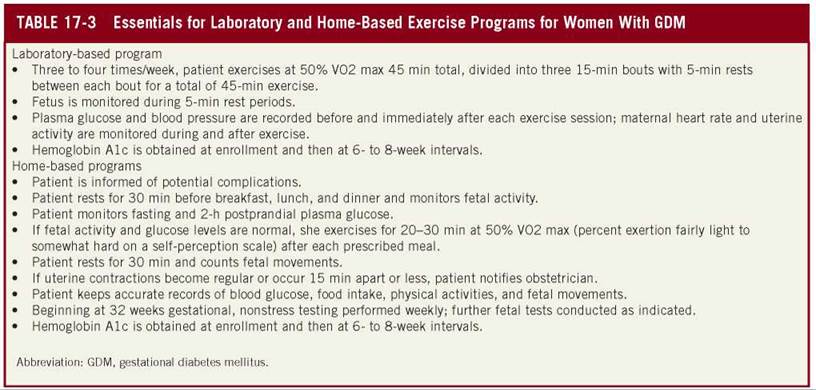
Through indirect calorimetry, we established that carbohydrates are the preferential energy source utilized during 20-30 minutes exercise sessions.25 From a physiologic standpoint, exercise is a logical therapeutic intervention for diabetes. As adjunctive therapy, it may avert or delay the need for pharmacologic intervention and limit the degree of that intervention if multifaceted therapy is required.
We recommend that exercise be initiated 30 minutes after a meal and continued for at least 20-30 minutes at 50% maximum aerobic capacity or higher at a self-perceived exertion of “moderate” to “somewhat difficult” (Table 17-3). Patients are advised to defer exercise and call or come in for evaluation if she is experiencing frequent uterine contractions, decreased fetal movement, or other concerning pregnancy-related symptoms, or her glucose level is persistently low or high (<80 mg/dL at 1 h post-prandial, >300 mg/dL). We instruct all patients to keep a food, activity, and glucose diary.45
SUMMARY AND CONCLUSIONS
GDM and type 2 diabetes have similar pathophysiology. Pregnancy and the postpartum period are ideal times for lifestyle modification. During pregnancy, women have easy and frequent access to medical supervision and care, more than any time in their life. Despite the easier access to medical care, women frequently mention barriers to exercise in pregnancy such as fatigue, nausea, edema, low back pain, and lack of time postpartum46,47; however, all reports indicate that higher levels of physical activity prior to pregnancy or in early pregnancy lower significantly the risk of developing GDM, particularly in overweight and obese pregnant women.
Lifestyle modification, exercise, and diet have been endorsed and advocated as a safe therapeutic adjunct in patients with GDM by ACOG, ADA, and ACSM. Women with previous GDM enrolled in the DPP to weight reduction and physical activity had a 53% reduction in type 2 diabetes, thus lifestyle modification, particularly exercise, is logical adjunct intervention to prevent or manage diabetes in pregnancy and beyond.
REFERENCES
1. Flegal KM, Caroll MD, Kit Bk, Ogden CL. Prevalence of obesity and trends in the distribution of body mass index among US adults, 1999-2010. JAMA. 2012;307(5):491-497.
2. Ratner RE. An update on the Diabetes Prevention Program. Endocs Pract. 2006;12(suppl 1):20-24.
3. Artal R, Catanzaro RB, Gavard JA, et al. A lifestyle intervention of weight-gain restriction: diet exercise in obese women with gestational diabetes mellitus. Appl Physid Nutr Metab. 2007;32:596-601.
4. Langer O, Berkus M, Brustman L, et al. Rationale for insulin management in gestational diabetes mellitus. Diabetes. 1991;40(suppl 2):196.
5. Artal R, Wiswell R, Romem Y. Hormonal response to exercise in diabetic and non-diabetic pregnant women. Diabetes. 1985;34(2):78-80.
6. Proceeding of the Second International Workshop-Conference on Gestational Diabetes Mellitus. Diabetes. 1985;34(2):125.
7. Evenson KR, Saritz DA, Huston SL. Leisure time physical activity among pregnant women in the U.S. Paedietr Perinet Epiolemiol. 2004;18(6):400.
8. Ning Y, Williams MA, Dempsey JC, et al. Correlates of recreational physical activity in early pregnancy. Obstet Gynecol. 2003;13:385-393.
9. Tucker JM, Welk GJ, Beyler NK. Physical activity in U.S.: adults compliance with the physical activity guidelines for Americans. Am J Prev Med. 2011;40(4):454.
10. Standards of Medical Care in Diabetes-2013. Diabetes Care. 2013;36(1):S11-S66.
11. ACOG Committee Obstetric Practice. ACOG Committee opinion. Number 267, January 2002: exercise during pregnancy and the postpartum period. Obstet Gynecol. 2002;99(1):171-173.
12. ACSM and ADA. Exercise and type 2 diabetes: the American College of Sports Medicine and the American Diabetes Association: joint position statement. Diabetes Care. 2010;33(12):e147-e167.
13. Committee on Practice Bulletins—Obstetrics. Practice Bulletin No. 137: Gestational diabetes mellitus. Obstet Gynecol. 2013;122 (2 Pt 1): 406-16.
14. Hans S, Middleton P, Crowther CA. Exercise for pregnant women for preventing gestational diabetes mellitus. Cochrane Database Syst Rev. 2012;7:CD009021.
15. Metzger BE, Freinkel N. Effects of diabetes mellitus in the endo- crinologic and the metabolic adaptation of gestational. Semin Perinatol. 1978;2:309-318.
16. Kelly C, Booth G. Diabetes in Canadian women. BMC Womens Health. 2004;4 (suppl):516-524.
17. Hickey MS, Carey JO, Azevedo JL, et al. Skeletal muscle fiber composition is related to adiposity and in vitro glucose transport rate in humans. Am J Physiol. 1995;268 (3 pt 1):E453-E457.
18. Dela F, Larsen JJ, Mikines KJ, et al. Insulin stimulated muscle glucose clearance in patients with NIDDM: effects of one legged physical training. Diabetes. 1995;44:1010-1020.
19. Bjorntorp P, Fahlen M, Grimby G, et al. The effects of physical training and acute physical work on plasma in obesity. Eur J Clinc Invest. 1972;2:274-276.
20. Artal R, Hopkins S. Exercise. Clin Update Womens Health Care. 2013;XII(2):11-15.
21. Oken E, Ning Y, Rifas-Shiman SL, et al. Association of physical activity and inactivity before and during pregnancy with glucose tolerance. Obstet Gynecol. 2006;108(5):1200-1207.
22. Girard J. Gluconeogenesis in late fetal and early neonatal life. Biol Neonate. 1986;50:237-258.
23. Soultanakis HN, Artal R, Wiswell RA. Prolonged exercise in pregnancy: glucose homeostasis, ventilatory and cardiovascular responses. Semin Perinatol. 1996;20(4):315-327 (level III).
24. Artal R, Wiswell RA, Drinkwater BL, eds. Exercise in Pregnancy. Baltimore, MD: Williams and Wilkins; 1991.
25. Artal R, Masaki DL, Khodiguian N, et al Exercise prescription in pregnancy: weight bearing vs. non-weight bearing. Am J Obstet Gynecol. 1989;161:1464-1469.
26. Artal R, Platt LD, Sperling M, et al. Maternal cardiovascular and metabolic responses in normal pregnancy. Am J Obstet Gynecol. 1981;140:123-127.
27. ADA. Executive summary: standards of medical care in diabetes. Diabetes Care. 2013;36(1):S4-S10.
28. Schellenberg ES, Dryden DM, Vandermeer B, et al. Lifestyle interventions for patients with and at risk for type 2 diabetes: a systematic review and meta-analysis. Ann Intern Med. 2013;159(8):543-551.
29. Artal R, Lockwood CJ, Brown HL. Weight gain recommendation in pregnancy and the obesity epidemic. Obstet Gynecol. 2010;115:152-155.
30. American College of Obstetricians and Gynecologists. ACOG Committee opinion 548: weight gain during pregnancy. Obstet Gynecol. 2013;121(1):210-212.
31. Quinlivan JA, Julinia S, Lam L. Antenatal dietary interventions in obese pregnant women to restrict gestational weight gain to institute of medicine recommendations. Obstet Gynecol. 2011;118:1395-1401.
32. Gould Rothberg BE, Magriples U, Kershaw TS, et al. Gestational weight gain and subsequent postpartum weight loss among young, low income ethnic minority women. Am J Obstet Gynecol. 2011;2004(1):52.e1-52.e11.
33. Hillier TA, Pdeula KL, Schmidt MM, et al. Childhood obesity and metabolic imprinting. Diabetes Care. 2007;30:2287-2292.
34. Kiel DW, Dodson EA, Artal R, et al. Gestational weight gain and pregnancy outcomes in obese women: how much is enough? Obstet Gynecol. 2007;110:752-758.
35. Gavard JA, Artal R. The association of gestational weight gain with birth weight in obese pregnant women by obesity class and diabetic status: a population-based historical cohort study. Matern Child Health J. 2014;18(4):1038-1047.
36. Streuling I, Beyerlein A, Rosenfeld E, et al. Physical activity and gestational weight gain: a meta-analysis of intervention trials. BJOG. 2011;118:278-284.
37. Dempsey JC, Butler CL, Sorensen TK, et al. Prospective study of gestational diabetes mellitus risk in relation to maternal recreational physical activity before and during pregnancy. Am J Epidemiol. 2004;159:663-670.
38. Tobias DK, Zhang C, Ban Dam RM, et al. Physical activity before and during pregnancy and risk of gestational diabetes mellitus. Diabetes Care. 2011;34:223-229.
39. Stafne SN, Salvesen KA, Romundstad PR, et al. Regular exercise during pregnancy to prevent gestational diabetes: a randomized controlled trial. Obstet Gynecol. 2012;119(1):29-36.
40. Yin Y, Li X, Tao T, et al. Physical activity during pregnancy and the risk of gestational diabetes mellitus: a systematic review and meta-analysis of randomized controlled trials. Br J Sports Med. 2014;48(4):290-295.
41. Dye TD, Knox KL, Artal R, et al. Physical activity, obesity, and diabetes in pregnancy. Am J Epidemiol. 1997;146:961-965.
42. Oostdam N, Van Poppel NMN, Wouters MGAJ, et al. No effect of the Fit for 2 exercise program on blood glucose, insulin sensitivity and birth weight and at risk for gestational diabetes: results of a randomized controlled trial. BJOG. 2012;119(9):1098-1107.
43. Lesser KB, Gruppuso PA, Terry RB, Carpenter MW. Exercise fails to improve postprandial glycemic excursions in women with gestational diabetes. J Matern Fetal Med. 1996;5(4):211-217.
44. Richter EA, Wojtaszewski JFI. Effects of acute exercise training on insulin ectiel in skeletal muscle in Physical activity and type 2 diabetes. Hawley JA, Zierath, JR, eds. 2008:156.
45. Artal R, Zavorsky GS, Catanzaro RB. Exercise recommendation in women with gestational diabetes during and after pregnancy. In Gestational Diabetes During and After Pregnancy, Kim C, Ferraro A, ed. 2010. Springer-Verlag, London.
46. Downs DS, Ulbrecht JS. Understanding exercise beliefs and behaviors in women with gestational diabetes mellitus. Diabetes Care. 2006;29:236.
47. Artal R, O'Toole. Guidelines of the American College of Obstetricians and Gynecologists for exercise during pregnancy and postpartum period. Br J Sports Med. 2003;37:6-12.