
Elly Xenakis, MD Oded Langer, MD, PhD
The right thing at the wrong time is the wrong thing —Joshua Harris
Key Points
• The risk of stillbirth, large-for-gestational age fetus, macrosomia, and shoulder dystocia remain major factors in labor induction.
• The condition of the cervix (score >4) will be a major factor in determining induction success rate.
• Both low- and high-dose oxytocin can be used for augmentation of labor; however, the high-dose regimen will result in shorter delivery time and fewer complications.
• The main goal during labor is to maintain the glycemic profile between 70 and 90 mg/dL; there are several strategies for insulin administration to achieve this goal.
INTRODUCTION
Why, when, and how to deliver the pregnant diabetic patient are fundamental questions in the management of diabetes in pregnancy. The scope of this chapter is to attempt to describe the “How.” The mode of delivery, vaginal versus cesarean, of the diabetic patient remains controversial. Both induction of labor and cesarean delivery are common interventions in women with pregnancy compromised by diabetes. The rates of cesarean delivery in diabetic women are high; anywhere from 45% to 81%.1,2 Failed labor inductions and elective cesarean delivery contribute to these rates. The underlying reason for intervention (labor induction or cesarean delivery) is the increased rate of both perinatal morbidity and mortality associated with the infants of diabetic mothers. Reasons for elective delivery include prevention of stillbirth, fetal overgrowth, macrosomia, and shoulder dystocia. Also, a significant number of diabetic patients will go into labor spontaneously whereas some will require augmentation of labor. Data pertaining exclusively to labor in diabetic patients is limited; the actual methodologies of labor augmentation and induction are no different than in other obstetrical encounters.
LABOR AUGMENTATION
Most women with gestational and preexisting diabetes who achieved targeted levels of glycemic control and are free of obstet- ric/medical complications are allowed to go into spontaneous labor. Some of them will develop labor dystocia and will require augmentation of labor. Labor abnormalities in diabetic patients are a concern, and most clinicians maintain a low threshold in diagnosing and responding to them. The main concern is the occurrence of shoulder dystocia during labor. However, the association between labor abnormalities, Pitocin, and augmentation remain unsettled. McFarland et al.3 in a large study did not identify any labor patterns predictive of shoulder dystocia, even in those pregnancies complicated by diabetes and macrosomia. Lurie et al.4 in a retrospective analysis of 52 cases of shoulder dystocia reported no difference in labor abnormalities and mean duration of second stage of labor. Gemer et al.5 reported a significant association between labor abnormalities and shoulder dystocia.
Abnormal progression of labor can result from abnormalities of power, that is, inadequate uterine contractions, passenger (size, position, presentation), or passage (soft tissue and pelvis). Augmentation of labor should be considered when the patient is diagnosed with a protraction or arrest disorder, secondary to inadequate power, that is, less than three contractions in 10 minutes, or the intensity of the contractions is less than 25 mmHg. above baseline, or both. In all cases, the clinician must be watchful for labor abnormalities in large-for-gestational age and macrosomic fetuses, as these remain a major concern when augmenting diabetic patients.
The obstetrician's knowledge that the patient has diabetes has been shown to lower the threshold for performing a cesarean delivery.6 Assessment and documentation of the pelvis, fetus, and uterine contractility is imperative before initiating augmentation of labor. Oxytocin administration is appropriate only after such an assessment. The goal of oxytocin administration is to achieve cervical change and descent of the presenting part while avoiding uterine hyperstimulation and fetal compromise.
To make a diagnosis of arrest disorder in the first stage of labor, the following criteria should be used: the latent phase is completed and uterine contractility is equal or exceeds 200 Montevideo units.7 Several oxytocin regimens are appropriate for labor stimulation; these regimens fall mainly in two categories: low- and high-dose oxytocin.8-12 One of the leading investigators of insulin requirements during augmentation of labor was Joseph Seitchik of the University of Texas at San Antonio.9 He recommended that when oxytocin is needed, the starting dose should be 0.5-1 mU/min or 1-2 mU/min every 30-40 minutes or every 15 minutes, respectively. This was coined the low-dose oxytocin approach. Maximum recommended doses in these regimens are 20 mU/min and 40 mU/min, respectively.
We and others8,10,11 evaluated the effect of using high-dose oxytocin in the presence of labor abnormalities. In high-dose regimens, 4 or 6 mU/min are used as a starting dose and the incremental increase is the same, 4 or 6 mU/min, every 15-40 minutes up to a maximum dose of 40-42 mU/min. In our study10 using a randomized block design, we found that the rate of cesarean delivery in the low-dose oxytocin group was 25.6% compared to the 10.4% in the high-dose group (relative risk [RR] 2.47, 95% confidence interval [CI]: 1.44-4.22). For nulliparous women, the low-dose oxytocin group had a 27.7% cesarean section rate compared to 11.1% receiving high-dose oxytocin (RR 2.49, 95% CI: 20-5.17). For multiparous women, the low-dose oxytocin group had 22.6% rate of cesarean delivery compared to 9.8% for the high-dose oxytocin group (RR 2.31, 95% CI: 04-5.17). Our study suggests a significant benefit in the rate of cesarean delivery with the high-dose regimen. An additional benefit of this approach includes shorter delivery time, fewer cesarean deliveries, and a reduced amount of intrapartum chorioamnionitis and neonatal sepsis.7,8,10,11
An additional question is when to start Pitocin augmentation or how long the obstetrician should wait before declaring a labor abnormality that requires intervention. Although the classic defini- tion7 of arrest disorder in the first stage of labor remains two hours without cervical change with a uterine contraction pattern of >200 Montevideo units, there are reports suggesting the use of a four-hour limit.13 Before the implementation of such a rule, larger studies documenting efficacy and safety are needed. Also, this study did not specifically address pregnant diabetic patients; therefore, caution should be exercised when extrapolating its results.
LABOR INDUCTION
Induction of labor is on the rise in the United States, increasing from 9.5% in 1990 to 22.1% in 2004. Although it is not clear what proportion of these inductions are elective (i.e., without a medical indication), the overall rate of induction of labor is rising faster than the rate of pregnancy complications that would lead to a medically indicated induction. However, the maternal and neonatal effects of induction of labor are unclear. Many studies compare women with induction of labor to those in spontaneous labor. This is problematic because at any point in the management of the woman with a term gestation, the clinician has the choice between induction of labor and expectant management, not spontaneous labor. Expectant management of the pregnancy involves nonintervention at any particular point in time and allowing the pregnancy to progress to a future gestational age. Thus, women undergoing expectant management may go into spontaneous labor or may require indicated induction of labor at a future gestational age. Randomized controlled trials suggest that elective induction of labor at 41 weeks of gestation and beyond may be associated with a decrease in both the risk of cesarean delivery and of meconium-stained amniotic fluid. The evidence regarding elective induction of labor before 41 weeks of gestation is insufficient to draw any conclusions. There are concerns about translation of such findings into clinical practice.
Avoidance of cesarean delivery, fetal overgrowth, shoulder dystocia, and prevention of stillbirth are the main indicators for labor induction in pregnant diabetic patients. Induction of labor in mothers with diabetes mellitus is widely advocated and prac- ticed.14-16 Data pertaining specifically to labor induction in diabetic pregnancies are scarce. Kjos et al.17 assessed whether a program of expectant management of uncomplicated pregnancies in mothers requiring insulin in gestational or pregestational diabetes reduces the incidence of cesarean birth. The expectant management did not reduce the incidence of cesarean delivery. Furthermore, there was an increased prevalence of large-for-gestational age infants (23% vs. 10%) and shoulder dystocia (3% vs. 0%). Although the recommendation of the authors was to consider delivery at 38 weeks’ gestation, it was not supported by the Cochrane Database evaluation, which concluded that the sample size was too small to make the above recommendation.18
In a retrospective study, Lurie et al.19 concluded that elective induction for uncomplicated gestational diabetes mellitus (GDM) pregnancies does not seem to confer any advantages over expectant management. In another study of insulin use in gestational diabetes, Lurie et al.20 showed that induction at 38-39 weeks was associated with a significantly lower rate of shoulder dystocia <4% versus 10.2% in historic controls.
In summary, the Cochrane Database18 concluded that:
There is very little evidence to support either elective delivery or expectant management at term in pregnant women with insulin-requiring diabetes. Limited data from a single randomized controlled trial suggests that induction of labor in women with gestational diabetes treated with insulin reduces the risk of macrosomia. Although the small sample size dos not permit one to draw conclusions, the risk of maternal or neonatal morbidity was not modified. Women's views on elective delivery and on prolonged surveillance and treatment with insulin should be assessed in future trials.
Today, when elective delivery in general and delivery by demand (cesarean delivery or induction) are creating a new trend, the obstetrician, in his decision-making capacity, needs to take into consideration that the success of labor induction is largely dependent on the state of the cervix, which is often unripe at the time induction is undertaken. The inescapable fact that cervical status is the most important predictor of success led to the development of scoring and predictive systems to assess the induci- bility of the cervix; these in turn led to the search for methods to increase cervical compliance.
Induction of labor undertaken with an unfavorable cervix is associated with high failure rates, prolonged labor, a high incidence of cesarean delivery, and an overall increase in maternal-fetal morbidity.21 Although spontaneous labor has been well characterized, little of practical value is known regarding induced labor. Paucity of information exists regarding the efficacy of labor induction using an integrative approach. In 1997, we studied the efficacy, safety, and duration of induced labor using an integrative approach (prostaglandins, amniotomy, oxytocin).22 The vaginal delivery rate of 80% in our study was compatible with that previously reported by Satin et al.8 using a different methodology. We concluded that in women who require delivery, regardless of the Bishop score, strong consideration should be given to induction of labor instead of cesarean delivery because the majority of women induced can achieve vaginal delivery.
Although the success rates of labor induction in this study were encouraging, the cesarean rate in patients who are induced is still significantly higher than that encountered in women undergoing spontaneous labor. Similarly, the clinician should not ignore the potential for complications even though the morbidity rate was <2%. On the basis of these issues, the decision to undertake induction of labor should be made by weighing the risks and benefits compared with those of expectant management. Prostaglandins (PG E2 and synthetic E1) are currently by far the most widely used pharmacological agents for cervical ripening. The use of prostaglandins for cervical ripening has been shown to reduce total and maximal doses of oxytocin and to significantly reduce induction to delivery intervals. In double-blind, controlled clinical trials,23-26 the researchers compared the use of vaginally administered misoprostol to placebo for outpatient labor induction in patients with diabetes. They concluded that misoprostol administered vaginally was no more effective than placebo in reducing the need for inpatient labor induction or the induction-delivery interval. The effects of prostaglandin use on cesarean delivery rates have been inconsistent; in the case of PG E2 preparations, although some studies showed a reduction, most have not shown a significant decrease. Misoprostol (PG E1) studies show higher rates of vaginal delivery within 24 hours of induction and that it is more effective for labor induction than oxytocin.25 When compared to other PG or oxytocin, misoprostol did not result in a significant reduction in cesarean delivery rate. Misoprostol remains associated at higher doses (50 |ag) with increased tachystole, meconium passage, and meconium aspiration when compared to PG E2.23 The use of 25 |ag misoprostol appears to be a safer option.27 Cesarean delivery rates are also increased because of hyperstimulation when compared to PG E2. Misoprostol is contraindicated in patients with previous cesarean delivery as the risk of uterine rupture is about 6%.28
The management of the macrosomic fetus in diabetic mothers deserves special attention. The relationship between birth weight and rate of shoulder dystocia is well documented in the literature. The higher the birth weight, the higher the risk of shoulder dystocia; at birth weights of 4000-4499 g, the risk of shoulder dystocia is as high as 23%, whereas at birth weights of over 4500 g the risk is 20%-50%.29 The clinical concerns of fetal macrosomia are increased maternal morbidity and fetal morbidity and mortality. Maternal risks include cesarean delivery, postpartum hemorrhage, and vaginal lacerations. The most common fetal injuries associated with fetal macrosomia are shoulder dystocia complicated by clavicular fracture and brachial plexus injury. Also, fetal macro- somia may be associated with significant long-term effects, such as the risk of childhood and adolescent obesity and the predisposition to obesity in adulthood.
The risk of birth trauma associated with vaginal delivery is well documented. Cesarean delivery, on the other hand, confers a significant protective effect with reported odds ratio of 0.01-0.20.30 Therefore, common sense would dictate we offer prophylactic cesarean delivery to women with macrosomic fetuses in instances when accurate prediction of birth weight is possible.31 To date, accurate antepartum prediction of fetal weight still eludes us. Extensive reviews have been written on this subject. Sacks et al.31 studied whether fetal macrosomia can be predicted, and if changing patient management based on that prediction will significantly alter maternal and perinatal outcomes. The authors concluded that sonographic estimates are no more accurate than clinical estimates of fetal weights and that, to date, no management algorithm based on estimates of fetal weight has demonstrated efficacy in reducing the incidence of either shoulder dystocia or brachial plexus injury. O'Reilly-Green et al.,32 in a study reviewing sonographic and clinical methods in the diagnosis of macrosomia, concluded that clinical decisions about the timing and route of delivery for patients with diabetes should be based primarily on clinical rather than on sonographic estimates of fetal weight.
In our study33 of shoulder dystocia, we strongly advocated for the need to develop a preventive strategy recommending elective cesarean delivery for diabetic women with fetuses with an estimated fetal weight of >4250 g. The study showed that in diabetic women, approximately 80% of the cases of shoulder dystocia with and without trauma can be eliminated by cesarean delivery at estimated fetal weight of 4250 g, with negligible increase in the overall cesarean delivery rate. In contrast, in the nondiabetic group, no definitive weight category was identified as the optimal threshold for cesarean delivery to prevent shoulder dystocia. Rouse et al.34 analyzed the cost-effectiveness of elective cesarean delivery for macrosomia and found that cesarean delivery of diabetic pregnancies with an estimated fetal weight >4000 g is defensible. The American College of Obstetrics and Gynecology considers a planned cesarean delivery for a diabetic woman whose estimated fetal weight is >4250-4500 g a reasonable option.29,35
GLUCOSE CONTROL DURING LABOR
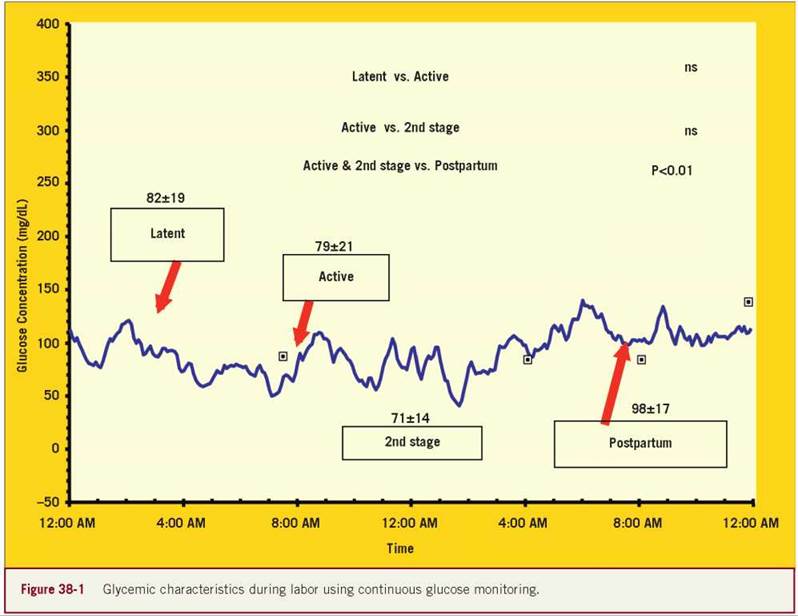
With the development of new technology such as continuous glucose monitoring, we are able to characterize the true nature of the glycemic profile throughout a 24-hour period. A question that has often been raised is if labor is comparable to exercise and if different stages of labor utilize glucose differently. By answering these questions, we are able to manage fluid administration more efficiently. We studied nondiabetic women during labor. All patients were evaluated using continuous glucose monitoring system (CGMS) for 72 consecutive hours. CGMS measures in subcutaneous tissue interstitial glucose levels within a range of 40-400 mg/dL every five minutes for a total of 288 measurements/day. The evaluation time frame was from the latent phase until 24-hour postpartum. Eligibility was limited to healthy nondiabetic women >37 weeks singleton pregnancy, with no chronic diseases, who did not receive drugs known to have an effect on carbohydrate metabolism (i.e., steroids and β2-sympathomimetics). All participants did not receive fluids containing glucose during labor and had spontaneous vaginal delivery. During the second stage of labor, significantly lower mean blood glucose (MBG) was recorded in comparison to latent and active phases, P = 0.001. During the second stage 9/32 of the women had hypoglycemic events (blood glucose <40 mg/dL for more than 10 consecutive minutes) with no alteration in fetal heart rate. MBG during the 24-hour postprandial was significantly higher in comparison to labor and delivery, P = 0.02. During normal labor, there is a gradual physiological decrease in glucose levels, which is pronounced during the second stage. Glycemic profile characterization during delivery and early postpartum may be used to define normality in this time frame and to define the degree of deviation from this norm that may be associated with immediate neonatal adverse outcome in a diabetic pregnancy (Figure 38-1).
The goal of intrapartum glycemic control is maintenance of maternal euglycemia. Intrapartum maternal hyperglycemia is directly related to fetal hypoglycemia. Even in the presence of poor antepartum glycemic control, tight control of plasma glucose levels appears to significantly reduce the incidence of neonatal hypoglycemia. Therefore, careful attention should be given to the administration of dextrose solutions and to insulin administration during labor. Several studies showed an association between neonatal-fetal hypoglycemia and increased fetal lactate levels and oxygen consumption with subsequent acidosis and fetal death.36 The fetal and neonatal hazards increased when 5% dextrose solution was used during labor. Kenepp et al.37 in a randomized study demonstrated that rapid infusions of >25 g glucose is associated with fetal acidosis, neonatal hyperinsulinemia, hypoglycemia, and hyperbilirubinemia. The authors concluded that it seems prudent to limit maternal dextrose infusions before cesarean delivery to 6 g/h, whereas for the patient in active labor, the dose may be greater. Maximum safe doses still have to be established. Jovanovic and Peterson38 showed that in diabetic women with good glycemic control before labor, insulin requirements decrease to zero during induced active labor and glucose requirements are relatively constant. Other studies39,40 have shown no decrease in cord pH level with the infusion of 5% dextrose solutions at rates of 125-200 mL/h. As maternal hyperglycemia remains the major cause of neonatal hypoglycemia, the following guidelines are recommended for the intrapartum glycemic management of diabetic women in labor:
• Maintain blood glucose at 70-90 mg/dL
• Before labor induction or elective cesarean delivery, patients should not eat and/or drink for at least eight hours
• Insulin is administered in the usual dose at bedtime. In patients using the pump, the infusion is continued overnight.
• Withhold the morning dose of insulin before labor induction or cesarean delivery
• Normal saline may be sufficient to maintain glucose control
• Regimens for insulin administration during labor include the following:
• 10 U of regular insulin in 1000 mL of 5% dextrose solution with an infusion rate of 100-125 mL/h (1 U/h)
• 15 U of regular insulin in 150 mL of normal saline at a rate of 1-3 U/h
• Syringe pump at a rate of 0.25-2 U/h.
• Glucose levels should be checked and documented every 1-2 hours and the insulin administration should be adjusted accordingly
• Patients who achieved good glycemic control throughout pregnancy, in the first stage of labor might require glucose at an infusion rate of 2.5 mg/kg38
• In the second stage of labor, they might require an increase in insulin administration secondary to increased cathecolamine secretion and muscle action
• Bolus doses of glucose should be avoided during labor because of an increased risk of neonatal hypoglycemia, fetal hypoxia, and fetal/neonatal acidosis.37,41
Postpartum insulin requirements drop significantly. It is recommended to restart patients at 1/3 of the end of pregnancy dose, or recalculate the insulin requirements at about 0.6 U/kg per day based on actual weight. Caution should be exercised in the management of postpartum and nursing diabetic mothers as hypoglycemia appears to be more frequent at these times.
SUMMARY
How to deliver the pregnant diabetic patient is directly related to the why and when to deliver. The risk of stillbirth, large-for-gestational age fetus, macrosomia, and shoulder dystocia remain major concerns in these pregnancies and account for the high rates of labor induction and cesarean delivery. Furthermore, diabetic fetopathy is associated with labor abnormalities and shoulder dystocia.42 The conduct of labor, labor induction, and augmentation should follow current recommendations.7,28 Cesarean delivery is a reasonable option for estimated fetal weight of >4000 g.29,33 The goal of intrapartum glycemic control is maintenance of maternal euglycemia to preclude neonatal hypoglycemia.
REFERENCES
1. Martin F, Heath P, Mountain K. Pregnancy in women with diabetes.
Fifteen years’ experience: 1970-1985. Med J Aust. 1987;146(4): 187-190.
2. Leveno K, Hauth J, Gilstrap L, et al. Appraisal of “rigid” blood glucose control during pregnancy in the overtly diabetic woman. Am J Obstet Gynecol. 1979;135(7):853-862.
3. McFarland M, Hod M, Piper J, et al. Are labor abnormalities more common in shoulder dystocia? Am J Obstet Gynecol. 1995;173 (4): 1211-1214.
4. Lurie S, Levy R, Ben-Arie A, et al. Shoulder dystocia: could it be deduced from the labor partogram? Am J Perinatol. 1995;12(1): 61-62.
5. Gemer O, Bergman M, Segal S. Labor abnormalities as a risk factor for shoulder dystocia. Acta Obstet Gynecol Scand. 1999;78(8): 735-736.
6. Naylor C, Sermer M, Chen E, et al. Cesarean delivery in relation to birth weight and gestational glucose tolerance: pathophysiology or practice style? Toronto Trihospital Gestational Diabetes Investigators. JAMA. 1996;275:1165-1170.
7. American College of Obstetrics and Gynecology Committee on Practice Bulletins-Obstetrics. American College of Obstetricians and Gynecologists. Practice Bulletin No. 49, December 2003: dystocia and augmentation of labor. Obstet Gynecol. 2003;102(6):1445-1454.
8. Satin A, Leveno K, Sherman M, et al. High- versus low-dose oxytocin for labor stimulation. Obstet Gynecol. 1992;80:111-116.
9. Seitchik J, Castillo M. Oxytocin augmentation of dysfunctional labor I: clinical data. Am J Obstet Gynecol. 1983;144:893-905.
10. Xenakis E, Langer O, Piper J, et al. Low-dose versus high-dose oxytocin augmentation of labor—a randomized trial. Am J Obstet Gynecol. 1995;173(6):1874-1878.
11. O'Driscoll K, Foley M, McDonald D. Active management of labor as an alternative to cesarean section for dystocia. Obstet Gynecol. 1984;63:485-490.
12. Seitchik J, Amico J, Robinson A, et al. Oxytocin augmentation of dysfunctional labor. IV. Oxytocin pharmacokinetics. Am J Obstet Gynecol. 1984;150:225-228.
13. Rouse D, Owen J, Hauth J. Active phase labor arrest: oxytocin augmentation for at least 4 hours. Obstet Gynecol. 1999;93:323-328.
14. Barss V. Obstetrical management. In: Hare JW, editor. Diabetes Complicating Pregnancy: The Joslin Clinic Method. New York: Alan R. Liss; 1989.
15. Gabbe S. The diabetic pregnancy: application of scientific rationale. In: Merkatz IR, Adam PAJ, editors. The Diabetic Pregnancy: A Perinatal Prospective. New York: Grune & Stratton; 1979.
16. Caughey A, Sundram V, Kaimal A, et al. Maternal and neonatal outcomes of elective induction of labor. Evid Rep Technol Assess. 2009;176:1-257.
17. Kjos S, Henry O, Montoro M, et al. Insulin-requiring diabetes in pregnancy: a randomized trial of active induction of labor and expectant management. Am J Obstet Gynecol. 1993;169(3):611-615.
18. Boulvain M, Stan C, Irion O. Elective delivery in diabetic pregnant women. Cochrane Database Syst Rev. 2000;(2):CD001997.
19. Lurie S, Matzkel A, Weissman A, et al. Outcome of pregnancy in Class A1and A2gestational diabetic patients delivered beyond 40 weeks gestation. Am J Perinatol. 1992;9(5-6):484^88.
20. Lurie S, Insler V, Hagay Z. Induction of labor at 38 to 39 weeks of gestation reduces the incidence of shoulder dystocia in gestational diabetic patient Class A^ Am J Perinatol. 1996;13(5):293-296.
21. Xenakis E, Piper J. Chemotherapeutic induction of labor. A rational approach. Drugs. 1997;54(1):61-68.
22. Xenakis E, Piper J, Conway D, et al. Induction of labor in the nineties: conquering the unfavorable cervix. Obstet Gynecol. 1997;90: 235-239.
23. Wing D, Rahall A, Jones M, et al. Misoprostol: an effective agent for cervical ripening and labor induction. Am J Obstet Gynecol. 1995; 172:1811-1816.
24. Rayburn W. Prostoglandin E2 gel for cervical ripening and induction of labor. A critical analysis. Am J Obstet Gynecol. 1989;160: 529-534.
25. Bernstein P. Prostoglandin E2gel for cervical ripening and labor induction: a multicenter placebo controlled trial. Can Med Assoc J. 1991;145(10):1249-1254.
26. Incerpi M, Fassett M, Kjos S, et al. Vaginally administrated misoprostol for outpatient cervical ripening in pregnancies complicated by diabetes mellitus. Am J Obstet Gynecol. 2001;185:916-919.
27. Wing D, Paul R. A comparison of different dosing regimens of vaginally administered misoprostol for pre-induction cervical ripening and labor induction. Am J Obstet Gynecol. 1996; 175: 158-164.
28. American College of Obstetricians and Gynecologists. Induction of Labor. Practice Bulletin No. 107. Washington, DC: American College of Obstetricians and Gynecologists; 1993.
29. American College of Obstetricians and Gynecologists. Shoulder dystocia. Practice Bulletin No. 40, 2002. Int J Gynaecol Obstet. 2003;80(1):87-92.
30. Ecker H, Greenberg J, Norwitz E, et al. Birth weight as predictor of brachial plexus injury. Obstet Gynecol. 1997;89:643-647.
31. Sacks D, Chen W. Estimating fetal weight in the management of macrosomia. Obstet Gynecol Surv. 2000;55:229-239.
32. O'Reilly-Green C, Divon M. Receiver operating characteristic curves of sonographic estimated fetal weight for prediction of mac- rosomia in prolonged pregnancies. Ultrasound Obstet Gynecol. 1997;9:403-408.
33. Langer O, Berkus M, Huff R, et al. Shoulder dystocia: should the fetus weighing greater than or equal to 4000 grams be delivered by cesarean section? Am J Obstet Gynecol. 1991;165:831-837.
34. Rouse D, Owen J, Goldenberg R, et al. The effectiveness and costs of elective cesarean delivery for the fetus macrosomia diagnosed by ultrasound. JAMA. 1996;276(18):1480-1486.
35. American College of Obstetricians and Gynecologists. Fetal Macrosomia. Practice Bulletin No. 22. Washington, DC: American College of Obstetricians and Gynecologists; 2000.
36. Robillard J, Sessions C, Kennedy R, et al. Metabolic effect of constant hypertonic glucose infusion in well-oxygenated fetuses. Am J Obstet Gynecol. 1978;130(2):199-203.
37. Kenepp N, Kumar S, Shelley W, et al. Fetal and neonatal hazards of maternal hydration with 5% dextrose before cesarean section. Lancet. 1982;1(8282):1150-1152.
38. Jovanovic J, Peterson C. Insulin and glucose requirements during the first stage of labor in insulin-dependent diabetic women. Am J Med. 1983;75:607.
39. Fisher A, Huddleston J. Intrapartum maternal glucose infusion reduces umbilical cord acidemia. Am J Obstet Gynecol. 1997;177(4):765-769.
40. Cerri V, Tarantini M, Schena V, et al. Intravenous glucose infusion in labor does not affect maternal and fetal acid-base balance. J Matern Fetal Med. 2000;9(4):204-208.
41. Grylack G, Chu S, Scanlon J. Use of intravenous fluids before cesarean section: effects on perinatal glucose, insulin, and sodium hemostasis. Obstet Gynecol. 1984;63(5):654-658.
42. Johnstone F, Prescott R, Steel J, et al. Clinical and ultrasound prediction of macrosomia in diabetic pregnancy. Br J Obstet Gynecol. 1996:103:747-754.