
In the previous chapter, you learned what mindfulness is and you also learned the basic “what” skills of dialectical behavior therapy. This means that you learned to become more mindful of what you are focusing on by using these methods:
· Focusing more fully on the present moment
· Recognizing and focusing on your thoughts, emotions, and physical sensations
· Focusing on your moment-to-moment stream of awareness
· Separating your thoughts from your emotions and physical sensations
What You’ll Learn in This Chapter
Now, in this chapter, you’ll be introduced to the more advanced “how” skills of mindfulness (Linehan, 1993a). These skills will help you learn how to be both mindful and nonjudgmental in your daily experiences. In this chapter, you will learn five “how” skills:
1. How to use wise mind
2. How to use radical acceptance to acknowledge your daily experiences without judging them
3. How to do what’s effective
4. How to create a mindfulness regimen for yourself in order to live your life in a more aware, focused way
5. How to overcome the hindrances of your mindfulness practice
As in the last chapter, it is important that you do the exercises in this chapter in the order that they’re presented. Each of these exercises builds on the one before it.
Wise Mind
As stated in the last chapter, wise mind is the ability to make healthy decisions about your life based on both your rational thoughts and your emotions. This sounds easy to do, but let’s consider the traps that many people often fall into.
For example, Leo was a successful salesman with a new company. He had a happy family and a fairly good future ahead of himself. However, Leo frequently became upset when he couldn’t close a deal, and so he often felt depressed and thought of himself as a person who would never be able to fully succeed in his life. Despite the positive feedback he received from his supervisors, Leo couldn’t shake the feelings of failure that came from deals he couldn’t close. As a result, a few months after starting his job, Leo quit, just like he had quit similar jobs in the past. He went on to take a new job, but similar feelings of failure followed him wherever he went, and he never felt fully satisfied with himself.
Similarly, Takeesha was a popular college professor who always received high ratings from her students and other faculty members. But after a few unsuccessful personal relationships, Takeesha felt very lonely. She eventually stopped trying to meet new people because she anticipated that those relationships would just end in failure too. As a result, she felt unworthy of anyone’s love and resigned herself to spend the rest of her life living alone.
Unfortunately, both Leo and Takeesha were overcome by what dialectical behavior therapy calls emotion mind (Linehan, 1993a). Emotion mind occurs when you make judgments or decisions based solely on how you feel. But keep in mind that emotions themselves are not bad or problematic. We all need emotions to live healthy lives. (You’ll learn more about the role of emotions in chapters 6 and 7.) The problems associated with emotion mind develop when your emotions control your life. This trap is especially dangerous for people with overwhelming emotions because emotion mind distorts your thoughts and judgments and then these distortions make it hard to formulate healthy decisions about your life. Consider what happened to Leo and Takeesha: despite their successes, their emotions overwhelmed their lives and led them to make unhealthy decisions.
The balancing counterpart to emotion mind is reasonable mind (Linehan, 1993a). Reasonable mind is the part of your decision-making process that analyses the facts of a situation, thinks clearly about what is happening, considers the details, and then makes rational decisions. Obviously, rational thinking helps us solve problems and make decisions every day. But again, as with emotions, too much rational thinking can also be a problem. We all know the story of the very intelligent person who didn’t know how to express his or her emotions and, as a result, lived a very lonely life. So here too a balance is needed in order to live a fulfilling, healthy life. But for people with overwhelming emotions, balancing feelings and rational thought is often hard to do.
The solution is to use wise mind to make healthy decisions about your life. Wise mind results from using both emotion mind and reasonable mind together (Linehan, 1993a). Wise mind is a balance between feelings and rational thoughts. Again, let’s consider the examples of Leo and Takeesha. Both of them were being controlled by their emotion minds. If Leo had been making decisions with wise mind, before quitting his job he would have balanced his decision with reasonable mind. He should have reminded himself of the facts of the situation: he was already a successful salesman, and he only became upset when he couldn’t close a deal. Therefore, was it reasonable that he should quit? Definitely not. What about Takeesha? She received great feedback from both her students and fellow faculty members. So was it reasonable to stop meeting new people after a few failed relationships? Definitely not. This is why using wise mind is so important.
You can develop wise mind by using the mindfulness skills you have already been practicing in chapter 3. Remember that part of what these exercises did was to help you recognize and separate your thoughts from your emotions. So you’ve already been using both your emotion mind and reasonable mind. And by practicing those mindfulness skills even more, it will become easier to make healthy decisions based on a balance of what your emotions and your rational thoughts tell you.
Wise Mind and Intuition
According to dialectical behavior therapy, wise mind is similar to intuition (Linehan, 1993b). Often, both intuition and wise mind are described as “feelings” that come from “the gut” or the stomach area. The exercise that follows will help you get more in touch with your gut feelings, both physically and mentally. This exercise will help you locate the center of wise mind in your body. This is the spot from which many people report making sensible, wise-mind decisions about their lives.
Interestingly, this phenomenon of gut feelings might be supported by scientific evidence. Researchers have discovered that a vast web of nerves covers the area of the stomach. This web of nerves is second in complexity only to the human brain, so some researchers have referred to this area as the enteric brain, meaning the brain in the stomach.
Exercise: Wise-Mind Meditation
When you begin using this technique, set a kitchen timer or an alarm clock for three to five minutes and practice this exercise until the alarm goes off. Then, as you get more accustomed to using this technique, you can set the alarm for longer periods of time, like ten or fifteen minutes. If you feel more comfortable listening to the instructions, use an audio-recording device to record the directions in a slow, even voice so that you can listen to them while practicing this technique.
Instructions
To begin, find a comfortable place to sit in a room where you won’t be disturbed for as long as you’ve set your timer. Turn off any distracting sounds. If you feel comfortable closing your eyes, do so to help you relax.
Now locate the bottom of your sternum on your rib cage. You can do this by touching the bone at the center of your chest and then following it down toward your abdomen until the bone ends. Now place one hand on your abdomen between the bottom of your sternum and your belly button. This is the center of wise mind.
Take a few slow, long breaths and relax. Now slowly breathe in through your nose and then slowly exhale through your mouth. Feel your abdomen rise and fall as you breathe. Imagine your belly filling up with air like a balloon as you breathe in, and then feel it deflate as you breathe out. Feel the breath moving in across your nostrils and then feel your breath blowing out across your lips. As you breathe, notice any sensations in your body. Feel your lungs fill up with air. Notice the weight of your body as it rests on the seat in which you’re sitting. With each breath, notice how your body feels, and allow your body to become more and more relaxed.
Now, as you continue to breathe, let your attention focus on the spot underneath your hand. Let your attention focus on the center of wise mind. Continue to take slow, long breaths. If you have any distracting thoughts, just allow those thoughts to leave you without fighting them and without getting stuck on them. Continue to breathe and focus on the center of wise mind. Feel your hand resting on your stomach.
As you focus your attention on your center of wise mind, notice what appears. If you’ve had any troubling thoughts, problems, or decisions that you have to make in your life, think about them for a few seconds. Then ask your center of wise mind what you should do about these problems or decisions. Ask your inner intuitive self for guidance, and then notice what thoughts or solutions arise out of your center of wise mind. Don’t judge whatever answers you receive. Just note them to yourself and keep breathing. Continue to focus your attention on your center of wise mind. If no thoughts or answers come to your questions, just continue breathing.
Now continue to notice your breath rising and falling. Keep breathing and returning your focus to the center of wise mind until the timer goes off. Then when you’ve finished, slowly open your eyes and return your focus to the room.
How to Make Wise-Mind Decisions
Now that you’ve had practice locating your wise-mind center, you can “check in” with that area of your body before you make decisions. This can help you determine if a decision is a good one. To do this, simply think about the action you are about to take and focus your attention on your center of wise mind. Then consider what your wise mind tells you. Does your decision feel like a good one? If so, then maybe you should do it. If it doesn’t feel like a good decision, then maybe you should consider some other options.
Learning to make reliably good decisions about your life is a process that evolves as long as you are alive, and there is no single way to do this. Checking in with your center of wise mind is simply one way that often works for some people. However, some words of caution are needed here. When you first use wise mind to make decisions about your life, it will probably be difficult to tell the difference between an intuitive gut feeling and a decision made the old way with emotion mind. The difference can be determined in three ways:
1. When you made your decision were you being mindful of both your emotions and the facts of the situation? In other words, did you make the decision based on both emotion mind and reasonable mind? If you haven’t considered the facts of the situation and are being controlled by your emotions, you’re not using wise mind. Sometimes we need to let our emotions settle and “cool off” before we can make a good decision. If you’ve recently been involved in a very emotional situation, either good or bad, give yourself enough time for your hot emotions to cool down so that you can use reasonable mind.
2. Did the decision “feel” right to you? Before you make a decision, check in with your center of wise mind and notice how it feels. If you check in with your center of wise mind and you feel nervous, maybe the decision you’re about to make isn’t a good one or a safe one. However, maybe you feel nervous because you’re excited about doing something new, which can be a good thing. Sometimes it’s hard to tell the difference, and that’s why using reasonable mind to make your decision is also important. Later, when you have more experience making healthy decisions for your life, it will be easier to tell the difference between a good nervous feeling and a bad nervous feeling.
3. You can sometimes tell if you’ve used wise mind by examining the results of your decision. If your decision leads to beneficial results for your life, chances are you used wise mind to make that decision. When you start using wise mind, keep track of your decisions and the results in order to determine if you’re really using wise mind. Remember, wise mind should help you make healthy decisions about your life.
Radical Acceptance
Another very important part of wise mind, and mindfulness in general, is a skill called radical acceptance (Linehan, 1993a). (You already explored radical acceptance in chapter 2, Advanced Distress Tolerance Skills, but the following description will help you understand how it relates to mindfulness skills.) Radical acceptance means tolerating something without judging it or trying to change it. Remember the definition of mindfulness that we gave you in the last chapter? Mindfulness is the ability to be aware of your thoughts, emotions, physical sensations, and actions—in the present moment—without judging or criticizing yourself or your experience. Radical acceptance is a very important piece of being mindful because if you’re judging yourself, your experience, or someone else in the present moment, then you’re not really paying attention to what’s happening in that moment. In many ways, judgment is the royal road to suffering, because when you judge others you get angry and when you judge yourself you get depressed. So in order to be truly mindful in the present moment, and in order to be fully centered in wise mind, you must practice being nonjudgmental.
Radical acceptance might sound like a difficult skill to master, but it’s definitely worth the effort. Consider this example. Thomas struggled with a problem that’s very common for people with overwhelming emotions. He divided everyone and everything into two categories: they were either all good or all bad. There was no in-between for him. When people treated him nicely, they were good, but when someone disagreed with him, he considered them to be bad, even if the person had just been on his good side a few minutes before. This quick fluctuation between good and bad led Thomas to make a lot of judgments and critical remarks about himself and others. Over the years, the accumulation of fluctuations and judgments made Thomas very sensitive to situations that could go wrong. He always expected that other people would make mistakes, insult him, or betray him in some way. One time his sister said that she couldn’t help him take his car to the repair shop, and Thomas blew up at her. He criticized her for being ungrateful and selfish. However, the truth was that she had to take her own daughter to the doctor, but Thomas never heard her reasoning. He was too wrapped up in his own judgmental thinking to really listen to anyone else. In truth, Thomas had created a pattern in his life where all of his judgments and critical thinking became realities, and this led to a very lonely and distressing life.
When Thomas was finally introduced to the skill of radical acceptance, he was critical of it too. “This is ridiculous,” he thought, “This stupid idea isn’t going to help me. I don’t need this. How can anyone not be critical?” But with the urging of his family, Thomas decided to try using radical acceptance. At first, it was very difficult for him to not make judgments about himself and other people, but he continued using the exercises in this workbook, and, with practice, radical acceptance became easier. Slowly his thinking began to change. Thomas spent less time obsessing over judgmental thoughts and critical remarks, and he spent less time anticipating that other people would insult or betray him. He also no longer thought of people as either just good or bad. He began to recognize that everyone makes mistakes, and that’s okay. He also became more mindful of his thoughts, feelings, sensations, and actions in the present moment, which helped him focus better on his daily experiences and make healthier choices for his life.
As you can see from this example, one of the hardest parts of using radical acceptance is recognizing when you’re being judgmental of yourself or others. This takes practice, and the skills in the workbook will help. But recognizing when you’re being judgmental also takes time. You’re going to make mistakes. When you’re first learning to be nonjudgmental, there will be times when you will be judgmental. Then you’ll recognize what you’re doing, and you’ll be further critical of yourself for being judgmental. But that’s okay too. That’s part of the learning process. Learning how to use radical acceptance is a lot like the story of a man who’s walking down a city street and falls through an open manhole to the sewer. He climbs out, looks in the hole, and says, “I better not do that again.” But the next day, walking down the same street, he steps into the same open manhole, climbs out, and says, “I can’t believe I did it again.” Then on the third day, he’s about to step into the same open manhole when he suddenly remembers what happened on the two previous days, so he avoids the fall. On the fourth day, the man remembers to walk around the open manhole as soon as he starts walking down that street. And on the fifth day, he chooses to walk down a different street in order to avoid the problem completely. Obviously, learning how to use radical acceptance will take you longer than five days, but the process of falling into the same judgmental traps will happen in a very similar way.
Below are several exercises to help you develop a nonjudgmental attitude and to use the skill of radical acceptance. But before you start, let’s clarify radical acceptance a little more, because it can often be a confusing concept for many people. To use radical acceptance does not mean that you silently put up with potentially harmful or dangerous situations in your life. For example, if you are in a violent or abusive relationship and you need to get out, then get out. Don’t put yourself in harm’s way and simply tolerate whatever happens to you. Radical acceptance is a skill that is supposed to help you live a healthier life; it is not a tool to fill your life with more suffering.
However, there’s no doubt that it will be tough to start using radical acceptance because it will require you to think about yourself, your life, and other people in a new way. But once you start using radical acceptance, you’ll find that it actually gives you more freedom. You’ll no longer spend as much time judging yourself and others, and so you’ll be free to do many other things instead. Radical acceptance is one of the most important tools to learn in dialectical behavior therapy, and it’s definitely worth the effort.
Exercise: Negative Judgments
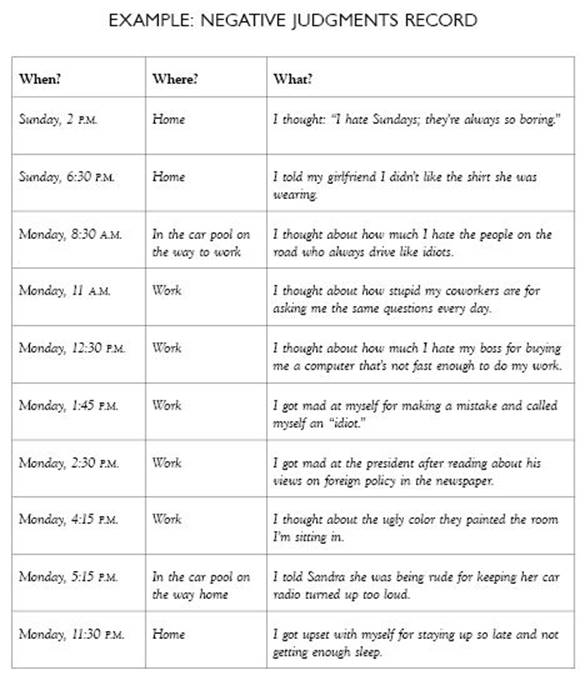
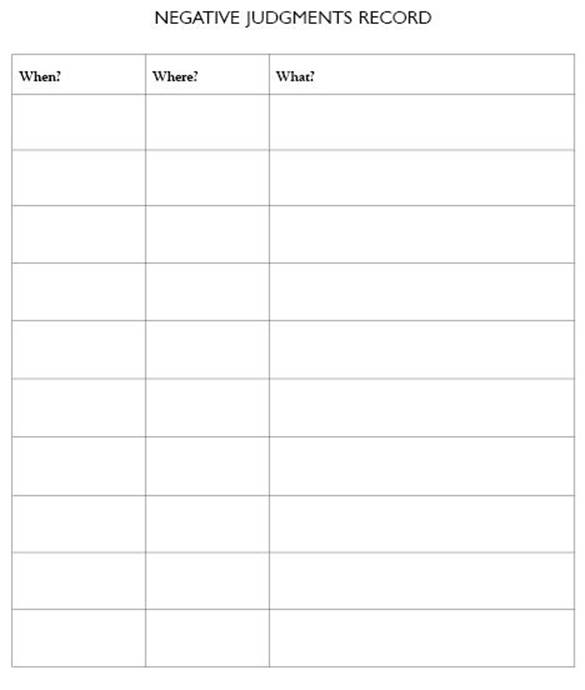
The first step to changing a problem is to recognize when that problem occurs. So to begin changing your judgmental thinking, the first step is to recognize when you’re being judgmental and critical. On page 87 is a Negative Judgments Record. For the next week, do your best to keep track of all the negative judgments and criticisms that you make. This includes those you make about things you read in the newspaper or see on television, judgments you make about yourself and other people, and so on. Make photocopies of the Negative Judgments Record if you need to, and keep one folded in your pocket so that you can record your judgments as soon as you recognize that you’re making them. If you decide that you’re only going to write down your negative judgments once a day, such as before you go to sleep, the process of learning radical acceptance will take longer. At the end of the day, you might forget many of the negative judgments that you’ve made.
In order to remind yourself to write down your negative judgments, it might help to give yourself visual reminders. Some people have found that wearing something special to remind them, like a new ring or a bracelet, prods their memories to write down their judgments. Other people put up sticky notes around their home and office with the word “judgments” written on them. Use whatever works best for you. Do this exercise for at least one week, or until you recognize that you’re starting to catch yourself in the moment when you’re making negative judgments. Keep track of when you made the judgment, where you were, and what the negative judgment was. Use the following example to help you.
(NOTE: When you have completed a Negative Judgments Record, keep it to use in the Judgment Defusion exercise later in this chapter.)
Radical Acceptance and Beginner’s Mind
Now that you’ve recognized many of your negative judgments, you’re closer to using full radical acceptance. Remember, radical acceptance means that you observe situations in your life without judging or criticizing yourself or others. In the previous exercise, you focused on recognizing your negative judgments because they are usually the easiest ones to spot. But positive judgments can also be problematic.
Remember the example of Thomas we recently gave you? He divided everyone into two categories: either all good or all bad. He liked people when they were good, but when they did something to upset him, he got angry and labeled them “bad.” So do you see how making even positive judgments about people or things can be problematic? When you think of someone (or something) with a rigid and predetermined idea of how that person is going to treat you, then it’s easy to become disappointed, because no one (and nothing) is perfect. Presidents sometimes lie, religious people sometimes gamble, things that we like sometimes break, and people we trust sometimes hurt us. As a result, when you put someone into a category of being 100 percent good, trustworthy, saintly, wholesome, or honest, it’s very easy to get disappointed.
But this doesn’t mean that you should never trust anyone. What radical acceptance says is that you should approach people and situations in your life without judging them to be good or bad, positive or negative. In some forms of meditation, this is called beginner’s mind (Suzuki, 2001). This means that you should enter every situation and every relationship as if you were seeing it for the very first time. This reoccurring newness prevents you from bringing any old judgments (good or bad) into the present moment, which allows you to stay more mindful. Plus, by keeping the situation fresh, it also helps you stay in better control of your emotions. As a result, it’s easy to see why one of the goals of dialectical behavior therapy is to help you stop making any judgments at all, either positive or negative (Linehan, 1993b).
Exercise: Beginner’s Mind
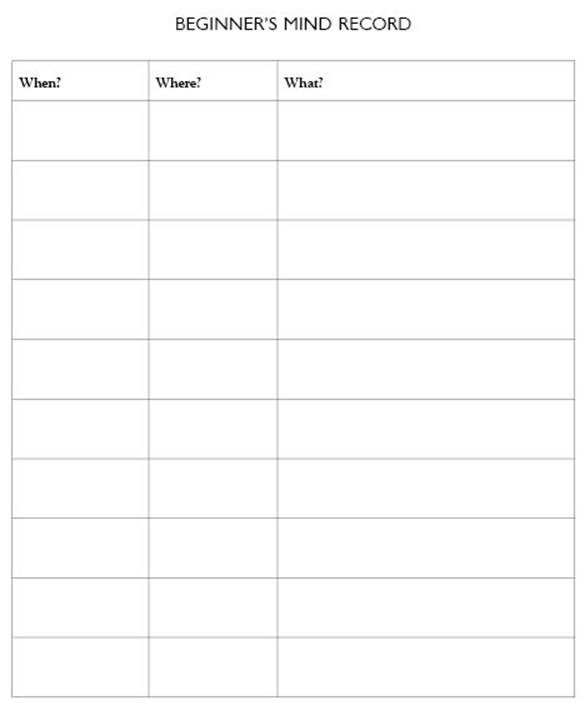
In the following exercise, you’ll practice using radical acceptance and beginner’s mind. This exercise is similar to the last one, but now you will need to be aware of both the positive and negative judgments that you make. Again, if you need to use visual reminders to help you remember to write down your judgments, use whatever works for you: a bracelet, a ring, a sticky note with the word “judgment” on it, and so on.
Do this exercise for at least one week or until you recognize that you’re starting to catch yourself in the moments when you’re making both positive and negative judgments. Keep track of when you made the judgment, where you were, and what the positive or negative judgment was. As with the last exercise, make photocopies of the Beginner’s Mind Record if you need to, and keep one folded in your pocket so that you can record your judgments as soon as you recognize that you’re making them. The more quickly you record them after they occur, the sooner radical acceptance will become a regular part of your life. Use the example of the Beginner’s Mind Record on the following page to help you. The blank Beginner’s Mind Record for your use is on the page after that.
(NOTE: When you have completed a Beginner’s Mind Record, keep it to use in the Judgment Defusion exercise later in this chapter.)
Judgments and Labels
Hopefully, after the last exercise, it’s easy to see how putting labels on people, thoughts, and objects—making them either good or bad—can later lead to disappointment. In order to move closer to using radical acceptance, the next exercise will continue to help you monitor the judgments that you make and then it will help you let go of those judgments.
So far in this chapter, you’ve already recognized many of the problems associated with making judgments:
· Judgments can trigger overwhelming emotions.
· Judgments can often lead to disappointment and suffering.
· Judgments prevent you from being truly mindful in the present moment.
Obviously, one of the problems with judgments and criticisms is that they occupy your thoughts. In many cases, it can become very easy to start obsessing on a single judgment. Perhaps you’ve even had the experience of a single judgment occupying your thoughts all day. Maybe it was something bad about yourself or someone else. Or maybe it was something good about yourself or someone else. We’ve all had this experience. So when your thoughts are occupied by something that happened in the past or by something that might happen in the future, how mindful are you being about the present moment? Probably you’re not being very mindful. And when those obsessive thoughts are judgments about yourself or someone else, how easy is it for your emotions to get triggered? Probably it’s very easy, especially if you struggle with overwhelming emotions.

Exercise: Judgment Defusion
The following Judgment Defusion exercise is designed to help you release or “let go” of your judgments and other obsessive thoughts. In the last chapter, you practiced using the thought defusion technique as a basic mindfulness exercise. This exercise is very similar. Again, the object is to watch your judgments arise and then to let go of them without getting stuck on them.
Like thought defusion, judgment defusion also requires the use of your imagination. The object of this exercise is to visualize your judgments, either as pictures or words, harmlessly floating away from you without obsessing about them or analyzing them. Whichever way you choose to do this is okay. If you used a technique in the last chapter that worked, use it again here. If you need a new visualization technique, here are just a few suggestions that other people have found helpful:
· Imagine sitting in a field watching your judgments float away on clouds.
· Picture yourself sitting beside a stream watching your judgments float past on leaves.
· Picture yourself standing in a room with two doors; then watch your judgments enter through one door and leave through the other.
If one of these ideas works for you, that’s great. If not, feel free to create your own. Just be sure that your idea captures the purpose of this exercise, which is to visually watch your judgments come and go without holding on to them and without analyzing them.
Before you begin this exercise, review the records you filled out for the Negative Judgments exercise and the Beginner’s Mind exercise, in order to refamiliarize yourself with some of the judgments you’ve made over the last few weeks. You can even keep these records near you so you can refer to them if you have trouble remembering any of your recent judgments. During the exercise, you will close your eyes and imagine whichever visualization technique you’ve chosen. Then you’ll watch your past judgments (and any new judgments) come into your thoughts and float away, without you getting stuck on them.
Read the instructions before beginning the exercise to familiarize yourself with the experience. If you feel more comfortable listening to the instructions, use an audio-recording device to record the instructions in a slow, even voice so you can listen to them while practicing this technique. When you are first using judgment defusion, set a kitchen timer or an alarm clock for three to five minutes and practice letting go of your thoughts until the alarm goes off. Then, as you get more accustomed to using this technique, you can set the alarm for longer periods of time, like eight to ten minutes.
Instructions
To begin, find a comfortable place to sit in a room where you won’t be disturbed for as long as you’ve set your timer. Turn off any distracting sounds. Take a few slow, long breaths, relax, and close your eyes.
Now, in your imagination, picture yourself in the scenario that you chose in order to watch your judgments come and go, whether it’s by a stream, in a field, in a room, or somewhere else. Do your best to imagine yourself in that scene. After you do, start to become aware of the judgments that you’re having, just like in the last exercises in which you wrote down your judgments. Start to observe the judgments that are coming up, whatever they are. Don’t try to stop your thoughts, and do your best not to criticize yourself for any of the judgments. Just watch the judgments arise, and then, using whatever technique you’ve chosen, watch the judgments disappear. If you need to refer to any of the records from the past exercises to remind yourself of recent judgments, feel free to do that. But then close your eyes and watch those judgments float away.
Whatever the judgment is, big or small, important or unimportant, watch the judgment arise in your mind and then let it float away or disappear by whichever means you’ve chosen. Just continue to watch the judgments arise and disappear. Use pictures to represent the thoughts or words, whatever works best for you. Do your best to watch the judgments arise and disappear without getting hooked into them and without criticizing yourself. If more than one judgment comes up at the same time, see them both arise and disappear. If the judgments come very quickly, do your best to watch them all disappear without getting hooked on any of them. Continue to breathe and watch the judgments come and go until your timer goes off.
When you’ve finished, take a few more slow, long breaths, and then slowly open your eyes and return your focus to the room.
Nonjudgment and Your Daily Experiences
The purpose of the previous exercise is to help you let go of your judgments, and the more you practice it, the easier it will get. Then, after you’ve been practicing it regularly for at least a few weeks, it will become easy for you to let go of your judgments in the present moment. Hopefully, there will come a day, very soon, when a judgment will arise in your thoughts, either positive or negative, and you’ll simply let it go. Maybe you’ll need to close your eyes for a few seconds, if you’re in a place where that’s safe, and visualize the thought floating away. Or maybe you’ll be in a conversation with someone when a judgment arises in your thoughts, and you’ll simply be able to let it go. That is when you will truly be using radical acceptance.
Exercise: Judgments vs. the Present Moment
Now that you’ve practiced being mindful of your thoughts, feelings, and senses in the previous chapter, and you’ve practiced being mindful of your judgments in this chapter, the next step is to combine the two experiences. In this exercise you will learn to shift your attention back and forth in a mindful, focused way between your judgments and your physical sensations.
When you spend a lot of time obsessing over your thoughts and judgments, it’s easy to get lost in your own fantasies about how the world should be. But again, these fantasies often lead to disappointment and suffering. As you continue to practice your mindfulness skills in your life, it will continue to be important to recognize and separate your judgments and fantasies from what’s really happening in the moment. One of the easiest ways to do this is to become mindful of your physical senses—what you notice using your eyes, ears, nose, and senses of touch and taste. Often, people refer to this as grounding themselves. Grounding yourself in your physical sensations can stop you from obsessing over your judgments, and by doing so it will also help you become more mindful of what’s happening in the present moment.
Read the following instructions before beginning the exercise to familiarize yourself with the experience. Then you can either keep these instructions near you if you need to refer to them while you’re doing the exercise, or you can record them in a slow, even voice on an audio-recording device so that you can listen to them while you practice shifting your focus between your judgments and your present-moment awareness.
Instructions
To begin, find a comfortable place to sit in a room where you won’t be disturbed for ten minutes. Turn off any distracting sounds. Take a few slow, long breaths, close your eyes, and relax.
Now, keeping your eyes closed, focus your attention on the weight of your body as it rests on the seat in which you’re sitting. Notice the weight of your feet and legs resting on the ground. Notice the weight of your hands and arms resting. Notice the weight of your head resting on top of your neck. Mentally scan your body from head to toe and notice any sensations that you feel. Take your time. [Pause here for one minute if you are recording the instructions.]
Now notice any tension you might be feeling anywhere in your body, and imagine the tension melting away like wax in the hot sun. Again, take your time to scan your body for any tension, and keep taking slow, deep breaths.[Pause here for one minute if you are recording the instructions.]
When you are finished scanning your body, move your focus to your thoughts and judgments. Just notice any thoughts or judgments that arise in your mind, and when they do, allow them to float away by whichever means you found successful in the last exercises. Allow the thoughts and judgments to leave you without getting stuck on them. Take a minute to do this, and keep breathing slow, long breaths.[Pause here for one minute if you are recording the instructions.]
Now redirect your attention to your sense of hearing. Notice any sounds that you can hear coming from outside your room, and note to yourself what they are. Now become aware of any sounds you hear coming from inside the room, and note to yourself what they are. Try to notice even small sounds, such as the ticking of a clock, the sound of the wind, or the beating of your heart. If you become distracted by any thoughts, return your focus to your sense of hearing. Take a minute to do this, and keep breathing. [Pause here for one minute if you are recording the instructions.]
When you are finished noticing any sounds, once again redirect your focus to your thoughts and judgments. Notice any thoughts or judgments that arise in your mind, and when they do, allow them to float away by whichever means you found successful in the last exercises. Allow the thoughts and judgments to leave you without getting stuck on them. Take a minute to do this, and keep breathing slow, deep breaths. [Pause here for one minute if you are recording the instructions.]
Now, once again, redirect your attention. This time, put your focus on your sense of smell. Notice any smells that are in the room, pleasant or otherwise. If you don’t notice any smells, just become aware of the flow of air moving into your nostrils as you breathe in through your nose. Try your best to maintain your focus on your sense of smell. If you become distracted by any thoughts, return your focus to your nose. Take a minute to do this, and keep breathing slow, deep breaths. [Pause here for one minute if you are recording the instructions.]
When you are finished noticing any smells, once again redirect your focus to your thoughts and judgments. Notice any thoughts or judgments that arise in your mind, and when they do, allow them to float away by whichever means you found successful in the last exercises. Allow the thoughts and judgments to leave you without getting stuck on them. Take a minute to do this, and keep breathing slow, long breaths. [Pause here for one minute if you are recording the instructions.]
Now redirect your attention to your sense of touch. Notice the sensation of whatever your hands are resting on. Or, keeping your eyes closed, reach out with one of your hands to touch an object that is within reach. Or, if there is no object within reach, touch the chair you’re sitting in or touch your leg. Notice what the object feels like. Notice if it’s smooth or rough. Notice if it’s pliable or rigid. Notice if it’s soft or solid. Notice what the sensations feel like on the skin of your fingertips. If your thoughts begin to distract you, simply return your focus to the object that you’re touching. Take a minute to do this, and keep breathing slow, long breaths. [Pause here for one minute if you are recording the instructions.]
When you are finished noticing any touch sensations, once again redirect your focus to your thoughts and judgments. Notice any thoughts or judgments that arise in your mind, and when they do, allow them to float away by whichever means you found successful in the last exercises. Allow the thoughts and judgments to leave you without getting stuck on them. Take a minute to do this, and keep breathing slow, long breaths. [Pause here for one minute if you are recording the instructions.]
Now, slowly, open your eyes. Keep breathing slow, deep breaths. Take a few minutes to focus your visual attention on the room you’re sitting in. Notice the objects that are in the room. Notice how light or dark the room is. Notice the different colors that are in the room. Notice where you are in the room. Move your head to look around. Take in all the visual information that you can. If your thoughts begin to distract you, simply return your focus to the room you’re looking at. Take a minute to do this, and keep breathing slow, long breaths. [Pause here for one minute if you are recording the instructions.]
When you have finished noticing any visual sensations, once again redirect your focus to your thoughts and judgments. But this time, keep your eyes open. Pick a few objects in the room to focus on. But in your mind, continue to notice any thoughts and judgments that arise, and when they do, allow them to float away. Allow the thoughts and judgments to leave you without getting stuck on them. If you need to close your eyes to do this, that’s okay. But open your eyes once the thoughts have floated away, and return your focus to the room you’re in. Continue to monitor your thoughts and judgments and continue to let them go without getting stuck on them. Take a minute to do this, and keep breathing slow, long breaths. [Pause here for one minute if you are recording the instructions.]
When you’ve finished, if you still have time left, continue to switch your focus between your thoughts and judgments and what you notice visually. Then, when your timer goes off, take three to five slow, long breaths and return your focus to the room.
Mindful Communication with Others
As you continue to practice mindfulness skills by yourself, it’s also very important that you begin to incorporate these skills into your interactions with others. Mindful communication is often the key to a successful relationship. If you’re constantly making judgmental statements to someone, the chances are good that you’ll lose that relationship. In the chapters on interpersonal effectiveness skills, you will learn how to ask others for what you need in a healthy way. But for now, let’s look at how to be more mindful of the messages you send to other people.
Consider the following statements:
· “You make me mad.”
· “You’re such a jerk, I could scream.”
· “Sometimes you make me so upset I just want to end it all.”
· “I know that you did that to me on purpose just to hurt me.”
What do all of these statements have in common? It’s true that they all express some kind of emotion, such as anger, distress, and sadness. But more importantly, they’re all judgments of the other person. Each of the statements blames the other person for the way the speaker feels. Now consider how you would feel if someone said one of these statements to you. What would you do? Maybe you would say something just as angry back to the person, which would lead to a big fight. The result would be that nothing gets resolved. Or maybe you would just shut down emotionally, stop listening, or walk away. Again, nothing would get resolved. Judgmental statements like these stop any form of effective communication. So what can you do instead?
One of the solutions is to turn “you” statements into mindful “I” statements.
· Mindful “I” statements are based on your own mindful awareness of how you feel.
· Mindful “I” statements are a more accurate description of how you feel.
· Mindful “I” statements let a person know how you feel in a nonjudgmental way.
· Mindful “I” statements evoke greater empathy and understanding from the other person, which allows the person to meet your needs.
Let’s look at the four previous examples and turn them from “you” statements into mindful “I” statements.
Instead of saying “You make me mad,” say “Right now, I feel very mad.” Doesn’t that sound less judgmental and blaming? If someone said the alternative statement to you (“I feel very mad”), wouldn’t you be more willing to discuss the situation? Wouldn’t you feel less angry?
Look at the second sentence. Instead of saying “You’re such a jerk, I could scream,” say “I feel so angry right now I could scream.” Do you hear the difference it makes to change a “you” statement into an “I” statement? The other person no longer feels blamed and will be more willing to listen.
Let’s look at the third sentence. Instead of saying “Sometimes you make me so upset I just want to end it all,” say “I feel so upset and hopeless sometimes that I get very depressed.”
And finally, look at the last sentence. Instead of saying “I know that you did that to me on purpose just to hurt me,” say “I felt very hurt when you did that.”
Again, mindful “I” statements are more accurate about how you feel, they are less judgmental, the other person will probably be more willing and able to listen to you if you use them, and most importantly, you are more likely to get your needs met if you use them.
Exercise: Mindful “I” Statements
Now let’s look at some more judgmental “you” statements and have you practice turning them into mindful “I” statements. Write your alternative mindful “I” statement in the space to the right of the judgmental statement.
1. “You make me feel horrible.” ___________
2. “I know you’re doing this on purpose to make me go crazy.” ___________
3. “Why do you keep making me feel so angry?” ___________
4. “You’re being insulting.” ___________
5. “Stop fooling around; you’re getting on my nerves.” ___________
6. “If you don’t listen to what I’m telling you, I’m not going to talk to you anymore.” ___________
7. “You’re being a jerk, stop it.” ___________
8. “You’re such a @%&!*#!, I can’t believe it.” ___________
9. “Why do you keep doing that to me?” ___________
10. “Sometimes I feel like you’re being too inflexible.” ___________
How did you do? Did it get harder to think of mindful “I” statements as the exercise progressed? Some of the later sentences probably required extra thinking. Let’s look at some possible answers.
The first sentence was easy. The message is that the speaker feels horrible. So an alternative mindful “I” statement could be “I feel horrible” or “I feel horrible sometimes, when you (say that, do that, and so on).”
In the second sentence, the speaker feels crazy, anxious, or upset. So an alternative mindful “I” statement could be “I feel crazy/anxious/upset when you do that.”
In the third sentence, the speaker feels angry. So an alternative mindful “I” statement could be “I feel angry right now.”
In the fourth sentence, the speaker feels insulted or foolish. So an alternative mindful “I” statement could be “I feel like an idiot when you do that.”
In the fifth sentence, the speaker feels anxious, tired, or angry. So an alternative mindful “I” statement could be “I feel anxious/tired/angry when you tease me like that.”
In the sixth sentence, the speaker feels insulted, unheard, and ignored. But he or she also probably feels upset about being ignored. So an alternative mindful “I” statement could be “I feel upset when you ignore me.”
In the seventh sentence, the speaker might feel many things. Usually, when you ask someone to stop doing something, it’s because the action hurts. So maybe the speaker feels hurt, and an alternative mindful “I” statement could be “I feel hurt when you do that.”
The eighth sentence is trickier. The speaker calls the other person some insulting expletive. This also usually indicates that the speaker’s feelings have been hurt. So an alternative mindful “I” statement could be similar to the last sentence: “I feel very hurt when you do that.”
The ninth sentence is phrased as a question, but it’s really a statement about how the speaker feels. Again, the implication is that the speaker feels hurt, insulted, belittled, or something similar. So an alternative mindful “I” statement could be any version of these: “I feel very hurt (or insulted, or whatever) when you do that to me.”
And lastly, the tenth sentence is the trickiest because the speaker uses the word “feel.” Maybe you were tricked into thinking that this sentence didn’t need to be changed. But this sentence is really a hidden judgment about the other person. What the speaker really means is “I think you’re too inflexible.” But people often exchange the word “think” for “feel” in order to hide their criticism or make their judgment sound less harsh. However, now you know better, so don’t fall into the same trap. In this case, something about the other person’s inflexible actions make the speaker feel uncomfortable or trapped. Maybe the other person never considers other points of view before he or she makes decisions. So an alternative mindful “I” statement could be “I feel uncomfortable when you don’t consider my point of view.”
Mindful “I” statements are clearly a more effective way of communicating how you feel and what you need, but they depend on your mindful awareness of your own feelings. Hopefully, after practicing the exercises in the last two chapters, you’ve become more skilled at recognizing your own emotions and you can start using mindful “I” statements to let others know how you feel.
Doing What’s Effective
Using successful communication skills, such as mindful “I” statements, is a part of what dialectical behavior therapy calls “doing what’s effective” (Linehan, 1993b). This means that you do what’s appropriate and necessary in the present moment—to resolve a problem, cope with a situation, or reach your goal—even if what you do feels unnatural, uncomfortable, or it goes against what you are experiencing emotionally. For example, you’re probably not comfortable making statements like the ones you made in the last exercise, where you speak directly to the other person about how you feel. But sometimes in order to get what you want, you have to modify what you feel like doing, especially if you struggle with overwhelming emotions. Here are some other examples of doing what’s effective:
· You’re in the grocery store shopping for your weekly supply of food, but unfortunately, so are many other people. After shopping for an hour and waiting in line for fifteen minutes, you feel exhausted. You’re so tired and annoyed that you think about leaving your shopping cart and just walking out. But if you did walk out, then you’d be without groceries for a week or you’d just have to start all over again at some other supermarket. So you stay in line and just get it over with.
· You’re driving down the freeway and the car in front of you is driving below the speed limit in the left-hand lane. You feel so angry that you think about smashing into the car to push it out of the way. But if you did, you and the other driver would be seriously injured, and chances are you’d also get arrested. So you patiently wait for a chance to pass the driver, or you wait for your exit and then get off the freeway.
· You and your romantic partner get into a big argument. Both of you are yelling. You feel so hurt and upset that you think about walking out the door and ending the relationship. But in the back of your mind, you also recognize that this is the best relationship you’ve had in a long time, and you wish that it would work out. So, instead of leaving, you take a deep breath and use mindful “I” statements to let your partner know how you’re feeling.
· Your boss gives you a new task even though you’re already burdened with more work than you have time for. You feel insulted, angry, and taken advantage of. You’re so mad that you think about screaming at your boss, telling him off, quitting, and walking out the door. But if you did, then you’d be without a paycheck for a long time. So you decide to bite your tongue for now until you can speak to your boss more calmly at some point in the near future, and you do the best you can.
· You ask your friend to take you shopping because she has a car and you don’t. But your friend says she can’t because she’s busy doing something else. You feel annoyed and angry because you help her all the time when she asks you. You want to yell at her and tell her what a lousy friend she is. But if you did, you might lose her friendship completely. So instead of yelling, you call a different friend to ask for a ride.
As you can see, doing what’s effective sometimes means not doing what you feel like doing or not doing what you’ve been habitually doing for many years. This is why mindfulness is such an important part of doing what’s effective. If you’re going to change the way you behave in the present moment, you have to be aware of what you’re thinking, feeling, and doing in the present moment so that you can choose to do what’s effective.
Doing what’s effective also depends on not making judgments. You already know that making both positive and negative judgments can lead to disappointment and suffering. But making judgments about situations and your actions can also prevent you from doing what’s effective. Here’s an example: Judith had a math teacher who assigned homework that Judith thought was too hard. “This is ridiculous,” she thought to herself. “How unfair of him to give us these assignments. This is wrong; he shouldn’t be allowed to do this. I’m not going to do the homework.” So she didn’t. But as a result, she failed the class. Judith’s judgments about what was “right” and “wrong” prevented her from doing what was effective. Clearly, it would have been more beneficial to her if she had remained mindful of her thoughts and feelings, avoided judging the assignments, and just done the best that she could.
Doing what’s effective is doing what is necessary in a given situation in order to get a resolution to a problem. Doing what’s effective isn’t “selling out,” “giving up,” or “caving in.”
Doing what’s effective is a skill, just like acting. Sometimes in order to get what you want, you have to behave in a certain way. Sometimes you have to act as if you are competent, skilled, or satisfied in order to reach your goal, even if you don’t feel that way. And that’s what effective actions are designed to do—help you reach your goals. In the example above, Judith’s goal was to get a satisfactory grade in her math class. But she allowed her judgments and feelings to prevent her from reaching that goal.
Remember, in order to do what’s effective, you have to do the following:
· Be mindful of your thoughts and feelings.
· Avoid judging the situation or your actions.
· Choose actions that are appropriate and necessary to reach your goal.
· Do the best you can.
Being Mindful in Your Daily Life
Now that you’ve almost completed these two chapters on mindfulness skills, you probably recognize the benefits of being mindful in your daily life. But to be realistic, no one is mindful all the time. There will certainly be moments in your life when you’ll forget to be mindful. So what should you do?
In his book Living the Mindful Life: A Handbook for Living in the Present Moment, psychologist Charles Tart (1994, p. 13) remarks: “It does not take a really strenuous effort to make yourself become mindful and more present. The effort is very small. The problem is remembering to do it! We forget all the time. It is not hard, but we just do not remember to do it.” So how should you remember to be mindful? Throughout his book, Dr. Tart uses a bell that rings at random times to remind the reader to be mindful of how he or she is thinking and feeling. But if you don’t want to use a random bell, there are other ways to remind yourself. In some of the exercises in this chapter, you might have used a special ring or bracelet to remind yourself. Or maybe you used sticky notes. If those tools helped you, continue to use them to remind yourself to stay mindful.
However, the best way to continue to stay mindful in your daily life is to practice being mindful. The more you practice, the more you will remember to stay mindful. As part of the last exercise in this section, we have designed a simple daily mindfulness regimen to help you continue practicing your skills. It’s very important that you continue to use these skills, and to practice other mindfulness exercises that you think are necessary, even as you move on to learning other dialectical behavior skills in this workbook. Mindfulness skills are so important to the overall effectiveness of dialectical behavior therapy that they have been labeled “core” skills (Linehan, 1993a).
Daily Mindfulness Regimen
Your daily mindfulness regimen will consist of three skills that you’ve already learned:
1. Mindful breathing
2. Wise-mind meditation
3. Doing tasks mindfully
Mindful breathing is a skill you learned in chapter 3, Basic Mindfulness Skills. Remember, to breathe mindfully, you need to focus on three parts of the experience:
1. You must count your breaths. This will help you focus your attention, and it will also help you calm your mind when you’re distracted by thoughts.
2. You need to focus on the physical experience of breathing. This is accomplished by observing the rising and falling of your breath as you slowly inhale and exhale.
3. You need to be aware of any distracting thoughts that arise while you are breathing. Then you need to let the thoughts float past without getting stuck on them, as you did in the Thought Defusion exercise. Letting go of the distracting thoughts will allow you to refocus your attention on your breathing and help you further calm yourself.
Practice breathing mindfully for three to five minutes a day at a minimum. But if you want to practice it longer, do it for as long as you can. Remember, the more frequently you practice mindfulness skills, the calmer you will feel and the more control you will have over your present-moment experiences. Refer to the Mindful Breathing exercise in chapter 3 if you need to review the instructions.
The wise-mind meditation is a skill you learned earlier in this chapter. It will help you focus your attention on your center of wise mind, which is also sometimes called your center of intuition or “gut feelings.” Remember, wise mind is just one decision-making process that many people find helpful. It incorporates using both your emotion mind and your reasonable mind, meaning that wise-mind decisions require you to reflect on how you feel as well as the facts of a situation. This skill also helps you make intuitive decisions that “feel” right to you. Wise-mind meditation will help you make decisions based on the way your body reacts to a decision and your own inner knowledge (what you know to be “true” for you). Again, practice the wise-mind meditation for at least three to five minutes a day, or longer if you want to.
And finally, your daily mindfulness regimen will include doing tasks mindfully. This might sound like a new skill to you, but you’ve already practiced doing all the steps that are necessary. Doing tasks mindfully means doing all the things you normally do in your life, like talking, walking, eating, and washing, while also staying focused on your thoughts, emotions, physical sensations, and actions in the present moment, and without judging what is happening. In effect, this is the exercise where all the skills you’ve learned in the last two chapters finally come together.
To do tasks mindfully, you need to do the following:
· Focus and shift your attention between your thoughts, feelings, physical sensations, and actions in order to be mindful of your present-moment experience.
· Let go of distracting thoughts and judgments by allowing them to float past without getting stuck on them so that you don’t get distracted from what’s happening in the present moment.
· Use radical acceptance to remain nonjudgmental.
· Use wise mind to make healthy decisions about your life.
· Do what’s effective in order to accomplish your goals.
Some people find it helpful to use the following memory device to remind themselves to do tasks mindfully:
“Mindfulness is like a FLAME.”
Focus and shift your attention to be mindful of the present moment.
Let go of distracting thoughts and judgments.
Use radical Acceptance to remain nonjudgmental.
Use wise Mind to make healthy decisions.
Do what’s Effective to accomplish your goals.
Let’s look at some examples of doing tasks mindfully, using all the skills you’ve learned in chapters 3 and 4.
After reading these two chapters, Loretta began approaching many of her tasks mindfully. At night, she would even brush her teeth mindfully. First, she focused her attention on how the toothbrush felt in her hand and how the tube felt as she squeezed out the paste. She was also aware of how her body felt, standing in front of the bathroom mirror, and how the weight of her body felt as she stood in front of the sink. Then, as she began to brush, she became aware of the taste in her mouth, the feel of the bristles on her gums, and the movement of her arm as she brushed. When distracting thoughts arose, such as things she did earlier in the day, she imagined the thoughts floating down a river on a leaf. If judgments arose about people she knew, she did the same thing and watched the judgments float away. Then she continued to shift her focus every few moments to her breathing, feeling it rise and fall. Loretta did a good job being as aware as possible of simply brushing her teeth in that moment. At other times throughout the day, she had similar experiences with other activities. When she washed the dishes, she paid attention to how the water felt and to the smell of the dish soap. While she was cooking, she was very aware of the heat from the stove, the sensation of hunger in her stomach, the sound of the water boiling, and her distracting judgments, which usually concerned whether or not her husband would like the meal. She did her best to let those judgments go and to be as fully present in the moment of cooking as she could be.
Similarly, Scott did his best to be mindful throughout the day. As he walked, he focused his attention on how his feet felt as they touched the pavement. Sometimes, he was even aware of how his feet felt moving in his socks. Then he would shift his focus to what he was seeing. He visually scanned what was around him as he walked, and he made mental notes to himself: “Right now, I’m seeing a woman, a tree, a building,” and so on. When distracting thoughts arose, he imagined the thoughts coming in one door and leaving through another. If he saw someone on the street whom he didn’t like and judgments arose, he would also let those judgments go. Similarly, if positive judgments arose about people or places he liked, he did his best to let those go too. For example, once he caught himself thinking “Oh look, there’s Mike. He’s the guy that loaned me twenty dollars that time. He’s the greatest guy in the world. I wish I could be more like him.” Scott knew that he couldn’t stop those judgments from arising, but instead of getting stuck on them, he would let them go. And if the judgments came back, he would let them go again.
But clearly, the greatest challenge to using mindfulness skills is when you are interacting with someone else. Talking or arguing with someone and being mindful at the same time is often difficult. But it is also the most important time to be mindful, especially for someone struggling with overwhelming emotions. Here’s an example.
Claire had been practicing her mindfulness skills for a few weeks when she went shopping for a new dress with her friend Laura. Sometimes, Claire worried that Laura really didn’t like her. As a result, when Laura made suggestions, Claire did whatever Laura wanted because she was afraid of losing Laura’s friendship. However, Claire didn’t like the fact that Laura pushed her into doing things.
On the way to the store, Claire drove and she did her best to remain mindful of what she was doing. She felt the steering wheel in her hands. She felt the weight of her body resting in the seat. She felt her breath rising and falling as she breathed. She was also very aware of what she was seeing, especially the other cars. But she was also very aware of Laura talking to her as she drove. Naturally, judgments about Laura came up while Claire was driving, and she did her best to just let them go. However, some judgments were easier to let go of than others.
When they got to the shopping mall, Claire also had opportunities to use radical acceptance. There were certain stores she liked and certain stores she didn’t like. At first, she was positive that she would find the “perfect” dress in the store she really liked because they always had the “best” clothes. But quickly, Claire recognized the positive judgments she was making, and she let them go. That was lucky too, because none of the stores she liked had the dress she was looking for. In the past, she would have been crushed and gotten upset. But because of radical acceptance, her neutrality and her nonjudgmental attitude allowed her to cope with the situation in a healthier way.
Later, the two women found themselves in a higher-end store looking at dresses that were more expensive than what Claire could afford. However, both she and Laura found a dress that they loved. Immediately, Laura began pressuring Claire to buy it. “Don’t worry about how much it costs,” Laura said. Claire looked at herself in the mirror and fell in love with the dress, regardless of the price tag. Claire was about to buy the dress when she remembered to use wise mind to help her make her decision. Her emotion mind loved the dress, but her reasonable mind reminded her that she already had a hefty credit card bill and this dress was far too expensive. In the dressing room, Claire took a few slow, deep breaths and put her hand on her center of wise mind. Her abdomen felt very nervous, not happy and excited. Instantly, she knew it was a very bad idea to buy the expensive dress, so she gave it back to the salesclerk and left the store.
Claire was proud of herself for making the right decision, but the drama didn’t end there. Laura began making fun of Claire for being “too cheap” to buy the dress. Again, Claire’s mind began to fill with judgments about Laura. She did her best to let them go, but as Laura continued to ridicule her, Claire’s only goal became leaving the mall and dropping Laura at home. Internally, Claire wanted to scream at Laura, but she knew that would end up in a big fight. Claire thought about doing what was effective in that moment. She knew that she just had to get home as quickly and safely as possible without getting into a fight that she might later regret.
Claire drove home silently, listening to Laura’s criticisms. She was relieved when she finally let Laura off at her house. Later, when Claire was feeling less angry, she even found the courage to call Laura to discuss what happened. Claire did a great job using mindful “I” statements such as “I felt hurt when you teased me.” Laura understood and said she was sorry. Claire was proud of herself for handling the situation in a new, healthier way.
Be Mindful of Your Mindfulness Activities
Obviously, it will take lots of practice to become as mindful as Claire was in that situation. But hopefully, you see the benefits of using mindfulness in all of your daily tasks.
In the beginning of chapter 3, Basic Mindfulness Skills, you learned that there were three main reasons why you should learn mindfulness skills:
1. They will help you focus on one thing at a time in the present moment, and by doing this you can better control and soothe your overwhelming emotions.
2. They will help you learn to identify and separate judgmental thoughts from your experiences.
3. They will help you develop wise mind.
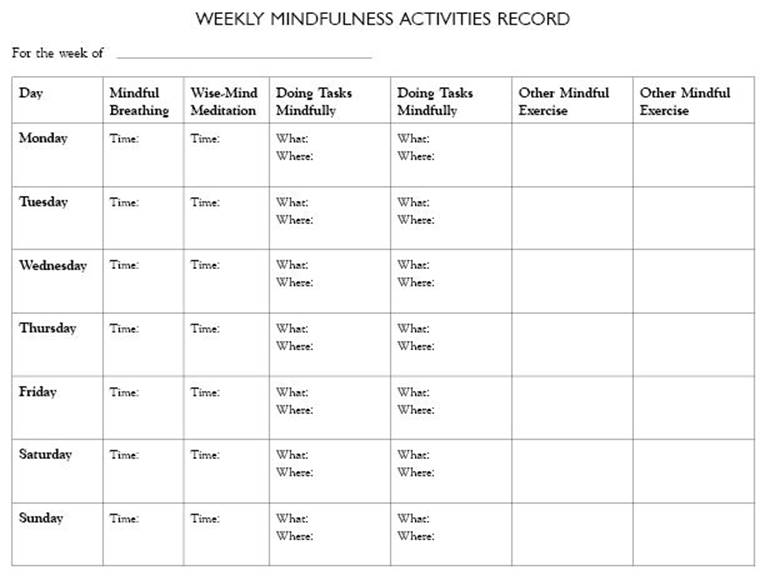
Unfortunately, there is no shortcut to becoming instantaneously and permanently mindful. But as Dr. Charles Tart said, learning how to be mindful isn’t a strenuous activity; you simply have to remember to do it. So, however you need to remember to be mindful, we hope it works for you. One way is to use the Weekly Mindfulness Activities Record on page 112. This will help you remember to follow your daily mindfulness regimen. Make photocopies of this page for each week to record how often you use mindful breathing, wise-mind meditation, and do tasks mindfully.
Under the headings of “Mindful Breathing” and “Wise-Mind Meditation,” record the length of time you spend doing each exercise. This will help you keep track of your improvement doing these exercises. Under the headings of “Doing Tasks Mindfully,” record what it was that you did mindfully and where you were when you did it.
Then, under the headings labeled “Other Mindful Exercise,” record any further mindfulness exercises that you do during the week.
Remember, these mindfulness skills are “core” skills in dialectical behavior therapy (Linehan, 1993a). So continue to use them even as you move on to using the other skills in this workbook.
Resistances and Hindrances to Mindfulness Practice
It is common to encounter inner resistance and difficulties as you practice mindfulness and develop skills. What many people do not know is that there are some hindrances to mindfulness that are so common that they have been recognized by meditation teachers and practitioners for thousands of years!
This final section of the chapter will help you identify five common hindrances to mindfulness meditation and suggest ways you can work skillfully with each one.
The Five Hindrances
Desire, aversion, sleepiness, restlessness, and doubt are the five hindrances long recognized as common obstacles to meditation (and mindfulness) practice.
These energies appear as obstacles when they take you out of the present moment or cause you to become lost in thoughts and feelings that interfere with your mindfulness practice of observing accurately and without judgment. However, they do not have to be obstacles. In truth, they can become your wisest teachers if you are willing to recognize, observe, and learn from them.
· Desire refers to the wish for things to be different—right now! This can be a wish for a different sense experience (to “feel better” or “feel happy or peaceful,” for example) or to become someone or something different than what you experience yourself as now (become the “perfect person” or “perfect meditator,” for example).
· Aversion means having anger for or ill will toward what is here. Aversion includes other forms of resistance to present-moment experience, such as feeling bored or afraid. Often, the very activity of judgment or judgmental thinking is an expression of aversion.
· Sleepiness means just that—feeling sleepy, heavy, and dull. It is important to note that the causes of sleepiness can include physical fatigue, but, also, a second kind of sleepiness is actually a resistance to something happening in mind and body that may be frightening or painful. Learning to distinguish between these two is very helpful.
· Restlessness is the opposite of sleepy. It can be very uncomfortable. It is a “storm” of thoughts, feelings, and sensations that demand movement and are quite distracting.
· Doubt is that inner voice that says, “I can’t handle this. I don’t know how to do it. What good is this? This definitely is not for me.” Doubt is often expressed as words in your mind and feelings of fear and resistance to what is happening.
Working Wisely with the Hindrances
The first and most potent way to handle any of the hindrances is to make the experience of the hindrance itself a focus for your mindfulness. Acknowledge what is happening without fighting it. Gently place attention on desire, aversion, sleepiness, restlessness, or doubt, and look deeply, allowing the energy to reveal itself in all of its forms. Patiently return your soft and curious attention time and again, as often as necessary, to the hindrance energy, naming it and learning what it has to teach you. The lessons can come in many ways, including thoughts, memories, feelings, and body sensations.
In addition, you may find benefits in the following specific suggestions for each hindrance:
· For desire, recall that no matter how many times you get what you desire, you always want more. Let this wisdom empower you to resist the temptation of desire and learn from it instead. Keep noticing and naming desire without acting on it.
· For aversion, recognize anger and ill will as some of your strongest teachers. Resolve to learn from them. At times, it also helps if you can work to balance them by developing thoughts of compassion, kindness, and forgiveness.
· For sleepiness, know it as a powerful condition that demands your full attention. It can help to sit up straight, even stand. Splash water on your face. Take a break and do something active, walking mindfully, for example.
· For restlessness, besides making it the object of mindfulness, it can be very helpful to sharpen your concentration. Take a more narrow or smaller focus, for example, placing attention at the tip of your nose for practicing mindful breathing, or relaxing and counting your breaths from one to ten and back to one until the restlessness subsides.
· For doubt, especially when your mind is racing everywhere, it can help to concentrate attention in the present moment with some resolve and steadiness. Other remedies for doubt can be conversation with mindfulness teachers and others who follow this path, and inspirational readings related to how others handle doubt.
Finally, remember to take a kind and interested nonjudging attitude toward the hindrances when they appear. When you can treat them as teachers, not obstacles, they will cease to be hindrances!