To put it simply, emotions are signals within your body that tell you what’s happening. When something pleasurable is happening to you, you feel good; when something distressing is happening to you, you feel bad. In many ways, your emotions are like an instant news service that gives you constant updates about what you’re doing and what you’re experiencing.
Your initial reactions to what is happening to you are called primary emotions. These are strong feelings that come on quickly, that don’t involve having to think about what’s happening. For example, if you won a contest, you might instantaneously feel surprised. When someone you care about dies, you quickly feel sad. When someone does something that offends you, you might immediately feel angry.
But in addition to experiencing primary emotions, it’s also possible to experience secondary emotions. These are emotional reactions to your primary emotions. Or to put it another way, secondary emotions are feelings about your feelings (Marra, 2005). Here’s a simple example. Erik yelled at his sister because she did something that made him feel angry. His feeling of anger came on very quickly. But a little later he felt guilty about getting so angry with her. Anger was his primary emotion, and guilt was his secondary emotion.
However, it’s also possible that you can experience numerous secondary emotions in response to a single primary emotion. Here’s a more complicated example. Shauna became anxious when she was asked to make a future presentation at work. As the day drew closer, she became depressed as she thought about how anxious she was getting, and then she started to feel worthless that she couldn’t make a simple presentation. Then, the day after the presentation, she started to feel guilty that she had made such a big deal about it in the first place. You can see how a person’s emotions can get very complicated very quickly. Anxiety was Shauna’s primary emotion, and depression, worthlessness, and guilt were all her secondary emotions in response to her anxiety.
It’s possible that your primary emotional reaction to a situation can set off a limitless chain reaction of distressing secondary emotions that cause you much more pain than your original emotion does. For this reason, it’s important that you try to identify what your original primary emotion is in a distressing situation so that you can learn to cope with that feeling before the avalanche of secondary emotions overwhelms you. This is where emotion regulation skills can be helpful. Emotion regulation skills are an important part of dialectical behavior therapy because they will help you cope with your distressing primary and secondary feelings in new and healthier ways (Dodge, 1989; Linehan, 1993a).
These skills are especially useful, because without them, people often choose to deal with their primary and secondary emotions in ways that only cause them more suffering. In Shauna’s example, it’s easy to imagine that she could have chosen to use alcohol or drugs to deal with her feelings of anxiety, cutting or self-mutilation to deal with her feelings of depression, and binge eating to deal with her feelings of guilt. These are all harmful coping strategies that are often used by people with overwhelming emotions. For this reason, it’s extremely important that you learn the emotion regulation skills in this workbook so that you can cope with your primary and secondary emotions in healthier ways and avoid the prolonged suffering that often accompanies them.
Emotion regulation skills are also important for dealing with another problem called ambivalence. Ambivalence occurs when you have more than one emotional reaction to the same event and each emotion pulls you in a different direction or makes you want to do something different. For example, Tina had grown up without her father in her life. Then one day when she was twenty-five, her father contacted her and wanted to see her. Tina felt excited about the opportunity of forming a new relationship with him, but she was equally angry with him for abandoning her family. Clearly Tina’s emotions were split, and they pulled her in two different directions about what to do.
If you’ve been dealing with overwhelming emotions for a long time, it’s easy to understand that you might feel frustrated and hopeless about controlling your emotional reactions. But remember: although it might be difficult to control your primary emotional reaction, there’s still hope that you can learn to control your secondary emotional responses as well as how you choose to cope with your emotions. And it could be that later on, when you start using all the skills in this workbook, especially the mindfulness skills, you might even gain some control over your primary emotional responses too.
How Do Emotions Work?
Emotions are electrical and chemical signals in your body that alert you to what is happening. These signals often begin with your senses of sight, touch, hearing, smell, and taste. Then the signals travel to your brain, where they are processed in an area called the limbic system, which specializes in observing and processing emotions so that you can respond to emotional situations. The limbic system is also connected to the rest of your brain and body so that it can tell your body what to do in response to an emotional situation.
Your emotions are extremely important for many reasons, especially your survival. Here’s an example. Louise was walking down Main Street when suddenly a very large and angry dog began barking viciously and running toward her. In that instant, an emotional signal was sent from her eyes and ears to her brain. Her limbic system then processed the information without Louise having to think about what to do. This type of response is called fight or flight,and it determined if Louise was going to stay to fight the dog or run away. Wisely, she chose to run away, and she escaped without being harmed. Her emotions helped her survive and avoid any pain.
Now let’s suppose that two weeks later she was once again walking through town when she started to turn down Main Street. Very quickly, she began to feel afraid. This is called a conditioned response. Louise’s limbic system was trying to protect her by helping her remember the dangerous dog on Main Street. Sensibly, she chose to walk down a different street to avoid the dog. In this example, Louise’s emotions initially helped her escape danger and pain, and later, they also helped her avoid potential harm.
Here’s another example of how emotions work. Sheila was walking through town when she suddenly saw Courtney, a good friend from many years before. Immediately, Sheila felt happy. When Courtney saw Sheila, she smiled right away. Sheila noticed her smile and thought, “She must be happy to see me too.” So Sheila smiled as well. The two women quickly reconnected and made plans to do something together in the near future. The encounter made both women feel happy that they’d met accidentally after so many years.
In this example, the smile was an act of communication for both women. It helped each person recognize how the other person was feeling. If Courtney had frowned and looked the other way when she saw Sheila, Sheila would have recognized the expression as one of disgust and would probably have avoided contact with her. Every person, no matter what their culture, has the ability to express emotions in the same way and to recognize emotional expressions in other people. A smile is a smile no matter where you were born.
These are just two very simple examples, but you can see that emotions serve many purposes. Emotions are signals that help you to do the following:
· Survive (“fight or flight”).
· Remember people and situations.
· Cope with situations in your daily life.
· Communicate with others.
· Avoid pain.
· Seek pleasure.
What Are Emotion Regulation Skills?
As you’ve already learned, emotion regulation skills will help you cope with your reactions to your primary and secondary emotions in new and more effective ways. (Remember, you can’t always control what you feel, but you can control how you react to those feelings.) These are some of the most important techniques to learn in dialectical behavior therapy, so you might not be surprised that you’ve already been practicing some of them in the chapters on distress tolerance and mindfulness skills. The four skill groups in dialectical behavior therapy (distress tolerance, mindfulness, emotion regulation, and interpersonal effectiveness) overlap and reinforce each other because this helps you learn the skills more easily and to remember them more quickly.
In dialectical behavior therapy, there are nine emotion regulation skills that will help you gain control of your emotions and the behaviors associated with them (Linehan, 1993b). These skills are as follows:
1. Recognizing your emotions
2. Overcoming the barriers to healthy emotions
3. Reducing your physical vulnerability
4. Reducing your cognitive vulnerability
5. Increasing your positive emotions
6. Being mindful of your emotions without judgment
7. Emotion exposure
8. Doing the opposite of your emotional urges
9. Problem solving
This chapter will cover the first five emotion regulation skills, and the next chapter will cover the last four skills. As in the previous chapters, the exercises in these two chapters will build on each other, so make sure that you do the exercises in order.
Recognizing Your Emotions
Learning how to recognize your emotions and their effect on your life is the first step to controlling your high-intensity emotional reactions. Very often, people spend their lives paying little attention to how they feel. As a result, there are a lot of important things happening inside them that they know little about. The same holds true for people struggling with overwhelming emotions, but it occurs in a different way. Very often, people struggling with this problem recognize the tidal wave of distressing emotions that overcomes them (such as sadness, anger, guilt, shame, and so on), but by the time they recognize the tidal wave, it’s too late to do anything about it.
To control your overwhelming emotional reactions, it’s first necessary to slow down the emotional process so that it can be examined. And then, after it’s examined, you can make healthier decisions. This exercise will help you begin this process by examining an emotional situation that has already occurred in the past. It will require you to be as honest with yourself as possible. The purpose of this exercise is to discover what emotions you were feeling (both primary and secondary emotions) and then figure out how those emotions affected your actions and feelings later on.
Let’s consider an example. Ling struggled with overwhelming emotions that often got out of control. One evening, she came home from work and found her husband drunk on the sofa again. He refused to go to psychotherapy and he didn’t consider himself an alcoholic, so he wouldn’t go to a meeting of Alcoholics Anonymous. Ling immediately felt angry, so she started screaming at her husband, calling him a “worthless drunk.” But he just lay there without arguing or moving. She wanted to hit him, but she didn’t. After a few minutes, Ling started to feel hopeless and ashamed too. She had tried everything to help her husband, but nothing seemed to work. She didn’t feel like she could stay in her marriage any longer, but she also didn’t believe in divorce. Ling went to the bathroom and locked herself in. She thought about killing herself, to end the pain she was feeling. But instead, she took out a razor and started cutting herself on her leg just enough to make herself bleed. That night she forgot to set her alarm because she was too upset, so she missed the first few hours of work and got reprimanded by her manager.
Ling’s story is common for many people. Using this story, let’s follow the six-step process that will help you recognize your emotions (Linehan, 1993b).
1. What happened? This is your opportunity to describe the situation that led to your emotions. In this example, Ling comes home and once again finds her husband drunk. He refuses to get help or to talk about his problem.
2. Why do you think that situation happened? This is an opportunity for you to identify the potential causes of your situation. This is a very important step because the meaning that you give to the event will often determine what your emotional reaction is to that event. For example, if you think someone hurt you on purpose, you will react very differently than if you think someone hurt you by accident. Here, Ling believes that her husband is an alcoholic who hates her and regrets marrying her in the first place, so he has just given up on his life to hurt her.
3. How did the situation make you feel, both emotionally and physically? Try to identify both primary and secondary emotions if you can. Learning how to identify your emotions will take practice, but it will be worth the effort that you make. If you need help finding words to describe how you feel, see the List of Commonly Felt Emotions in chapter 3. Also, try to identify how you were feeling physically. Emotions and physical sensations, especially muscle tension, are strongly related. In this example, Ling’s primary emotion is anger (after seeing her husband drunk), and then she feels the secondary emotions of hopelessness and shame. Physically, she notices that all the muscles in her face and arms become very tense, and she feels sick to her stomach.
4. What did you want to do as a result of how you felt? This question is very important because it identifies your urges. Often, when a person is overwhelmed with emotions, he or she has the urge to say or do something that is drastic, painful, or extremely dangerous. However, the person doesn’t always do these things; sometimes the urges are just thoughts and impulses. When you start to notice what you wantto do and compare it with what you actually do, the results can be cause for hope. If you can control some urges, chances are good that you can control other urges too. In this example, Ling had the urge to do two things that would have been very dangerous and deadly: hit her husband and kill herself to end her pain. Thankfully, she didn’t do either one, which later gave her hope that she could control other urges as well.
5. What did you do and say? This is where you identify what you actually did as a result of your emotions. In this example, Ling locks herself in her bathroom and begins to mutilate herself. She also yells at her husband and calls him a “worthless drunk.”
6. How did your emotions and actions affect you later? Here you can identify the longer-term consequences of what you felt and did. In Ling’s example, she oversleeps for work the next morning since she forgets to set her alarm, and she is disciplined by her boss, which puts her job at risk.
Exercise: Recognizing Your Emotions
On the next page is an example of the Recognizing Your Emotions Worksheet with Ling’s experience filled in. On the following page, there’s a blank worksheet for you to fill in an example from your own life. Before you use the blank worksheet, make photocopies of it so that you can continue to use it in the future. Or simply write the headings on a clean sheet of paper to make your own worksheet.
For now, use the worksheet to examine an emotional incident from your recent past. Pick a situation that you can clearly remember. Do your best to identify your primary and secondary emotions. And remember, be as honest as you can with yourself. No one has to see this worksheet except for you.
Then, for at least the next two weeks, pick a situation that happens to you each day and examine it using the Recognizing Your Emotions Worksheet. Remember, you need to practice examining past situations so that you can later learn how to identify your emotions and their consequences while they are happening.


Exercise: Emotional Record
To help you recognize your emotions, it’s often helpful to say how you’re feeling out loud. This method of labeling might sound silly at first, but the act of saying how you feel out loud will highlight your emotions for you and help you pay extra attention to what you’re experiencing. Describing your emotions aloud, especially your overwhelming emotions, can also help deflate your distressing feelings. So the more you can talk about an emotion, the less urge you might have to do something about it. You do not have to scream how you feel; it might be enough to say your emotion quietly to yourself. Just find what works best for you. Say to yourself: “Right now I feel …” If you need a reminder of how you might be feeling, refer to the List of Commonly Felt Emotions in chapter 3. And remember to pay attention to your pleasant and joyful emotions too. The more you’re able to recognize them and say them out loud, the more fully you’ll be able to enjoy those feelings.
Then, in order to further reinforce the experience, record your emotions in your Emotional Record. Recording your feelings throughout the week will help you recognize, label, and describe your emotions. On page 131 is an Emotional Record that you can photocopy and keep with you in order to record your emotions shortly after you recognize them. Do this exercise for at least two weeks. Use the example of the Emotional Record to help you make a note of how you felt, whether or not you described your emotion out loud, and what you did in response to your emotion.


Overcoming the Barriers to Healthy Emotions
Now that you’ve started to recognize your emotions more fully, hopefully you’re also noticing how your emotions can influence your behaviors and thoughts. Please look carefully at the following diagram.

This diagram depicts how your emotions can influence your thoughts and behaviors and also how your emotions can be affected by your thoughts and behaviors. For example, Jim lost his favorite watch (a behavior). He felt sad (an emotion), and then he thought to himself, “I’m so absentminded; I’m an idiot” (a thought). But this thought just made him feel more depressed (an emotion), so he went home and got drunk (a behavior) and later felt ashamed (an emotion). Do you see how your emotions can be both the result and the cause of your thoughts and behaviors?
This can become a vicious cycle for your emotions if you get caught in self-destructive behaviors or self-critical thinking. But this cycle can also lead to more fulfilling emotional experiences if you engage in healthy behaviors and self-affirming thoughts. For example, maybe after Jim lost his watch (a behavior) and felt sad (an emotion), he could have used a coping thought like “Mistakes happen; nobody’s perfect.” Then he might have been able to forgive himself for his mistake (another thought) and continue his day, feeling at ease (an emotion). Or after feeling sad about losing his watch, maybe he could have gone for a long walk (a behavior), which would have made him feel refreshed (an emotion). There were many coping thoughts and behaviors Jim could have used to prevent getting caught in a cycle of distressing emotions.
Emotions and Your Behaviors
Clearly, your emotions and your behaviors are strongly linked, and, not surprisingly, stronger emotions often lead to bigger behavioral reactions. As a result, many people with overwhelming feelings also struggle with out-of-control behaviors. People with overwhelming emotions often do many self-destructive things when they feel angry, depressed, or anxious. They cut or mutilate themselves, manipulate others (which often leads to fights and destructive relationships), overeat, undereat, drink alcohol excessively, and use street drugs. Obviously, these types of behaviors are harmful to everyone who’s involved. Yet people who engage in these behaviors often do them repeatedly. So the question remains: why do people do these types of things? The answer lies in your emotions.
Let’s start with the basics: many behaviors are repeated because they are rewarded. A person goes to work for the reward of a paycheck. A student goes to school for the reward of a degree. People play sports for the reward of competing. A musician plays an instrument for the reward of creating music. And a gardener plants flowers for the reward of seeing them blossom. All of these rewards reinforce these behaviors and make them more likely to be repeated in the future. If you didn’t get a paycheck for going to work, you wouldn’t go anymore. If your teachers told you that there was no chance for you to graduate, you’d probably drop out. And if you only got weeds every time you planted a garden, you’d probably stop doing that too.
In the same way, your emotions can serve as rewards that reinforce your behavior. Here’s a simple example of how pleasurable emotions can reinforce a 'margin-top:3.6pt;margin-right:0cm;margin-bottom:3.6pt; margin-left:0cm;text-align:justify;text-indent:12.0pt;line-height:normal'>However, emotions can reinforce self-destructive behaviors as well. Consider this example: Teresa, who struggled with overwhelming emotions, once said, “If I feel bad, I want my husband to feel bad too.” Logically, this doesn’t make sense, but thoughts, emotions, and behaviors aren’t always logical. As a young girl, Teresa had never been taught how to cope with her distressing emotions. When she was in emotional or physical pain, she suffered alone without anyone’s help. No one paid attention to how she felt.
Then, as an adult, she realized that someone would give her and her pain attention if she hurt the other person too, usually by making them feel upset. For example, when Teresa felt upset at work, she would go home and pick a fight with her husband about something unimportant (her behavior), and he would feel miserable as well. Then he would finally recognize how Teresa felt and talk to her about her feelings (which was her emotional reward). Teresa may not have been consciously aware that she was hurting her husband on purpose, but that didn’t matter. At some point in her life, her thoughts had become automatic: “I feel bad, so I have to make someone else feel bad; then I’ll feel better.” And because her behavior was consistently rewarded with a positive (although illogical) emotional experience—validation from her husband—her behavior was reinforced and repeated in the future.

However, the way Teresa coped with her distressing feelings only made her feel better for a very limited amount of time. In the long term, her marriage suffered at the expense of her emotional validation. Teresa and her husband had frequent fights as a result of her behaviors, and these fights always made her feel even worse.
The emotional rewards that reinforce self-destructive behaviors are important to understand. Two types of self-destructive behaviors that people with overwhelming emotions often engage in are cutting/self-mutilation and manipulating others. Both of these behaviors offer short-term rewards that make them likely to be repeated, but both types of behaviors are also followed by long-term damage. (In the next section, Reducing Your Physical Vulnerability to Overwhelming Emotions, you’ll learn about self-destructive eating and substance-use behaviors too.)
Cutting/Self-Mutilation
Many people who cut, burn, or scar themselves say that their actions make them feel better or that their actions relieve some of their pain. To a certain degree, they’re right. Cutting and other types of self-mutilation can cause the body to release natural painkillers called endorphins that help heal the wound. These painkillers can make a person feel physically and emotionally better for a very short amount of time. Yet as temporary as these rewards are, these physical and emotional feelings reinforce self-mutilation in the future. But remember, these behaviors can be dangerous and possibly lead to death or infection. And while the pain relief is temporary, the scars, the memories, and the guilt that often accompany these actions still remain.
If you engage in any cutting or self-mutilating behaviors, identify what those behaviors are in the space below. Then identify what the temporary rewards might be. And finally, identify what the long-term cost and dangers are, due to those behaviors.
The cutting and self-mutilating behaviors that I engage in are ___________
___________
___________
The temporary rewards for my behaviors are ___________
___________
___________
The long-term costs and dangers of my behaviors are ___________
___________
___________
Manipulating Others
In the earlier example, you saw why Teresa picked fights with her husband when she was feeling upset. Her actions, though damaging to her marriage, made her feel better for a short amount of time. Her behavior was rewarded with emotional validation, so it was repeated in the future. But, the frequent fights with her husband made her feel even worse in the long run.
Similarly, other forms of manipulation can have short-lived emotional rewards that lead to repetition. When you force someone into doing what you want, maybe you feel satisfied or in control. These can all be strong emotional rewards, especially considering that many people with overwhelming emotions feel like their own lives are out of control. But, again, even these emotional rewards are temporary.
Here are some examples. Whenever Brandy felt bored she liked to “mess with people,” just to give herself pleasure. Often she would lie to her friends and tell them phony rumors she claimed to have heard about them. Then, when her friends would get upset, Brandy would pretend to comfort them. This made her feel powerful, until her friends discovered the truth and then stopped talking to her. Similarly, Jason was very controlling of his girlfriend Patricia. When they would go out for dinner, he would order for her, even if she wanted something different. He also wouldn’t let her spend time with her friends; he was constantly calling her on her cell phone to see where she was; and he told her that if she ever left him, he’d kill himself. Patricia really cared about Jason, and she didn’t want to see him get hurt, but eventually, Jason’s manipulative behaviors wore her out. So, despite his suicidal threats, Patricia broke up with him.
Remember, no one likes to be manipulated. Eventually, the person who is being manipulated gets tired of being controlled and puts up resistance. Then the relationship becomes confrontational and unrewarding and often ends very painfully. This is usually the worst possible result for a person struggling with overwhelming emotions because he or she is often extremely afraid of being abandoned by others. In fact, all the manipulative behaviors are usually attempts to cope with this fear of being left alone and to force people to stay with them. But when the relationships fail, the fear of being abandoned becomes a reality, and this can set off even more incidents of self-destructive behaviors.
If you engage in any manipulative behaviors, identify what those behaviors are in the space below. Then identify what the temporary rewards might be. And finally, identify what the long-term cost and dangers are due to those behaviors.
The manipulative behaviors that I engage in are ___________
___________
___________
The temporary rewards for my behaviors are ___________
___________
___________
The long-term costs and dangers of my behaviors are ___________
___________
___________
Reducing Your Physical Vulnerability to Overwhelming Emotions
In addition to recognizing how your thoughts and behaviors can influence your emotions, it’s also important that you recognize how other health-related issues influence how you feel. Here are some examples.
Food
Your body needs the nutrients it gets from food in order to keep functioning properly, just as a car depends on gasoline to keep running. As a result, the food you eat affects how you feel directly, both emotionally and physically.
Different foods can affect the way you feel as can the amount of food you eat. For example, foods with a lot of fat in them, like ice cream and pastries, can temporarily make you feel pleased and satisfied. But if you eat too much of them, you might start to feel heavy and sluggish. Over time, if you eat an excessive amount of food with high levels of fat or sugar, you’ll also gain weight. This often makes people feel sad or unhappy about themselves, and it can also lead to health problems like diabetes and heart disease. Other foods with high sugar content, like candy and soda, can quickly make you feel energized. But as the effect wears off, these foods can leave you feeling very tired or even depressed.
Just as eating too much of certain foods can make you feel ill, eating too little food can also make you feel unhealthy. Getting too few nutrients in your diet can make you feel dizzy or light-headed since you’re not getting the energy you need to keep functioning.
It’s recommended that you eat a moderate amount of a wide variety of healthy foods every day, including fruits, vegetables, grains, and proteins. If you are curious about your diet or need help creating a healthy diet, contact a medical professional or a certified dietician for advice. Or visit a reputable nutrition Web site, such as the site for the United States Department of Agriculture at www.mypyramid.gov where you can find recommendations and guidelines for eating a healthy, well-balanced diet.
In the space below, record any thoughts you have about how your own eating habits affect how you feel, and then write at least two ways you can improve your eating habits in order to feel better.
My eating habits affect how I feel because ___________
___________
______________
I can improve my eating habits by
1) ___________
___________
2) ___________
___________
Overeating and Undereating
Also, be aware that some people with overwhelming emotions use food in self-destructive ways, either by drastically overeating or undereating. Sometimes people overeat because the food makes them feel emotionally calm, or even numb, for a short amount of time. And, again, these feelings lead to the person’s behavior being repeated in the future. Equally dangerous is the fact that some people try to control their overeating by engaging in purging activities like vomiting. Frequent purging can lead to a very dangerous eating disorder called bulimia that can have devastating effects on your body.
Drastic undereating can also make a person feel good for a short amount of time. Undereating can serve as a form of self-control. Many times, people with overwhelming emotions feel like their lives are out of their own control, and undereating gives them a sense of power over their lives that makes them feel better. However, this quest for control can be dangerous because excessive undereating can lead to anorexia, an extremely unhealthy and potentially life-threatening eating disorder characterized by a person’s drastically reduced weight.
If you engage in any overeating or undereating, identify what those behaviors are in the space below. Then identify what the temporary rewards might be. And finally, identify what the long-term costs and dangers are due to those behaviors.
The overeating or undereating behaviors that I engage in are ___________
___________
___________
The temporary rewards for my behaviors are ___________
___________
___________
The long-term costs and dangers of my behaviors are ___________
___________
___________
Drugs and Alcohol
Like food, anything else you put in your body will affect how you feel. Alcohol and drugs often make a person feel temporarily happy, numb, excited, or just different. Naturally, these feelings can lead to repeated use of these substances, especially after the temporary feelings have worn off. However, the excessive use of alcohol, street drugs, or abused prescription drugs can lead to many health complications, addiction problems, legal issues, financial difficulties, and relationship problems.
For example, alcohol is a depressant that makes you feel tired, sluggish, and sad. Many people don’t believe this because they say alcohol makes them feel more energized and social. However, alcohol actually makes them feel less self-conscious, so they’re more willing to do or say things that they normally wouldn’t. But with enough alcohol in anyone’s body, he or she will start to feel sad and tired, and the less you weigh, the quicker the alcohol will start to take effect on your body and feelings.
The use of street drugs and certain prescription drugs can have similar effects. Certain drugs, such as cocaine and crack, can initially make a person feel “good” or “energized.” But after the effects of the drug wear off, the person may also start to feel depressed, anxious, or paranoid. The same is also true of many other street drugs, such as marijuana, methamphetamines, and heroin. Certain prescription drugs can also make you feel depressed and anxious, so be sure to check with the medical professional who prescribed them if you’re feeling any distressing side effects.
Nicotine from tobacco products and caffeine are also considered to be drugs, although they are legal and very prominent in our society. Nicotine is a stimulant that activates a person’s muscles, regardless of the fact that some people say that smoking makes them feel more relaxed. In these cases, what the person is actually experiencing is a temporary sense of relief from his or her body, which has been craving more nicotine. Nicotine is a highly addictive substance that makes people want to smoke more cigarettes, and that craving can make a person feel very irritated until he or she smokes again.
Caffeine is also a stimulant that is found in coffee, tea, many sodas, sports drinks, and some painkillers. If you drink too much caffeine, you will start to feel jittery, shaky, and irritated. You can also become addicted to caffeine, and if you don’t get enough of it in your body after you’re addicted, you can become irritated and possibly develop headaches and other physical symptoms.
With the regular use of alcohol, street drugs, and many prescription drugs, you may crave more of the substance just to feel the same effect it once gave you or to feel “normal.” This is called tolerance. If you notice you are having this experience with any substance, including prescribed drugs, you should speak with a medical professional. You should also speak with a medical professional if you have a history of alcohol or drug abuse and you want to stop. Withdrawal from alcohol and some other drugs can be potentially dangerous.
In the space below, identify what the temporary rewards might be for your behavior and identify possible long-term costs and dangers. Then record any thoughts you have about how your own alcohol and drug use affects how you feel, and write at least two ways you can improve your habits in order to feel better.
The alcohol or drug-using behaviors that I engage in are ___________
___________
___________
The temporary rewards for my behaviors are ___________
___________
___________
The long-term costs and dangers of my behaviors are ___________
___________
___________
My alcohol and drug use affects how I feel because ___________
___________
___________
I can improve my alcohol and drug habits by
1) ___________
___________
2) ___________
___________
Physical Exercise
The human body is designed for motion and activity. Because of this, it’s important that everyone engage in some amount of regular exercise in order to keep their bodies healthy and functioning properly. Without exercise, your body won’t burn up the extra energy it stores from the food you eat. As a result, you might start to feel sluggish, you might start to gain weight, and you may even feel a little depressed. It’s recommended that everyone engage in approximately thirty minutes of moderate or vigorous exercise most days of the week. This can include walking, jogging, swimming, biking, weight training, or any other activity that makes your body work harder than it usually does. Regular exercise is especially important to keep your heart healthy.
Even if your movement is limited or if you’ve never exercised before, there’s always something that you can do that’s within your safety limits. Be sure to check with a medical professional or a physical fitness trainer before engaging in any type of strenuous activity, like weight lifting. And talk with your medical professional if you experience any abnormal pain when you exercise.
In the space below, record any thoughts you have about how your own exercise habits (or lack of exercise) affect how you feel, and then write at least two ways you can improve your habits in order to feel better.
My exercise habits affect how I feel because ___________
___________
___________
I can improve my exercise habits by
1) ___________
___________
2) ___________
___________
Sleep
Getting enough sleep is one of the most important things you can do to feel healthy. The average adult needs approximately seven or eight hours of sleep each night. Children and some adults need slightly more. If you’re not getting enough sleep each night, you probably feel sluggish and tired all day and you probably also find it hard to think clearly. It’s no wonder that a lack of sleep is often the cause of accidents and poor decision-making ability.
No amount of caffeine can make up for the sleep you missed the night before. In fact, caffeine, alcohol, and other drugs can all interfere with your ability to sleep at night. Your body needs a proper amount of rest because it uses the time when you are asleep to repair itself. If you’re not sleeping, your body can’t heal itself properly.
If you wake up many times throughout the night, if you snore excessively, or if you wake up gasping for breath, these can all be signs of sleep disorders, and you should talk to a medical professional.
Do your best to develop proper sleep habits in order to get the rest that you need. Refer to the Guide to Sleep Hygiene on page 142 to develop healthy sleep habits if you need help. Then, in the space below, record any thoughts you have about how your own sleep habits affect how you feel, and write at least two ways you can improve your sleep habits in order to feel better.
My sleep (or lack of sleep) affects how I feel because ___________
___________
___________
I can improve my sleep habits by
1) ___________
___________
2) ___________
___________
Illness and Physical Pain
Obviously, if you’re experiencing any illness or physical pain, this will affect how you feel emotionally. Your physical feelings and your emotional feelings are directly connected, and sometimes it’s hard or impossible to feel emotionally healthy if you aren’t also feeling physically healthy. Therefore, it’s critical that you get medical help for any illness or physical pain you might be experiencing. Furthermore, it’s also extremely important for you to follow the advice of the medical professional who is treating your illness and to follow the prescription plan for any medications you might be given.
To prevent possible illness and physical pain in the future, if you aren’t already experiencing them now, use the guidelines in this section to create a healthier life based upon proper nutrition, plenty of exercise, avoidance of alcohol and nonprescribed drugs, and plenty of necessary sleep.
In the space below, record any thoughts you have about how your own illness or physical pain affects how you feel, and then write at least two ways you can treat any illness or pain in order to feel better.
My illness or pain affects how I feel because ___________
___________
___________
I can treat my illness or pain by
1) ___________
___________
2) ___________
___________
GUIDE TO SLEEP HYGIENE
Proper sleep habits are essential for any healthy lifestyle. Use the following suggestions if you have trouble falling asleep or staying asleep.
· Avoid caffeine for at least six hours before going to sleep.
· Avoid alcohol, nicotine, and street drugs before going to sleep and throughout the night.
· Avoid bright lights, including television, before going to sleep because they are stimulating.
· Don’t exercise or eat a heavy meal shortly before going to sleep.
· Avoid napping during the day because it will make you less tired at night.
· Make your bedroom as comfortable as possible. Keep the temperature at a cool, comfortable level, keep your room as dark as possible (use a sleep mask if you need one), and minimize as much noise as possible (use earplugs if you need them).
· Only use your bed for sleeping and sexual activity, not for working, reading, or watching television. This way, your body will associate your bed with sleep, not with activity.
· If you have trouble falling asleep or if you wake up in the middle of the night and can’t fall back to sleep, get out of bed and do something soothing until you feel tired enough to go back to sleep. Don’t lie in bed thinking about other things; this will just make you feel more aggravated and make it harder to get back to sleep.
· Go to bed at the same time every night and wake up at the same time every morning. Create a regular pattern of sleeping and waking that your body can predict.
· Use some kind of relaxation method before going to sleep in order to calm your body and mind: take a bath, meditate, pray, write down your thoughts, use relaxation skills, and so on.
· If your sleep problems persist, if you can’t stay awake during the day, or if you’re feeling depressed, contact a medical professional for advice.
Physical Tension and Stress
If you experience physical tension on a regular basis, you also probably feel emotionally stressed-out, anxious, drained, or irritated. Muscle tension, like an illness, directly affects your emotions. Similarly, if you feel anxious, your emotions can often lead to muscle tension, especially in the neck and shoulders, as well as stomach ailments and skin problems.
There are many situations in modern life that can make you feel physically tensed and stressed: long working hours, a job you don’t like, commuting to work, difficult relationships, a demanding family schedule, what’s happening in the world news, politics, and so on. As a result, it’s very important that you find healthy ways to cope with tension and stress so that they don’t lead to further illness.
Many good coping skills are found in this book in the mindfulness and distress tolerance chapters. The mindful breathing exercise is very effective for helping you relax, as are many of the self-soothing exercises. Go back to those chapters, if you need to, to find exercises that work for you.
In the space below, record any thoughts you have about how your physical tension and stress affect how you feel, and then write at least two ways you can cope with your stress and tension in order to feel better.
My tension and stress affect how I feel because ___________
___________
___________
I can treat my tension and stress by
1) ___________
___________
2) ___________
___________
Exercise: Recognizing Your Self-Destructive Behaviors
Now that you’ve learned about different forms of self-destructive behaviors and physical vulnerabilities, make photocopies of the following Recognizing Your Self-Destructive Behaviors Worksheet to observe your own self-harming actions for the next two weeks. This worksheet is very similar to the Recognizing Your Emotions Worksheet found earlier in this chapter. However, this exercise asks you to observe your self-destructive behaviors and then to identify what the emotional rewards were for your behavior and why those rewards were only temporary. Use the following example worksheet to help you.


Observing Yourself Without Judging Yourself
As you can see from the previous exercise, self-destructive behaviors can only offer you temporary relief. In the long term, they are all more damaging to yourself and others. For this reason, it’s important that you begin to notice what the rewards are for all of your behaviors, but especially the self-destructive ones.
But at the same time, also remember that you shouldn’t criticize or judge yourself if you discover unhealthy rewards reinforcing your behaviors. Remember that the principle on which dialectical behavior therapy is based states that two apparently contradictory things can both be true. The most important dialectic is accepting yourself without judgment while simultaneously changing destructive behaviors so you can live a healthier life (Linehan, 1993a). It’s not wrong to admit that some of your behaviors need to be changed; you can still be a good, kind, and loving person. Your behaviors probably exist as they do because you were never taught how to deal with your overwhelming and distressing emotions in any other way. If you had been shown a healthier way to deal with your emotions, you’d probably do it, wouldn’t you? That’s what the skills in this workbook are all about—teaching you healthier ways to cope with your feelings.
Reducing Your Cognitive Vulnerability
You’ve already learned how your thoughts influence how you feel. Remember Jim who lost his watch? He originally thought, “I’m so absentminded; I’m an idiot,” which just made him feel worse about what he had done. This type of thought is called a trigger thought (McKay, Rogers, & McKay, 2003) because it triggers, or causes, emotional pain and suffering. If you frequently dwell on trigger thoughts, you probably experience overwhelming emotions more frequently than other people. However, we all have trigger thoughts that pop up from time to time. The goal of developing emotion regulation skills is to learn what to do with those thoughts when they do come up. Some of these thoughts are criticisms that we were told when we were children by our parents, guardians, teachers, and others. But other trigger thoughts are self-criticisms that we use to insult ourselves or make our lives more difficult.
Below are several trigger thoughts that often cause a person to feel emotionally distressed. Check ( ) any of them that you use, and then write any additional trigger thoughts in the space provided. If you have trouble remembering a trigger thought that you use, think of the last time you felt upset, angry, sad, depressed, worried, or anxious, and then remember the thoughts you had that made you feel worse. These are your trigger thoughts. Here are some examples:
· ___ “I’m an idiot/jerk/moron/___________ .”
· ___ “I can’t do anything right.”
· ___ “I’m a failure.”
· ___ “I’m incompetent.”
· ___ “No one’s ever going to love me.”
· ___ “I’m unlovable.”
· ___ “There’s something wrong with me.”
· ___ “I’m broken.”
· ___ “No one cares about me.”
· ___ “Everyone always leaves me.”
· ___ “People always hurt me.”
· ___ “I can’t trust anyone.”
· ___ “I’m going to be alone forever.”
· ___ “I can’t make it in life without the help of ___________ .”
· ___ “I don’t deserve to be happy/successful/loved/ ___________ .”
· ___ Other ideas: ___________
· ___________
Obviously a trigger thought can be a powerful negative force in your life if it constantly comes to your attention and leads to distressing emotions. But remember, in addition to trigger thoughts, Jim also used a coping thought, “Mistakes happen; nobody’s perfect,” and then he was able to feel more at ease. Coping thoughts can be an equally powerful force if you know how to use them. In this section, you’ll learn three cognitive skills to help you deal with trigger thoughts and overwhelming emotions: thought and emotion defusing, coping thoughts, and balancing your thoughts and feelings.
Exercise: Thought and Emotion Defusion
Thought defusion (Hayes et al., 1999) is a practice that was already taught in chapter 3, Basic Mindfulness Skills, but it’s so important as an emotion regulation skill that it deserves to be repeated here too. Thought defusion is a skill that helps you “unhook” from your thoughts and overwhelming emotions. This is a skill that requires the use of your imagination. The purpose is to visualize your thoughts and emotions either as pictures or words, harmlessly floating away from you, and without obsessing about them, analyzing them, or getting stuck on them.
Typically, people find that imagining their thoughts and emotions floating away in one of the following ways is helpful. But if you’ve already been using a different means of visualization, or if you want to create something similar, do what works best for you. Here are some examples:
· Imagine sitting in a field watching your thoughts and emotions floating away on clouds.
· Picture yourself sitting near a stream watching your thoughts and emotions floating past on leaves.
· See your thoughts and emotions written in the sand, and then watch the waves wash them away.
Remember to continue using the concept of radical acceptance while doing this exercise. Let your thoughts and related emotions be whatever they are, and don’t get distracted by fighting them or criticizing yourself for having them. Just let the thoughts and emotions come and go.
For the purposes of learning emotion regulation skills, you can use one of two variations of this thought- and emotion-defusion exercise. You can start the exercise without any preconceived thoughts and simply watch whatever thoughts and related emotions arise, and then let them come and go without getting stuck on any of them. Or you can begin this exercise by first focusing on one of your trigger thoughts. Recall a recent distressing memory in which your trigger thoughts arose. Notice how you feel emotionally and physically, and then begin the thought-defusion exercise. In this case, many memories from that event (and the trigger thought itself) will come to your thoughts automatically. As they do, continue as usual to watch those thoughts and emotions come and go without analyzing them or getting stuck on them.
Read the instructions before beginning the exercise to familiarize yourself with the experience. If you feel more comfortable listening to the instructions, use an audio-recording device to record the instructions in a slow, even voice so that you can listen to them while practicing this technique. When you are first using thought defusion, set a kitchen timer or an alarm clock for three to five minutes and practice letting go of your thoughts and related emotions until the alarm goes off. Then, as you get more accustomed to using this technique, you can set the alarm for longer periods of time like eight or ten minutes. But don’t expect to be able to sit still that long when you first start.
Do this exercise as often as possible. Then, when you feel comfortable with the skill, you can begin letting go of trigger thoughts and distressing emotions in your daily life by briefly closing your eyes and imagining the thoughts and emotions floating past.
Instructions
To begin, find a comfortable place to sit in a room where you won’t be disturbed for as long as you’ve set your timer. Turn off any distracting sounds. Take a few slow, long breaths, relax, and close your eyes.
Now, in your imagination, picture yourself in the scenario that you chose to watch your thoughts come and go, whether it’s by the beach or a stream, in a field or a room, or wherever. Do your best to imagine yourself in that scene.
After you do, also start to become aware of the thoughts that you’re having. Start to observe the thoughts that are coming up, whatever they are. Don’t try to stop your thoughts, and do your best not to criticize yourself for any of the thoughts. Just watch the thoughts arise, and then, using whatever technique you’ve chosen, watch the thoughts disappear.
If any of your thoughts is a trigger thought, just note to yourself that you’re having a trigger thought, observe any emotion that it brings up, and then let the thought and emotion go past, by whatever means you’ve chosen, without getting stuck on them and without analyzing them.
Whatever the thought or emotion is, big or small, important or unimportant, watch it arise in your mind and then let it float away or disappear by whichever means you’ve chosen.
Keep breathing slowly, in and out, as you watch your thoughts and emotions float away.
When you notice distressing emotions arising in you because of your thoughts, let them float past in your imagination.
Just continue to watch the thoughts and feelings arise and disappear. Use pictures or words to represent your thoughts and feelings, whatever works best for you. Do your best to watch the thoughts and related feelings arise and disappear without getting hooked into them and without criticizing yourself.
If more than one thought or feeling comes up at the same time, see them both arise and disappear. If the thoughts and feelings come very quickly, do your best to watch them all disappear without getting hooked onto any of them.
Continue to breathe and watch the thoughts and feelings come and go until your timer goes off.
When you’ve finished, take a few slow, long breaths, and then slowly open your eyes and return your focus to the room.
Using Coping Thoughts
Coping thoughts are designed to soothe your emotions when you’re in a distressing situation. They are statements that remind you of your strength, your past successes, and some commonly held truths. Do you remember what happened to Jim when he lost his watch? Originally, he thought, “I’m so absentminded; I’m an idiot,” which made him feel depressed. But then he used the coping thought “Mistakes happen; nobody’s perfect,” and he was able to feel more at ease. You already learned about using self-encouraging coping thoughts in chapter 2, Advanced Distress Tolerance Skills, but they’re so important for helping you regulate your emotions that they need to be repeated here. In the following List of Coping Thoughts, you’ll find many coping thoughts that you can use to remind yourself of your strength and your past successes when you find yourself in a distressing situation.
Find a few coping thoughts that you consider powerful and motivating, or create your own. Then write them on a note card and keep them with you in your wallet to remind yourself of them when you’re in a distressing situation. Or put them on sticky notes and post them in spots where you can see them on a regular basis, like on your refrigerator or mirror. The more often you see these soothing and self-affirming thoughts, the quicker they’ll become an automatic part of your thought process.
Here’s a list of some coping thoughts that many people have found to be helpful (McKay et al., 1997). Check () the ones that might be helpful for you and then create your own.
LIST OF COPING THOUGHTS
· ___ “Mistakes happen; nobody’s perfect.”
· ___ “This situation won’t last forever.”
· ___ “I’ve already been through many other painful experiences, and I’ve survived.”
· ___ “This too shall pass.”
· ___ “My feelings are like a wave that comes and goes.”
· ___ “My feelings make me uncomfortable right now, but I can accept them.”
· ___ “I can be anxious and still deal with the situation.”
· ___ “I’m strong enough to handle what’s happening to me right now.”
· ___ “This is an opportunity for me to learn how to cope with my fears.”
· ___ “I can ride this out and not let it get to me.”
· ___ “I can take all the time I need right now to let go and relax.”
· ___ “I’ve survived other situations like this before, and I’ll survive this one too.”
· ___ “My anxiety/fear/sadness won’t kill me; it just doesn’t feel good right now.”
· ___ “These are just my feelings, and eventually they’ll go away.”
· ___ “It’s okay to feel sad/anxious/afraid sometimes.”
· ___ “My thoughts don’t control my life; I do.”
· ___ “I can think different thoughts if I want to.”
· ___ “I’m not in danger right now.”
· ___ “So what?”
· ___ “This situation sucks, but it’s only temporary.”
· ___ “I’m strong and I can deal with this.”
· ___ Other ideas: ___________
· ___________
· ___________
Balancing Your Thoughts and Feelings
As you’ve already learned, overwhelming emotions can be caused by many events. But you can also be overwhelmed by your emotions when you only pay attention to part of what’s really happening. This type of thinking is called filtering (Beck, Rush, Shaw, & Emery, 1979). Here are some examples:
· Zeva was a straight-A student, she always made the honor roll, and she had already received a full scholarship to her first choice of colleges. But when she got a poor grade on her math test she broke down. “I’m such a loser,” she thought to herself, and, very quickly, she felt overwhelmed, upset, and angry.
· Antonio asked his girlfriend if she could come over at three o’clock. She said that she was busy until seven, and she’d come over then. Antonio immediately got angry and accused her of abandoning him.
· Jennifer grew up in a typical middle-class family in a fairly good neighborhood. Most often, her parents were kind and supportive, and they always tried to do their best for her. However, one day when Jennifer was five, her father punished her for talking back to him, and she was grounded for a week. Later, as an adult, whenever Jennifer thought about her young life, she only remembered that incident, and she got upset whenever she thought about it.
Do you see the filtering in each person’s thought process? Zeva was devastated by one less-than-perfect grade because she filtered out all of her past successes. Antonio filtered out the fact that his girlfriend said she would come over at a different, more convenient time. And Jennifer filtered out all of her positive childhood experiences and only focused on the one hardship she’d experienced.
Imagine living your life with dark sunglasses on all the time so that it’s impossible to see the colors of the world. Think about what a limited, dreary life you might have. Similarly, when you filter your experience and only focus on the distressing elements of your life, you’re also choosing to live a limited, unfulfilling life.
In order to begin balancing your thoughts—and therefore your emotions as well—it’s necessary to examine the evidence that supports both sides of an emotion-stimulating event:
· Evidence supporting your self-criticisms versus evidence that you’re a good person
· Evidence that only bad things happen to you versus evidence that good things happen too
· Evidence that no one cares about you versus evidence that people do care about you
· Evidence that you never do anything right versus evidence of your past successes
· Evidence that the current situation is awful versus evidence that it’s not as bad as you think
· In general, evidence for the bad versus evidence for the good
Seeing the “big picture” is the opposite of filtering. This can be hard to do if you’ve spent your life narrowly focusing on just the negative evidence in your life. But you can learn to see the big picture by examining the evidence that goes against your distressing thoughts and feelings. These facts, which are often ignored by people with overwhelming emotions, fill out the rest of the big picture and can often change how you feel about a situation. Then, with practice, you’ll filter less of your experiences and become less overwhelmed by your emotions.
In order to see the big picture, use the following guidelines. Whenever you find yourself in a situation in which you feel overwhelmed by your emotions, ask yourself these questions:
1. What happened?
2. As a result, what did you think and feel? (Be specific.)
3. What evidence supports how you think and feel?
4. What evidence contradicts how you think and feel?
5. What’s a more accurate and fair way to think and feel about this situation?
6. What can you do to cope with this situation in a healthy way?
Naturally, when you start to feel overwhelmed by a situation, first ask yourself what happened. This is the best place to start. Identify what it is that’s making you feel upset. Using Zeva as an example, she would have noted that she got a poor grade on her math test.
Second, identify your thoughts and feelings. Remember, your thoughts greatly influence how you feel. But if your thoughts about a situation are being filtered and you’re not seeing the big picture, your thoughts are more likely to cause overwhelming, distressing emotions. In Zeva’s example, she thought, “I’m such a loser,” and then she felt overwhelmed, upset, and angry.
Third, ask yourself what evidence supports how you’re thinking and feeling about the situation. This is usually an easy question to answer. If you’ve spent your life filtering your experiences so that you only see the negative, distressing facts, it’s easy to think of lots of reasons why you feel so distressed and overwhelmed. After all, this is what you usually do. Zeva could easily identify why she was feeling so upset: she had studied hard, as she always did, but had gotten a poor grade on her test, which was her lowest score all year.
The fourth question, however, is usually new and challenging for people struggling with overwhelming emotions. Asking yourself to identify the evidence that contradicts how you think and feel about a situation requires that you view the situation in a new and deeper way. For instance, imagine how much different the world must look to a person standing on the street when compared to a person flying above in an airplane. They’re both looking at the same landscape, but the person in the plane has a better view of the whole landscape—the big picture.
Similarly, you need to examine more of the facts and evidence that affect your situation and make up your big picture. As you saw earlier in the examples, people often filter out the positive elements of their lives and ignore the facts that might change the way they feel about a situation. If you really want to stop being overwhelmed by your emotions, you’ll have to look at all those facts. Remember what Zeva filtered out? She’s a straight-A student, she’s on the honor roll, and she got a full scholarship to her first choice of colleges. Now consider how that information contradicts what she thought (“I’m a loser”) and how she felt (overwhelmed, upset, and angry). Obviously, Zeva filtered out some very important pieces of her big picture.
Remember, since this question is new for you, it often takes some time to think of an answer. So give yourself a few minutes to think about the possible facts before saying, “There is no contradictory evidence.” Be fair and kind to yourself. There’s always evidence for and against any topic. And even if the contradictory evidence is minor, it still adds to your big picture. Consider Zeva’s example. Even if her example was different and she was a B student or a hardworking student, these facts still could have changed the way she felt about the poor grade. No fact or contradictory piece of evidence is too small to be overlooked.
Next, keeping in mind the new evidence that contradicts the trigger thought, ask yourself if there is a more accurate and fair way to think and feel about this situation. This is a good time to be mindful of your emotions and to use radical acceptance. Remember, this exercise is designed to help you look at your emotional reactions in a new way; it is not designed to criticize you. Therefore, don’t be critical of yourself. Try to be accepting of yourself and your emotions as you continue to see your emotions in a new way. In this step, add the new evidence to your big picture and try to create a more accurate and fair way to think and feel about this situation. In reality, this might not change how you feel right now, but it will help you to notice how you could feel about this situation in the future. Using these skills, Zeva’s answer could have been something like, “It’s okay to feel disappointed because I studied a lot and I didn’t do well. But this is just one bad grade. I mostly get A’s, and I’m doing well in general.”
Finally, Zeva would have asked, “What can I do to cope with this situation in a healthy way?” Here is where you should draw from all the skills and techniques you’ve learned in this workbook to help you distract, relax, and cope. For example, Zeva could have used some of the distress tolerance and self-soothing skills to calm her emotions, like talking to a friend or listening to some relaxing music. She could also have used her mindfulness skills, like mindful breathing or thought defusion. Or she could have used a coping thought, like “Nobody’s perfect; everyone makes mistakes.”
Obviously, using the questions in this exercise isn’t going to magically change the way you feel right away. But asking yourself these questions will help you recognize the facts that you’ve been filtering out, and it will also show you the possibilities of how you might react to a similar situation in the future. Then, with practice, you’ll start reacting to those similar situations in a new, healthier way.
Seeing the big picture will also give you hope for your future. Many people who filter their experiences feel hopeless and desperate because they’re only seeing the problems and the difficulties in their lives. But looking for contrary evidence opens up their perspectives and lets them see that their lives do include some positive experiences. Looking for evidence against overwhelming emotions is like taking off those dark sunglasses so that you can see the variety of colors in your life, and that’s a hopeful experience.
Use the following evidence log to help you recognize the evidence for and against the ways you think and feel. Make photocopies of the log and keep one with you. Then, when you’re in a situation in which you feel overwhelmed, use the log to help you see the big picture. Use the following example of Zeva’s experience to help you.


Increasing Your Positive Emotions
Before you picked up this workbook for the first time, you were probably an expert on distressing emotions and you understood what a life filled with them could feel like. Now, however, you understand that many people with overwhelming emotions discount their pleasurable emotions, filter them out, or never take the opportunity to experience them in the first place. As a result, they focus only on their distressing emotions, such as anger, fear, and sadness, and they rarely notice their pleasurable emotions, such as happiness, surprise, and love.
Maybe that’s what you did before, but now you know that it’s very important for you to begin noticing your pleasurable emotions. As you continue to use dialectical behavior therapy to improve your life, you’ll want to find more ways of experiencing pleasurable emotions, if you don’t have enough of them in your life already. This doesn’t mean that you’ll never experience another distressing feeling. That’s impossible. We all have distressing emotions at different points in our lives. But your life doesn’t have to be dominated by them.
One very reliable way of focusing on pleasurable emotions is to create pleasurable experiences for yourself. Again, this is a skill that you’ve already learned in chapter 1, Basic Distress Tolerance Skills, but it deserves to be repeated here. To begin building a more balanced, healthier life for yourself, take some time out of each day to create a pleasurable experience for yourself, and make note of how you felt and what you thought as a result of that experience.
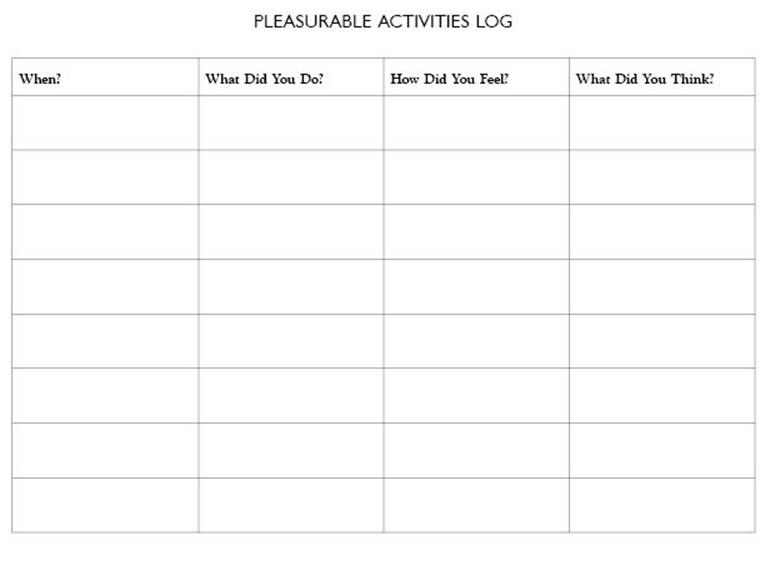
If you need help thinking of pleasurable experiences, use the Big List of Pleasurable Activities found in chapter 1 on pages 15-16. Then use the following Pleasurable Activities Log and the example to record what you did, how you felt, and what you thought about the experience. Remember, try to do something pleasurable for yourself every day. You deserve it.