
Shlomo Raz1
(1)
Division of Pelvic Medicine and Reconstructive Surgery, UCLA School of Medicine, Los Angeles, CA, USA
Electronic supplementary material
The online version of this chapter (doi:10.1007/978-1-4939-2941-2_7) contains supplementary material, which is available to authorized users.
Keywords
Urinary obstructionUrethral strictureBladder neck obstructionUreterolysisUrethroplasty
Bladder outlet obstruction in the female is rare. The patient may complain of symptoms of obstruction such as the need to strain, difficulty in starting the stream, interrupted or prolonged stream, or the sensation of incomplete emptying. The patient’s symptoms may not correlate with the residuals of urine, which can be low or high. Patients with chronic retention can present with minimal symptoms of obstruction but a significant residual of urine.
7.1 Etiology of Urethral Obstruction
Many factors can contribute to the etiology of urethral obstruction in women:
· Prior anti-incontinence surgery
· Urethral stricture
· Primary bladder neck obstruction
· Extrinsic compression
· Pelvic organ prolapse
· Neoplasm
· Infection
· Prolapsed urethral mucosa
· Urethral angulation (kinking)
After sling procedures, a number of factors can result in urinary retention and obstruction.
· Too much tension (tied too tight)
· Fixed, nonmobile urethra
· Sling that is into the urethral wall without entering mucosa
· Urethral fibrosis (post hematoma or infection)
· Sling material in the bladder or urethra
· Cystocele (secondary or primary)
· Bladder dysfunction (impaired contractility)
7.2 Diagnosis of Urethral Obstruction
The diagnosis of urethral obstruction in the female is not standard. Many patients present with clear lesions causing distal obstruction (thrombosis of distal urethra, Skene’s gland diverticula). The inability to pass a catheter in the female requires further testing and may be diagnostic of the location of the stricture. In patients with bladder neck obstruction, the passage of a catheter through the urethra can be without difficulties. Urodynamic findings like high pressures and low flow often are not present. Since the present of a urethral catheter may distort the voiding pattern of the patient during the voiding phase. Also patients with a de-compensated large bladder will not develop high pressure voiding. Radiological findings of a stricture or narrowing of the urethra in the presence of a sustained bladder contraction appear to be the most reliable method of diagnosis. Cystoscopy is important to locate the stricture location and determine the size of the stricture.
The etiology of female outlet obstruction can involve various benign or malignant lesions, functional or anatomical, as listed above. The most common reason for urethral obstruction is urinary retention after an anti-incontinence procedure. Inability to void after surgery for stress incontinence is one of the most devastating complications for a patient who was voiding normally before surgery. Technical problems are the most common reason for the obstruction, but urethral obstruction can occur in spite of adherence to the most detailed surgical technique.
With abdominal surgery, the Marshall–Marchetti operation is most prone to create urethral obstruction because of the close proximity of the suspension sutures to the urethral wall, creating fixation and fibrosis of the urethra. In the Burch bladder neck suspension, sutures are placed laterally to the urethra, leaving the urethra free to contract, funnel, and open during voiding. But in the Burch suspension, close proximity of the suspending vaginal sutures to the urethra can entrap it, producing urinary obstruction.
In vaginal surgery, this complication is seen mainly in sling procedures and bladder neck suspension procedures, and very rarely with anterior colporrhaphy. Applying excessive tension on the suspension sutures, applying the sutures too close to the urethra, or bleeding or infection owing to fibrosis are all risk factors for postoperative urinary retention.
7.2.1 Diagnosis of Inability to Void After Surgery for Incontinence
Inability to void a few days or weeks after anti-incontinence surgery should initiate diagnostic maneuvers to rule out urethral obstruction. The patient should be taught intermittent self-catheterization to eliminate the Foley catheter as a factor in persistent retention. A history of urgency, frequency, and overactive bladder symptoms is a good predictor of bladder function. The physical examination should look for the presence of a large cystocele creating obstruction, urethral fixation, and elevation or scar tissue or granulating tissue present in the anterior vaginal wall. Cystoscopy will rule out any urethral or bladder injury from accidental suture penetration. The cystoscopy can be used to assess urethral fixation. One of the important features of organic obstruction is the loss of the normal elastic mobility of the urethra while moving the cystoscope sheath up and down. Urethral dilation and calibration can be performed, but organic urethral obstruction is rarely found. Urodynamic evaluation can be performed to study bladder contractility, sensations, compliance, level of continence, and pressure-flow studies. In urodynamics, we study sensations, compliance level or continence, and pressure-flow recording; they are important to show storage and voiding function. Urodynamic studies have been not predictable or correlated with the outcome of surgery to correct obstruction. If the patient is still unable to void after 3 or 4 months, surgical correction should be considered.
7.3 Preoperative Considerations
The surgical approach to urethrolysis (takedown) surgery can be transabdominal or transvaginal. The abdominal approach is rarely needed and reserved for very selected patients in whom abdominal anti-incontinence surgery is the reason for the retention. The use of omental flaps is recommended in this situation. The vaginal approach can be used for patients in whom either vaginal or abdominal surgery is the reason for the retention. Two types of transvaginal procedures are described in this chapter: anterior vaginal wall procedures and suprameatal urethrolysis. Urethrotomies and transurethral incisions of the bladder neck are to be discouraged in patients with obstruction after anti-incontinence surgery.
7.4 Surgical Techniques
The rest of this chapter presents a variety of cases of urethral obstruction and discusses their respective treatment strategies.
7.4.1 Case 1: Urethral Obstruction After Sling
The patient is in urinary retention 2 months after the placement of an obturator sling. She is unable to void, performing self-catheterization (Figs. 7.1 and 7.2).

Fig. 7.1
Physical examination of a patient suffering from urinary retention after an obturator sling. On examination, the urethra is fixed (not mobile using Van Buren sounds), elevated, and angulated. Cystoscopy showed no erosion

Fig. 7.2
On exploration, the mesh is found deep into the urethral wall (arrows) without penetration into the mucosa. Removal of the mesh corrected the retention
7.4.2 Case 2: Urethral Erosion After Sling
This patient had recurrent urinary tract infection, pain in urination, severe obstructive symptoms, and high residuals of urine after placement of a transobturator sling (Figs. 7.3 and 7.4).

Fig. 7.3
Voiding cystogram showed an area of narrowing in the midurethra without extravasation. The arrow point the area of narrowing and deformity in the midurethra
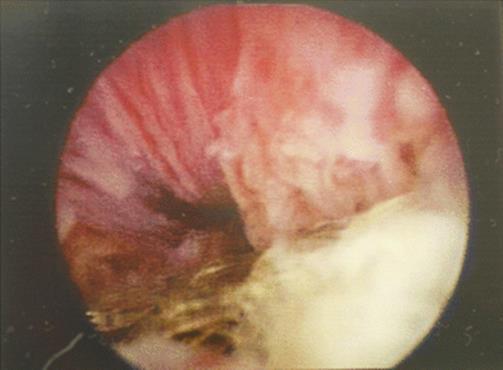
Fig. 7.4
Cystoscopy showed an erosion in the left side of the urethra that was not recognized at the time of surgery. Erosions of mesh into the urethra are unrecognized perforations during the surgery
7.4.3 Case 3: Secondary Cystocele After a Sling
The patient had a sling for stress incontinence. After voiding normally for 5 months, she started to suffer from symptoms of urinary obstruction. Postoperatively she noticed a progressive vaginal protrusion. The stream is poor and interrupted; manual reduction of the prolapse is required to void. The residual of urine is elevated (Figs. 7.5 and 7.6).

Fig. 7.5
A standing lateral cystogram shows a significant cystocele behind a highly supported urethra

Fig. 7.6
Physical examination revealed a moderate cystocele coming out of the introitus with urethral elevation and fixation. Correction of the cystocele resulted in normal voiding, relief of the obstructive symptoms, and minimal residuals of urine
Because the patient was voiding fine after placement of the sling and the obstruction occurred many months later, the sling was left intact the cystocele was repaired correcting the problem; it was not the source of the obstruction.
7.4.4 Case 4: Obstruction After a Burch Procedure
The patient suffered from urinary retention after a Burch procedure. She was using intermittent self-catheterization (Figs. 7.7, 7.8, and 7.9)

Fig. 7.7
A standing lateral cystogram shows a urethra in a high position, which is fixed and not mobile behind the pubic bone

Fig. 7.8
Transvaginal retropubic urethrolysis is initiated by performing a lateral anterior vaginal wall incision and entering the retropubic space

Fig. 7.9
The Burch sutures (Prolene sutures) are transected, and all adhesions of the bladder and urethra, from the posterior aspect of the pubic bone up to the Cooper ligaments, are freed. The patient was able to void on her own without retention
7.4.5 Case 5: Retention from Distal Urethral Diverticulum (Skene’s Gland Cyst)
A young woman is in retention of urine owing to a large, tender, cystic lesion in the distal urethra (Figs. 7.10 and 7.11).

Fig. 7.10
A large, right distal cystic lesion (Skene’s gland cyst) (arrows) displaces the urethra
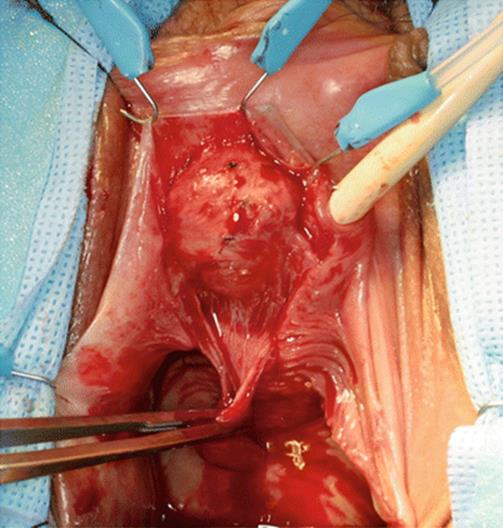
Fig. 7.11
A flap of the anterior distal vagina is performed to expose the cyst. The cyst will be excised, including the communication to the urethral meatus, leaving the urethra intact
7.4.6 Case 6: Obstruction from Distal Urethral Thrombosis
The patient developed acute urinary retention, urethral pain, and vaginal bleeding while receiving chemotherapy for advanced ovarian cancer (Figs. 7.12 and 7.13).

Fig. 7.12
A large, friable, tender mass is present in the distal urethra due to thrombosis and prolapse of the distal urethra, causing the urinary retention

Fig. 7.13
After excision of the mass, a normal urethra is seen. The patient resumed normal voiding
7.4.7 Case 7: Urethrolysis and Retropubic Martius Flap for Recurrent Urinary Retention
The patient developed urinary retention after a retropubic and an obturator sling. She had three prior unsuccessful urethrolysis procedures for retention. The urethra is not mobile and is adherent to the pubic bone and the lateral pelvic wall (Figs. 7.14, 7.15, 7.16, 7.17, 7.18, 7.19, 7.20, and 7.21).

Fig. 7.14
Exposure of the anterior vaginal wall. Two oblique incisions will be made in the lateral distal vagina

Fig. 7.15
A complete retropubic urethrolysis is performed, allowing the passage of a finger from the right to the left periurethral incisions
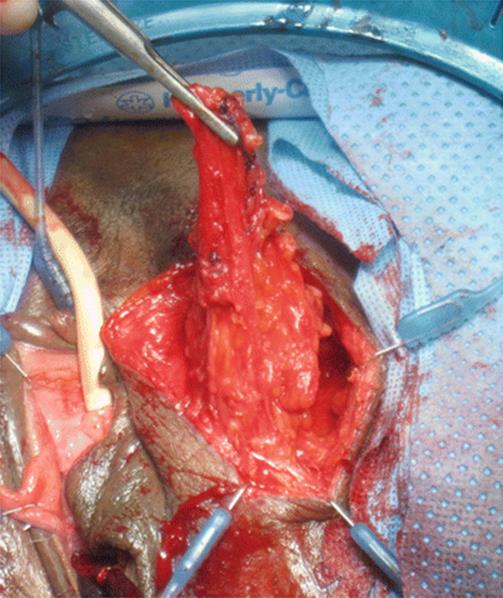
Fig. 7.16
A left Martius flap is prepared and the superior pedicle is incised, keeping intact the inferior pudendal blood supply

Fig. 7.17
A tunnel is made from the left vaginal incision to the labial incision and a large, curved clamp is inserted

Fig. 7.18
The mobilized Martius flap is transferred from the labial incision to the left vaginal incision

Fig. 7.19
An angulated curve clamp (Derra clamp) will be inserted in the right periurethral incision under finger control in the retropubic space and brought out at the left periurethral incision, where the end of the Martius flap will be anchored

Fig. 7.20
The end of the Martius flap is transferred without tension from the left to the right periurethral incision. The end of the flap (arrows) is brought outside the incision

Fig. 7.21
The anterior vaginal incisions are closed with delayed absorbable sutures. On the right side, the end of the Martius flap is incorporated into the suture to prevent displacement. The urethra is now mobile
7.4.8 Case 8: Suprameatal Urethrolysis and Retropubic Martius Flap for Recurrent Retention
The patient presented with severe urethral obstruction after two retropubic slings complicated by infection and hematoma. Prior urethrolysis failed. The urethra is not mobile and is highly fixed to the posterior pubic bone (Figs. 7.22, 7.23, 7.24, 7.25, 7.26, 7.27, 7.28, and 7.29).

Fig. 7.22
Standing cystogram confirms urethral elevation and fixation without a cystocele

Fig. 7.23
A semicircular incision is made 1–2 cm anterior to the urethral meatus. The dissection is carried out toward the periosteum of the pubic bone. The urethra is dissected free from the inferior rami of the pubic bone by detaching the pubourethral fascia

Fig. 7.24
Sagittal MRI of the urethra showing the attachment of the urethra to the inferior rami of the pubic bone by the pubourethral fascia. This fascia is the only direct connection of the urethra to the pubic bone

Fig. 7.25
Diagram of the surgical approach to suprameatal urethrolysis, with the dissection of the urethra from the inferior rami of the pubic bone

Fig. 7.26
Suprameatal exposure of the retropubic space. The urethropelvic fascia has been detached from the inferior rami of the pubic bone. Sharp dissection is carried out outside the periurethral fascia, in the direction of the anterior face of the pubic bone. With sharp dissection, the retropubic space is entered by detaching the pubourethral ligaments from the inferior margin of the pubic bone. The dissection must be kept superficial over the periurethral fascia because significant bleeding can occur if this fascia is penetrated. All adhesions in the retropubic space are freed using sharp and blunt dissection. The lateral attachments of the urethra to the lateral pelvic wall (urethropelvic ligaments) are left intact. Any sling material (fascia or synthetic) or suspending sutures are excised
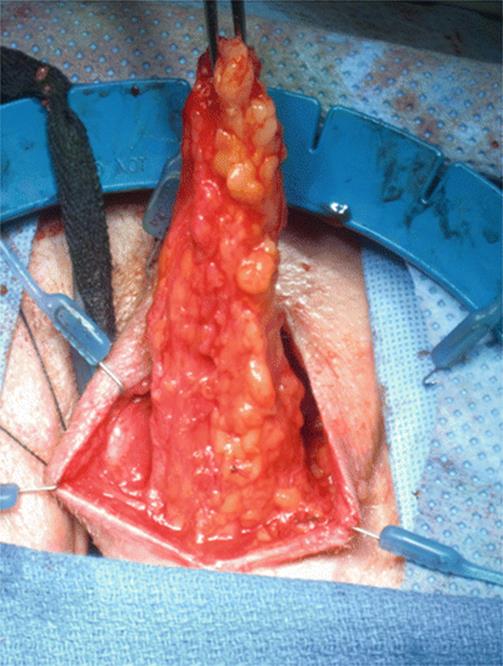
Fig. 7.27
A left Martius flap is isolated and mobilized to the base

Fig. 7.28
Diagram of the transfer of the Martius flap under the pubic bone to the retropubic space
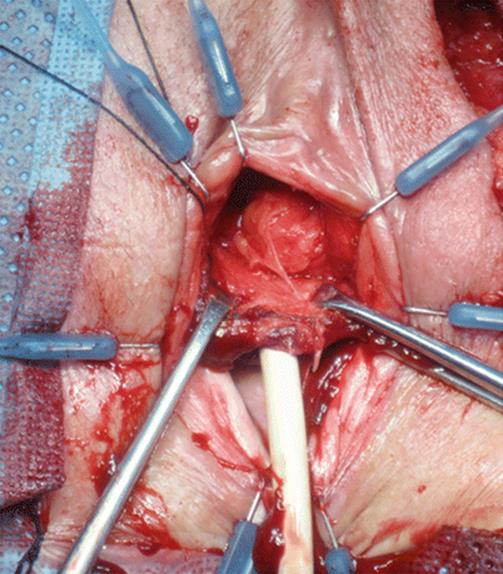
Fig. 7.29
A tunnel is made under the labia and the Martius flap is transferred to the retropubic space. The flap is anchored with absorbable suture to the anterior bladder wall and urethra to prevent recurrent adhesions. The patient resumed normal voiding after surgery
7.4.8.1 Intraoperative Complications
Bleeding of the retropubic space and periurethral area can be significant if the dissection is performed in the wrong cleavage of dissection. Bladder or urethral perforation should be repaired and a drain inserted in the retropubic space.
7.4.8.2 Postoperative Care
The operation can be performed in the outpatient setting. Ice packs and broad-spectrum antibiotics should be used in the perioperative period. Voiding trials should be postponed until the vaginal and urethral swellings subside, generally after 3–5 days. The patient may require self-catheterization for several weeks after surgery.
7.4.8.3 Postoperative Complications
Retropubic or labial incision infection or abscess may require drainage and proper antibiotic therapy. Secondary bleeding is very uncommon but can be significant. Continuation of the urinary retention may require further investigations after the healing period. Overactive bladder symptoms are common for several months after a successful urethrolysis; they will respond to cholinolytic therapy or other therapies if the obstruction is eliminated.
7.4.9 Case 9. Transurethral Incision of the Bladder Neck for Severe Bladder Neck Obstruction
A 70-year-old woman on self-catheterization for 3 years is experiencing urinary retention. She does not have urinary incontinence, has no neurological conditions, and has had no prior surgeries (Figs. 7.30, 7.31, and 7.32).

Fig. 7.30
Video urodynamics shows trabeculation of the bladder, multiple large diverticula, high-pressure voiding (detrusor pressures above 95 cm pressure), and flow of only 2 cc per second. At the time of voiding, the bladder neck is not funneling or opening

Fig. 7.31
After failing pharmacological treatment, a transurethral incision of the bladder neck was performed using the Collings knife. The incisions were done at the 3 o’clock and 9 o’clock positions

Fig. 7.32
Cystoscopy after surgery shows the bilateral incisions of the bladder neck (arrows) at the 3 o’clock and 9 o’clock locations
After the procedure, the patient does not require self-catheterization and residuals of urine are low. She remained minimally symptomatic. The diverticula were not treated.
7.4.10 Case 10: Retention of Urine Due to Periurethral Abscess After Implant of Durasphere™
The patient presented with severe urethral pain, poor interrupted stream, recurrent urinary tract infections, and large residuals of urine. A few months before presentation, she had a transurethral implant of Durasphere™ (Coloplast, Minneapolis, MN) for stress incontinence (Figs. 7.33, 7.34, 7.35, 7.36, 7.37, and 7.38).

Fig. 7.33
Exposure of the anterior vaginal wall shows a cystic and tender mass. The vaginal skin is discolored by the Durasphere™ material
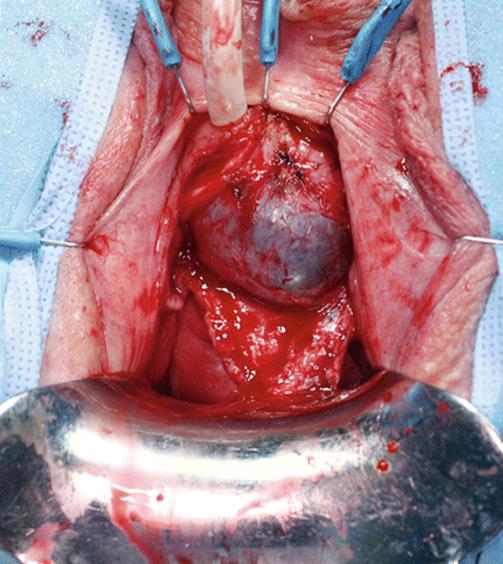
Fig. 7.34
A flap of the anterior vaginal wall is created to expose the periurethral fascia, which is very distended by the underlying collection

Fig. 7.35
Drainage of the collection shows a large amount of pus material and Durasphere™ adherent to the urethral mucosa

Fig. 7.36
After irrigation with antibiotic solution, a delicate dissection is required to excise the cystic cavity with the residual Durasphere™ material

Fig. 7.37
The anterior vaginal wall is reconstructed by approximation of the periurethral fascia to cover the urethral mucosa

Fig. 7.38
A flap of the anterior vaginal wall is advanced distally to cover the area of the reconstructed urethral wall
7.4.11 Case 11: Distal Urethral Stricture
The patient presented with recurrent urethral stricture, poor stream, elevated residuals of urine, and inability to perform cystoscopy. Urethral catheterization was possible only after urethral dilation over a guidewire (Figs. 7.39, 7.40, 7.41, and 7.42).

Fig. 7.39
Video urodynamics of the patient during voiding shows a pattern of very high pressures (true detrusor pressures of 120 cm H2O) and a flow of 6 cc per second
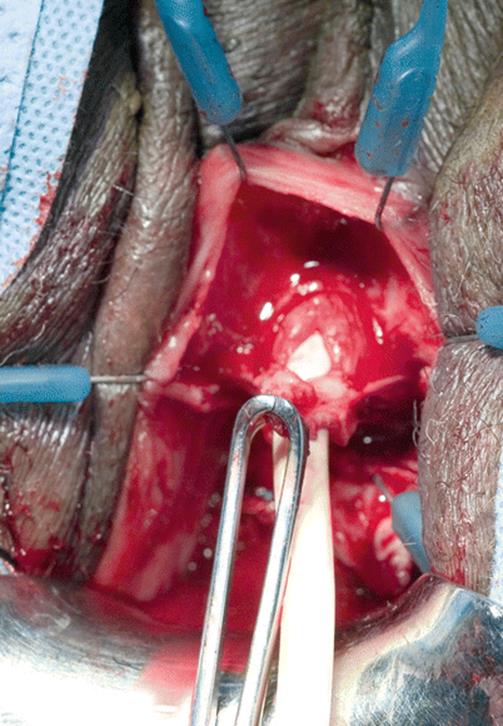
Fig. 7.40
A circular incision around the urethra was performed. A flap of the anterior distal vaginal wall was created. Exposure and incision of the distal anterior urethra were performed
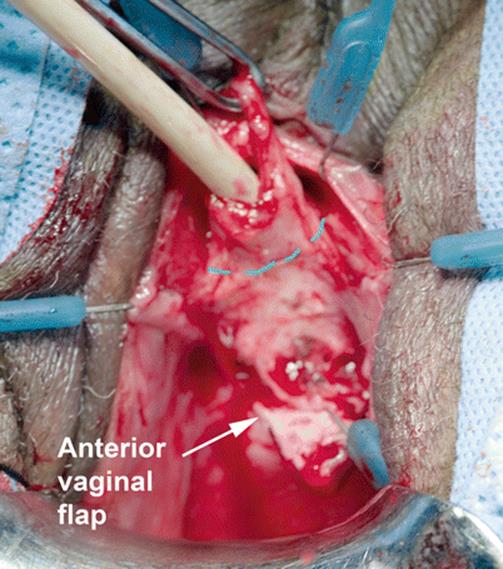
Fig. 7.41
Exposure of the distal posterior urethral wall is obtained, and a circular incision will be performed to complete the excision of the distal urethra with the stricture

Fig. 7.42
The end of the excised urethra is anastomosed to the distal vagina in a circular line of delayed absorbable sutures
7.4.12 Case 12: Repair of Midurethral Stricture using the Heineke–Mikulicz Technique
A 62-year-old patient presented with symptoms of obstruction, large post-void residuals, and difficulty in passing a catheter. She was diagnosed with a recurrent midurethral stricture. Multiple urethrotomies failed, and she required frequent dilation of the urethra to prevent complete retention (Figs. 7.43, 7.44, 7.45, 7.46, 7.47, 7.48, 7.49, and 7.50).

Fig. 7.43
Voiding cystogram demonstrating the narrowing of the midurethral area. Cystoscopy confirms the finding of a urethral stricture

Fig. 7.44
An inverted U flap of the anterior vaginal wall is created to expose the urethra. The top of the flap reaches the distal urethra

Fig. 7.45
The length of the urethra and the periurethral fascia are exposed just proximal to the bladder neck

Fig. 7.46
A transverse incision is made over the periurethral fascia, and two flaps (superior and inferior) are created to expose the urethral wall

Fig. 7.47
A longitudinal incision of the whole urethral wall is made. The urethral wall is dissected proximally and distally for a distance of at least 1 cm in each direction
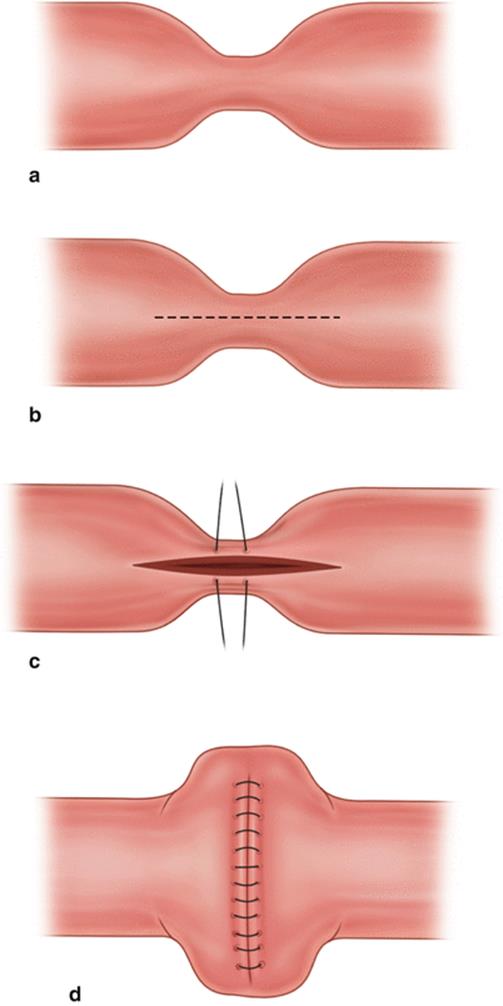
Fig. 7.48
Diagram of the Heineke–Mikulicz technique to widen a midurethral stricture (a). A longitudinal incision (b , c) is made proximal and distal to the stricture. The closure is done in a horizontal fashion (d), widening the stricture area

Fig. 7.49
The margins of the open urethra are approximated in a horizontal fashion using delayed absorbable sutures, providing a wide caliber to the urethra

Fig. 7.50
The flaps of periurethral fascia are closed in a transverse fashion, covering the urethral closure. The vaginal wall flap is advanced distally to cover the area of reconstruction
7.4.13 Case 13: Suprameatal Anterior Urethral Pediculated Rotational Labial Flap to Correct Urethral Stricture
A 67-year-old patient presented with progressive obstructive symptoms after prior vaginal surgery. The stream is poor and interrupted, and there is a high residual of urine. The patient has required numerous urethral dilations and visits to the emergency room for complete retention. Cystoscopy revealed a tight midurethral and distal urethral stricture with a length of 1.5 cm (Figs. 7.51, 7.52, 7.53, 7.54, 7.55, 7.56, 7.57, 7.58, 7.59, and 7.60). We will use a rotational vascularized labial flap to correct the stricture. Alternatively a buccal graft can be used.
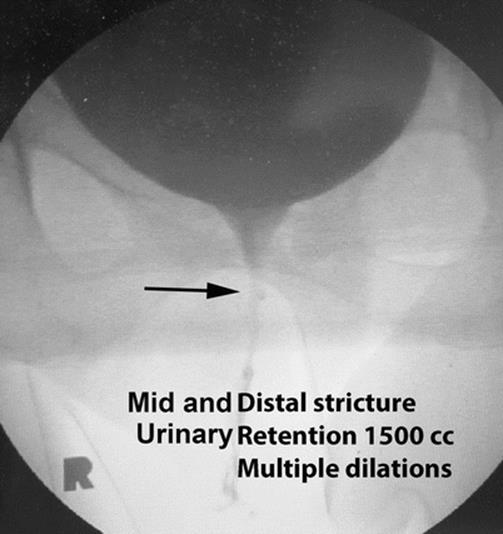
Fig. 7.51
Voiding cystogram showing the area of urethral narrowing persistent throughout the study. The post-void residuals of urine were 1500 cc

Fig. 7.52
Under cystoscopy, a guidewire and an open-ended 5-Fr ureteric catheter is inserted into the urethra. No dilation of the urethra is performed

Fig. 7.53
A suprameatal semicircular incision is made anterior to the urethra, 1 cm or more from the external meatus

Fig. 7.54
Dissection is carried out anterior to the urethra toward the pubic symphysis and the inferior margin of the pubic bone. The anterior distal urethra is mobilized

Fig. 7.55
The anterior urethra is incised from the meatus to the midurethra, until a normal wide urethral lumen is seen. The urethra is calibrated to show patency, and a Foley catheter is inserted without difficulty. A series of #3-0 delayed absorbable sutures are applied to the margins of the incision, keeping the needle for later use

Fig. 7.56
The inner aspect of the labia minora will be the donor site. An inverted U incision will be made to create the pediculated flap of the labial skin
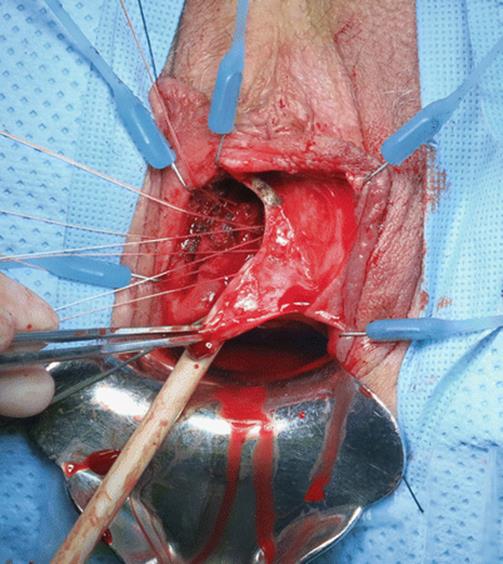
Fig. 7.57
A flap of the inner labium is mobilized, keeping the inferiorly based vascular supply intact

Fig. 7.58
The flap is rotated and anastomosed to the urethra, using the preplaced urethral sutures

Fig. 7.59
The anastomosis is completed and the fatty tissue of the inner labium is used to cover the anastomosis
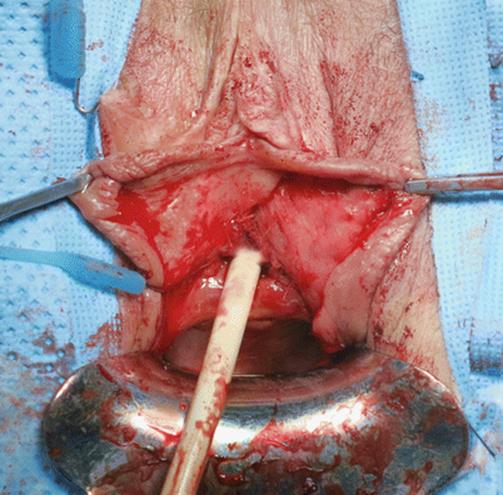
Fig. 7.60
The incision of the inner labium is closed toward the superior aspect of the urethra, using running intradermal delayed absorbable sutures
Suggested Reading
Klutke C, Siegel S, Carlin B, et al. Urinary retention after tension-free vaginal tape procedure: incidence and treatment. Urology. 2001;58:697–701.CrossRefPubMed
Laurikainen E, Killholma P. A nationwide analysis of transvaginal tape release for urinary retention after tension-free vaginal tape procedure. Int Urogynecol J Pelvic Floor Dysfunct. 2006;17:111–9.CrossRefPubMed
Sokol A, Jelovsek J, Walters M, et al. Incidence and predictors of prolonged urinary retention after TVT with and without concurrent prolapse surgery. Am J Obstet Gynecol. 2005;192:1537–43.CrossRefPubMed