James Lim, Bruce Waxman, Marcel Favilla
13.1 Introduction
Care of the injured patient begins at the scene of injury and should optimally follow a continuum of integrated care from soon after the moment of injury to definitive care in hospital and subsequent rehabilitation. Initial assessment and resuscitation should occur simultaneously to identify and manage life-threatening conditions. Once stable the patient can be assessed for definitive care that can occur in the primary hospital, but if the resources are not adequate then transfer to another hospital should be arranged.
Should the doctor fortuitously be the first at the scene where a person has been injured then they should assume leadership and establish order, delegate others to contact emergency services and protect the injured from further trauma by keeping the scene clear of bystanders and traffic, while simultaneously performing initial assessment and resuscitation. The injured patient may face environmental hazards at the scene: fire and explosion, electrocution, continuing civil or military violence, as well as inappropriate intervention by bystanders. The doctor first on the scene must be prepared to attend to non-medical priorities, like dousing fire, diverting traffic and arranging to move the injured patient rapidly to a safer environment. These first aid principles are summarised by the pneumonic ‘DRABC’ (Box 13.1) — where the initial priority at the accident scene is to identify potential Dangers (to the patient and bystanders) and to assess patient Response (conscious or unconscious).
Box 13.1
The ‘DRABC’ first aid action plan
D — Danger: Identify and manage potential dangers to the patient, bystanders or yourself. You will not be able to help if you also become injured. Move the patient to a safer environment, out of harm’s way, if required.
R — Response: Assess the patient’s response with the following: ‘Can you hear me?’, ‘Open your eyes’, ‘What’s your name?’ and ‘Squeeze my hand’. Unconscious patients should be managed in the left lateral (recovery) position.
A — Airway
B — Breathing (covered in ‘Primary survey’ below)
C — Circulation
The problem of caring for the injured patient will be divided into two components: principles of management of the injured patient and definitive care of specific types of injury. This doctrinal approach is adapted from two courses: Advanced Trauma Life Support™ (ATLS™) (developed by the American College of Surgeons, ACS) and Emergency Management of Severe Trauma™ (EMST™) (developed by the Royal Australasian College of Surgeons, by agreement with the ACS).
Each section in this chapter will be discussed under three major headings: initial assessment; adjuncts to the initial assessment (diagnostic plan); and definitive care (treatment plan).
13.2 Managing the injured patient
Initial assessment
Initial assessment is the term used to describe the clinical process of assessing the injured patient and it has three phases: a rapid evaluation of the patient to determine and treat any life-threatening problems (the primary survey); a comprehensive history, physical examination and any special investigations (the secondary survey); and re-evaluation. Once the initial assessment is completed the patient can be considered for definitive care and transfer.
Initial assessment of the injured patient is time critical; management received during the first hour directly influences patient outcomes in the longer term. In this ‘golden hour’ the main objectives are to identify life-threatening injuries and to institute early management and resuscitative measures. An ordered protocol is required and has a stabilising influence on the emotional concerns of both the injured person(s) and onlookers. Throughout this process good communication and comprehensive documentation are vital.
When conducted in a hospital environment, the examination must be conducted utilising universal precautions, to protect oneself and the patient, by wearing: headdress, mask, eye protection, gown and gloves. The patient may also require decontamination if exposed to irradiation, toxic chemicals or other harmful substances.
Primary survey and resuscitation
The primary survey is a prioritised and logical process of identifying life-threatening conditions in the injured patient. Resuscitation occurs simultaneously. When initially assessing the injured patient, whether in a hospital resuscitation cubicle or at the trauma scene, the ABCDE of trauma care must be employed:
Airway management and cervical spine protection
Breathing and ventilation
Circulation with control of haemorrhage
Disability and neurological assessment
Exposure and environmental control
A Airway and cervical spine
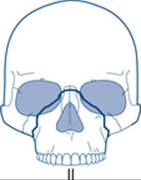
A compromised airway may occur secondary to maxillofacial or neck trauma, foreign body obstruction or simply from anatomical narrowing of the airway in the flexed neck (Fig 13.1a). In assessing the airway it is essential to simultaneously protect the cervical spine and spinal cord by avoiding excessive movement or rotation and by using an immobilising device such as a cervical collar. If the patient needs to be moved, it is important to stabilise the cervical spine with manual in-line immobilisation, which should be the sole focus of one member of the trauma team. The cervical collar should remain in place until radiological clearance has been obtained.

Figure 13.1a In the unconscious patient the tongue falls back
Simple measures to obtain a patent airway include the head tilt, chin lift and jaw thrust (protraction by lifting the angles of the mandible forwards) (Fig 13.2a). The mouth and pharynx are cleared manually of blood, vomitus or other foreign bodies (e.g. false teeth) if necessary (Fig 13.1b). An oropharyngeal (Guedel) or nasopharyngeal airway may be inserted.

Figure 13.2a Head tilt, chin lift and jaw thrust manoeuvres

Figure 13.1b Adequate airway
In the unconscious patient the airway is first cleared by making sure that the tongue is forward and that the pharynx is clear of foreign bodies.
In the unconscious patient, a definitive airway is required. This is achieved with tracheal intubation using an inflatable cuffed tube (Fig 13.2d). If the means of intubation are not available in the presence of an obstructed airway, surgical cricothyroidotomy may be required to secure a definitive airway. The procedure is not without hazard (especially in the very young, where the brachiocephalic vein may be inadvertently damaged) and requires a careful technique.

Figure 13.2d Endotracheal intubation: passage of an endotracheal tube
Nasotracheal intubation is preferable when there is a danger of cervical spine injury.
B Breathing and ventilation
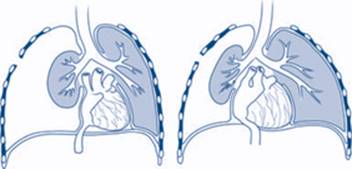
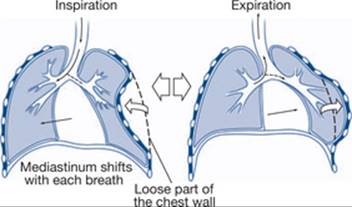
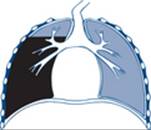
Once airway patency and cervical spine protection have been confirmed the patient’s chest should be assessed. Adequate exposure will facilitate inspection, palpation, auscultation and percussion. Thoracic injuries that may compromise ventilation include open pneumothorax, tension pneumothorax, fractured ribs or flail chest, pulmonary contusion or massive haemothorax. The clinical signs and emergency management of these conditions are indicated in Table 13.2.
Table 13.2 Recognition and initial management of life-threatening thoracic injuries
|
Condition |
Clinical signs |
Initial management |
|
Tension pneumothorax |
↓ chest wall excursion, neck vein distension/cyanosis, tracheal deviation to opposite side, unilateral absent breath sounds, hyperresonant percussion note |
The diagnosis is clinical — there is no time for a chest X-ray |
|
Open pneumothorax |
‘Sucking chest wound’, decreased breath sounds, hyperresonant percussion note |
Close the defect in the chest wall with occlusive dressing that is taped only on three sides (to create a one-way valve) |
|
Flail chest |
Paradoxical/asymmetrical movement of chest wall |
Analgesia |
|
Massive haemothorax |
↓ chest wall excursion, tracheal deviation to opposite side, decreased breath sounds, stony dull percussion note |
Insert 28 or 32G intercostal catheter |
|
Cardiac tamponade |
Beck’s triad (↓ arterial pressure, distended neck veins from ↑ venous pressure, muffled heart sounds) |
Pericardiocentesis via subxyphoid approach |
Based on www.netterimages.com and www.beliefnet.com
Oxygenation
Supplemental oxygen should be administered to all trauma patients. The conscious patient with a nasopharyngeal or oropharyngeal airway should receive oxygen via a bag-valve mask. The use of an oxygen reservoir device maximises oxygen delivery to the patient (Fig 13.2b and c) and is therefore strongly recommended.
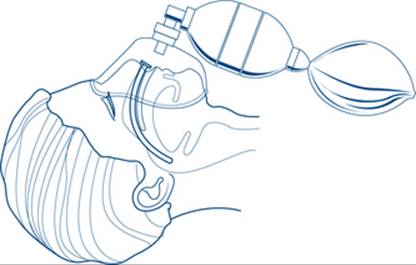
Figure 13.2b Nasopharyngeal airway with bag-valve mask and reservoir device

Figure 13.2c Oropharyngeal airway with bag-valve mask
C Circulation and control of haemorrhage
The most likely cause of hypotension in the multiply injured trauma patient is hypovolaemia secondary to haemorrhage. Haemorrhage is the most common cause of death in these patients. Useful indicators of a patient’s circulatory status include vital signs (pulse and blood pressure), skin colour and level of consciousness. The normovolaemic patient would be expected to have a pink, well-perfused face and peripheries with a full, regular pulse. In contrast, the unconscious patient with cold, mottled peripheries and tachycardia is on the verge of hypovolaemic circulatory collapse.
Although the body’s physiological response to hypovolaemia is predictable, this statement needs qualification. At extremes of age (i.e. the elderly and the young child or toddler) tachycardia may be absent in the setting of hypovolaemia. One possible reason for this is polypharmacy; it is not uncommon to find elderly patients taking beta-blockers for cardiovascular disease. Other contributing factors include chronic illness and age-related blunting of the sympathetic response to hypovolaemia. By virtue of their large physiological reserves, children (and athletes) are well able to compensate for significant reductions in blood volume. Clinical signs of hypovolaemia may be initially absent. If these patients are severely injured, decompensation is often precipitous. In caring for such patients, one cannot afford to be solely comforted by the presence of a ‘normal’ heart rate or blood pressure. Frequent reassessment during resuscitation is mandatory.
External bleeding
Haemorrhage may be internal or external. Whatever the type, local manual compression, aided by suitable
Table 13.1 Summary of airway management
|
Patient assessment |
Management |
|
Speaking |
Unlikely to have immediate airway compromise. Reassess patient. |
|
Conscious, but possibility of deterioration in airway |
Nasopharyngeal airway (better tolerated than oropharyngeal airway in conscious patients). Reassess with a view to securing a definitive airway (intubation). |
|
Unconscious |
Definitive airway required immediately via: endotracheal intubation or nasotracheal intubation or surgical cricothyroidotomy. |
dressing pads and bandaging, together with elevation of the part, will control most limb haemorrhage. Tourniquets are not advised as they can exacerbate bleeding if too loose and imperil limb viability if too tight. Massive limb bleeding may require additional temporary proximal compression of the brachial artery against the humerus in the axilla or the femoral artery against the femoral head in the groin. The use of artery forceps to control bleeding is not recommended; their application in the uncontrolled, poorly lit environment of the trauma scene may lead to unnecessary tissue damage (nerves, veins, muscle), as well as being time consuming.
Fluid resuscitation
A minimum of two large-bore intravenous cannulas (14 or 16G) should be placed percutaneously in peripheral veins and blood should be obtained for baseline investigations and for cross-matching type-specific blood.
When percutaneous access is difficult, a venous cutdown technique should be considered. The best sites are the long saphenous vein on the medial side of the ankle or any vein in the cubital fossa (Fig 13.3). Intra-osseous access in children over the upper tibia using an intra-osseous needle is very effective.
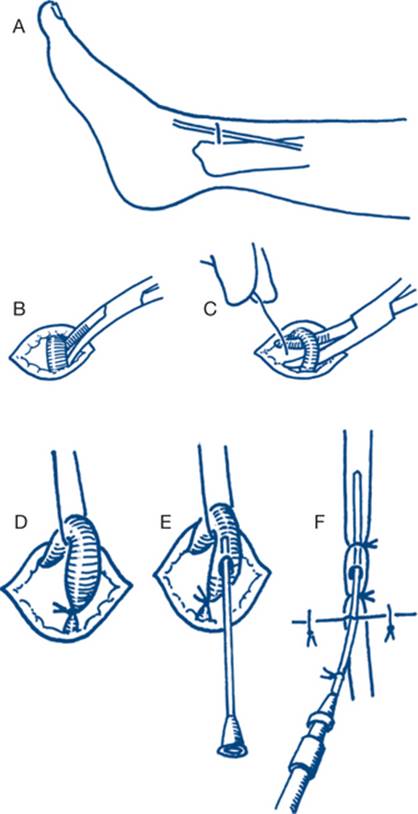
Figure 13.3 Venous cutdown
A: incision above and anterior to the medial malleolus; B: the vein margins are defined; C: a length of vein is cleared; D: the vein is elevated and ligated; E: a bevelled incision is made and the vein is cannulated; F: the catheter is tied in and infusion begins
When the rapid infusion of large volumes of fluid is anticipated the percutaneous insertion of a large bore cannula (8G) in the femoral vein in the groin is indicated. The insertion of a central venous catheter in the subclavian or internal jugular vein is more useful in monitoring the response to fluid resuscitation than in gaining access for the rapid infusion of fluids.
Intravenous fluid therapy is now commenced via a giving set with a pump, using a balanced salt solution (Hartmann’s solution) with 2 L given rapidly to achieve an appropriate response. All fluids used should be pre-warmed (37–40° C) or administered via a blood-warming device.
Blood transfusion may be necessary in the patient who fails to respond or in whom there is massive blood loss. Type-specific blood is preferred but if this is not available then type O-negative can be used. When more than four units of blood are transfused or anticipated consider the use of other blood products to prevent coagulopathy, particularly fresh frozen plasma, platelets and prothrombin. There are specific guidelines for the use of recombinant factor V and vitamin K.
During the resuscitative phase of circulation management it is vital to keep the patient warm with: pre-warmed intravenous fluid, external space blankets and/or specific devices with circulating warm air (Bair hugger).
The lethal triad that complicates the management of the severely injured patient: coagulopathy, acidosis (from poor tissue circulation/perfusion) and hypothermia, can be prevented in the primary survey by following the principles outlined above.
Surgical intervention may in some circumstances be the only effective method to stabilise the circulation.
D Disability and neurological assessment
An assessment of the central nervous system is crucial in detecting secondary brain injury. Two simple tools may be utilised — the AVPU method and the Glasgow coma scale (GCS). The AVPU method is a simple mnemonic that enables a rapid assessment of the level of consciousness:
Alert
Vocal response
Pain response only
Unresponsive
The cooperative, conscious patient may be asked to identify the site of the injuries, whereas the drowsy, head-injured patient who only responds to painful stimuli warrants reassessment of airway patency and consideration of intubation. This is seen particularly in patients with extradural haematomas, where approximately one-third will have the classic ‘lucid interval’ (see Ch 13.5).
The GCS is more commonly used during the secondary survey and will be discussed later.
E Exposure and environmental control
Complete removal of the patient’s garments is necessary to facilitate a thorough inspection and examination. Equally as important is the conservation of core body temperature. As such, once a thorough examination has been conducted, it is important to use a warming blanket to prevent the loss of body heat. Exposure to the cool of the ground, the wind or rain prior to retrieval — combined with blood loss and polytransfusion — lead to core body temperatures well below normal. The surgeon dealing with ongoing ooze during emergency laparotomy knows only too well the effect of hypothermia on the coagulation cascade. The use of pre-warmed intravenous fluids for resuscitation should be standard procedure. Patient temperature should be monitored and documented, alongside blood pressure and heart rate; it should be regarded as an important part of the vital statistics.
Investigations and procedures following the primary survey and resuscitation
During the primary survey the medical officer attempts to identify and treat life-threatening injuries in a logical, sequential manner. There are a number of useful investigations and procedures that enhance initial management of the injured patient (Table 13.3).
Table 13.3 Important investigations and procedures following the primary survey and resuscitation
|
Investigation/procedure |
Clinical value |
|
ECG monitoring |
Detection of: • arrhythmias (bradycardia/tachycardia) • myocardial ischaemia/infarction • pulseless electrical activity (PEA) in setting of severe hypovolaemia, tension pneumothorax, pericardial tamponade |
|
Transurethral bladder catheterisation |
Enables monitoring of: • urine output • response to fluid resuscitation |
|
Gastric catheterisation |
Reduces the risk of aspiration by: • gastric decompression
|
|
Arterial blood gas (ABG) analysis |
Facilitates assessment of: • acid–base status • effectiveness of resuscitation |
|
Pulse oximetry |
Provides measurement of: • oxygen saturation of haemoglobin
|
|
Blood pressure |
Blood pressure measurement may be a useful indicator of response to resuscitation, but this should be balanced by the fact that a ‘normal’ blood pressure does not necessarily indicate adequate end-organ perfusion |
|
X-rays |
Detection of injuries in primary survey: • chest XR — bony fracture, widened mediastinum, haemopneumothorax • lateral C-spine XR — cervical spine trauma • pelvis XR — Significant pelvic disruption may indicate the need for aggressive fluid resuscitation and early blood transfusion |
Many trauma units are using FAST (focused assessment with sonography for trauma) to assess for occult intra-abdominal bleeding and insist on CT scan of the neck to exclude any occult cervical spine injury.
Before moving a patient out of the emergency department resuscitation bay to have any form of diagnostic imaging, ensure the patient is stable by re-evaluating the primary survey. The patient should be accompanied by a doctor, ideally the trauma team leader.
Diagnostic peritoneal lavage
Diagnostic peritoneal lavage (DPL) involves the delivery of normal saline into the peritoneal cavity and subsequent analysis of red blood cell concentration in this fluid. In some circumstances DPL may be a valuable adjunct to the primary survey when the diagnosis of intra-abdominal trauma is considered. Based on the results, surgical intervention (diagnostic laparotomy) may be indicated. This will be discussed further in the section on ‘abdominal injury’.
Secondary survey
In assessing the trauma patient, some injuries are obvious while others may be subtle or concealed. The sucking chest wound will draw the immediate attention of the doctor, whereas the slow leak of cerebrospinal fluid (CSF) rhinorrhoea or the perineal bruise may not be discovered for some time. The secondary survey is designed to address this issue through history-taking and a comprehensive head-to-toe examination of the injured patient, including a neurological assessment.
History
The AMPLE mnemonic is commonly used to obtain important information from others (such as family or pre-hospital personnel) or from the patient if conscious and stable.
Allergies
Medications
Past medical history/pregnancy
Last meal
Events/environment related to injury
The patient will be delivered to the emergency department by an ambulance officer or paramedic who has already performed a thorough initial assessment. Respect their role in the management of the injured patient and obtain a handover of the events surrounding the injury, if you have not done so already before the primary survey. An understanding of the mechanism of trauma is always helpful in predicting the pattern of injuries sustained. Useful questions to ask an ambulance officer specifically relating to the events or environment surrounding the injury are shown in Box 13.2.
Box 13.2
Useful questions to ask an ambulance officer at handover (e.g. for motor vehicle accident)
Q. What were the circumstances surrounding the accident? (time of impact, speed of vehicles, direction of impact: head-on collision, T-boned, rear vs side impact, rollover)
Q. Was the patient wearing a seatbelt? (Or was the patient ejected through the windscreen? Airbag deployed?)
Q. What type of damage did the vehicle sustain? (Was there significant cabin intrusion? Windscreen intact? Steering column position?)
Q. What was the patient’s GCS at time of arrival? (Was there evidence of drug or alcohol intoxication?)
Q. What were the vital signs?
Q. How was the patient removed from the vehicle? (self-extricated vs assisted extrication e.g. ‘jaws of life’)
Q. What injuries does the patient have?
Q. What immediate treatments were instituted by paramedical staff? (Response to resuscitative measures?)
Q. Did any other passengers die at the scene? (provides an impression of the severity of the mechanism of injury)
Examination
The examination of the injured patient should proceed in a systematic manner. Ask a cooperative conscious patient to indicate the site of their injuries.
Head: Inspect and palpate skull and face for lacerations and contusions. Assess the eyes for pupil size and reaction, conjunctival haemorrhage and restriction of movement that may indicate extraocular muscle entrapment from orbital fracture. The bony margins of the skull and facial skeleton should be palpated to exclude tenderness or discontinuity. Inspect the nose and ears for blood or CSF leak.
Neck: All patients with significant multi-trauma or trauma to the head should be considered high risk for cervical spine injury; further assessment with C-spine imaging is mandatory. Palpate the trachea (should be in the midline position) and feel for neck crepitus (subcutaneous emphysema from underlying lung injury). The carotid arteries should be palpated and auscultated; an expanding haematoma or bruit may indicate dissection.
Chest: Check for a sucking wound or flail segment. Inspect and palpate ventilatory movements. Assess the bony components by compressing the thoracic cage and palpating the clavicles and sternum. Listen for breathing and heart sounds; inspect the jugular pulse and pressure.
Abdomen: Inspect for bruising and palpate for tenderness. Remember that clinical examination of the abdomen in the patient with multiple (‘distracting’) injuries may not be completely accurate. In many hospitals, trauma patients are admitted under a general surgical unit for a minimum period of 24 hours. In addition to facilitating the involvement of other surgical specialties, a major responsibility of the general surgical unit is to routinely reassess the patient and to exclude intra-abdominal injury.
Perineum and genitalia: The perineum should be inspected for bruising, swelling or extravasated blood at the urethra. Rectal examination should also be performed, assessing sphincter tone (spinal injury), position of the prostate in males (high-riding prostate in pelvic fractures), bony discontinuity and bleeding. The genitalia should be inspected for the presence of blood (e.g. in the vaginal vault) or external trauma (e.g. penile laceration or degloving injury).
Musculoskeletal injuries: Examine the upper and lower limbs for deformity, tenderness and function. Check for vascular or nerve impairment in the limbs, especially distal to any deformity. Inspect back, buttocks, spine and sacral areas (often after patient has been log-rolled into position). Note any wounds or deformities. If the patient cannot move their legs, check for a level of sensory loss and for anal, cremasteric and superficial abdominal reflexes.
Neurological: Glasgow coma scale (GCS)
The GCS (Figs 13.13 and 13.14) is a widely used scoring system designed to assess neurological function in three areas: eye opening (‘open your eyes’), verbal response (‘what’s your name?’) and motor function (‘squeeze my hand’). A patient who responds appropriately to these instructions has a GCS of 15 and is alert and conscious. The unconscious patient with GCS ≥8 usually requires a definitive airway.

Figure 13.13 Conscious state and head injury chart
Rreproduced with permission from Southern Health

Figure 13.14 Guide to recording neurological observation chart
Rreproduced with permission from Southern Health
Investigations and procedures following the secondary survey
There are a number of investigations and procedures that may follow the secondary survey. The elderly head-injured patient may require a CT scan of the brain to exclude a subdural haematoma, whereas the young patient with a fractured pelvis and blood at the external urethral meatus may require contrast urography to exclude trauma to the urinary tract. Other investigations may include echocardiography, endoscopy/bronchoscopy or angiography. Regardless of the indication, it is imperative that only the stable patient is considered suitable to leave the emergency department for such investigations.
Re-evaluation
Re-evaluation of the trauma patient is mandatory. The stable injured patient may quickly decompensate and become unstable either through injuries previously overlooked (e.g. intra-abdominal bleeding) or progression of known injury processes (e.g. development of tension pneumothorax in a patient with subcutaneous emphysema). Constant re-evaluation is the only safeguard against missing new findings or signs of deterioration. Parameters that need regular assessment include the vital signs and urine output. Another important aspect of managing the injured patient is ensuring adequate pain relief.
Pain relief and splinting
Morphine is valuable for pain relief and is best administered intravenously in small doses and with particular care if hypovolaemic shock is present. Subcutaneous injections of morphine are poorly absorbed and not recommended. The dosage and time of administration of opiates must be prominently recorded.
An alternative analgesia regimen on site is to use a 50–50 nitrous oxide–oxygen mixture as an inhalational analgesic.
At the scene of injury, immobilisation of the injured part before transportation is essential and materially aids pain relief. Major fractures should be splinted where the patient lies before transport, unless there is an immediate danger of fire, explosion or escaping toxic gases. For fractures of the lower leg, incorporation of moderate traction is helpful in preventing painful bony crepitus during transfer. Emergency manipulation is confined to gentle straightening of deformity when distal ischaemia is present. An obvious break in a limb with gross deformity should be gently straightened with maintained traction. When deformity is accompanied by evidence of ischaemia in the limb distal to the site, early reduction is urgent and may dramatically improve the state of the circulation. Prompt consultation with an orthopaedic surgeon is important.
Definitive care and transfer
Definitive care should be organised once the initial assessment is completed. The details are discussed by individual systems in subsequent sections. The need for interhospital transfer arises when there is a mismatch between the definitive care needs of the patient and the capabilities or resources of the treating medical team or institution. If the patient has been managed in a local hospital and initial assessment has revealed clinical problems that exceed the capabilities of that institution, early transfer should be arranged. Although time is of the essence and delays are associated with poorer outcomes, the trauma patient should be transferred to the closest, appropriate facility — rather than the closest facility alone.
Interhospital transfer
Each emergency department should have a protocol specifying which patients should be transferred and the possible modes of transportation. The following principles regarding interhospital transfer should be used as a guide.
• Life-threatening injuries (e.g. tension pneumothorax) must be treated prior to transfer, if the resources are available and if the procedure can be performed quickly.
• Once the need for interhospital transfer has been determined, do not allow investigations that do not impact on immediate management to delay transportation.
• The patient should experience no further harm as a result of transportation.
• Ongoing management of the ABCDEs should occur, with resuscitation and vigilant re-evaluation.
• Appropriately skilled medical staff should accompany the transfer patient.
• Excellent communication between the referring hospital and receiving hospital staff is mandatory (formal written notes and detailed verbal handover).
• Thorough documentation is important.
Medical records and documentation
Two important reasons for keeping meticulous records are: the patient receives a higher standard of care and detailed records are essential whenever medicolegal problems arise. The best examples of documentation describe the clinical history, findings and management in a systematic manner, reflecting the components of the initial assessment described above. Figure 13.4 is one example.

Figure 13.4 Example of medical record/documentation
Shock
Shock is an acute clinical syndrome characterised by widespread inadequate tissue perfusion and cellular hypoxia — a ‘rude unhinging of the machinery of life’. Insufficient oxygen is supplied to vital tissues and metabolic waste products are inadequately removed. In physiological terms, decreased oxygenation leads to a reduction in mitochondrial oxidative phosphorylation and subsequent anaerobic metabolism. The decreased production of adenosine triphosphate (ATP) in this setting results in cellular damage at multiple levels.
After trauma, shock within the first few hours usually results from haemorrhage, which may be concealed within the chest, the abdomen or the tissues. Occasionally, early shock is due to cardiac tamponade or tension pneumothorax. Plasma loss from burns is another cause of hypovolaemic shock in the injured patient. Sepsis is an important cause of delayed shock after the first 24 hours. In patients with acute spinal injury, neurogenic shock may result from a loss of sympathetic tone.
Clinical features of haemorrhagic shock
The clinical features of haemorrhagic or hypovolaemic shock vary with the amount of blood loss. Mild tachycardia, hypotension, poor peripheral perfusion and patient agitation are usually only present when at least a quarter of the blood volume is lost. Significant hypotension and tachycardia (together with pallor, sweating, collapsed veins, air hunger, low jugular and central venous pressures) indicate blood loss in the order of 30–40% and should compel one to search for a bleeding source and to make an urgent surgical referral. Astonishing amounts of blood can be sequestered after injury in the abdominal cavity, pelvis or retroperitoneal space without visible external swelling. The classic signs of shock may not be evident at extremes of age; elderly patients are less able to mount a sympathetic response to blood loss or may be on beta-blocker medications, while the young and fit have abundant physiological reserve.
Diagnostic and treatment plan
The hypovolaemic patient should be resuscitated with intravenous fluids (crystalloid, colloid or blood); vasopressor agents are contraindicated. Patients who continue to exhibit features of hypovolaemic shock despite initial fluid resuscitation should be presumed to have ongoing haemorrhage.
Haemorrhagic shock. In these patients, urgent operative intervention is necessary to restore circulatory stability. Bleeding may be from arteries, veins or capillaries and can be aggravated by a bleeding tendency, particularly after massive preoperative and intra-operative blood transfusions. Haemorrhage then results from dilution of coagulation factors. Significant transfusion (more than four units or more than the patient’s estimated blood volume in a 24-hour period) should warrant consideration of the need for prophylactic fresh frozen plasma, platelets, vitamin K or prothrombin. Other causes contributing to shock must be considered once hypovolaemia has been corrected or excluded.
Non-haemorrhagic shock may arise from a number of conditions, including cardiac tamponade, pulmonary embolism, tension pneumothorax, sepsis or neurogenic mechanisms. A large pulmonary emboluscauses pulmonary arterial obstruction, with hypotension and increased right ventricular pressure. Cardiac tamponade interferes with cardiac filling and decreases cardiac output, resulting in hypotension. In tension pneumothorax mediastinal shift causes a reduction in venous return that decreases cardiac output. Chest X-ray, central venous pressure monitoring, electrocardiogram, blood gas analysis and pH are important guides to diagnosis and treatment. Noninvasive monitoring with transoesophageal echocardiography (TOE) may also provide useful information regarding cardiac function. Continuing refractory shock due to severe systemic sepsis can occur later after injury and is often caused by a continuing septic focus (necrotic tissue or pus) and demands initially an appropriate antibiotic regimen and cardiovascular support and timely surgical exploration and drainage. Surgical control of the septic focus is essential because the patient will not improve until the causative focus is removed. Neurogenic shockresults from a loss of sympathetic tone, leading to bradycardia, vasodilation and hypotension.
13.3 Soft tissue injury and wound care
Wounds are open injuries of tissue. Their severity depends on the extent of penetrating and disrupting tissue damage and on the degree of bacterial contamination and factors enhancing infection.
Classification of wounds
Wounds are classified by:
• degree of bacterial contamination (clean, clean–contaminated, contaminated, dirty–infected)
• mechanisms and agents of injury:
• wounds due to kinetic, chemical, thermal, electrical or ionising radiation energy transfer
• incised (stab or knife) wounds, lacerations (tearing injuries), gunshot wounds
• low- and high-velocity missile wounds.
These classifications determine a spectrum of severity and of potential complications and markedly influence early wound management. A convenient classification is specified by the Centers for Disease Control and Prevention (CDC) is detailed below (see also Table 13.4).
Table 13.4 Classification of wounds
|
|
1 Clean wounds
These comprise uninfected surgical wounds in which no inflammation is encountered and the respiratory, alimentary, genital or uninfected urinary tracts are not entered. In addition, clean wounds are closed primarily and, if necessary, drained with closed drainage. Surgical incisional wounds that occur with nonpenetrating (i.e. blunt) trauma should be included in this category if they meet the criteria.
2 Clean–contaminated wounds
A surgical wound in which the respiratory, alimentary, genital or urinary tracts are entered under controlled conditions and without unusual contamination. Specifically, procedures involving the biliary tract, appendix, vagina and oropharynx are included in this category, provided no evidence of infection or major breaks in technique are encountered.
3 Contaminated wounds
Contaminated wounds are open, fresh, accidental wounds. In addition, procedures that have major breaks in sterile technique (e.g. open cardiac massage) or gross spillage from the gastrointestinal tract and incisions in which acute, nonpurulent inflammation is encountered are included in this category.
4 Dirty–infected wounds
Old traumatic wounds that have retained devitalised tissue and those that involve existing clinical infection or perforated viscera. This definition suggests that the organisms causing postoperative infection were present in the surgical field before the procedure.
Principles of wound healing
Observed macroscopically, the time span of wound healing varies from a few days for a sutured clean wound (first intention healing) to weeks or months for an open wound containing necrotic tissue (second intention healing). The healing processes are identical in each case, but more scarring and wound contraction occurs in second intention healing.
Phases in wound healing
There are three major phases in wound healing: haemostasis and inflammation (two to five days); proliferation (beginning from about three days); and maturation (extending over many months). Haemostasis occurs via platelet aggregation and activation of the clotting cascade. Following this, polymorphonuclear leucocytes (PMN) and macrophages migrate to the area of injury, followed by lymphocytes (inflammation). Proliferation involves fibroblastic proliferation and angiogenesis, with resultant collagen formation. During the final stage of wound healing, the collagen and extracellular matrix are remodeled (maturation). There is overlap in these phases and wound strength progressively increases. Epithelialisation over the defect begins from the first day after injury; in clean surgical wounds treated by primary closure this is completed by the second day. In large wounds left to heal by second intention the process is hastened by wound contraction but will nevertheless take significantly longer.
Factors adversely affecting wound healing
To achieve optimal wound healing, it is important to understand the factors that influence healing. The elderly patient with poor diabetic control and an infected neuropathic foot ulcer requires a substantially different treatment to the young patient with a clean incisional wound on the forearm. Surgical management decisions must therefore acknowledge the local and general factors.
Local factors
Local factors are the most common causes of failure of wound healing. Bacterial contamination, particularly when combined with a nidus facilitating bacterial growth, is followed by infection. Common factors acting as niduses are areas of dead or dying tissue, foreign bodies (including suture materials) and collections of blood, serum and lymph. Other local tissue factors — such as the adequacy of the arterial and venous circulation and lymphatic drainage and previous irradiation damage — are extremely important. Excessive tension during repair of wounded tissues inevitably leads to local tissue ischaemia, subsequent necrosis and wound breakdown (Box 13.3).
Box 13.3
Local factors that interfere with wound healing
 Bacterial contamination: the risk depends on number, duration of exposure, virulence of organism and antibiotic resistance
A persistent nidus or haematoma or foreign and devitalised material
Ischaemia
Tension
Chronic oedema
Extensive skin loss
General factors
Age, diabetes, malignancy. Advanced age is associated with impaired or delayed wound healing. This may be due to a higher prevalence of other adverse factors such as vascular insufficiency, metabolic disease, malnutrition, cancer and drugs. Diabetes may cause neuropathy and microvascular or macrovascular disease leading to tissue ischaemia. Defects in angiogenesis, granulocyte function and wound matrix formation have also been described. Patients with cancer may be malnourished and immunocompromised from treatment (chemoradiotherapy) or disease progression (Box 13.4)
Box 13.4
General or host factors that interfere with wound healing
Advanced age, especially with vascular insufficiency
Diabetes
Malignant disease
Renal failure
Steroids for chronic disease
Malnutrition: deficiency of protein, vitamins (C and K) and trace elements (Zn); seen especially in the aged and alcoholics
Post splenectomy
Shock and generalised tissue ischaemia at the time of injury
Renal insufficiency, steroid treatment, cytotoxic treatment. All markedly retard wound healing. Steroid administration inhibits the inflammatory phase of wound healing, whereas cytotoxic drugs interfere with cell proliferation and protein synthesis. Renal insufficiency may lead to uraemia or anaemia, both of which impair tissue regeneration.
Nutritional deficiencies. Adequate protein and haemoglobin levels are important nutritional factors. The wound maintains its individual energy requirements in the face of moderate body deficits. Gross deficiencies are relatively rare in surgical practice and are more likely to be found in those suffering from the chronic effects of alcohol or drug abuse or patients with prolonged malnutrition or sepsis. Vitamins (particularly A and C) and trace elements (particularly zinc) are also essential for wound healing but deficiencies are uncommon.
Definitive care
Wound care — debridement
A clean surgical wound treated by primary closure is expected to heal with a fine, thin, cosmetically and functionally acceptable scar. With contaminated non-surgical wounds, the aim of management is to gain wound closure as soon as possible by converting them to a state analogous to the clean surgical wound, that is, by removing dead and doubtfully viable tissue and foreign matter and by arresting haemorrhage. This procedure is called wound debridement, excision or toilet. (‘Débridement’, a term coined by Napoleon’s chief surgeon, literally means unbridling or opening up. It has no relation to the word debris.)
The wound must be thoroughly explored and should be enlarged on either side as far as is required to determine the extent of deeper damage. Excision of necrotic tissue proceeds in depth. Skin edges usually need only a narrow margin of excision. Partially avulsed and bruised skin flaps require complete defatting and excision of the apex of the flap back to the point of dermal bleeding. Subcutaneous fat is freely excised back to pristine bleeding fat. Deep fascia is split widely to expose underlying structures and damaged muscle is radically excised back to healthy tissue (which bleeds and contracts when cut). Free bone fragments devoid of periosteum are removed and foreign material and debris must be removed from bone ends and marrow cavities. Subsequent treatment of fractures and injuries to other deep tissues (major tendons, nerves and vessels) depends on the degree of damage and contamination.
Irrigation of the wound with warm saline should be performed during debridement and before closure. This helps remove foreign matter and blood clots; it has no additional antibacterial effect. Early administration of intravenous antibiotics is also indicated in heavily contaminated wounds, but systemic (or topical) antibiotic administration should never be used as justification for inappropriate primary wound closure. If doubt exists as to the wisdom of closing the wound, it should be left open in readiness for subsequent delayed closure.
Wound closure
Two questions are fundamental to wound closure: When should the wound be closed? and By what means? These are separate but interrelated aspects of wound closure. Timing of closure is determined mainly by the degree of bacterial contamination (risk of infection) and viability of tissue. Techniques of closure are influenced particularly by the different types of injured tissues and whether the wound involves a defect or loss of tissue.
Timing of wound closure
Immediate (primary) closure. Primary closure is preferred for clean surgical wounds and clean–contaminated wounds following debridement. For most wounds, layered anatomical closure is performed using sutures as fine as is compatible with the tensile forces acting on the wound. Absorbable sutures should be used for subepithelial tissues where possible, to minimise the risks of persisting infection due to foreign bodies. Deep repair of clean wounds may include primary tendon and nerve suture. Primary skin closure can be by suture, tapes, clips or bioglue. The wound edges can be brought together or a free graft can be used. If a defect cannot be closed without tension a skin graft can be applied or a flap repair may be required.
Delayed closure. The risks of infection and wound breakdown are high when gross and prolonged contamination is combined with severe local damage. It is safer to leave such a wound open after debridement. This allows the wound to drain freely; it can then be more safely closed at a later stage. Repair of deep tissues is also usually best deferred in dirty–infected wounds. Internal fixation of bones is inadvisable in such wounds because the risk of sepsis is high. However, external fixation using pins through normal tissue above and below the fracture site (skeletal transfixion) is permissible and may be performed. The stabilisation of the limb skeleton so achieved facilitates repair and promotes healing of the associated soft tissue injuries. This is particularly so when an accompanying arterial anastomosis is essential. The techniques of repair of tendons and nerves in dirty–infected wounds are, however, so critical that sometimes these are best delayed until the wound has healed and is free of infection.
When complex contaminated wounds breach body cavities (cranial, peritoneal, pleuropericardial or joint cavities) the linings of the cavity walls should be repaired and sealed if possible. The superficial layers should be left open, lessening the likelihood of infection in the surface wound. Deep infection must be prevented by meticulous debridement and by appropriate systemic antibiotic treatment. Deep drainage may be indicated in specific circumstances, for example, in the pleural cavity.
When the large bowel is also breached, the danger of severe infection of the peritoneal cavity is so great that it is preferable to make a deliberate enterocutaneous fistula — a stoma (colostomy) at the site of the damage. It is, for example, virtually mandatory to establish a colostomy for a gunshot wound of the colon. If the bowel is repaired, the consequences of failure are unacceptably high.
Open wounds treated by delayed closure under dressings heal by granulation tissue, forming a mesenchymal scar. Excessive scar is an acceptable price for low morbidity and mortality.
Delayed primary closure. The first few days of wound healing are phagocytic and preparative rather than fibroblastic and reparative — the continuing biological debridement complements the surgical procedure. Because of this, closure can be delayed for a few days without prejudice to the end result or to the speed of healing. If closure is performed within a few days, the tissues are still soft, with little fibroblastic activity, and the wound can readily be closed. Delayed closure is thus best done between the second and fifth days after wounding. The end result is similar to that of primary healing. If closure is deferred for more than five days, granulation tissue will have developed on the exposed wound surface. The tissues are stiffer and do not approximate well and the procedure then becomes one of secondary wound closure.
Secondary closure. A clean granulating wound can often be induced to heal more quickly by secondary closure after the first week or so. This can be achieved by either skin graft or apposition of granulating surfaces. The tissues are too rigid to allow neat or precise closure, but apposition of granulating surfaces diminishes the volume of scar tissue required to bridge the gap. The process of adherence of two granulating surfaces in such circumstances is sometimes called healing by third intention. If the defect is large and cannot be closed without tension, skin grafting of the granulating surface is, of course, preferred.
Wound closure techniques and materials
Suturing techniques use needle and suture material (either absorbable or non-absorbable) to appose subepithelial connective tissue layers neatly and without undue tension. The surface skin layer requires very accurate apposition. Skin sutures, in contrast to sutures uniting connective tissue layers, should evert the wound edges slightly. This is best achieved by the sutures on either side of the wound picking up a cone of tissue, with the base of the cone situated deeply. A reverse type of suture with the apex of the cone placed deeply tends to invert the cut edges. This may be desirable or acceptable for mesothelial surfaces but is disastrous for epithelial wounds. A vertical mattress suture may also be used to achieve eversion of skin edges. Skin staples are useful in some circumstances.
Vacuum-assisted closure (VAC™). The VAC™ system of wound closure utilises continuous negative pressure applied to a foam dressing. It is effective in managing exudative wounds; large open wounds can thus be closed by second intention, delayed primary closure or by subsequent skin grafting following VAC™ therapy.
Repair of defects. Free skin grafts will not take on bared bone, cartilage or tendon. Vascularised tissues must be transferred to the defect by flaps. Flaps can be of local or distant origin and are used extensively in plastic surgery.
Local flaps (Figs 13.5 and 13.6). Advancement describes the situation where one edge of a flap is simply advanced to cover the defect. Undermining the skin edges around a wound before suturing it effectively forms two advancement flaps. With larger defects, local flaps may be moved by rotation or transposition as illustrated. Rotation flaps rotate in the arc of a circle of which the primary defect is a segment; skin closure redistributes tension over a much more extensive suture line. Transposition flaps are pivoted to fill the gap, leaving a secondary defect that may require grafting or may be closed directly. Combined rotation–transposition flaps are common. A Z-plasty (Fig 13.6) redistributes wound tension by transposing two triangular flaps, bringing in tissue from the sides to lengthen the wound and break up tension across it. It is more commonly used as a secondary procedure to relieve contractures than in primary wound closure. It can be helpful in wounds with unequal sides and may be used to advantage to break up tension across the defect left after excision of a skin lesion. Particularly when wounds cross skin lines or cleavage lines, a Z-plasty may be used to stagger the line of the scar and place a portion of it in the crease line.

Figure 13.5 Local wound flaps
In random flaps without an axial blood supply the ratio of length to width should not exceed 1:1.

Figure 13.6 Local flaps: Z-plasty flap
Source: www.wheelessonline.com
Distant flaps are used if local tissue rearrangement is impossible or inappropriate. They may be directly applied to the defect without an appreciable pedicle or they may require a long carrier vascular pedicle. The vascular pedicle may be tubed or may be buried or tunneled to insert the flap as an island into the defect. The anatomy of flaps and their vascularity enable distinctions to be made between randomly or axially supplied flaps that determine their safe limits. A transverse rectus abdominis myocutaneous (TRAM) flap is one type of distant flap (Fig 13.7).
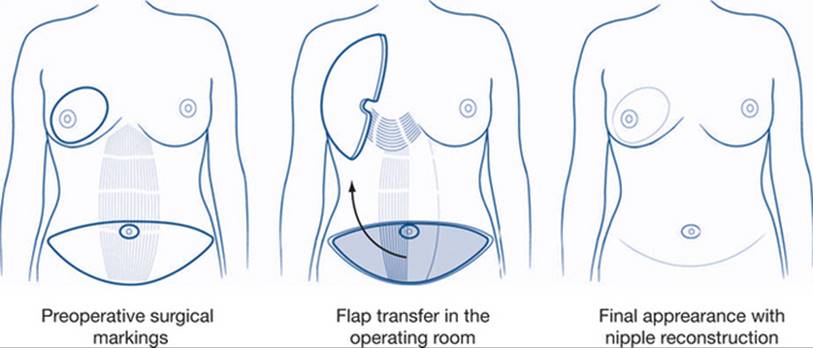
Figure 13.7 TRAM flap used for reconstruction after mastectomy
Based on Mayo Foundation for Medical Education and Research, and BRO Development
Free grafts. Free skin grafts may be split skin (Thiersch) or whole thickness (Wolfe). Skin grafting remains the most common, most simple and usually the best technique of covering a well-vascularised defect.
More complex free transfer of composite tissues may be performed by direct microvascular anastomosis of the blood supply of the composite graft to local vessels. These free flaps often involve combinations of skin, fat, muscle or bone or other vascularised tissues.
Closed soft tissue (sporting) injuries
Soft tissue (including sporting) injuries can be classified into three groups:
• direct injuries due to local blunt trauma
• indirect injuries due to overloading of muscles, tendons, synovial sheaths and ligaments
• secondary complications of overload and overuse.
Severe closed visceral injuries often produce life-threatening complications. Direct contusion to the quadriceps, gluteal and gastrocnemius muscles are common sites of sporting injuries. They require immediate recognition and care if morbidity is to be kept to a minimum. A direct blow to the quadriceps can, unless treated early, lead to severe muscle contusion with secondary haemarthrosis (which may be confused with an injury of the knee joint), periosteal contusion and sometimes muscular calcification. Severe direct injury to the buttock — another common sporting injury — may cause rupture of the superior gluteal vessels and sciatic nerve contusion. Subcutaneous haematomas and fat necrosis can cause large fluid collections that take weeks or months to resolve.
Treatment during the acute inflammatory phase of injury aims to minimise bleeding and oedema formation by methods described by the acronym RICE:
Rest of the injured part
Ice application for 20–30 minutes every few hours
Compression bandaging for 48 hours after the injury
Elevation to minimise oedema
Local heat should not be applied for at least 24 hours after injury, as this will increase blood flow, bleeding and oedema formation. Alcohol should also be avoided, as it is a potent vasodilator. Intramuscular injections of local anaesthetic or steroids are of no benefit and may introduce infection. If complete muscle or ligament rupture has occurred, early surgical repair is indicated. Fasciotomy may sometimes be necessary for compartment syndrome with impending muscle necrosis.
Later treatment during the phase of fibrous repair of the muscle or ligament requires maintenance of muscle mobility as repair proceeds. Graduated increase in use of the injured part is combined with passive and active exercises. Attention must also be given to strengthening adjacent muscle groups, particularly those that act as joint stabilisers. Early physiotherapy involvement is essential to prevent long-term limitation of movement.
13.4 Burns
Severe burns cause gross morbidity and mortality. Many domestic and industrial burning accidents are preventable. Public and workplace education concerning risks and their avoidance is of even greater importance than treatment of established burns.
History
Important points in the history are the details of the event of burning: the time it occurred; the nature of the burning agent; whether burning occurred in an enclosed space; whether respiratory difficulties exist; and whether first aid has been given, including any drugs and their dosages. Explosive burns may be associated with blunt trauma and internal injuries. Burns that occur in a confined space raise the possibility of inhalational injury, which may be associated with carbon monoxide poisoning, thermal injury to the respiratory tract or smoke inhalation.
Types
Burns are classified by the agent concerned into the following categories.
Flame burns. Temperatures and the duration of burning vary with the burning material and can reach as high as 500°C. Burns are commonly full thickness and may involve charring of deeper tissues, with very major tissue necrosis.
Scalds. The severity of scalding is related to the following factors: the scalding agent (thicker fluids retain more heat and may cause more severe burns); duration of contact; temperature of the agent; and skin thickness. Burns due to spills of hot water will more commonly be partial thickness; more severe deeper burns can occur in natural body crevices or with prolonged immersion. Burns beneath clothing may also be more severe due to retained heat in the material. Molten metal spills cause full thickness localised burns.
Electrical burns. High amperage and voltage electrical burns add the risk of electrocution to that of burning. Electrical currents travel along planes of least electrical resistance within the body. These are often along neurovascular bundles in limbs and tend to cause further ischaemic damage. The extent and severity of electrical burns are thus commonly underestimated. Only limited areas of skin necrosis may be evident at points of entry or exit, but damage to subcutaneous tissues may be extensive, although not apparent on first assessment. Rhabdomyolysis may lead to acute renal injury; these patients should be well hydrated with strict fluid balance assessment, urinary catheterisation and regular estimations of blood creatinine kinase (CK) and urea, electrolytes and creatinine (UEC). Damage to cardiac muscle may also occur with electrical burns.
Chemical burns. Chemical burns cause damage by the cytotoxic effects of the chemical which, if hot, also causes thermal damage. Acids and alkalis are common chemical agents, with alkali agents generally more able to penetrate deeper than acids. Chemical burns can cause additional damage by the agent remaining in contact with the tissues. Thus detection and neutralisation of the chemical is an urgent first aid measure, as of course is removal of the injured patient from the source of burning from any cause.
Pathophysiology of burns
The physiological response to a burn injury is complex and involves the release of numerous inflammatory mediators (e.g. histamine, cytokines, eicosanoids). The physiological response to burns occurs at both the local and systemic level.
Local response to burns: Jackson’s burn zones
In 1947 DM Jackson described the three zones of a burn and this still forms the foundation of our understanding today (Fig 13.8). The zone of coagulation is the area where the most severe thermal injury occurs: cells are necrotic and irreversible tissue loss necessitates debridement. Surrounding this area is the zone of stasis, which is characterised by decreased tissue perfusion due to changes in the microcirculation. The viability of tissue in this zone may be preserved by restoring perfusion through appropriate resuscitation. Suboptimal fluid resuscitation or subsequent infection may, however, convert the zone of stasis into one of coagulation and necrosis, resulting in a larger and deeper burn. The outermost area is the zone of hyperaemia, where tissue perfusion is increased secondary to the release of inflammatory mediators from viable cells. This area usually recovers fully in burns.
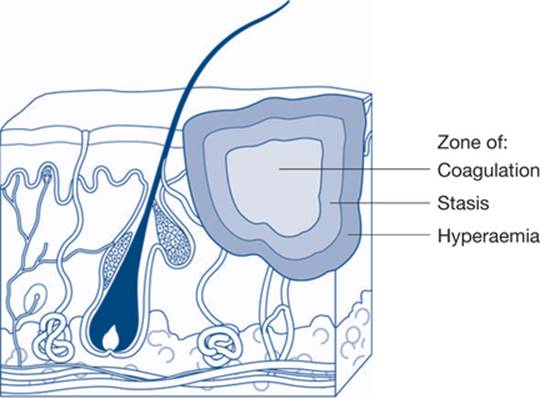
Figure 13.8 Jackson’s burn zones
Based on firstaidwarehouse.co.uk
Systemic response to burns: SIRS and MODS
The release of inflammatory mediators causes an increased capillary permeability with significant fluid shifts from the intravascular to the extravascular space. A reduction in the plasma volume contributes to hypovolaemia, which leads to shock and a reduction in end-organ perfusion. Other organ systems may be affected; bronchoconstriction and a reduction in splanchnic perfusion may exist. The resultant systemic inflammatory response syndrome (SIRS) is defined as two or more of: patient temperature >38°C or <36°C; heart rate >90 beats/minute; respiratory rate >20/min or PaCO2 <32 mmHg or leucocyte count >12,000/mm3; <4,000/mm3 or >10% immature (band) cells. Multiple organ dysfunction syndrome (MODS) exists when there is organ dysfunction in an acutely ill patient, such that homeostasis cannot be maintained without intervention.
First aid
The victim must be moved from the source of burning and fiery clothing extinguished. Treatment of associated life-threatening injuries takes first priority (airway, breathing and control of haemorrhage). Respiratory obstruction and stridor on initial assessment indicate the need for early intubation. Constrictive clothing, watches, rings or other jewelry should be removed in anticipation of ensuing oedema.
Only after an initial assessment of the patient has been performed can attention be directed to the actual burn site. Where practical the burnt area should be cooled with water. Ice is contraindicated. Makeshift clean dressings, such as sheets or plastic (polyethylene) wrap, can then be applied. The general principle is to cool the wound but keep the patient warm. Special first aid burns dressings of sterile polyurethane foam should be used as temporary dressings of major burns if available and will protect against contamination and further trauma. Greasy dressings should not be used for severe burns. The patient should be transported to the most appropriate facility for further management.
Initial assessment
On admission the priorities as with any form of trauma are to review the ABCDEs. Focused assessment of the burn patient can then proceed in relation to:
• extent and depth of burns
• evidence of inhalational burn injury and assessing need for intubation
• evidence of other injuries
• assessing patient’s weight by questioning or examination.
The magnitude of tissue destruction depends on the extent and depth of the burn. These two factors determine the mortality, morbidity and metabolic insult, initial treatment, character of healing and the functional end result. Respiratory injury should always be suspected, particularly with burns of the face and neck.
Extent of burns
The burnt area is established as a percentage of body surface area (BSA), using the ‘rule of nines’ (Fig 13.9). A cross-check is always done by estimating the area not burnt. It is important to recognise that children have different proportions to adults and paediatric charts displaying body surface area estimations are useful in more accurately estimating burn extent.

Figure 13.9 ‘Rule of nines’ — calculating the percentage distribution of burnt skin in the adult and child
A: adult burns chart B: paediatric burns chart
Classification of burn depth
Burns are most helpfully considered as either shallow or deep. Shallow burns are further classified as epidermal (first-degree) or superficial partial-thickness (second-degree). Deep burns comprise deep partial-thickness (second-degree) and full thickness (third-degree). In areas where the skin is thick (e.g. palm, sole, back, buttock) burns are more likely to be partial thickness. Where skin is thin (dorsum of hands and feet, skin around the eyes), deep burns are more likely.
Epidermal burns (first-degree). These are minor burns (e.g. sunburn) involving only the superficial epidermis. Pain and erythema result from inflammation but blistering does not occur. Healing usually occurs over days to one week, with complete regeneration of a normal epithelium.
Superficial partial-thickness burns (second-degree). Tissue death involves both the epidermis and the upper layers of the dermis. Superficial (subepithelial) blisters occur that contain fluid and electrolytes. Beneath the blisters the tissue is painful (hypersensitive) and usually has a pinkish appearance owing to an intact blood supply. Complete regeneration can occur in two to three weeks from viable dermal elements, with little scarring.
Deep partial-thickness burns (second-degree). Involvement of the deeper (reticular) layers of the dermis may also cause blistering of the skin but the underlying tissue has a mottled pinkish-white appearance. This reflects variable damage to the deeper dermis, with blood supply to some areas still viable, interspersed among islands of non-viable tissue. Left

Figure 13.10 Depth of burns
A: full thickness (deep) burn; B: partial thickness (superficial) burn
Based on Williamson & Waxman, 1998
untreated, these wounds may heal spontaneously (over three months) by surface re-epithelialisation from surviving hair follicle, sebaceous and sweat gland remnants but with a considerable degree of subepidermal scarring. Surgical excision combined with conventional skin-grafting methods will achieve a better cosmetic result.
Full-thickness (third-degree). All epithelial elements, including dermal elements, are destroyed. Such burns will heal spontaneously very slowly. A dead eschar or slough forms, which ultimately separates. Excessive granulation tissue and scarring occur; slow re-epithelialisation occurs from the periphery. Gross scarring and crippling deformities are common.
Assessment of burn depth
This may be easy with severe burns with charring and evident necrosis, but often depth is difficult to diagnose with absolute certainty on first examination. Demonstration of viability depends on detecting sensitivity to sterile pin prick (dermal viability) and demonstration of an active circulation.
Partial-thickness burns. These cause erythema, blistering and moist exudate, are soft, painful to pinprick and touch and show a circulation with blanching on pressure and refilling on release.
Full-thickness burns. These are dull white or opaque or brown and charred with visible thrombosed veins beneath a transparent glassy panniculus. They are dry without blistering or moist exudate, firm and inelastic, painless to pinprick and touch and show no capillary response on pressure. Accurate clinical assessment of depth requires a thorough and skilful examination and a cooperative and alert patient.
Burns to the respiratory tract
Singed eyelashes and eyebrows are a clue to anticipating respiratory tract burns. The mouth and nose is carefully inspected for mucosal oedema, erythema, blistering, and for carbon particles in the sputum, and the patient is observed for any stridor or dyspnoea. Evidence of upper airway thermal injury (nasopharynx oropharynx, trachea) should prompt early (immediate) intubation. Absence of these signs does not exclude a respiratory burn; frequent reassessment is necessary, as oedema may develop over a short period. Injury to the lower airway usually manifests as tracheobronchitis; these patients often have wheeze, shortness of breath and cough.
Subsequent assessment and definitive care
General management
Pain and analgesia. Severe pain is less of a problem with full thickness burning. Extensive partial-thickness burns can be extremely painful and require an adequate dose of narcotic analgesia. These patients may experience severe pain even with air currents passing across the burn surface.
Antibiotics. Antibiotic prophylaxis is not indicated, their use reserved until required for management of an established infection.
Tetanus prophylaxis is as essential in the management of burns as in management of any other traumatic wound.
Resuscitation. Large volumes of water, electrolytes, plasma and sometimes blood are lost from the burnt surface, and also into the surrounding normal tissue, due to a systemic increase in microvascular permeability. Fluid replacement must start as soon as possible after burning to prevent hypovolaemic shock. Burns over 10–15% BSA will require intravenous fluid replacement. A secure intravenous line must be established without delay in such patients. Fluid loss begins immediately after burning and is maximal during the first few hours, then gradually slows until reabsorption from tissues commences after 48 hours. Large burn wounds can thus cause the loss of many litres from the circulatory blood volume. Once the intravenous line is in place, fluid resuscitation can be planned and monitored. Delays of more than one hour should be avoided in burns over 20% BSA. The patient should be nursed in a warm environment. A urethral catheter is also inserted in patients with burns of 20% or more to help monitor fluid replacement.
Many formulae have been used as guides to initial replacement. Whatever guidelines are used, resuscitation is tailored to individual needs and the results of continuing monitoring. Resuscitation volumes and intravenous replacement derived from formulae start from the time of burning and not from the time of insertion of the intravenous line. A commonly used regimen is based on the Parkland formula:
volume replacement for the first 24 hours
= 4 mL Hartmann solution/kg weight/percentage burn BSA.
A burn of 30% BSA in a 70-kg adult may therefore require over 8L of fluid in the first 24 hours after burning. Of this replacement volume, half should be given in the first eight hours and the remaining half in the next 16 hours. For children, the same formula may be used but an additional maintenance infusion (by weight) of glucose-containing fluid (e.g. 4% NSaline and 1/5 dextrose solution) may be required to maintain the specified urine output. The addition of glucose reflects the decreased glycogen reserves in children and tendency towards hypoglycaemia.
In practice, some clinicians may reduce the amount of resuscitation fluid administered to 2 mL/kg/percentage burn in various clinical circumstances and reserve resuscitation with 4 mL/kg/percentage burn for inhalational injury, prolonged patient exposure or delayed retrieval time. The crucial point to make is that fluid resuscitation must be adequate; both under- and overresuscitation may be detrimental to the patient and should be avoided. Resuscitation formulae are limited by the accuracy of BSA calculations (which may be difficult to estimate in some circumstances) and also do not account for patients with inhalational injury (who require more fluid volumes). Monitoring urinary output with the insertion of a catheter is an invaluable clinical aid and provides an objective measure of the adequacy of fluid resuscitation.
For burns exceeding 30% BSA, a central venous line is additionally inserted and is very helpful for monitoring response. A nasogastric tube may be required to decompress the stomach in patients with severe burns, as gastric stasis is initially common. Later, it can be used for enteral feeding. For burns exceeding 50% BSA, the initial calculation is made as for 50% and modified according to clinical assessment and response. These patients should be transferred to the intensive care unit (of a specialised burns centre) for monitoring and further management.
Monitoring
Fluid replacement is monitored by the following observations.
Pulse, blood pressure, respiration rate. These will usually show no worrying changes. Hypotensive hypovolaemic shock should be preventable, provided resuscitation begins within one hour of burning. Agitation and restlessness indicate hypoxia, which should be treated with oxygen delivered by face mask at 4–6 L/minutes to give an FiO2 of 40–50%.
Urine output. This is the best guide to adequate replacement. Sufficient fluid should be given to provide for sensible and insensible losses from the burn wound and into the tissues, and to provide for a continuing urinary output of 30 mL/hr in adults (0.5 mL/kg/hr) or 1.0mL/kg/hr in young children who weigh 30 kg or less. The urine should be regularly tested for albumin, haemoglobin and myoglobin. Evidence of myoglobinuria requires urine output to be maintained at a higher level (i.e. 0.5–1 ml/kg/hr).
Central venous pressure. Central venous pressure monitoring is essential in patients with burns greater than 30% BSA. It is only occasionally necessary in burns of lesser extent. A progressively falling central venous pressure (CVP), below the normal range of 0–10 cmH2O relative to the right atrium, indicates hypovolaemia. A progressively rising CVP above 15 cmH2O indicates hypervolaemia.
Other biochemical analyses. Frequent arterial blood gas analyses and serum electrolyte (particularly serum K+) and creatinine levels are required for patients with severe burns over 30%. Carboxyhaemoglobin and random blood glucose should also be performed.
After the first 24 hours, capillary stability begins to return. Colloid (usually in the form of albumin) may be administered sparingly, although no consensus exists as to whether this is of any significant clinical benefit. Maintenance fluid replacement should continue following successful burns fluid resuscitation.
After the first 48 hours, total fluid therapy can be gradually regulated to allow a return to normal intake. Fluid reabsorption from oedematous tissues begins by the third to fifth day and is associated with diuresis and weight loss. Blood is generally not required in the early post-burn period but blood transfusion will be necessary to cover major burn wound excisional surgery.
Respiratory care: management of the airway. In severe facial burns, gross oedema of the face occurs in the first 24 hours and the adequacy of the airway must be carefully monitored, preferably by serial blood gas analyses. Intubation will be required for progressive hypoxia unresponsive to oxygen delivery by face mask. The oedema will subside within a few days; tracheostomy remains controversial and is to be avoided if possible.
Burns to the respiratory tract can be difficult to diagnose and progressive respiratory failure can result from smoke inhalation with minimal skin burning. Regular chest X-rays, blood gas and carbon monoxide estimations help in diagnosis. Severe pulmonary insufficiency will require assisted ventilation and the use of positive end expiratory pressure (PEEP) will improve oxygenation by reversing atelectasis.
Nutritional support. A major burn can result in the death of kilograms of tissue and if invasive infection supervenes, continued loss of body energy stores and weight losses and a hypercatabolic state persist. Adequate nutrition is vital. In patients with burns less than 20% oral intake is usually adequate after the first 24 hours. With burns more than 20–30%, nutritional support should be delivered through a nasogastric or nasojejunal feeding tube in preference to the parenteral route. The advantages of this are well documented: gut mucosal integrity is preserved and the incidence of bacterial translocation is significantly reduced. Where significant burnt tissue exists, maintenance of nutrition is best achieved by timely excision and early skin cover by skin grafting to avoid invasive infection. Overall patient management and burn wound management are thus intimately linked. Uncontrolled sepsis is the major cause of morbidity and mortality and can rapidly lead to a vicious circle of weight loss and further depletion of protein stores in an already immunocompromised host, with exacerbation of invasive infection.
Burn wound management
The patient is admitted to hospital (burn unit) or treated as an outpatient.
Admission is required for burns >10% in a child and >15% in adults, all deep burns, and all burns of vital or difficult areas such as face, hands and perineum.
Outpatient treatment is appropriate for superficial burns of small extent suitable for treatment by dressings.
Early wound care. The burn wound is covered with a temporary sterile dressing; local cleansing is performed as soon as the patient is stable. Cleansing and subsequent dressings are best performed in a warm environment (25–30°C) to help reduce evaporative losses. The initial cleansing of the burn wound is done gently using sterile swabs moistened with antiseptic-detergent solutions ‘aqueous chlorhexidine’ or ‘Betadine’ (povidone iodine). Adequate analgesia is essential. Obviously nonviable shards or shreds of dermal elements are excised, blisters are left unbroken unless very large and tense. Ingrained dirt and carbon are wiped gently away. Classification of some wounds may be difficult; dermal viability of wounds with uncertain burn depth may only be discovered with the passage of time or response to grafting.
Superficial (first-degree) burns. These wounds normally heal spontaneously over a week or so and require little else except simple non-adherent dressings and analgesia.
Superficial partial-thickness (second-degree) burns. If relatively clean, these wounds should be treated with paraffin-gauze dressings and left to heal over a period of two weeks. Dressings may be changed daily or every second day. In wounds with more contamination or suspected infection, the topical antibacterial cream, silver sulfadiazine (SSD), has a broad antibacterial and antifungal profile and may be used. All burn areas, including the margin with surrounding normal skin, are smeared with cream, applied with the sterile gloved hand or spatula as a buttered layer 3 mm thick, over the whole burn surface. After application of the antibacterial cream, the burnt area can be treated by one of two techniques.
• Exposure (‘open’ method). The burnt area covered with the layer of cream is left exposed, without dressings. The method is simple, economic and successful. The coating of cream is renewed every 12 hours or more often if abraded or diluted by exudation. The method is very suitable for burns of the face and perineum and for single surface burns of the extremities or trunk. It is less suitable for circumferential limb burns. Similarly, for burns of hands, exposure is an unsatisfactory method unless combined with plastic gloves to maintain finger separation and protection and continued exposure to cream within the glove.
• Dressings (‘closed’ method). The creamed burnt area is covered with a nonadherent dressing layer such as tulle and then dressed with an absorbent dressing. Dressings are suitable for superficial domestic burns, for circumferential limb burns and for burns of areas with multiple joints such as hands or feet. A plaster or thermoplastic splint can be used to maintain the part immobile in the position of rest. Burns of hands and fingers are best splinted with the wrist extended and the fingers and thumb flexed at the metacarpophalangeal joints and extended at the distal joints, to prevent joint contractures. Dressings should be changed on a daily basis. An alternative to cream is silver-impregnated dressings, which have the advantage of only requiring dressing change every third day (or longer).
Deep partial-thickness (second-degree) or full-thickness (third-degree) burns. Obviously deep burns (i.e. involving deeper layers of the dermis) should be excised as soon as possible and a split skin graft applied to the fresh surface. Left untreated, such wounds heal with significant scarring that may lead to contractures, deformity and subsequent loss of function. Tangential excision is the process whereby the burnt area is progressively sliced, using a skin graft knife (dermatome) set to take very fine surface shavings, and the exposed surface is observed for the presence of bleeding. The presence of circulation confirms viable tissue and a meshed split skin graft can be applied to the surface that first shows punctate haemorrhages, to facilitate healing and return of function. This process is used predominantly in partial-thickness burns. For full-thickness burns, fascial excision is more commonly used and involves the removal of the burnt tissue down to the level of the underlying fascia.
Escharotomy and fasciotomy. Escharotomy (Fig 13.11) involves an incision through burnt skin (eschar), to release any constriction that may compromise circulation. It is urgently indicated in burns that encircle the body wall (leading to abdominal compartment syndrome or restriction of respiration) or limb (threatening neurovascular supply). Electrical burns causing injury to deeper tissues may lead to significant swelling and increased compartment pressures and may require fasciotomy.

Figure 13.11 Locations for escharotomies
The incisions are placed along the mid-medial and mid-lateral lines of the extremities and the thorax (dashed lines). The skin is especially tight along major joints, and decompression at these sites must be complete (solid lines). Neck and digital escharotomies are rarely necessary.
Based on Brunicardi et al, 2005
Later care. The patient with a severe burn requires prolonged follow-up to prevent or treat late deformities and to aid rehabilitation. Skin destroyed by burns, even when excised early and replaced by a split skin graft, may never regain full function and convalescence is often slowed by painful and hypertrophic scars. A multidisciplinary approach to burn management is critical in improving patient outcomes and is the core strategy of burn units throughout the world. Physiotherapists and occupational therapists with training in burns physical therapy form an integral part of the team.
13.5 Head injury
Classification and definitions
Traumatic head injury may affect the scalp, brain or skull. Most head injuries are closed and follow blunt injury. Scalp wounds are common and mainly of importance as a source of significant haemorrhage or infection. Traumatic injury to the brain is either classified as primary or secondary. Primarily injury refers to damage sustained at the time of impact. This occurs from compression, stretching and shearing stresses or by collision with the skull or dural structures such as the falx or tentorium. The damage may be directly under the site of impact (coup injury) or diagonally opposite the site of injury (contrecoup) because of the to and fro movement of the brain (Fig 13.12a). Primary injuries can be further classified into ‘focal’ (contusions, lacerations, skull fractures, intracranial haemorrhage or haematoma) or ‘diffuse’ (diffuse axonal injury or concussion). Secondary brain injury usually develops hours to days after the initial impact (primary injury) and may be due to cerebral oedema, raised intracranial pressure, hydrocephalus or brain herniation. A significant goal of managing the head-injured patient is preventing secondary brain injury.

Figure 13.12a Mechanism of contrecoup injury
Primary injury: focal lesions
Contusions are brain surface bruises that occur mainly in the temporal and frontal lobes during acceleration/deceleration injury. Symptoms (most commonly prolonged confusion) usually persist for more than 24 hours. Depending on the site of contusion, focal neurological signs may be present. Most patients with cerebral contusion recover over a period of days, but some may develop secondary brain injury from raised intracranial pressure or cerebral oedema. Seizures may also occur.
Lacerations result from severe trauma to the brain; focal neurological deficit is invariable and is often permanent.
Skull fractures significantly increase the likelihood of underlying brain injury and may be classified according to whether they are open or closed, by morphology (linear vs stellate vs depressed) or by site (cranial vault vs base of skull). Depressed skull fractures imply a significant impact, with the potential for the fractured fragment to cause underlying dural penetration or brain laceration. Such injuries may increase the risk of infection (meningitis) by providing a portal of entry for bacteria. Basilar (base of skull) fractures usually involve the temporal bone and are characterised by the following clinical features: CSF otorrhoea or rhinorrhoea (from dural trauma); periorbital ecchymosis (raccoon eyes); ecchymosis around the mastoid process (Battle’s sign); haemotympanum (disruption of the temporal bone that houses the middle ear); and cranial nerve deficits (nerves III, IV and VI — from disruption of the cavernous sinus).
Intracranial haemorrhage may be extradural, subdural or intracerebral. Extradural haematomas (EDH) result, in most cases, from laceration of the posterior branch of the middle meningeal artery adjacent to a skull fracture. This leads to a unilateral increase in intracranial pressure. Only about one-third of patients have the classic ‘lucid interval’. There may be no initial loss of consciousness or minimal concussion with a rapid recovery of normal brain function. Prodromal features include increasing headache and restlessness, and oedema and bruising of the scalp over the fracture. With increasing size of the haematoma the temporal lobe is compressed, CN 3 palsy develops, increasing hemiparesis of the opposite side and eventually transtentorial herniation of the mid-brain occurs (Fig 13.12b). CT scanning typically reveals a biconvex, hyperdense, lenticular lesion that does not extend beyond the suture lines (sites of dural attachment).

Figure 13.12b Coronal section of a patient undergoing herniations of the brain caused by an EDH
A and B based on Williamson & Waxman, 1998
Subdural haematomas (SDH) are the most common intracranial space-occupying lesion complicating head injury. Unlike the arterial bleeding in EDH, the slower venous bleeding in SDH may delay clinical presentation. Classification of SDH is by time from injury: acute (<24 hours), subacute (24 hours to two weeks) and chronic (two weeks or more after trauma). Symptomatic acute SDHs are usually associated with severe brain damage and cortical lacerations, with bleeding from torn veins running from the cortex to the dural sinuses or from the venous sinuses themselves. Many patients with an acute SDH have a poor prognosis and surgical intervention is often not curative. Subacute and chronic SDH are a particular problem in the elderly, where poor memory for past events and injuries can delay diagnosis. Headache is the main presenting symptom. Features on CT scan include a hyperdense, crescentic lesion with associated mass effect and midline shift. The lesion often extends beyond the suture lines and may cover the surface of one hemisphere.
Intracerebral haematomas (ICH) occur in severe trauma and comprise haemorrhage deep within the substance of the brain (usually frontal and temporal lobes). Secondary brain injury may occur with raised intracranial pressure and bleeding into ventricles may cause obstructive hydrocephalus.
Primary injury: diffuse lesions
Concussion is classically defined as a temporary disruption of neurological function associated with posttraumatic amnesia that usually resolves within six hours. There may be associated loss of consciousness and autonomic dysfunction. Common clinical features include retrograde amnesia, headache, dizziness and nausea. It is generally accepted that the duration of amnesia is an accurate reflection of the severity of concussion. On clinical examination, there are usually no focal neurological signs.
Diffuse axonal injury (DAI) is common after head injury and is defined as a coma that persists for at least six hours and occurs immediately after trauma. Classification is into mild, moderate or severe, depending on the duration of coma. The underlying cause for the condition is thought to be diffuse disruption of axonal white matter tracts secondary to shearing trauma. Patients with mild DAI regain consciousness between six and 24 hours and exhibit a relatively complete recovery. In severe cases the patient may be in a prolonged coma, suffer from secondary brain injury and never regain consciousness.
Secondary injury
Raised intracranial pressure (ICP) is defined as CSF pressure greater than 15 mmHg. The physiological basis for raised ICP is best illustrated by the Munro-Kellie doctrine. The basis for the hypothesis is that the total volume inside the cranium (i.e. comprising brain, CSF and blood) is fixed and that the cranial compartment (dura and skull) is essentially incompressible. The assertion therefore is that any increase in the volume of one component (e.g. brain) must result in a compensatory reduction in the volume of the other components (e.g. CSF and blood). These compensatory changes in the volume of CSF and blood enable the intracranial pressure to be maintained at normal levels between 10 and 15 mmHg. Elevations of ICP under 25 mmHg may result in significant brain injury if prolonged and elevations above 40 mmHg may cause severe injury or death. Intracranial pressure may be increased by numerous factors, including intracranial haemorrhage, cerebral oedema or hydrocephalus.
Cerebral oedema occurs when there is excess water within the brain parenchyma. Two main forms are described: vasogenic cerebral oedema (due to disruption of the tight endothelial junctions of the blood brain–barrier) and cytotoxic cerebral oedema (sodium–potassium cell membrane pump failure). The resultant increase in the volume of the brain can cause a precipitous rise in ICP once compensatory mechanisms are exhausted.
Brain herniation occurs when ICP is elevated and describes the displacement of brain tissue across structures within the skull (e.g. tentorium cerebelli, falx cerebri) or through the skull (i.e. foramen magnum). Patients with brain herniation usually do not survive.
Initial assessment
Patients presenting with depressed conscious level and a potential head injury may be very difficult to assess. Collapse, followed by a mild head injury, is a common sequence of events in the unconscious patient. One should always assume initially that the head injury is primary, rather than secondary, but a careful history, from as many sources as possible, will help to answer this vital question. Common conditions leading to collapse and associated head injury are epilepsy, subarachnoid haemorrhage, stroke, myocardial infarction, drug overdose, diabetic coma and hypoglycaemia. Alcohol and head injury is the most frequent combination. It is always safer to assume that a significant head injury may be the basis of unconsciousness or a confusional state in these patients.
Approach to the head-injured patient should proceed along the same principles discussed — primary survey and resuscitation, followed by the secondary survey and finally re-evaluation. The only difference is the urgency of the neurological assessment; this should be performed at the earliest opportunity once the patient has been stabilised. Although the broad concepts have already been covered earlier, specific points pertaining to the head-injured patient will be discussed briefly.
Primary survey and resuscitation
Airway management in the severely head-injured patient is vital. The patient should also be presumed to have a cervical spine injury and particular care must be taken to support and protect the cervical spine at the same time as maintaining airway patency. A poorly managed airway is the most common cause of secondary brain injury. Cerebral injury may lead to centrally mediated respiratory depression or coma and securing a definitive airway (early intubation) is crucial.
As a general rule shock is not due to the head injury alone. Hypotension in these patients should still be assumed to be secondary to hypovolaemia or haemorrhage, rather than from primary brain injury (which is possible but less likely). Intravenous access should be obtained and fluid resuscitation commenced while any obvious haemorrhage is controlled. Significant blood loss from scalp lacerations can occur before arrival at hospital. The combination of such lacerations with the vasodilation secondary to alcohol intoxication can lead to hypovolaemic shock. Cerebral perfusion pressure (CPP) is equal to the mean arterial pressure (MAP) minus the ICP. For this reason, hypotension (decreased mean arterial pressure) is not tolerated by the brain and results in cerebral injury.
Once the patient has been stabilised, a brief neurological examination should be performed. The level of consciousness is the most important measure of the patient’s progress and is graded by eye opening, verbal and pain response according to the GCS. Determination of the GCS enables stratification of the patient into the mild, moderate or severe head injury category.
Secondary survey
Trauma severe enough to cause head injury often results in additional injuries to other parts of the body. Systematic (head-to-toe) examination aims to exclude or diagnose other injuries — in particular injuries to the chest and abdomen. Such injuries often produce hypoxia and shock that, unless promptly dealt with, will significantly decrease the chance of neurological recovery.
Examination of the scalp and face
The scalp must be scrupulously examined so that penetrating wounds are not missed. Subgaleal haemorrhage may cause irregularities in the scalp contour, which can suggest underlying skull fracture. Basal skull fractures may lead to bleeding from the ear, otorrhoea or rhinorrhoea from CSF leak or bilateral ecchymoses confined to the orbits and not extending out over the supra-orbital ridge. It is very important to recognise CSF rhinorrhoea. Facial injuries commonly accompany head injuries and their significance should not be underestimated in early management; intubation and maintenance of an airway may be extremely challenging in these circumstances.
Abnormal neurological signs
A baseline assessment of the neurological state (GCS) is essential (if not already performed in the primary survey). Pupil dilatation is the best guide to the side of a developing space-occupying lesion. Constriction in response to light indicates function of both the optic nerve and the oculomotor nerve, the latter conducting the parasympathetic constricting fibres. A baseline observation of equal and reacting pupils is required before a dilated pupil can be unequivocally attributed to ipsilateral extradural haemorrhage. A fixed dilated pupil may be present from the time of injury due to optic nerve damage. Paralysis of pupillary constrictor fibres in the occulomotor cranial nerve often denotes unilateral cerebral compression. The other cranial nerves are also tested (Table 13.5).
Table 13.5 Head injury: testing of cranial nerve function after head injury


Increased ICP from an expanding supratentorial mass is usually associated with transtentorial or temporal lobe herniation of the mid-brain. A triad of signs is produced by pressure on the upper mid-brain. There is progressive CN 3 palsy with loss of medial rectus function and sluggish or absent pupillary constriction in response to light in a dilating pupil.
Motor disorders follow compression of the motor region of the frontal lobe. Increasing contralateral weakness may be accompanied by Jacksonian epileptic seizures affecting these areas.
In the patient with diminished consciousness, motor weakness is recognised by diminished pain response on the affected side and dropping of the affected limb when it is released after lifting. Further mid-brain compression causes progressive loss of consciousness because of depressed reticular function. Testing of reflex function is of limited usefulness in the diagnosis of an expanding unilateral lesion. Papilloedema is not always a feature of increased ICP.
Vital functions are also recorded. These are of most value in monitoring the state of other systems but they may give warning of cerebral compression. Typically this is signified first by slowing of the pulse rate, then a progressive rise in systolic blood pressure and finally slowing of the respiratory rate. By the time respiratory rate slows the process is advanced and recovery less likely.
History
The history of the injury (including ‘AMPLE’) is obtained from the patient or from observers. Of particular interest are: the time, place and circumstances; the sequence of events; the severity of the injury; and the presence of early neurological signs such as convulsions, paralysis, speech disorders and loss of consciousness. A history of initial loss of consciousness then temporary recovery (the lucid interval) suggests the possibility of EDH — the most eminently treatable complication of head injury.
Re-evaluation
A standard head injury observations chart is required so that progress of the patient’s consciousness, eye signs, pain response, motor function and vital signs is recorded. Any deviations in trends or changes in neurological status can thus be recognised and treated promptly (Figs 13.13 and 13.14). Clinical deterioration is best detected by serial examination.
Investigations
Plain X-ray
Plain X-rays of the skull are only indicated when CT scanning is not available. They may also be used in the setting of penetrating head injury, where it may be useful to determine the number or characteristics of intracranial foreign bodies. CT scanning can then be used to ascertain the exact location of the penetrating objects. When performed, several varieties of skull fracture may be seen on plain X-ray; all signify that the patient has suffered a significant head injury. Simple linear non-displaced vault fractures require no specific treatment, although fracture lines that cross the middle meningeal groove or major dural venous sinuses raise the possibility of EDH or SDH, respectively. Depressed skull fractures are readily detected on X-rays and may require surgical elevation. Compound (open) fractures, where the skin is breached adjacent to a fracture, require wound debridement and closure. Basal fractures may be internally compound and complicated by CSF leak into the nose or ear, with the dangers of meningitis and brain abscess. The presence of skull fractures significantly increases the likelihood of underlying traumatic brain injury and is a strong indication for immediate CT scanning. Other plain X-ray findings requiring further evaluation with CT scanning include subarachnoid or intraventricular air. A normal skull radiograph does not exclude intracranial injury.
CT scan
A non-contrast CT scan is the ideal investigation in all cases of head injury, especially if accompanied with a history of loss of consciousness or amnesia. The scan can be acquired rapidly and most emergency departments have protocols in place to determine which head-injured patients require CT scanning. These algorithms take into account GCS, presence of fracture, amnesia, seizure activity, focal neurological deficit, age, presence of coagulopathy and mechanism of injury. CT scanning may demonstrate skull fractures (on bone windows) or intracranial haematomas (on tissue windows). Other important radiological features include midline shift, herniation, petechial haemorrhage, hydrocephalus, intraventricular blood or air and cerebral oedema. There is no further benefit in ordering skull X-rays once CT scanning has been performed.
Lumbar puncture
There is very little place for lumbar puncture in the patient with head injury. In the patient with increased ICP, lumbar puncture may induce fatal brain herniation.
Magnetic resonance imaging (MRI)
MRI is not usually indicated in the immediate assessment of the head injured patient; it is time consuming, may not adequately define acute haemorrhage and lacks sensitivity in detecting bony injury. It is, however, useful in patients with persistent neurological dysfunction despite normal CT scan results. MRI is superior to CT scanning in detecting abnormalities associated with diffuse axonal injury and may demonstrate small cerebral contusions not otherwise detected by CT.
Cerebral angiography
Angiography is rarely indicated in the patient with an acute head injury. It is only indicated when CT scanning is not available and a vascular injury (i.e. dissection) is suspected.
Definitive care
General principles of management
Intravenous fluid resuscitation. The treatment of hypotension in head injury should be with intravenous infusions of normal saline or Hartmann’s solution. Hypotonic solutions such as 5% dextrose should not be used; hyponatraemia may lead to cerebral oedema and subsequent coma or death.
Mannitol. The use of osmotic agents such as mannitol (a sugar alcohol or polyol) is indicated in patients with increased ICP who demonstrate deterioration in neurological status. Intravenous bolus administration causes water to be drawn into the intravascular space by osmosis; this reduces cerebral oedema and brain volume, with a resultant decrease in pressure. Dosages of intravenous mannitol range from 0.25–1 g/kg and administration should be in consultation with a neurosurgeon. Urine output, blood pressure and serum electrolytes should be monitored closely.
Ventilation. Hypoxia must be avoided so that optimum cerebral oxygenation is maintained. An increase in PaCO2 causes cerebrovascular dilatation and an increase in cerebral blood flow, which tends to increase ICP. A fall in PaCO2 on the other hand causes cerebral vasoconstriction that can reduce ICP. In the patient with persistently raised ICP despite sedation, a limited period of hyperventilation (to keep PaCO2 in the range of 30–35 mmHg) may be used in the acute setting to reduce the pressure. It is generally accepted that a PaCO2 of less than 25 mmHg may cause significant cerebral ischaemia from vasoconstriction and should be avoided.
Steroids. There has been no convincing evidence in the literature to support the use of steroids in the management of acute head injury or raised ICP. They are not recommended.
Seizure prophylaxis. Approximately 10% patients who sustain a significant head injury develop early posttraumatic seizures. Early seizure activity in these patients may additionally traumatise the brain through secondary mechanisms and raised ICP, and anticonvulsant therapy is an effective preventative strategy. Drugs such as diazepam or phenytoin may be used in the acute setting. The long-term risk of posttraumatic seizure development, however, is not reduced by early administration of anticonvulsants.
Management of mild head injury (GCS 14–15)
The vast majority (approximately 75–80%) of all patients presenting to the emergency department with head trauma will have a minor injury. Most of these patients will recover completely and only a small minority will develop complications. At the very least, patients with mild head injury should be kept in the emergency department and observed for 12–24 hours and subsequently discharged with written advice if they remain asymptomatic, not intoxicated and when there is no clinical deterioration. In practice it is not possible to perform a CT scan on all patients with minor injury; risk stratification dictates which patients should be scanned. In general, those who present with loss of consciousness and amnesia for the traumatic event should be scanned, whereas the asymptomatic patient with GCS 15, alert and non-intoxicated may simply be observed for 12–24 hours. Advanced age (>60 years old), severe mechanism of trauma, headache and vomiting, drug or alcohol intoxication or seizure activity are some factors that warrant CT scanning and admission into hospital.
Management of moderate head injury (GCS 9–13)
Approximately 10% of head-injured patients presenting to the emergency department will have a moderate injury. These patients frequently have been involved in a motor vehicle accident and a large proportion suffer from intracranial haematoma (EDH or SDH). Clinical presentation is varied but includes confusion, headache, somnolence, amnesia, seizures and vomiting. Focal neurological signs may also be present. All of these patients should undergo CT scanning and admission into hospital (under a neurosurgical bedcard) for close observation and serial examination. A repeat CT scan may be indicated to investigate changes in neurological status or to assess for progression of known lesions.
Management of severe head injury (GCS 3–8)
One in 10 patients will be classified as having a severe head injury on presentation to the emergency department. These patients require a structured approach, described above, incorporating the ATLS™ principles of primary and secondary surveys with simultaneous resuscitation, management and frequent reassessment. Outcome following severe head injury is relatively poor, with less than half of adult patients surviving and of these, a significant proportion experiencing severe neurological deficits.
Management of specific complications
The treatment of head injuries can lead to a number of potentially dangerous complications that clinicians must be aware of (Box 13.5).
Box 13.5
Complications of head injury
Open and depressed skull fractures
Intracranial haemorrhage and cerebral compression
CSF leak, meningitis and intracranial abscess
Posttraumatic epilepsy and post-concussion syndrome
Facial injuries: airway, fractures
Compound or depressed fracture of the skull. The main aim in treating open fractures (in the absence of significant underlying brain injury) is to prevent infection. Debridement and closure of scalp wounds should be performed as soon as practicable. The amount of skin excised is determined by skin mobility, as well as the extent of damage to skin, but wounds of the scalp heal well, so tissue can usually be preserved. Debridement of imbedded foreign material and identification of underlying skull and cerebral damage is very important in minimising complications. In addition to infection risk, depressed fractures are also associated with a higher risk of early posttraumatic seizures; anticonvulsant therapy may therefore be indicated in the emergency department.
Depressed fractures are elevated if the depression is significant (i.e. if the depressed segment is at a deeper level than the adjacent inner table of the skull). This is done through an adjacent burr hole. Only completely detached fragments of bone are removed and with caution to avoid further damage to the underlying dura. All depressed fractures should be evaluated with CT scanning to exclude underlying intracerebral haematoma or contusion.
Intracranial haemorrhage. EDH: Current thinking (ATLS™) regarding the emergency management of EDH recommends that patients be transferred to a facility with neurosurgical services. In patients who are rapidly deteriorating due to expansion of the haematoma or, where neurosurgical facilities are a considerable distance away, an emergency burr hole may be life-saving. The procedure is not without risk, however, and should not be attempted without consultation with a neurosurgeon. The burr hole itself may cause direct trauma to the brain or contribute to intracranial haemorrhage. Furthermore, a well-positioned burr hole may only partially evacuate the haematoma.
SDH: These result from slower, venous bleeding. Early neurosurgical consultation is necessary and most patients undergo formal surgical evacuation in theatre.
Intracerebral haemorrhage, forming a localised haematoma in the brain, is uncommon. The early signs are of a focal expanding lesion. Operative decompression may be indicated when there is a local intracerebral lesion seen on CT scan.
CSF leak, meningitis and intracranial abscess (Fig 13.15). In most cases with CSF rhinorrhoea or otorrhoea, the leak will close spontaneously. CSF rhinorrhoea is detected by noting a thin nasal discharge, which must be distinguished from the discharge of allergic rhinitis. Beta-2-transferrin is found almost only in CSF and its presence in fluid assay confirms the diagnosis of CSF leak. Blowing the nose or sitting up should be avoided so that chances of retrograde CSF flow are minimised. There is no current evidence to support the routine use of prophylactic antibiotics. Rhinorrhoea is more likely to cease spontaneously than otorrhoea.

Figure 13.15 Complications of basal skull fracture
A: anterior fossa fracture with posterior conjunctival haemorrhage, CSF rhinorrhoea and epistaxis; B: middle fossa fractures with bleeding and CSF leak from the ear
The onset of meningitis should be suspected in the patient who develops fever and toxicity, with headache, restlessness, photophobia, vomiting and meningism. Lumbar puncture is indicated under these circumstances to obtain fluid for culture of organisms and antibiotic sensitivity. Empirical antibiotics should be commenced.
Intracranial abscess may be extradural, subdural or intracerebral. It should be suspected in the patient with meningitis who is unresponsive to treatment. Evidence of a space-occupying lesion is sought on CT scan. Abscess may arise from reversal of flow in CSF leak, an infected scalp wound in association with compound fracture or as an embolic phenomenon from sepsis elsewhere in the body.
Post-concussion syndrome (PCS). The duration of symptoms in concussion have been arbitrarily defined as less than six hours. When symptoms following the initial concussion persist for weeks, months or even years later, this is termed PCS. Headaches and dizziness are the most common symptoms experienced. Emotional disturbance and cognitive deficits may also be associated with PCS.
13.6 Facial injury
Maxillofacial trauma commonly results from interpersonal violence, motor vehicle accidents (from cabin intrusion — steering wheel, windscreen or dashboard), industrial and workplace injury or sporting accidents. Injuries may involve the soft tissues, facial skeleton or both — and frequently may compromise the airway by anatomical deformity, blood clot or oedema. Early intubation, or sometimes tracheostomy, may be indicated.
Facial soft tissue injuries commonly present as lacerations, abrasions, contusions or avulsion injuries. Degloving injuries occur with severe facial trauma. The rich blood supply of the facial soft tissues is derived from branches of the external carotid artery (facial, labial, superficial temporal) and internal carotid artery (supraorbital and supratrochlear via the ophthalmic). Sensation is supplied by the three divisions of the trigeminal nerve (V1 — ophthalmic, V2 — maxillary and V3 — mandibular).
Facial skeletal injuries may be arbitrarily divided into three different zones for ease of description: upper, middle and lower thirds (Table 13.6).
Table 13.6 Zonal classification of facial skeletal injuries
|
Potential skeletal injury |
Anatomical structures at risk |
|
|
Upper third |
Frontal bones, supraorbital rim |
Frontal sinus, frontal lobe of brain, supraorbital nerve, supratrochlear nerve, cribriform plate (olfactory function) orbit (ocular function), lacrimal apparatus |
|
Middle third |
Zygoma orbital bones (below supraorbital rim), nasal and maxillary bones |
Blowout fracture, globe injury, infraorbital nerve, maxillary sinus, naso-orbital-ethmoid fractures, upper teeth, parotid gland and duct |
|
Lower third |
Mandible |
Temporomandibular joint (TMJ), condylar fractures, inferior alveolar nerve injury, lower teeth, malocclusion |
Source: Department of Radiology, University of Washington
Initial assessment
A thorough primary survey should be performed with particular attention paid to the airway and cervical spine. Airway compromise may occur as a result of oropharyngeal obstruction (from blood, teeth, vomitus or oedema) or direct trauma to the larynx or trachea. Concurrent head injury with decreased GCS may compromise the patient’s airway and necessitate early intubation. With severe facial trauma, however, it may not be possible to perform safe endotracheal intubation via the oral route. Nasotracheal intubation is contraindicated, due to the risk of intracranial tube insertion via a fracture. In such patients an emergency cricothyroidotomy may be required.
After the initial ABCs have been assessed and managed, a formal examination of the face may take place.
Examination will reveal any asymmetry. Systematically examine the scalp, eyes and eyelids, ears, nose, lips and tongue. Lacerations may be obvious, but CSF otorrhoea or rhinorrhoea may be missed unless specifically targeted on examination. Speculum examination of the nose may reveal a septal haematoma. The oropharynx should be inspected for evidence of obstruction (foreign body, oedema, blood) or dental injury. Mucosal or gingival tears, intraoral ecchymosis or haematoma may be signs of mandibular fracture. An otoscopic examination may reveal haemotympanum. Increased intercanthal distance may result from underlying fracture or disruption of the medial canthal ligament.
Palpation over bony margins may reveal cortical discontinuity and point tenderness, which are highly suggestive of fractures. The temporomandibular joint should be assessed for instability or tenderness. Nasal fractures may be indicated by deformity or crepitus of the nasal bridge or displacement of the nasal septum.
Testing for sensory deficits will provide clues to underlying injury, for instance, loss of sensation in the distribution of the infraorbital nerve suggests a fracture of the inferior orbital rim. In the cooperative, stable patient a full cranial nerve examination should be performed. This will include a formal assessment of eye movement, visual fields and acuity. Blowout fracture of the orbit is frequently associated with diplopia on upward gaze because of entrapment of the inferior rectus muscle in the fracture site (Fig 13.16). The patient’s bite should be assessed — maxillary and mandibular fractures frequently result in malocclusion, premature molar contact or sensory deficits in the distribution of the inferior alveolar nerve.

Figure 13.16 Blowout fracture of the orbital floor with an intact orbital rim
The entrapped inferior rectus muscle produces diplopia on upward gaze.
Le Fort classification
René Le Fort was a French army surgeon whose experiments with facial fractures in cadaveric skulls were published in 1901, giving rise to the Le Fort classification of midface fractures. Although some consider this classification to be an oversimplification, it is still used widely today (Table 13.6 and Fig 13.17). All Le Fort fractures involve a fracture of the pterygoid plates. Combinations of fractures frequently occur.
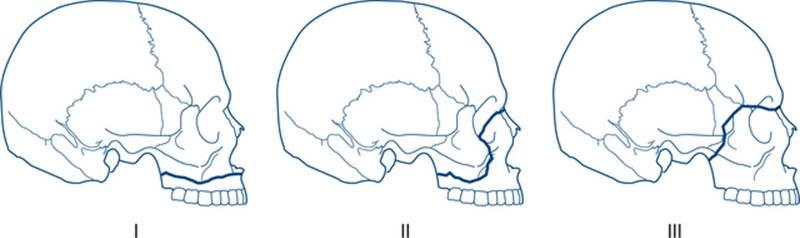
Figure 13.17 Le Fort classification of fractures of the maxilla
I: the infraorbital rim remains stable as the maxilla is rocked; II: only the medial section of the infraorbital rim moves — associated infraorbital nerve damage is common; III: the whole of the infraorbital rim moves with the maxilla
Source: Department of Radiology, University of Washington
Le Fort I: horizontal fracture of the maxilla immediately above the teeth and hard palate.
Le Fort II: pyramidal fracture that extends from the nasal bridge, inferior orbital floor, through the maxillary processes and across the pterygomaxillary fissure to involve the pterygoid plates.
Le Fort III: transverse fractures that are positioned at a high (suprazygomatic) level. These fractures extend from the nasal bridge and cribriform plate, to the medial wall of the orbit and into the zygomaticofacial suture.
Mandibular fractures
Mandibular fractures are described according to the anatomical site of damage, which may include the condylar process, body, angle, ramus, coronoid process or alveolar process.
Adjuncts to initial assessment
This has been significantly assisted by three-dimensional reconstructive views obtained by CT scanning.
Definitive care
A detailed description of the repair of maxillofacial injuries is beyond the scope of this chapter. Optimal operative conditions are necessary, especially for detection and repair of facial nerve damage and for an optimal cosmetic result. The accurate reduction and immobilisation of facial fractures is a critical aspect of successful management. Fractures are most often fixed by a combination of internal and external fixation, after open operative reduction.
13.7 Eye and orbital injury
Introduction
Ocular injuries may occur in isolation or in association with major trauma, particularly with injuries involving the face. Common causes of ocular injury are blunt force trauma by either a direct blow from a fist or large projectiles such as squash or tennis balls. Smaller projectiles travelling at low velocity are likely to cause superficial trauma, whereas high-velocity projectiles often cause serious penetrating injury to the globe or orbit. Ultraviolet radiation and chemicals in both dry and liquid form are also important causes of ocular injury, with acids and alkalis the most serious. Despite improvements in occupational health and safety, workplace injuries remain a common source of referral. A significant proportion of injuries also occur at home, particularly during activities such as gardening.
History taking
It is important to take a careful history of the mechanism of injury as this will provide important clues to the type and extent of the ocular trauma. Hammering metal against metal can generate high-velocity metal fragments capable of penetrating the globe or orbit. Injuries contaminated by organic material are more likely to result in wound infection and endophthalmitis (intraocular infection). With chemical injuries, try to obtain accurate information on the nature, concentration and duration of exposure, in addition to any first aid measures given at the scene. For workplace injuries it is useful to obtain details of the employer and whether or not safety measures were in place and adhered to. You should also ask about prior ocular problems, including surgery. Keep meticulous records in case of future legal proceedings or claims for compensation.
Examination
Ocular pain can result in nausea, vomiting and vasovagal syncope so it is often best to nurse and examine patients with severe eye injuries on a trolley with reduced room lighting to minimise photophobia. Even in cases of severe injury some attempt should be made at measuring visual acuity. The ability to perceive light, hand motions or to count fingers is still a useful finding in the initial assessment. If the patient is able to open their eye comfortably, then test the vision of each eye separately using a Snellen chart or equivalent and the patient’s distance spectacles if they wear them.
One of the most important goals in the history-taking and initial assessment of the eye is to determine whether the patient has a penetrating injury or rupture of the globe. Visualisation of the eye may be severely hampered by periorbital bruising and blepharospasm (i.e. involuntary lid closure with inability or difficulty in opening the eye). If the globe is ruptured then further manipulation of the eye or eyelids may result in extrusion of intraocular contents through the wound. Pressure on the eye or periorbital tissues, removing intraocular foreign objects or the use of eye drops or ointment must be avoided. If an open injury is suspected then no further attempt at examination should be made until the patient is in the operating theatre.
If a penetrating injury or ruptured globe can be reliably excluded on history and initial examination, then a drop of single-dose, non-preserved topical anaesthetic (e.g. amethocaine or benoxinate) can be used to facilitate a more detailed inspection of the eye. The slit lamp is the best instrument for this and most emergency departments will have one. Other useful equipment for examining the eye includes a pen light, fluorescein drops, cotton buds to hold or evert the eyelids and a direct ophthalmoscope.
Chemical injury
The most severe ocular injuries result from strong alkalis and acids. Alkalis such as powdered lime (used in cement) and sodium hydroxide (the basis of most industrial and domestic bleaches) readily penetrate the ocular tissues causing cell death and destruction of stromal ground substance. There is immediate sloughing of the corneal and conjunctival epithelium and in severe injuries damage occurs to blood vessels, leading to ischaemic necrosis. Death of corneal stem cells located at the limbus (junction of cornea and sclera) may result in progressive corneal ulceration and perforation. Subsequent scarring of the corneal and conjunctival surfaces can result in permanent visual loss and problems such as chronic dry eye syndrome. In contrast to alkalis, strong acids denature and coagulate protein, forming a barrier to further penetration. The damage tends to be more superficial, so the underlying stroma and important cellular elements may be spared. Solvents such as petrol or irritants such as capsicum spray cause painful injuries but rarely result in any long-term sequelae. The effects of other chemical classes on the eye are less predictable but information is usually available through the local poisons advisory service. Many industrial and domestic chemicals are supplied with labels or information sheets providing details of ocular toxicity and suggested first aid measures.
First aid
Immediate and copious irrigation of the eye with tap water or a similar aqueous-based neutral fluid at the scene of the chemical injury is the only effective treatment. All other measures after this are essentially supportive towards healing and regeneration of the ocular tissues. Once the patient has presented to hospital, further irrigation using normal saline or a commercial eye irrigation fluid for a period of 20–30 minutes is recommended to remove any residual chemical. Lay the patient on a trolley and direct a stream of irrigating fluid at the inner canthus while the patient blinks frequently or if possible keeps their eye open. This step may be facilitated by an initial drop of single-use, non-preserved topical anaesthetic. Following irrigation, the pH of the tear film can be tested using litmus paper, to ensure that a neutral pH has been reached. The eyelids should be everted and the conjunctival fornices inspected for any residual particulate matter. This is especially important with powdered lime injuries, where residual particles will continue to cause injury if left undetected.
Clinical assessment
Always test and record vision. In cases of severe pain induces blepharospasm, temporary relief can be provided by a drop of single-use, non-preserved topical anaesthetic. This will allow vision to be tested and the eye examined at the slit lamp. Loss of corneal and conjunctival epithelium is readily detected using fluorescein drops and the blue light on the slit lamp. A slight speckled staining pattern is seen in mild injuries whereas large areas of staining represent ulceration. It is recommended that all cases of acid and alkali burn are referred for assessment by an ophthalmologist. In these cases, damage to the limbal blood vessels is assessed by looking for a prompt refilling of blood after blanching the vessels with the tip of a cotton bud. Patients with extensive areas of limbal ischaemia are at greater risk of corneal perforation and scarring.
Treatment plan
Following first aid, treatment is supportive. Topical antibiotic (e.g. chloramphenicol drops or ointment) is typically prescribed when there is conjunctival or corneal epithelial loss. Topical citrate and ascorbate have traditionally been used in the treatment of severe alkali burns to assist in collagen regeneration but are not readily available in all emergency departments. Topical steroids are sometimes given to modify the healing response but must be used with caution in the presence of ulceration.
Corneal flash burns
Ultraviolet (UV) radiation can damage the surface of the eye in the same way as it causes sunburn to the skin. Common sources of UV radiation include welding, tanning lamps, sunlight reflected from snow and lamps used for sterilisation. Patients are usually asymptomatic at the time of the exposure and therefore unaware of the danger. The onset of symptoms is typically delayed several hours so that patients frequently present late in the evening. Symptoms include blurred vision, photophobia, pain, foreign body sensation, profuse tearing and blepharospasm.
Clinical assessment
The diagnosis is usually easily made on history with the hallmark features of delayed onset, bilateral symptoms and exposure to a source of UV radiation. Sunburn involving the face may be an accompanying feature. Blepharospasm and tearing will usually make examination difficult and can be temporarily relieved by a drop of topical anesthetic. Test and record vision and examine the eye carefully for alternative causes of symptoms such as foreign bodies. Slit lamp examination typically reveals conjunctival hyperaemia and corneal epithelial changes that, when severe, may have the appearance of ground glass. Fluorescein usually stains the corneal and conjunctival epithelium with a punctate (point-like) pattern.
Treatment plan
Treatment is supportive, as the superficial epithelial changes will resolve usually over one to two days. Chloramphenicol ointment is often prescribed, but there is no evidence to support the need for antibiotic prophylaxis. Any simple lubricating drop or ointment would be as effective. Topical cycloplegic drops, such as homatropine 2%, twice daily may provide some improvement in discomfort and photophobia in severe cases. Simple oral analgesics can be prescribed but they are unlikely to prove effective against the pain. Never prescribe topical anaesthetic drops, as the effect of such drops will rapidly diminish with each subsequent dose and they will have a toxic effect on the corneal epithelium, resulting in ulceration and impaired healing.
Perforating globe injuries
Open globe injuries can occur with both sharp and blunt force trauma. Those injuries occurring with blunt trauma often involve tearing of the sclera at its thinnest point behind the insertion points of the extraocular muscles. A surgical wound from previous large-excision cataract surgery or a corneal graft is also a likely site for rupture to occur. Scleral tears may extend circumferentially or posteriorly towards the optic nerve. The tear may be complicated by herniation of intraocular contents such as the crystalline lens, uveal tissue, vitreous and retina. Activities that generate high-velocity projectiles and injuries involving sharp objects, such as nails, should raise suspicion of a penetrating injury that may also include a retained foreign body within the globe or orbit.
The anatomy of the globe is shown in Figure 13.18.

Figure 13.18 Anatomy of the globe
Clinical assessment
Sometimes globe rupture or perforation is obvious even to the inexperienced eye. Collapse of the globe, a foreign body such as a nail or staple protruding from the cornea or scleral surface or the prolapse of black uveal tissue through a gaping scleral or corneal wound are obvious signs. If the globe rupture is posterior, poor vision, extensive subconjunctival haemorrhage, distorted pupil, hyphaema and the loss of the red reflex are important clues. If the penetrating object is small and travelling at high speed, the injury may not be so obvious. Small holes in the sclera or cornea may self-seal so that the architecture of the globe and its visual function can be relatively well maintained. Corneal wounds can be inspected thoroughly with the aid of a slit lamp. The presence of iris adherent to the inner surface of the corneal wound or a shallowing of the anterior chamber depth should alert the clinician to the presence of full-thickness penetration. Injury to the lens will result in a localised opacification and holes in the iris can be detected by looking for a red reflex or transillumination through the defect while shining a small beam through the pupil.
As mentioned previously, an attempt should be made to test and record visual acuity in each eye, even with severe injuries. A Snellen chart designed for use at three metres is usually the best option, particularly for patients examined in a bed or on a trolley. If this is not practical due to pain, severe blepharospasm or altered conscious state, simply asking the patient to detect a penlight beam or hand motions is still useful clinical information.
First aid
Once an open eye injury is suspected, no further examination should be attempted. Further pressure on the eye or eyelids should be avoided by covering the injured eye with a commercial plastic eye-shield. Alternatively, a makeshift shield can be constructed from the cut end of a disposable foam drinking cup or a cone made from a circle of cardboard. The edges of the shield should rest against the bony margins of the orbit and be fixed in place with tape until the patient is in the operating theatre. No attempt should be made to remove any intraocular foreign body, nor should any type of eye drop or ointment be used in the eye. Keep the patient fasted and establish intravenous access. Provide a parenteral antiemetic, such as prochlorperazine 12.5 mg IV, to prevent vomiting. If the injury is very painful, a small dose of opiate analgesic can be given but this should be delayed until the antiemetic has had an opportunity to work. Vomiting will raise central venous pressure and thereby raise intraocular pressure with the potential to extrude intraocular contents.
Diagnostic plan
A CT scan performed with fine axial and coronal sections through the orbits will provide useful information about the architecture of the globe, the presence of associated bony orbital fractures and retained foreign bodies within the eye or orbit. This is particularly important in patients with a history of striking metal against metal where small, high-velocity metal fragments may have penetrated the eye or orbit. Intraocular foreign bodies consisting of iron and copper are toxic to the intraocular tissues over time if left undetected.
Treatment plan
The next steps in management involve preparing the patient for surgery. Antibiotic prophylaxis is given in the form of broad-spectrum parenteral agents with good ocular penetration. An example is ceftriaxone 1 g IV combined with clindamycin 600 mg IV. Alternatively, a single agent such as gatifloxacin, (a fourth-generation fluoroquinolone) has broad-spectrum activity against both Gram-negative and Gram-positive organisms, with good ocular penetration. Tetanus prophylaxis should also be given. Surgery should be performed as soon as it is practical, given the constraints of fasting and transportation to a facility equipped to deal with ocular trauma. Delay in repair of open eye injuries increases the likelihood of infection and is associated with poorer outcome.
The principles of primary surgical repair are to remove any foreign objects, close the ocular wound and restore normal ocular anatomy as best as possible. Subsequent surgery may involve treatment of intraocular infection (endophthalmitis), removal of a cataract, reattachment of the retina, corneal grafting or removal of the eye (enucleation). The latter is usually reserved for cases where the eye is blind, painful and has a significant cosmetic deformity. Enucleation is sometimes necessary to avoid the rare condition of sympathetic ophthalmia where cell-mediated immune destruction of the injured eye may also involve the uninjured eye.
Superficial foreign body injury
A variety of low-velocity objects may lodge in the superficial layers of the corneal and conjunctival surfaces of the eye and eyelids. Symptoms may be minimal at the time of injury so that presentation is delayed until the following day or even later. Symptoms include pain or a scratchy sensation with blinking, redness, blepharospasm, tearing and/or discharge. Vision may or may not be impaired depending on the location of the foreign body. The central 4-mm-diameter zone of the cornea is the most crucial with respect to maintaining normal vision. Metallic foreign bodies containing iron quickly rust once exposed to the tear film and usually appear brown. Rust staining in the corneal stroma may extend as a halo around the foreign body.
Clinical assessment
Ask about the possible mechanism or injury and details of safety measures in place. If a penetrating injury is suspected then proceed as detailed in the previous section. Test and record vision and make an initial inspection of the eye using a slit lamp. If you are confident that no penetration has occurred then instill a drop of single-use, non-preserved topical anaesthetic into the eye. This will facilitate your examination and allow vision to be tested if the patient has difficulty in opening their eye. Inspect the corneal and conjunctival surfaces of the eye, including the conjunctival surfaces of the upper and lower eyelids. The upper eyelid can be everted by first asking the patient to look down, grasping the upper eyelashes and applying gentle counter pressure to the upper eyelid crease. Practice is necessary to accomplish this manoeuvre reliably with minimal distress to the patient. Your examination will be enhanced by staining the tear film with fluorescein and examining the surfaces using the cobalt blue light. Fine linear abrasions or larger areas of epithelial loss on the corneal and conjunctival surfaces suggest a subtarsal foreign body until proven otherwise.
Treatment plan
The surgical aim is to remove the object and any associated rust while minimising damage to the ocular tissues. Foreign bodies only lightly embedded in the conjunctiva and cornea may be removed using a cotton bud or dislodged using the tip of a 25-gauge needle. This is best achieved with the aid of a slit lamp. The slit lamp provides a well-illuminated, magnified image of the foreign body and a stable platform for the patient’s head. When using a needle to remove foreign bodies it should be held parallel to the plane of the face to avoid inadvertent ocular penetration. The elbows of the surgeon should rest on the table of the slit lamp to reduce tremor and involuntary movement of the arm and hand. Anaesthesia is provided by two or three drops of topical anaesthetic (e.g. amethocaine or benoxinate) applied over a few minutes. The patient’s eyelids should be held open by the surgeon’s other hand or by an assistant.
Rust staining of the corneal stroma is difficult to remove with a needle and is best debrided using a small-tipped dental burr attached to a battery-powered motor. Centrally placed or deeply embedded corneal foreign bodies should be referred to a specialist for removal. Corneal foreign bodies in young children should be removed under general anaesthesia. Prophylactic topical antibiotic cover should be provided with chloramphenicol drops or ointment four times a day until the eye is healed. Applying a patch to the eye for the first 12 hours is traditional but there is no firm evidence to suggest that this improves comfort or recovery.
Closed globe injury
Blunt force, non-penetrating trauma to the globe can result in a variety of injuries to the intraocular structures. The injuries occur due to tearing or shearing forces when the globe is deformed at the moment of impact. Tears in the iris that may involve the pupil margin or iris root are usually accompanied by bleeding into the anterior chamber (hyphaema). Other injuries that may be present include dislocation of the crystalline lens into the vitreous cavity, retinal oedema, retinal tears and detachment, vitreous haemorrhage and traumatic optic neuropathy.
Clinical assessment
Test and record vision. Examine the direct and consensual pupil responses, looking carefully for evidence of an afferent pupillary defect. An afferent pupillary defect will be present in cases of optic nerve injury and retinal detachment. An efferent pupillary defect is usually the result of trauma to the iris sphincter muscle, which may result in a permanently dilated pupil (traumatic mydriasis). A hyphaema is often visible macroscopically as a collection of blood or clot in the anterior chamber. A small hyphaema consisting of circulating red blood cells in the anterior chamber fluid may only be visible with the aid of a slit lamp. Over time, a hyphaema will collect in the inferior portion of the anterior chamber due to the influence of gravity. Check for the presence of a red reflex. Any opacity in the ocular media, such as hyphaema, traumatic cataract or vitreous haemorrhage, will lead to a reduction or loss of the red reflex. An attempt should be made to examine the fundus with a direct ophthalmoscope. Blunt trauma often results in a visible whitening of the retina (commotio retinae) that may affect vision if it involves the macula region. Commotio retinae usually resolves spontaneously with recovery of vision. Retinal tears are more common in the peripheral zones and are difficult to detect with a direct ophthalmoscope. Clues to the presence of a retinal tear include symptoms of flashes (photopsia) or mobile spots (floaters) in the vision. Look for an accompanying orbital injury (see below).
Diagnostic plan
A CT scan performed with fine axial and coronal sections through the orbits will provide information about the integrity of the globe and detect the presence of any associated orbital fractures.
Treatment plan
Refer blunt globe injuries to an ophthalmologist for further assessment. Management is usually conservative, but retinal tears and retinal detachment will require surgical intervention. The management of hyphaema is bed rest and the avoidance of antiplatelet medications, to minimise the potential for secondary haemorrhage. The risk of secondary haemorrhage is greatest in the first week following injury. The decision to admit the patient to hospital will depend on the likelihood of compliance with treatment and the presence of pain or complications. The threshold for hospital admission should be lower with children, large hyphaemas and patients living in remote locations. Complications of hyphaema include secondary glaucoma and corneal blood staining. Anti-glaucoma medications are sometimes required and less commonly surgical intervention.
Injury to the orbit
Blunt trauma to the eye or orbit often results in the development of a periorbital haematoma. The subcutaneous blood is confined to the eyelids and tissues anterior to the orbital septum. This type of haematoma should be distinguished from a true orbital haematoma where the blood lies within the orbital cavity, either outside or within the extraocular muscle cone or beneath the periosteum (periorbita). A large periorbital haematoma may result in complete closure of the eyelids making examination of the globe difficult, but not threatening the eye. If a glimpse of the globe can be obtained then you will notice that ocular motility is normal and there is no blood or fluid beneath the conjunctiva.
An orbital haematoma is usually accompanied by restriction of ocular movement, protrusion of the globe (proptosis) and haemorrhage beneath the conjunctiva. This type of haemorrhage has the potential to threaten vision by secondary glaucoma, compression of the optic nerve and/or ocular blood supply.
The medial wall and floor of the bony orbit are thin and easily fractured by a direct blow to the cheek or eye. These fractures may result in prolapse of the orbital fat and extraocular muscles through the defect into the ethmoid or maxillary sinuses respectively. This is particularly common with orbital floor fractures. The loss of orbital tissue volume will lead to a posterior displacement of the globe within the orbit (enophthalmos). Entrapment of the inferior rectus muscle within the fracture may lead to ischaemic injury to the muscle or fibrosis that restricts ocular movement. The infraorbital nerve (branch of trigeminal) may be damaged during its course through the orbital floor resulting in numbness over the ipsilateral cheek, upper lip and gum.
The anatomy of the orbit is shown in Figure 13.19.

Figure 13.19 Anatomy of the orbit
Based on Zitelli & Davis, 2007
Clinical assessment
Test and record vision. Look for any associated injury to the globe. Check the direct and consensual pupil responses to assess the function of the optic nerve. Ask about diplopia and test the vertical, horizontal and oblique binocular movements. A restriction of upward gaze is typical of orbital floor fractures involving the inferior rectus muscle. Ocular movement may also be limited by orbital haemorrhage. Enophthalmos is usually not evident in the first few days following an orbital fracture but will become manifest over the next few weeks as haemorrhage and swelling subside. Subcutaneous air (emphysema) due to communication between the orbit and sinuses may be palpable in the periorbital tissues. Test sensation over the lip and gum.
Diagnostic plan
A CT scan performed with fine axial and coronal sections through the orbits will demonstrate the presence of an orbital fracture, any prolapse of orbital tissue and the likelihood of extraocular muscle entrapment. The latter should be suspected when the muscle is seen in close proximity to the fracture site. Blood in the maxillary sinus is a strong indicator of orbital floor fracture, even if the bony landmarks do not appear displaced. Associated fractures of the zygoma, maxilla and nasal bones may also be evident.
Treatment plan
Orbital injuries resulting in reduced vision, proptosis or a relative afferent pupil defect should be referred promptly so that measures can be taken to relieve pressure on the globe and optic nerve. This can be achieved relatively quickly by performing a lateral canthotomy. A canthotomy releases pressure on the orbital tissues by enlarging the palpebral opening. After infiltrating the skin of the lateral canthus with 2% lignocaine or similar local anaesthetic agent, the lateral canthus can be cut horizontally using scissors. This incision cuts through the skin, orbicularis muscle and the centre of the lateral canthal tendon. Bleeding from the incision can be minimised by first compressing the area with a vascular clamp prior to making the incision. Intravenous mannitol may also be effective in reducing orbital pressure. Parenteral antibiotics covering upper respiratory organisms may be given as prophylaxis in cases of orbital fracture. Repair of orbital fracture is indicated in the presence of restricted eye movement or if the fracture is large and enophthalmos is likely to develop overtime. Ideally this should be performed in the first two weeks following injury before fibrosis and permanent restriction of eye movement occurs. A subperiosteal approach is used to identify the fracture site and after releasing any orbital tissues the defect is closed using a synthetic implant.
Injury to the eyelids
The eyelid is composed of skin, orbicularis muscle, tarsal plate and conjunctiva (Fig 13.20). There is a lacrimal punctum on the posterior aspect of the upper and lower eye lid margins, about 3–5 mm from the inner canthus. The lacrimal puncta are the openings to the lacrimal canaliculi that drain tears into the lacrimal duct and then into the nose. A full-thickness laceration of the eyelid margin medial to the lacrimal punctum may involve the lacrimal canaliculus. Full-thickness lacerations of the upper eyelid above the tarsal plate may involve the levator palpebrae superioris muscle or its tendon sheath.

Figure 13.20 Anatomy of the lacrimal system
Based on Mandell et al, 2005
Clinical assessment
The laceration must be inspected to see if it is superficial (i.e. involving skin and or the obicularis muscle) or full thickness. Always suspect an injury to the lacrimal canaliculus if the eyelid margin is involved medial to the lacrimal punctum. Failure to repair the canaliculus, particularly on the lower eyelid, will result in a watery eye (epiphora). Ask the patient to look up and note the function of the levator tendon. If the levator tendon is damaged, it will need to be explored and repaired to avoid a permanent ptosis. These cases are best referred to an experienced plastic or ophthalmic surgeon.
Treatment plan
Superficial lacerations involving the skin and orbicularis can be closed simply with interrupted sutures using 6/0 silk or nylon. Full thickness lacerations require both deep closure with an absorbable suture such as 6/0 polyglactin and superficial closure with 6/0 silk or nylon. Care is needed when reforming the eyelid margin to avoid a notch, which will result in an obvious cosmetic deformity and, on the lower lid, constant leakage of the tear film through the gap. Opposing the two edges of the eyelid margin is best achieved using a vertical mattress suture of 6/0 silk through the middle or ‘grey line’ of the eyelid margin. The ends of the suture should be left long, folded forward over the skin of the eyelid and tied within the knot of a superficial skin suture. This will avoid suture ends rubbing against the globe. Deep sutures should be placed anterior to the tarsal surface, again to avoid rubbing against the eye. Due to the natural tension across the eyelid, the silk sutures should be left for 14 days in cases of full-thickness laceration.
13.8 Chest injury
In civilian practice the majority of chest injuries are closed and follow blunt trauma in motor vehicle accidents. Associated injuries, particularly head injuries, are common. Upper respiratory obstruction can occur at any time from the moment of injury to arrival at hospital. Airway obstruction may lead to death in an otherwise salvageable patient. The unconscious patient with chest injury is prone to airway obstruction not only from aspiration of vomitus and falling back of the tongue but also from haemoptysis. In most cases open thoracotomy is not necessary and there is time for careful assessment, immediate nonoperative treatment, chest X-ray and CT scan.
Life-threatening chest injuries
1. Tension pneumothorax
2. Open pneumothorax
3. Massive haemothorax
4. Airway obstruction
5. Cardiac tamponade
Initial assessment
Primary survey
The aim is to recognise and treat any life-threatening injuries, particularly tension pneumothorax. Injury to the airway often accompanies major thoracic trauma. Obstruction may be associated with cyanosis, stridor, intercostal retraction and ineffective respiratory movements. Breathing should be assessed with the chest and neck fully exposed; look (for symmetry of chest wall movement, evidence of stab wounds), listen (for normal breath sounds) and feel(for midline tracheal position or the presence of subcutaneous emphysema). Circulatory assessment should include an evaluation of the neck veins (distended in cardiac tamponade and tension pneumothorax). Simultaneous resuscitation should be performed in the patient with thoracic trauma.
Circulatory failure suggests massive haemothorax (or haemoperitoneum), tension pneumothorax or cardiac tamponade. Shock in tension pneumothorax or cardiac tamponade is due to vascular obstruction; hypotension will be accompanied by distended neck veins and increased central vein pressures (in contrast to the findings in haemothorax). Immediate needle aspiration of the pleural or pericardial space can be life-saving in these cases. Clinical examination of the chest may reveal the stony dullness of haemothorax on percussion, with grossly diminished or absent breath sounds (silence) on auscultation. Pneumothorax is characterised by hyperresonance with silence and a shift of the mediastinum (heart and trachea) to the opposite side when the pneumothorax is under tension. Haemopneumothorax, with combinations of these signs, is common.
Specific thoracic injuries should be dealt with as they are discovered — these are discussed in detail below.
Secondary survey
A thorough examination of the patient with thoracic trauma needs to occur if clinically subtle injuries are to be detected. Open chest wounds and anterior flail segments are usually readily identified, but other injuries may not be clinically obvious: small pneumothoraces, traumatic cardiac injury or mediastinal vascular injury. Useful adjuncts include a chest X-ray, arterial blood gas analysis, pulse oximetry, electrocardiography and echocardiography. A clear history of the circumstances of the accident is essential. Few patients with chest injury require thoracotomy but thoracentesis is often required.
Investigations
A posteroanterior chest X-ray is performed in the upright position to better display effusions and pneumothorax. Other features to be sought are fractures, collapse or contusion of the lung, diaphragmatic hernia and mediastinal widening. Chest X-rays should precede intubation and controlled ventilation, apart from extreme emergencies. CT scanning of the chest is also indicated, especially when there is a significant mechanism of injury or when injury to lung parenchyma, mediastinum or great vessels is suspected. Haemoglobin and serial blood gas estimations are necessary in most patients. A baseline ECG should be performed and may be abnormal if cardiac injury has occurred. Echocardiography can be used to provide diagnostic information on valvular function, ejection fraction, left ventricular systolic function, right atrial pressures and can also assess the pericardial space for effusions. Angiography may be indicated when mediastinal widening suggests the possibility of mediastinal injury, such as a ruptured thoracic aorta with temporary tamponade.
Definitive care
General management
The patient with major thoracic trauma should be managed at a facility that offers cardiothoracic surgical services. Immediate measures to establish a clear airway, assist ventilation and treat circulatory failure are instituted. Endotracheal intubation and ventilation are indicated in most patients with severe chest injuries, associated head injury and altered consciousness, airway obstruction because of facial or neck injuries, sucking chest wounds, flail chest and associated severe shock. Failure to respond to adequate resuscitation also suggests the possibility of massive haemothorax, tension pneumothorax, cardiac injury or cardiac tamponade. Immediate thoracotomy is indicated in patients with a penetrating chest wound that has possibly involved the heart (traversing the mediastinum) and is associated with cardiopulmonary arrest or with shock that has not responded rapidly to blood transfusion. Immediate thoracotomy is rarely required or of benefit in blunt chest injuries. Thoracotomy may be indicated at a somewhat later stage for significant and continuing haemothorax or for large air leaks preventing re-expansion of the lung. An intrapleural chest tube (intercostal catheter) is required for flail chest and in patients with haemothorax or pneumothorax or tension pneumothorax.
Insertion of an intercostal catheter (ICC)
The successful insertion of an ICC relies on two factors: understanding the anatomy of the intercostal space and utilising a safe method of insertion. The intercostal space is bounded by the ribs (one above and one below). It is important to appreciate that the neurovascular bundle lies under the cover of the rib above. This comprises the vein, artery and nerve (V-A-N) from superior to inferior, in the plane between the internal intercostal and transversus group of muscles. The chest tube is preferably inserted through the fifth intercostal space anterior to the mid-axillary line (Fig 13.21) and ‘just above the rib below’ to avoid the neurovascular structures. In obese patients or in women with large breasts, the anterior mid-clavicular second intercostal space approach may be preferred. The pleura should be entered with the spreading tips of a forceps rather than with uncontrolled thrusting of a trochar. The intercostal catheter (size 30Fr) is passed posterosuperiorly (towards apex) for evacuation of air in pneumothorax or inferiorly, to facilitate dependent drainage of a haemothorax.
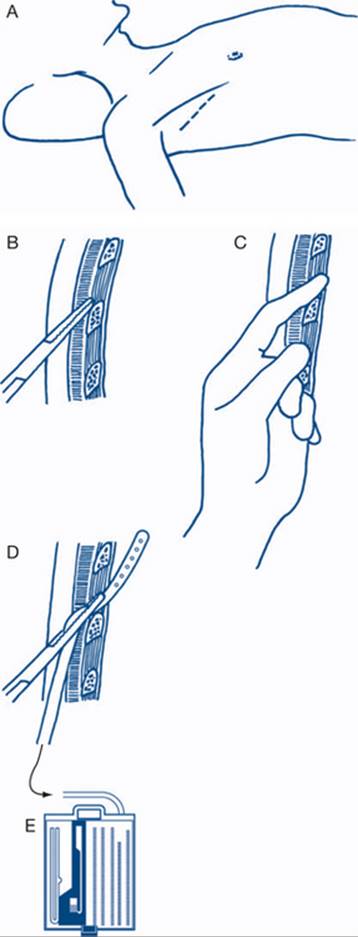
Figure 13.21 Tube thoracotomy
A: the fourth intercostal space is exposed in the mid-axillary line; B: a tunnel is made with an artery forcep starting over the fifth rib and directed under the fourth rib; C: finger or artery forceps entry is made into the pleural space; D: a large tube is inserted in a posterosuperior direction and sutured to the skin; E: the intercostal tube is attached to underwater drainage
Management of specific types of chest injury
Tension pneumothorax. Sometimes tension pneumothorax occurs immediately because a rib fracture has produced a one-way flap valve leak from the pleural surface. It may also be secondary to positive pressure ventilation in patients in whom an initially simple pneumothorax has not been recognised. Thus it is prudent to insert an ICC in all patients with posttraumatic pneumothorax or subcutaneous emphysema who need early endotracheal intubation and positive pressure ventilation. A suspected tension pneumothorax should be relieved immediately by inserting a wide-bore needle into the second intercostal space of the affected side. The diagnosis is made on clinical grounds — there is no time for a chest X-ray. The needle is subsequently replaced by a formal ICC with underwater drainage. A cardiothoracic referral should be made and the patient considered for VATS (video-assisted thoracoscopic surgery) pleurodesis at a later stage.
Haemothorax. Stony dullness to percussion, decreased breath sounds on auscultation and decreased chest wall expansion are features that are consistent with a haemothorax. A massive haemothorax may even cause mediastinal shift and contralateral deviation of the trachea. The diagnosis is confirmed by chest X-ray. Shock is treated by appropriate blood transfusion. In most patients the insertion of a large ICC (minimum 32Fr) is the only additional treatment necessary as bleeding has usually already stopped. Thoracotomy may, however, be indicated when there has been immediate drainage of blood greater than 1500 mL or continued blood loss greater than 150–200 mL per hour. The source of bleeding is usually found to arise from intercostal vessels that have been damaged by fractured ribs.
Open pneumothorax (‘sucking chest wound’) is treated early by surgical debridement and closure of the chest wound with ICC insertion. A simple first aid measure is to place a sterile, adherent dressing onto the wound, taped only on three sides so that a flap valve mechanism is formed. This enables air to leak out from the chest during the expiratory phase of breathing but prevents the sucking of air into the chest cavity during inhalation.
Cardiac tamponade. Cardiac tamponade occurs when fluid accumulates within the pericardial space and is evidenced by Beck’s triad: decreased arterial blood pressure (due to impaired ventricular filling and subsequent reduction in stroke volume and cardiac output); distended neck veins (from poor right ventricular diastolic filling); and muffled heart sounds (due to pericardial effusion). Although the triad is considered pathognomonic for acute cardiac tamponade, it is important to recognise that the distension of neck veins may not be present in the hypovolaemic patient. Treatment of cardiac tamponade is by pericardial aspiration performed through the left fourth intercostal space or from the epigastrium below the xiphoid. Penetrating cardiac injuries require prompt thoracotomy with decompression of the pericardium and repair of the myocardium if necessary.
Flail chest. A flail segment may be difficult to detect on admission. Paradoxical movement may only become apparent later with the development of atelectasis, especially when associated with lung contusion. Pulmonary contusion causes a reduction in lung compliance, with maximum reduction at about 24–48 hours after injury. The contused lung is sensitive to under- and over-fluid resuscitation and intravenous fluid administration must therefore be carefully managed. Multiple rib fractures that isolate a flail segment of chest wall are usually sited anterolaterally. There must be at least two fractures of the same rib for a segment to float and to move paradoxically. Involvement of a specialist pain service (for multimodality analgesia) and physiotherapist (for aggressive chest physiotherapy) should be organised as soon as possible. The patient should never be allowed to languish on the surgical ward with suboptimal analgesia — the outcome is predictable: these patients become tachypnoeic, diaphoretic and develop pneumonia. In addition, the increased work of breathing and metabolic demands may result in myocardial ischaemia or infarction in some patients with underlying cardiovascular disease. In some cases endotracheal intubation and positive- pressure mechanical ventilation may be indicated. Although operative fixation of the fractures is not routinely performed, thoracic surgeons may take the opportunity to perform rib stabilisation when the patient requires a thoracotomy for another reason (e.g. ongoing intrathoracic bleeding).
Pulmonary contusion. This condition usually follows severe blunt trauma or high-velocity missile wounds. Interstitial haemorrhage, oedema and atelectasis occur with a risk of secondary infection and progressive hypoxia. The subsequent release of inflammatory mediators may lead to the development of ARDS in a significant proportion of patients and this is potentially lethal. Intubation and mechanical ventilation is often required in patients with significant pulmonary contusion — especially in patients with pre-existing chronic airways disease. A high index of suspicion is required as clinical and radiological signs commonly do not appear until about 24 hours after injury; these patients should therefore be monitored closely with arterial blood gas analysis, ECG monitoring and chest X-ray. High-velocity missile wounds require operative debridement and pulmonary resections.
Blunt cardiac injury. The mechanism of the thoracic injury is important. Patients not wearing seatbelts and with clinical evidence of contact with the steering column are most likely to have a cardiac injury. Blunt cardiac injury may result in myocardial contusion, valvular disruption or rupture of the atria or ventricles. Patients often present with a fractured sternum and the following management is necessary: initial ECG followed by continuous cardiac monitoring (telemetry) for at least 24 hours (to exclude myocardial ischaemia/infarction and arrhythmias); serial cardiac enzyme estimations (biochemical evidence of myocardial injury); and echocardiography (to exclude pericardial tamponade or other cardiac injury).
Penetrating chest injuries. Damage to intercostal vessels, underlying heart, lungs and pleura, the diaphragm and abdominal structures are common. Mediastinal traversing wounds from bullets and other missiles require early or immediate thoracotomy, as will stab wounds associated with massive haemothorax. Structures potentially damaged include lung parenchyma, tracheobronchial tree, oesophagus, heart, great vessels (e.g. aortic disruption) and diaphragm (with possible secondary injury to subdiaphragmatic structures such as the liver or stomach). Stab wounds without progressive haemopneumothorax may only require local wound care combined with thoracocentesis, if the wound of entry is above the nipple line. Stab wounds between the nipple line and costal margin may also require a diagnostic laparotomy to identify or exclude intra-abdominal or diaphragmatic injury.
13.9 Abdominal injury
Damage to abdominal viscera may be caused by a penetrating injury (usually the result of a stab or gunshot wound) or by blunt trauma (usually the result of a car accident or direct blow). The number of severely injured patients with abdominal trauma has increased since the introduction of compulsory wearing of seatbelts, while mortality due to motor vehicle accidents has fallen (mainly due to the reduction in the number of head injuries). Early recognition of intra-abdominal injury or bleeding is essential and a high index of suspicion is necessary when managing unconscious patients with multiple injuries.
The most important objective in emergency management of the patient with abdominal trauma is to decide whether or not exploratory laparotomy is indicated, rather than the diagnosis of a specific organ injury. The next important decision is the timing of laparotomy, a decision based upon the circulatory state and response to resuscitation (Box 13.6). Diagnostic laparoscopy is useful in the management of stab wounds to the anterior abdominal wall.
Box 13.6
Principles of surgical management of abdominal injury
The main decision to be made is whether laparotomy is necessary. The diagnosis of a specific organ injury is relatively less important.
The timing of laparotomy depends upon the circulatory response to resuscitation.
Blunt trauma
The most common injuries sustained from blunt abdominal trauma occur to the spleen and liver, followed by the small bowel and retroperitoneum. Two major mechanisms are responsible: compression and deceleration. In motor vehicle accidents at the time of impact, the intra-abdominal organs are compressed against the seatbelt, steering wheel or dashboard, resulting in tearing or shearing forces. Solid organs sustain rupture (e.g. spleen) or subcapsular haematoma (liver). Compression of hollow viscera (e.g. small bowel) causes a transient increase in intraluminal pressure that may also cause rupture and subsequent peritonitis. Retroperitoneal haemorrhage may also occur as a result of blunt trauma. During deceleration organs that have some degree of mobility (e.g. liver, spleen, small bowel) experience stretching and shearing forces at their points of fixed attachment (ligamentum teres, splenic ligaments and small bowel mesentery respectively).
Penetrating trauma
The severity of intra-abdominal trauma sustained from penetrating injury depends largely on the velocity of the object and the trajectory or path taken through the body. With low-velocity injuries (e.g. stab wounds from knives or civilian gunshot wounds), damage occurs by incision or laceration usually confined to the point of entry and course within the tissues. High-velocity trauma (from high-powered rifles or machine guns), however, imparts significant energy to tissues and causes damage by cavitation (pressure waves generated within tissues that cause both transient and permanent cavities). Penetrating abdominal injuries commonly involve the liver and diaphragm, small bowel and colon and blood vessels.
Initial assessment
The initial assessment incorporating the primary survey (ABCDE) and secondary survey should be performed with simultaneous resuscitative efforts and adjunctive investigations. A careful history of the circumstances of the accident, particularly the forces involved and whether seatbelts were being worn, is important. Systematic examination should include a thorough assessment of the abdomen, back, pelvis, perineum and genitalia. Signs to observe include evidence of continuing blood loss, increasing abdominal distension and tenderness, and evidence of developing peritonitis or mass. Certain groupings of injuries can be anticipated. Fractures of the ribs on the right side are associated with liver injury, rib fractures on the left with splenic injury, pelvic fractures with bladder rupture, fractures to the lumbar pedicles with renal and intestinal injuries and blowout disruption of bowel is common from seatbelt injury (Fig 13.22). The diaphragm extends at its apex to the fourth intercostal space and injuries that may appear to be confined to the chest wall frequently have a subdiaphragmatic component. In patients with penetrating abdominal wounds, the back, perineum and perianal region must be as carefully examined as the anterior abdominal wall for entry or exit wounds. Localised blunt injury may cause pancreaticoduodenal injury, an injury in which there may be minimal early signs but which bears a high mortality if not promptly recognised.

Figure 13.22 Blunt abdominal trauma
Common sites of injury — 1: liver; 2: pancreas; 3: duodenum; 4: spleen; 5: small bowel and mesentery; 6: caecum; 7: urinary bladder
Investigations
The diagnostic approach to abdominal trauma remains controversial. A number of diagnostic modalities have been used to evaluate the injured abdomen including plain radiographs, contrast studies, serial clinical examination, local wound exploration, diagnostic peritoneal lavage (DPL), focused assessment with sonography for trauma (FAST), CT, laparoscopy and laparotomy. It is beyond the scope of this chapter to discuss each modality in detail, but a brief overview and suggested approach are presented.
Diagnostic modalities available for intra-abdominal trauma
Serial clinical examination. Thorough clinical examination of the abdomen in trauma cases is extremely important. In certain clinical situations, however, the accuracy of the clinical examination is limited. Distracting injuries are often present in patients with multiple injuries; the presence of drug or alcohol intoxication, head injury or loss of consciousness are common factors that make clinical examination unrewarding at times and potentially misleading. Serial clinical examination therefore cannot be relied upon in such patients and other diagnostic modalities are required to exclude intra-abdominal trauma. Nonetheless it is still important to document clinical findings in the medical record.
Plain radiographs. Imaging is indicated when the patient is stable. Patients with blunt abdominal trauma may be imaged with chest and abdominal X-rays, pelvic X-ray and lateral C-spine films. On plain X-ray of the chest and abdomen particular attention should be given to the contour of the diaphragm, fractures of ribs or pelvis, the presence of free gas under the diaphragm, displacement of the gastric air bubble, trapped retroperitoneal gas, obliteration of the renal and psoas shadows and fractures of the lumbar pedicles. Chance fractures occur in the thoracolumbar junction (T12–L2) as a result of flexion–distraction forces typically from wearing lap-only seatbelts; there is a significant (up to 50%) association with trauma to the pancreas, small bowel mesentery and duodenum.
Contrast studies. A number of contrast studies may be performed in patients with abdominal trauma. Retrograde urethrography should be performed when urethral trauma is suspected, prior to insertion of an indwelling catheter. Transurethral cystography may be used to exclude bladder injury and is performed after 300–500 mL of water-soluble contrast is instilled into the bladder via a Foley catheter. Radiographs taken in multiple views (anteroposterior, lateral, oblique) as well as a post-micturition film are necessary to assess for extravasation of contrast from the bladder. Intravenous urography involves a rapid injection of high-dose renal contrast and subsequent X-ray two minutes later in order to determine whether the kidneys are functioning. Significant trauma to the kidney or disruption of the blood supply may be detected with urography. Contrast-enhanced CT scanning should be used in the first instance, where available, in preference to intravenous urography. Gastrointestinal contrast studies with a water-soluble contrast agent may be used to evaluate the integrity of retroperitoneal small bowel (duodenum) or large bowel (ascending, descending colon or rectum).
Local wound exploration. Some centres advocate surgical exploration of incisional (stab) wounds to the abdomen under local anaesthetic in the emergency department to determine whether the there is a breach in the anterior fascia. The wound is explored by a surgeon and extended if necessary and the depth of tissue penetration is assessed. If trauma extends beyond the anterior fascia, local exploration need not continue and either DPL or laparoscopy/laparotomy is arranged. However, it should be noted that a significant proportion of patients who have a positive local wound exploration (i.e. breach of anterior fascia) have a negative laparotomy (no peritoneal breach).
Diagnostic peritoneal lavage (DPL). The clinical indications for DPL have reduced due to the availability of CT scanning. DPL may be performed through a supra- or infra-umbilical approach and involves the insertion of a catheter into the peritoneal cavity (Fig 13.23). After the bladder has been emptied, local anaesthetic is infiltrated in the lower midline of the abdomen down to the peritoneum. A small skin incision is made and a peritoneal dialysis catheter is carefully inserted after gaining entry to the peritoneal cavity. Aspiration of blood, vegetable or faecal matter (from perforated bowel), or bile, is an indication for urgent laparotomy. If nothing is aspirated, one litre of warm Hartmann’s solution is infused into the peritoneal cavity and allowed to drain out (after gentle compression of the abdomen and repositioning the patient to allow free intraperitoneal diffusion). The lavage fluid is then sent to the laboratory for analysis. A positive result is indicated by: high red blood cell count (RBC >100,000/mL), high white cell count (WBC >500/mL), evidence of bacteria on Gram stain, or the presence of amylase or faeculent material. Despite the fact that DPL is highly sensitive (98%) for haemoperitoneum, its main disadvantages are that it is invasive, misses retroperitoneal and diaphragmatic injuries and may compromise non-surgical management. DPL should therefore be performed only when ultrasound or CT scanning facilities are unavailable.
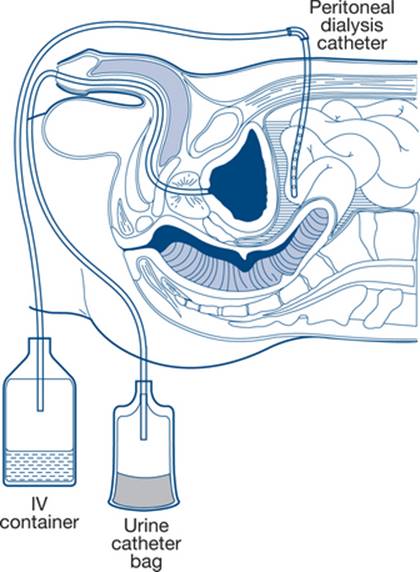
Figure 13.23 Diagnostic peritoneal lavage in blunt trauma
Based on Williamson & Waxman, 1998
Diagnostic laparoscopy. This is particularly useful in the assessment of stab wounds when penetration of the fascia is in question. In this situation it may prevent unnecessary laparotomy, exclude peritoneal injury and provide excellent visualisation of the diaphragm and pelvis. Laparoscopy carries a risk of trauma from port insertion. If fascial penetration is confirmed on laparoscopy, immediate conversion to laparotomy is recommended.
Focused assessment with sonography for trauma (FAST). Ultrasonography is noninvasive, quick and can be performed simultaneously during the initial assessment and management of the injured abdomen. In experienced hands, some studies suggest that ultrasound is equally as sensitive as DPL or CT scanning in detecting haemoperitoneum. Its main disadvantages, however, are that it is operator-dependent, may miss small injuries in hollow viscera (small amounts of intraperitoneal fluid) and cannot be performed reliably in the obese or those with subcutaneous emphysema. Although the sensitivity of ultrasound can be improved with serial examinations, its use as the single diagnostic modality for intra-abdominal trauma remains controversial.
CT scanning. Patients who present with possible abdominal trauma should proceed to the CT scanning suite only if haemodynamically stable and with a medical escort. CT scanning provides both intraperitoneal and retroperitoneal information but may miss early injuries to the pancreas, diaphragmatic trauma and bowel injury. It is, however, valuable in detecting solid organ injuries such as hepatic or splenic trauma. Despite the fact that it is relatively expensive, time consuming and may require contrast administration (with associated risks of renal impairment, allergic reaction or aspiration), CT scanning is currently the modality of choice in evaluating the stable patient.
Laparotomy. The indications for laparotomy are:
• haemodynamic instability/hypotension with obvious penetrating abdominal trauma
• suboptimal response to fluid resuscitation or recurrent hypotension in patients with blunt abdominal trauma
• peritonitis
• positive DPL (when performed) or FAST scan demonstrating significant haemoperitoneum
• evisceration
• gunshot wounds that traverse the peritoneal cavity.
Definitive care
Laparotomy and damage control principles
After control of the airway and establishment of ventilation, resuscitation through one or more wide-bore cannulas in the upper limb is commenced. The urgency of laparotomy is determined by the circulatory response. In patients who are near death with a massively distended abdomen or rapidly increasing girth secondary to haemoperitoneum, thoracotomy may be necessary before laparotomy to cross-clamp the descending thoracic aorta. In less urgent but still critical cases, compression of the abdominal aorta is performed upon laparotomy. Priorities are established in relation to multiple injuries. As a general rule abdominal exploration follows chest or cardiac surgery; treatment of vascular injuries of the extremities is carried out before fixation of bone fractures.
Preparation for laparotomy. Time taken to transfer the patient from the emergency department (or radiology suite) to the operating table should be minimised. This requires effective communication with anaesthetic and nursing staff, theatre technicians and patient services personnel. Consent for laparotomy should be sought from the patient (if appropriate) or from next of kin or those who hold medical power of attorney. The possibility of bowel resection and formation of a stoma should be mentioned. Patients with significant vascular trauma may benefit from autotransfusion devices (cell saver). Blood products and warmed intravenous fluids should be readily available.
Conduct of laparotomy. The principles of management during laparotomy are:
• control of haemorrhage
• debridement and excision when necessary
• control of contamination from visceral injury
• judicious drainage and wound closure.
A long, vertical midline incision extending from the xiphisternum to the pubic symphysis is used to achieve optimal access. Adequate relaxation is essential for adequate exposure, so endotracheal anaesthesia is mandatory in these cases. Induction of anaesthesia may precipitate circulatory collapse, so means for rapid infusion of blood should be available before induction. Upon opening the abdomen it may be necessary to compress the aorta manually against the body of the 12th thoracic vertebra to control continuing haemorrhage and allow time for the anaesthetist to restore the circulatory state. The site of maximum clot and therefore of first bleeding gives a clue to the site of major haemorrhage in an abdomen full of blood. The abdomen should be systematically packed; each area can then be unpacked separately and haemorrhage control achieved in a stepwise manner, proceeding to the area of most significant trauma last of all.
The options for treating retroperitoneal haematomas include angiography and embolisation or operative exploration in some circumstances. However, bleeding or haematomas resulting from pelvic fractures should not be surgically explored; haemostasis is achieved with reduction and fixation of the fracture instead. Contamination from bowel injury is controlled by temporary clamping or stapling to avoid further spillage. Definitive haemostasis can often be achieved by ligation or excision of solid organs such as the spleen. Extensive debridement is necessary with high-velocity missile wounds. After haemorrhage is controlled, the abdominal contents are examined systematically and visceral perforations are closed definitively. The peritoneal cavity is washed out thoroughly with warm saline and the wound closed by mass closure.
With contamination from large bowel injury or ongoing capillary bleeding (in the setting of coagulopathy), the laparotomy wound is best left open (laparostomy) for delayed primary closure. Wounds on the back or buttock are debrided and left open. Drainage is not necessary unless haemostasis is inadequate or further collections of peritoneal fluid are anticipated (as may follow pancreatic injury).
Damage control laparotomy
The injured patient may present with multiple complex injuries resulting in significant physiological compromise: profound coagulopathy, acute renal injury, myocardial ischaemia and metabolic derangement. In this situation, the trauma laparotomy should be ‘abbreviated’ and the main objectives focused on ‘damage control principles’: control bleeding, limit contamination and temporarily close the abdomen. Rather than performing a lengthy resection and anastomosis for bowel injury, the bowel ends are promptly exteriorised or stapled — thus limiting contamination. Instead of attempting a prolonged exploration of difficult-to-access retrohepatic (IVC) bleeding, indirect control may be obtained with packs. The abdomen that simply will not close due to visceral oedema and third-space fluid shifts may be left open as a laparostomy or temporarily closed with towel clips. These damage-control principles seek to minimise the operative timeframe and surgical stress imposed on the patient at initial laparotomy — when the patient is most frail — thereby facilitating earlier return to the ICU for ongoing resuscitation. Following attempted optimisation of physiological parameters (and not more than 24–48 hours later), the patient should be returned to theatre for a ‘second look laparotomy’ where the potential exists for definitive repair of injuries in a patient who is more stable.
Abdominal compartment syndrome (ACS)
Patients with intra-abdominal or retroperitoneal trauma who undergo laparotomy, massive fluid resuscitation and develop a postoperative ileus are at significant risk of developing intra-abdominal hypertension and subsequent abdominal compartment syndrome. The World Society of the Abdominal Compartment Syndrome (WSACS) categorises intra-abdominal hypertension as grade I (12–15 mmHg), grade II (16–20 mmHg), grade III (21–25 mmHg) and grade IV (>25 mmHg), and defines ACS as a sustained intra-abdominal pressure greater than 20 mmHg with new organ dysfunction. ACS is associated with significant morbidity and mortality. Surgical management of the patient with abdominal trauma should therefore take this into consideration; temporary closure of the abdominal wound may be achieved with special dressings or sandwich-vacuum packs in preference to fascial mass closure.
Management of specific organ injuries
Liver. The liver is susceptible to blunt or penetrating abdominal trauma despite its relatively sheltered location in the right upper quadrant. The major factor in determining treatment is haemodynamic status. Blunt hepatic injury in the unstable patient should be treated with laparotomy, perihepatic packing and damage control principles in the first instance. Haemostasis is the main problem in the management of liver injuries and most bleeding is venous in origin. Once bleeding is controlled, the patient is transferred to the ICU where further resuscitative efforts may continue. Ongoing bleeding despite perihepatic packing may also be treated with angiography and selective embolisation.
With more severe injuries, temporary haemostasis is achieved by compression of the free edge of the lesser omentum (Pringle manoeuvre), thus controlling blood flow in the hepatic artery and portal vein. If this manoeuvre fails to control bleeding, retrohepatic venous injury should be suspected (i.e. hepatic veins or IVC). The liver, although more sensitive to ischaemia than the kidney or pancreas, will tolerate temporary ischaemia of 15–30 minutes. A more serious consequence is the increased portal pressure and gut congestion induced by such clamping. Haemostasis in severe injuries is achieved by direct suture ligation, with finger fracture hepatotomy, if necessary, to expose the bleeding vessel and to remove devitalised liver. Omental packing into the hepatic injury can also achieve haemostasis by a tamponade effect. Formal lobectomy is rarely necessary and goes against the general principle of parenchymal preservation.
Pancreas. The pancreas is a retroperitoneal organ and blunt or penetrating trauma frequently involves other organs in close proximity, such as duodenum, stomach, liver and spleen. Management of obvious penetrating injury to the pancreas involves haemorrhage control, contamination control and exposure of the pancreas to facilitate thorough examination. Major pancreatic duct transection may be evidenced by leakage of clear pancreatic fluid from the duct. Once a pancreatic injury has been identified, management depends upon whether the duct is transected, the location of duct injury and whether other organs have been injured.
Mid-body transection is common in closed injuries with compression of the pancreas against the lumbar vertebrae. In these cases distal pancreatectomy is indicated. Drainage alone is satisfactory only when there is no major duct injury. Injuries of the head of the pancreas may be combined with duodenal injuries (‘combined pancreaticoduodenal injury’). Duodenal injuries are closed by direct suture. Loss of duodenal wall is treated by duodenojejunostomy. Duct injury in the pancreatic head is treated by drainage and by duodenal exclusion by pyloric transection and gastroenterostomy combined with catheter drainage of the duodenum (tube duodenostomy). Initial serum amylase levels do not correlate with the severity of pancreatic injury and are frequently normal in a significant proportion of patients who have major duct disruption.
Spleen. Splenic injuries are now treated more conservatively than in previous years, especially in children. The increased dangers of early intra-abdominal abscess and of overwhelming post-splenectomy sepsis have led to a re-evaluation of the place of splenectomy in trauma. The key to conservative management is to identify the extent of injury accurately and to perform frequent reassessments of the patient. The American Association for the Surgery of Trauma (AAST) organ injury scale classifies splenic injury into grades I–V (Table 13.7). In general terms, grade I–II injuries are managed conservatively, while patients with disruption of the splenic hilum (grade IV) or a shattered spleen (grade V) usually undergo surgery.
Table 13.7 The AAST splenic organ injury scaling system, 1994 revision
|
Gradea |
Injury description |
|
|
I |
Haematoma |
Subcapsular, <10% surface area |
|
Laceration |
Capsular tear, <1 cm parenchymal depth |
|
|
II |
Haematoma |
Subcapsular, 10–50% surface area, <5 cm in diameter |
|
Laceration |
1–3 cm parenchymal depth that does not involve a trabecular vessel |
|
|
III |
Haematoma |
Subcapsular, >50% surface area or expanding; ruptured subcapsular or parenchymal haematoma, intraparenchymal haematoma >5 cm or expanding |
|
Laceration |
>3 cm parenchymal depth or involving trabecular vessels |
|
|
IV |
Laceration |
Laceration involving segmental or hilar vessels producing major devascularisation (>25% of spleen) |
|
V |
Laceration |
Completely shattered spleen |
|
Vascular |
Hilar vascular injury that devascularises spleen |
Moore EE et al J Trauma. 1995; 38 : 323–324
a Advance one grade for multiple injuries up to grade III
Significant splenic injury in association with bowel injury and contamination is more safely treated by splenectomy. The splenic bed should be drained by a closed, soft, suction drainage tube.
Bowel. Lacerations of the small bowel are managed by standard techniques of resection and anastomosis. Wider resection is necessary in high-velocity missile injuries. Diverting colostomy remains the safest method of managing colonic injury, especially after blunt trauma. Thorough irrigation of the peritoneal cavity is necessary after small bowel repair. Early colostomy is essential with rectal injuries, combined with rectal irrigation and wide drainage of the retrorectal space (Fig 13.24).

Figure 13.24 Extraperitoneal injuries of the rectum
A: defunctioning sigmoid colostomy; B: intraperitoneal drain; C: repair of rectal wound; D: extraperitoneal presacral drain
13.10 Nerve injury
Peripheral nerve injuries are common and may be overlooked unless meticulously sought. Appraisal of nerve injuries is difficult in casualties suffering from multiple injuries or those who are unconscious. The most precise clinical examination possible should always be performed, with motor, sensory and reflex findings documented. If the patient is unresponsive and uncooperative or otherwise inaccessible, loss of sweating over the peripheral nerve distribution can be a sensitive indicator of nerve injury. Nerve injuries can occur from penetrating wounds or from closed compressive or traction injuries. They may be the only soft tissue injury or have an associated fracture or dislocation.
Nerve injuries associated with open penetrating wounds should always be explored so that the degree of damage can be identified and primary repair undertaken if appropriate. Closed nerve injuries are not usually explored unless associated injuries need operative treatment or an anatomical diagnosis with repair is considered important because of the severity of injury and its location.
Classification
Nerve injuries are classified according to prognosis and pathology (Fig 13.25) into three types (Seddon’s classification).

Figure 13.25 Peripheral nerve injuries
1: endoneurium; 2: axon; 3: myelin. Peripheral nerve injury A: neurapraxia; B: axonotmesis: axonal regrowth occurs at 1 mm per day; C: neurotmesis: a neuroma forms unless the axon has become connected with the distal sheath by suturing
Neurapraxia. Neurapraxia (often incorrectly spelt neuropraxia) is a functional concussion of the nerve that is reversible. Due to the trauma sustained, nerves are unable to conduct an impulse. There is no anatomical disruption to the nerve itself or its sheath; axonal continuity is preserved. Complete recovery usually occurs in three to eight weeks — which is significantly less time than that required for axonal regeneration.
Axonotmesis. This is axonal division within an intact neuronal sheath, usually caused by crushing or stretching injuries. Reinnervation occurs at the rate of approximately 1–3 mm per day. Recovery, therefore, slowly progresses from proximal to distal branches over the course of several months but can ultimately be complete. Because axonal continuity has been compromised, the distal portion of the nerve degenerates, with macrophage influx and phagocytosis of myelin or axonal debris. This process is called Wallerian degeneration and occurs in axonotmesis and neurotmesis but not in neurapraxia.
Neurotmesis. This involves nerve severance with destruction of the nerve and its sheath; it is always anticipated with open injuries. It is rare in closed injuries but can occur from a jagged bony fragment or from major disrupting forces. Recovery is variable in extent and will not occur unless the nerve ends are apposed and sutured; Wallerian degeneration occurs.
There are a number of common clinical associations that can occur with peripheral nerve injuries (Fig 13.26). Any peripheral nerve can be injured by a penetrating wound. Closed and open injuries have common associations as follows:
• facial cuts and lacerations — facial nerve injuries
• brachial plexus — closed birth injuries in infants, neck and shoulder injuries from motorcycle accidents, stab wounds to neck
• axillary nerve — dislocation of shoulder
• radial nerve — compression crutch or chair palsy, fractures of humerus
• ulnar nerve — early or late palsies from supracondylar fractures
• median and ulnar nerves in forearm and wrist — open wounds
• digital nerves — cut finger
• sciatic nerve — fractured and dislocated hip
• common peroneal nerve — soft tissue and bony knee injuries, fibular fractures and plasters.

Figure 13.26 Common closed peripheral nerve injuries
1: circumflex (axillary) nerve with deltoid paralysis and sensory loss; 2: radial nerve with wrist and finger drop and minor sensory loss; 3: ulnar nerve with sensory loss and inability to abduct the minimus; 4: median nerve with sensory loss and loss of palmar abduction of pollex; 5: sciatic nerve with foot drop, extensive sensory loss and loss of ankle jerk; 6: lateral popliteal (common peroneal) nerve with sensory loss and foot drop
Initial assessment
Diagnosis is on the basis of demonstrable motor, sensory, reflex and autonomic loss distal to the injury. Diagnosis is made difficult by the pain of associated injuries, fractures and wounds and by deformities and disabilities due to associated muscle or tendon injury or bone and joint injuries. The administration of local anaesthetic (digital ring block) in the emergency department will limit the accuracy and usefulness of the examination in some circumstances; assessment of nerve function should therefore be performed prior to this if possible. No muscle atrophy will be present in the acute injury nor any longstanding deformities due to trophic changes and muscle wasting. Also, the normal elastic recoil of denervated muscles after stretching can mimic active movement, unless carefully tested. Assessment should always be carried out in a well-lit environment.
Sensory assessment
Sensory loss is a reliable guide to nerve injury in the conscious cooperative patient. For example, in the upper limb the presence of sensation to pinprick of the pulp of the index finger indicates continuity and normal function of the median nerve; the presence of sensation to pinprick in the pulp of the little finger correlates with intact ulnar nerve function. The radial nerve’s sensory distribution is inconstant and small and sensory loss is not a discriminatory test.
Motor assessment
Loss of motor function is tested by active movement against resistance, if possible. But if pain or associated injuries make such testing difficult, isometric contraction of an accessible superficial muscle is used. The muscle must be seen and felt to contract actively and confirm nerve function.
Therefore, active contraction of the deltoid muscle, together with sensation over the outer aspect of the shoulder, are tested for axillary nerve function.
Active elbow and wrist extension and extension of the thumb at its distal joint are the test for radial nerve function.
Active flexion of the end joint of the thumb and of the little finger test for median and ulnar nerve function in the forearm, provided the tendons are intact. Contraction of abductor pollicis brevis and of abductor digiti minimi test for median and ulnar nerve function respectively at the wrist.
Brachial plexus injuries are checked by testing the dermatomes of C5–T1 and by progressively testing for active movements of shoulders, elbows, wrists and fingers. Key muscles whose function is easily tested include pectoralis major, latissimus dorsi (test by feeling the posterior axillary fold while coughing) and serratus anterior (test by active protraction of the arm). Horner’s syndrome may be present with central lesions and is a bad prognostic sign.
Injuries of the sciatic nerve must always be suspected with a femoral neck fracture or hip dislocation and will cause paralysis of the flexors and extensors of the ankles and toes, loss of sensation over the sole of the foot and back of the calf. Sciatic nerve palsy on one or both sides must be differentiated from cauda equina lesions caused by spinal injuries, which may also be unilateral or partial. Thus if the patient cannot move one or both legs it is essential to check cutaneous reflexes, particularly anal and genital and superficial abdominal reflexes, as well as bladder and rectal function, to differentiate these lesions. Involvement of the autonomic sacral outflow automatically localises the lesion to the spinal cord or issuing nerve roots. The initial paralysis from such spinal injuries will, of course, be flaccid with absent reflexes. Up-going plantars and spastic paralysis with hyperactive reflexes are late signs.
Common peroneal nerve injury is diagnosed by foot drop with inability to extend the ankle or toes and a variable sensory loss over the lateral aspect of the leg and dorsum of the foot.
Definitive care
Splinting to allow relaxation of the affected muscles and padding to avoid pressure necrosis of insensitive skin is essential. A cock-up splint is applied for wrist drop, a sling for paralysis of the elbow or shoulder and a plaster or moulded plastic splint to prevent foot drop. The foot is maintained at 90° to the leg in the neutral position, neither inverted nor everted.
Open wounds with nerve injury
Exploration of open wounds identifies nerve division. Primary nerve repair with fine epineural sutures (8-0 or 10-0), often using microvascular techniques, is indicated for a clean, sharply lacerated nerve. This is usually performed by an experienced microsurgeon. Delayed nerve repair may be required for the grossly contaminated untidy wound, in which case the divided nerve ends are loosely approximated by an epineural suture, which is left long. Physiotherapy and occupational therapy are essential during follow-up and rehabilitation.
Autonomic dysfunction after injury — vasomotor dystrophy
Reflex sympathetic dystrophy (RSD), Sudeck’s atrophy and aberrant pain patterns are exceedingly painful, disabling complications of partial peripheral nerve injuries and occur late in the post-injury course.
13.11 Vascular injury
Historically our understanding of vascular injury has been intimately linked to experience gained during wartime. Major advances in the treatment of vascular injuries occurred during the Korean War. During the Second World War arterial injuries were associated with an amputation rate of approximately 50%, due mainly to the fact that almost all injuries were managed by ligation. Repair of major arterial injuries by direct suture and vein graft became standard during the Korean War and the amputation rate was reduced to about 15%. Better resuscitation and rapid evacuation of the injured also contributed to improved results. Rapid transport is of particular importance in the successful management of vascular injury and if there is any significant delay, then ligation and amputation becomes a matter of necessity. Results from the Korean War, and more recent experience gained during the war in Iraq, indicate that repair of concomitant venous injuries is important, particularly for vascular injuries of the lower limb. Understanding the principles of management of vascular trauma is important not only in the context of war, but also in dealing with civilian injury resulting from traffic accidents, industrial or workplace trauma or acts of terrorism.
Classification
1. Blunt injuries
2. Penetrating injuries
The vascular injuries of blunt trauma often involve vessels near joints, where they are relatively fixed and vulnerable to shearing forces of fractures or dislocations (Box 13.7). Thrombosis may in these instances be due to fracture and elastic recoil of the intima, with subsequent exposure of collagen and activation of clotting. These lesions are not associated with significant blood loss. Alternatively, complete or partial transection of the vessel with significant blood loss can result from damage occurring at the fracture site. The concealed local tissue damage may be quite severe and comparable to the cavitation that follows high-velocity missile injury. Penetrating vascular injuries usually result from knife wounds or civilian gunshot or other missile wounds. Gunshot wounds produce more serious injuries, more commonly involve the trunk and are more likely to result in loss of a segment of an artery or vein.
Box 13.7
Common blunt injuries leading to closed vascular injury
Fractured skull (extradural haemorrhage)
Supracondylar fracture of the humerus and fracture dislocation of the elbow
Fractured pelvis (venous bleeding)
Fractured ribs (splenic rupture)
Posterior dislocation of the knee
Supracondylar fracture of the femur
Initial assessment
The principles of the primary and secondary surveys, with simultaneous resuscitation and re-evaluation, should be applied. Airway and breathing should be assessed while the cervical spine is protected. Adequate supplemental oxygen delivery and ventilation are important. Circulatory status should be assessed and sites of obvious bleeding controlled. In the unconscious patient, stab wounds may be hard to find and easily missed on cursory examination. The possibility of blunt arterial damage should always be considered in a patient with multiple injuries, particularly after injuries close to a joint such as posterior dislocation of the knee or pelvic fractures. A careful search of the body surface must be made for wounds.
Major (hard) signs of peripheral arterial injury are absent pulses, major haemorrhage with shock, an expanding haematoma, pulsatile mass, a bruit at the site or distal to an injury and signs of distal ischaemia (Box 13.8). It may be difficult to detect ischaemia in the hypotensive patient; peripheral pulses will be difficult to feel in any case. Extensive soft tissue wounds may also make the detection of arterial and venous injuries difficult. In nearly one-third of patients with penetrating arterial injuries of the limbs, signs of distal ischaemia are absent and distal pulses are palpable. This occurs particularly with injuries at sites rich in collateral circulation, such as the shoulder or pelvis, or injuries of arteries such as the profunda femoris that branch from the main arterial tree. Relatively normal distal blood flow may also be found on Doppler studies, as the distal blood flow is influenced by the same haemodynamic factors that govern the pulse. The presence of a pulse signal detected on a handheld Doppler probe therefore does not exclude significant proximal arterial injury and this test should not be performed; it provides no additional diagnostic or clinical advantage and may be misleading.
Box 13.8
Major signs of vascular injury
Major haemorrhage
Expanding haematoma
Pulse deficit
Pulsatile mass
Bruit
Minor (soft) signs of peripheral arterial injury include a history of significant haemorrhage at the scene, a reduced but palpable pulse, an associated peripheral nerve deficit, trauma in close anatomical proximity to major vessels or a clinically apparent (but stable) haematoma. Capillary refill and skin temperature are unreliable signs because of the cutaneous vasoconstriction that is likely to be present in most trauma patients exposed to cold or presenting with shock.
Intrathoracic vascular injury must be presumed to be present in the patient with a thoracic stab wound with cardiac arrest, continued shock despite treatment, cardiac tamponade, widened mediastinum on chest X-ray or recurrent and persistent haemothorax. These signs are indications for emergency thoracotomy in the patient with penetrating injuries. In patients with blunt trauma, immediate surgery is rarely required or rewarding.
Chronic arteriovenous fistulas and false aneurysm may be discovered later but are now seen less frequently because more arterial injuries are promptly diagnosed and treated. Arteriovenous fistulas may be complicated by ischaemia, rupture and false aneurysm. The chronic arteriovenous fistula can produce venous insufficiency with oedema, as well as arterial insufficiency, aneurysm formation of the proximal artery and eventually high output cardiac failure. A large arteriovenous fistula may exhibit the Nicoladoni-Branham sign: occlusion of the artery proximal to the fistula results in acute bradycardia. This occurs secondary to vagal stimulation in the setting of reduced venous return and cardiac output, and activation of the arterial baroreflex system with dampening of the sympathetic influence.
Investigations
The choice of diagnostic imaging is determined by two factors: haemodynamic status of the patient and whether immediate surgical exploration is indicated. When signs of major arterial injury are present, preoperative imaging is generally not performed; the patient is transferred to the operating theatre as soon as possible for surgical exploration with the option of on-table angiography.
Plain X-rays. Plain X-rays taken as part of the routine trauma series may demonstrate fractures, dislocations or foreign body that highlight the possibility of coexisting vascular trauma.
Duplex ultrasound. Ultrasound may be performed in the emergency department or in the operating theatre by the surgeon during anaesthetic preparation time. Advantages include that it is noninvasive, essentially complication-free and has a relatively high sensitivity for peripheral vascular injury. B-mode imaging may detect intimal tears or flaps and arteriovenous fistulas. Ultrasound remains operator dependent, however, and its routine use as a first-lineinvestigation in assessment of vascular injury is yet to be established.
Handheld Doppler ultrasound. Use of a handheld Doppler ultrasound probe to assess for the presence of a peripheral pulse signal provides no clinical benefit.
Ankle–brachial pressure index (ABPI). Some institutions recommend the use of ABPI calculations for stratification of patients with reduced peripheral pulse or other minor (soft) signs of vascular injury. Depending on results, these patients are either managed conservatively or transferred to the angiography suite. Patients with ABPI under 1.0 are deemed at higher risk for vascular injury and further investigated with angiography, while those patients with ABPI above 1.0 are managed conservatively without the need for angiography.
CT angiography (CTA). Imaging by CT scan may be useful in the stable patient with suspected vascular injury from blunt trauma, especially of the chest and trunk where it is also helpful in localising a haematoma. It should not be performed in unstable patients or those with renal injury. In institutions where access to formal angiography may be limited or unavailable, CTA may be a useful alternative in the assessment of peripheral vascular trauma. Although the contrast load required for CT angiography is slightly less than that used in formal angiography, there is still a risk of contrast nephropathy.
Angiography. Angiography is the gold standard for investigating vascular injury in the stable patient. It may be particularly valuable in the patient with penetrating chest injury, high or low neck injury, assessment of multiple bullet wounds, or in blunt and penetrating limb injuries where vascular injury is suspected. Digital subtraction angiography (DSA) is most useful for vascular injuries of the trunk associated with an arteriovenous fistula or false aneurysm. Although it also carries a risk of contrast nephropathy, a significant benefit over CT angiography is the opportunity of endoluminal therapeutic intervention such as stenting or thrombolysis in cases of vascular occlusion. In addition, on-table angiography during surgery can be used to assess the proximal or distal extent of vascular injury or the immediate results following surgical repair.
Definitive care
General principles
Treatment should proceed in accordance with injuries detected during the initial assessment. Early attention should be given to securing the airway and ensuring adequate breathing and ventilation. Immediate priorities thereafter are control of haemorrhage and restoration of normal circulation. In many cases of vascular trauma, however, the restoration of a normal circulatory state is not possible until definitive repair of the injury has been carried out.
Control of life-threatening haemorrhage is best achieved with direct pressure over the wound — a responsibility that should be delegated to one member of the trauma team. The use of artery forceps in an attempt to occlude the bleeding vessel is often performed blindly, associated with damage to other important structures (nerves and muscle) and prone to failure. It is time-consuming, difficult and should not be attempted.
Preoperative fluid resuscitation is important for patients who are profoundly hypotensive (systolic blood pressure <60 mmHg) and unconscious on arrival. However, for patients with a systolic blood pressure greater than 60 mmHg, with significant arterial bleeding but preservation of consciousness — aggressive fluid resuscitation is not required and may cause more bleeding through elevation of arterial blood pressure, dilution of coagulation factors and subsequent disruption of existing haemostasis. These patients often have major signs of vascular injury and should be transferred to the operating suite immediately. A ‘conscious blood pressure’ (BP >60 mmHg in the conscious patient) is acceptable. The administration of inotropes in such patients is strongly contraindicated for three main reasons: the reason for the patient’s hypotension is hypovolaemia; the patient is likely to be already maximally vasoconstricted; and increasing myocardial oxygen consumption in the setting of systemic hypoperfusion may precipitate myocardial ischaemia. What is required is prompt definitive repair of the vascular injury and subsequent restoration of blood volume.
Postoperative fluid resuscitation following definitive vascular surgical repair should seek to restore circulatory status to the patient’s premorbid baseline levels. Postoperative hypotension should be avoided as it compromises blood flow and reduces tissue perfusion. This may cause distal ischaemia in cases of traumatic limb injury, renal impairment or myocardial ischaemia. Hypertension from fluid overload may cause primary haemorrhage.
Concomitant orthopaedic injuries such as fractures or dislocations are common. Fractures should be stabilised where possible and dislocations reduced in the emergency department prior to vascular assessment of peripheral pulses.
Other measures such as insertion of a chest tube and passing a urinary catheter may be required. The insertion of intravenous lines for resuscitation must take into account the possibility of injury proximal to the site of cannula insertion and the possibility that venous grafts may be needed for vascular repair, especially in patients with massive injury and vessel loss.
Principles of surgical management
Indications for exploration are usually based upon the presence of major clinical signs: distal ischaemia, absent pulses, major continuing haemorrhage with shock, an expanding haematoma, and bruit at or distal to the injury or pulsatile mass. The following six operative principles should be adhered to.
1. Preparation. The need for patient transfer to the ICU postoperatively should be anticipated and communicated as early as possible. Autologous transfusion devices, warmed intravenous resuscitation fluids and blood products should be made available. Exploration of a wound with potential vascular injury must be done under ideal conditions in a theatre equipped for vascular surgery, preferably on a radiolucent table that permits intra-operative angiography. Both the affected and normal limbs should be prepared with povidone-iodine solution, ensuring sufficient access proximal and distal to the site of injury and providing access to the unaffected limb should vein harvest be required.
2. Obtain proximal and distal vascular control. Exploration of the actual injury site in an attempt to gain control of bleeding is difficult. It is best to leave the site of injury undisturbed and make longitudinal incisions above and below so that proximal and distal vascular control can be achieved. Once exposed, the vessel can then be controlled with vessel loops or carefully applied vascular clamps. Longitudinal skin incisions (as opposed to transverse incisions) allow for extension along the course of the vessel, should injury or thrombosis extend more proximally or distally than originally anticipated.
3. Repair the vascular injury. Once proximal and distal control has been achieved, the focus should be directed to the site of vascular injury.
• Wound care is important. Debridement must be thorough, but all undamaged tissue must be preserved so that muscle cover to repaired vessels is possible, even though it may be necessary to leave the superficial layers of the wound open.
• The vessel injury is then exposed and an assessment of the inflow and outflow is made. Clot is cleared from the vessel with a Fogarty balloon catheter.
Options for vascular repair include (Fig 13.27):
• direct suture of small transverse defects that only involve a small portion of the vessel circumference (ensuring that there is no luminal narrowing)
• patch angioplasty (ideally with vein) in larger vascular defects where direct repair would otherwise result in luminal narrowing
• direct end-to-end anastomosis of cleanly transected vessels where there is tension-free approximation of the ends (interrupted sutures should used, as opposed to a continuous suturing technique)
• bypass grafting utilising a reversed vein graft (e.g. long saphenous vein) or synthetic graft (e.g. polytetrafluoroethylene, PTFE) may be required for severe injuries involving loss of substantial portions of the vessel. In general there is a strong preference for autogenous vein conduits; prosthetic materials should be avoided if possible during trauma surgery.

Figure 13.27 Vascular repair
A: end-to-end anastomosis; B: vein graft; C: synthetic graft; D: lateral suture with or without endarterectomy; E: patch angioplasty
4. Concomitant skeletal injury. In general terms the repair of significant limb-threatening vascular injury takes precedence over the operative management of fractures. Sometimes a temporary shunt may be used to re-establish blood flow while the skeletal injury is managed. In mild vascular injury where limb viability is preserved, fractures are reduced and internally or externally fixed first. A stable skeletal base is essential for maintenance of flow across an anastomosis or graft.
5. Fasciotomy. Fasciotomy may be indicated (Box 13.9) in the patient with moderate or severe ischaemia and when there is diminished motor and sensory function, massive tissue loss, loss of deep and superficial veins and a prolonged time from injury to surgery, especially where venous ligation has been necessary (Fig 13.28).
Box 13.9
Indications for fasciotomy
Prolonged severe ischaemia
Diminished sensory and motor function
Massive tissue loss in the proximal limb
Loss of deep and superficial veins
Venous ligation
Compartment syndrome
Intra-arterial drug injection
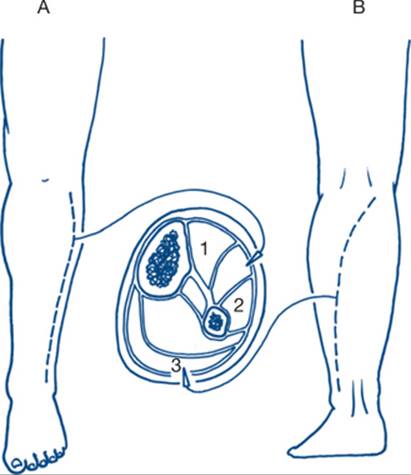
Figure 13.28 Fasciotomy of the lower limb
Two skin incisions (A and B) are sufficient to decompress the anterior, lateral and posterior compartments (1, 2 and 3).
6. Amputation. The decision to perform primary amputation of a limb is a matter of clinical judgment for the surgeon. Some important factors that should be considered include the degree of tissue loss, damage to distal innervation and the general clinical condition of the patient.
Management of specific vascular injuries
Vascular injuies take many forms, some of which are listed in Box 13.10.
Box 13.10
Specific vascular injuries
Carotid artery injury
Injury of the abdominal aorta and its branches
Injury of vessels of the extremities
False aneurysm and arteriovenous (AV) fistula
Intra-arterial drug injection
Carotid arterial injury. Carotid artery damage is the most serious vascular injury associated with a penetrating neck wound. Associated injuries of the pharynx and oesophagus are common; exploration is indicated in virtually all cases and always in those with active bleeding. The patient with established coma is best treated non-surgically due to poor prognosis. Penetrating injury to the neck is divided into three anatomical zones for the purposes of management (Fig 13.29).
• Zone I: extends from the clavicles to the cricoid cartilage. Relevant structures include the great vessels (subclavian, brachiocephalic, common carotids, internal and external jugular veins, and vertebrals), oesophagus, thoracic duct and lung apices.
• Zone II: extends from the cricoid cartilage to the angle of the mandible. Relevant structures include common carotid arteries and bifurcation, continuation of the vertebrals and jugular veins. The larynx is also contained within this zone.
• Zone III: extends from the angle of the mandible to the mastoid process (base of skull). Relevant structures include the internal carotid artery and external carotid branches, vertebral and jugular vessels.

Figure 13.29 Anatomical zones of the neck
Arteriography is often helpful in stable cases with injuries in zones I and III, where surgical access is limited. Patients with injuries in zone II (with haemodynamic instability or major signs of vascular trauma) should undergo immediate operation without arteriography, unless in a coma.
The main signs of carotid artery trauma are haematoma on the lateral side of the neck, Horner’s syndrome, a transient ischaemic attack or established limb paresis in an alert patient. Injuries in the root of the neck are particularly difficult to evaluate and exposure and proximal control is difficult unless the sternum is split down to and extended laterally into the third intercostal space. If blood is seen coming from the root of the neck during exploration for a zone II injury, a sternotomy should be considered to expose the great vessels arising from the arch of the aorta.
Injury of the abdominal aorta and its branches. Most injuries are caused by penetrating trauma. Lower back wounds between the lower ribs can be missed and, like intervertebral disc surgery, may unexpectedly produce aortic or lumbar vessel injury and massive retroperitoneal bleeding. Laparotomy releases tamponade and rapid anteroposterior clamping of the aorta at the hiatus is necessary in cases of injury of a major vessel. Sometimes clamping at thoracotomy before laparotomy is safer, tamponade being maintained while proximal control is then achieved. Most aortic injuries can be repaired with simple suturing. For more extensive injuries, bypass grafting may be required (e.g. axillo-bifemoral bypass). Associated IVC injuries are common and must also be repaired; IVC control may be achieved with the Kocher manoeuvre (right medial visceral rotation). For injuries of the retropancreatic abdominal aorta, the best approach is reflection of the spleen, pancreas and left colon in the retroperitoneal plane from left to right (left medial visceral rotation). Seat belts may sometimes be the cause of aortic intimal tear and occlusion.
Arterial injuries of the extremities. Lower limb vascular injuries are more likely to lead to limb loss than upper limb damage. Common femoral arterial injury is the most common and ligation will lead to a 50% amputation rate. Penetrating injury in the femoral triangle commonly also produces nerve and venous injury. Injuries to the superficial femoral artery lower down are usually caused by the sharp edge of fractures after blunt trauma. Popliteal artery ligation after trauma also commonly leads to amputation, due to the limited collateral circulation around the knee. The injury is a difficult problem both to diagnose and to treat. About a third of patients with posterior dislocation of the knee have an associated intimal tear and thrombosis of the popliteal artery. This injury is easily missed in the patient with multiple injuries and shock. Careful arterial repair free of tension is essential (Box 13.11). The repair of associated venous injury should be performed where possible, but prolonged attempts at reconstruction provide little benefit and should be avoided. Careful postoperative observation is essential and any evidence of further thrombosis is an indication for immediate re-operation.
Box 13.11
Reasons for failure of repair of a vascular injury
Established irreversible ischaemic damage to muscle
Poorly stabilised concomitant fracture
Technical error in the vascular repair
Failure to remove distal thrombus adequately
Failure to repair venous injury and restore venous return
False aneurysms and AV fistula. The incidence of chronic false aneurysm and AV fistula has fallen with improved early diagnosis and immediate surgical treatment. False aneurysms result from partial division of an artery (complete division usually leads to thrombosis or continuous bleeding with an expanding haematoma). Contiguous tangential injury to artery and vein may lead to an AV fistula. Aneurysm presents as a pulsating haematoma adjacent to an old penetrating wound. Chronic AV fistula is also a pulsatile lesion associated with a continuous murmur, increasing oedema because of venous compression, a positive Nicoladoni-Branham’s sign (when large), varicosities and developing ischaemia. An AV fistula may occasionally be associated with a bleeding tendency because of platelet consumption. Angiography and ultrasonography are indicated before surgery to plan the procedure and to define the often unexpectedly extensive ramifications of dilated vessels. In the limbs surgery is best performed under tourniquet control. Endovascular repair techniques (stent grafts) may also be an option. In the trunk, cardiopulmonary bypass is sometimes required.
Acute arterial injury can result from intra-arterial injection. This is sometimes an iatrogenic injury; prophylactic measures are outlined in Box 13.12. Much more common is accidental or deliberate intra-arterial injection of drugs of addiction by drug addicts. Arterial injection is characterised by severe pain in the limb, small vessel occlusion and patchy gangrene — often with normal distal pulses. There is often flexor compartment muscle damage and developing claw deformities, as seen with Volkmann’s contracture.
Box 13.12
Precautions to avoid inadvertent arterial injection
 Choose another injection site (forearm, hand)
Avoid hyperextension of the elbow
Palpate for aberrant arteries
Give injection into an already running infusion line
Inject towards the lateral side of the cubital fossa
Avoid applying tourniquet occlusion pressure to above arterial pressure
Treatment is summarised as pain control, elevation of the limb and fasciotomy, heparin infusion and observation — allowing the areas of patchy necrosis to demarcate. If the process is complicated by infection or demonstrates rapidly progressive necrosis, early debridement is indicated. Hand therapy and mobilisation are important aspects of rehabilitation.
13.12 Urinary tract injury
Injuries of the urinary tract are classified as upper (kidneys, renal pelvis, ureters) or lower (bladder and urethra). Most urinary tract injuries are minor in severity and the vast majority occur from blunt trauma. Genitourinary tract injury occurs in approximately 5–10% of abdominal trauma, and when present, is rarely an isolated injury. Each specific injury type will be discussed separately and the ATLS™ principles discussed earlier should be applied.
Renal injury
Blunt renal trauma (accounting for 70–80% of renal injuries) is much more common than penetrating injury. Blunt injuries are likely to have associated fractures of the lower ribs or transverse processes of that side. Injuries to the lung, spleen and liver frequently coexist and laparotomy may therefore be indicated for significant trauma to the latter of these organs. Sporting injuries are a relatively common cause, as are falls, car accidents and blunt trauma to overlying ribs (e.g. from kicks). Isolated injuries rarely need urgent operation and are usually managed conservatively.
Classification of renal injury (Grades I–V) is specified by the AAST’s organ injury severity scale for the kidney (Table 13.8). The usual lesion is a contusion or laceration of the parenchyma entering the calices and causing haematuria. Patients present with pain and tenderness in the loin, flank and abdomen. The degree of haematuria does not reflect the magnitude of parenchymal damage, as major urinary tract trauma may exist in the absence of haematuria. Persistent bleeding causes increasing loin pain and swelling and pain on breathing. Ectopic and pathologically enlarged kidneys, especially with hydronephrosis, are much more vulnerable to trauma and may present with haematuria after relatively minor injury.
Table 13.8 AAST organ injury severity scale (1989) for the kidney
|
Grade |
Type of injury |
Description of injury |
|
I |
Contusion |
Microscopic or gross hematuria, urologic studies normal |
|
Hematoma |
Subcapsular, nonexpanding without parenchymal laceration |
|
|
II |
Hematoma |
Nonexpanding perirenal hematoma confirmed to renal retroperitoneum |
|
Laceration |
<1.0 cm parenchymal depth of renal cortex without urinary extravagation |
|
|
III |
Laceration |
<1.0 cm parenchymal depth of renal cortex without collecting system rupture or urinary extravagation |
|
IV |
Laceration |
Parenchymal laceration extending through renal cortex, medulla and collecting system |
|
Vascular |
Main renal artery or vein injury with contained hemorrhage |
|
|
V |
Laceration |
Completely shattered kidney |
|
Vascular |
Avulsion of renal hilum that devascularises kidney |
Moore EE et al J Trauma. 1989; 29 : 1664–1666
Initial assessment
The choice of diagnostic modality in suspected renal trauma depends largely on the haemodynamic status of the patient. Contrast-enhanced CT scanning has replaced the intravenous pyelogram (IVP) as the preferred first-line investigation for renal injury in the stable patient. CT is also more sensitive than angiography, with the role for the latter now limited only to selective embolisation procedures of the renal arterial branches or evaluation of renal vein trauma. Ultrasound is not routinely recommended for assessment of renal injury, as it is operator-dependent, does not provide any functional information and fails to accurately access depth of injury.
Haemodynamically stable patients should undergo CT scanning when patients have haematuria in the following circumstances: blunt trauma and initial hypotension (which responds to fluid resuscitation), penetrating abdominal trauma or when there is a rapid deceleration injury with associated intra-abdominal trauma. Although it is more expensive and time-consuming, the advantages of CT over IVP are a greater sensitivity for detecting renal trauma, better anatomical localisation of injury, more accurate estimation of the degree of parenchymal damage and possibly demonstrating injury to other solid organs (spleen, liver). Complete absence of function and of contrast enhancement on CT scan indicates division, avulsion or occlusion of the main renal vessels or severe renal parenchymal destruction (shattered kidney). Occlusion of the renal artery can occur from stretching and intimal tearing without gross bleeding or other signs and it is important to diagnose these injuries early. Where CT scan is not available, IVP may be performed, although its lack of sensitivity for detecting penetrating renal trauma should be remembered.
Haemodynamically unstable patients should not be transferred to the CT scanning suite but should be taken to the operating theatre immediately. Preoperatively, a single-shot IVP may be performed relatively quickly. The presence and function of the opposite kidney, as well as that of the injured one, should be noted in case an emergency nephrectomy of the injured kidney is required. Other features to note include contour deformities and extravasation of contrast.
Definitive care
Patients are initially evaluated according to the ATLS™ principles already described. Regular observations of vital signs are essential and successive urinary specimens are sent for analysis.
Surgical intervention
Early surgical intervention is indicated in the following situations:
• rapidly increasing loin and abdominal haematoma, associated with hypovolaemia and not responding to immediate transfusion
• Grade V renal injury severity.
If operation is required, an intraperitoneal approach is best via a vertical midline incision. Other intraperitoneal and retroperitoneal injuries are identified. The renal vessels are controlled before the retroperitoneal fascia is opened, as this may precipitate massive bleeding.
Penetrating injuries involving the kidney must all be explored, using a similar intraperitoneal approach to exclude associated injuries.
Operative options include total nephrectomy, partial nephrectomy, renovascular repair and renal reconstruction (renorrhaphy). Total nephrectomy will be required for severe injuries (avulsion of the pedicle, shattered kidney). Occasionally, partial nephrectomy is possible, with repair of the remaining collecting system and parenchyma and evacuation of extravasated blood and urine. Repair of renal pedicle injuries is only likely to be of value if performed within one to two hours of the injury. Two hours of complete normothermic ischaemia causes irreversible infarction. Surgery in these patients is still associated with low rates of success and the majority of patients require nephrectomy at a later stage. Despite this, renovascular repair should be considered in cases of bilateral renal trauma or in patients with a solitary kidney. Nephrectomy is recommended for all other cases of avulsion of the pedicle. Principles of renal reconstruction include debridement, preservation of the renal capsule and repair of renal and collecting system parenchyma.
Delayed surgery may be required for persistent bleeding and extravasation or, rarely, the development of hypertension
Conservative management
Most haemodynamically stable patients with Grades I–IV injuries may be managed conservatively. Such patients need admission to hospital for investigation with imaging (usually CT scanning) to characterise the severity of injury. Management includes strict bed rest until haematuria resolves, antibiotic prophylaxis, monitoring of vital signs and frequent clinical examination. Any deterioration or haemodynamic instability mandates laparotomy and renal exploration.
Ureteral injury
Ureteral injuries usually result from surgical division or penetrating injury (gunshot or stab wounds), although blunt trauma from rapid deceleration may lead to avulsion of the ureter from the kidney. A high index of suspicion is required for early detection of ureteral injury, as there are no specific symptoms and haematuria may be absent in one-third of cases. The diagnostic hallmark is extravasation of contrast — most frequently seen on CT scanning with delayed pyelography (CT-IVP). If recognised at the time, the injury is best treated by immediate repair or re-implantation over a stent. An indwelling urinary catheter is inserted to facilitate bladder drainage and assessment of urine output. The administration of intravenous methylene blue or indigo carmine at the time of surgery may assist identification of the exact site of ureteric injury. A Boari flap may be performed, whereby a bladder flap is raised to compensate for the loss of ureteric length, in injuries involving the lower two-thirds of the ureter. Various other reconstructive and repair methods exist and depend on the grade of ureteral injury.
Bladder and urethral injury
Initial assessment
Bladder and posterior urethral injuries
The empty bladder is well protected within the bony pelvis and quite severe or penetrating injuries are required to damage it. The full bladder distended with urine (and alcohol) is much more likely to be injured from abdominal or pelvic trauma. Rupture of the bladder or posterior (prostatomembranous) urethra must always be suspected when a pelvic fracture occurs. Most injuries are due to blunt trauma, motor vehicle injuries or falls, rather than to penetrating wounds. Suspicion of urinary injuries is increased if:
• bleeding occurs at the external urethral meatus (men) or the vaginal introitus (women) (the cardinal sign)
• there is inability to void
• suprapubic pain, tenderness or mass are present.
Bladder injuries
These can be:
• extraperitoneal: usually occurs due to penetration of the bladder wall by a bony fragment
• intraperitoneal: usually follows injury to the lower abdomen in the presence of a distended bladder, which ruptures at the dome, the least protected point.
Posterior (prostatomembranous) urethral rupture
This injury occurs with severe pelvic fractures (Fig 13.30). The puboprostatic ligaments and membranous urethra (the portion between the prostatic apex and the inferior surface of the urogenital diaphragm) are partially or completely torn by the shearing stresses, particularly when a large H-shaped segment of pubis and rami is displaced backwards, carrying the bladder and prostate with it. With complete division of the membranous urethra the bladder and prostate are displaced backwards and upwards, blood leaks, often copiously, from the urethra and the patient cannot void.
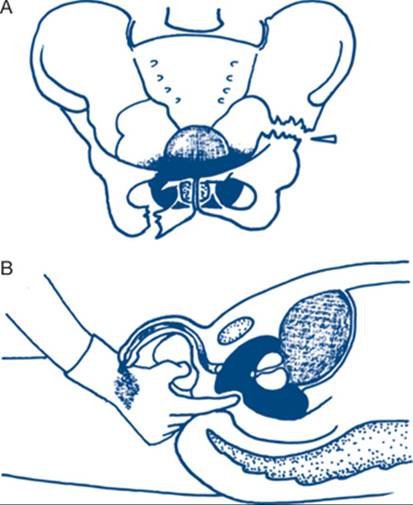
Figure 13.30 Extraperitoneal rupture of the bladder or posterior (prostatomembranous) urethra
Urinary extravasation above the urogenital diaphragm. A: shearing strain when the pelvic ring is broken and displaced; B: on rectal examination a haematoma obscures the prostate
Penetrating bladder or posterior urethral injuries (and occasionally non-penetrating ones) can also involve rectal injury and other severe intraperitoneal visceral injuries. The wound may be on the anterior abdominal wall, the perineum or the buttock.
Injuries to the anterior urethra
These also may be open or closed. Closed injuries are far more common. The anterior urethra extends from the inferior surface of the urogenital diaphragm to the external meatus. Damage occurs from fall-astride injuries (bicycles, beams), kicks in the crutch or inept instrumentation injuring the bulbous urethra. Bleeding from the urethral meatus occurs. Blood, and later urine, can also extravasate throughout the perineum (butterfly haematoma), scrotum and penis and up onto the anterior abdominal wall within the confines of the attachments of Scarpa’s fascia. If diagnosis and treatment of incomplete ruptures are delayed, widespread cellulitis and necrosis of the overlying skin can occur if the extravasated urine becomes infected.
Investigations
If a bladder, posterior urethral or anterior urethral injury is suspected clinically, and particularly when bleeding from the urethral meatus or a perineal haematoma or severe fractured pelvis is present, the patient should not be catheterised until an urgent retrograde urethrogram is performed using a water-soluble contrast medium.
Definitive care
In patients with suspected anterior urethral injuries
If the urethrogram is normal with no extravasation and with dye entering the bladder, and the patient continues to improve and voids satisfactorily and without pain, no further treatment is necessary.
Partial urethral ruptures with extravasation require a splinting urethral catheter that will also provide proximal urinary diversion. The catheter should be inserted gently and any resistance should prompt consideration of endoscopically assisted catheterisation. Suprapubic catheterisation is also a viable treatment option for partial urethral injury.
Complete urethral ruptures (extravasation, dye does not enter bladder) require immediate urinary diversion by suprapubic catheterisation and definitive urological repair.
In patients with suspected posterior urethral or bladder injury
Posterior urethral injury
If injury of the posterior urethra is confirmed by extravasation of dye or failure of dye to fill the posterior urethra or enter the bladder, immediate large-bore suprapubic urinary diversion is required. If operative treatment is not immediately available, diversion can be performed under local anaesthesia via suprapubic catheterisation. The suprapubic cystostomy is retained until the patient’s general condition permits urethroplasty.
Bladder injury
If the urethrogram is normal but bladder injury is suspected, a urethral catheter is passed and bladder distension cystography performed. The bladder is emptied after an initial film of the distended bladder is taken. Further films are taken in several planes, which often disclose tears and extravasation obscured by the large bolus of contrast seen on the initial X-ray.
Cystography will thus show associated bony injuries, bladder compression or displacement, and extraperitoneal or intraperitoneal extravasation or both.
Treatment of bladder rupture secondary to blunt injury is determined by whether the rupture is extraperitoneal, intraperitoneal or combined. Extraperitoneal rupture may be treated by observation and catheter drainage. Intraperitoneal rupture and combined injuries should be explored with laparotomy to exclude other injuries and to facilitate closure of identified tears in the bladder. A suprapubic catheter and a urethral catheter should be inserted. All penetrating bladder injury should be explored with laparotomy and repaired; other intra-abdominal injuries should be sought.
13.13 Spinal injury
Each year in Australia there are approximately 350 new cases of persisting spinal cord injury (SCI) recorded on the register, translating into an age-adjusted rate of 15 new cases per million population aged 15 years or older. The major causes include motor vehicle accidents (accounting for around 50% of cases), ‘everyday accidents’ (such as injuries sustained at work or home, during day-to-day activity) and sporting injuries. Many of those injured will remain permanently paraplegic or quadraplegic.
Fractures of the spinal column occur due to axial compression, flexion–compression, flexion–distraction, hyperextension or rotational strains. Severe flexion–rotation strains are most likely to cause fractures or fracture–dislocations, with associated spinal cord damage. Fortunately, less than 10% of spinal fractures are associated with neurologic defects. The spinal cord terminates between the L1 and L2 vertebrae. The cord has two symmetrical enlargements: cervical (for the brachial plexus) and lumbosacral (for the lumbar and sacral plexuses) and occupies varying degrees of space within the spinal canal during its course. In the thoracic and lower cervical regions the spinal cord occupies nearly half the spinal canal and is more vulnerable, but more free space exists below L1 and in the upper cervical spine.
Classification of spinal cord injury
Spinal cord injury can be classified according to severity of injury (complete or incomplete), level of injury (sensory or motor) or in terms of the neurological pattern of presentation.
Severity of injury. Patients with complete injury have loss of both sensory and motor function below a neurological level. Those patients with incomplete injury retain some sensory or motor function below the level of injury and generally have a better prognosis for recovery.
Level of injury. The neurological level of injury should be assessed in terms of sensory and motor function, separately for each side (left and right) because injuries may be asymmetric. The sensory level of injury refers to the most caudal level of the spinal cord with normal sensation (light touch and pinprick). The motor level of injury refers to the most caudal segment of the spinal cord with normal motor function (‘normal’ defined as at least 3 of 5 power grade). A patient with asymmetric injury may therefore be described as having the following neurologic deficit: left C6 sensory–C7 motor and right C5 sensory–C6 motor level, for example.
Neurologic patterns of injury
Anterior cord syndrome is due to an interruption of the blood supply to the anterior portion (two-thirds) of the spinal cord. This results in loss of motor function (often paraplegia) and loss of pain and temperature sensation (lateral spinothalamic tract injury), with preservation of proprioception and vibration sense (posterior column function). The prognosis is poor.
Central cord syndrome commonly occurs as a result of a hyperextension injury in patients with pre-existing spinal canal stenosis. Blood flow in the anterior spinal artery that supplies the central portion of the cord is compromised and therefore preferentially injures the more centrally-placed motor fibres to the cervical segments. Motor function of the upper limb is controlled predominantly by cervical components from the brachial plexus; the upper limbs are therefore affected more than the lower limbs (hence the term ‘inverse paraplegia’). Sensory loss is variable. Motor function of the lower limb is relatively spared because the innervation comes from corticospinal tracts that occupy a more peripheral location in the spinal cord. Prognosis is reasonably good and recovery follows a characteristic pattern starting distally first (lower limbs), then progressing proximally (upper limbs last).
Brown-Séquard syndrome occurs with hemitransection of the spinal cord and usually carries a good prognosis. On the ipsilateral side there is loss of motor function (corticospinal tract), proprioception, vibration and light touch (posterior column function). One to two levels below this, there is a contralateral loss of pain, temperature and deep touch sensations (reflecting trauma to the spinothalamics).
Initial assessment
Any patient with persisting pain in the neck or back after injury must be suspected of having a spinal fracture until proved otherwise. SCI must be identified early.
Clinical examination must be careful, thorough and gentle. The principles of the initial assessment

Figure 13.31 Spinal cord injury: levels of function
(primary and secondary surveys) should be applied. The patient’s neck and back should not be moved until fracture or dislocation has been excluded. The history of the mechanism of injury is often helpful in evaluating its likely degree of severity, but complete SCI can also follow apparently minor injuries, so vigilance in detecting fractures and neurological symptoms and deficits is vital. The patient is initially examined in the position in which first seen.
Primary survey
Airway and cervical spine. The cervical spine should be protected with a hard collar while the airway is secured.
Breathing and ventilation, circulation. If breathing and ventilation are satisfactory, the circulation should be assessed next. Hypotension in the multiply injured patient should always be presumed to be hypovolaemic in origin — neurogenic shock can occur but is much less common. Hypotension in hypovolaemic shock is usually accompanied by compensatory tachycardia, while in neurogenic shock the loss of sympathetic tone is associated with hypotension and bradycardia.
Disability, exposure. A brief initial neurological examination is then performed (AVPU or GCS) and the motor and sensory status of the extremities is assessed. Clothing is removed to allow detailed inspection of the spine and overlying skin. Once injury to the spine is identified or suspected, immediate immobilisation should occur (e.g. hard cervical collar). This enables the medical officer to safely defer the management of spinal trauma and attend to other more urgent life- threatening problems such as tension pneumothorax, haemorrhage or pericardial tamponade, for instance.
Secondary survey
Gentle palpation from the occipital protuberance to the coccyx is undertaken, palpating each spinous process for tenderness. Only then may the patient be gently rolled to the lateral position to examine for swellings, abrasions, bruising and deformities such as a kyphosis — often more readily palpated than seen.
Complete neurological examination is essential in patients with suspected spinal injuries and must precede imaging or other investigations. Motor, sensory and reflex testing of the extremities, trunk and neck is done. Sensory testing determines if sensory loss exists and the level of its cut-off, if complete. Motor loss checks extremities, intercostal and abdominal muscles. Testing of reflexes includes limb and abdominal reflexes and, very importantly, anal and genital reflexes and anal sphincter tone together with perineal sensation. Many spinal cord and nerve functions are concentrated in this small area of the perineum.
Investigations
Plain X-rays. Cervical and thoracolumbar spinal plain radiographs are taken in at least two planes. If cervical spine fracture is suspected because of neck pain, it is important to take X-rays with adequate shoulder depression, so that all cervical vertebrae are visible and so that the regions of the atlas and axis are shown well on open-mouth (odontoid) views. The initial cervical X-ray is a cross-table lateral view (CTLV). If C7 and T1 are not on clearly on view, a swimmer’s view should also be performed. Back pain and suspected fracture need views of the thoracic and lumbosacral spine.
CT scanning. CT is a useful adjunct to plain radiographs where abnormalities are detected or when portions of the spine are not clearly imaged. It is useful in assessing stability of fractures and can provide information on the spinal cord and osseous anatomy of the spinal canal.
MRI scanning. MRI scans are not indicated in the primary assessment of cervical spine injury in the multiply injured patient. Although it may provide useful information in the presence of neurologic deficits, trauma patients are often too unstable and the presence of resuscitative equipment precludes transfer to an environment with a strong magnetic field. For stable patients, however, MRI scans are routinely performed following transfer to a spinal unit for evaluation of cord trauma.
Definitive care
Management in the emergency department
Once a spinal injury has been diagnosed, early referral to the orthopaedic or neurosurgical team should be made. Consultation with a specialised spinal unit subsequently occurs. The following management principles should be considered.
Respiratory function. Particular emphasis should be placed on respiratory assessment and management as patients with spinal injury (particularly high cervical cord injury) are at significant risk of loss of respiratory function through diaphragmatic denervation. The airway should be assessed for associated trauma while the cervical spine is protected. Breathing and ventilation should be evaluated and any concerns should prompt early consideration of intubation.
Immediate spinal immobilisation. The injured segment of the spinal column must be immobilised immediately. Cervical spine injuries should be immobilised with a hard cervical collar. In emergency departments affiliated with spinal units, specialised spinal beds are available for use. The trauma surgeon or orthopaedic specialist will seek to manage cervical dislocation or fracture by reduction and stabilisation as soon as possible to prevent further neurological damage, particularly in incomplete or threatened cord lesions. Cervical spine dislocations and fractures are usually reducible by traction using a halo splint and traction is subsequently maintained with a reduced weight. The patient is subsequently admitted under the spinal unit where a multidisciplinary approach is adopted.
Pharmacologic treatment: methylprednisolone. Current evidence for the administration of methylprednisolone in patients with acute spinal trauma is inconclusive; a definite benefit has not been clinically proven. The usual procedure is to discuss the possible benefits and risks with the patient (if alert) or family member and proceed with administration when agreement exists.
Intravenous fluids. The administration of intravenous fluids should aim to keep the patient euvolaemic. Bradycardia in the setting of hypotension raises the possibility of neurogenic shock through loss of sympathetic tone and in this setting continued aggressive fluid resuscitation will lead to fluid overload and acute pulmonary oedema.
Urinary catheterisation. In the absence of urethral trauma, insertion of an indwelling catheter permits monitoring of urine output and fluid balance, as well as prevention of urinary retention in spinal injury.
Gastric decompression. Insertion of a nasogastric tube is recommended to empty gastric contents and reduce the risk of aspiration.
Transfer to a spinal unit
Patients with SCI are best managed at a specialised spinal unit that comprises surgical specialists (orthopaedic/neurosurgical), spinal/rehabilitation physicians, nursing staff, physiotherapists, occupational therapists, social workers and neuropsychologists. Delays in transfer should be avoided. Patients with spinal injury should be transported with appropriate immobilisation devices (cervical collar, cervicothoracic splints) and backboard with straps. Compromise in respiratory function should be anticipated and patients with high cervical cord injury may require intubation prior to transfer. The risk of pressure ulcers is significant and time spent on the rigid backboard should be limited only to what is required for safe transport.
13.14 Major fractures and joint injury
Major fractures are often associated with other injuries and priorities must be set in each patient. Control of internal concealed haemorrhage, for example, from a ruptured spleen, takes precedence over fracture management. It is, however, important in severely injured patients that open fractures are managed as early as possible. The advantages of this approach include diminished risk of infection, reduction in pain, early ability to sit upright with improved respiratory function, reduced continuing blood loss, improved healing of soft tissue injuries and a reduced incidence of fat embolism. Aims of treatment include prompt fracture healing, and early and complete rehabilitation.
Initial assessment
Primary survey
The ABCDEs of the primary survey should be assessed. Haemorrhage from musculoskeletal injury should be identified and controlled with direct pressure. It is important to recognise that significant amounts of blood may be lost from fractures of the pelvis or femur and haemodynamic instability from hypovolaemia may be present. Physical examination is carried out while resuscitation is in progress in hypovolaemic patients. Clothing is cut free and the patient is examined for fractures and for evidence of internal haemorrhage. The following are important adjuncts to the primary survey and resuscitation.
• Fracture reduction and immobilisation. Emergency splinting of fractures will minimise soft tissue damage, reduce blood loss, control pain and prevent conversion of a closed fracture to an open fracture. Temporary traction devices may be used to maintain satisfactory alignment. It is important to examine the injured limb for signs of vascular and nerve injury, as well as searching for a fracture or dislocation. The fractured limb should be handled as gently as possible if some realignment is necessary in order to apply a padded standard or improvised splint. Splinting should immobilise the joints above and below the fracture also. The open wound of a compound fracture should be promptly covered with a clean or sterile dressing. Bone protruding from the wound should be left undisturbed.
• Analgesia. Although splinting greatly assists pain control, the administration of intravenous narcotic analgesia is almost always required.
Resuscitation
Up to four litres of blood may be lost with severe fractures of the pelvis or femur. Adequate resuscitation before internal fixation is particularly important in such patients, who may lose 50% or more of their blood volume, either externally (with open injuries) or into the tissues of the thigh and pelvis. One or two litres of blood distributed evenly throughout the soft tissues of the thigh will increase the external diameter by a mere 1–2 cm; patients with multiple pelvic and other fractures can require replacement of considerably more than their total blood volume. If resuscitation is inadequate, induction of anaesthesia may lead to a fall in venous return sufficient to cause cardiac arrest. The danger of cardiac arrest is greater in elderly patients with established ischaemic heart disease.
Secondary survey
During the secondary survey a focused history and examination are performed, including a neurological assessment.
History-taking should incorporate ‘AMPLE’ and the following points should be considered: circumstances of the accident, and a history of crushing trauma or explosive forces. If the patient has been involved in a motor vehicle accident the questions listed in Box 13.2 will provide useful information.
Physical examination and neurological assessment. Signs of fracture are local loss of function, bony tenderness, swelling, deformity, bruising and protective muscle spasm. Testing for abnormal movement and crepitus is unnecessarily painful and contraindicated. An obvious fracture may often distract attention from a less obvious injury. For example, dislocation of the hip may coexist with an obvious femoral shaft fracture (sometimes the real cause of persistent shock); a spinal fracture with a fracture of the calcaneus. Visceral injuries such as splenic rupture are seen with fractured ribs; urethral or bladder injuries with a fractured pelvis. The examiner should check peripheral pulses and evidence of limb ischaemia beyond a fracture — such a complication requires urgent correction. The most common vascular injuries are at the knee and elbow — to the popliteal vessels after severe knee injury in children and to the brachial artery following supracondylar fracture. Neurological examination is also essential; loss of motor power in any muscle group or loss of any cutaneous sensation indicates nerve injury. If the patient can flex and extend the toes and ankle, the major nerves of the lower extremity are intact; if the fingers can be spread and flexed and the thumb can be extended, functional integrity of the major nerves of the upper limb is present. Common nerve injuries following fractures are: the radial nerve from fracture of the mid-humerus; the peroneal nerve from proximal fibular fracture and knee injuries; and the ulnar nerve from fracture of the medial epicondyle of the humerus. Sciatic and axillary nerve injuries must always be excluded after dislocation of a hip or shoulder.
Investigations
A radiological examination is necessary in all cases and can be combined with additional diagnostic modalities to detect other suspected injuries. X-rays should be in at least two planes (usually AP and lateral). X-rays of long bones should always include the joints above and below the suspected injury and include the entire length of the bone so that double fractures are not missed. X-ray of both sides for comparison is often valuable in establishing the correct diagnosis, especially for fractures about the joints in children where the presence of growth plates may make interpretation difficult. An X-ray of the pelvis should always be done in the presence of major lower limb trauma. Some fractures and joint injuries are classic of the injury: falling from a height causes calcaneal, femoral neck and spinal fractures; front-seat car accidents cause fractured patella or dislocated hip. CT scans may be required for further evaluation of complex fractures or to exclude concomitant vascular injury. Other tests such as retrograde urethrography or cystography may be required to exclude lower urinary tract trauma if there are pelvic fractures.
Definitive care
Careful attention to the details of local treatment is most important. Fractures heal promptly with correct local treatment. Healing will invariably occur when there is a good blood supply to the fragments, the bone surfaces are apposed and immobilisation of the fracture is adequate. Systemic or host factors are a less important cause of nonunion than local conditions — such as circulatory impairment, poor apposition of the bone ends, interposition of muscle or other soft tissue between the bone ends, inadequate immobilisation and sepsis. Infection is the most serious cause of delayed union and is the major danger with compound fractures. Physiotherapy and mobilisation must start early so that normal function is restored and full rehabilitation is achieved as soon as possible.
The objectives of fracture management vary according to the location of the fracture. In the upper limb the most important objective is the return of normal hand function and mobility. Early union and then physiotherapy to increase mobility are especially important; perfection of alignment and length less so. In the lower extremity, stability without pain is most important and mobility less so; full length may be partially sacrificed in order that solid fracture union is achieved so that early weight-bearing can be commenced.
Principles of management
1. Fracture reduction with minimal secondary trauma.
2. Restoration of normal alignment and length. This will either require internal fixation or a external frame for most unstable fractures and is especially valuable in the patient with severe and multiple injuries.
3. Immobilisation until healing has occurred.
4. Restoration of function as rapidly as possible.
5. Rehabilitation.
Methods of management
Managing fractures effectively includes five general methods and a host of specific techniques. The technique required depends upon the site of the fracture and the stability of reduction. Comminuted, oblique and spiral fractures are often unstable.
The methods used are:
• closed manipulative reduction and immobilisation, usually with a plaster cast (LAMP — local anaesthetic manipulation and plaster or GAMP — with general anaesthetic)
• manipulative reduction and continuous skin or skeletal traction
• manipulative reduction and external skeletal fixation, including multiple transfixion pins incorporated in a frame as an external fixateur
• open reduction and internal fixation (ORIF)
• no immobilisation, except for a sling or a bandage.
Closed reduction and plaster fixation. In undisplaced fractures, immobilisation is all that is necessary. Greenstick fractures in children also need simple immobilisation. When the two fragments are displaced, reduction usually requires manual traction and counter-traction in the long axis of the limb. Rotation deformity is corrected, the distal fragment is placed in apposition to the proximal one and, finally, the angulation deformity can be corrected. Closed manual reduction is all that is required when the reduction is stable and good alignment is maintained by immobilisation. Closed reduction is the most common method of managing fractures of the extremities and is the safest form of management. A lightly padded plaster cast is applied to immobilise the fracture. The plaster should include the joints above and below the fracture. Added safety may be gained by bivalving the plaster soon after its application as a precautionary measure against circulatory impairment, which may be produced by developing oedema. Subsequent exercise within the cast is important to avoid muscle wasting and joint stiffness and to improve the rate of recovery. Early care after plaster fixation is of vital importance. Immediately after recovery from anaesthesia, the patient’s peripheral circulation and nerve function must be assessed. X-rays should also be taken to confirm that reduction is maintained. The first 24 hours is a danger period from reactionary swelling, which may compromise the circulation within a plaster cast. A bivalved cast must be completely split (including division of the internal vellband and stocking, until skin is on view) if there is any question of circulatory insufficiency and the circulation must always be assessed formally once more on the day after application of any plaster to a fractured limb. A formal plaster education sheet should be given to the patient on discharge. This sheet should clearly explain the features of a plaster that is too tight — mandating immediate return to the emergency department for plaster review and possible removal: marked swelling of the fingers or toes, bluish discolouration, paraesthesia or loss of movement.
Reduction and continuous traction. Continuous traction maintains reduction when a comminuted or spiral fracture cannot be controlled by external immobilisation and is most commonly used in the younger patient with a single bony injury. While continuous traction can maintain length, the control of rotation, angulation and displacement is not assured. These aspects must be corrected by manipulation and maintained by splints, slings and pads. Continuous skin traction is reserved for cases where only light traction is required for a short period. For longer term stronger traction, skeletal traction is required. A pin or wire is placed through the bone and a traction bow is applied.
External skeletal fixation or open reduction and internal fixation. These offer the advantages of exact apposition and alignment; full length can usually be achieved. The methods are most useful in the severely injured patient, facilitating nursing care, shortening recovery time and improving survival. An external fixateur is particularly valuable when the fracture is associated with extensive local tissue damage (Fig 13.32).

Figure 13.32 External fixation to facilitate soft tissue repair
External fixation stabilises an open comminuted fracture of the tibia associated with extensive tissue damage, and facilitates soft tissue repair.
Open (compound) fractures. An open fracture is a surgical emergency. The major hazard is secondary infection and delayed union of the fracture. Therefore, the objective of management is to obtain rapid healing without infection. On presentation careful surgical debridement of all dead and doubtfully viable tissue is performed under general anaesthesia, removing foreign material. Antibiotics are no substitute for proper wound care. Drainage may be required to minimise haematoma formation. The skin is cleaned thoroughly with a detergent wash and then painted with a skin antiseptic. The wound margins are excised preserving as much tissue as possible (particularly skin and periosteum) but widely excising dead or doubtful fat and muscle. When there is extensive local soft tissue damage, which may have required vascular or nerve repair, immobilisation by external fixation is essential. In cases with minimal tissue damage and contamination where bony fragments have simply pierced the skin, the wound can be closed. If there is any doubt about tissue viability, if contamination has been extensive and if wound debridement has been delayed for 12 or more hours since the accident, the wound is not closed. It is packed lightly with dry gauze and delayed primary closure carried out two to five days later.
Internal fixation is generally contraindicated with compound fractures, but in the severely injured patient who has been transported to a trauma centre with minimal contamination and delay, early internal fixation can facilitate total patient management and improve prospects of survival.
Compartment syndrome
Compartment syndrome is a surgical emergency that occurs when increased pressures within a fascial compartment compromises the blood supply and leads to muscle and nerve injury. Causes include: fractures (increased local oedema), vascular injuries (haematoma, reperfusion) or inappropriately tight bandages or plaster casts (increasing compartment pressures). Compartment pressures over 30 mmHg result in compression of small vessels and decreased blood flow, causing ischaemic necrosis of tissues. The normal pressure at rest is zero.
Clinical signs. The two reliable signs of compartment syndrome are: pain out of proportion to what is expected on passive movement and paraesthesia in the distribution of the involved cutaneous nerve. The pulse is usually palpable and this has no diagnostic or prognostic significance. Limb paralysis is often a late sign and the end result is an ischaemic (Volkmann’s) contracture.
Management is time-critical and by emergency fasciotomy of all involved compartments, ensuring that the incision extends to the fascial layer such that muscle (often bulging out) is on view.
Rhabdomyolysis and renal impairment
Management of the patient with musculoskeletal injuries should take into consideration the risk of traumatic rhabdomyolysis. This condition describes the destruction of muscle tissue and the subsequent release of breakdown products, such as myoglobin — which is toxic to the kidneys and can lead to acute renal injury. Myoglobinuria is evidenced by darkened urine in these patients. Patients with compartment syndrome, severe musculoskeletal trauma or a history of crushing injury or prolonged immobilisation prior to retrieval are at risk. Other causes include vascular occlusion and electrical injury. Treatment is with adequate fluid resuscitation and maintenance of sufficient urine output.
13.15 Hand injury
The primary emphasis in the treatment of hand injuries is preservation and restoration of hand function. Recovery depends upon the correct treatment being instituted within a few hours of injury, supported later by an intense program of physiotherapy and rehabilitation. Early mobilisation of the hand after injury is also important.
Initial assessment
Management of the injured patient should proceed according to priorities prescribed by the ATLS™ principles (ABCDE). At the time of injury the hand should be covered with a sterile dressing and the bleeding controlled by elevation. Arterial bleeding may require digital pressure for control. The hand should be immobilised with a simple splint. An amputated digit or limb should be placed in a separate, sterile bag, which is further placed in another bag containing ice water. This prevents freezing injury and tissue compromise from direct contact with ice.
Assessment of the hand
Inspection. Look for open wounds and skin loss and deformity indicating the presence of skeletal damage. The degree of contamination is also noted. Injuries to the ulnar nerve result in clawing of the ring and little fingers (hyperextension at the metacarpophalangeal (MCP) joints, with flexion at the proximal interphalangeal (PIP) and distal interphalangeal (DIP) joints). Radial nerve injuries result in wrist drop due to paralysis of wrist extensors.
Palpation. Feel for bony tenderness around various bony landmarks, including the base of the anatomical snuffbox (scaphoid or radial styloid injuries), head of ulna, carpal bones, metacarpals and phalanges.
Testing as follows:
1. Sensation of the hand should be tested in accordance with the most constant regions of individual nerve supply:
• ulnar nerve: ulnar tip of the little finger
• median nerve: radial tip of the index finger
• radial nerve: first dorsal web space.
2. Motor function of the hand may be assessed by the following:
• ulnar nerve: abduction of the little finger (tests abductor digiti minimi) or Froment’s sign (test adductor pollicis) where a piece of paper held between the thumb and a flat palm is easily pulled away
• median nerve: abduction of the thumb (tests abductor pollicis brevis)
• radial nerve: wrist extension or extension of the thumb (tests extensor pollicis longus).
3. Tendon damage may be obvious when one or more digits are disproportionately flexed or extended. Simple tests of flexion and extension confirm whether flexor and extensor tendons are intact. Ability to flex the fingers at the DIP joint suggests an intact flexor digitorum profundus tendon, while flexion at the MCP joint simply indicates that the long flexors are intact and is not specific for FDP or FDS.
Investigations
X-rays are taken to show the site of dislocations or fractures and any opaque foreign bodies. Ultrasonography is increasingly used to detect foreign bodies and may provide useful information regarding ligamentous disruption or injury. CT scanning may provide better anatomical detail of injury and may assist preoperative planning in complex hand injuries.
Definitive care
Principles of surgical management
General or regional anaesthesia may be used, depending upon the general state of the patient and the severity and the extent of the local injury. A bloodless field is essential for accurate evaluation and dissection. A pneumatic tourniquet is used unless there is a severe contaminated injury or significant associated muscle trauma. A padded blood pressure cuff is applied to the upper arm after a period of elevation to exsanguinate the limb. The blood pressure cuff is inflated to above systolic pressure. There is no uniform safe period for which a tourniquet can be applied, but ischaemia can usually be tolerated in the anaesthetised normal arm for one to two hours. It is prudent to allow the circulation to return intermittently after an hour of ischaemia if the total time is likely to exceed two hours. The skin is thoroughly washed with a mild antiseptic solution such as chlorhexidine. The wound is cleared of debris by washing repeatedly with isotonic saline. Careful debridement of the wound is then performed, removing all dead and devitalised tissue and embedded foreign bodies. The skin edges may need to be lightly trimmed after crushing injury but preservation of all viable skin is essential in hand wounds. The amount of skin excised depends upon dermal bleeding at the skin edges upon tourniquet release. The wound often needs enlargement for adequate exposure, evaluation and treatment of the injury. The incisions should not cross skin creases or interdigital webs. Incisions can be zigzagged across lines of tension or can connect the lateral limits of the flexion and extension creases of the phalanges. Normal structures can then be identified and followed back to the site of injury. Extending incisions must also be designed so that skin flaps can be raised, if necessary, to cover repaired deeper structures.
Extensor tendons are repaired unless there is extreme contamination or sepsis. Flexor tendon repair should not be performed in the presence of gross contamination, that is, when there is tendon loss or marked tendon retraction or for tendon injuries within the flexor sheath between the distal palmar crease and the PIP joint, because adhesions are prone to form within the flexor sheath, leading to stiffness. In such instances secondary tendon repair with grafting is carried out three to six weeks after injury. Repaired tendons must be covered with healthy, pliable and supple skin. Nerves, including digital nerves, are best repaired at the first operation, provided contamination is not severe. Unstable fractures may be internally fixed to facilitate early movement, avoiding prolonged external splintage and stiffening of the fingers. Percutaneous pinning techniques are very suitable for unstable fractures. Amputation should be avoided if possible. Re-attachment of amputated digits (especially the thumb) should be considered but require special microvascular techniques and considerable judgement in choosing the appropriate circumstances. Irreversible ischaemia is an absolute indication for amputation. The objective in amputation is to achieve a painless stump covered with pliable and sensitive skin and subcutaneous tissue. When local skin cover is not available this must be obtained by using free grafts or flaps.
With machine-driven rotor injuries or wringer injuries, avulsion of skin and friction burns of tissues occur. These injuries are maximal at sites of anatomical obstruction, namely the thumb, the elbow and the axilla. All structural components of the hand may be injured. Forearm compartment syndrome due to oedematous compression is common and fasciotomy may be necessary.
The immediate aim of treatment of a burnt hand is to restore mobility as soon as possible, preferably within one to three weeks, if contracture formation is to be minimised. Measures that must be taken include control of swelling by elevation, fasciotomy and removal of eschar, immediate or early grafting and prompt debridement. Electrical burns often produce significant hidden damage in the hand. A localised small burn at the point of electrical contact can be associated with extensive deep coagulative necrosis of vessels, nerves and tendons under apparently normal skin. Treatment is similar to that required for high-pressure injection injuries, where a similar degree of deep damage can occur. Immediate decompression and removal of the foreign material offers the best chance of recovery, but a high rate of finger and partial hand amputation is unavoidable in many instances of severe electrical burns.
Digital reimplantation and microsurgery
In some circumstances an amputated digit or thumb may warrant reimplantation. In these circumstances the duration of warm ischaemia (ideally less than 12 hours) or cold ischaemia (less than 24 hours) has an impact on the viability of reimplantation. General principles include: wound preparation and decontamination of the amputated digit; identification of neurovascular structures; bone shortening (to facilitate tension-free neurovascular repair); microsurgical repair of neurovascular structures (ensuring adequate blood flow); and fixation of fractures (e.g. with Kirschner, K-wires).
Wound closure
Direct suturing is the preferred method for clean incised wounds or those made so after debridement, if this can be achieved without tension. Skin cover is desirable unless there is gross contamination, oedema or infection, in which case closure is best delayed for a few days. Primary free skin grafts or flaps may be necessary to gain closure. When bare tendon or bone is exposed, skin grafts will not take and flaps must be transferred from local or distant sites for skin cover. Sometimes the skin from a severely damaged finger can be used, after its amputation, as a rotation or transposition flap.
Postoperative management and secondary procedures
At the end of the operation the hand is elevated and rested in a splint (‘every operation on the hand deserves a plaster’). The metacarpophalangeal joints are flexed to 90° and the fingers are extended so that the joint capsules are kept in the stretched position. The hand is dressed with layers of porous paraffin and dry gauze and acriflavine wool. A firm crepe bandage is used to apply even pressure to the hand and the hand is splinted in elevation for 48 hours to minimise oedema formation. Dressings are changed at two to three weeks or earlier if it is necessary to inspect whether a skin graft has taken. Persistence of pain suggests congestion or inadequate immobilisation. Congestion should be relieved by elevation, division of the plaster cast and sometimes reopening of the skin and fascia. Active exercises are commenced as soon as the wound has healed. Secondary operations may be necessary and include correction of skin contractures by Z-plasty or skin grafting, secondary tendon repair or tendon grafting and nerve re-suture. Later reconstruction may also be necessary for the severely mutilated hand. These operations include finger and thumb reconstruction and toe transfer. Rehabilitation is coordinated in a specialist hand clinic.