
Ming Kon Yii, Marinis Pirpiris
6.1 Introduction
Diseases of the arterial, venous, lymphatic, neurological and musculoskeletal systems of the limbs produce specific symptoms requiring special examination techniques for each system. These techniques are discussed in more detail under the clinical problems that arise from diseases of the bones, joints, vessels, nerves and other structures of the upper and lower limbs. It is essential to compare both sides during examination. In all patients it should be routine to test the urine for diabetes, a common aetiological factor in diseases affecting the lower limb.
Arterial circulation
History
The symptoms of arterial insufficiency include: intermittent claudication; rest pain; acute ischaemic pain of the limb; acute onset of weakness; ulceration and gangrene; and Raynaud’s phenomenon.
Examination
1 Inspection
In patients presenting with claudication, the limb may appear normal. The onset of rest pain indicates that a more severe disease has developed and that gangrene is imminent. The most notable feature of the severely ischaemic limb is its colour. Dusky cyanotic rubor is common, most marked on standing. Hence on first appearance the foot may appear to be well vascularised with rubor. Rubor slowly fades to an unhealthy pallor when the patient lies down and the cutaneous veins are empty, appearing as pale blue gutters in the skin. Trophic skin changes include epithelial thinning and hair loss (hair loss alone is often just age related). Ulceration or gangrene may be seen over pressure points such as: the malleoli; beneath the heads of the metatarsal bones and under the heels; on the dorsum of the foot (a common site of minor trauma); or at the tips of the toes and fingers.
Buerger’s test is performed with the patient supine. In patients with rest pain and pregangrene, cadaveric pallor and guttering of surface veins develop upon elevation of the legs to 45° and exercise of the foot, indicating lack of adequate arterial vis a tergo. This is followed by dependent rubor as the legs are lowered over the side of the bed when the patient sits up. The skin of the foot and toes rapidly becomes reddened, slowly changing to dusky cyanosis. During dependency the maximally dilated small vessels of the ischaemic limb are insensitive to normal vasoconstrictor stimuli and respond passively to changes in transmural pressure. Dependency, with its attendant pressure increase, causes passive hyperaemia. It is thus important to exclude patients who present with a red foot because of severe ischaemia.
2 Palpation
The leg with arterial ischaemia is cool, a sign that is emphasised by comparison with the other side. Skin temperature is best appreciated by palpation using the sensitive thin skin over the dorsum of the middle phalanges (Fig 6.1). Diminished capillary return is present if more than two seconds is taken for colour to return after finger pressure is applied to the big toe.

Figure 6.1 Temperature change detected by applying the thin skin of the dorsal surface of the fingers to the lesions
The peripheral pulses in the affected limb are diminished or absent. The dorsalis pedis artery runs from a point midway between the malleoli to the space between the first and second metatarsal bones and is just lateral to the extensor hallucis longus on the forefoot. The dorsalis pedis may be absent in 5–10% of the population and its place may be taken by a branch of the peroneal artery. The pulse will then be felt more laterally. The posterior tibial artery is found in the soft tissue groove below and behind the medial malleolus, halfway between it and the Achilles tendon. The popliteal pulse is the most difficult to find and is best palpated in the lower popliteal fossa with the knee passively flexed. Beware that an easily felt popliteal pulse is often a sign of a pathologically enlarged popliteal artery. The femoral pulse is usually easily palpable in the groin at the midinguinal point (Fig 6.2). The effects of exercise on the appearance of the limb and on distal pulses should be assessed. In moderately severe disease, palpable pulses may disappear on exercise. It is also important to remember the surface landmarks for the various pulses in situations of ‘extremis’ when pulses may be very weak. The abdominal aorta and iliac vessels should also be examined.
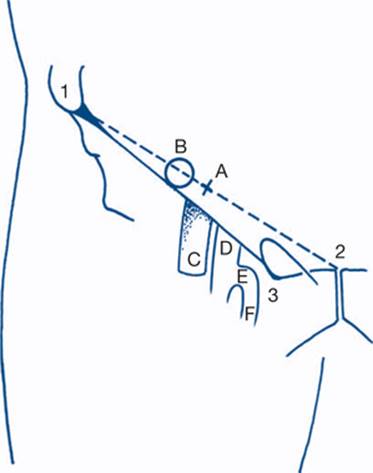
Figure 6.2 The midinguinal point
A: lies halfway between the anterior superior iliac spine (1) and symphysis pubis (2) the deep inguinal ring; B: lies above the midpoint of the inguinal ligament which attaches to the pubic tubercle (3); C: common femoral artery; D: common femoral vein; E: saphenous opening; F:great saphenous vein
3 Auscultation
Systolic murmurs heard over the femoral or popliteal arteries suggest local or more proximal stenosis of the vessel. The use of the sphygmomanometer in the lower limbs has been augmented by Doppler ultrasound blood velocity detection as a measure of peripheral arterial blood flow in patients with absent pulses. The ankle–brachial pressure index (ABI) is derived as the ratio of the ankle systolic pressure to the brachial systolic blood pressure. The normal ABI is 1.0–1.2 and is a simple yet accurate marker of arterial occlusive disease. Measurements are often repeated after walking or following induction of hyperaemia. ABI is lowered immediately after walking in patients with significant occlusive disease. The test is used to: confirm the presence of lower limb ischaemia; determine the likelihood that ischaemic ulcers will heal; monitor patient progress; and indicate the appropriate level for amputation. However, a low ABI is often not present in patients with diabetes due to their very calcified arteries.
Venous circulation
History
Symptoms of presentation of venous disease include varicose veins, swelling and oedema, pain on standing, ulceration and superficial venous thrombophlebitis.
Examination
1 Inspection
The legs are inspected for visible varices involving the long and short saphenous venous systems. A small proportion will also show evidence of chronic venous insufficiency. In patients with chronic venous insufficiency, inspection reveals visible subcutaneous or varicose veins together with bluish-red patches of minute intradermal vessels, known as ankle or malleolar flares or venous stars. The skin in the region of the lower medial third of the leg (gaiter area) shows the signs of venous hypertension: apart from malleolar flares these are: the brown pigmentation of extravasated haemosiderin; dry eczema with a ‘psoriatic’ skin reaction; sclerosing periangiitis with subcutaneous induration; and fibrosis and ulceration. With chronic ulceration and fibrosis, the leg takes the permanent shape of an inverted bottle; contracture may be sufficient to produce an equinus deformity of the ankle and a characteristic waddling gait.
2 Palpation
Palpation of the lower limb confirms the presence of oedema, which initially pits on pressure. Pitting is best demonstrated by applying pressure over the subcutaneous surface of the tibia. Valvular incompetence may be detected by feeling a cough impulse at the saphenofemoral junction and by finding palpable defects in the deep fascia at the site of perforating and communicating veins along the tributaries of the long saphenous vein. The main sites of perforators are: at the saphenofemoral junction and the lower thigh medially; and in the lower leg 5 cm above the medial malleolus (often beneath a venous ulcer), and at the mid-calf and 15 cm above the medial malleolus (two fingerbreadths, a handbreadth and a handspan above the malleolus). The long saphenous vein often runs one fingerbreadth posterior to the subcutaneous surface of the tibia. Tourniquet tests can also be used to locate the site of valvular incompetence. In the supine patient the tourniquet is applied at different levels in the leg after emptying the superficial veins. If the veins above the tourniquet fill on standing when those below remain collapsed then the site of incompetence of the communications between the deep and superficial veins is above the tourniquet. If the veins below the tourniquet fill on standing then the incompetent site is below the tourniquet. In the Trendelenburg test a tourniquet or finger pressure is applied just below or over the saphenofemoral junction. Saphenofemoral incompetence is present and the test is positive if continued pressure prevents retrograde filling of the saphenous vein on standing up from the supine position and if retrograde filling with a waterfall effect rapidly occurs from above on release of pressure.
Neurological system
This system is discussed in more detail in Chapter 5. The following is a brief summary relevant to limb examination.
History
Symptoms of neurological disease include paralysis, anaesthesia (to pain, light touch and temperature) and paraesthesia.
Examination
The aim on examination is to detect the site of a neurological lesion by evaluating disordered function. Neurological examination of the limbs commences with inspection and proceeds to assessment of motor nerve function, sensory nerve function and reflex functions. Assessment of gait and of other coordinated movements is an important component of the examination.
1 Motor nerve function
Five separate aspects of motor function are assessed: the severity of wasting, muscle tone and power, coordination and the presence or absence of involuntary movement.
Muscle power is tested by active movement against resistance and graded from 0 to 5 therefore (see Tables 5.1 and 5.2):
• no active movement = grade 0
• flicker of movement = grade 1
• movement possible but not against gravity = grade 2
• movement possible against gravity but not against resistance = grade 3
• movement against resistance but weakened = grade 4
• normal power = grade 5.
2 Sensory nerve function
Testing of superficial touch, pain and temperature sensation is followed by assessment of position and vibration sense and by discriminatory sensation.
3 Reflex function
(See Table 5.3 on page 105.)
4 Gait
Gait often gives an insight into the functional weaknesses and deformities that may be present. For instance, a Trendelenburg gait in patients with unilateral hip disease is not uncommon, with the pelvis on the affected side dropping as weight is transferred on and off that hip rapidly — a dot–dash type of gait. This is due to abductor muscle weakness or dysfunction, with the abductors failing to maintain a level pelvis during single-limb stance. It is the abductors of the stance phase limb that are responsible for maintaining the pelvis level.
Bilateral abductor dysfunction or weakness may result in a waddling gait. Waddling gait may also be seen in obese patients, those with bilateral congenital dislocation of the hips and in patients with muscular dystrophy affecting the trunk and pelvic girdle muscles. In those with dystrophy there is often a need to use their hands to climb up their own thighs when getting up from lying down (‘Gower sign’). A short leg results in a limp that can easily be recognised. A stiff knee and hip results in the leg often being swung out (circumducted) as it is brought forward to take a step (using pelvic rotation to advance it rather than hip or knee flexion). In the hemiplegic gait the foot is dragged and the toes are scraped along the ground. With each step the affected limb is circumducted at the hip and swung out and the pelvis on that side tilts forward (see also Ch 5).
Musculoskeletal locomotor system
History
Symptoms of musculoskeletal disorders include joint pain, swelling (bony, joint and muscle swellings), locking or instability and deformity.
Examination
Each musculoskeletal segment, that is, the site of the presenting problem (e.g. shoulder pain) is examined fully (as described in that section) before moving on to complete the examination, which always follows the sequence: look, feel, measure, move. It is summarised below.
1 Inspection
The limb is inspected for the changes in colour that accompany inflammation and pigmentation, as well as for local or general swelling, deformities, wasting, scars and sinuses. The length of the limbs is compared and abnormality in gait recorded.
2 Palpation
There is a temptation to commence this part of the process by poking the painful area — something best avoided until closer to the end of the examination. Signs of heat, tenderness, swelling or oedema are noted by a hand laid gently onto the affected limb segment. Any localised swelling is noted and its physical characteristics recorded. In the supine patient, one leg may appear to be shorter than the other (apparent shortening — measured from the malleolus to a fixed point on the trunk such as the umbilicus). True shortening of the limb is established by comparing the distance on both sides from the tip of the medial malleolus to a fixed point on the bony pelvis — the anterior superior iliac spine. Accurate measurement of true shortening requires that the joints of both limbs be in an identical position, with the pelvis square to the sagittal plane and both iliac spines at right angles to the line of the spine (Fig 6.3). A fixed abduction or adduction deformity of one limb can cause apparent lengthening or shortening of that side — true shortening is checked after placing the opposite limb in a similar position of abduction or adduction. True shortening is often due to hip disease. The level can be simply and rapidly demonstrated by the disparity in span shown on bilateral palpation of the hip joint — placing the thumb on the anterior superior iliac spine and the middle finger on the greater trochanter and measuring by eye any disparity in distance between these digits on each side.

Figure 6.3 Apparent and true shortening
A: adduction deformity of the left leg. The legs are kept in line by pelvic tilt and the leg is apparently short (measured from umbilicus); B: when the pelvis is set square and the legs are matched for position the difference in length disappears; C: true shortening of the left leg (measured from ASIS) at hip or femoral neck. Measured with pelvis square and legs matched for position.
3 Movement
Both active and passive movements are tested and abnormal movement is tested by assessing the integrity of the ligaments of each joint. The presence of crepitus (suggesting joint disease) should also be noted during movement.
6.2 Bony lumps
The usual causes of bony lumps are injuries, benign or malignant neoplasms and malformation and inflammatory lesions (Fig 6.4). A history of injury suggests reparative bony callus as a cause. It must be remembered that fractures may occur through a pathological focal lesion and sometimes normal bones fracture with no history of injury. Primary bone neoplasms are much less common than are secondary tumours but are more common as a cause of a painfully enlarging mass in the bone. Secondaries in the bone more often present with pain alone or as a spontaneous or pathological fracture. Infections, soft tissue sarcoma and benign developmental skeletal abnormalities can also present as a painful bony swelling. Bony swellings near a joint can be mistaken for an inflammatory monoarticular arthritis. In some instances it may be difficult to tell whether a limb swelling is arising from the bone or from adjacent soft tissues. Normally, when a soft tissue swelling arises primarily from bone, it involves all layers and radiates more or less symmetrically from the bone outwards. The adjacent joints are usually normal.
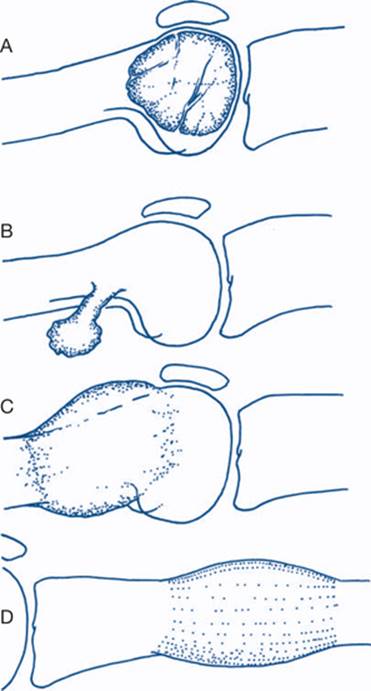
Figure 6.4 Typical sites of long bone tumours
A: an expanding swelling at the end of the bone is likely to be a giant cell tumour; B: a swelling to one side at the epiphysis is likely to be an exostosis; C: a swelling in the region of the metaphysis may be osteosarcoma, chronic osteomyelitis (Brodie’s abscess) or a simple or aneurysmal bone cyst; D: a swelling in the middle of a long bone may be an eosinophilic granuloma, Ewing’s sarcoma or callus formation
The most common causes of localised bony swelling in patients aged under 25 years are fracture, callus formation, acute osteomyelitis and osteosarcoma; aged from 25 to 50 years, giant cell tumour, fibrosarcoma and chondrosarcoma; aged over 50 years, metastatic bone disease, localised myeloma and fibrosarcoma (Table 6.1). Nearly all benign tumours occur in the young and stop growing when growth is completed, so diagnosis of these is easy to make in most cases. Large tumours are not necessarily malignant, although recent increase in size does suggest the possibility of malignant change. The main features that suggest malignancy are pain, warmth and tenderness with cortical destruction on X-ray and calcification that extends into the soft tissues. The most common benign tumours are exostoses (bony hard lesions fixed to the bone found near the lower end of the femur and upper end of the tibia), osteomas (flat bony swellings frequently found on the forehead) and chondromas. Chondromas may grow in or out from the surface of the bone. Enchondroma within the bone may present as a fusiform swelling of the bone. Biopsy is essential when malignancy is suggested clinically and histological confirmation of malignancy is essential prior to radical surgery.
Table 6.1 Common causes of localised swelling of bone
|
Age group (years) |
Lesion |
|
<25 |
Fracture, callus formation, acute osteomyelitis, osteosarcoma |
|
25–50 |
Giant cell tumour, fibrosarcoma, chrondrosarcoma |
|
>50 |
Metastatic bone disease, myeloma, fibrosarcoma |
Causes
1. Callus formation
2. Acute osteomyelitis
3. Osteosarcoma
4. Giant cell tumour of bone
5. Fibrosarcoma
6. Chondrosarcoma
7. Metastatic carcinoma
8. Less common causes
History, physical examination and radiology
1 Callus formation
The most common cause of a bony tumour is exuberant callus formation at a fracture site. In most cases there is a history of injury, but sometimes a palpable callus is felt to develop after some weeks of pain from a spontaneous fracture. It is the latter group where diagnosis may be a problem. The most common sites are rib after paroxysmal coughing, second metatarsal bone after a long walk (‘March fracture’) and the upper end of the tibia (‘Recruit’s fracture’). Examination reveals a relatively nontender fusiform enlargement of the bone. The diagnosis is, as a rule, made easily on X-ray.
Myositis ossificans. Patients with myositis ossificans usually present with a painful bony swelling dating from an episode of definite trauma. However, the marked calcification and sometimes ossification of muscle may be confusing. The muscles most often affected are the brachialis and the quadriceps femoris after severe injuries of the distal arm and thigh. The ossification occurs in the bulk of the muscle and is fixed to the underlying bone. Unlike malignant processes the condition becomes less symptomatic with new bone becoming better defined.
Traumatic subperiosteal haematomas may also calcify. This diagnosis usually presents no difficulty as the swelling is localised and the X-ray shows normal dense bone with increase in thickness of the cortex alone.
2 Acute osteomyelitis
Most cases of acute osteomyelitis occur during or before adolescence. The presentation is typical of an acute inflammatory condition — in adults it is often in the setting of immunosuppression. The precise anatomical site of the lesion may be difficult to determine, but on examination a hot, tender, oedematous swelling is usually found at the end of a long bone, particularly about the knee. The organisms usually lodge in the metaphysis of the bone. There is associated systemic toxicity. The differential diagnosis is from cellulitis of soft tissue, an acute inflammatory noninfective joint lesion and, if the condition is less acute in its onset, osteosarcoma. Diagnosis is more difficult if the patient presents during the chronic phase of the disease.
The causative organism is usually one of the Gram-positive cocci such as Staphylococcus aureus or Streptococcus pyogenes. Haemophilus is becoming less common with recent advances in immunisation. Gram-negative organisms such as Escherichia coli and Pseudomonas aeruginosa must also be considered at the extremes of age, the immunosuppressed and when clinical response to treatment is not as expected. A subacute or chronic abscess (Brodie’s abscess) usually also involves the end of a long bone and manifests as a mildly tender, palpable bony thickening. As well as osteogenic sarcoma, tuberculosis must also be excluded.
X-rays show a central area of rarefaction, surrounding sclerosis of bone and deposition of subperiosteal new bone. Within about two weeks of the onset of acute osteomyelitis, an area of sclerotic dead bone (sequestrum) will appear in the central area of rarefaction (Fig 6.5). However, X-rays may not show any abnormal features in the first few days of the disease process.
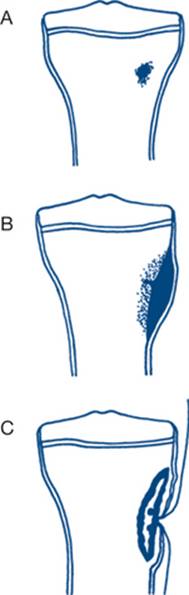
Figure 6.5 Bone infection commonly starts in the metaphysis below the epiphyseal plate
A: the plate acts as a barrier to spread into the joint; B: spread through the cortex forms a subperiosteal abscess; C: stripping of the periosteum interrupts the blood supply to the cortex, which forms a sequestrum; the sequestrum froms a nidus for chronic ostemyelitis
3 Osteosarcoma
Most cases of osteosarcoma (osteogenic sarcoma) occur before the age of 25 years. Occasionally osteosarcoma occurs in the aged patient as a complication of Paget’s disease of bone. Osteosarcomas may also arise in bone that has been irradiated for other reasons. A painful bony lump is the predominant symptom. The onset is usually gradual, with a progressive increase in pain, a variable degree of swelling, local heat, venous engorgement and tenderness. Most sarcomas develop in the medullary cavity near the metaphysis of a major long bone; half lie in the region of the knee. A history of previous trauma may be given, that is, either incidental to the underlying process or has precipitated a pathological fracture. Palpation usually reveals a swelling close to the knee without detectable joint disease and with free joint movement.
The tumour felt is frequently much larger than the changes in bone demonstrable on X-ray. The interpretation of the X-ray can be difficult as the findings are variable depending upon the amount of osteolysis or osteosclerosis within the tumour. There is a loss of the normal bone trabecular pattern in the area of concern, combined with destruction of the cortical wall and elevation of the periosteum and extension into the surrounding soft tissues. A radiographic sign termed a Codman’s triangle is often associated with this tumour. It is a triangular area of subperiosteal new bone formation near the cortical margin of the tumour. Bony spicules are laid down perpendicular to the normal surface and may produce a sun-ray or ‘sunburst’ appearance. There is often a large soft tissue component, which is evident on the imaging. In some instances there may be little or no bony reaction, only irregular lysis of the cortex of the bone. The histological picture can also be indefinite and experienced assessment is essential. It may be difficult to make a diagnosis from an inflammatory cause, even with histology.
4 Giant cell tumour of bone
Giant cell tumours occur mostly around the knee joint and sometimes at the lower end of the radius. Most present with pain and swelling in patients between the ages of 25 and 50 years. A mass in bone may sometimes be the sole symptom. The tumour is usually easily palpable. In advanced cases, the outer bony shell of the tumour becomes so thin that eggshell crackling can be detected. It is an aggressive, locally recurrent tumour with low metastatic potential. In about half the cases the clinical behaviour of the tumour is benign, in about a third there is local aggressive behaviour and the remainder are frankly malignant with early metastasis. About 80% appear in the long bones after skeletal maturity and 75% occur around the knee joint. It usually affects the bone in the region of the epiphysis. On X-ray, an asymmetrically located osteolytic focus is seen within the bone, with expansion of the cortex and cortical erosion. Roughly spherical, foam-like areas can be seen in the cancellous bone in the distal metaphysis. Differential diagnosis on X-ray is from simple bone cysts. In simple bone cysts the age of onset is earlier and the bone expansion and destruction is much less marked.
5 Fibrosarcoma
Fibrosarcoma is a rare, malignant tumour of fibrous tissue, muscle or sometimes periosteum, which is often confused with a primary bone tumour. Fibrosarcoma occurs in middle age. A history of a lump is often of longstanding. Patients usually present because of slow growth of a lump in a limb muscle that interferes with muscle function. On examination the lesion can appear to be fixed to the bone. The consistency of the lump is firm, rather than hard. Eventually, fibrosarcoma forms a large and asymmetrical lesion, much larger than the X-ray findings, in contrast to many bone tumours. With the rarer periosteal fibrosarcoma there can be radiological evidence of periosteal elevation with developing erosion into the cortex. Pathological fracture is common (30%).
6 Chondrosarcoma
Chondrosarcoma occurs mainly during middle age — half of all chondrosarcomas occur in people over the age of 40. Presentation is a mass in the epiphyseal area of the major long bones and in flat bones such as the ilium. Most cartilaginous tumours are benign; however, when associated with rapid increases in growth and pain, one must be mindful of an underlying condrosarcoma rather than a benign cartilage lesion. X-ray reveals areas of mottled translucency in the epiphysis with a demarcating line of sclerotic bone around the tumour.
7 Metastatic carcinoma
Secondaries are a relatively uncommon cause of painful bony swelling. However, they are the most common bone tumour in patients over the age of 40. The major primary sites that commonly metastasise to bone include a lung, breast, prostate, kidney and thyroid. The vast majority of metastases in bone present with bone pain rather than swelling and a minority present with spontaneous fracture. Kidney and thyroid secondaries are the ones most likely to produce swelling as well as pain. The patient often has a past history of the primary tumour and its treatment, such as mastectomy for carcinoma of the breast. Sometimes symptoms of the primary tumour and its metastases may be synchronous. Approximately 10% of patients with cancer present with bony metastases as the first sign of disease. Some metastases, such as from the kidney, may be so vascular that they resemble an aneurysm. The common sites of metastasis are areas of bone marrow formation such as skull, clavicle, rib, vertebrae and upper femur and humerus. Local radiotherapy will often relieve bone pain. Lesions in long bones resulting in extensive cortical destruction and pain may often require an orthopaedic opinion regarding prophylactic surgery in order to prevent fracture.
8 Less common causes
Hydatid disease is an unusual cause of bone swelling that is almost impossible to treat successfully and may eventually require amputation.
Myeloma. The outstanding symptom is bone pain at multiple sites, without swelling. Occasionally myeloma will present as a lump in the bone. Focal lesions are seen on X-ray as circumscribed punched-out areas of rarefaction with minimal local sclerosis; only occasionally is there cortical expansion.
Osteomas occur in children and adolescents as longstanding, small, exquisitely tender tumours mainly affecting the femur and upper tibia. The pain sometimes precedes the appearance of radiographic changes. Nocturnal pain and pain relieved by salicylates are prominent and characteristic symptoms. On X-ray the lesion is densely sclerotic with a radiolucent centre. Treatment is by surgical removal. More recently advances in image-guided radiofrequency ablation have provided a less invasive means of effecting a cure.
Enchondromas may be solitary or multiple (Ollier’s disease). Presenting complaints include tender swellings of the bones of the hands and feet. They are rarely painful unless there has been a pathological fracture. They have been reported in most bones. On X-ray there may be multiple, mottled, translucent lesions with cortical expansion but not erosion. Treatment is by curettage often combined with bone grafting. Lesions in flat bones may be locally invasive in their behaviour.
Reticulum cell (Ewing’s) sarcoma presents as a painful, tender swelling of the shaft of a long bone in young adults or adolescents. However, it is prudent to remember that in approximately 20% of cases the lesion is found in the innominate bone. It is rarely found in individuals aged under five or over 30 years old. Later these lesions are associated with systemic toxicity. X-ray shows the characteristic ‘onion peel’ appearance of subperiosteal lamination in the mid-long bone. A soft tissue mass over the area involved indicates soft tissue involvement. In the past the outcomes of treatment were disappointing with low medium-term survival rates. However, the advent and advances in chemotherapy have improved the outlook. Treatment is usually radiotherapy and chemotherapy.
Chondromyxoid fibroma occurs in young adults, mainly in the metaphysis of long bones. The X-ray findings are not characteristic and treatment is by curettage after biopsy confirmation of the diagnosis.
Tuberculosis of the bone has an insidiously mild onset, with the development of painful bony swelling. Mild systemic toxicity and joint involvement are common, in contrast to tumours of bone. As tissue necrosis and caseation are common, abscess formation with spontaneous external drainage can lead to chronic sinus formation. If the joint is involved the synovium becomes thick and oedematous giving rise to an effusion. The pannus slowly destroys the articular cartilage with active bone erosion often also occurring at the edges of the joint leading to the characteristic, yet seldom seen, radiographic appearance of periarticular osteopenia. Diagnosis depends upon isolation of acid-fast bacilli from biopsy specimens. This often requires protracted culture in specific culture media. When the lesion is limited to the metaphysis of bone, it appears as single or multilocular cysts surrounded by sclerotic bone. Initial treatment is conservative, using antituberculous antibiotics.
Diagnostic and treatment plans
A benign tumour remains localised and on X-ray has a well-defined edge. In contrast, a malignant tumour has the potential to metastasise, growth is rapid and its edge is often ill defined. The features that suggest malignancy on X-ray are cortical destruction and calcification extending into the soft tissues (Fig 6.6).
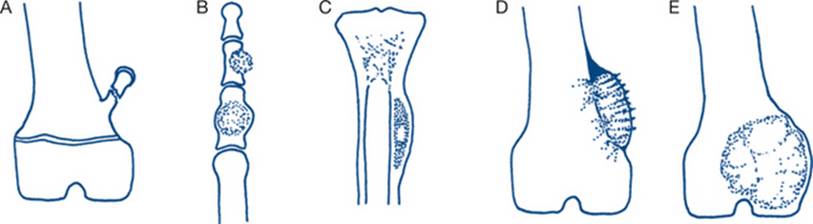
Figure 6.6 Radiological features of common bone tumours
A: ecchondroma may be painful or may fracture; B: enchondromas are often multiple and may also fracture; C: osteoid osteoma is associated with increasing bone pain; D: osteosarcoma produces destruction of the cortex, elevation of the periosteum (Codman’s triangle) and sunray appearance; E:osteoclastoma is a radiolucent lesion expaling the cortex and may extend to the articular surface
One of the main management problems is to establish the diagnosis of osteosarcoma and to exclude the differential diagnoses of subacute osteomyelitis or a benign neoplasm. It may also be difficult to distinguish neoplasia from the various cystic diseases of bone. Biopsy and histology generally provide the definitive diagnosis but must be correlated with the other clinical and radiological findings. If the diagnosis remains in doubt, conservative treatment may be started, with careful clinical and radiological observation for a period of time before radical surgery is recommended. With a definitive diagnosis of osteosarcoma surgery combined with chemotherapy improves survival. Limb salvage surgery combined with adjuvant chemotherapy, in the right setting, may provide results that are at least comparable to those with amputation and adjuvant chemotherapy. The chemotherapy is most often administered preoperatively, with the pathologist being able to examine the specimen postoperatively and comment on a better outcome should there be a higher degree of necrosis (preferably greater than 95%). Other malignant tumours may also often require limb ablation surgery.
Local excision is preferred to curettage for giant cell tumours of bone and lessens the likelihood of recurrence. There may be a temporary filling of the cavity with synthetic substances, such as bone cement, in order to observe the behaviour of the tumour in the postoperative phase, prior to definitive bone grafting.
With acute osteomyelitis, if the correct antibiotics are given early, drainage may not be necessary. In uncomplicated osteomyelitis, shorter periods of antibiotic treatment (three days of intravenous antibiotics followed by three weeks of oral antibiotics) have now demonstrated great promise. In complicated cases, a subperiosteal abscess may be suggested by the presence of local pain and oedema but if toxicity and local tenderness persist for more than 24 hours of adequate antibiotic treatment, drainage of pus is indicated. An ultrasound may often confirm the diagnosis of this condition, as may MRI of the relevant area. Whether the bone should be drilled to drain the medulla of pus in early and focal osteomyelitis is controversial. In the setting of significant disease that may compromise the bone’s vascular supply through a pressure effect, a bony window with debidement and curretage is often performed. A cold bone scan in this case may indicate necrotic bone rather than excluding acute osteomyelitis.
Chronic osteomyelitis is more insidious in onset and presents a challenge to one’s diagnostic acumen in the assessment of painful bony swellings. In areas with difficult access to medical care, it is not an uncommon outcome in open fractures. The bone is often hard and sclerotic with an area of new bone formation (involucrum) surrounding the infected site. The site may also contain necrotic bony fragments (sequestra). Purulent material may intermittently drain to the skin surface via a sinus (cloaca). Depending on the geographical location, tuberculous osteomyelitis should be considered in the list of potential underlying aetiologies. A Brodie’s abscess is a sterile fluid-containing cavity. This lesion may result from prolonged use of antibiotics for the treatment of osteomyelitis, where drainage early in the course of the illness might have been the more appropriate approach.
6.3 Musculotendinous lumps
Swellings related to muscles or tendons frequently pose diagnostic problems. They present as deep subcutaneous lumps that are within, derived from or attached to muscles. They occur in children and adults from sporting injuries; in older patients they are often due to degenerative wear and tear. The contractile capacity of muscles gives certain classic signs to lumps near them and associated with them. Lumps due to injuries, tears and ruptures are induced or thrown into greater focus by muscle contraction; the bunching of torn muscle fibres gives a focal lump adjacent to a defect. The history of injury may be obvious or occult. The entire muscle should be examined, from origin to insertion, for accurate diagnosis.
Muscle rupture and degeneration often occur at the junction of the muscle with its tendon or aponeurosis. Sometimes the injury occurs within a tendon widely distant from the parent muscle and presents as a focal lump in the tendon or a spontaneous rupture of the tendon. Symptoms and signs will then be mainly concerned with the tendon; disabilities and deformities induced by active contraction will again be diagnostic.
Benign and malignant neoplasms within and near muscles have their physical characteristics distorted by this proximity — important signs are limited mobility or fixation of the lump when the muscle is tensed and contracted. As well as becoming less mobile, swellings may change in shape and size on muscle contraction. The lump may disappear or become more difficult to feel, suggesting that the lump is within the muscle (Fig 6.7). On the other hand, the lump may occasionally become prominent only when adjacent muscles contract, suggesting extrusion from between muscle bundles or through a defect in the fascial envelope of the muscle. The patient can be asked to contract the muscle isometrically or isotonically to elicit these points or the muscle can be put on the stretch by the examiner, separating origin and insertion by passive joint movements.
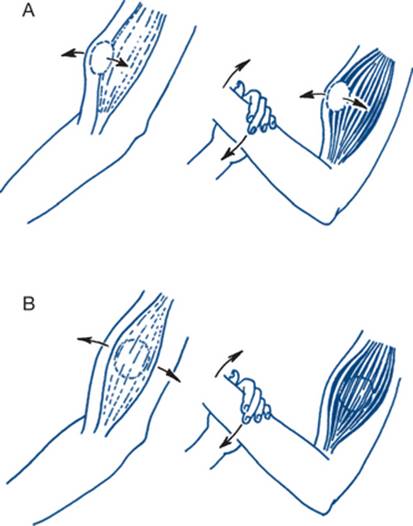
Figure 6.7 A lump located within a muscle
A: lumps superficial to muscle remain easy to feel when the muscle contracts; B: lumps within muscle become obscured or impalpable when the muscle contracts
It is essential to always compare the lesion with the normal side of the body and to examine the muscle concerned and its adjacent joints and tendons, both at rest and in the contracted state.
Muscle swellings
Causes
1. Muscle and tendon rupture
2. Intramuscular haematoma
3. Muscle hernia
4. Benign or malignant intramuscular neoplasm
5. Less common causes
Tendinous swellings
Cause
• Stenosing tenosynovitis (De Quervain’s disease, trigger finger and snapping thumb)
Clinical features, diagnostic and treatment plans
Muscle swellings
1 Muscle rupture
Muscle rupture in youthful and adult patients is often due to sporting injuries. Spontaneous rupture of certain skeletal muscles, tendons and aponeurosis is also common after trivial or unnoticed strain. Degenerative wear and tear with age makes elder patients especially liable to spontaneous rupture during sport. Muscle rupture presents as a lump of bunched-up fibres that is emphasised by contraction.
Sometimes, with deeper muscles not accessible to palpation or with spontaneous tendon rupture distant from the muscle, patients present with muscle weakness or disability or a limp rather than with a lump. Biceps brachii (long head), Achilles tendon, supraspinatus (rotator cuff) and quadriceps femoris are common muscles involved. Affected characteristics of visible muscles are a tender hollow defect and deformity of the muscle at rest, with an indistinct edge adjacent to the lump. On contraction, the lump moves with the muscle and is made more prominent. Weakness and pain are present when muscle power is tested.
Ruptured long head of biceps brachii tendon. The patient is usually over 50 years; however, the injury may also occur in an athlete performing a large amount of weight training such as bench-press activities. Rupture in the older age group is usually secondary to degenerative weakness and the long head, with its complex intracapsular course over the humeral head, is particularly at risk. The patient may have felt something snap while lifting or flexing the elbow but may not have noted a precipitating event. The clinical picture is unmistakable (Fig 6.8). The belly of the muscle is distorted, looks lower than the other side, does not tighten properly on contraction and is round or semicircular in shape rather than fusiform and ovoid. Shoulder and elbow movements are free and painless — apart from evidence of degenerative joint disease or, occasionally, rheumatoid arthritis. In the younger athlete, sometimes pain may be reproduced by passive stretching of the biceps (Speed’s test) or resisted active contraction (Yergason’s test). While active treatment in either case is rarely required, there is an increasing tendency to repair proximal ruptures in the younger, high-performance athlete. Occasionally the biceps are avulsed from their distal (radial) insertion — this is usually a more acute and painful injury from lifting heavy weights and the muscle belly retracts to a higher position and sometimes requires repair to the bicipital tuberosity in order to preserve full motor power in the younger person.
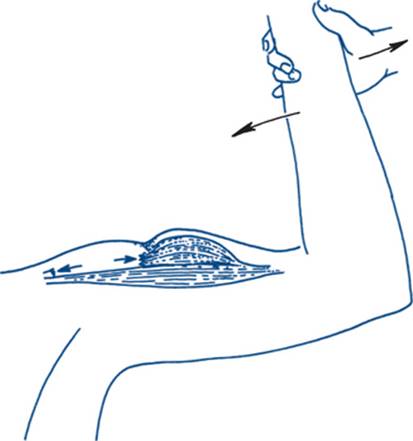
Figure 6.8 Ruptured long head of biceps brachii
Ruptured Achilles tendon. This injury is common in middle-aged squash players. It classically occurs in athletes in their 30s and 40s. The sufferer feels acute pain in the lower calf or ankle and may fall to the ground thinking he has been struck by a squash racquet. The examination findings are almost diagnostic. There is a tender defect palpable in the muscle just above the insertion of the tendo achilles into the calcaneum, with a painful tender lump above it. Active flexion of the ankle is painful and limited. The patient should not be able to stand on his toes and the foot should be able to be passively hyperextended; however, the latter signs are seldom elicited due to pain. Local bruising is not uncommon.
Complete rupture is best treated by operative repair. This is associated with 27% lower re-rupture rate compared with non-operative means. Incomplete rupture or rupture in the older patient may be treated conservatively. In this case healing with elongation is not uncommon, giving signs of a firm ovoid lump in the tendo achilles, hyperextension of the foot and weakness of plantar flexion. However, it does avoid an 11% risk of complications such as infection and adhesions between the tendon and the skin.
Supraspinatus (rotator cuff) rupture. This can accompany shoulder injuries such as dislocation or lifting strains. A degenerative rotator cuff in patients over 45 years is more prone to rupture. Active abduction of the shoulder is impaired or not possible, despite an actively contracting deltoid. The shoulder hunches laterally on attempts by the patient to initiate abduction. If the arm is passively elevated through the painful arc, it can be maintained above the head by action of deltoid and the remaining muscles (see Ch 6.4). The treatment of this pathology should include treatment of the tendinopathy and treatment of the associated bony abnormalities. The lateral edge of the acromion may impinge on the rotator cuff during active abduction of the shoulder. Surgical repair of complete rupture is the standard in young patients. In older patients a corticosteroid injection into the subacromial space combined with an exercise program to strengthen the rotator cuff and the periscapular muscles may be all that is required. Surgery in older patients is mainly for the pain-relief associated with alleviating impingement rather than gains in muscle power.
Quadriceps femoris. Rupture classically occurs just above the patella at the junction of the vastus intermedius with its tendon, due to resisted extension strain. This usually occurs in older patients but may occasionally occur in weightlifters during their deeper squats. There is a tender defect and lump at this site — knee extension is weakened but not usually absent. Surgical repair is indicated for major ruptures.
Sternomastoid ‘tumour’. Tearing of sternomastoid muscle fibres can occur in infants, causing a sternomastoid muscle ‘tumour’ with muscle spasm and torticollis (wry neck). The wry neck is seldom visible at birth. Usually within a week or two the parents notice a lump at the lower end of the sternomastoid muscle with the head being held asymmetrically and persistently rotated to one side. As the child spends more time on the one side the face and occiput become more flattened on that side. Treatment is predominantly conservative, with gentle stretching exercises supervised by a paediatric physiotherapist. It is prudent to ask for an orthopaedic opinion in order to exclude congenital cervical vertebral anomalies. The syndrome can also occur in older children and adults. In older children inflammatory conditions of surrounding soft tissue structures, optical disorders and rotatory subluxation of the C1 vertebra on the C2 vertebra are the most common casues. In adults it is more commonly due to a nearby inflammatory lymph node swelling.
Rupture of other tendons. Spontaneous rupture of long tendons occurs in a variety of classic sites, usually on the basis of chronic attrition from occupational stress or local pathology. Presentation is with deformity and weakness rather than as a lump. Common tendons involved are: tendon of extensor pollicis longus at the wrist from excessive use (‘Kettle-drummer’s palsy’) or after Colles’ fracture; spontaneous rupture of extensor tendons of fingers in association with rheumatoid arthritis; and ‘boutonnière’ deformity from rupture of the central slip of extensor digitorum to the middle phalanx. Mallet finger (rupture of distal insertion of extensor digitorum) usually occurs as a hyperflexion sporting injury.
2 Intramuscular haematoma
This presents as a painful, tender, firm lump with indistinct edges within a muscle. It often follows an injury during a movement with the muscle under heavy load or after localised contusion. There is associated muscle pain and weakness. Common sites are the thigh, involving quadriceps femoris or hamstring muscles in footballers (‘cork leg’). Treatment is by a brief period of rest; local ice packs and compression, followed by active exercises (Ch 13).
Muscle haematoma in older patients can occur after a trivial strain or from nocturnal leg cramps causing a painful, indistinct calf muscle swelling exacerbated by movement. Absence of a history of previous injury can make the diagnosis difficult — sometimes an ecchymosis is visible and establishes the diagnosis.
Tearing of fibres in the anterior abdominal wall can mimic acute intra-abdominal injuries. All haematomas are more common in patients on anticoagulants.
Chronic haematomas. These form localised firm intramuscular lumps and may become osmotically encysted. If there is no history of injury, diagnosis from a malignant muscle tumour may be impossible without open operation and biopsy.
3 Muscle hernia
This is due to a localised defect in the overlying deep fascial envelope of the muscle. At rest no lump is usually visible, but on contraction a bulge of muscle protrudes through the fascia. These hernias are common in the lower leg over the anterior or lateral compartments and involve the tibalis anterior, extensor digitorum or the peronei. They may follow a known injury to the leg and a palpable defect is usually apparent when the muscle is relaxed. They require no treatment but can be confused with localised blowouts of varicose veins by the inexperienced observer.
4 Benign or malignant intramuscular neoplasms
Intramuscular lipomas. Lipomas are very common neoplasms and may be found within muscles and between muscle groups. They arise from normal fat and appear during adulthood. Physical signs are usually distinctive. The history is usually of a longstanding and clearly benign lump. Most lipomas are of the subcutaneous type and are well-circumscribed, ovoid masses that are movable. They are also commonly situated in relation to the large muscles of the back. Subfascial and intramuscular lipomas are firmer and more flattened than their subcutaneous counterparts, the edge is more difficult to define and the classic lobulated contour more difficult to detect. Occasionally the lump appears with an acute history after exertion, suggesting extrusion of the lipoma from between muscle groups.
Occasionally lipomas ramify widely and diffusely in tissue planes, especially between muscles (lipoma arborescens). Complete removal is difficult because the lesion extends into surrounding tissue planes and local recurrence is common. This is not a sign of malignancy but of incomplete initial removal. Intramuscular lipomas should be removed surgically to establish the benign nature of the diagnosis beyond doubt.
Fibromatosis. The fibromatoses comprise a group of localised hyperplasias of connective tissues that form nodules with scarring and fibrosis. They may be split into superficial fibromatoses and deep fibromatoses (desmoids — abdominal and extra-abdominal). The superficial category includes variants such as the palmar (Dupuytren’s) and plantar types. They tend to recur locally after removal and form a spectrum from benign conditions to locally malignant tumours. Dupuytren’s contracture is the most benign and well-known form, beginning as a slow-growing palmar nodule in subcutaneous tissue.
‘Desmoid’ tumour (Paget’s tumour). This is a less common form of locally aggressive tumour and usually occurs in the muscles of the anterior abdominal wall. It presents as a firm lump within the rectus muscle of the lower abdomen, often in multiparous women. It requires wide local excision to avoid recurrence (Ch 8.3).
Malignant muscle tumours (fibrosarcoma, rhabdomyosarcoma). Fibrosarcoma is the most common mesodermal tumour of muscle and presents as a painless intramuscular lump. Distal spread occurs late, the lump may be firm or soft and may be vascular and even demonstrate a soft bruit. It can be difficult to distinguish from a benign haematoma without biopsy. CT scanning and more recently MRI are helpful in the diagnosis and delineation of the extent of suspected tumour masses. The lesions are most common on the limbs and may be close to or attached to bone. Smaller tumours present as completely circumscribed and, as they enlarge, tend to become diffusely infiltrative. Other sarcomas such as rhabdomyosarcoma are more malignant and spread locally and systemically at an early stage. Removal of the tumour is necessary for local control. Treatment requires wide local excision after exploration and biopsy. As local spread tends to be within the muscle bundle, excision should encompass the whole muscle involved, from origin to insertion. Consideration needs to be given to excising the whole compartment in which the muscle is found. Chemotherapy and radiotherapy are often also required. Multimodal therapy involving limb salvage surgery combined with adjuvant chemotherapy and radiotherapy may provide survival rates comparable to amputation and chemotherapy, while preserving a functioning limb.
5 Less common causes
Myositis ossificans. Traumatic myositis ossificans occurs after severe soft tissue or bony injury with lifting and disruption of the periosteum at the site of attachment of muscles and ligaments to bone. Calcification and ossification occur within the soft tissue haematoma. Common sites are around the elbow and knee — within the brachialis, deltoid or quadriceps femoris after fractures and dislocations or tendinous avulsions. Patients present with hard, bony lumps, usually attached to bone at the site of tendinous insertions or in continuity with the callus of a fracture. Initially the swelling may have sharp edges and be painful and tender. Later the swelling’s edges become rounded, tenderness diminishes and the lump may regain a degree of mobility on the underlying bone. Joint stiffness is common, but there are no signs of inflammation. Differentiation from an intrinsic bony swelling can be difficult (Ch 6.2). With a primary swelling of bone, the muscles are usually more freely mobile over the lesion. In myositis, muscle function is impaired and the swelling is in continuity with the muscle.
A somewhat similar picture to traumatic myositis can occur with prolonged hypercalcaemia and is due to metastatic calcification. Rarely, in myotonia dystrophica congenita, widespread calcification occurs throughout muscle bellies.
Suppurative myositis (pyomyositis). This is an uncommon condition as normal muscle is resistant to bacterial infection because of good blood supply. It is most common in tropical countries. The quadriceps, iliopsoas and other large muscles are most commonly affected. Painful, fluctuant swellings occur acutely in muscles of limbs or trunk, with signs of local inflammation. Exploration reveals intramuscular abscesses that are often multiple. Culture may be sterile or reveal staphylococci or nonspecific organisms. The lesions may be seen in patients already ill and debilitated with tuberculosis, leprosy or other chronic infective conditions.
Cinchona bodies and other chronic reactions to intramuscular infections more commonly present as subcutaneous lumps. Injections of irritant materials or contaminated injection sites within the gluteal muscles or subcutaneous tissues of the buttocks are followed by chronic inflammatory granulomatous lumps or, occasionally, a chronic thick-walled abscess without overt signs of infection.
Common materials seen in migrant European men and women are quinine (cinchona) bodies and bismuth. Quinine tends to form round or ovoid lumps in subcutaneous fat or gluteal muscles, which are firm and nontender and often exhibit the sign of eggshell crackling on palpation.
Bismuth and other heavy metal injections tend to form deeper and less well defined intramuscular lumps.
X-rays show characteristic findings. Cinchona bodies show a thin rim of calcification in a round or ovoid buttock mass, bismuth shows as radiating converging radio-opaque lines in the line of muscle fibres. Treatment other than reassurance is rarely required.
Tendinous swellings
Stenosing tenosynovitis
Occupational wear and degenerative disease can lead to the condition of stenosing tenosynovitis in several specific synovial tendon sheaths. The combination of pain and entrapment of the involved tendon gives classic syndromes. A nodule often develops in the tendon sheath at the site of constriction, not unlike how an oversized braided thread will bunch and knot when pulled through too tight an orifice.
De Quervain’s disease (stenosing tenosynovitis of the wrist). This presents as pain and tenderness over the radial styloid process at the site of the common sheath of the tendons of abductor pollicis longus and extensor pollicis brevis, with pain radiating down to the thumb. A tender nodule may be felt at the site of the constriction while movements of the thumb exacerbate discomfort (e.g. writing or typing). Ulnar deviation of the wrist and thumb in combination is exquisitely painful (Finkelstein’s test), ulnar deviation of the fingers alone much less so.
Surgical treatment is simple and curative — the sheath is exposed and slit for a distance of at least 4 cm above and below the constricting band, preferably with excision of a segment of sheath at the site of maximal constriction where the sheath can be 1 cm thick.
Trigger finger, snapping thumb (stenosing tenosynovitis of the flexor tendons of the hand). This gives a classic and immediately recognisable clinical picture and is a stenosis at the origin of the fibrosynovial flexor sheath just proximal to the metacarpal head in the palm of the hand. The ulnar digits (little and ring) and the thumb are most frequently affected. The power of flexion of the digits is greater than extension so the affected finger can be flexed into the palm but, on attempts to straighten it, remains flexed until straightening occurs on increased effort with a characteristic ‘give’ or jerk. A tender nodule is usually palpable along the course of the tendon just proximal to the metacarpophalangeal joint (see Ch 6.7). The condition has a variable natural history and often resolves spontaneously with time. Recalcitrant and persistent symptoms are easily cured by releasing the tendon pulley just proximal to the fibrous flexor sheath, exposing the nodule in the tendon and checking that free gliding occurs at operation.
The alternative treatment is to inject steroid into the flexor sheath and this can resolve the problem although there is a possibility of recurrence.
6.4 Painful shoulder
The predominant symptoms of shoulder joint disease are pain, stiffness and loss of function. Pain in the shoulder is usually felt anterolaterally along the edge of the acromion and down the lateral side of the arm. The pain of intrinsic shoulder disease can be difficult to distinguish from that referred from the neck, diaphragm or mediastinum. Ischaemic heart disease may be associated with localised pain in either shoulder. Correlation of anatomy and function is particularly important in the examination of the shoulder. Sites of articulation and movement are designed to allow maximum freedom of action and reach combined with strength. The sites required to move during the various stages of shoulder abduction are the glenohumeral joint, the subacromial space, the acromioclavicular joint, and the sternoclavicular joint (Fig 6.9).
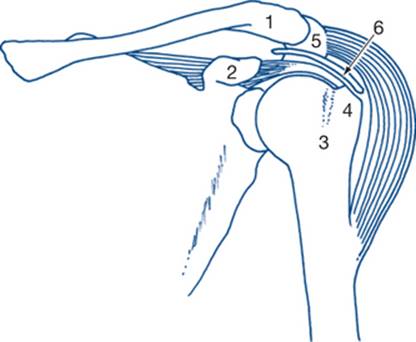
Figure 6.9 Surface landmarks of the shoulder
1: clavicle; 2: coracoid process; 3: bicipital groove; 4: greater tuberosity; 5: acromion; 6: subacromial bursa
Scapular movement on the thoracic wall allows considerable further range of movement. Stability of the glenohumeral joint is maintained by the tendons of the short rotator muscles — the supraspinatus above, the subscapularis anteriorly and the infraspinatus and teres minor posteriorly. These muscles blend with the capsule of the joint to form the rotator cuff. They act to stabilise the joint during movement and to rotate the arm externally or internally during abduction to allow the great tuberosity to clear the acromion. In the majority of instances, painful shoulder is due to rotator cuff problems. Osteoarthritis of the glenohumeral joint is uncommon. When examining the shoulder, the normal side should always be tested before the abnormal one. Inspection may reveal muscle wasting, swelling or deformity. Local tenderness and stiffness of movement are the most important signs. Active and passive movements may reproduce the pain. If the movement of abduction is painful, it should be noted if this is maximal over a limited arc of abduction. Pain early in the arc of abduction suggests a supraspinatus tear in the mid-range subacromial bursitis and, at the end of abduction, suggests acromioclavicular joint arthritis. Abduction of the arm above the head normally involves a fluid combination of glenohumeral movement and scapular rotation. Frozen shoulder (adhesive capsulitis) can cause complete immobility of the glenohumeral joint, but passive movement to 90° is still possible by rotation of the scapular on the chest wall. Thus, to test for glenohumeral abduction, the angle of the scapula must always be fixed with one hand, while the other moves the patient’s arm. A very sensitive test for frozen shoulder is the lack of shoulder external roration.
Causes
1. Rotator cuff lesions
2. ‘Frozen’ shoulder
3. Biceps tendinitis and rupture
4. Osteoarthritis of the acromioclavicular joint
5. Referred pain
6. Less common causes
History and physical examination
1 Rotator cuff lesions
The tendons of the rotator cuff are separated by the subacromial bursa from the bony arch of the coracoid process and the undersurface of the acromion. The pathology of rotator cuff disease consists of three processes: degeneration; traumatic and inflammatory oedema; and bursitis. An insidious onset during middle age, with pain on lifting the arm, particularly in mid-abduction within a painful arc, suggests the presence of chronic supraspinatus tendinitis. The condition is predisposed to overuse and minor trauma, accompanied by degeneration and calcification in the tendon. The pain is often worse at night and is a dull pain felt in the shoulder and down the lateral side of the arm. Local tenderness extends along the edge of the acromion and anteriorly in the angle between the acromion and the coracoid process. Abduction is painful particularly between 60° and 120° of its arc — a ‘painful arc’ (Fig 6.10). The arc may be negotiated with less pain by a trick movement in which the shoulder is dropped while externally rotating the arm to allow the tendon to clear the coracoacromial arch. It is not uncommon to have a bony spur on the undersurface of the acromion. Acute intermittent or cyclical supraspinatus tendinitis also affects young adult females. Pain may increase to an agonising peak over hours, and then subside over the next few days. During the acute attack the arm is held immobile and is too painful to examine. Early calcification of the tendon can occur. In older patients, complete rotator cuff tears in the shoulder may suddenly occur on lifting, without the warning of longstanding shoulder symptoms. Pain is felt immediately and the patient is unable to abduct the arm despite an active deltoid. There may be partial recovery with a persistent painful arc of abduction or gradual development of a frozen shoulder or slow full recovery. Traumatic defects in the rotator cuff are often situated anteriorly, and instability and recurrent anterior dislocation of the shoulder may be associated with the rotator cuff lesion. Chronic cuff tears can predispose the shoulder to osteoarthritis with a humeral head that sits more superiorly than its normal relationship to the glenoid cavity — ‘cuff arthropathy’.
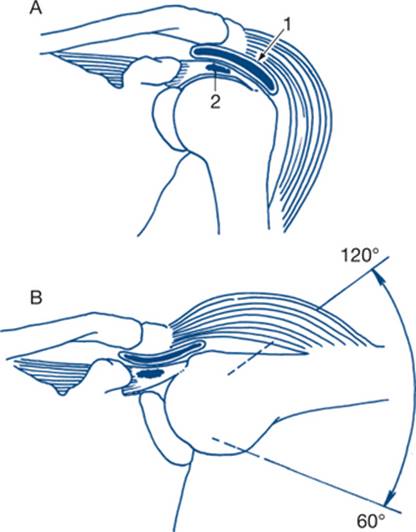
Figure 6.10 Anatomical basis of rotator cuff disorders
A: 1: inflamed subacromial bursa; 2: degeneration and calcification of the supraspinatus tendon; B: the painful arc of shoulder movement through 60° and 120° of shoulder abduction
2 ‘Frozen’ shoulder
Frozen shoulder may be primary or secondary in nature. The primary form has vague beginnings and a protracted natural history. It often starts with chronic night pain and a painful arc of abduction characteristic of chronic degenerative tendinitis. Sometimes a history of minor trauma is followed by increasing shoulder pain and tenderness with walking and when the patient lies on the involved shoulder. There are three phases with the first characterised by pain, the second by stiffness — which may last between three and 18 months — and the third by a gradual improvement as the pain subsides and the stiffness improves — ‘thawing’. During the initial period, as the pain lessens, the stiffness of the shoulder increases. Stiffness may progress to involve the hand and elbow; alternatively, any distal lesion of the hand or forearm causing prolonged immobility can lead to secondary shoulder stiffness (‘shoulder–hand syndrome’). Movements of the shoulder are limited in all directions; in severe cases the arm may be held internally rotated, with gross restriction of movement in all directions and muscle wasting. The secondary form may follow significant injuries to the shoulder including fractures and dislocations. Frozen shoulder may also be a part of a complex regional pain syndrome (previously termed reflex sympathetic dystrophy) as in patients after myocardial infarction and stroke.
3 Bicipital tendinitis and rupture
Tendinitis of the long head of the biceps muscle occurs in athletes, particularly those who repeatedly move their arm at the shoulder. Pain is felt on abduction and external rotation of the shoulder with precise localisation of tenderness to the bicipital groove. In older patients chronic bicipital tendonitis is often associated with cuff tears. The proximal biceps tendon may also completely rupture through a degenerated section of tendon. In these cases, function usually returns to near normal after the initial acute pain. On examination, the distorted belly of the long head of the biceps can sometimes be mistaken for a muscle tumour (Ch 6.3).
4 Osteoarthritis of the acromioclavicular joint
Mono-articular osteoarthritis usually follows a previous injury. The joint feels thick and tender and pain is most marked during the final 60° of abduction. The range of shoulder movement is not significantly diminished. A good provocative test is the crossed adduction in which the arm is adducted towards the other shoulder. The pain may be relieved after an intra-articular injection of local anaesthetic — not uncommonly used to confirm the site of the origin of the pain.
5 Referred pain
Occasionally pain may be referred from disease extrinsic to the shoulder. Cervical spondylosis is the most common cause of referred shoulder pain. The pain is referred from the base of the neck, over the shoulder and down the arm and may be associated with neurological signs in the arm and hand. Movements of the cervical spine in these patients will reproduce the shoulder pain while shoulder movements are usually full and painless. Visceral diseases such as angina pectoris, diaphragmatic pleurisy, pericarditis and oesophageal disorders may sometimes present with shoulder pain. Pancoast’s tumour of the lung apex is usually associated with shoulder pain. In most cases of referred pain the patient can reach behind the back with the arm in full adduction or from over the shoulder with the arm in full abduction (the back scratch test).
Any old shoulder injury, particularly fractured surgical neck of the humerus in middle-aged patients, can cause later diminution in shoulder function with pain and stiffness.
6 Less common causes
Attacks of gout are rare in the shoulder. Osteoarthritis in the shoulder usually follows an identifiable cause such as a previous injury; primary generalised osteoarthritis usually spares the shoulder. Rheumatoid arthritis only rarely affects the shoulder joint in the first instance.
Diagnostic plan
Plain X-ray often reveals calcification just above the greater tuberosity in acute and chronic tendinitis. The X-ray may also show sclerosis and osteophytic lipping of the acromioclavicular joint, with osteoarthritis of that joint. A varying degree of osteoporosis is seen on X-ray in any chronic disease of the shoulder. Old bony injuries may be visible. Arthrography has now been replaced by MRI in the diagnosis of rotator cuff defects. However, while MRI may be sensitive in the detection of cuff tears, the presence of a cuff tear, per se, does not necessarily translate to pain and poor function. Various authors have reported defining a large proportion of asymptomatic rotator cuff pathology in the elderly.
Treatment plan
The pain of chronic tendinitis may respond to a course of local steroid injections. Operation may be necessary in some chronic cases, removing a wedge of bone consisting of the anterior lip and undersurface of the acromion together with the attached coraco-acromial ligament. The severe pain of acute tendinitis may also be relieved by injection of corticosteroid and local anaesthetic into the area of local tenderness and calcification. Occasionally, operative removal of calcific material is necessary.
Reassurance is important for patients with frozen shoulder; they should be informed that recovery will eventually occur. Once the acute pain has subsided, manipulation under anaesthesia may hasten recovery; however, one must avoid perioperative periarticular fractures. More recently, hydrodilatation of the capsule, which entails radiologically guided overdilatation of the shoulder joint with saline, may hasten recovery. Local anaesthetics and corticosteroids by local injection can assist recovery. Active pendular exercises should commence with resolution of the pain to preserve as much function as possible and assist with rehabilitation.
Complete tears of the supraspinatus tendon or rotator cuff may require surgical repair. In the young this is most commonly associated with a return of strength and function. In the elderly the goals are more limited, with the pain-relieving effects of subacromial decompression being the goal.
6.5 Pain in the upper limbs
Persisting pain in the upper limb (brachialgia) is a common symptom and can have a great variety of causes.
Referred pain from lesions at another site is common and important. Cardiac ischaemic pain can radiate down the arm or to the neck; occasionally pain at the referred site may seem to be the major or sole presenting problem. Ischaemic pain from peripheral vascular disease can be precipitated by exertion or episodic and precipitated by cold in Raynaud’s syndrome (Ch 6.16). Pain due to cervical spondylosis or, less commonly, to a spinal cord lesion, is another important cause of brachialgia (see Ch 2.18). Local shoulder lesions, particularly of the rotator cuff and subdeltoid bursa, can give shoulder, neck and arm pain (Ch 6.4).
Careful history and examination will identify the above causes. An important group of patients remains with episodic and chronic acral upper limb pain involving predominantly hand, digits and forearm. Most cases occur in middle age. They may be related to definable degenerative musculoligamentous disease highlighted by occupation or sport and presenting as an entrapment tenosynovitis or tendinitis. Treatment of these conditions is well established and usually successful. Nerve entrapment syndromes are also usually well defined. A further subgroup is functional illness linked with repetitive strain but associated with no defined pathological lesion — treatment of this group is more difficult.
There are four common causes of chronic acral upper limb pain and paraesthesia.
Common causes
1. Carpal tunnel syndrome
2. De Quervain’s disease
3. Tennis elbow
4. Repetitive strain injury (RSI)
Clinical features and diagnosis
1 Carpal tunnel syndrome
Carpal tunnel syndrome is due to compression of the median nerve beneath the flexor retinaculum at the wrist. The syndrome is a common complication of fluid retention so occurs with cyclical oedema in women at the menopause and during pregnancy. Carpal tunnel syndrome may be the presenting symptom of rheumatoid arthritis.
Symptoms consist of burning pain and paraesthesia in the median nerve distribution, felt mostly at night. The pain is due to ischaemia of the median nerve. Pain is usually felt in one or all of the radial three and half digits and often radiates to the elbow or even to the shoulder. There are few early physical signs. In late cases, wasting of the thenar muscles occurs with impaired sensation over the area of median nerve. The median nerve cutaneous innervation is to the volar aspect of the thumb, index, middle and the radial half of the ring fingers and the radial side of the palm. It also innervates the distal aspect of the dorsum of the thumb, index and middle finger, back to at least the distal interphalangeal joint. The sensation to the palm is often spared as the cutaneous branch to this area arises proximal to the carpal tunnel. Carpal tunnel syndrome can follow wrist fractures or dislocations, particularly those involving the scaphoid. It is only rarely due to a lesion of the nerve itself, such as a neurofibroma. Symptoms, whatever the primary cause, relate to entrapment of the nerve within a too-tight carpal tunnel and can be cured by relieving the compression. Tapping over the flexor retinaculum (Tinel’s test) may produce identical symptoms. The clinical picture, particularly the history, is usually classic. Sometimes the differentiation from nerve root compression due to cervical osteoarthrosis can be difficult. Electromyography and nerve conduction studies may then be necessary to confirm the diagnosis.
Ulnar nerve compression is less common and may occur either as the nerve passes behind the medial epicondyle (the cubital tunnel) or in its passage from the pisiform bone to the hook of the hamate (Guyon’s canal).
2 Tennis elbow
Tennis elbow, also called baseball elbow, is localised pain due usually to a tendinitis at the origin of the extensor muscles from the lateral epicondyle of the humerus (Fig 6.11). The condition is characterised by precise local tenderness over the dorsal radial head below the epicondyle. Most cases will settle with activity modification and nonsteroidal anti-inflammatory medications. An injection of local corticosteoid or autologous blood at the site of the tenderness is sometimes required. For recalcitrant cases surgical excision of the origin of extensor carpi radialis brevis with decortication of the lateral epicondyle may be required. Tenderness at the origin of the flexor muscles from the medial epicondyle on the other side of the elbow has been called golfers’ elbow. The point of maximal tenderness is usually anterior to the medial epicondyle. The pain can usually be reproduced with flexion of the wrist and pronation of the forearm against resistance. Management is also along conservative lines. Surgery is rarely required. Both conditions can follow repetitive actions such as hammering, sawing and sanding and are frequently related to occupation as well as to sport.
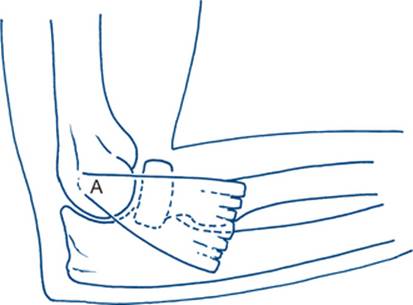
Figure 6.11 Tennis elbow
A: the site of tenderness is over the extensor tendons just anterior to the lateral epicondyle
3 De Quervain’s tenosynovitis
De Quervain’s disease is a stenosing tenosynovitis of the extensor pollicis brevis and abductor pollicis longus causing pain and tenderness proximal to the radial styloid process (Fig 6.12). Clinical features are as outlined in Chapter 6.2.
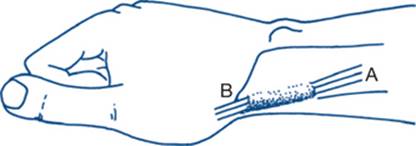
Figure 6.12 De Quervain’s tenosynovitis
Thickening in the sheath of abductor pollicis longus and extensor pollicis brevis (A) where they cross the styloid process of the radius (B)
4 Repetitive strain injury
Repetitive strain injury (RSI) is a chronic, poorly localised, painful condition of the forearm. It occurs in occupations where repetitive movements are necessary, such as typing and machine and processing work. The chronic pain may radiate to the neck and elsewhere in the body in a varying pattern and is associated with cold extremities (that look normal) and may radiate to the other arm. Sleep deprivation is a common complaint. The condition has no defined pathology and no constant physical signs are demonstrable — it embraces a group of functional disorders. Prognosis often depends upon expectations of compensation. Its incidence has fallen dramatically since it ceased to be a valid cause for a compensation claim.
Treatment plan
Carpal tunnel syndrome can be treated initially by conservative measures such as night splinting and local injection of steroids. The natural history is variable and some cases will resolve once the acute episode is helped by a period of rest. Weight reduction and oral pyridoxine and diuretics have been used, but continuing symptoms are best treated by surgical decompression. If there is an established neurological deficit, surgical division of the flexor retinaculum, open or endoscopic, is indicated as first treatment. It is essential that all the flexor retinaculum is divided and care must be taken to avoid damaging the recurrent branch of the median nerve to the thenar muscles.
Tennis or golfers’ elbow is usually a self-limiting condition that resolves with rest. Injection with steroids and local anaesthesic agents, and physiotherapy are useful for recurring and persistent pain. Surgery to release the common muscle origin can relieve persistent and disabling pain.
For De Quervain’s disease, splinting and steroid injection may occasionally relieve acute symptoms, but division of the tendon sheath invariably provides a rapid cure.
Treating RSI is often unsuccessful until litigation and compensation claims have been settled but is conservative and based upon pain relief and local treatment with ultrasound, massage and active muscle movements.
6.6 Subcutaneous hand lumps
Lumps affecting subcutaneous tissues are very common in the hand and warrant special consideration. The disorders that cause them can almost all present at other sites in the body as well. Several such swellings are found more frequently in the hand than elsewhere (implantation dermoid, ganglion) and some (Dupuytren’s disease, giant cell tumour of tendon sheath, Heberden’s nodes) are specific, or almost so, to the hand. Patients present with a focal lump because of concern over appearance or function, pain and fear of cancer. Skin lesions of the hand are common, particularly on the dorsum and many of these are indeed malignant. Subcutaneous lumps are rarely malignant, although local recurrence and invasiveness can occur. Hand infections (Ch 6.8) present as local or diffuse swellings, but severe pain and local or systemic signs of inflammation easily distinguish most infections as a separate group. Gross deformities of the hand and of the fingers are due to contractures of palmar fascias, tendons, joints or nerve palsies and are considered in Chapter 6.7.
Causes
1. Ganglion
2. Synovioma of tendon sheath (giant cell tumour, xanthoma)
3. Dupuytren’s disease
4. Traumatically induced lesions
5. Nodules with associated joint disease
6. Less common causes
Clinical features and diagnostic plan
1 Ganglion
These are the most common chronic lumps affecting hands or fingers. They are slow growing and patients usually present because of concern with appearance rather than pain. A number of varieties are specific to the hand.
Small localised wrist ganglia. The dorsal ganglion is the most common, located over the dorsal carpus near the proximal tubercle of the capitate, lying to the radial aspect of the midline on the dorsum of the wrist (Fig 6.13). This often arises from the dorsal wrist joint and effective management involves excision of the stalk of the ganglion and repair of the defect in the dorsal wrist capsule.

Figure 6.13 Dorsal wrist ganglion
A: sectional view; B: surface view of a ganglion presenting between slips of the extensor digitorum longus
A ventral ganglion is also common and is invariably also on the radial side, arising from the fibrous sheath of the flexor carpi radialis tendon and in close proximity to the radial artery.
Small localised ganglia of palm and fingers (‘sesamoid’ ganglia). These ganglia arise from the lateral volar aspects of the fibrous flexor tendon sheath of the metacarpophalangeal joints of the thumb or fingers — usually opposite the metacarpal head. The small firm tense nodule can be confused with the sesamoid bones that lie on the volar aspects of the metacarpophalangeal joints cradling the flexor tendon (Fig 6.14).
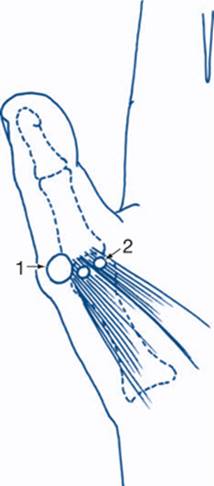
Figure 6.14 Ganglion
1: sesamoid ganglia on the lateral palmar aspect of the metacarpophalangeal joints arising from the fibrous flexor tendon sheath; 2: sesamoid bones lie medially in relation to the volar aspect of the thumb
Ganglia of the fibrous flexor tendon sheath may also occur more distally, at the sides of the shaft of the proximal phalanx, causing a small tender firm lump.
Mucous (synovial) cysts of the fingers: These give classic clinical features and present as subcutaneous cystic lumps over the dorsum of the distal phalanx in or near the midline. These often occur in the setting of arthritis and one must beware that there may be a skin deficit to fill subsequent to their excision.
Extensive compound palmar and dorsal ganglia involving flexor and extensor tendon sheaths. These present as bilobed ganglia with fluctuation across the wrist. They may be associated with the chronic synovitis of rheumatoid arthritis.
Ganglia should be excised if symptomatic. Excision of a focal ganglion must include a complete excision of the lining of the ganglion and repair of any associated capsular defect to minimise risk of recurrence.
2 Synovioma of tendon sheath (benign giant-cell tumour, xanthoma)
These lesions are benign solid neoplasms of tendon sheaths and are virtually confined to the hand. They present as progressive, but slow-growing, firm lumps related to the tendon sheaths of fingers or thumb, usually on the proximal volar surface. They are thus often difficult to distinguish clinically from ganglia. Pain is not usually a marked feature although discomfort occurs with finger movement or gripping. The firm, solid, lobulated mass spreads into tissue planes around the tendon sheath and adjacent joints. They can cause absorption of bone and joint surfaces (usually metacarpal head or proximal phalanx) by compression rather than infiltration and may encircle the bone. They occur in adults of all ages and require surgical excision with an adequate margin because the risk of local recurrence from incomplete excision is high. On exploration, synoviomas are greyish-white lobulated lumps, showing yellow or red areas on the cut surface. On histology, characteristic multinucleated giant cells and foamy macrophages are seen, which are responsible for the yellow colour and the alternative name of xanthoma.
Xanthomas around other joints (e.g. knee and elbow) can be associated, as can linear streaks in the palmar creases and xanthomas around the eyes. Multiple xanthomas should raise suspicion of hypercholesterolaemia or diabetes and a family history should be sought.
3 Dupuytren’s disease
This condition starts as a firm nodule in the subcutaneous tissues of the palmar aponeurosis just proximal to the base of the ring or little finger. As the lesion progresses, signs of skin attachment develop with skin fixation, pitting or dimpling over the lump. Skin sinuses due to fibrosis may progress to skin fistulas. Joint contractures are a later manifestation and progress is often very slow over many years.
Knuckle pads (subcutaneous thickenings over the closed metacarpophalangeal joints) may accompany Dupuytren’s disease.
Histology of nodules shows an exuberant fibromatosis that can be mistaken for a low-grade fibrosarcoma unless the characteristic site and clinical picture are known. Nodules are best merely observed, surgery is not usually necessary as symptoms are minor.
There is an aggressive form of Dupuytren’s contracture (Dupuytren’s diathesis) that begins at an early age with a strong family history, knuckle pads, plantar fibromatosis (Ledderhose’s disease) and penile fibromatosis (Peyronie’s disease). In this form of the disease, progression, despite surgery, is the rule.
4 Traumatically induced lesions
Implantation dermoid. These characteristic small, firm, painful nodules are palpable just beneath the skin of the finger pulps or palm. They are the most common tumour in the distal phalanx. They are sensitive to palpation and usually blanch on pressure. An overlying discoloured spot on the skin or small scar may tether the cyst to overlying skin. They have long natural histories and consist of whorled fibrous tissue surrounding a squamous epithelial-lined cyst that contains keratin. They are due to implantation of dermal elements and are often occupation related. They are effectively treated with surgical excision.
Foreign body granuloma. A firm solid subcutaneous lump can develop months or years after a penetrating injury with a retained foreign body (e.g. glass, wood, metal). The history of the injury may often have been forgotten. X-ray may clarify the diagnosis by revealing a radio-opaque foreign body. Ultrasonic examination may be required for organic matter. Lesions should be excised. Tetanus prophylaxis prior to excision is vital.
Traumatic false aneurysms of the radial artery can develop after arterial puncture for blood gas analysis or after a penetrating injury.
Ulnar hammer syndrome. This gives an intriguing clinical syndrome in men using the ulnar and palmar surfaces of the hand as a hammer in their jobs — workers such as motor mechanics and repairers are most often affected. The repetitive trauma to the ball of the hypothenar eminence can damage the deep branch of the ulnar artery near the hook of the hamate, causing a false aneurysm. Symptoms are usually of the pulsating painful swelling associated with paraesthesia in the ulnar nerve distribution. Distal ischaemia of the ulnar digits is rare. The lesion should be excised, taking care to avoid the ulnar nerve and its branches. An Allen test, to ensure that there is an adequate collateral circulation to the hand, is important prior to the surgical excision.
5 Nodules associated with joint disease
These are common, especially in association with osteoarthritis. They rarely require treatment on their own account, but patients often present with the nodule as an independent problem.
Heberden’s nodes. These firm fibrous nodules on each side of the dorsum of the terminal interphalangeal joints are associated with osteoarthritis. They require no treatment. Differentiation from the less common mucous (synovial) cyst of the finger, which is over the dorsum of the distal phalanx in or close to the midline, should be easy.
Bouchard’s nodes. These are fibrous thickenings of the proximal interphalangeal joints seen in rheumatoid arthritis. Subcutaneous rheumatoid nodules may be seen on the dorsum of hand and wrist and present as firm discrete lobulated subcutaneous fibrous nodules, also common around the forearm and elbow.
Gouty tophi. In longstanding gouty arthritis, tophaceous deposits are often present in the hand. These cause firm nodules stretching the overlying skin with the yellowish–white colour of the tophaceous deposit shining through the skin. They are common on the lateral dorsal aspects of interphalangeal joints and may discharge through the skin. Occasionally they require surgical enucleation. X-rays usually show classic gouty arthritis.
6 Less common causes
Glomus tumour. Glomus tumour is among the rarest of hand tumours. These small vascular subcutaneous nodules are reddish-brown in colour and are most common on the limbs. They can cause severe, excruciating pain and are exquisitely tender to pressure. They are often so small that they will escape detection on cursory examination and symptoms may be thought fabricated and histrionic. A common site is a reddish-brown subungual nodule, which is dramatically cured by removal of the nail and enucleation. The characteristic triad of severe pain, point tenderness and cold sensitivity should be sought. It must be differentiated clinically and histologically from the less painful subungual melanoma that requires radical excision by finger amputation.
Lipoma. Lipomas are uncommon in the hand — only 10–20% of upper limb lipomas occur in the hand and wrist area. The most frequent site is the thenar eminence. Those under the thick palmar skin are flatter and firmer than at other sites and usually need excisional biopsy for diagnosis. Confined beneath the flexor retinaculum, they may spread along fascial planes between tendons (lipoma arborescens) and can cause symptoms of nerve compression. Lipoma arborescens and neurofibroma of the median nerve each present as vague swellings of the palm with carpal tunnel syndrome symptoms. They are very rare causes, but important, as surgical treatment is conservative, requiring just flexor retinaculum division and, in the case of the lipoma, very conservative excision with extreme care to avoid injury to the median nerve. MRI examination of the wrist and carpus if often useful in delineating the underlying pathology.
Treatment plan: general
Many lesions just require clinical diagnosis and reassurance of the patient (most commonly ganglia, Dupuytren’s nodules and Heberden’s nodes). Persistent discomfort or a suspicion of malignancy requires surgical exploration. Optimal surgical management requires detailed knowledge of hand anatomy and function. Almost all lesions are best explored under an avascular field with a pneumatic tourniquet using either general anaesthesia or brachial plexus block. Adequate removal of ganglia and synoviomas is almost impossible without an avascular field. Because of the compact and complex anatomy of the hand, many lesions are closely associated with important nerves and blood vessels, tendons and joints. An avascular field facilitates preservation of all these structures, but care in avoiding inadvertent arterial damage is very important when operating under a tourniquet. The operation should be concluded and circulation restored within an hour under ordinary circumstances. If prolonged ischaemia is inevitable, it is preferable to release the tourniquet intermittently each hour. Haemostasis is important. Unipolar cautery is never used when operating on the fingers under a tourniquet for fear of thrombosing the digital vessels — bipolar diathermy may be used judiciously. A firm, but not tight, elastic dressing and plaster immobilisation conclude the procedure. After the operation the surgeon must check the hand for circulation. At the end of the procedure, haemostasis (with the tourniquet deflated) is performed in order to avoid the development of a subcutaneous haematoma.
6.7 Hand deformities
The hand is an intricate and highly sophisticated organ. Even minimum deformity can produce marked disability that can prevent both gainful employment and normal performance of the activities of daily living. Treatment aims to restore, as far as possible, hand functions. These comprise three main areas: sensory perception; fine dextrous movements; and more powerful gripping functions. Manipulative precision, as in the use of fine tools, depends upon sensory perception and dexterity. Precision of grip entails the ability to oppose the thumb with the index and middle fingers. The stronger power grip requires the additional ability to flex strongly the ring and little fingers, combined with powerful movements of wrist, shoulder and elbows (Fig 6.15).
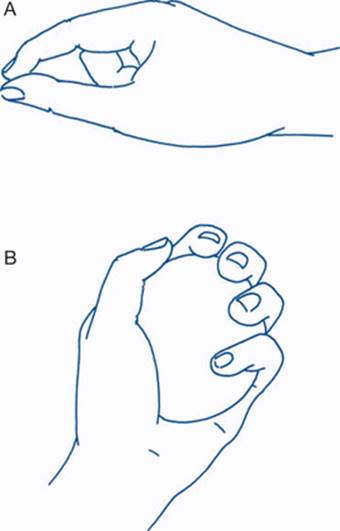
Figure 6.15 The stronger power grip
A: precision grip depends on the pinching movement; B: power grip requires wrist, elbow and shoulder as well as hand power
Detailed knowledge of the anatomy and function of the hand is required to prevent and correct deformity. Elective skin incisions must be designed to cause the least interference with hand function and to heal with minimal scarring. Incisions may be placed in flexure skin creases or along lines of cleavage or along the lateral margins of fingers in areas of relative skin immobility (Fig 6.16).
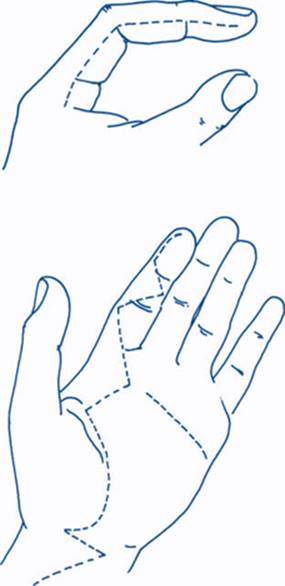
Figure 6.16 Skin incisions
Skin incisions are best placed in flexure skin creases, along lines of cleavage or along the lateral margins of the fingers in areas of relative skin immobility. Zig-zag oblique incisions between joint flexure lines ensure that the incision does not cross the crease line at right angles.
Zig-zag oblique incisions between joint flexure lines can ensure that the incision does not cross the crease line at right angles but does so at the lateral extremities of the creases in areas of less mobile skin. Immobilisation early after surgery promotes healing: ‘every operation on the hand deserves a plaster’. However, the hand tolerates prolonged immobilisation poorly and finger splints should not be maintained for longer than three weeks. The position in which the hand is splinted is also extremely important (Fig 6.17).
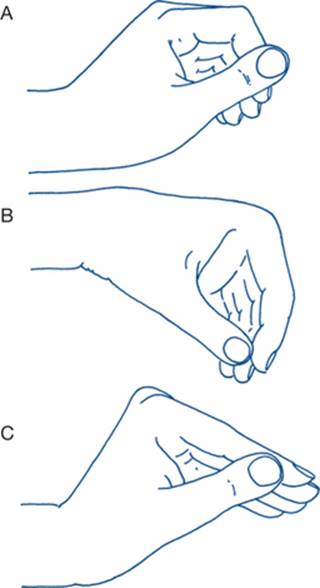
Figure 6.17 Correct hand splintering
A: the position of function. The wrist is extended and the fingers progressively flexed; B: the position of rest of the hand and fingers. The wrist is in neutral; C: splintage position. Wrist extended, flexed metacarpophalangeal joints and relatively straight fingers (Z-position)
In the position of rest, the wrist is slightly flexed and the fingers moderately and progressively flexed into the palm from index to little finger. In the position of function, the wrist is extended and the fingers are a little more flexed. Short-term splinting is usually in the position of function. The lateral ligaments of the finger joints can become shortened during prolonged immobilisation and, to prevent contracture, are preferably kept taut during more prolonged splinting. To do this the metacarpophalangeal joints of the fingers are splinted in flexion with the interphalangeal joints maintained in extension.
Common causes
1. Congenital contractures
2. Wound contractures
3. Dupuytren’s contracture
4. Ischaemic muscle contracture (Volkmann’s)
5. Tendon disorders
6. Deformities due to arthritis
7. Deformities due to neurological lesions
History and physical examination
1 Congenital contractures
Congenital deformities should be recognisable on inspection, but a practised eye is required to pick up even such seemingly obvious lesions as polydactyly.
Syndactyly (web fingers). Two or more digits are united by a web that may be thin and incomplete in some instances or involve the full thickness of the fingers in others. Simple (cutaneous) syndactyly refers to cases with no underlying bony fusion, whereas complex (osseous) syndactyly indicates underlying bony fusion. Incomplete syndactyly refers to cases where the web began to recede but stopped short of the normal level and complete syndactyly indicates that the entire web is absent to the tips of the fingers. Syndactyly is often an isolated anomaly; however, it is prudent to be aware that it may be sometimes linked to chromosomal and craniofacial conditions.
Polydactyly (supernumerary digits). This is characterised by the presence of extra digits or toes. Syndactyly and polydactyly have a familial tendency. Polydactyly often has a genetic link. The extra digit in the hand may be radial, central or ulnar in its position. Radial polydactyly may be a duplication of the distal phalanx, the middle and distal phalanges or the proximal, middle or distal phalanges. A triphalangeal thumb, an uncommon variant of this condition where the thumb appears as a fifth finger is rare but important to identify as it may be linked with cardiac pathology and pancytopenia. Central polydactyly is less common; however, one must be aware that it often has an autosomal inheritance pattern. Ulnar polydactyly is common and may present as a floating digit (autosomal dominant in African-American patients) or may have skeletal attachment.
Congenital contracture of the little finger. This is common and should be instantly recognisable on inspection as distinct from the deformities of Dupuytren’s contracture or of nerve lesions. The little finger alone — usually on both sides — is involved, with a congenital fixed flexion deformity at the interphalangeal joints. The finger is often also curved inwards (camptodactyly, clinodactyly — bent finger). Disability is usually mild and functional adaptation of the hand is usually complete. The deformity is often familial.
2 Wound contractures
Skin contractures due to secondary scarring of wounds across skin creases, and especially after deep burns, are common causes of deformity. They have a characteristic history and appearance. Surgery may be required in order to improve function; however, there is a tendency for recurrence.
3 Dupuytren’s contracture
Dupuytren’s contracture involves a thickening and shortening of the palmar aponeurosis and adjacent subcutaneous tissues. The aponeurosis lies deep to the subcutaneous tissues of the hand and superficial to the flexor tendons. Nodular thickenings in the palmar fascia progress to longitudinal bands that result in flexion contractures of the fingers. The condition may have a familial predisposition. It is also not uncommon in patients with cirrhosis of the liver and in epileptics receiving phenytoin. An association is also described with chronic illness and immobility of the hand, diabetes and pulmonary tuberculosis. Progression may be affected by local trauma and by occupation but these latter effects are probably minor. Dupuytren’s disease begins as a firm nodule in the palm, usually at the base of the ring finger and often many years before the development of a contracture. Men are more often affected than women and the development of severe contracture is uncommon in patients under 45 years of age. The earlier the lesion starts in life, the more aggressive the condition is and the more likely it is to recur after treatment. All digits may be affected, most commonly the ring finger, followed by the little, middle and index fingers. Thumb involvement is much less common. The palmar nodule becomes attached to the skin and causes puckering, dimpling, pits and sinuses of the surface.
As the disease progresses, continuing fibrosis and infiltration involve the subcutaneous tissues and palmar aponeurosis. Diverging bands run from the palm in the region of the flexor retinaculum to the volar aspects of the digits and extend across the metacarpophalangeal joint and proximal interphalangeal joint to the middle phalanx. The terminal interphalangeal joint is usually not involved. The effect of the disease on the end joint of the finger depends upon the degree to which the finger is rolled into the palm by contracture at the metacarpophalangeal and proximal interphalangeal joints. The deformity can cause flexion of the metacarpophalangeal and proximal interphalangeal joints to a right angle; the distal and intermediate phalanges remain in line and forced against the palm (Fig 6.18). Less commonly the terminal interphalangeal joint is flexed and the affected finger is rolled tightly into the palm with flexion of all joints. All degrees of contracture of the metacarpophalangeal and proximal interphalangeal joints occur; the firm subcutaneous fascial bands causing the deformities are easily palpable and often attached to overlying skin. The deformity is unaffected by movements of the wrist joint and there is no sensory disturbance. The contracted fingers impair the grip and make it difficult to let objects go, and also get caught up in pockets.
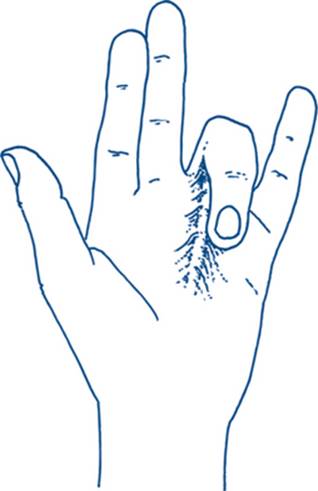
Figure 6.18 Dupuytren’s contracture
4 Ischaemic muscle contracture (Volkmann’s)
Volkmann’s ischaemic contracture follows ischaemic fibrosis involving the long flexor muscles of the forearm and gives a disabling and characteristic claw-like deformity of the fingers and wrist. The usual causes of muscle ischaemia are injury to the brachial artery from supracondylar fractures of the humerus or to its branches from fractures of both bones of the forearm or from an excessively tight arm plaster or occasionally after arterial embolism. Prevention of the complication requires adequate treatment of these conditions and effective management of incipient ischaemia from any cause. The major sign of incipient ischaemia of the long flexor muscles of the forearm is extreme pain on attempted finger extension. This should alert the clinician to the danger of ischaemic contracture; it demands immediate diagnosis and relief. The muscle ischaemia involves muscles within the flexor compartment of the forearm, often with secondary involvement of nerves due to ischaemic neuritis. The skin and subcutaneous tissues are not involved and the fingers are paraesthetic but not ischaemic. Muscle ischaemia leads to permanent damage and ultimately fibrosis if ischaemia is not relieved within six to 12 hours. The infarcted muscles undergo progressive fibrotic contracture that particularly affects the long finger flexors and, to a variable degree, the wrist flexors.
In the most severe case the deformity is unmistakable and involves all digits and the whole hand. The wrist is usually held moderately flexed. The metacarpophalangeal joints are in neutral position or extended due to tension of the long extensors and the proximal and interphalangeal joints are grossly flexed (Fig 6.19). Varying degrees of ischaemic neuritis may accompany the contracture. Most often, regeneration of affected nerves occurs so that muscle function of the small muscles of the hand is maintained and sensation of the fingers is present. The deformity and its effects are thus very different from that produced by a claw hand due to a neurologic deficit. It is also soon obvious on examination that the deformity is associated with contracture of the long flexor muscles of the fingers: extension of the wrist worsens the finger deformity and flexion of the wrist diminishes it. The source of proximal ischaemia will be apparent on questioning or examination. The most common findings are an old fracture of the elbow or forearm or a proximal source of vascular embolus.
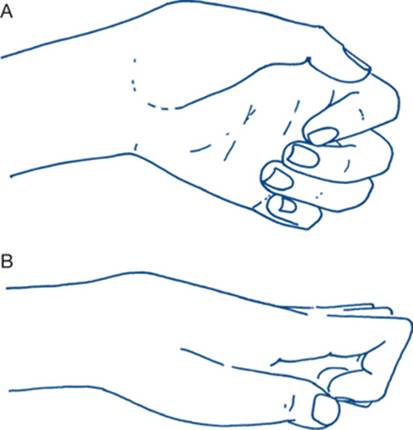
Figure 6.19 Volkmann’s contracture
A: moderate flexion of the wrist with gross flexion of the interphalangeal joints; the metacarpophalangeal joints are in the neutral position or slightly extended; B: the thumb is partly spared in this case
Fibrous contracture of the small muscles of the hand can also occur, secondary to ischaemia or to rheumatoid arthritis, or to the hypertonicity found in cerebral palsy. The deformity resulting from fibrous shortening of the interossei and lumbricals is very typical and results in metacarpophalangeal flexion of the joints of the fingers and thumb, interphalangeal joint extension and adduction of the thumb. This position is called the ‘intrinsic plus’ hand (Fig 6.20). Minor degrees of contracture of the short muscles are diagnosed by passive hyperextension of the metacarpophalangeal joints; the interphalangeal joints will not be capable of passive flexion in this position, as it stretches the intrinsic muscles of the fingers and thus the dorsal capsules of the distal joints.
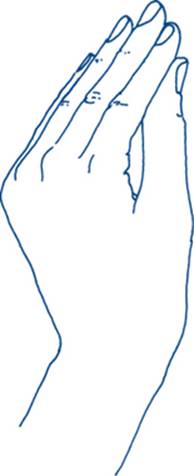
Figure 6.20 The ‘intrinsic plus’ hand
The ‘intrinsic plus’ hand results from fibrous contracture or hypertonicity of the small muscles of the hand. Flexion of the metacarpophalangeal joints, interphalangeal joint extension and adduction of the thumb.
5 Tendon disorders
Trigger finger (stenosing flexor tenosynovitis) is a very characteristic condition in which the finger becomes locked in full flexion. Forced active or passive extension is associated with a sudden click and release (Fig 6.21).
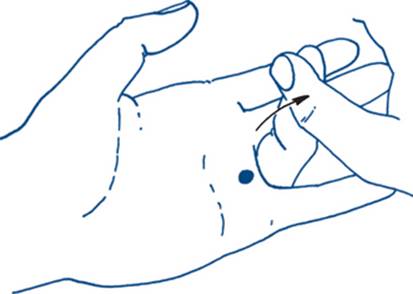
Figure 6.21 Trigger finger from stenosing tenosynovitis of the flexor tendon
The finger becomes locked in flexion. Forced extension leads to a sudden click and release.
Mallet finger (Fig 6.22) is a flexion deformity of the distal interphalangeal joint caused most commonly by a hyperflexion injury of the finger tip while catching a ball, resulting in rupture of the extensor tendon slip to the base of the distal phalanx. Sometimes the injury is associated with avulsion of a small flake of bone from the dorsal aspect of the base of the distal phalanx. Occasionally, division of the tendon occurs from a penetrating wound. For closed injuries, early treatment by splinting in the hyperextended position can result in healing without final disability or deformity, particularly when a bony fracture is present. However, healing of the tendon is often accompanied by lengthening and deformity, with failure of complete extension on straightening the finger. Passive extension confirms that the deformity is not due to joint stiffness but to tendon weakness (drop finger). The condition may also follow invasion of the extensor tendon and its insertion by rheumatoid inflammatory tissue, in which case other deformities of rheumatoid arthritis are usually obvious. Treatment is usually immobilisation of the distal joint in a hyperextended position in a ‘mallet splint’. Should the piece of bone be large or include a significant segment of articular surface, then surgical repair may be warranted.
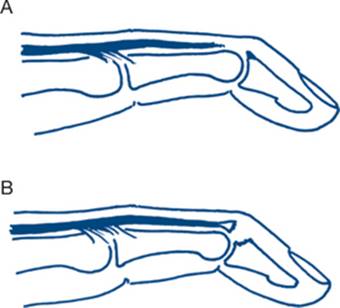
Figure 6.22 Mallet finger
A: extensor tendon avulsion; B: avulsion of bone fragment, tendon intact
Boutonnière deformity. This is a flexion deformity of the proximal interphalangeal joint due to traumatic division, rupture or stretching of the central slip of the extensor tendon expansion where it inserts into the base of the middle phalanx. The lateral slips separate and dislocate around the sides of the flexed joint and the head of the proximal phalanx protrudes through the gap, as though through a button-hole. Eventually there is hyperextension of the distal interphalangeal joint and fixed flexion of the proximal interphalangeal joint giving a typical deformity (Fig 6.23).
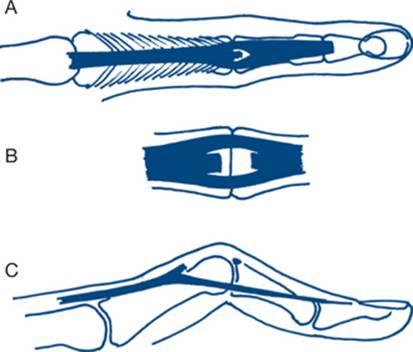
Figure 6.23 Boutonnière deformity
A: normal tendon B: ruptured central slip; C: established deformity
Swan neck deformity is the reverse of the boutonnière deformity. The proximal interphalangeal joint is hyperextended and the distal interphalangeal joint is flexed. The swan neck deformity can be seen in normal hands and is secondary to an imbalance between extensor and flexor tendon action. It is a common deformity in rheumatoid arthritis (Fig 6.24) and is often associated in this disease with other deformities and fibrotic contacture of the interossei and lumbrical muscles. Testing for intrinsic muscle contracture and isolated sublimis action (Ch 5.2), and observing if stabilising the metacarpophalangeal joint corrects the deformity, will usually indicate the cause.
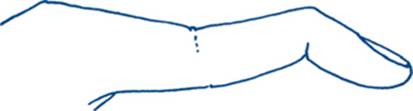
Figure 6.24 Swan neck deformity
6 Deformities due to arthritis
Osteoarthritis affects particularly the distal interphalangeal joints and wrist joint. Heberden’s nodes are hard or firm nodules over the dorsum of the distal interphalangeal joints. Radial or ulnar deviation of the distal phalanx may also be present. The index finger is most often affected. Adventitious bursae occasionally develop between the skin and the Heberden’s nodules.
Rheumatoid arthritis. This usually has its most disabling effects on the hands. The disease commonly begins with pain, stiffness and swelling of the fingers. The joints mainly involved are the metacarpophalangeal joints and proximal interphalangeal joints (different to the distal pattern of osteoarthritis). Synovial thickening and associated muscle wasting give the fingers and hands a spindle-shaped deformity. Rheumatoid granulomatous nodules develop in the subcutaneous tissue, usually over bony prominences and within tendon sheaths. Thickening of the dorsal ligaments of the proximal interphalangeal joints causes Bouchard’s nodules. Progressive disease causes the typical deformity of the ‘intrinsic plus’ hand: with thickened deformed wrists and metacarpophalangeal joints, ulnar deviation of the hand and fingers and a Z-deformity of the thumb. Progressive flexion deformity at the metacarpophalangeal joints can progress to subluxation. Hyperextension of the interphalangeal joints, tendon erosion and rupture, swan neck deformity, boutonniere and mallet finger deformities are all common (Fig 6.25).
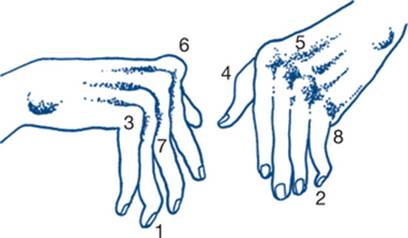
Figure 6.25 Rheumatoid hand
1: ‘swan neck’ finger deformity; 2: mallet finger; 3: flexion contracture of M-P joint; 4: Z-thumb deformity; 5: muscle wasting; 6: synovial thickening; 7: thickening of the dorsal ligaments of the proximal interphalangeal joints; 8: ulnar deviation of fingers
Gout. Gouty arthritis affecting the hand can cause severe deformities that can occasionally be difficult to distinguish from rheumatoid arthritis. Gouty arthritis produces tophaceous deposits (a toothpaste-like yellow material containing infiltrates of uric acid crystals). Tophi are maximal at terminal interphalangeal joints but can affect proximal interphalangeal joints and metacarpophalangeal joints as well. Tophi are also responsible for subcutaneous deposits at elbow and ear. The yellowish colour of the uric acid deposits is usually visible through the skin. The degree of muscle wasting and systemic illness is rarely as severe as with rheumatoid arthritis.
7 Deformities due to neurological lesions
Peripheral nerve lesions. These give classic hand deformities (Ch 5.3).
Radial or posterior interosseous nerve deformity gives wrist and finger drop. Sensory loss with radial nerve palsy is usually minor and confined to the anatomical snuff box. Extension of the wrist joint, of the metacarpophalangeal joints of all digits and of the terminal interphalangeal joint of the thumb are all paralysed. Power grasp is impaired as there is an inability to stabilise the wrist in neutral or extension. Furthermore, as the fingers and thumb are unable to be spread sufficiently during prehension there is an inability to open the palm to grasp objects. In a posterior interosseous nerve palsy, the extensor cari radialis longus and brevis tendons and the brachioradialis tendons are still functioning, thus preserving wrist extension, albeit in radial deviation.
Ulnar nerve palsy gives the classic deformity of ulnar claw hand. The characteristic posture enables this to be easily distinguished from the other claw deformities. Only the little and ring fingers are clawed, unless the ulnar nerve supplies all the lumbrical muscles. Sensation is lost over the ulnar side of the hand and over the little finger and the ulnar side of the ring finger. The claw deformity of an ulnar claw hand involves hyperextension at the metacarpophalangeal joints and flexion of the other finger joints (Fig 6.26).

Figure 6.26 Claw hand due to ulnar nerve palsy
As the metacarpophalageal joints hyperextend due to the lack of hand intrinsic function, full extension of the proximal interphalangeal joints is not possible. Wasting of the small muscles of the hand is present, apart from the short abductor and flexor of the thumb. Functional impairment is significant. With grasping there must be a coordinated action of the long and short flexors in the forearm and hand such that flexion proceeds from the metacarpophalangeal joints to the interphalabgeal joints. With a loss of the interossei and lumbricals there is an inability to selectively initiate flexion at the metacarpophalangeal joint. As such, the remaining long flexor tendons — flexor digitorum superficialis and profundus — curl the fingers into the palm with the metacarpophalangeal joints being activated towards the end of this motion. The arc of finger motion is therefore significantly shortened and large objects are unable to be grasped. Stability of pinch is also affected, as demonstrated using the Froment test — the interphalangeal joint of the thumb flexes to increase the mechanical advantage of the extensor pollicis longus and compensate for the weakened or missing action of the adductor pollicis.
Klumpke’s paralysis. This is an eponymous name attached to a palsy of the lower roots of the brachial plexus (C8 and T1). This gives a complete claw hand due to paralysis of all intrinsic muscles of the hand. It follows brachial plexus injury due to birth trauma or motor vehicle accident. All digits are clawed with hyperextension of the metacarpophalangeal joints; the thumb drifts in line with the other digits. Sensation of the hand is normal but is lost in the axilla and inner arm from the first thoracic nerve root lesion. A combined median and ulnar nerve palsy due to slashed wrist will give a similar picture, but sensory loss will, in that instance, be confined to the hand.
Motor neurone disease and other neurological conditions (syringomyelia, leprosy) can also give claw hand deformities (Box 6.1).
Box 6.1
The causes of ‘claw hand’ deformities
 Ulnar palsy, combined ulnar and median nerve palsy
Brachial plexus lesion (lower trunk)
Spinal cord lesions: syringomyelia, poliomyelitis, motor neurone disease — amyotrophic lateral sclerosis
Volkmann’s ischaemic contracture
Advanced rheumatoid arthritis (‘intrinsic plus’hand)
Dupuytren’s contracture
Diagnostic plan
Diagnosis of the cause of hand deformities is usually obvious from the history and clinical examination.
Plain X-rays are valuable in the diagnosis and evaluation of arthritis. For a detailed study of the carpal bones, posterior, anterior, lateral and oblique views are necessary. If more proximal bony lesions are suspected, X-rays of these areas will be required as well.
The X-ray changes of rheumatoid arthritis vary from marginal joint erosion with adjacent osteoporosis to advanced destruction. Subluxation affects the metacarpophalangeal joint and wrist joints in particular and later the interphalangeal joints.
X-rays in gout show the classic punched-out lesions of articular margins and the soft tissue swelling of urate deposits. Serum uric acid will usually be elevated.
Osteoarthritis shows changes maximal in the distal interphalangeal joints and wrist joints. Radiological changes are joint narrowing and sclerosis of the margins, with osteophyte and cyst formation.
Checking for anaemia and auto-antibodies will be required in assessment for patients with rheumatoid arthritis. Conduction studies may be required to assess progress of recovery in nerve lesions.
Treatment plan
1 Congenital contractures
Treatment is surgical with the exception of congenital contracture of the little finger.
2 Scar contractures
Established contractures are treated by excision of scar tissue or release incisions with skin grafting or Z-plasty. Insensitivity of areas of palmar surface skin can be treated by transposing flaps of skin with an intact nerve supply to the defective site as local or island flaps.
3 Dupuytren’s contracture
Operation is only indicated for deformity and not for subcutaneous nodules without contracture. Surgery is usually indicated when the patient complains of functional impediment and fails Hueston’s tabletop test — placing the palm and fingers flat on a tabletop and being unable to simultaneously place the palm and fingers flat on the tabletop. This usually translates to a metacarpophalangeal contracture of at least 30°. The usual operation is a limited excision of the fascia sufficient to reduce the contracture through one or more palm or finger incisions. Z-plasties are often used in reconstruction to prevent contracture. Skin grafting is sometimes necessary where the bands involve large areas of skin. Amputation is indicated for a severe contraction of the little or ring finger with associated fixed-joint capsule contracture. Division of localised bands by subcutaneous tenotomy is only occasionally possible — surgery must preserve the digital sensory nerves. Care must be taken during surgery as the cords often displace the neurovascular bundle medially and superficially, particularly at the level of the first transverse finger crease. At present the treatment of this disorder is surgical with the aim of alleviating the flexion deformties by removing the fibrous cords while preserving the neurovascular structures.
4 Ischaemic contracture
Volkmann’s ischaemic contracture may require tendon transfer or, in less severe cases, distal transfer of the origin of the flexor muscles. It may be necessary to supplement this procedure with nerve grafting.
5 Tendon lesions
Surgical treatment of trigger finger is curative. An early mallet finger deformity usually just requires splinting. Boutonnière and swan neck deformity are commonly associated with other changes of rheumatoid arthritis but, in an isolated lesion, splinting may be successful.
6 Arthritis
In the early stages splinting may help to reduce pain, improve mobility and reduce loss of function when combined with systemic treatment (e.g. aspirin and corticosteroids). In more advanced disease it is important to be sure that the operative procedures planned will improve function. Surgical procedures are complicated and include synovectomy, tightening of capsular structures, tendon release and tenoplasty, arthrodesis and joint replacement. Gout is treated by dietary management, colchicine (for acute attacks) and long-term allopurinol, a urate-blocking agent. Surgical measures include drainage of infected tophi.
7 Neurological lesions
Treatment of neurologically induced deformities of the hand may involve tenolysis or tendon transfer, arthroplasty or arthrodesis.
6.8 Hand infections
In his classic study on hand infections, Kanavel classified these infections on an anatomical basis. He described the clinical course of hand infections, such as mid palmar space infection and suppurative tenosynovitis, as determined by the anatomical compartments and confining spaces in which they occur. At that time rapidly spreading infections were more common and usually due to Streptococcalcellulitis. Many such infections are now amenable to antibiotic treatment and do not progress to serious cellulitis or suppuration. Hand infections of defined spaces, with classic physical signs as described by Kanavel, are thus now much less common but infections after injury are more common. Trauma breaks down anatomical boundaries and inflammation in an infected open wound is therefore less likely to progress along such predictable lines. The Kanavel classification is still convenient, but many cases do not now fit readily into it; the classic and often extensive incisions for such infections are now rarely used.
Types of hand infection
1. Infected recent wounds
2. Subcutaneous infections
3. Deep infections
Clinical assessment and diagnostic plan
The first evidence of a wound infection is usually the development of pain that is distinguishable from the subsiding pain of the original injury. Systemic effects are initially mild. If the organism is virulent and the infection is confined to the deep fascial spaces under tension, constitutional disturbance is more severe. Throbbing pain disturbing sleep is suggestive of pus and requires mechanical relief by drainage — not just analgesia, antibiotic treatment and splintage. In many cases of hand sepsis there is no obvious wound and the patient presents because of the infection itself. Infections are commonly seen in horny and calloused hands, with potential breaches in the skin surface.
Infection in confined spaces such as the nail fold, the finger tip pulp space and the palmar surface of the hand are more painful than those of the dorsum of the hand. Flexor tendon sheath infections are more painful than extensor expansion infection. Pulp space infections are more painful than infections in the web space or in the subcutaneous tissues of the dorsum.
Radiology is essential to determine whether foreign bodies are present. Unfortunately, nonopaque material such as wood is a more potent source of persistent infection than are radio-opaque (but less reactive) material like metal fragments. Organic matter is often more easily identified with ultrasound examination. Subcutaneous infections may produce rarefaction of an adjacent bone on X-ray; this sign is therefore not conclusive evidence of osteomyelitis. The X-ray findings must be related to the time from injury and from the onset of the infection. A diminution of joint space is the first radiological sign of suppurative arthritis. The position of the joint influences the size of the joint space seen on X-ray so that the positioning for X-ray is an important factor in interpretation. Bacteriological study is necessary, but antibiotics should be started before the results of culture and sensitivities are available. The choice of antibiotics is based upon the knowledge of the type and resistance of organisms commonly found in the community and within the hospital.
Classification of treatment plan
Three main pathogenic factors provide a classification that guides treatment, as outlined below.
Local factors. A nidus that causes persistent infection demands early attention. In the hand, skin necrosis is the most common local factor that delays healing. Skin necrosis may result from trauma, ischaemia secondary to poor suturing or from an undermining subcutaneous abscess. Necrotic tendon, ligament, bone or cartilage, retained foreign body (particularly wooden splinters), inclusion dermoid cyst and pyogenic granuloma are other common local factors that interfere with healing.
The infectious agent. The type of organism cultured and its virulence are important but often to a lesser degree than local and general factors facilitating infection. Routine hand hygiene is of preventive importance in workers at risk from hand trauma.
Host susceptibility to infection. Patients with general medical conditions such as diabetes, atherosclerosis and Raynaud’s phenomenon, malnutrition and alcoholism have a lower resistance to infection.
When the clinical diagnosis is cellulitis, the hand is immobilised with a splint, elevated and antibiotics are commenced. Within a day or two, evidence of resolution or of localisation usually occurs. Localisation is suspected by the detection of maximal tenderness at a point or by the appearance of subcuticular blistering overlying a subcutaneous abscess. This is the ideal time for drainage. Conservative treatment should not be continued for more than two or three days if symptoms and signs do not show a favourable response. The usual cause of failure of response is undetected pus. Early and very severe pain suggests tissue necrosis and is an urgent indication for surgery — pus is invariably present and may be visible under the skin. Operative conditions should allow careful inspection of the infected wound and its depths. General anaesthesia and tourniquet are essential in most cases. The principles of operations for skin or hand infection depend upon the types of infection. Drainage incisions should run parallel to and not across the paths of nerves, arteries and veins. With severe cellulitis, relieving fasciotomy may be required.
1 Infected recent wounds
Wound infection often follows inappropriate primary repair of lacerations and is usually the result of errors of inadequate debridement. Wounds that are seen more than 24 hours after injury should be treated initially with antiseptic dressings rather than closure. Delayed closure can be performed, if required, after the swelling has settled down. With established infection it is necessary first to lay open the wound after suture removal. The open wound is treated by the repeated application of moist porous dressings. More recently, negative pressure dressings, often termed ‘vacc dressings’, have eliminated the requirements for numerous daily dressing changes. Final healing may require secondary closure. Skin grafting is necessary when there has been skin loss or major skin retraction.
2 Subcutaneous infections
Subcutaneous infections are particularly common with the fingers (Fig 6.27).

Figure 6.27 Finger infection
1: nail fold suppuration (paronychia); 2: pulp space suppurative necrosis; 3: eponychium — cuticle; 4: pulp space with fascial septa
Pulp-space infection. Subcutaneous infections of pulp (Whitlow) and web spaces, nail bed, palmar compartments and thenar and hypothenar eminences, are initially treated similarly — with antibiotics and splinting and careful review to identify any developing abscess that requires drainage. If the abscess has not involved the skin, a short incision is made at the point of maximum tenderness — if possible, parallel to the nearest skin crease. If the abscess is carefully cleaned by curettage and any slough is excised, healing will be rapid. Exposure is usually best by a direct approach, combined with careful removal of infected material and antibiotic treatment.
The distal finger pulp is divided into a number of tiny compartments by strong fibrous septa that traverse from the skin to the periosteum. Because of these septa, a pulp space abscess — felon — presents with severe and immediate pain, due to the increase in pressure within the pulp, with early evidence of subcutaneous necrosis. Incision should be combined with excision of slough and treatment with antibiotics (Fig 6.28). Be aware that the felon may extend into the periosteum and around the nail bed.

Figure 6.28 Pulp-space infection (Whitlow)
Direct incision, adequate excision of slough and antibiotic treatment have reduced the need for older methods of extensive incision and irrigation.
Paronychia. The management of acute paronychia with pus formation depends upon the extent and direction of spread. In early cases, only elevation of the nail fold is required to facilitate drainage. With subungual extension of pus, a small vertical incision alongside the nail or removal of the nail in part or whole may be necessary (Fig 6.29). Staphylococcus aureus is the most common bacterial source in acute infections; however, recent studies have identified a 25% incidence of anaerobic infections. In chronic paronychia, candida albicans is the causative agent in 70–90% of cases.

Figure 6.29 Paronychia
A: raising the eponychium to release pus is sufficient in most cases; B: more severe infections require incision of the cuticle and removal of some or all of the nail
Hair follicle infections usually appear on the dorsal aspect of the hand. Folliculitis has pus formation within a hair follicle with infection limited to the dermis. A furuncle is an infection of a number of hair follicles within a confined area and a carbuncle is an abscess involving a number of adjacent hair follicles where the infection has penetrated the dermis and formed a subcutaneous abscess. A dorsal abscess is treated by excising the slough, preserving as much viable skin as possible and treating with antibiotics. The treatment of a carbuncle must also include the excision of the abscess and its fibrous septa. Firm bandaging after cleaning out the cavity will result in rapid obliteration of the space. The causative agent is usually a staphylococcal species; however, with lesions below the waist coliforms and anaerobes should also be considered. Diabetes must be excluded in all hand infections. Attention to hygiene is important if recurrence is to be prevented.
3 Deep infections
Palmar space infection. Most abscesses in the palm or over the thenar eminence lie between the skin and the fascia overlying the muscles and tendons. Most of these infections point early and are best treated by early drainage with excision of slough. However, there are deeper spaces in the palm that may become infected — the thenar, midpalmar and hypothenar spaces. These infections lie between the fascia covering the metacarpals and their associated muscles and the fascia dorsal to the flexor tendons (Fig 6.30). On examination, these deep infections tend to flatten or obliterate the palmar cavity and also produce swelling of the dorsum of the hand. Extension of the fingers may cause severe pain suggestive of tendon sheath infection. Incision into the subcutaneous space is usually made parallel to the nearest skin crease and then into the subfascial space by bluntly separating the fibres of the aponeurosis. Debridement is then performed under direct vision.
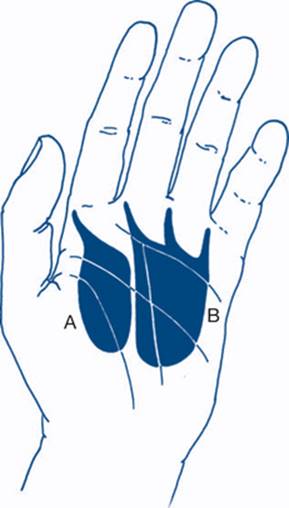
Figure 6.30 Surface markings
A: thenar fascial space; B: midpalmar fascial space
Tendon sheath infection. Kanavel described four signs of suppurative flexor tenosynovitis: tenderness over the flexor tendon sheath; a flexed posture of the digit; fusiform swelling of the digit; and pain on passive extension of the digit. The most common organism is Staphylococcus aureus and surgical drainage if usually required. Prolonged use of antibiotics may be a factor in the development of persistent, low-grade, poorly localised infection around the tendons. Pain on passive extension of the finger, if persistent, suggests the need for exploration. Irrigation of the sheath with an antibiotic solution infused through a fine, supple, nonreactive thin tubing inserted at points of incision may control infection in cases with established suppurative tenosynovitis.
Acute suppurative arthritis may develop from a neglected — and often apparently trivial –wound to the dorsal aspect of the joint. The knuckles are common sites where penetrating tooth wounds can become infected. Human, feline and canine bites often cause severe spreading infections after apparently trivial wounds and response to treatment may be slow. Human bites commonly transmit Eikenella corrodensand animal bites Pasteurella multocida. If the bite is limited to soft tissue, the treatment is conservative with antibiotics and the immobilisation of the hand in plaster, with elevation in a sling. Any suspicion of joint involvement should include surgical exploration of the wound, debridement and lavage. In some cases the original wound may need to be enlarged to improve drainage. In advanced cases, drainage should be combined with removal of sequestra, necrotic tissue and curettage of infected bone and cartilage as required.
Careful rehabilitation is crucial to the full recovery of hand function after infection. The hand is splinted initially in the position of function. Once the infection has been controlled and healing is in progress, graduated finger movement and exercises are begun. In this way, tendon and joint adhesion formation can be minimised and late stiffness of the hand prevented. Contractures may not develop for weeks or months after injury and infection and are especially common in cases where massive scarring is associated with delayed treatment and healing. Infections in wounds crossing the flexor joint creases are especially likely to be complicated by skin contracture. Prevention may require early skin grafting, especially when significant skin loss exists.
6.9 Nail disorders
The nails are commonly the site of pathology. Lesions requiring surgical treatment can usually be distinguished from the nail changes associated with systemic disease (Table 6.2).
Table 6.2 Nail changes in systemic disease
|
Disease |
Nail changes |
|
Connective tissue disorders |
Periungual erythema and telangiectasis |
|
Psoriasis |
Pitting, thickening and deformity of nail plate |
|
Cyanotic heart disease and chronic lung disease |
Clubbing of the fingers (Hippocratic nails) |
|
Iron deficiency anaemia |
Koilonychia |
|
Infective endocarditis |
Subungual splinter haemorrhages |
|
Cirrhosis |
Leuconychia |
|
Hypoalbuminaemia |
Parallel white bands in the nail bed |
|
Renal disease |
Half and half nail — white proximal and red distal discolouration of the nail |
|
Thyrotoxicosis |
Clubbing, onycholysis |
|
Local trauma or severe systemic disease |
Beau’s lines — transverse grooves |
|
Raynaud’s phenomenon |
Brittle, thin nails, paronychia |
Some local nail disorders, such as fungal infection (onychomycosis), are treated medically. Fungal infections closely resemble the changes of psoriasis, the most common systemic condition associated with disorders of the nail. Early in the course of fungal infection the nail plate thickens with a yellow–brown discolouration, which starts at the lateral nail fold. Eventually the nail lifts (onycholysis) and becomes brittle, scored and fragmented.
Nail pitting is more prominent in psoriasis, which usually begins with pinhead size depressions in the nail plate. Late changes include ridging, thickening and deformity of the nail plate.
Eczematous dermatitis of the fingers is common and is also a common cause of nail changes. The diagnosis is made from a history of previous dermatitis and the presence of eczematous vesiculation, scaling and erythema of the fingers. Involvement of the proximal nail fold leads to dystrophic changes in the nail plate, which becomes cross-ridged and coarsely pitted, and eventually the nail cuticle (eponychium) is eroded.
The most common cause of onycholysis is repeated nail trauma (typing and other occupational causes). Onycholysis may follow thyrotoxicosis and other systemic diseases.
Brittle nails are a common complaint. In most cases no cause is found; exposure to cleansers or solvents is occasionally a factor. Vitamin and mineral deficiences are rare but important causes. Nail polish remover can cause or exacerbate brittleness.
Common surgical disorders of the nail
1. Subungual haematoma or melanoma
2. Ingrown toenail
3. Paronychia
4. Periungual warts
5. Less common conditions
History and physical examination
The normal anatomy is shown in Figure 6.31.
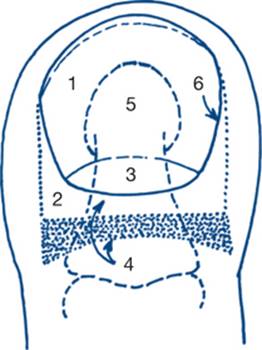
Figure 6.31 Anatomy of the nail
1: visible nail; 2: nail covered by cuticle or oponychium; 3: lunule; 4: nail bed and germinal matrix; 5: terminal phalanx; 6: nail sulcus and lateral nail fold
1 Subungual haematoma and melanoma
Melanoma must be considered in all patients presenting with a dark spot beneath the nail. A history of trauma does not automatically exclude melanoma. A haematoma is usually reddish-brown with sharp edges. A melanoma forms a dark brown or bluish-black discolouration of the nail bed with indistinct edges. The lesion of melanoma has mass to it and may elevate the nail. There may also be streaks of pigment in the nail plate. Eventually ulceration and bleeding of the nail bed occurs with erosion of overlying nail. Some tumours are amelanotic, forming red friable subungual plaques or papules. In contrast to melanoma, haematomas move distally with nail growth and are often accompanied by a depressed line and ridge (Beau’s line) in the overlying nail. When there is any doubt, the lesion should be treated as a melanoma, by biopsy excision after removal of the overlying nail.
A pyogenic granuloma adjacent to the nail fold may be difficult to diffentiate from amelanotic malignant melanoma. Pyogenic granulomas at this site are usually secondary to ingrown toenail, so the history and appearance is usually typical. When the diagnosis is not obvious, biopsy is necessary.
Mucous cysts of the fingers usually cause a subcutaneous lump proximal to the nail on the dorsal surface of the finger. Deformities in nail growth are commonly associated. If the cyst affects the nail bed alone, it will present as a subungual tumour and will require nail removal and biopsy.
Pigmented naevi of the nail bed are occasionally seen in Asians. The appearance of the lesion is that of a dense longitudinal pigmented band; its occurrence in Europeans is rare and biopsy is required.
2 Ingrown toenail
Ingrown toenail is the most common surgical condition affecting the nail and is classically located along the lateral edges of the great toenail. It represents an imbalance between the soft tissues of the nail fold and the growing nail edge. It is exacerbated by faulty nailtrimming, by constricting shoes and by poor hygiene. The pressure exerted by the shoe’s toebox pushes the great toe towards the second toe, resulting in pressure on the lateral aspect of the nail where it abuts the second toe, with the shoe itself exerting pressure on the medial aspect of the nail. A skin breach, due to the sharp edge of an improperly cut nail, is followed by infection and by succulent oedema and a poorly draining abscess. The resultant exuberant granulation tissue of the nail fold causes further imbedding of the edge of the nail and a vicious circle ensues. In the established case the nail acts as a foreign body preventing healing. The condition is most common in adolescent boys. Poorly fitting shoes and repeated trauma to the big toe, as in playing football, exacerbate the problem. The tendency for the nail to be ingrown may occasionally be due to a congenital excessively curved nail or a subungual exostosis producing doming of the nail plate. Heaping and rolling over of the nail fold on the nail also contributes. Ingrown toe nail is uncommon in adults but may follow injury or deformity of the nail bed.
3 Paronychia
Paronychia is an acute or chronic inflammatory condition of the lateral nail fold. Fingernails are more commonly affected than toenails. The condition is seen most frequently in those with constantly wet hands, such as dishwashers. Diabetes is a common predisposing factor. The condition is also common in patients with chronic fungal or yeast infections of the nail. Hypertrophy of the nail fold and rigidity of the nail leads to pressure necrosis and ulceration of the nail fold with secondary bacterial infection and abscess formation. The condition is often triggered by formation of a hang nail after lateral paring of the nail or trimming of the cuticle (eponychium). Paronychia is also more common in patients with Raynaud’s phenomenon.
4 Periungual warts
Warts of the nail fold and eponychium present particular difficulties in treatment and are often painful and subject to inadvertent injury. The warts may be confluent or isolated papules. Typical warts are also seen elsewhere on the hand in most cases.
5 Less common conditions
These include onychogryposis, subungual exotosis and glomus tumour.
Onychogryposis is a heaped and clawed appearance of the nail resembling a ram’s horn. The condition can be precipitated after repeated injury to the end of the toenail sufficient to interfere with the sliding growth of the nail on the nail bed, especially with sporting trauma and in people going barefoot. Onychogryphosis is, however, most commonly seen as an incidental finding in the elderly patient. The aetiology is unknown but may be a combination of lack of nail care and the presence of a fungal infection. Arterial ischaemia is not commonly a major problem in these patients but may contribute and should always be checked.
A subungual exostosis on the dorsal surface of the distal phalynx can contribute to disordered nail growth or to ingrowing toenail. The deformity is usually obvious and confirmed by X-ray.
A glomus tumour is an angioneuromyoma (a benign hamartoma). Presentation is with an exquisitely tender, small purple–red spot beneath the nail. The symptoms are characteristically markedly severe in relation to the physical findings.
Diagnostic and treatment plans
Diagnosis is usually obvious on physical examination although, in the case of subungual lesions, removal of the nail and biopsy may be necessary to exclude melanoma.
1 Subungual haematoma and melanoma
Excisional biopsy and histological confirmation is essential before amputation of the finger or toe.
2 Ingrown toenail
All patients with an ingrown toenail should be instructed on correct foot and nail care. The patient is advised to wear correctly fitting shoes and to cut the end of the nail squarely, not at the sides, so that the nail can grow out from the nail fold (Fig 6.32). In the meantime the patient must attend to foot hygiene, including foot baths, avoiding the use of nylon socks and frequent changes of clean cotton or wool socks, and placing cotton wool beneath the nail edge to assist separation of the edge from the nail fold. Thinning the central portion of the nail with a nail file or razor blade makes the edge more pliant and easier to lift away from the nail fold.
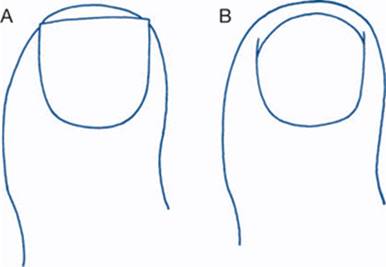
Figure 6.32 Correct (A) and incorrect (B) trimming of toenails
Antibiotics are only indicated for associated cellulitis. In such instances drainage may be a matter of urgency, especially when the patient is diabetic.
Persistent or recurrent ingrown toenail requires surgical treatment. Avulsion of the nail may be indicated for severe purulent infection, especially when both sides of the nail are involved, and gives very effective drainage. Recurrence occurs on regrowth of the nail in about 30% of patients. Elective surgical treatment involves removal of the offending section of the nail and nail bed (wedge resection) so that regrowth and recurrence will not occur. The operation can be performed under a digital nerve block (Fig 6.33) or under general anaesthesia. Before the procedure is performed, the circulation to the foot must be checked — circulatory problems must be identified in older patients and problems prevented by alternative plans of management.
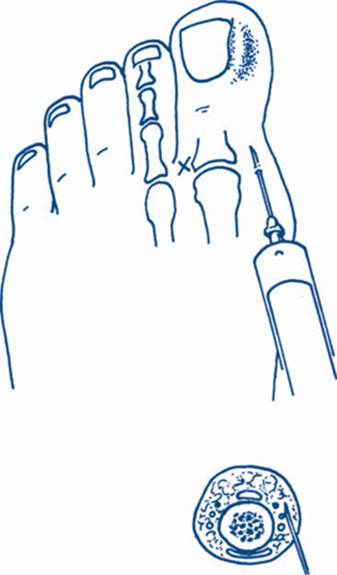
Figure 6.33 Digital nerve block
Adrenaline must not be added to local anaesthetic for a digital block.
In a simple wedge resection the affected side of the nail is excised and the underlying nail bed surgically removed and curetted, taking particular care to remove the entire lateral extension of the nail bed (the key to success). Zadik’s operation (originally described by Quenu in 1887) is a more radical procedure done for severe and recurrent disease. Two lateral incisions in the eponychium are extended proximally from the edges of the nail fold to allow the raising of a wide flap of skin and also distally along the nail fold so that granulation tissue can be excised. The entire proximal nail bed is excised so that regrowth of the nail does not occur. The exposed nail bed keratinises and becomes less sensitive, forming a ‘pseudo-nail’ with time (Fig 6.34). Incomplete excision may lead to dysmorphic regeneration of the nail and further symptoms.
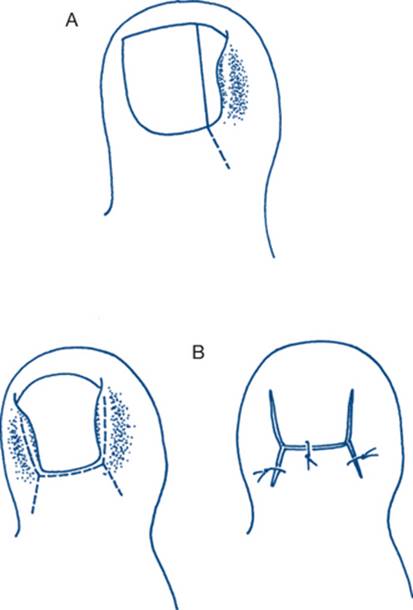
Figure 6.34 Surgical treatment for ingrown toenail
A: wedge excision procedure. The lateral third of the nail is avulsed. The nail bed is either excised, curetted or ablated with local phenol; B: Zadik’s operation — the entire nail and nail bed, and the lateral nail folds, are excised.
3 Paronychia
This is treated initially by antiseptic-soaked dressings, elevation of the nail fold to drain pus, and antibiotics. Many abscesses can be drained satisfactorily through the point of necrotic fluctuant skin overlying the abscess. Occasionally the nail must be avulsed to establish free drainage of a subungual abscess. Careful avoidance of moisture and injury to the affected area is the most important element in the treatment of chronic paronychia. Diagnosis of chronic fungal paronychia is by culture of scrapings on Sabouraud’s medium. Treatment by local antifungal creams is helpful, but curative treatment may require several months of oral griseofulvin therapy.
4 Periungual warts
These are difficult to treat, especially if the wart extends under the nail plate. Available treatments include topical agents such as podophyllin and salicylic acid. The sclerosant action may be localised by painting around the wart with nail polish during treatment. Simple methods such as these are always first lines of treatment. Recurrent lesions require cryodestruction (liquid nitrogen), surgical curettage or electrocautery.
5 Less common causes
Onychogryposis. In young patients, limitation of repeated trauma must be achieved if recurrence is to be prevented after removal of the nail. Repeated trimming of the nail usually requires the use of heavy cutters. This is the preferred form of treatment in older patients where there is always concern for the adequacy of the peripheral circulation. A nail bed obliterative procedure is the only absolute cure.
6.10 Painful hip
Hip pain in adults is usually due to osteoarthritis. Patients usually present with pain and a limp; early in the course of the disease before pain is established they may present with an ‘irritable hip’. Pain felt in the region of the hip may also be referred from the lumbar spine and the sacroiliac joint or from pelvic inflammatory disease. Ischaemic muscle pain secondary to aortoiliac occlusion is sometimes confused with joint pain.
The pain of osteoarthritis of the hip is felt mainly in front of the joint and in the groin and is often referred down the inside of the thigh to the knee. Occasionally knee pain may be the predominant symptom of osteoarthritis of the hip. Pain from diseases extrinsic to the hip joint is more often felt in the buttock and sometimes in the perineum. In disorders of the lumbar spine, referred pain is mainly felt in the buttock radiating down the outer side and back of the thigh. Referred pain from the back is often made worse by stooping, lifting or sitting and is decreased by walking and recumbency. In contrast, hip pain becomes worse on walking, is most severe early in the day and is relieved by rest.
Causes
1. Osteoarthritis
2. Extrinsic causes of referred hip pain
3. Less common causes
Clinical assessment
The gait is first assessed. A short limb may be observed — shortening may be apparent or real (Fig 6.3). A painful, unstable hip is often associated with a Trendelenburg gait. The sound side sags as the good leg is swung through; the trunk is often tilted to come above the affected weight-bearing leg, so as to minimise the abductor moment required to maintain pelvic alignment. This may be tested with the Trendelenburg test where the patient stands on the affected limb while the good leg is lifted from the ground. Should the pelvis sag or the torso be laterally flexed over the affected limb the test is deemed to be positive — indicative of abductor dysfunction or weakness.
The patient is then examined supine. The hip is buried deeply and is not accessible to direct palpation. An important preliminary step is to set the pelvis square. This is done by placing the line between the anterior superior iliac spines at right angles to the line of the trunk and limbs. True shortening is present when the distance from the top of the femoral head to the medial malleolus is shorter on one side than the other. Because the femoral head is inaccessible, measurements are taken from the nearest bony point — the anterior superior iliac spine. True shortening may be due to shortening of the tibia, femoral shaft or femoral neck or (occasionally) ilium or to dislocations at the hip. Shortening due to femoral neck or femoral head disease can be roughly assessed by placing the thumbs on each anterior superior spine and feeling with the middle fingers for the top of each greater trochanter. More accurate methods of estimating shortening are made by drawing Nelaton’s line or constructing Bryant’s triangle (Fig 6.35).

Figure 6.35 Shortening at the hip joint
A: Nelaton’s line is drawn through the anterior superior iliac spine, the tip of the greater trochanter and the ischial tuberosity, and is a straight line when the femoral neck is of normal length; B: Bryant’s triangle is constructed in the standing patient by drawing a horizontal line from the anterior superior spine to a vertical line drawn from the greater tuberosity. The vertical distance is reduced when shortening is at the hip or femoral neck.
Passive abduction and adduction of the hip are tested by moving the legs while one hand fixes the ilium, limiting movement to that occuring at the hip alone. To test flexion–extension the sound hip is first flexed to obliterate any lumbar lordosis (Thomas’ test). If by this manoeuvre the other thigh rises from the couch, then a fixed flexion deformity of the hip on that side is revealed (Fig 6.36). In the presence of a flexion deformity of the knee, the patient is moved down the bed such that the knees hang down and the test is repeated. To test rotation, both legs are rotated internally and externally at the ankle and thigh. Observation of patella movement allows rotation at the hip joint to be identified and compared between both sides. The patient is turned prone to test passive extension of the thigh. In the child the rotational profile of the hips (internal versus external rotation) is also measured in the prone position with the hip in neutral abduction.
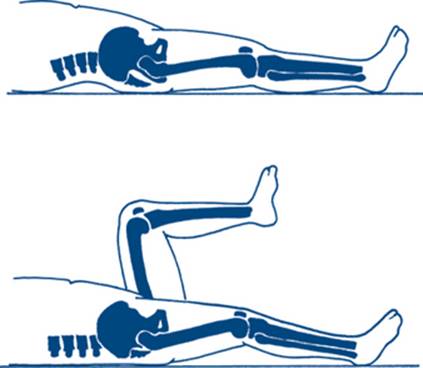
Figure 6.36 Thomas’ test for fixed flexion deformity of the hip
Lying supine, the flexion deformity of the right hip is masked by lordosis of the lumbar spine. When the sound hip is flexed, the deformity is revealed as the spine is flattened against the examination couch.
Examination is completed by assessing the patient for extrinsic causes of hip pain. This may include examination of the spine and sacroiliac joints, a neurological assessment of the lower limbs, pelvic and rectal bimanual examination and examination of the peripheral vascular system.
1 Osteoarthritis
In the majority of patients over 60 years of age with osteoarthritis, no specific risk factors are apparent. In young adults, osteoarthritis is more often a sequelae of traumatic dislocation, slipped upper femoral epiphysis, Perthes’ disease, infection, rheumatoid arthritis or osteonecrosis. Pain is felt in the front of the hip or groin and may radiate down the inside of the thigh to the knee. It occurs with weight-bearing activities. At first the pain is more severe early in the day or when movement follows a period of rest. Later the pain is constant. It may even disturb sleep — particularly in those who turn regularly during sleep. Initally stiffness may manifest itself on rising by difficulty putting on socks and doing up shoe laces. On examination of the patient with moderate to severe disease, the affected leg lies in external rotation and adduction so that it appears to be shorter than the other leg (Fig 6.37). Some degree of flexion deformity can often be demonstrated by Thomas’ test. The greater trochanter can be felt higher and a little posterior on the affected side. Internal rotation, adduction and extension are the first movements to be decreased on examination.

Figure 6.37 Osteoarthritis of the right hip joint
The characteristic deformity is true shortening with external rotation of the lower limb. Flexion deformity may also be present.
2 Extrinsic causes of referred hip pain
As a general rule in these conditions, a full range of painless hip movement is present. The longstanding intermittent pain of lumbar spinal disc disease is often referred to the buttock or lateral aspect of the thigh. On examination, tender areas may be demonstrable in the back and buttocks and lumbar spine movements are limited and painful while hip movements are free. Neurological examination may show objective evidence of past disc prolapse and nerve compression, such as an absent ankle jerk. The pain of sacroiliac arthritis spreads diffusely over the buttock and may simulate hip pain. Sacroiliac arthralgia is characterised by local pain and tenderness over the sacroiliac joints. Sacroiliac arthralgia may herald the onset of ankylosing spondylitis. Chronic salpingitis may also simulate hip pain. The hip symptoms arise because of irritation of the obturator nerve and the hip muscles that have their origin within the pelvis. Pain in the hip related to vascular disease is brought on by exercise and relieved by rest. Evidence of peripheral arterial insufficiency will be present. Signs of ischaemia not present at rest may be induced by exercise.
Meralgia paraesthetica is a nerve entrapment syndrome causing pain over the lateral aspect of the hip and thigh in the distribution of the lateral cutaneous nerve of the thigh.
Referred pain should always be considered when full investigation of hip pain still leaves the diagnosis in doubt. Clinical and X-ray examination of the hip joint is found to be normal in these cases.
3 Less common causes
Less common causes include inflammatory conditions such as rheumatoid arthritis and Reiter’s disease, and paediatric conditions that lead to an altered surface geometry to the femoral head including slipped upper femoral epiphysis, Perthes’ disease and osteonecrosis. Osteonecrosis may be posttraumatic in those with previous fracture or dislocation of the hip joint, due to the intake of high-dose steroids or excessive alcohol or due to disorders of metabolism that somehow interfere with the blood supply to the femoral head. Most of these diseases affect younger patients. Occasionally tuberculosis and septic arthritis involve the hip joint.
Diagnostic plan
In most instances a diagnosis can be made from the history and physical examination. Plain X-ray may reveal the four typical radiographic features of osteoarthritis: narrowing of joint space; subarticular sclerosis; bone cysts; and osteophyte formation. Initially the first three features are restricted to the major load-bearing part of the joint, but eventually the entire joint is affected. Symmetrical erosion of the joint surface with few features of osteoarthritis must alert the clinician to the possible presence of an inflammatory condition. There may be X-ray evidence of longstanding disorders such as congenital defects, Perthes’disease or slipped epiphysis, rheumatoid arthritis or old fractures.
Treatment plan
The principles of treatment of osteoarthritis in the early stages are:
• relief of pain, using oral analgesics or occasionally intra-articular steroids
• maintenance of the range of movement by a program of non-weight-bearing exercises
• load reduction on the joint by weight reduction, the use of a walking stick and the avoidance of unnecessary activity.
For advanced disease in older patients, joint replacement arthroplasty may be necessary for control of pain. Excellent results are obtained in older patients using modern prosthetic materials (including polyethylene, ceramic and metallic bearing surfaces that attach to the stainless steel, cobalt chrome and titanium alloys used to produce the femoral and acetabular components) and fixation methods. Cemented and cement-less prostheses have steadily improved. Recent advances have provided resurfacing arthroplasty of the hip that is purported to provide good long-term results while more closely approximating the hip joint’s native biomechanics. Osteotomy is sometimes indicated in younger patients with severe pain and a deformed femoral head who still have minimal evidence of osteoarthritis and a good range of movement. The femur is divided between the greater and lesser trochanter and the lower fragment is displaced medially throughout about a quarter of its diameter. The femoral head may be abducted or adducted in order to bring an area of preserved articular cartilage into the weight-bearing area of the acetabulum. Internal fixation of the fragments by a blade plate is usually employed to hold the position. Arthrodesis is sometimes required in young patients to achieve long-term freedom from hip pain. The lack of motion in the fused hip is supplanted by motion in the lower lumbar spine, the contralateral hip and the ipsilateral knee, which eventually become symptomatic of arthritis in middle age.
6.11 Painful knee
The cause of acute pain in the knee is usually obvious and usually results from either trauma or inflammation. Traumatic haemarthrosis may result from a chondral fracture, ruptured anterior cruciate ligament or a severe capsular tear. Spontaneous haemarthrosis may occur in haemophilia. A traumatic effusion may result from a meniscal derangement such as a tear. Chronic, persistent or intermittent pain in the knee can present considerable diagnostic difficulty.
Pain from disorders of the knee is usually felt only within the knee. Unlike disorders of the hip, pain in the knee is usually not referred to other parts of the leg. Knee pain of inflammatory and degenerative disease tends to be more diffuse than the pain related to traumatic injury to intra- and extra-articular structures, which can usually be localised to one area or point. Pain referred from the hip to the knee is poorly localised. Patients with a prolapsed lumbar intervertebral disc can occasionally present with pain in the region of the knee but it is often associated with other symptoms and signs.
Knee stability is dependent upon the integrity of the ligaments and surrounding muscles. Compromise of the integrity of these structures may lead to a sense of instability with the knee felt to ‘give way’.
The functional wellbeing of the knee can often be inferred from the appearance of the quadriceps femoris muscle. After disease or injury of the knee this muscle wastes rapidly. As well as the value of this finding in the assessment of diseases of the knee, early wasting highlights the importance of exercising the quadriceps muscle in assisting recovery after a knee injury. The knee is affected by osteoarthritismore than any other joint and is also particularly vulnerable to injury. Osteochondritis dissecans and intra-articular loose body formation are not uncommon. The region of the knee is also the area of most active bone growth in childhood. This may account for the fact that the region of the knee is the most common site of osteomyelitis and primary malignant bone tumours.
Common causes
1. Osteoarthritis and rheumatoid arthritis
2. Traumatic derangement of the knee
3. Bursitis
4. Osteochondritis dissecans and osteonecrosis
History and physical examination
The history is important, perhaps even more important than physical examination — a careful history often establishes the diagnosis. The type of pain, its circumstances and severity and the time from any injury is often diagnostic.
Swelling is common in knee disease. A history of intermittent swelling is common in the degenerative disorders of the knee that follow trauma and in osteoarthritis. Intermittent swelling of a joint from haemarthrosis is characteristic of haemophilia. The term ‘locking’correctly means that the limb cannot be fully straightened. Locking should not be used to describe a general restriction of movement — this is more accurately referred to as stiffness. Sudden unlocking of a previously locked knee is a more reliable indication of a mechanical disorder than inability to straighten the limb actively or passively on physical examination. A sense of instability or ‘giving way’in the knee is also indicative of compromised mechanical stability, whether it be related to torn ligaments or muscles. The feeling of instability may also be a reflection of a meniscal tear where the meniscus caused a lateration in the smooth flexion/extension arc of the knee range of motion and the knee has to distract slightly to permit the condyle to continue rotation on the plateau.
Fluctuance indicates the presence of fluid in the knee joint. Fluid is best detected above the knee in the suprapatellar pouch. Fluid in the knee can be detected by cross-fluctuance and by the patellar tap. To detect cross-fluctuation the suprapatellar pouch is compressed with one hand while the other hand straddles the joint below and around the patella (Fig 6.38).
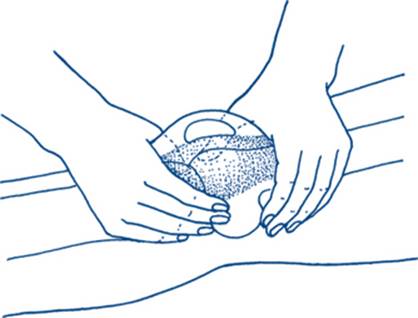
Figure 6.38 Detection of fluid in the knee joint — medical aspect of the right leg
The suprapatellar pouch is compressed with one hand while the other hand straddles the joint below and around the patella. Squeezing either hand transmits a fluid impulse.
A positive test is present when squeezing either hand transmits pressure to the other. To detect a patellar tap the suprapatellar pouch is compressed with one hand while with the index finger of the other hand the patella is pushed sharply backwards. A positive test is present when the patella can be felt to strike or tap the femoral condyles. During palpation, a loose body may be felt free within the suprapatellar pouch or beside the patella. The range of movement is recorded. Normally the knee flexes until the calf meets the back of the thigh. Extension is not present in the normal knee beyond the straight line of leg on thigh. Abduction and adduction are absent with the knee straight, as is rotation. Increased mobility suggests ligamentous damage. Limited rotation is possible with the knee bent.
Knee rotation is further tested by McMurray’s test (Fig 6.39). The knee flexed to 90° is stabilised with one hand, the other hand rotates the foot through varying degrees of flexion of the knee, while it is subjected to abduction. Meniscal lesions may be detected by a pain or click or palpation of a transitory protrusion on the medial side of the knee.

Figure 6.39 McMurray’s test
The McMurray test aims to induce jamming of the torn meniscus between the tibia and femur. The knee is flexed. The heel is grasped with the right hand and the knee steadied with the left hand. The knee is pressed medially and extended while the tibia is internally and externally rotated with the right hand.
The anterior–posterior glide of the knee (tibial draw test) is tested by flexing the knee to 90° with the patient in a supine position, fixing the foot by sitting on it and moving the tibia backwards and forwards with both hands (Fig 6.40). The lack of a firm end-point with this test is indicative of a complete tear of the anterior cruciate ligament. A more sensitive test of an anterior cruciate ligament rupture is the Lachmann test (an anterior draw test performed with the knee bent to 30°.
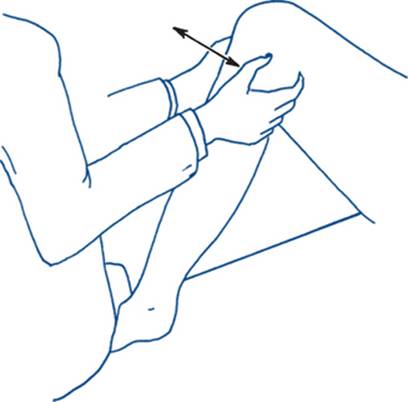
Figure 6.40 Detection of cruciate ligament and meniscal damage
The tibial draw or glide test of cruciate ligament integrity. The examiner sits on the foot of the patient and with both hands, draws the tibia forward for anterior cruciate, and back for posterior cruciate damage.
Comparison of the girth of the thighs and the power of the quadriceps muscle action is tested. Passive movement of the patellofemoral joint is tested. The patellofemoral joint is further assessed by moving the patella up and down while pressing it against the femur (‘patellofemoral grind test’). A painful grating sensation is usually secondary to degeneration in the articular cartilage. Crepitus in the patellofemoral joint may also be a sign of degeneration; however, this sign is nonspecific as there are many knees that are felt to grind and are completely asymptomatic. During active flexion and extension of the knee joint with the knee bent over the end of the examination couch may also assess the tracking of the patellofemoral joint. J-shaped tracking — the patella tracking out of the trochlear groove with active knee extension — may be indicative of patellofemoral instability and a tendency towards patella dislocation.
1 Osteoarthritis and rheumatoid arthritis
Osteoarthritis is most common in obese older women and in this group affects primarily the knee rather than the hip or ankle. Other predisposing factors include an old fracture, chronic inflammation (especially rheumatoid arthritis), torn medial meniscus, osteochondritis dissecans with loose body and longstanding bow leg. The dull aching pain of osteoarthritis is worse with exercise. If the patellofemoral joint is damaged, pain on walking up and down stairs and arising from a seated position are particularly uncomfortable. The pain begins with movement and there is increasing stiffness at rest. Intermittent swelling of the knee is common. On examination a varus deformity of the knee is often present with some limitation at the extremes of movement because of pain, with little or no evidence of inflammation or fluid within the joint. A valgus alignment, while sometimes associated with idiopathic osteoarthritis, should arouse one’s suspicion of an underlying inflammatory arthropathy. Patellar disease is commonly detectable by a positive grind test. With chronic inflammation due to rheumatoid arthritis muscle wasting may be marked, in contrast to osteoarthritis. There may be warmth and tenderness of the joint and all movements are restricted. Gout is a cause of acute rather than chronic pain in the knee.
2 Traumatic derangement of the knee
Meniscal injury. The most common lesion is a longitudinal split of the medial meniscus resulting from grinding trauma during weight-bearing, with the flexed knee subjected to a twisting strain. Presentation may be with intermittent locking of the knee and swelling, rather than pain. When remembered, the initial injury may be described as pain following a twisting force to the knee. Pain is often localised to the medial side of the knee. Swelling appears within a few hours of the injury, rather than at the time of the injury, with apparent subsequent recovery of function. Later, symptoms recur with episodes of inability to extend the knee fully. In many cases of knee injury, careful analysis of locking will indicate that the knee was too painful to move, rather than a mechanical inability to extend the knee totally. When seen after the initial injury, the joint is held in moderate flexion, there is pain and tenderness on the medial side of the joint with some fluid in the joint. Full extension is impossible, further flexion is free. After resolution of an attack the physical signs may be minimal, although McMurray’s test may be positive.
Cruciate ligament injury. This lesion is common in football, soccer and netball players. It may occur subsequent to a tackle that forces the knee joint valgus while the athlete is cutting to one direction with a flexed knee or it may occur when landing from a jump with an extended knee. It is more common in female athletes. The swelling is immediate and often associated with a ‘pop’ being heard at the time of the injury. The knee is too painful to move due to the haemarthrosis that is present. The athlete may be able to move the knee in the mid-range relatively comfortably at the time of the injury but not at the extremes of flexion or extension due to the haemarthrosis. The anterior drawer test and Lachmann tests are often positive.
A partial tear of the medial ligament of the knee may lead to recurring episodes of pain and tenderness on the medial side and pain on forced abduction of the knee.
Traumatic synovitis. This is manifest by fluid in the knee after injury and may occur without any internal derangement, apart from initial stiffness. The acute episode is usually followed by complete recovery.
Extensor mechanism injuries and chondromalacia patellae. Extensor mechanism injuries may follow a sporting accident, typically catching the toes or forefoot while running. This can produce a tear or strain of the extensor mechanism because of a resisted extension to the knee. In the young the injury is usually below the knee as a traction strain of the patellar tendon (patellar tendinitis) or the tibial apophysis (Osgood-Schlatter’s disease). On examination there is a painful tender lump over the tibial tuberosity. In middle adult life the lesions are more common at the patella and include fracture of the patella. In the more elderly the injury tends to be at the quadriceps insertion into the patella. Injuries of the extensor mechanism of the knee can lead to recurrent dislocation of the patella.
Chondromalacia, whether it affects the whole knee or specifically affects the patellofemoral joints, is an enigma. Pathogically it is probably an early form of degeneration of the articular cartilage. This condition may be associated with a loose body in the joint. The patient commonly complains of diffuse pain in the front of the knee, mainly after sitting for long periods or after walking down, for example, a steep slope or a flight of stairs. The grind test is positive. There is generally full movement of the tibiofemoral joint.
3 Bursitis
Painful swellings around the knee may be due to bursitis. Bursitis usually causes localised extra-articular swellings and the diagnosis is easy. The common varieties of bursitis about the knee are prepatellar bursitis (housemaid’s knee) where there is a tender fluctuant swelling over the patellar and infrapatellar bursitis (clergyman’s knee) where the swelling is superficial to the infrapatellar ligament. The semimembranosus bursa is sited between the semimembranosus and the medial head of the gastrocnemius and presents as a painless lump behind the knee that is more obvious in the extended knee. This lesion may be confused with a popliteal cyst (Baker’s cyst), which is in communication with the joint and thus will often reduce into the joint with extension of the knee. Baker’s cyst can rupture producing calf swelling with a very similar clinical picture to calf vein thrombosis. Baker’s cyst is below the joint line and commonly associated with arthritis of the knees. A semimembranosus bursa is seen in younger patients, is above the joint line and the knee is usually normal. Popliteal aneurysm may sometimes be confused with these swellings (Fig 6.41).

Figure 6.41 Swellings on the medial side of the knee
1: prepatellar bursitis (housemaid’s knee); 2: infrapatellar bursitis (clergyman’s knee); 3: effusion in the suprapatellar pouch; 4: loose body; 5: pes anserinus bursa; 6: cyst of the medial meniscus; 7: Baker’s cyst; 8: semimebranosus bursa; 9: popliteal aneurysm
4 Osteochondritis dissecans and osteonecrosis
The exact aetiology of osteochondritis dissecans remain uncertain. It may result from an ununited subchondral fracture in young adults. There may be a history of previous trauma. The fracture site is nearly always on the articular surface of the medial condyle of the femur. Recent biomechanical studies have suggested that stresses in the subchondral bone arising from loading the femur are greatest in the medial femoral condyle. There is an area of avascular necrosis of the bone of the medial femoral condyle with a surrounding cleft of scarring. The hyaline articular cartilage is intact in the first instance; however, with the loss of support it eventually fissures and degenerates. Eventually the fragment separates as a loose body, leaving a shallow cavity on the articular surface that eventually fills with fibrocartilage and may lead to osteoarthritis of the knee in the long term. Clinically, intermittent joint swelling occurs and there is intermittent jamming of the knee from the loose body, localised tenderness of one femoral condyle and pain on extension of the medially rotated and flexed knee (Wilson’s test).
Osteonecrosis is probably of different aetiology and presents with severe pain of sudden onset in older patients. Plain radiographic abnormality does not appear until about three months after the onset, as a porotic area with a distinct sclerotic margin, usually directly on the weight-bearing area of the condyle, as distinct from osteochondritis dissecans, which occurs on the lateral aspect of the medial condyle. However, MRI examination will demonstrate changes consistent with avascular necrosis in the early stage of the disease process.
Diagnostic plan
Radiology
On plain X-ray, anteroposterior, lateral and patellofemoral views are necessary. When a loose body is seen in the knee it should be differentiated from the fabella, which lies on the lateral side and behind the knee. With osteoarthritis the joint space is diminished, a feature that is best demonstrated on a weight-bearing film. Sclerosis of the bone ends and osteophytic lipping are seen and there may be loose bodies in the knee. Osteophyte formation on the articular margin of the patella is commonly seen on lateral X-ray. With meniscal and ligamentous lesions, the plain X-ray may be normal although a small effusion may be seen. Chronic inflammatory disorders of the knee are associated with extensive osteoporosis. MRI examination has revolutionised the imaging of intra- and extra-articular disorders of the knee. With variations in the scanning protocol, traumatic lesions of the chondral surface, intra- and extra-articular ligaments and menisci may be immediately identified. As an imaging modality it has surpassed CT scanning and arthrography due to its high sensitivity and good resolution.
Once arthritis has developed, the joint space is reduced. With osteochondritis dissecans a loose body may be seen with a visible lucent site of origin often on the medial femoral condyle.
Treatment plan
Arthroscopic surgery is used in the treatment of meniscal lesions, the reconstruction of cruciate ligaments and the management of osteochondritis and loose bodies. Recent advances may soon permit arthroscopic reconstruction of cartilage defects with chondrocyte implantation. It is also used in the visualisation and internal fixation of some forms of articular fractures.
The menisci, once thought to be avascular and incapable of repair, have now been found to have a peripheral blood supply (at the capsular attachment). While the symptoms of a meniscal tear are relieved by meniscectomy, concerns regarding the longer term predisposition to osteoarthritis have led investigative teams to the repair of tears at the meniscocapsular junction with good results.
The general measures of management for chronic knee conditions are a combination of analgesia, a period of avoidance of strenuous exercise and daily non-weight-bearing exercises designed to maintain full movement and to preserve quadriceps strength.
The conservative management of osteoarthritis consists of analgesics, maintenance of full joint movement by manipulation and exercises and quadriceps strengthening exercises. The joint is rested by the use of a walking stick and avoiding excessive or prolonged weight-bearing activity. Recent evidence suggests that glucosamine may aid in symptomatic control in early cases of knee osteoarthritis.
The main operations performed for osteoarthritis are osteotomy and arthroplasty. Arthrodesis is reserved for failed arthroplasty.
Localised osteoarthritis in one compartment of the tibiofemoral joint is one of the classic indications for osteotomy in order to change the alignment of the tibia in the case of medial compartment osteoarthritis of the knee and ‘off-load’ the affected joint surface. The osteotomy has the effect of moving the weight-bearing axis of the body towards the lateral compartment of the knee joint. However, more recently investigators have suggested that unicompartmental arthoplasty may be a more effective modality in the management of this condition.
Arthroplasty is the treatment of choice in patients with advanced degenerative disease and disability or a failed osteotomy. Total knee replacement is a very successful form of arthroplasty that alleviates pain and improves function. The chief indication is pain, especially when combined with deformity and instability. The results of arthroplasty in rheumatoid arthritis are more satisfactory than when performed for those with osteoarthritis. Patients with rheumatoid arthritis often have more severe preoperative deformity and are less mobile, resulting in a lower postoperative demand on their replaced joints.
6.12 Painful foot
Most causes of chronic foot pain are due to a local abnormality and are not referred from a more proximal lesion. The main exceptions are pain due to arterial obstruction and to the common peroneal nerve compression syndrome. Obese patients with ill-fitting shoes are especially susceptible to problems with their feet.
Clinical assessment
The diagnostic problem of chronic foot pain is most usefully divided, according to site, into two main groups:
• pain in the forefoot (metatarsalgia)
• pain in the heel and ankle.
With painful heel and ankle, the mode of onset of the pain also helps to categorise and assist in the diagnosis. Three main aetiological categories of foot pain exist: pain that follows trauma; pain with a history of overuse; and pain that is spontaneous in onset. These considerations, together with those of duration, pattern, radiation and offsetting factors, will in most cases lead to an accurate diagnosis.
On examination the foot is inspected for any abnormality of contour, alignment and colour and for evidence of swelling, skin atrophy, scars or sinuses. Local tenderness is an important physical sign. The peripheral circulation is assessed. Careful examination is necessary to test the stability and range of movement of each joint in the foot. The appearance of the foot on standing and walking are important, as this examination may be the only way deformity is revealed. The footwear should be examined for sites of greatest wear (normally on the outer aspect of heels and soles). Neurological examination is essential to exclude more proximal nerve lesions and local entrapment syndromes.
Common causes and clinical presentation
Pain in the forefoot (metatarsalgia)
Metatarsalgia is a descriptive term that refers to the presence of pain beneath the metatarsophalangeal joints of the lesser toes. Common causes include claw and hammer toes as the dorsal subluxation of the proximal phalanges is associated with a distal migration of the plantar fat pads with the eventual development of calluses. There are, however, many causes that the clinician must consider:
1. anterior flat foot (with hallux valgus, hammer toe and claw toes)
2. stress or fatigue fracture (of the second or third metatarsal bones)
3. Morton’s metatarsalgia
4. plantar warts
5. ischaemic rest pain.
1 Anterior flat foot (with hallux valgus, hammer toe and claw toes)
Anterior flat foot is the most common cause of metatarsalgia. In these patients the forefoot is splayed because of a dropped transverse arch (Fig 6.42) and pressure-induced callosities are found over the metatarsal heads. The condition is associated with three main deformities: hallux valgus and bunion; hammer toe; and claw toes.

Figure 6.42 Anterior flat foot
Dropped transverse arch from collapse at the metatarsophalangeal joint is the most common cause of metatarsalgia and associated toe defomities. A: normal foot; 1: metatarsal; 2: proximal phalanx; B: anterior flat foot leading to hammer toe with callosity formation (3, 4); C: claw toe with flexion on both the proximal and distal interphalangeal joints
Hallux valgus is the most common symptomatic deformity of the foot (Fig 6.43). Anterior flat foot may develop in the obese middle-aged patient due to weakening of the intrinsic muscles and ligaments of the foot. Collapse of the transverse metatarsal arch produces splaying and lateral deviation of the first metatarsal bone. This is accentuated by the wearing of narrow-toed high-heeled shoes that further concentrates pressure in the forefoot. A bunion, derived from the latin word bunio which means turnip, forms from shoe pressure over the first metatarsal head. This is a combination of the subluxated metatarsal head, an osteophyte and the overlying bursa. The pain is due either to osteoarthritic change within the metatarsophalangeal joint associated with stiffness (hallux rigidus) or to inflammation of the overlying bursa. Fusion is the solution to the pain of hallux rigidus. Osteotomy and realignment of the metatarsal, rather than the previously popular excisional arthroplasty, is the more commonly performed surgery for the correction of a hallux valgus deformity of the great toe.

Figure 6.43 Hallux valgus
A: exostosis over the head of the first metatarsal with metatarsus varus; B: excision of the exostosis and excision of the proximal third of the first phalanx may correct the deformity (Keller’s operation)
Hammer toe develops mainly in the second toe as the proximal interphalangeal joint is forced into fixed flexion causing the distal interphalangeal joint and the metatarsophalangeal joint to lie in compensatory hyperextension. A painful callus and bursa also form over the flexed joint from shoe pressure. This is different to the deformity of a mallet toe, which is a hyperflexion deformity at the distal interphalangeal joint.
Clawed toes are flexed at both interphalangeal joints and hyperextended at the metatarsophalangeal joints (Fig 6.42). This condition is seen in anterior flat foot but is also found in other conditions such as rheumatoid arthritis and in people with a cavus foot deformity. While no cause for clawing is found in many cases, it is important to exclude neurologic dysfunction with weakness and loss of the intrinsic muscle of the foot. This may be secondary to central nervous system disorders such as stroke, spinal cord conditions such as poliomyelitis or peripheral neuropathic conditions such as a form of hereditary sensory and motor neuropathy.
2 Stress or fatigue fracture (of the second or third metatarsal bones)
Stress or fatigue fracture in the forefoot usually involves the second or third metatarsal bone, presenting most often in young adults after a long walk (march fracture). After some weeks of healing and callus formation, a fusiform hard swelling may be palpable in the forefoot.
3 Morton’s metatarsalgia
Plantar digital neuritis is characterised by pain in the forefoot that radiates into the third or fourth toes — the third branch of the medial plantar nerve to the third web space is most commonly affected. Pain is often relieved by taking off the shoes and massaging the forefoot. Splay foot and hallux valgus are often present; these deformities potentially lead to compression of a digital nerve. Compression across the forefoot is used to reproduce a Mulder’s sign — pain in the involved web space.
4 Plantar warts
Papilloma may occur in any part of the sole of the foot, including the under surface of the heel. The plantar wart is a viral infection of the sole that is prevented from taking its normal configuration by the pressure of weight bearing. The chief complaint is of localised pain on walking. Unlike a callosity, the edge of the wart is clearly demarcated. It has a mosaic surface with a clearly defined margin and a potential cleft between the wart and the skin (Fig 6.44).

Figure 6.44 Plantar wart
A: papilloma with its clearly demarcated border; B: callous with its indistinct border
5 Ischaemic rest pain
Peripheral vascular disease and rest pain may temporarily be confused with a musculoskeletal disorder. Signs of arterial insufficiency are present and should make the diagnosis obvious (Ch 6.16).
Painful ankle and heel
1. Trauma:
• Ligamentous injuries and secondary arthritis
2. Overuse:
• Achilles tendinitis
• Calcaneal and Achilles bursitis
• Peroneal tendinitis
3. Spontaneous:
• Osteoarthritis of ankle
• Plantar fasciitis
• Entrapment syndromes
1 Trauma
The most common conditions due to trauma follow lateral ligament injury and fractured calcaneum. The most common cause of a chronically painful ankle is the chronic ligamentous weakness that arises after partial disruption of the lateral ligament of the ankle from an inversion sprain. On examination a point of marked tenderness is often found at the site of attachment of the lateral ligament to the lateral malleolus. Pain is felt especially when stepping forward from the affected leg. The patient who sustains a fractured calcaneum after falling from a height on to the heels almost invariably suffers chronic pain in the heel arising mainly from subtalar or talocalcaneal arthritis. Pain is exacerbated by walking on uneven ground and on examination movements of the subtalar joints are limited and are associated with pain.
2 Overuse
Conditions associated with overuse (particularly among athletes and obese subjects) include Achilles tendon disorders, peroneal tendon disorders and calcaneal and Achilles tendon bursitis (Fig 6.45).
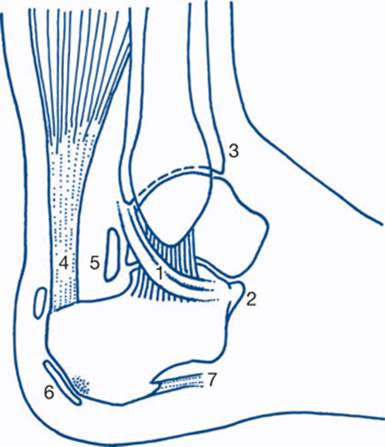
Figure 6.45 Painful heel
1: partial disruption of the lateral ligament of the ankle and tenosynovitis of the peroneal tendons; 2: subtalar arthritis with tenderness over the sinus tarsi just anterior to the lateral malleolus; 3: osteoarthritis of the ankle joint; 4: partial rupture of the Achilles tendon; 5: Achilles tendon bursitis; 6: calcaneal bursitis (tender heel pad); 7: plantar fasciitis
Degeneration of the Achilles tendon and tendinitis are associated with pain behind the heel. Both these conditions can lead to partial rupture. Local tenderness with a tender nodule can be felt about 2–3 cm above the insertion of the tendon. There is a painful push off phase of running or jumping. When tendinitis is severe, the swelling is diffuse and more extensive, affecting the loose areolar tissue along the lower tendon.
Calcaneal bursitis occurs mainly in young women and is sited over the prominent posterolateral boss of the calcaneum as a result of wearing poorly fitting footwear. The condition is often bilateral and known also as tender heel pad or calcaneal apophysitis.
Achilles tendon bursitis occurs at two sites: one is superficial to the insertion of the tendon and also results from poorly fitting footwear; the other is sited between the tendon and the upper third of the posterior surface of the os calcis. The latter pathology is difficult to distinguish clinically from tendinitis.
Peroneal tendinitis is associated with tenderness over the retinaculum that holds and retains the peroneus longus tendon behind and below the lateral malleolus. Pain occurs on eversion of the foot. An occasional cause of pain is the recurrent dislocation of the tendon over the lateral malleolus that follows rupture of the retaining retinaculum.
3 Spontaneous
Chronically painful conditions of the knee and ankle that usually develop spontaneously include osteoarthritis of the ankle joint, plantar fasciitis and entrapment syndromes.
Osteoarthritis of the tibiotalar joint is usually of insidious onset, although there may be a past history of Pott’s — bimalleolar ankle — fracture. An effusion in the joint may occur and is most obvious as a filling out of the fossae on either side on the Achilles tendon.
Plantar fasciitis is a chronic inflammatory condition of the attachment of the plantar fascia to the calcaneum. It may be a result of overuse in the obese or can be associated with Reiter’s syndrome or with ankylosing spondylitis. Pain beneath the heel extends forwards to beneath the longitudinal arch of the foot. Tenderness is found over the site of attachment of the plantar fascia to the calcaneum. A plantar calcaneal bony spur is often seen on X-ray.
Tarsal tunnel syndrome. The pain of common peroneal nerve compression is usually well above the ankle. It can occasionally occur in the foot. The pain of tarsal tunnel syndrome is felt on the medial side of the heel or foot in the distribution of the medial and lateral branches of the posterior tibial nerve. The pain is worse at night and may be relieved by walking and stamping the foot. Sometimes, when paraesthesia and sensory loss occur, this syndrome can be confused with lower lumbar disc lesions.
Diagnostic plan
In the majority of cases, history and physical examination supplemented by radiological examination will give the diagnosis. Certain investigations should be routine and can assist in the diagnosis of less common causes of foot pain. A raised erythrocyte sedimentation rate (ESR) indicates the presence of inflammation. A raised serum uric acid can assist in differentiating gout from pseudogout and septic arthritis. Rheumatoid arthritis may be suggested by the detection of rheumatoid factor. Unusual diseases of bone are always a possibility and a plain X-ray (supplemented by bone scan) will show bone tumours, Paget’s disease, osteomyelitis, stress fractures (only on follow-up X-ray may the cortical defect and periosteal reaction show up), avascular necrosis and osteoid osteoma. The finding of a calcaneal spur is of questionable value. A spur is often seen in normal individuals and unless there is erosion of the adjacent calcaneal bony cortex, a diagnosis of plantar fasciitis cannot be made on X-ray. These routine tests may be supplemented in difficult case by aspiration and analysis of joint fluid and nerve conduction studies to exclude nerve entrapment neuropathy. MRI examination is a good modality for indentifying oedematous change in inflamed structures and partial or complete tears of tendons and ligaments in the hindfoot and midfoot area. It will also detect bony change associated with inflammatory and infective conditions.
Treatment plan
Metatarsalgia
Properly fitting footwear is essential for the patient with anterior flat foot and metatarsalgia. A metatarsal bar to divert pressure from the tender callosities over the metatarsal heads may be necessary to control pain. Exercises designed to strengthen the foot muscles together with weight reduction are essential components of management. Arthrodesis or arthroplasty may be necessary for the associated deformities of anterior flat foot, hallux valgus, hammer toe and claw toes. Hallux valgus deformity surgery usually include an osteotomy of the first metatarsal in order to correct the bony deformity and a soft tissue realignment and plication to help balance the forces across the first metatarsophalangeal joint and maintain the corrected position. Proximal phalangeal osteotomy of the first ray may also be performed to improve the cosmetic appearance of the great toe. Hammer toe deformity may be surgically treated with a transfer of the flexor digitorum longus to the extensor mechanism in the toe with a flexible deformity or a proximal interphalangeal joint fusion or excisional arthroplasty in the toe with a fixed deformity. Stress fracture is treated by restricting activity, robust shoes and analgesia until fracture union occurs. Neurectomy may be necessary for Morton’s metatarsalgia. Plantar warts occasionally require formal excision because of pain and disability. Local treatment with paring of the hyperkeratinised surface and formalin application is usually symptomatically effective.
Painful ankle and heel
Correctly fitting shoes are an essential part of the plan of management for chronic foot pain. Subtalar and tibiotalar arthritis are treated with analgesia, weight reduction, muscle strengthening exercises and support. A rockerbottom shoe may sometimes alleviate the pain of ankle arthritis as it supplants the motion in the ankle joint. Arthrodesis is rarely necessary, but may be performed open or arthroscopically depending on the magnitude of the preoperative deformity. Attention to shoe fitting is all that is required in most cases of calcaneal bursitis. There is a danger of tendon rupture with Achilles tendinitis and bursitis. The heel of the shoe should be raised in these cases and physical activity is best restricted for a few weeks. With tender heel due to plantar fasciitis, injection of hydrocortisone may help to relieve severe symptoms. However, the pain spontaneously subsides within six to 12 months in most cases. Recovery may be hastened by providing a sponge rubber cushion as an insole. Only very rarely is surgical division of the plantar fascia necessary. The tarsal tunnel syndrome will usually resolve with conservative measures such as local cortisone injection, but decompression may sometimes be necessary.
6.13 Swollen leg
Diffuse leg and foot swelling is usually due to oedema, an accumulation of extracellular fluid in the interstitial tissues. The classic sign of oedema is pitting on finger pressure over the subcutaneous surface of the tibia. This sign is most easily demonstrable in acute oedema. Uncorrected pitting disappears over time as secondary changes in the skin and subcutaneous tissue occur. Chronic oedema secondary to venous insufficiency is associated with interstitial fibrosis and eczematous changes in the skin and when secondary to chronic lymphoedema, cutaneous hyperkeratosis and pachydermia are present. Repeated episodes of cutaneous and subcutaneous infections can exacerbate all of these effects. Oedema secondary to venous insufficiency is easily compressible (pitting), whereas the swelling associated with lymphoedema is firmer and pitting is minimal.
Bilateral oedema is commonly due to general causes. The syndrome of cyclical oedema in women is a common cause of swollen legs and is associated with other premenstrual symptoms such as headache, mastodynia and dysmenorrhoea. Clinical examination of patients rarely demonstrates gross swelling and pitting is often difficult to elicit.
Peripheral oedema is a feature of medical systemic disorders (congestive heart failure, liver failure and protein-losing renal diseases such as the nephrotic syndrome). The leg oedema in these conditions is bilateral, of relatively acute onset and soft to palpation. Pitting is easily demonstrable on pressure, in contrast to the findings when chronic oedema is due to local causes.
Common causes
Acute swelling
1. Deep venous thrombosis
2. Ruptured popliteal synovial cyst (pseudophlebitis)
3. Less common causes
Chronic swelling
1. Systemic disorders
2. Chronic venous insufficiency
3. Lymphoedema
Clinical features
Acute swelling
1 Deep venous thrombosis
Virchow’s triad relates the pathogenesis of acute venous thrombosis of the leg to three factors:
• abnormalities in the vein wall
• stasis in blood flow
• alteration in blood coagulability.
This is useful as a guide to prevention and to treatment. Risk factors for the development of acute venous thrombosis include malignancy, older age, oral contraceptive usage, operation site (particularly on the lower limbs or pelvis) and disorders associated with increased blood viscosity such as polycythaemia and recent child birth (Box 6.2). The risk of thrombosis is increased with venous stasis associated with congestive cardiac failure, obesity, varicose veins, obstructed venous return, immobilisation in hospital and a previous history of deep vein thrombosis (DVT) with venous insufficiency. Compression of the vessel wall against the operating table during surgery, together with stasis, are particularly likely to trigger calf vein thrombosis.
Box 6.2
Risk factors for the development of DVT
Abnormality in the vein wall
Decubitus compression of the calf veins
Previous venous thrombosis
Venous stasis
Congestive cardiac failure
Obesity
Varicose veins
Immobilisation in hospital
Obstructed venous return
Chronic venous insufficiency
Hypercoagulability
Malignancy
Oral contraceptives
Polycythaemia
Postpartum
Antithrombin III deficiency, protein S deficiency, protein C deficiency, lupus anticoagulant, etc.
DVT is often clinically silent but can present as an acute diffuse leg swelling. Most patients presenting with acute swelling complain of aching discomfort and tight sensation in the calf. Degree of swelling varies and is maximal with iliofemoral rather than calf vein thrombosis. Physical examination reveals a congested or mild cyanosis with unilateral oedema, with a tender doughy consistency of the calf on palpation. However, clinical diagnosis is not always diagnostic (only 50% of deep venous thromboses have clinical signs) and investigation is required for confirmation.
2 Ruptured synovial cyst (pseudophlebitis)
Distinguishing acute venous thrombosis from complications of a synovial popliteal cyst can be difficult. The cyst can either compress the popliteal vein to produce obstruction and swelling or induce a thrombophlebitis-like syndrome from rupture with extravasation of synovial fluid into the calf (pseudophlebitis). In about half of these patients the cyst is secondary to rheumatoid arthritis of the knee, with associated knee effusion. In some patients the cyst is secondary to osteoarthritis. Many patients also have a palpable popliteal mass, but in many the knee joint is normal, without a palpable cyst. Sometimes acute calf swelling may be the first presentation of arthritis.
Pseudophlebitis must therefore be excluded before anticoagulants are started for the clinical diagnosis of DVT. Clinical evaluation of the calf is an unreliable method of making a distinction between DVT and ruptured synovial cyst.
3 Less common causes
Less common causes of acute leg swelling include anterior compartment syndrome and haematoma or rupture of muscle such as the Achilles tendon, either spontaneous or traumatic. It can sometimes be difficult to distinguish venous thrombosis from contusion of the calf or rupture of plantaris fibres. Contusion or haematoma of the calf muscle occurs especially in patients on anticoagulants. An acute onset of symptoms during exercise or after nocturnal cramps, with ecchymosis visible in the calf, indicates that the cause of pain and swelling is likely to be muscle injury rather than thrombosis.
Chronic swelling
1 Systemic disorders
Separating the oedema of cardiac, renal disease and liver disease from peripheral causes of oedema is usually easy (Fig 6.46). Patients with oedema of insidious onset secondary to cardiac cirrhosis, especially patients with constrictive pericarditis, may pose a diagnostic problem. Signs of cardiac failure include tachycardia, elevated neck jugular vein, hepatic tenderness and enlargement and ascites. In protein-losing renal disease the oedema is usually generalised and gross proteinuria is present. In most patients with oedema associated with liver disease, peripheral signs of liver failure are demonstrable.

Figure 6.46 Pitting oedema
Chronic venous insufficiency is unlikely to be the cause of bilateral pitting oedema without other stigmata. A medical or systemic disorder is a much more common cause.
2 Chronic venous insufficiency
Venous insufficiency is a common cause of chronic swelling, which is often bilateral. Venous insufficiency is the principal late complication of DVT (postphlebitic syndrome) and venous incompetence. Many patients with serious chronic venous insufficiency have had previous episode of iliofemoral thrombophlebitis leading to destruction of deep valvular function on recanalisation. A history of leg fracture is also a common cause of postphlebitic limb from the accompanying DVT that forms when the leg is in the cast. Resultant ambulatory venous hypertension leads to oedema, perforator vein incompetence, secondary varicose veins and the postphlebitic syndrome.
Subcutaneous oedema, venous flares, venous eczema and varicose veins in the leg and ankle are usually the first manifestations of chronic venous insufficiency. Later manifestations are chronic brown pigmentation, fibrotic induration (lipodermatosclerosis) of the subcutaneous tissues and ulceration of the distal leg and ankle usually above the medial malleolus.
3 Lymphoedema
Primary lymphoedema is due to an inborn abnormality of lymphatics and can manifest as hypoplasia or dilatation (lymphangiectasis). Primary lymphoedema is classified as follows.
Congenital lymphoedema is manifest at birth, often with associated congenital anomalies. Lymphoedema that is both congenital and familial and associated with lymphatic hypoplasia, is known as ‘Milroy’s disease’.
• Lymphoedema praecox affects young adolescent women.
• Lymphoedema tarda manifests first in adulthood.
• Complications associated with lymphatic oedema include abnormal lymph communications leading to chylous reflux into lower limbs or scrotum, chylous ascites, chylothorax and chyluria.
Infection is the most common complication. Recurrent attacks of cellulitis due to streptococci or staphylococci are very common and contribute to further lymphatic obliteration. The end result of recurrent chronic nonsuppurative infections is chronic thickening of the skin (pachydermatosis) and intensive fibrosis of the oedematous tissues (elephantiasis).
Secondary lymphoedema is due to an acquired obstructive extralymphatic process and is more common than primary lymphoedema. Malignant lymphatic obstruction is the most frequent cause of lymphoedema and is most commonly the result of advanced prostatic carcinoma in men and retroperitoneal lymphoma or cervical cancer in women. Surgical removal of lymph nodes at radical groin dissection or during radical mastectomy are obvious causes of secondary lymphoedema. In Egypt and Africa filarial infection (Wuchereria bancrofti) is a common cause of secondary lymphoedema.
Box 6.3 summarises the causes of lymphoedema.
Box 6.3
Causes of lymphoedema
Primary
Congenital lymphoedema — Milroy’s disease
Lymphoedema praecox
Lymphoedema tarda
Secondary
Neoplastic infiltration of lymph nodes:
Secondary carcinoma, lymphoma
Infection:
Filariasis
Lymphogranuloma inguinale
Tuberculosis
Recurrent cellulitis with chronic venous insufficiency
Iatrogenic:
Surgical excision or irradiation of lymph nodes
Diagnostic plan
Acute swelling
In the majority of patients with acute leg swelling the diagnosis of a DVT can be made by noninvasive Doppler ultrasound. This test is also useful in excluding popliteal cyst complication. Invasive contrast venography and radionuclide I125-labelled fibrinogen scan can be used to establish the diagnosis of DVT in the relatively few instances that are missed by the simpler technique.
Chronic swelling
Most causes of chronic leg swelling can be diagnosed on history and physical examination. Medical causes of oedema are usually easily differentiated from lymphoedema. Clinical evidence of an obstructive extralymphatic process is present in lymphoedema and the tissues are usually thickened and indurated; the oedema of medical disorders is acute, pitting and bilateral. The major difficulty is to distinguish lymphoedema from the oedema of chronic deep venous insufficiency.
Lymphoedema initially produces a firm, rubbery and relatively nonpitting oedema that decreases little with elevation. It is not associated with venous engorgement, cyanosis or increased skin pigmentation. The toes are involved and appeared ‘square’ with the swelling.
The oedema of chronic venous insufficiency is initially soft and pitting but later becomes firm and associated with the secondary effects of pigmentation, venous eczema, ulceration and secondary varicose vein formation. In some cases, recurrent cellulitis and lymphangitis may add a lymphatic obstructive component to oedema due to chronic venous insufficiency and differentiation between primary lymphatic or venous causes for the oedema may be difficult.
Lymphatic nuclear scan and CT scanning may occasionally be helpful in diagnosing and identifying the cause of a chronically swollen lower extremity. CT scan can demonstrate malignant involvement of lymph nodes. Invasive lymphangiography has largely been superseded by these noninvasive tests and it can exacerbate the progress of lymphoedema because of the irritant and sclerosing effects of the agents used.
Treatment plan
Acute swelling
With DVT both treatment and the prevention of relapse aim to reverse factors associated with thrombosis (Box 6.4).
Box 6.4
Management of DVT
Symptomatic bed rest with elevation of legs to reduce swelling and pain
Application of one-way stretch elastic bandages to both legs to above the thighs
Continuous monitored infusion of intravenous heparin or subcutaneous low-molecular-weight heparin with overlap with and until oral anticoagulant becomes fully effective
Patient resumes early activity when swelling, pain and tenderness have been controlled
Convert to oral anticoagulants for six to 12 months depending on the presence of any persistent hypercoagulable state
General measures include correction of hydration, elevation of both legs and the application of one-way stretch elastic bandages or stocking to improve venous return. Strict bed rest is not necessary and is only required to reduce major swelling, pain and tenderness. Walking is permitted with the legs supported by elastic stockings, avoiding the venous stasis that follows sitting in a chair without the legs elevated or standing still for a prolonged period.
Heparin is given to diminish blood coagulability and prevent further spread of the thrombus. The usual loading dose for heparin is 100 international units per kilogram of patient weight followed by 25,000 units per day, adjusted to maintain the activated partial thromboplastin time (APTT) at two or three times the normal level. Alternatively, low-molecular-weight herapin is given subcutaneously either daily or twice daily according to the body weight. Oral anticoagulant (warfarin) can be started to overlap the heparin treatment on day three. Heparin is continued until the patient is fully anticoagulated with warfarin and physically active. In patients where the aetiology of the venous thrombosis is clearly related to surgery and immobilisation and little likelihood of a persisting risk factor exists, subsequent oral anticoagulant is rarely necessary beyond three months. In patients with evidence of a continuing hypercoagulable state, such as those treated for malignancy or hypercoagulopathy, oral anticoagulant is continued indefinitely.
Ruptured popliteal cyst is treated by rest, nonsteroidal anti-inflammatory agents and occasionally intra-articular corticosteroid therapy. Active physiotherapy is required once the acute pain has settled.
Chronic swelling
The primary aim of treatment in chronic venous insufficiency is to control persistent ambulatory venous hypertension in order to minimise oedema. This is best accomplished by wearing elastic support stockings, intermittent periods of leg elevation and avoiding prolonged sitting with angled knees or prolonged standing (Box 6.5).
Box 6.5
Instructions to patients for continued care of the leg damaged by phlebitis
Wear your elastic stocking from the time you get out of bed until you retire, with the exception of bath time. The stocking should be renewed every three months and it is best to have two stockings that can be alternated for cleaning.
Whenever you sit down, elevate your leg on a footstool or chair.
Do not stand for more than 30 minutes without sitting down for five minutes. When standing, get into the habit of flexing the toes in your shoes and frequently rising on tiptoes.
Plan your day so that you can lie down for two to three half-hour periods, keeping your leg raised to a 45° angle on pillows.
At night raise the foot of the bed on blocks by about 15 cm.
Apply a bland cold cream to the affected skin at night every second day.
Avoid irritation to the leg, especially sunburn and hot water bottles.
Be extremely careful not to bump, bruise or scratch the leg.
Patients with varicose veins and signs of chronic venous insufficiency secondary to primary venous incompetence may benefit from invasive treatment such as vein sclerosing or excision (Ch 6.15).
With lymphoedema the objectives of treatment are: to control the cause of lymphatic obstruction if possible; to control oedema by compression, massage and intermittent elevation; and to prevent recurrent infection (Box 6.6). Dietary sodium restriction and diuretics occasionally assist in the resolution of oedema. Foot care is particularly important to avoid minor injury and infection. Surgical procedures to improve lymphatic return are generally unsatisfactory. Prophylactic long-term antibiotics are often required.
Box 6.6
Lymphoedema: objectives of treatment
Continuous compression with elastic support stockings
Daily massage and elevation
First-aid leg care to prevent trauma and cellulitis
Early treatment of cellulitis (prophylactic long-term antibiotics may be necessary)
6.14 Leg ulcer
The site and appearance of a leg ulcer often establish the diagnosis. Characteristically, ulcers of venous insufficiency are found on the medial lower leg above the malleolus (the gaiter’s area). Ulcers of arterial insufficiency are more common over pressure points, at the tips of the toes and on the dorsum of the forefoot. Healing shallow ulcers with sloping serpiginous edges are characteristic of venous, traumatic or factitious ulcers. Indolent undermined ulcers are seen with neuropathy, ischaemia, diabetes and with immunodeficiency disorders. A sinus fixed to underlying bone with seropurulent discharge suggests osteomyelitis.
Causes
1. Chronic venous insufficiency (the ‘venous ulcer’)
2. Arterial insufficiency (the ‘arterial ulcer’)
3. Neuropathic ulcer (and often the ‘diabetic ulcer’)
4. Less common causes
History and physical examination
1 Chronic venous insufficiency (the ‘venous ulcer’)
Chronic venous insufficiency develops as a result of prolonged venous incompetence or obstruction. This can be the late complication of DVT or primary venous reflux and incompetence. Many patients with venous ulceration have had a past episode of iliofemoral thrombophlebitis, but a clear history of an acute clinical episode of DVT is only found in a minority. Recannulation of the thrombosed deep veins destroys the venous valves, producing incompetence and hence ambulatory venous hypertension with the resulting ‘postphlebitic syndrome’. The patient may complain of aches and bursting pain on standing. Discomfort and tenderness of the skin, with a history of pigmentation, eczema and subcutaneous oedema and fibrosis, often predate the ulcer for months or years. The ulcer often starts from minor trauma.
Venous ulcers are usually serpiginous and shallow, with granulation tissue often covered by necrotic slough in the base and with a sloping edge. In contrast to arterial ulcers, venous ulcers are only mildly painful. The venous ulcer is usually found above the medial malleolus, close to the lowest incompetent perforator vein of the medial calf but may extend onto the lateral ankle or circumferentially around the limb. The skin and subcutaneous tissue surrounding the ulcer show signs of chronic venous hypertension with fibrotic induration, oedema, pigmentation, redness, tenderness, eczema (lipodermatosclerosis) and ankle flares (Fig 6.47).

Figure 6.47 Venous ulcer
1: Chronic venous ulcer; 2: eczema and pigmentation; 3: oedema, fibrosis and varicose veins; 4: ankle flares
The skin has reduced mobility over the underlying bone. Secondary varicose veins are often (but not invariably) present. Defects in the fascia associated with dilated perforator veins may be palpable, although the lower ones are often obscured by the ulcer. By the stage of ulceration, pitting on pressure of the oedematous, indurated leg is usually minimal. In elderly patients, it is important to exclude any associated arterial insufficiency. In such cases signs of venous insufficiency are combined with diminished or absent pulses, diminished capillary return and coolness of the limb. Sometimes the relative contributions of arterial and venous insufficiency are difficult to assess and investigations such as measuring the ankle-brachial pressure index, Doppler ultrasound imaging or arteriography are needed.
Superficial venous thrombophlebitis is a separate condition and presents as a reddened, tender, subcutaneous cord with little or no oedema and no signs of deep venous insufficiency. It may occasionally be followed by ulceration over the vein. It is often associated with varicose veins.
2 Arterial insufficiency (the ‘arterial ulcer’)
An ischaemic ulcer is usually due to macrovascular atherosclerotic occlusive disease and the aftermath of limited gangrene after sloughing of necrotic tissue. Ischaemic ulcers are usually painful with associated rest pain predominantly in the forefoot and lower leg. A previous history of worsening claudication is common. The ulcer is often initiated by a minor injury, a common site being the dorsum of the foot. Ulcers are also seen over bony pressure points (heels, malleoli) and at the tips of the toes. The ulcers tend to be deeper than venous ulcers, are often punched out with exposed tendons or ligaments and show little granulation tissue formation. The surrounding tissues show signs of ischaemia with pallor, coldness and atrophy of the skin. The distal pulses are absent and capillary return is diminished. The ankle systolic pressure index is often low.
3 Neuropathic ulcer (and often the ‘diabetic ulcer’)
The most common cause of a neuropathic ulcer is diabetes. Apart from neuropathy, diabetic ulcers can be associated with ischaemia from large vessel atherosclerosis or the ulcer may be predominantly due to infection. Sometimes the principal cause is difficult to define as three factors can be involved in varying degrees. Many ulcers start with minor trauma or from an area of foot infection such as a penetrating ulcer at the site of a callosity, an ingrown toenail from tinea pedis or from injury while trimming the nail.
Neuropathy associated with diabetes can be autonomic, motor, sensory or a combination. Autonomic neuropathy with reduced skin moisture leads to dry and cracked skin that makes it susceptible to minor trauma and infection. Motor neuropathy causes muscular weakness and imbalance of the foot weight-bearing mechanism. This leads to excessive pressure in parts of the foot and subsequent skin necrosis and ulceration. Sensory neuropathy or insensate foot is prone to injury. Reduction of vibration and position sense and a glove-and-stocking loss of touch and pain sensation is characteristic. Objective testing can be done with a monofilament 10 g fibre.
Infection is more likely with the reduced immune response from hyperglycaemia.
The presentation of neuropathic diabetic ulceration may be:
• an acute infective wet gangrene. Relatively painless ulceration is seen at the extremity of the toes or over the pressure points. Local cellullitis is present and often an unrecognised (initially painless due to neuropathy) extensive spread of deep infection along tendons and fascial planes (Fig 6.48). Thrombosis of vessels occurs with further necrosis and infection.
• the more common indolent diabetic ulcer of the foot, mainly neuropathic in origin, with local and large vessel ischaemia being secondary factors. Neuropathic ulcers (Box 6.7) are deep and penetrating, painless and found over pressure areas. The surrounding tissues are relatively free of ischaemic damage.

Figure 6.48 Diabetic gangrene
A: neuropathic ulcer over head of second metatarsal; B: spreading septic gangrene along tendon sheaths; C: ischaemic gangrene of the second toe
Box 6.7
The causes of neuropathic ulceration
Peripheral nerve lesions
Diabetes
Nerve injuries
Leprosy
Alcoholism
Spinal cord lesions
Spina bifida
Tabes dorsalis
Syringomyelia
Diabetic foot ulceration is hence a term applied to patient with diabetes and foot complications that may be due to either one of these primary aetiologies or any combination.
Alcoholic neuropathic ulcers. These ulcers resemble the neuropathic ulcers of diabetes. They are commonly found on the pressure points of the foot and are associated with peripheral neuritis, poor hygiene and malnutrition. Chronic ulceration may also develop from subcutaneous infections anywhere in the lower limb.
4 Less common causes
Insect bites, particularly from certain types of spider (e.g. wolf spider), may not be noticed at the time of the bite but can lead to persistent cutaneous necrotic ulceration. Spider bites are an important cause of ulceration of the lower legs seen in outdoor workers, especially gardeners.
Infective causes of chronic ulceration include osteomyelitis, pyogenic and synergistic infections, tropical ulcer, mycobacterial ulcer and infection of an intravenous drug injection site. The presence of visible or palpable bone in the depths of the ulcer often indicates underlying osteomyelitis.
Systemic disorders associated with immunodeficiency and microvascular disease or vasculitis include rheumatoid arthritis, haemoglobinopathies, inflammatory bowel disease and polyarteritis nodosa. Severe hypertension can be complicated by leg ulceration (Martorell’s ulcer). Vasculitic ulcers are painful and slow to heal.
Other local microvascular disorders causing ulceration include Buerger’s disease, Raynaud’s disease, cold injury and prolonged foot immersion.
Microembolisation from proximal atheromatous plaques may produce transitory distal gangrene and subsequent ulcerations often in the toes (‘trash foot’). The source of microemboli may also be from thrombosis within aneurysms, vegetations upon heart valves damaged by rheumatic heart disease or atherosclerotic aortic plaques as a result of catheter manipulation during angiography.
Malignant ulcer. Other causes of ulceration include malignancies such as squamous cell carcinoma, Kaposi’s sarcoma and melanoma. Squamous carcinoma may occur as a complication of chronic venous ulceration, osteomyelitis or burn scar (Marjolin’s ulcer).
Self-inflicted (factitious) ulceration must also be considered in the differential diagnosis of leg ulcers, especially when there is an atypical appearance, site or response to treatment.
Diagnostic plan
In most instances the diagnosis is obvious from a careful history and physical examination. The early detection of infected diabetic gangrene is of particular importance. Many patients have concurrent medical illnesses that require diagnosis and treatment, especially those associated with peripheral oedema contributing to chronicity of ulceration.
Diagnostic investigations include:
• blood examination — full blood count
• serum electrolytes, liver function tests and glucose — excluding any significant renal impairment or poor nutrition such as low albumin and diabetes
• inflammatory markers — CRP and/or ESR; these are also useful as prognostic indicators
• urine examination for glucose
• culture of material from the ulcer for specific organisms
• biopsy if vasculitis or malignancy is suspected; arterial insufficiency is a contraindication to biopsy.
Arterial investigations such as Doppler ultrasound and angiography are indicated preoperatively to assist in the planning of arterial surgery. This should be performed in all patients with rest pain and ischaemic ulcer and advisable before any debridement except for drainage of infection, which takes precedence. It is important to ensure that renal function is normal and medications such as clopidogrel, warfarin and metformin are ceased before angiography.
Treatment plan
The initial aim of treatment is to heal the ulcer. Longer term aims are to prevent recurrence. Numerous factors can prevent healing but often one is of principal importance. For example, a chronic ulcer may start from an injury, become infected and then persist, as in a patient with diabetic peripheral neuropathy. In this case diabetes is the core factor to be considered in treatment and is also the condition that classifies the ulcer diagnostically. General principles of treatment for all ulcers are similar to those applying to surgical infections (Ch 11.10). If healing is to be achieved, local factors promoting chronicity must be controlled, specific infectious agents should be eliminated and any systemic host factors that inhibit healing should be corrected.
Local factors. Arterial insufficiency and ambulatory venous hypertension in chronic venous insufficiency and postphlebitic syndromes are the most common local causes (Box 6.8). Others include the insensitivity to repeated trauma of the neuropathic limb and embedded foreign bodies. In diabetes, reduced host resistance to infection is combined with varying degrees of ischaemia and peripheral neuropathy. Underlying bone infection and exposure of tendon and ligaments, act as niduses to prevent healing. Local oedema also interferes with healing. Oedema may be secondary to systemic diseases such as renal, cardiac and liver failure or due to primary or secondary lymphatic obstruction. Other systemic diseases such as haematological disease and collagen disorders can have local effects because of vasculitis, as well as general effects due to diminished immune response and diminished capacity for wound healing.
Box 6.8
Local factors contributing to chronic leg ulceration
Arterial ischaemia
Large vessels — atherosclerosis, Buerger’s disease
Small vessels
Diabetes
Collagen diseases
Rheumatoid arthritis
Martorell’s ulcer
Haematological disorders
Microembolism
Cold injury — Raynaud’s syndrome
Venous insufficiency
Usually postphlebitic
Lymphatic insufficiency
Lymphoedema
Pachydermatosis
Neuropathy
Diabetes
Other neuropathies
Insect and spider bites
Chronic oedema
Cardiac, renal, hepatic
Chronic infections
Tuberculosis
‘Bairnsdale ulcer’
Meleney’s ulcer
Underlying osteomyelitis
Pyogenic — tropic ulcer
Malignancies
Marjolin’s ulcer
Kaposi’s sarcoma
Nidus
Foreign body
Dead tissue e.g. tendon
Artefactual ulcer
Infectious agents. Virulence of the causative organisms and the degree of bacterial contamination are often important factors in initiation and persistence of infection. Contamination associated with poor hygiene or from established infections, such as tinea pedis or ingrown toenail, can create the conditions for persisting opportunistic infection, especially in the immunocompromised host. Contamination with specific mixed organisms can produce synergisitic cutaneous gangrene (Meleney’s ulcer), a chronic slowly spreading ulceration. Mycobacterial infection (Mycobacterium ulcerans — Bairnsdale ulcer) is another specific infection.
Systemic factors. The common conditions associated with reduced host resistance to infection and poor healing are: poor diabetic control (and, with infection, the serum glucose is often elevated); debility and protein malnutrition; steroid and other immune-suppressant treatment; chronic renal injury and malignancy; and AIDS. Alcoholism is a common cause of susceptibility to infection, especially when associated with poor hygiene and malnutrition (Box 6.9).
Box 6.9
Systemic factors contributing to chronic leg ulcer
Diabetes and alcoholism
Immune disorders
AIDS
Collagen diseases
Polyarteritis nodosa
Haematological disorders
Vasculitis
Thrombocytopenia
Inflammatory bowel disease
1 Venous ulcer
The primary goal of therapy is to control ambulatory venous hypertension. In some patients arterial disease coexists and will modify treatment. Arterial ischaemia is corrected first, which will allow compression dressing to reduce venous hypertension and promote healing.
If the ulcer is small and oedema is controlled, treatment can be started on an outpatient basis by providing compression to the lower leg with a semirigid lower leg dressing over an antiseptic paste, applied every one to two weeks or as in Box 6.10. With healing of the ulcer, control of symptoms and prevention of recurrence can be achieved by long-term elastic bandage support to the lower leg. Large ulcers usually require hospitalisation, bed rest, elevation to reduce oedema and frequent local dressings. Local antibiotics are contraindicated and systemic antibiotics are required only if there is cellulitis. Non-adherent dressings with or without various gel-type applications are applied regularly until slough and pus are removed. Once the local infection is controlled and there is a clean granulation tissue base to the ulcer, a split thickness skin graft can be applied to hasten healing.
Box 6.10
Compression treatment of varicose ulcers
The aim in treatment is to prevent swelling and to control the underlying varicose veins by firmly and evenly applied pressure to the leg. Saline solution may be used to moisten a gauze dressing for a few days to clean the ulcer if it is dirty. Patent ointments, penicillin or sulpha creams must not be used. These may cause rashes and may also delay healing.
Each morning
Massage the leg with olive oil from the ankle upwards, including around the ulcer.
If the ulcer is dirty, clean it first with the saline solution.
Wipe off the excess olive oil and cover the ulcer with one layer of Vaseline gauze.
Firmly (but not tightly) and evenly apply a crepe bandage from the base of the toes up the calf. Make sure that the heel is covered.
Place the sponge rubber pad over the ulcer area and then firmly bandage with the one-way stretch (white) elastic bandage. Start from the bottom. Overlap each layer to halfway across the previous one (to the blue centre line). Do not crinkle the bandage and apply more firmly over the ulcer and ankle region.
Each night
Elevate the foot of the bed on 15 cm blocks of wood.
Remove bandages — if correctly applied there should be no swelling of the leg.
Repeat steps one to four only (the morning regimen). Allow the elevated leg to ‘breathe’ for 15 to 20 minutes before re-bandaging after the massage.
During the day
Do not stand in one spot or sit still; move the legs continually while standing or sitting — ‘mark time’. If sitting, elevate the leg on another stool or chair as much as possible — these measures lessen any swelling.
If the bandage loosens or feels too tight, then re-apply.
Avoid situations where the leg may be knocked.
For patients with primary venous incompetence, especially of the superficial veins, relapse may be prevented by vein surgery and ligation of perforators (Ch 6.15). No operation can completely eliminate venous hypertension, so elastic support is required indefinitely even after this procedure.
Appropriate elastic stockings provide support to heal the ulcer, complementary to surgery and preventing recurrence. There are four strengths of support.
• Class I stocking (up to 18–25 mmHg) — slight compression for prevention of DVT, minimally symptomatic minor varicose veins
• Class II stocking (26–34 mmHg) — intermediate compression following surgery or sclerotherapy, thrombophlebitis, healing of ulcer and preventing DVT
• Class III stocking (35–49 mmHg) — strong compression for advanced chronic venous insufficiency
• Class IV stocking (>50 mmHg) — extra strong compression for lymphoedema, very advanced CVI, non-reversible oedema.
It is important to exclude any arterial occlusive disease in the lower limb before applying a compression stocking.
2 Arterial ulcer
Treatment is based upon attempts to improve the blood supply so that healing will occur. Treatment should also aim to control local infections and systemic risk factors. These measures include dietary changes and medication (statins) to correct gross disturbances of blood lipids, cessation of smoking, weight reduction, graduated exercise, control of diabetes and correction of any causes of oedema such as congestive cardiac failure. Most ischaemic ulcers are associated with rest pain and the circulation to the skin and limb is critically reduced, so that arterial reconstruction or amputation is required after appropriate arterial assessment (Ch 6.16).
3 The neuropathic ulcer and diabetic foot
Diabetic foot complication requires team management. This often includes a diabetic physician, infective disease specialist, podiatrist, orthotist, orthopaedic surgeon, vascular surgeon and an interventional radiologist.
The diabetic foot ulcer associated with infective gangrene is often a surgical emergency. In these instances a relatively painless spreading septic necrosis of deeper tissues may be difficult to detect. Infection progresses despite an apparently satisfactory blood supply. As a result, delays in diagnosis and surgical treatment are common. Urgent local surgery with radical debridement of necrotic tissue is essential if the limb and life are to be preserved. Local amputation of digits is often necessary and the wounds are left open to be dressed regularly (Fig 6.49). Revascularisation, including tibial angioplasties and bypasses, is the key to salvage if there is macro-vessel occlusive disease.
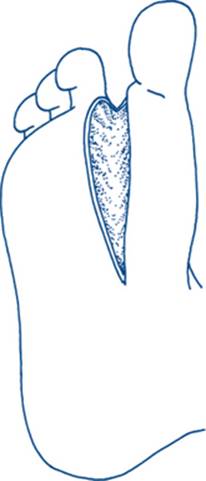
Figure 6.49 Local amputation and debridement of diabetic gangrene of the foot
The more common indolent pressure-induced neuropathic ulcer of the foot in diabetes is not usually associated with spreading cellulitis. These lesions are also best treated by surgical debridement, local amputation and daily dressings to control local sepsis and encourage healing. Podiatrist involvement with pressure area relief with padding and orthotic footwear is an essential part of team management. The prevention of recurrent ulceration requires meticulous foot care. The feet are inspected each morning, the tissue over the pressure points should be soaked in warm saline, callosities buffed with an emery board and then massaged with olive oil. Properly fitting shoes are essential (Box 6.11).
Box 6.11
Care of the diabetic foot
Inspect the feet daily for blisters, cuts, scratches and tinea or infections between the toes. Wash the feet at night and morning with face soap and warm water; dry carefully without rubbing and lightly powder between the toes.
Wear well-fitted shoes. Break in new shoes gradually and inspect the inside of shoes regularly for nail points, torn linings and foreign objects.
Do not use antiseptic lotions or creams on the feet.
Wear well-fitted clean cotton or wool socks or stockings that do not have seams and have not been darned. Keep the feet warm. Do not wear nylon socks, especially in warm weather.
Avoid walking barefoot and avoid standing in wet footwear.
Cut nails straight across to avoid ingrown toenails; do not cut or prune corns or calluses and do not use chemical agents to remove them. If you are under the care of a podiatrist, advise the podiatrist of your disease. Gently buff calluses and corns with an emery board and massage with olive oil after soaking the feet. Never use court plasters or corn medications.
Use sole inserts or metatarsal bars to avoid pressure on calluses over pressure points just behind the toes on the sole of the foot, especially if you have pain in the forefoot.
Avoid excess heat to the feet — test the temperature before bathing, do not toast the toes with a radiator, hot water bottle or an electric blanket and take particular care to avoid sunburn.
6.15 Varicose veins
Varicose veins are dilated, tortuous, elongated veins in the lower extremity. Somewhat similar venous abnormalities are seen in the spermatic cord (varicocele) and oesophagus (varices).
Common causes
Varicose veins can be classified into two groups.
1. Primary varicose veins
2. Secondary varicose veins
Primary varicose veins are veins dilated due to primary incompetence of valves in the superficial veins or in the communications between the deep and superficial venous systems. The cause of primary varicose veins is unknown but a number of risk factors can initiate and exacerbate the condition. The most important are: being female; pregnancy and multiparity; and family history. Others may include congenital venous valvular anomalies. Chronic constipation, prolonged standing, tight clothes and obesity are not proven risk factors.
Secondary varicose veins are the result of deep venous insufficiency, extrinsic compression of the veins by a pelvic or intra-abdominal tumour or occasionally arteriovenous fistula.
Physiopathology
The leg has two venous systems — superficial and deep (Fig 6.50). Connections between the two systems are known as communicating or perforating veins. Two main veins drain the superficial venous system. The long saphenous vein arises from the dorsal venous arch on the medial side of the foot. It runs superficial to the deep fascia from in front of the medial malleolus, up the leg and thigh and enters the femoral vein at the saphenofemoral junction. The short saphenous vein arises from the dorsal venous arch on the lateral border of the foot, runs behind the lateral malleolus, and upwards superficial to the deep fascia in the midline of the calf to disappear through the deep fascia over the popliteal fossa into the popliteal vein. Perforating and communicating veins pass through the deep fascia, connecting the superficial and deep systems. These may join superficial veins with the deep venous system by a connecting vein.
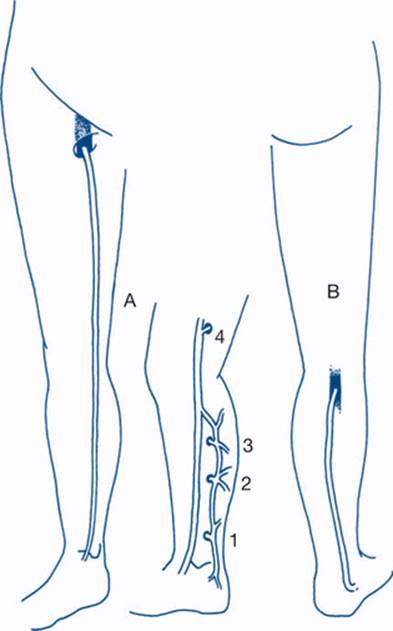
Figure 6.50 The surface anatomy of the long and short saphenous veins
A: the long saphenous vein runs from in front of the medial malleolus to the groin, reaching the femoral vein via the saphenous opening. The perforating veins below the knee run from the posterior arch vein through the deep fascia at three main sites — 1: above the medial malleolus; 2: at the mid-calf; 3: near the knee; 4: Hunterian perforator above the knee. B: the short saphenous vein
The saphenofemoral and saphenopopliteal junctions are the major sites of communication between the superficial and deep systems. A communicating vein often joins the long saphenous vein above the knee to the femoral vein and the posterior arch vein, a tributary of the long saphenous vein below the knee, has several sites of communication with the deep veins between knee and ankle. Alternatively, the perforating vein may drain directly from the skin into the deep system through the deep fascia. In normal circumstances, valves in these communicating and perforating veins allow blood to flow only from the superficial to the deep system so the superficial veins empty on exercise by a siphon effect as the calf muscle pump forces blood upwards in the deep veins. Incompetence of these valves allows free transmission of high pressure from the deep to superficial systems, with reversed flow during exercise.
Primary varicose veins usually follow incompetence of valves at the saphenofemoral junction. There are no constant, competent valves in the iliac system or inferior vena cava above the level of the saphenofemoral valve. Incompetence of this valve therefore causes transmission of the pressure of the venous column, in the upright position, from the right atrium to the saphenous vein and can produce progressive dilatation and incompetence of the entire long saphenous system. Some primary varicose veins develop because of perforator valvular incompetence in the lower leg rather than at the saphenofemoral junction. The increased pressure in the superficial veins during standing and muscle contraction leads to progressive dilatation and elongation of superficial veins. Primary varicose veins can also occur with reflux at the saphenopopliteal junction and the varices are predominantly in the calf.
Secondary varicosities from deep venous insufficiency develop through a similar mechanism. In this instance, however, the major cause is incompetence of the valves in the deep venous system, usually due to a previous DVT, so that marked ambulatory venous hypertension acts on the superficial venous system, with virtually no fall in pressure during exercise. In contrast to primary varicose veins, secondary varicosities have accompanying signs of chronic deep venous insufficiency, as well as showing superficial varicose veins.
History
Patients with primary varicose veins often present mainly because of the ugly appearance of the veins. Other symptoms include fatigue, swelling, heaviness in the leg and aching discomfort over the veins. Diffuse leg swelling is usually minimal with primary varices. The discomfort is relieved by elevation and elastic stockings. Cramps at night and restless legs are sometimes associated with varicose veins.
As a general rule, the size and number of the varicose veins are directly related to the severity of symptoms but, in some cases, poor correlation exists between symptoms and signs. A careful history will usually reveal if symptoms are truly due to varicose veins and not to transient or cyclical oedema, a common condition in women. In those patients, severe symptoms in the legs are associated with only minor varicosities and subcuticular venular flares. Headache, constipation, mastodynia and dysmenorrhoea are common associated symptoms.
Examination
Signs are elicited by inspection with the patient standing, vein palpation and percussion and the use of a tourniquet.
On standing, dilated veins will become prominent. Inspection of the front and the back of the limb with the patient standing will establish whether the long or short saphenous system or both systems are varicose.
Identification of a dilated long saphenous vein in the thigh and of the continuity of tortuous veins with the long saphenous system is aided by tapping over the veins and transmitted percussion felt along the varicosed saphenous vein. A cough impulse can also be felt at the groin over the saphenofemoral junction with gross reflux. On palpation fascial defects may be felt at the site of incompetent perforators, although these can be difficult to distinguish from localised simple varicose dilatations. The site of perforator incompetence is also suggested by an ankle flare or venular dilatation in relation to the overlying skin and a visibly blown-out varix.
Tourniquet tests can confirm the site of the offending perforator or incompetent communicating vein. After emptying the varicose veins by elevation of the leg, a firm tourniquet is applied just below the site of expected incompetence. If there are no incompetent communicating or perforating veins below the tourniquet, the distal veins will remain initially empty on standing — with gradual slow filling from below from arteriovenous inflow. Tourniquet applied on the upper thigh and control vein filling from above on standing confirms saphenofemoral reflux.
Varicose veins with chronic incompetence can result in signs of chronic venous insufficiency such as pigmentation, eczema, induration and ulceration.
A thrill or bruit on auscultation might suggest the presence of an arteriovenous fistula. General physical examination may reveal extrinsic compression, for example, from a pelvic tumour.
Diagnostic plan
In the majority of cases the clinical diagnosis is easy but, in some cases, it may be difficult to establish a conclusive relationship between the symptoms and mild varicose veins.
The examiner should answer the following questions:
1. Are definite superficial varicosities present?
2. Do they involve the long or short saphenous system or both?
3. Is there saphenofemoral or saphenopopliteal incompetence or both?
Questions 1 and 2 are answered by inspection, palpation and percussion. Question 3 is answered by the Trendelenburg test (Fig 6.51) and by testing for a venous groin cough impulse. With primary varicose veins, the answer to question 3 is almost always yes. Confirmation should be done with Doppler ultrasound before any surgical intervention.
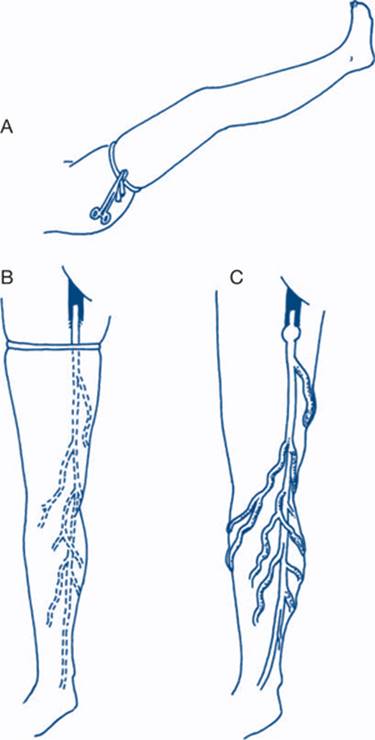
Figure 6.51 The Trendelenburg test
A: the leg is elevated to empty the veins; a tourniquet is applied to the upper thigh; B: if no filling of varicose veins occurs on standing until the tourniquet is released; C: incompetence at the saphenofemoral junction is present
Trendelenburg test
Varicose veins of the leg or thigh must be visible or palpable on standing to evaluate this test. The veins are first completely emptied of blood by elevating the leg to 45° with the patient supine (if the veins do not empty completely on this manoeuvre, secondary varicose veins due to major extrinsic compression or arteriovenous fistula are suspected). The upper thigh just below the saphenous opening is firmly compressed by a tourniquet, making sure pressure is sufficient to prevent reflux and the patient is asked to stand up. With experience, it is simpler and usually just as effective to compress the long saphenous vein at or just below the saphenous opening firmly with a finger, after first identifying the vein by percussion (Trendelenburg’s original description suggested occluding the long saphenous vein with a finger).
When the patient stands, the entire long saphenous system will remain collapsed if the valves of the lower communicating or perforator system are competent. If the tourniquet is not released, superficial veins will gradually refill from the arterial side over the next minute or two.
Before this happens and after observing the initially empty veins, the constricting tourniquet or finger is released. Blood promptly flows down the incompetent long saphenous system to fill the veins of the calf and thigh by retrograde backflow. This is a positive Trendelenburg test indicating incompetence of the saphenofemoral junction. The test is negative if no retrograde filling occurs either before or after the compressing tourniquet is removed.
Venous groin cough impulse
In obese patients, enlarged tortuous varicose veins are often palpable rather than visible, making tourniquet tests more difficult to interpret.
An enlarged long saphenous vein in the groin (saphena varix) is often palpable and a venous cough impulse felt expanding and transmitting down the long saphenous vein is a very helpful sign in such patients and confirms saphenofemoral incompetence. The saphenous vein at the groin is identified by antegrade percussion.
4. Are there incompetent communicating or perforating veins below the saphenofemoral junction?
Blood will promptly enter the superficial veins below the tourniquet when the patient stands if there are incompetent valves in the perforator-communicating system below the level of the tourniquet. The precise site of these communications between the deep and superficial systems is obtained by successively repeating the test, emptying the veins each time by elevation and applying the tourniquet at successively lower levels on the thigh and leg.
Relatively common sites of additional incompetent valves that may be identified are:
• in the lower thigh (Hunter’s communicating vein between the long saphenous vein and deep veins just above the knee)
• at the popliteal fossa behind the knee, involving the short saphenous vein and its saphenopopliteal junction
• in the leg below the knee, at the site of communicating veins between the posterior arch vein tributaries of the long saphenous vein and the deep veins.
Incompetent perforators and incompetence at the groin may coexist: this is a doubly positive Trendelenburg test. Rapid filling of the saphenous system in the leg below the knee occurs on standing when the greater saphenous vein is compressed at the groin, followed by an additional downward reflux through the saphenous vein in the thigh after the tourniquet is released. This indicates incompetent valves at both the saphenofemoral junction and between the leg perforators and deep veins.
Tests for saphenofemoral, saphenopopliteal and perforator valve incompetence can also be confirmed by Doppler ultrasound studies. In very obese individuals and in those with neither visible nor palpable varicosities, the answers to questions 1, 2, 3 and 4 can only be obtained by Doppler ultrasound over the incompetent valves.
5. Are the deep veins normal or is there is evidence of venous circulatory insufficiency?
The majority of patients with primary varicose veins have no evidence of serious circulatory insufficiency. Chronic venous insufficiency is often secondary to previous DVT. Recanalisation renders the deep valves incompetent; ambulatory venous pressures remain high and are transmitted through venous blowouts to the superficial veins with chronic sustained superficial venous hypertension and venous insufficiency of the limb.
Chronic venous insufficiency is manifest by venous pigmentation, eczematous scaling and browny subcutaneous induration (lipodermatosclerosis), actual or previous ulceration of the lower leg, chronic cyanosis of the toes exacerbated by walking and subcutaneous and intradermal venous flares, seen particularly over the malleoli.
If the evidence is suggestive but less striking, the effects of emptying the superficial veins during walking can be tested (Perthes’ test). The superficial varices from ankle to thigh are firmly compressed by an elastic stocking or compression bandage and the patient is asked to walk around the block or on a treadmill. Circulation of the toes remains healthy and pink with normal deep veins; cyanosis of the toes and bursting pain will develop if the deep veins are incompetent.
Duplex scanning is the investigation of choice for assessing saphenofemoral or short saphenous incompetence by detecting reflux on release of manual calf compression and also perforators’ incompetence. This test can evaluate the presence of deep vein incompetence and outflow obstruction. Venography is rarely performed except in patients with severe skin changes and pain in consideration for deep vein reconstruction surgery.
Treatment plan
Primary varices. A well-fitting elastic stocking should be applied in the morning before standing out of bed. Conservative measures are almost always the sole form of treatment for varicose veins of pregnancy.
Compression sclerotherapy has limitations because of the high incidence of long-term recurrence of varicose veins. The best method is to inject a small volume of sclerosant such as 5% ethanolamine oleate (or STD) into an empty (elevated) varicose vein at multiple sites and then apply pressure with a pad and bandage. Severe perforator incompetence is difficult to control with injection. The method is particularly useful for additional cosmetic value in the treatment of minor (or residual) varicose veins after surgery.
Ultrasound-guided foam injection sclerotherapy has improved the accuracy of saphenous injection with guided compression of the sapheno-femoral junction. A compression bandage is again applied following these injections. Sclerotheraphy is not suitable for varicose veins of large diameter.
Laser energy delivered endoluminally through a long probe inside the saphenous vein has recently been used to obliterate varicose veins with varying success. This can be done with local anaesthesia and the patient can be discharged to resume normal activities on the same day with minimal discomfort. Groin dissection and thigh bruising and tenderness are avoided. Often supplementary injection sclerotherapy or stab-avulsions of varicosities in the leg are required.
Complications of injection sclerotherapy include pigmentation and staining of veins, appearance of new telangiectasia and skin necrosis at injection sites that is slow to heal with a resultant scar.
Surgery is the appropriate form of treatment for many patients when a clear association exists between symptoms and obvious varicose veins. The principles of the operation are to: ligate the sites of pathological refluxing communication between the deep and superficial systems, usually the sapheno-femoral or the sapheno-popliteal junctions; remove the incompetent saphenous vein by stripping; and remove obvious varicosities by stab-avulsions. The saphenofemoral junction is ligated including all its tributaries in the groin, and the long saphenous vein is divided at the saphenofemoral junction. The long saphenous vein is removed with the aid of a flexible intraluminal vein stripper. Smaller varicose tributaries are avulsed through stab-incisions.
Secondary varicose veins require treatment of the primary cause. In some cases of secondary varicose veins, surgical treatment by subfascial perforator may prove beneficial. In most instances conservative and supportive treatments suffice and the aim is to improve venous return throughout the day. These measures include lower leg elastic stocking or elastic bandage (which is essential in the treatment of deep venous insufficiency), walking regularly and avoiding leg dependency on sitting and standing still. The leg is elevated as often as possible throughout the day.
6.16 Limb ischaemia
Discussion on limb ischaemia is divided into function ischaemia (intermittent claudication) or critical ischaemia (severe ischaemia) whereby the limb is threatened if no treatment is given.
Functional ischaemia — intermittent claudication
Ischaemic muscle pain on exercise (intermittent claudication: from the Latin word claudicare, meaning to limp) is an easily recognised symptom. The pain of claudication is absent at rest, precipitated by walking a given distance and is relieved by rest. In most cases claudication is due to ischaemia secondary to atherosclerotic arterial obstruction. Claudication is not necessarily a progressive disorder leading to rest pain and gangrene. Progression to severe ischaemia depends upon a number of factors that include the variable degree to which collateral vessels develop bypassing areas of arterial stenosis, the extent of the occlusion, the development of more proximal sites of stenosis, the complication of sudden complete occlusion by thrombosis and deteriorating atherosclerotic risk factors such as diabetes mellitus, hypertension, elevated lipids and smoking. Approximately one-third of patients will have progression of symptoms; the remaining two-thirds will regress or remain unchanged.
Causes
1. Occlusive peripheral vascular disease
2. Less common causes
History
Claudication is usually readily distinguishable from other causes of pain in the lower extremity, including the following.
Sciatica is commonly precipitated by straining, stooping and heavy lifting. The pain usually radiates from the buttock down the posterior thigh and leg. The pain is often associated with exercise though not always and may be associated with pins and needles. The pain is relieved with sitting or resting against a wall. Pain in distributed according to involved nerve root irritation, hence dermatomal in its pattern, rather than muscle groups as in claudication.
Spinal claudication is related to spinal canal stenosis and presentation is often similar to sciatica and may be bilateral rather than unilateral. There may be associated bladder or bowel symptoms.
Osteoarthritis of the hip, where pain is felt especially early in the day or throughout exercise and may be referred to the knee. There is often associated stiffness and limited range of hip movements.
The absence of local signs of peripheral vascular insufficiency, together with limitation of straight leg raising (as in sciatica) or hip movements (as in osteoarthritis of the hip) and normal ankle blood pressure measurements usually quickly clarify the diagnosis when any clinical doubt exists. In this chapter we therefore consider patients with an unequivocal diagnosis of ischaemic pain of the lower limb.
MRI of the lumbar spine is helpful in confirming any suspicion of neurological involvement.
Venous claudication is associated with signs of chronic venous insufficiency such as varicose veins, lower third of leg pigmentation, induration and swelling. The pain is often bursting in nature with standing rather than walking and is relieved with elevation, whereas ischaemic pain may be exacerbated with elevation.
1 Occlusive peripheral vascular disease
The majority of patients with peripheral vascular disease are over 50 years of age. Younger patients with claudication may have insulin-dependent diabetes, arterial embolism, Buerger’s disease or traumatic arterial occlusion. Peripheral vascular disease is much more common in men and in smokers.
Risk factors in the atherosclerotic patient include smoking, diabetes mellitus, hypertension, hyperlipidaemia, being male, renal impairment and a family history of atherosclerosis.
The pain of intermittent claudication is a cramp-like aching pain, most commonly affecting groups of muscles such as the calf or thigh or buttock. The pain is precipitated by walking and goes away after resting for a few minutes. Pain that appears at rest or on standing or in tissues other than muscle and is not relieved by rest is not claudication. Claudication distance is an accurate measure of severity and should be recorded. Variables that may influence distance, such as the speed of walking, the incline and the severity of associated vascular disease (angina pectoris), should be taken into account.
Muscles affected by claudication depend mainly upon the site of major arterial obstruction. Occlusion below the common femoris produces calf pain, above the profunda femoris thigh pain and above the internal iliac vessels claudication of the whole lower limb and often of the buttock muscles. In high occlusion there may also be transient numbness on exercise and persistent fatigue of the whole lower extremity. When symptoms of high occlusion are combined with impotence the condition is known as the Leriche syndrome. Numbness and paraesthesia in the skin of the foot may occur at the time muscle pain starts. These symptoms are caused by the shunting of blood from skin to muscle during exercise. Persistent numbness and decreased sensation suggest the possibility of associated diabetic or alcoholic peripheral neuropathy.
Because atherosclerosis is a diffuse disorder, at least 50% of patients have clinical evidence of arterial occlusive disease in other organs, manifest by the symptoms of anginal chest pain, (coronary artery disease), weakness or paraesthesia in the upper limbs or transient blurring or loss of vision (amaurosis fugax) (cerebrovascular) and hypertension (renal).
2 Less common causes
Thromboembolism: The patient has a recent history of episodes of acute localised ischaemia with recovery before claudication develops. The source of emboli may be prosthetic valves, popliteal aneurysm or segments of ulcerated atheromatous plaques from larger proximal vessels. Popliteal aneurysm can thrombose and produce acute ischaemia of the foot.
Buerger’s disease of the small arteries is usually associated with early rest pain and gangrene or ulceration and only occasionally with claudication. The patient is usually male, less than 50 years old and smokes heavily. Other systemic diseases presenting with arteritis include rheumatoid arthritis, systemic lupus erythematosus, scleroderma and Takayasu’s disease. Takayasu’s disease is relatively more common in people of Asian descent and in women and affects primarily the branches of the aortic arch. The ESR is elevated in the acute phase and steroid therapy is often required.
The popliteal entrapment syndrome is a rare cause of claudication that results from an anomalous course of the popliteal artery medial to the medial head rather than between the two heads of the gastrocnemius as it passes into the calf. The artery is compressed on extension of the knee and intimal fibrosis develops slowly with occlusion. Alternatively poststenotic dilatation may occur. The foot pulses are normal at rest and disappear with full extension of the leg and dorsiflexion or plantar flexion of the foot. Patients with popliteal entrapment syndrome are often young and athletic with muscular legs.
In cystic adventitial degeneration of the popliteal artery, stenosis is produced by a mucoid cyst in the medial layer. The only symptom is claudication. Arteriography shows a sharply localised curved indentation in the middle third of the popliteal artery lumen (‘scimitar’ sign). Doppler ultrasound is better at defining the cystic change in the artery. Acute intraluminal rupture with thrombosis results in acute ischaemia.
Physical examination
Inspection
In many patients with claudication the legs look normal. The trophic change of hair loss cannot be relied upon as a necessary sign of early arterial insufficiency: age-related hair atrophy is a more common cause than ischaemia. On inspection the colour is usually normal, but a positive Buerger’s test may be demonstrable with blanching on elevation and rubor with dependency — a sign of more advanced arterial disease. Comparison of both sides may reveal that the affected leg is a little cooler.
Palpation
The peripheral pulses are usually diminished or absent; that is, foot and popliteal pulses with calf claudication and in the groin the femoral pulse with thigh claudication. Palpable leg pulses may be present in those with proximal less severe stenosis. In such cases a bruit is often found over the femoral artery. A simple test to accentuate clinical finding of arterial stenosis is the exercise test. The popliteal and ankle pulses are present at rest. They disappear after a brief period of intense exercise. Exercise may also produce peripheral pallor or an audible bruit. Similarly with partial iliac artery stenosis, walking produces claudication in the thigh and often the whole lower extremity aches. On re-examination after walking, a bruit may be heard over the femoral triangle and the foot will be pale, with decreased or absent pulses. Examination of the abdomen may reveal an abdominal aortic aneurysm.
Motor, sensory and reflex neurological examinations are normal unless there is associated diabetic peripheral neuropathy. In diabetes, reduction of vibration and position sense and a glove-and-stocking loss of pain and touch sensation with normal motor function are characteristic.
The diagnosis of sciatica is made by a careful history, the finding of a sensory deficit on the outside of the foot, depression of ankle jerk and calf muscle weakness — all signs indicating the presence of L5 and S1 nerve root compression. The straight leg raising sign is positive.
General examination of the cardiovascular and respiratory systems is essential to detect associated hypertension, carotid artery stenosis or other features of diabetes.
Diagnostic plan
1. General assessment comprises full blood, urea and electrolytes examinations, chest X-ray, ECG and examination of the urine for glycosuria.
2. Comparison of ankle blood pressure to the brachial blood pressure (ankle–brachial index: ABI) provides a useful guide to the severity of ischaemia. Ankle blood pressures are measured using a sphygmomanometer cuff and Doppler probe. The normal ABI is 1.0–1.2. Claudication occurs when the ABI is less than 0.8. The ABI is usually below 0.5 in patients with severe critical ischaemia such as persistent forefoot rest pain and below 0.25 with gangrene or ulceration.
3. Exercise will result in a fall in the ankle pressure (dorsalis pedis and/or posterior tibial) when significant proximal stenosis is present. In instances where the differentiation of peripheral vascular disease from locomotor problems remains in doubt, MRI scan of the lumbosacral spine may reveal evidence of disc degeneration and nerve compression causing sciatica and X-ray of the hip may show the features of osteoarthritis, suggesting that musculoskeletal disease rather than vascular disease is the cause of the pain.
4. Doppler ultrasound or duplex scanning is the preferred first-line investigation. This is noninvasive and gives a guide to the site and severity of occlusion. It also allows subsequent planning for percutaneous transluminal intervention such as balloon dilatation (angioplasty) or stent insertion that can be performed at the same time as the digital subtraction arteriography.
5. Digital subtraction angiography is required only when intervention is required: it is not a routine investigation for claudication because it is invasive and not without risks. Computerised digital subtraction allows the use of lower dosage of contrast medium and hence reduces the associated contrast-related nephropathy.
6. Multi-slice CT imaging with contrast and reconstructed images is a relatively noninvasive technique to image the arterial circulation. This technique is useful in larger vessels and is limited by extensive calcification and small vessels.
Treatment plan
Box 6.12 lists ways to manage peripheral vascular disease.
Box 6.12
Management of peripheral vascular disease
Control of concurrent medical illness (heart failure and diabetes)
Attention to risk factors
Smoking
Obesity
Hypertension
Hypercholesterolaemia
Measures to maintain patency and assist development of collateral circulation
Graduated exercise
Stop smoking
Antiplatelet agents: e.g. aspirin
Foot care
Stop smoking — keep walking
The control of concurrent medical illness and correction of risk factors are important in patients with claudication. These measures include weight reduction, control of diabetes, control of hypertension and hyperlipidaemia and the treatment of heart failure in order to improve cardiac output. The risk factor of particular importance is smoking, which must be stopped if treatment is to be successful in the long term. Continued smoking increases the incidence of progressive disease by eight to 10 times. Dietary changes to control hyperlipidaemia should be instituted; antilipid medication (statins) is required to achieve acceptable levels. Diuretics can exacerbate lipid abnormalities.
Measures to assist development of collateral circulation include graduated exercise and stopping smoking. The patient is encouraged to walk beyond the pain threshold if possible. Foot care is important to prevent infection and minor trauma — especially in diabetic patients. Vasodilators are of little value. Nonsteroidal anti-inflammatory agents and platelet disaggregating agents such as aspirin may be of value when prescribed daily.
Revascularisation is indicated if claudication is a major or progressive disability, provided the patient’s general health is satisfactory. This can be done percutaneously by transluminal balloon angioplasty with or without stent or open reconstruction by localised endarterectomy or bypass surgery.
Percutaneous transluminal balloon angioplasty (PTA) is often the first-line revascularisation procedure. The artery is dilated with a fixed diameter balloon that is introduced remotely through a percutaneous puncture, often from the groin (see rest pain).
Surgery is indicated when PTA is not successful or not possible, such as with a long occlusion. In general, surgery is only reserved for those with severe claudicating symptoms such as short distant claudicants that failed conservative management and functionally impairs the quality of life. Localised iliac or common femoral stenoses are treated by endarterectomy. Femoral occlusions are treated bypass grafting, preferably with autogenous saphenous vein.
Critical ischaemia — rest pain, gangrene or ulcer
Chronic critical leg ischaemia is defined by either:
• persistent ischaemic rest pain requiring regular analgesia for more than two weeks, with an ankle systolic pressure ≥50 mmHg and/or a toe systolic pressure ≥30 mmHg
• ulceration or gangrene of the foot or toes, with an ankle systolic pressure ≥50 mmHg or a toe systolic pressure ≥30 mmHg.
Rest pain is a persistent severe pain of the forefoot from skin and muscle ischaemia. Rest pain nearly always leads to gangrene and limb loss, unless revascularisation can be successfully performed. Rest pain is therefore the principal symptom of pregangrene and indicates a circulation so precarious that death of tissue is likely to occur at any time. Tissue necrosis may be precipitated by minor trauma and infection, especially in diabetic patients. In patients with diabetes, septic tissue necrosis may produce an acute threat to life and limb. In diabetic patients, infection is often the main cause of gangrene rather than large vessel ischaemia; thus skin circulation may appear adequate and pain may be absent or mild.
In the atherosclerotic patient with rest pain, the pain usually follows a long history of claudication. Pain at rest is precipitated by thrombosis in a critically narrowed vessel or because of the development of a segment of occlusion more proximally in the arterial tree. The main aim of management is to prevent limb loss by improving blood flow.
In the septic gangrene of diabetic neuropathy, the immediate priority is surgical debridement of deep foot sepsis. In many such patients arterial surgery may not be needed, as occlusive disease component may be minor.
Common causes
1. Atherosclerotic large vessel disease
2. Micro-embolisation of the small digital vessels
3. Posttraumatic obstruction
History and physical examination
General
Rest pain is a severe persistent forefoot ache. The pain prevents sleep, requires powerful analgesics to relieve it and can be so severe that amputation is demanded for relief. The pain is made worse by lying down, by elevating or by using the limb and is partially relieved by hanging the leg out of bed or by standing up. Milder forms of rest pain are relieved by walking. There may be loss of function of the limb, especially with arterial stenosis proximal to the inguinal ligament. Gangrene may be triggered by minor trauma or infection — the area of gangrene is painless, but pain is severe at the line of demarcation from live tissue unless significant diabetic neuropathy is present. In at least 50% of patients there is evidence of generalised atherosclerosis — with angina (coronary), transient limb weakness and paraesthesia, TIAs (cerebrovascular) and dyspnoea. A general deterioration of health with weight loss and polyuria suggests the diagnosis of diabetes.
The patient appears haggard, has often lost weight and is not willing to lie flat because of the pain and hangs the leg over the side of the bed. Prolonged dependent position may result in a swollen foot. On inspection muscle wasting and rubor of the forefoot are often present. The toes are greyish-white when the patient lies supine and with elevation of the foot, guttering of the veins occurs. Thickening and scaling of the skin over pressure areas is common. Patches of dry black gangrene are often seen on the tips of the toes, (and over areas subject to trauma) over other pressure areas (heel, lateral malleolus, lateral fifth MT head) — especially in patients with diabetes. The line of demarcation between the area of gangrene and live tissue may be obscured by the erythema of spreading diabetic infective gangrene.
Signs on palpation include coolness of the affected limb, gross delay in capillary filling after the application of finger pressure to the skin, absent pulses and a grossly positive Buerger’s test. Severe ischaemia is present when pallor develops in a leg at less than 20° above the horizontal (in contrast to the normal limb that stays pink at 90°). When the leg is then hung over the side of the couch it slowly turns from white to pink and then assumes a flushed reddish-purple colour. Together these findings constitute a positive Buerger’s test. Neurological examination may reveal the glove-and-stocking sensory loss of diabetes. Loss of muscle power may also be present but is often due to arterial insufficiency rather than diabetic neuropathy.
Atherosclerotic large vessel disease
Most patients with atherosclerotic rest pain and gangrene have a long history of claudication. Most are over 60 years of age, unless diabetes or an unusual cause of ischaemia is present. Diabetes may complicate and potentiate the severity of large vessel peripheral vascular disease or cause septic gangrene, especially in younger diabetic patients with peripheral neuropathy.
Other causes
Intermittent embolic occlusion of smaller vessels can produce sudden transient pain, coldness, numbness and gangrene of the digits. These emboli may come from vegetations on prosthetic valves, mural thrombi within peripheral aneurysms or from ulcerated atheromatous plaques (Fig 6.52).
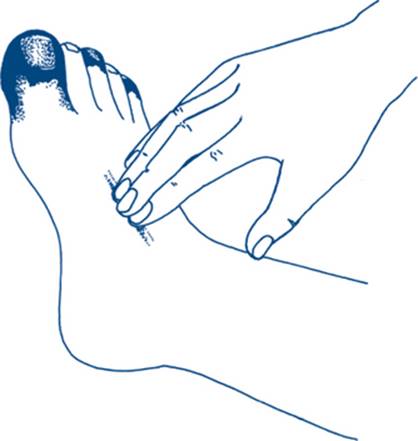
Fig 6.52 Intermittent embolic occlusion
Patchy gangrene with palpable peripheral pulses suggests diabetes mellitus or emboli from a proximal aneurysm or plaque.
Trauma can lead to stenosis and rest pain because of intimal damage and occlusion or because of accelerated atherosclerosis at the site of local damage, particularly in the hypertensive patient.
Buerger’s disease is sometimes associated with rest pain and gangrene associated with multiple segmental occlusions of small arteries. Phlebitis is common. A similar picture is seen with Raynaud’s phenomenon involving the feet. Acrocyanosis and livido reticularis rest pain is associated with excessive and prolonged cyanosis, which is triggered by cold. In causalgia painful cyanosis results from an abnormal posttraumatic vasomotor response to various stimuli.
Diagnostic plan
1. General assessment by blood examination, chest X-ray, ECG and examination of the blood and urine for glucose.
2. Duplex scanning provides a diagnosis of the site and severity of the invasive disease.
3. Arteriography is performed either by CT scanning (CT angiography) with contrast and computerised reconstruction of images or by standard intra-arterial puncture and administration of contrast with computerised soft tissue subtraction (DSA — digital subtraction angiography). CTA is less invasive, whereas DSA is usually performed by the transfemoral route. Angiography is indicated in all cases (Fig 6.53) in assessment and treatment planning. The features looked for on arteriography are the site(s), length and degree of obstruction, the state of the distal circulation (run-off) and the state of the collateral circulation. The most appropriate revascularisation procedure (either PTA or surgery) is selected. PTA can be carried out in the same setting provided appropriate patient preparation and consent are taken.

Figure 6.53 Transfemoral angiography in two patients with rest pain
A: good run-off with a patent popliteal artery — suitable for surgical bypass; B: poor run-off — not suitable for reconstructive surgery
Treatment plan
The aim of treatment is salvage of the limbs by increasing arterial inflow. The main aspects of management are control of concurrent illness, preoperative preparation and nonoperative management and the selection of cases for particular types of invasive treatment.
The control of concurrent medical illness is essential both to improve peripheral circulatory function and to increase the safety of surgery. This applies especially to diabetes mellitus, cardiovascular and respiratory diseases. Smoking must be stopped. Respiratory disease is common in these patients and chest physiotherapy is essential in order to improve the safety of surgery.
Local foot care is directed at both prevention and local treatment of gangrene. Early debridement and open drainage of areas of septic diabetic gangrene is mandatory, combined with the control of diabetes and intravenous antibiotics. Ischaemic dry gangrene is allowed to demarcate and is then treated locally by removal of slough or minor amputation. Moist porous dressings are used to control infection in ulcers while arterial reconstruction is planned. In cases not suitable for surgery, foot care is especially important. This includes attention to cleanliness, dryness, warmth, nail care, treatment of infections such as tinea pedis, care with shoes and the avoidance of situations where injury may occur such as crowded public transport. Risk factors for atherosclerosis must also be attended to if progression is to be halted. These include hypertension, hyperlipidaemia, renal impairment, diabetes and antiplatelet medication.
Revascularisation is indicated in patients with critical ischaemia in order to relieve pain, heal an ulcer or an amputation site in order to prevent major limb loss. The treatment options include percutaneous transluminal angioplasty with or without the insertion of a stent, local endarterectomy or open bypass surgery.
Percutaneous transluminal revascularisation is often the first procedure of choice (Fig 6.54). The artery is dilated to a predetermined diameter with a noncompliant balloon remotely introduced through the common femoral artery at the groin. This cracks the calcified, atheromatous plaque and stretches the media, causing local dissection and widening of the lumen. Healing occurs with formation of neointima over a few weeks resulting in a smooth lumen. Lesions that respond best to this procedure are in larger arteries such as the aortoiliac segment, the superficial femoral and popliteal arteries, focal stenoses and short occlusions. Significant residual stenosis or dissection after balloon angioplasty can be treated with vascular stents.
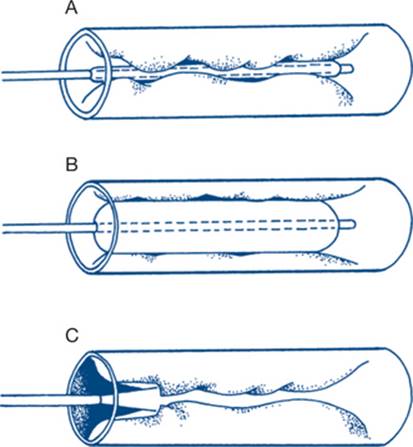
Figure 6.54 Percutaneous transluminal balloon or laser angioplasty
A: a Grunzig balloon or laser light transmission fibre is passed along a vessel to the site of partial or complete occlusion; B: in balloon angioplasty the balloon is blown up to compress atheroma and recanalise the artery; C: laser light is delivered through an optical fibre at a wavelength that produces nonthermal destruction of atheromatous tissue
PTA should not be regarded as a minor or nonmorbid procedure. Hazards and complications occur and the indications for PTA are similar to those for open surgery. Other endoluminal vascular procedures that can sometimes be used as alternatives to bypass grafting include percutaneous atherectomy and laser-assisted angioplasty though the results are not as promising.
Surgical reconstruction is indicated in cases when percutaneous angioplasty/stenting is not possible.
With localised lesions, such as the iliac or common femoral arteries, endarterectomy with patch repair is the ideal procedure.
In those with a longer lesion and occlusion, such as in the superficial femoral artery, with a good run-off distal vessels on arteriography (Fig 6.54), bypass grafting, such as femoropopliteal bypass, is the most effective procedure, using a reversed saphenous vein harvested from the same leg. Synthetic materials such as polytetrafluoroethylene (PTFE) may be used if there is no suitable vein.
In patients with simple or multiple segmental occlusions and relatively poor run-off, percutaneous transluminal balloon or laser angioplasty can provide some palliation in selected cases. Percutaneous (chemical) sympathectomy under radiographic control in patients is often ineffective in the management of gangrene and so is no longer used.
Amputation is required in patients unsuitable for dilatation or operation who have peripheral gangrene and intractable rest pain. Conservative amputation of the toes or forefoot is only successful when there has been a successful arterial reconstruction and for the distal gangrene of diabetes only after early drainage has been performed. Above-knee or below-knee amputation is usually necessary in patients not suitable for vascular reconstruction. The level of amputation depends upon the severity of the arterial disease. Below-knee amputation can usually be performed when there is a good inflow into the profunda femoris artery. A popliteal pulse is desirable, but not essential, for satisfactory healing of a below-knee amputation. Ankle systolic pressure index is a useful determinant of the success or failure of below-knee amputation. The decision is a very important one as the likelihood of satisfactory rehabilitation to walking with a prosthesis is very much enhanced by a below-knee amputation. Below-knee amputation is best performed by using a long posterior myocutaneous flap (Fig 6.55).
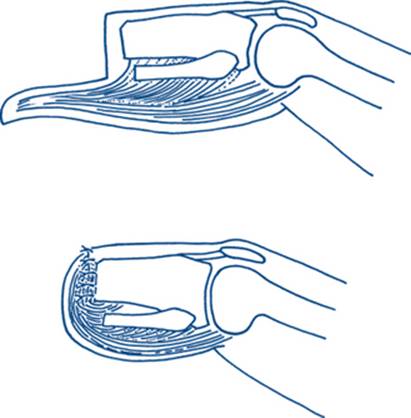
Figure 6.55 Below-knee amputation with long posterior myocutaneous flap
Acute limb ischaemia
Sudden occlusion of a peripheral artery is a dramatic clinical event. Diagnosis is straightforward but is often missed in the early stage. The most common site of acute occlusion is the common femoral artery. The prognosis depends upon the degree of collateral circulation around established peripheral vascular disease, the site of the obstruction and the delay before presentation. Obstructions in the upper limb, and those distal to the profunda branch of the common femoral artery in the lower limb, have a better prognosis. In most instances, by 12 hours from the onset of acute common femoral artery obstruction, tissue necrosis is established and irreversible and amputation will be necessary. In some cases of occlusion distal to the profunda artery or in cases of upper limb obstruction, spontaneous recovery can be evident within two to four hours and continued improvement in the circulation and function of the limb can be expected over further weeks.
Common causes
1. Embolus
2. Thrombosis
3. Traumatic contusion
Clinical features
In the patient with common femoral artery occlusion there is a sudden onset of severe pain in the leg and pallor. The foot becomes cyanotic over time. Diminution of nerve function (initially paraesthesia progressing to anaesthesia and later to paralysis of the limb) occurs with increasing hypoxia. The limb becomes cooler and cold progressively. Tissue necrosis is usually irreversible after 12 hours of obstruction. Pain increases mainly because of posterior compartment compression in the calf from an oedematous necrotic gastrocnemius muscle. Thrombosis in an area of atherosclerosis usually has a more gradual onset than embolic obstruction. Traumatic occlusion usually follows arterial puncture or an accident with compression of the artery causing intimal damage and occlusion.
On examination, the limb is cold and pulseless with no capillary return. Neurological examination reveals loss of muscle power and anaesthesia; there is associated increasing tenderness and swelling of the calf muscles indicating the presence of progressive irreversible muscle infarction. After 12 hours a line of demarcation appears — usually at the junction of middle and lower third of the thigh in patients with common femoral block. Treatment must therefore start within six hours of the onset of symptoms.
General examination may reveal atrial fibrillation indicating a possible source of an embolus.
The clinical features of an acutely ischaemic limb are thus summed up as the six p’s, namely, pain, pallor, pulselessness, parathesia, paralysis and ‘perishingly’ cold.
Treatment plan
Intravenous heparin is started immediately on diagnosis; the aim is to slow the progression and distal propagation of thrombus. A loading dose of 100 units per kilogram is given intravenously, this is followed by infusion of a 1000 units per hour, adjusted to keep the APTT at two to three times normal. If distal ischaemic changes spontaneously improve with heparin at an early stage, the need to proceed to embolectomy will depend on an estimation of future disability. Chronic occlusion of an upper limb artery is usually not associated with disability, whereas untreated embolus in a lower limb artery is nearly always associated with eventual claudication and in many instances rest pain and later gangrene.
Embolectomy is usually indicated unless marked and rapid improvement occurs in the circulatory status of the limb. Embolectomy is performed under local or general anaesthesia through an arteriotomy. The embolus is extracted together with its thrombotic tail using a Fogarty balloon catheter (Fig 6.56). Late embolectomy after 12 hours is successful only when clinical evidence exists that propagation of thrombosis has been limited by already established reentry of distal collateral blood flow. Fasciotomy should always be contemplated if there is any delay in revascularising the limb.

Figure 6.56 Aortic embolectomy using a Fogarty balloon catheter
Occasionally fasciotomy of the posterior, peroneal and anterior compartments of the calf in the lower leg can improve prognosis after a partially successful embolectomy. When there is an irreversible ischaemic change, early amputation is necessary if the patient is to survive.
Non-surgical treatments include percutaneous aspiration of embolus and intra-arterial thrombolysis by urokinase or tissue plasminogen activator. These require skilled vascular interventionalists and radiologic support. Percutaneous intra-arterial thrombolysis is more often indicated in acute ischaemia thought to be due to thrombosis of an underlying diseased artery or bypass graft.
Raynaud’s phenomenon
Raynaud’s phenomenon (syndrome) is a vasospastic disorder precipitated by cold. Local pain is accompanied by a sequence of colour changes in the hand from whiteness (pallor) to blueness (cyanosis) and finally continuing redness (rubor) with warmth and burning pain. The hands look normal between attacks unless finger tip gangrene occurs in an attack.
Common causes
1. Primary (idiopathic) Raynaud’s disease
2. Cervical rib
3. Scleroderma
4. Cervical spondylosis
Clinical features
Raynaud’s disease. This term is applied to patients with the characteristic syndrome and sequence of colour changes where no specific proximal cause (such as cervical rib) is discovered and the disease process appears confined to the small vessels of the digits.
Other causes of Raynaud’s phenomenon are cervical rib, scleroderma and cervical spondylosis.
Cervical rib. Raynaud’s phenomenon usually develops in adulthood. The symptoms are usually due to emboli from thrombosis within a poststenotic dilatation of the subclavian artery. Reduction of the radial pulse on hyperabduction of the limb with rotation of the head to the opposite side (Adson’s test) may be positive in cervical rib and other, less common, thoracic outlet compression syndromes.
Scleroderma. Raynaud’s phenomenon may precede the other signs of scleroderma by months or years. In most cases the skin of the hands in these patients is involved and shows the white, waxy, taut skin of scleroderma. By the time there is ulceration and atrophy of the finger tips, cutaneous fibrosis of the hands and fingers is well advanced, often with circumscribed pulp calcification. The CREST syndrome refers to the associated of calcinosis, Raynaud’s phenomenon, oesophageal hypomotility, sclerodactyly and cutaneous telangiectasia.
The diagnosis of cervical spondylosis is suggested by discomfort on moving the neck, limitation of neck movements and, occasionally, upper limb neurological signs. Raynaud’s phenomenon may rarely be associated with cold agglutinins in the blood, hypothyroidism or diabetes mellitus.
Treatment plan
Patients with Raynaud’s disease are treated initially with a calcium channel blocker such as long-acting nifedipine. In addition, patients with persistent cold-sensitive Raynaud’s phenomenon may benefit from avoiding cold exposure by wearing gloves and moving to a warmer climate, if this can be arranged.
Cervical sympathectomy is of benefit in Raynaud’s disease and in those connective tissue diseases associated with Raynaud’s phenomenon. Most patients with the thoracic outlet syndrome can be treated conservatively and will benefit from avoidance of cold, postural correction and physiotherapy to the shoulder girdle.