
Filip Bednar
Mark R. Hemmila
Presentation
A 22-year-old man is brought to the hospital by ambulance after being stabbed during a domestic dispute. He arrives in the emergency room with a kitchen knife sticking out of his abdomen in the right upper quadrant. By report, the knife has a blade at least 10 in long. The knife blade is now buried in his abdominal wall up to the handle. His initial SBP is 80 mm Hg.
Differential Diagnosis
This patient has a penetrating mechanism of injury with possible traumatic injuries to the abdomen, retroperitoneum, and chest region. Vital structures and injuries that could prove rapidly lethal include pericardial tamponade, tension pneumothorax, and arterial or venous laceration. It is imperative to consider and evaluate for these injuries during the initial assessment in the trauma bay.
Workup
The primary survey focuses on airway, breathing, circulation, neurologic deficit, and exposure using the Advanced Trauma Life Support protocol. This patient may or may not require endotracheal intubation in the emergency room. He should have large bore IV access established but not receive significant crystalloid fluid administration until operative intervention is underway. A focused abdominal sonography for trauma (FAST) exam quickly evaluates the patient’s pericardial space for evidence of pericardial fluid and/or tamponade. A flat-plate chest radiograph will reveal the presence of a hemothorax or pneumothorax requiring chest tube placement. It is important to logroll this patient, examining for additional evidence of injury. If time permits, a blood sample should be obtained for blood type and crossmatch. Type-specific or O negative blood products should be available for immediate administration, if necessary.
Presentation Continued
In the present case, FAST exam is negative for pericardial blood but positive for a fluid stripe between the liver and the kidney in the right upper quadrant of the abdomen. Chest x-ray shows no hemothorax or pneumothorax. Given the mechanism of injury and fascial penetration, this patient has a clear indication for immediate operative exploration.
His ER workup should be expeditious and ideally last <10 minutes. The knife should be left in place and prepped into the operative field. The surgeon should be prepared to explore for injuries to the liver, biliary system, duodenum, inferior vena cava (IVC), right kidney, stomach, small bowel, colon, and vascular system in retroperitoneal zones 1 (central abdomen) and 2 (flank).
Treatment
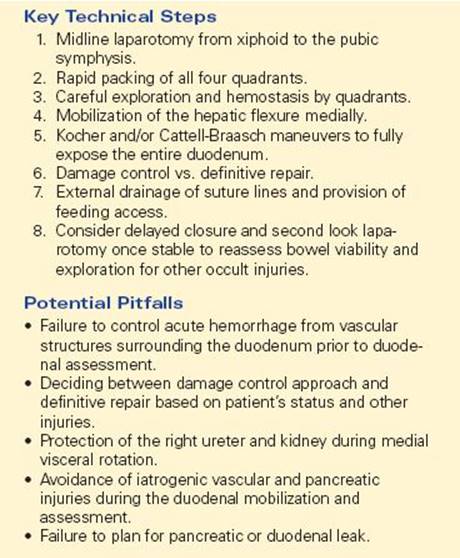
A generous midline laparotomy is the standard approach for trauma in this circumstance (Table 1). The patient should be surgically prepped and draped from the sternal notch to the groin. One leg should be prepped and draped into the field from the groin to the knee. Endotracheal intubation, if not already performed, should occur just prior to skin incision. Blood products must be available. Entry into the abdomen should be accomplished quickly and safely, typically using a scalpel with limited passes to divide the skin, subcutaneous tissue, and fascia. Next, the peritoneum is sharply divided over the length of the incision both cephalad and caudad with heavy scissors. An examination of the position of the knife blade, trajectory, and injuries is quickly made prior to removing the knife. All four quadrants should be rapidly packed off with laparotomy sponges and the small bowel eviscerated toward the midline. Once all four quadrants are packed, a careful exploration and systematic control of significant acute hemorrhage is performed one quadrant at a time. If time permits, allowing the anesthesia team to catch up with blood product administration prior to starting the exploration can be helpful to the patient. The most likely vascular structures to be injured under these circumstances include the intrahepatic vasculature, the portal triad, IVC, right renal pedicle, celiac axis, superior mesenteric vessels, aorta, and the pancreaticoduodenal complex of blood vessels.
TABLE 1. Key Technical Steps and Potential Pitfalls to a Duodenal Injury Repair
Duodenal Exposure
Once initial hemostasis has been obtained and the patient has been adequately resuscitated, a systematic exploration of the abdominal viscera is performed. In this case, the surgeon has to have a high suspicion for duodenal and pancreatic injuries along with the other abdominal viscera in the area of the penetration. Exposure of the duodenal loop and pancreatic head is achieved using a combination of the Kocher and the Cattell-Braasch maneuvers (Figure 1). The surgeon may also elect to divide the ligament of Treitz to further expose the fourth portion of the duodenum and the duodenojejunal junction. To begin the exposure, the retroperitoneal attachments of the hepatic flexure of the colon and the gastrocolic ligament are initially divided to gain access to the lateral aspect of the second portion of the duodenum. A Kocher maneuver is performed by incising the peritoneum laterally to the duodenal C-loop and then mobilizing the duodenum and the pancreatic head medially. This will allow visualization of the majority of the first, second, and a portion of the third section of the duodenum.

FIGURE 1 • The Cattell-Braasch and Kocher maneuvers allow rotation of the right colon and the small intestine completely away from the right retroperitoneum, allowing exposure of the duodenum and the pancreatic head, as well as the vascular structures and kidney. (From Mulholland. Greenfield’s Surgery. Philadelphia, PA: Lippincott, Williams and Wilkins, 2006.)
The Cattell-Braasch maneuver is a full right to medial visceral rotation including the right colon and small bowel. To perform this maneuver, the white line of Toldt is incised lateral to the right colon and the right colon and cecum are mobilized medially. Attention must be given to identify and protect the right ureter in the process. This maneuver allows the surgeon access to the base of the bowel mesentery, which is also mobilized from the right lower quadrant to the ligament of Treitz. This exercise will further expose the third and the fourth portions of the duodenum with additional mobilization provided by division of the ligament of Treitz itself. Once the full medial visceral rotation is performed, the surgeon also has access to all of the right-sided retroperitoneal organs and vascular structures including the IVC, right renal complex, and the superior mesenteric blood vessels.
Injury Assessment and Repair
With full exposure and the patient stabilized, the surgeon has to assess the degree of duodenal injury before selecting the proper repair or damage control approach. Duodenal injuries are graded (Table 2) and it is important to ascertain the location of the laceration in relation to the other nearby anatomic structures. A crucial maneuver is to assess whether the duodenal papilla is involved as this will determine whether a simple or a complex repair is required. If uncertainty exists, a cholecystectomy and an on-table cholangiogram can be performed to assess the common bile duct. Passing a balloon catheter (“biliary Fogarty”) or a similar small catheter through the cystic duct stump following cholecystectomy and feeding it distally can prove to be a simple maneuver to identify the relationship of the ampulla to the area of injury.
TABLE 2. AAST Grading of Duodenal Injuries
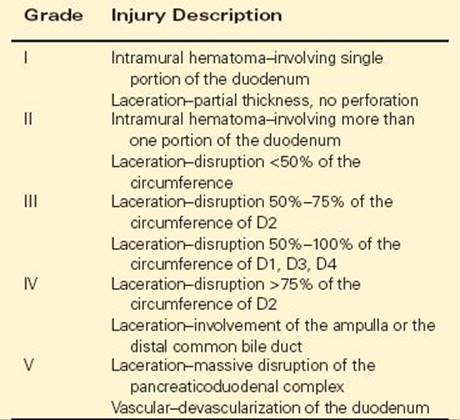
Advance one grade for multiple injuries up to grade III. D1, first portion of duodenum; D2, second portion of duodenum; D3, third portion of duodenum; D4, fourth portion of duodenum.
Options for repair of a duodenal laceration include simple primary closure with or without debridement, simple repair and drainage with pyloric exclusion, Roux-en-Y duodenojejunostomy, duodenal diverticularization (antrectomy, oversewing of duodenum, and loop gastrojejunostomy), and a full pancreaticoduodenectomy for massive injuries of the pancreaticoduodenal complex. In general, the simplest repair that gets the job done and an operation that will “fail well” is preferred. Performance of a Whipple for trauma should be the option of last resort and is best conducted in stages. All of these repairs should have consideration given to supplementation of the repair with buttressing of vulnerable suture lines and strategic placement of external drainage devices. Drainage of the pancreas and attention to provision of feeding access for the patient in the form of a nasojejunal tube, gastrojejunostomy tube, or a distal feeding jejunostomy are imperative.
Most simple duodenal injuries are closed primarily without tension using a single- or double-layer closure technique in a transverse fashion to avoid narrowing the bowel lumen. Suture lines may be buttressed with an omental flap or a serosal flap by oversewing with a loop/limb of jejunum. Another option for more extensive lacerations or perforations of the duodenum, which cannot be closed primarily, is to create a Roux limb of jejunum and use it to repair the luminal defect by constructing a duodenojejunostomy in a side-toside fashion. Pyloric exclusion can offer protection of a fresh suture line and temporarily redirect gastric outflow (Figure 2). To create pyloric exclusion, a distal longitudinal gastrostomy is made on the anterior surface of the stomach. The pyloric ring is grasped with an Allis clamp, pulled into the stomach, and the pyloric opening oversewn with a running 2-0 or 3-0 Prolene suture. Another option is to staple the pylorus shut with a thoracoabdominal (TA) stapler. A draining loop gastrojejunostomy is then fashioned. More complex repairs such as duodenal diverticularization (biliary and pancreatic diversion from the affected duodenum) have become less favored with the more frequent use of a pyloric exclusion approach. Complex type III duodenal injuries (>50% of the duodenal circumference or more than a simple perforation) will require selection of a more complex repair and this may be best accomplished at a second operation.
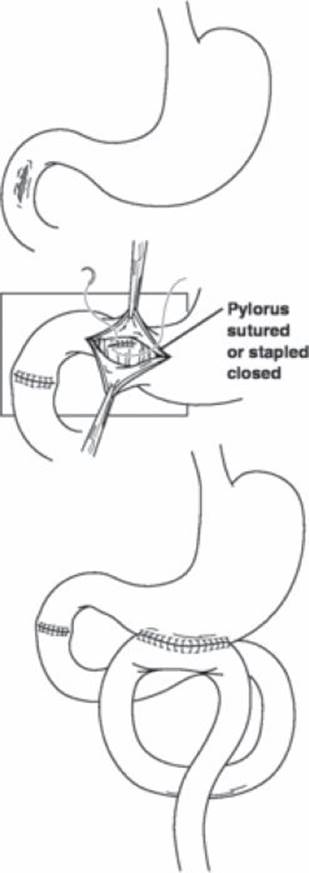
FIGURE 2 • The pyloric exclusion procedure: primary repair of the duodenal injury, protective closure of the pylorus, and gastrojejunostomy to reestablish enteric continuity.
Decompression of a duodenal repair with an antegrade or a retrograde duodenostomy tube can reduce the rate of fistula formation. Most simple lacerations of the duodenum can be repaired primarily, and decompression and pyloric exclusion are often not necessary. There has been a recent trend in literature suggesting that pyloric exclusion is associated with greater morbidity. However, the patients who receive pyloric exclusion also have more associated pancreatic injuries and a higher rate of grade IV or V injuries. No prospective randomized trials are available to answer this question definitively.
The most important goal in selecting any repair or drainage procedure of the duodenum lies not only in understanding how it will work but often in how it will affect the patient if it fails. The second key aim is to be constantly aware of the overall state of the patient. If the patient is moving toward the lethal triad of hypothermia, acidosis, and coagulopathy, damage control will become the primary goal with reconstructions reserved for a later operation.
Special Intraoperative Considerations
Isolated injury to the duodenum is rare and injury to the duodenum is typically associated with injuries to other vital structures in the area. The surgeon may encounter severe hemorrhage from portal structures, the aorta, the IVC, the superior mesenteric or celiac vessels, or the renal vessels. Exsanguination from any of these is the most rapid mode of death from this type of injury. During the Kocher and Cattell-Braasch maneuvers, the surgeon must be ready to obtain control of vascular structures in the area. Frank bleeding or a large hematoma should warrant the surgeon taking appropriate steps to gain proximal and distal vascular control prior to further exploration. The Pringle maneuver will provide control of portal and hepatic hemorrhage. The superior mesenteric and pancreaticoduodenal vessels may be controlled by manual occlusion of the supraceliac aorta and compression of the pancreaticoduodenal complex with tightly rolled laparotomy sponges after the Kocher and Cattell-Braasch maneuvers. Right renal hilum injuries may be exposed by mobilizing the kidney out of Gerota’s fascia. Full aortic clamping may be necessary depending on the extent and location of the vascular injury. Walking the clamps to isolate just the area of injury once vascular control has been achieved will lessen the ischemic burden. IVC injuries may be repaired primarily, if properly visualized. In these scenarios, more definitive duodenal or pancreatic repair will often have to be delayed to a later time, and simple drainage with temporizing measures will suffice for initial control of the area. Resuscitation, stabilization, and avoidance of the lethal triad of hypothermia, acidosis, and coagulopathy are important.
Postoperative Management
Patients are typically admitted to the ICU after an initial trauma laparotomy and stabilization. Critical care goals include proper resuscitation and warming of the patient with reversal of any significant coagulopathy. Monitoring for ongoing hemorrhage is essential. Many patients will be admitted with an open abdomen secondary to perioperative resuscitation and massive visceral swelling. Management of the open abdomen requires care, diligence, and constant attention to avoid an enterocutaneous fistula. If the abdomen is open, the surgeon should plan for reexploration within the next 12 to 48 hours based on the patient’s response to resuscitation. Tube feeding may begin within 24 to 48 hours of injury, provided the patient has stabilized and a repair of the injury has been performed.
Postoperative complications after a duodenal injury include duodenal narrowing, duodenal leak with attendant abscess formation, and occult injury to other surrounding viscera, most notably the pancreas or biliary tree. Useful diagnostic studies to evaluate for these complications may include upper GI contrast studies, CT scan, ERCP, MRCP, and HIDA scans. Long-term duodenal narrowing with functional obstruction will most likely require a definitive operative repair with duodenorrhaphy, Roux-en-Y duodenojejunal reconstruction, or gastrojejunostomy. Duodenal leaks are a common occurrence despite adequate vascularity and buttressing of the repair. Drainage of suture lines will allow for the formation of a stable fistula tract. Duodenal fistulas will often close spontaneously and a definitive repair or fistula closure operation should be delayed until patient has fully recovered from his acute injuries. Presence of distal feeding access in the form of a feeding jejunostomy or a nasojejunal tube is absolutely necessary and should be considered as part of the initial operation, if allowed by the patient status. Pancreatitis can lead to dehiscence of suture lines. Vascular repairs near the pancreas should utilize native tissue rather than prosthetic graft material whenever possible. Protecting the repair with tissue coverage from omentum is extremely wise. Pancreatic duct or biliary tract injuries may require stents, or drainage tube placement involving endoscopic or radiologic techniques in addition to operative interventions as necessary.
Case Conclusion
On operative exploration, the injured man was found to have a lateral laceration of the second portion of his duodenum without associated vascular injuries. The duodenal defect was repaired primarily in two layers. In performing the repair, the duodenum was closed in a transverse direction and the suture line covered by omentum. The site was also drained externally using a closed-suction drain. Despite these precautions, the patient did develop a duodenal leak, which was well controlled with the closed suction drain. Enteral nutrition was provided via a nasojejunal tube placed at the time of operation. By 6 weeks after his initial operation, his duodenal leak had resolved and he was tolerating oral intake.
TAKE HOME POINTS
· Duodenal injuries are frequently associated with injuries to other surrounding viscera and vascular structures.
· Proper exposure to assess the duodenal injury is essential and is achieved with a combination of the Kocher and Cattell-Braasch maneuvers.
· Definitive repair or damage control measures are performed based on the overall patient status and the extent of the duodenal injury.
· External drainage of all duodenal repairs suture lines is recommended.
· Feeding access must be obtained to provide the patient with the necessary nutrition for proper recovery. This feeding access should be capable of functioning even if the duodenal repair fails.
· A high suspicion must be maintained postoperatively for duodenal repair breakdown, leak, and abscess formation.
SUGGESTED READINGS
Carrillo EH, Richardson JD, Miller FB. Evolution in the management of duodenal injuries. J Trauma. 1996;40:1037–1045.
Ivatury RR, Nassoura ZE, Simon RJ, et al. Complex duodenal injuries. Surg Clin North Am. 1996;76:797–812.
Seamon MJ, Pieri PG, Fisher CA, et al. A ten-year retrospective review: does pyloric exclusion improve clinical outcome after penetrating duodenal and combined pancreaticoduodenal injuries? J Trauma. 2007;62:829–833.
Snyder WH, Weigelt JA, Watkins WL, et al. The surgical management of duodenal trauma: precepts based on a review of 247 cases. Arch Surg. 1980;115:422–429.
Velmahos GC, Constantinou C, Kasotakis G. Safety of repair for severe duodenal injuries. World J Surg. 2008;32:7–12.
Weigelt JA. Duodenal injuries. Surg Clin North Am. 1990;70:529–539.