
Introduction
Cleft lip and palate deformities are the most common congenital deformities of the facial region. This chapter will focus on the secondary correction of cleft-related deformity.
The management of secondary deformity must involve the surgeon, orthodontist and speech pathologist working closely with the paediatrician, ear nose and throat surgeon, plastic surgeon, and clinical psychologist when appropriate.
The clinical problem depends on the type and severity of the cleft and on the type, extent and quality of the primary surgery and any revisions of these “primary procedures”. Compromises between function, aesthetics and growth have to be made which determine the timing of surgery. For instance the timing of palate repair is a balance between enabling speech development and optimum facial growth. What ever the compromise the number of operations must be kept to the minimum.
Important Factors
1. The amount of tissue in the original embryological defect (Figure 11.1).
Although structures may be displaced, the amount of soft tissue is not usually deficient in the unrepaired unilateral or bilateral cleft deformity (Figures 11.2a–11.2d). Impaired growth and development usually arise from subsequent surgery rather than inherent differences in growth potential. The exception is in some bilateral cases where the premaxilla and pro-labial segment can be relatively small before surgical intervention (Figures 11.3aand 11.3b). True aplasia of tissue is uncommon although can be seen in cases of mid line clefting.

Figure 11.1 A complete cleft of the lip and palate extends through the alveolus in the region of the left lateral incisor with or without fistula extending into the nose.
2. The nature and quality of the primary surgery.
Facial deformity will develop as a consequence of scar contraction following surgery especially in the palate (Figures 11.4a–11.4c).
Patients with similar clefts repaired in different ways may exhibit different patterns of facial growth. Figures 11.5a–11.5h illustrate two brothers, both with complete right side unilateral cleft lip and palate operated using different palatal techniques demonstrating different mid facial growth.
3. Also important is the preservation of tissue. Tissue removal should be avoided whenever possible.

Figure 11.2 Soft tissues are not normally absent in the typical untreated unilateral or bilateral cleft (a), (c) preoperatively, and (b), (d) postoperatively.
The surgical correction of skeletal cleft deformity presents a greater challenge than most orthognathic procedures. A variety of programmes for treating these cases is possible. Unfortunately the selection of operation is usually dictated by the surgeon's preference rather than objectively compared data.

Figure 11.3 Hypoplasia may occur in bilateral cases — particularly of the premaxilla and prolabial segments.

Figure 11.4 Surgery, particularly to the palate can cause secondary changes resulting in marked deformity of the mid-face.

Figure 11.5 Surgically impaired growth potential can be impossible to predict as illustrated by these two brothers.
Surgical Instrumentation
Intra-oral access is possible with a Mushin dental prop but this can be distracting at crucial moments. A self-retaining gag such as a Featherstone is better, but for ultimate ease one should use a cleft palate gag such as the Kilner modification of the Dott or the Dingman, which also provides simultaneous retraction.
The choice of needles is crucial, and include the 5/8 25 mm (Denys Browne), a 16 mm slim blade needle or the small J shaped compound curved needle mounted with 4/0 or 5/0 Vicryl Rapide (Ethicon). Children do not like suture removal. Small needles demand a fine-tipped ratchet needle holder, e.g. Stille Converse, and very fine dissecting forceps, e.g. Adsons. Subperiosteal flap dissection within a cleft also requires a small sharp periosteal elevator such as the McDonald, Friers pattern or even a Mitchell's trimmer.
Table 11.1 Pathway of care
Early stages of treatment
Aims:
1. Reconstruction of the oral sphincter and restoration of an acceptable appearance.
2. Reconstruction of the soft palate to allow speech development.
3. Avoid unnecessary surgery and enable optimal facial growth.
4. Normal psychosocial development.
Means:
1. Lip repair within first 6 months.
2. Soft palate repair at one year of age.
3. Speech therapy.
4. Secondary hard palate surgery should be delayed as long as possible. Usually until 12 months.
Treatment in the mixed dentition
Aims:
1. Orthodontic alignment of the developing dentition.
2. Reconstruction of the alveolar cleft and dental arch form.
3. Oronasal fistula closure.
4. Restore normal symmetrical maxillary bony contour.
5. Stabilisation of the dentoalveolar segments.
6. Maintenance of a healthy adult dentition.
Means:
1. Orthodontics essential for surgery.
2. Alveolar reconstruction with bone grafting.
3. Segmental alveolar distraction osteogenesis where appropriate.
4. Fistula closure.
5. Preventative and restorative dental care.
Treatment in adolescence and early adulthood
Aims:
1. Correction of any disturbance of facial growth and skeletal imbalance.
2. Reconstruction of nasal deformity.
3. Correction of any soft tissue deformity.
4. Correction of any occlusal disturbances.
5. Provision of an aesthetically pleasing smile.
Means:
1. Presurgical orthodontic treatment.
2. Malar maxillary distraction osteogenesis where appropriate.
3. Orthognathic surgery to correct secondary skeletal deformities.
4. Post-orthognathic orthodontics.
5. Residual fistula closure.
6. Dental reconstruction.
7. Definitive nose and lip correction.
The Surgical Procedures
Establishment of bony continuity (bone grafting of the alveolar cleft).
· The optimum time for alveolar bone grafting is between 7 and 12 years, before the permanent canine on the cleft side erupts and when half to two thirds of its root has formed.
· At this age, anteroposterior and transverse maxillary growth is practically complete apart from the alveolar development of the erupting permanent teeth. Hence grafting at this time does not affect mid face growth but provides the all important bone support for the erupting canine.
· The bone also enables orthodontic positioning of the canine.
· Creates a one piece maxilla for orthognathic surgery.
· Provides stabilisation for any prosthetic replacement.
· It is also possible to simultaneously graft the alar base.
Prior to grafting, presurgical orthodontics will have expanded the maxillary arch to restore the arch form between the major and lesser segments. The teeth adjacent to the cleft will have been aligned providing there is sufficient bone around the roots and a good periodontal attachment to accommodate the alignment.
If the premaxillary segment has been surgically repositioned forwards or orthodontic arch expansion has been used to facilitate the grafting procedure, a retaining appliance is essential to prevent collapse before consolidation of the bone graft.
The Problems
· A unilateral alveolar defect.
· Anterior oronasal fistula.
· Alar-base asymmetry.
Surgical Treatment
1. Instruments should comprise a basic intraoral surgical set with the addition of a fine periosteal elevator, such as a McDonald, Frier or Mitchell's trimmer, and skin hooks. Access may be gained with a Dingman cleft palate or Featherstone gag.
2. The incision is made down to bone around the margin of the anterior fistula, except where the fistula lies high in the anterior vestibule beneath the upper lip. At this point there is no underlying bone and the incision is through mucosa only (Figures 11.6a–11.6d).
Figure 11.6b shows how the narrow strip at the cervical margin of the tooth is sliced to create as wide a band of de-epithelialised tissue as possible.
The initial incision can be extended safely along the buccal sulcus overlying the lesser segment unless a segmental osteotomy is required.
If the fistula or alveolar defect extends into the palate a palatal flap will need to be raised (Figure 11.6c).
Subperiosteal dissection is directed into the fistula and the liberated soft tissues are pushed up towards the nasal cavity.
Much of this tissue becomes redundant and can be cut away leaving just sufficient to form a nasal layer.

Figures 11.6 Alveolar bone grafting with simultaneous repair of oral and nasal mucosal layers. The rotator finger flap (g and h) is seldom used in current practice.
3. Where the soft tissues bridge the cleft, i.e. in the buccal sulcus and behind on the palate, two layers are created by sharp dissection.
4. If the fistula is wide enough the nasal layer can be closed with resorbable sutures on a very small needle (Figure 11.6d). If the bone defect is too narrow to insert a suture in the nasal layer (Figure 11.6e), a piece of oxidised cellulose (Surgicel, Ethicon Ltd, Edinburgh, UK) or acellular submucosal matrix can be inserted to seal the nasal surface of the cleft (Figure 11.6f). Any supernumerary teeth are extracted and cancellous bone chips are packed into the whole defect.
5. Cancellous bone chips are obtained from the iliac crest and packed firmly into the bone cleft. A substantial amount may be required as it is particularly important to pack bone up under the lateral part of the alar cartilage to create a nasal sill (Figure 11.6g).
6. An oral defect remains at the site of the original incision. These margins cannot be brought together as they are largely attached gingiva.
7. A mucogingival transposition flap pedicled superiorly in the sulcus is raised and mobilised by dividing the inelastic periosteum with a sharp blade. When rotated into position it leaves a bare area of buccal alveolus distally, which will epithelialise spontaneously. This technique is most useful after bone grafting in the patient with a mixed dentition. In these cases the oral defect is narrow and the transposition flap is taken from the gingival margins of the deciduous molars, which are usually extracted at the same time (Figures 11.7a–11.7c).
8. The flap is rotated over the bone graft and sutured to the margins of the fistula with 5/0 Vicryl on a 16 mm slim blade needle. This must be done meticulously with multiple fine sutures to produce a watertight edge-to-edge closure (Figure 11.6h).
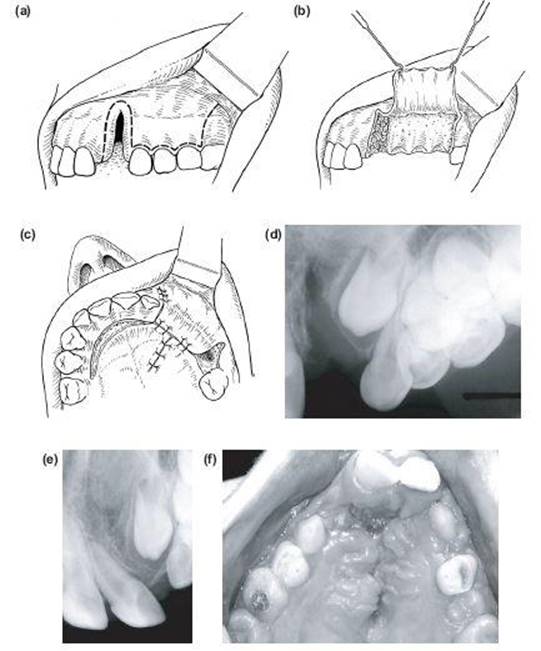
Figure 11.7 (c) Raising and rotating a buccal transposition flat. (d) Ungrafted cleft. (e and f) Canine erupting through consolidated bone graft.
9. The palatal flap from the greater segment is not always required in small defects.
10. Figures 11.7d–11.7f show the alveolar defect before and after grafting and the erupting canine.
Postoperatively
Intraoral bone grafts in cleft patients require meticulous postoperative care. The following precautions are recommended:
1. Preoperative intravenous antibiotics should be administered and then postoperative prophylactic antibiotics given orally for 5 days.
2. Maintain scrupulous oral hygiene. The patient is given a semi- solid diet by mouth and chlorhexidine gluconate mouthwashes.
3. Adequate analgesia for both oral and donor sites.
Segmental Surgery
Segmental surgery is now rarely required at the time of alveolar bone grafting, as orthodontic preparation or distraction osteogenesis will usually align the segments. It should be avoided because
a) fixation is problematic and
b) bone grafts do not unite with mobile segments.
However, the local dentoalveolar relationship may be improved by combining the alveolar bone graft with an osteotomy to the lesser segment or premaxilla. The most common indications are:
1. Adequate vertical and anterior growth of the greater alveolar segment but vertical deficiency of the lesser segment. This may be associated with dental arch collapse and recession with asymmetry of the nasal base.
2. The fistula is too large to close for bone grafting, and soft tissue coverage is not possible.
3. Orthodontic expansion of the arch has not been possible as the lesser segment may be trapped palatally.
4. Distraction osteogenesis is not available.
The Problems
· A unilateral alveolar defect.
· Anterior fistula and nasal base asymmetry.
· Deficient vertical growth of the lesser segment and collapse of the maxillary dental arch.
The Surgical Treatment
· Osteotomy to reposition the lesser segment.
· Bone graft to the alveolar defect and osteotomy site.
· Closure of the anterior oronasal fistula.
1. The initial incision is made around the intraoral margin of the fistula, as before. A horizontal sulcus incision can be made at this stage to improve access but this incision should now be made along the line of the greater segment (Figure 11.8a).
2. The lesser segment osteotomy is carried out at the LeFort I level from the buccal side by inserting a suitably protected bur or the narrow blade of a reciprocating power saw. The horizontal cut is carried through until the blade action can be palpated beneath the attached palatal mucosa (Figure 11.8b).
3. The lesser segment is still not free posteriorly. In cleft patients the anatomy of the tuberosity-pterygoid plate junction is frequently distorted and the bone may be very dense in this area. In order to free the segment, a 1 cm mucosal incision is made behind the tuberosity and a 7 or 10 mm thin osteotome directed vertically (Figure 11.8c).

Figure 11.8 Lesser segment of alveolar osteotomy at the time of alveolar bone grafting.
4. The freed lesser segment is now further mobilised by blunt dissection until it can be aligned according to the preoperative plan.
5. If the dental arch is expanded to any extent it will open up the cleft of the hard palate. This can only be made good by lifting and rotating the mucoperiosteum covering the palatal aspect of the greater segment and suturing it to the freshened edge of the palatal mucosa covering the lesser segment. The palatal mucosa covering the lesser segment should remain attached to maximise the blood supply to the segment. In practice, nasal layer closure is not found to be a problem, even after surgical expansion of the maxillary arch.
6. Cancellous bone chips and sheets of cancellous bone obtained from the iliac crest or by trephining the tibia, are used to fill the alveolar defect and to pack the osteotomy site on the lesser segment.
7. The lesser osteotomised segment is immobilised by attachment to the greater segment using a preformed arch bar (Figure 11.8d) ligated with 0.35 mm prestretched soft stainless steel wire.
8. There remains the oral mucosal defect on the buccal and alveolar aspect of the cleft. It is not advisable to raise an anteriorly based finger flap or buccal mucogingival transposition flap if above changes are made as suggested, this should be removed because this would compromise the buccal mucosal attachment to the osteotomised segment. The vestibular finger flap is therefore based posteriorly and raised from the mucosa and submu- cosa of the buccal sulcus between the anterior part of the greater segment and the lip, as shown in Figures 11.8c and 11.8d.
9. Suturing and postoperative care are as already described above.
Bilateral Clefts (Figure 11.9)
Orthognathic surgery for bilateral clefts is very difficult and should only be attempted by experienced surgeons. Three presentations will be considered. However all cases are complicated by:
i) scarring of the prolabium indicating poor vascularity,
ii) multiple previous operations,
iii) a large anterior palatal fistulae extending bilaterally through the alveolus, and
iv) marked asymmetry.
Presentation 1 — The Problems
· Large anterior palatal fistulae extending bilaterally through the alveolus.

Figure 11.9 Care must be taken not to compromise the blood supply of the premaxillary segment in bilateral cleft cases.
· Recession of the nasal tip.
· Shortening of the columella.
· Symmetrical flaring of the alar bases.
The Surgical Treatment
Closure of the anterior fistulae with bone grafts to the alveolar defects.
· Reconstruction of the nasal sills providing bony support to the alar bases.
· Lengthening of the columella, and forward repositioning of the alar cartilages with narrowing of the nasal tip.
· Rotation of the alar bases inwards towards the mid line.
· Narrowing of the nasal bridge (see Rhinoplasty).
1. Orthodontic expansion of the maxillary arch must precede surgery. Rapid maxillary expansion may be employed if the scarred palatal tissues are later mobilised surgically.
2. If the maxillary arch alignment and forward development is adequate, surgical dissection of the anterior fistulae and alveolar defects can proceed as in the unilateral case, duplicating the surgery for each of the two clefts (see previously).
3. Teeth in the premaxillary segment adjacent to the cleft alveolus on each side may be found to be denuded of bone. This applies particularly to any remaining lateral incisors. In order to achieve a successful bone graft such teeth must be removed.
4. It is difficult to raise a healthy mucoperiosteal flap from the palatal aspect of the premaxillary segment which can be sutured to the scarred palatal mucosa behind and the buccal flaps which are rotated inwards to cover the bone graft.
It is therefore better to confine the autogenous grafts to the higher and buccal parts of the alveolar defect and to make no attempt to achieve a bridge of bone across the anterior part of the hard palate.
Presentation 2 — The Problems
· Retroposition of the premaxilla with collapse of the maxillary arch, but satisfactory vertical growth of the bilateral posterior segments.
· Nasal deformity as above, but more severe.
The Surgical Treatment
· Osteotomy of the premaxilla in severe cases.
· Bone graft to the alveolar defects with closure of anterior fistulae.
· Rhinoplasty.
1. If the orthodontic expansion is satisfactory and produces a satisfactory alignment of each segment, surgical closure of the anterior fistula can proceed as in point 1 above.
2. Frequently, expansion of the lateral segments is achieved but the premaxilla remains retroposed (Figure 11.10a). In this case, an osteotomy of the premaxilla alone is necessary at the time of the alveolar grafting.

Figure 11.10 Osteotomy of the retroposed premaxillary segement in the bilateral case by sectioning of the vomerine-premaxillary spur (vms). Once displaced forwards the mucosa is carefully raised to provide cleft closure (g-l).
3. Retropositioning of the premaxilla also prevents surgical dissection of the clefts from a buccal approach. The premaxilla is held back by a solid spur of bone extending forward from the anterior part of the base of the vomer, the vomerine-premaxillary spur, VMS (Figure 11.10b). Figure 11.10c shows the sagittal section of a bilateral cleft to illustrate the vomerine-premaxillary spur of bone. This spur may have a cartilaginous section behind the premaxilla in some cases but is too dense to be fractured by manipulation alone.
4. The surgical exposure of this spur of bone can be achieved via the nose. Horizontal incisions are made in the nasal mucosa overlying the anterior part of the base of the septum (Figures 11.10d and 11.10e).
The mucosa is raised by sharp dissection on each side of the septal base in a downwards and backwards direction towards the oral cavity just behind the premaxilla. In this way the vomerine-premaxillary spur is dissected free of its overlying mucoperiosteal cover without penetrating the mucosa on the nasal and oral aspect. The spur is cut with a surgical fissure bur at which point the premaxilla can be swung forwards, opening up the cleft on each side with its mucoperiosteum still attached (Figures 11.10h and 11.10i).
5. Dissection of each side of the cleft can now take place as in the unilateral case and bone grafts inserted. Note the preservation of the mucosa on the back of the premaxillary segment to assist palatal closure together with the anteriorly based vestibular flaps (Figures 11.10j to 11.10l).
6. Figure 11.10j illustrates the amount of palatal mucosal which needs to be carefully raised from the back of the premaxillary segment to achieve oral closure after the premaxilla has been repositioned.
7. The premaxilla is immobilised by means of a preformed arch bar. Cap splints may be previously applied to the lateral segments but the premaxilla itself is best retained by gentle 0.35 mm ligatures to a preformed arch bar screwed to locking plates on each of the two cap splints on the lateral segments (Figure 11.10l).
8. Rhinoplasty is carried out as a secondary procedure.
Presentation 3 — The Problems
· A retropositioned premaxilla with a collapsed maxillary arch.
· Inadequate vertical growth of the lateral segments.
· Mid facial retrusion.
· Severe nasal tip recession.
The Surgical Treatment
This presentation would benefit from distraction osteogenesis. However if not available surgical correction can be performed in two stages separated by 6 weeks. It is impossible to carry out, with consistent success, segmental osteotomies, grafting of alveolar defects, closure of fistulae and total maxillary repositioning in one operation.
1. Orthodontic expansion of the lateral segments is usually required.
2. The premaxillary osteotomy and grafting is performed as in point 2 above. In this case it is frequently necessary to reposition the premaxilla upward to align with the lateral segments, in which case part of the nasal septum may have to be cut away to accommodate the segment.
3. A simultaneous segmental osteotomy of one or other lateral segment may be required to achieve satisfactory total arch alignment. If the lateral segments have been expanded orthodontically against resistance from the scarred palatal tissues, the palatal mucoperiosteum must be mobilised surgically at this stage to prevent relapse.
4. After at least 9 months, and preferably 1 year, a standard Le Fort I osteotomy with down-fracture can be undertaken in those cases where alveolar reconstruction has been successful. The repositioned maxilla no longer requires extraoral craniomaxillary fixation in addition to miniplate internal fixation.
5. Rhinoplasty is carried out after the maxilla has been shown to be stable for 1 year.
Lesser Segment Alveolar Distraction
Segmental alveolar distraction may overcome the technical difficulties of dividing and fixing small osteotomy segments. By slowly moving the lesser segment at one millimetre per day towards the cleft, the size of the alveolar and dental gap is reduced. This decreases the size of both the graft and the flaps raised to close the fistula. It may even eliminate the need for an autogenous bone graft.
· Segmental distraction is only possible in young patients with erupted teeth on which brackets and tubes can be applied to fit a rigid wire to guide the distraction forward and around the arch form.
· Care must be taken to preserve the vascular supply to the osteotomised bony fragment and so a tunnelling approach is used buccally and palatally in order to perform the osteotomy cuts.
· The segment of alveolus chosen to be distracted will determine the site of the interdental osteotomy cut.
· This site requires the provision of space by the orthodontist, and a rigid archwire is fitted before surgery to guide the distraction.
The Surgical Preparation for Distraction
1. A horizontal incision is made through the buccal mucosa and the flap is raised to provide access for the horizontal segmental cut and a vertical interdental cut which is started buccally with a fine surgical bur (Figures 11.11aand 11.11b). Interdental space has been made orthodontically. The adjacent palatal mucoperiosteum is also raised with a fine elevator such as a Frier or a MacDonald exposing only sufficient bone to make the equivalent vertical cut through the palatal alveolus.
2. The palatal horizontal cut is now made by a tunnelling approach through the anterior cleft margin with a periosteal elevator (Figure 11.11a) and then the distal interproximal bone is divided with a fine osteotome.

Figure 11.11 Segmental alveolar distraction.
3. The distractor is placed buccally across the vertical osteotomy site. The clover leaf plate on each side of the division is secured with three 5 mm screws and a trial distraction is carried out to ensure the fragment moves easily and the 3-dimensional vectors are correct (Figure 11.11d).

4. The wound is sutured without the need for relieving incisions. Postoperative care is as stated above.
5. The distractor is activated after 5 days to achieve 0.5-1.0 mm a day guided by the rigid arch wire within tubes attached to each tooth on the segment to ensure controlled forward movement. On completion of the distraction, as seen in Figures 11.11d–11.11f, a consolidation phase of 4-6 weeks is required to ensure maturation of the callus.
6. The distractor is then removed under an general anaesthetic and a gingivoperiosteoplasty is performed as for an alveolar bone graft to complete the closure. Bone grafting is rarely required as the alveolar cleft has been closed as a function of the osteodistraction.
Residual Fistulae
Small Fistulae
A double-layered closure is the most reliable technique, as is described in the alveolar bone grafting section. Figures 11.12a and 11.2b show a rotation flap based on the posterior palatal vessels, which must be patent. Reflection of the flap and skeletalising the exposed vessels gives a more manoeuvrable island flap.
The Surgical Treatment (Figures 11.12a to 11.12d)
1. Outline the fistula with a pen and the adjacent contralateral pedicled flap.
2. Infiltrate with a local anaesthetic containing vasoconstrictor.

Figure 11.12 Closure of a small residual palatal fistula.
3. Incise the margin of the fistula and undermine and elevate the inner fistula margin tissue into the nose sufficiently to close with a purse string suture using a small J shaped needle.
4. Incise the outline of the pedicled flap down to bone and elevate back to the posterior palatine foramen.
5. Separate the vessels visible on the under surface from the overlying submucosa with fine scissors, carefully and widely. If they have been thrombosed due to previous surgery go to point 8.
6. Cut the thick mucosal pedicle leaving the island flap attached by its palatine vessels.
7. Rotate the island flap over the lined fistula and suture with interrupted 4/0 vicryl sutures. The bare area should be covered with a ribbon gauze and Whiteheads varnish pack sutured around the margins and over-sewn for stability.
8. If the vessels are not readily separable, rotate the broad based pedicled flap (Figure 11.12b) suture and pack the bare area.
A pedicled sliding flap is shown in Figures 11.13a to 11.13c.
Closure of Large Fistulae in Cases Presenting Late
The Problem
Large defects of the anterior hard palate require a different strategy. They result from the expansion and advancement of grossly collapsed maxillary dental arches. Large fistulae also exist in some older patients due to the pattern of surgery practised 40 years ago or more. Such large oronasal communications become a major problem when full dentures are worn.
The Surgical Treatment
1. Unilateral or bilateral segmental alveolar distraction slowly closes the dental and alveolar gap and will generate bone in the alveolar region (see above) but if not available a flap will be required.

Figure 11.13 Large palatal fistula closure.
2. Tongue flaps.
· The tongue has an extremely good blood supply and has been extensively used for reconstruction of large palatal fistulae.
· Reconstruction is performed in two stages. The second stage to divide the pedicle and inset the flap may be 10–14 days from the initial procedure.
· The use of lingual mucosa over the alveolus is an unfavourable environment for tooth eruption and long term maintenance of periodontal health.
Lateral tongue flaps are reliable axial flaps and tend to be well tolerated and stable, despite tongue movements during the transfer stage.
Anterior-based dorsal tongue flaps are random flaps and are less well tolerated during the period of transfer as they are distorted by movements of the tongue. This may occasionally prejudice the blood supply. However, they provide an ideally shaped tissue transfer and leave little or no deformity of the tongue. The width is made slightly greater than the defect with two to three millimetres of muscle included with the mucosa to ensure the blood supply.
The Surgical Treatment
The Lateral Tongue Flap
1. The tongue margin is injected with 1:200,000 adrenaline in 0.5% Bupivacaine. Hypotensive anaesthesia is used if available. A 2/0 black silk mattress stay suture through the tip facilitates access.
2. The flap is incised comprising the lateral one-third of the tongue based posteriorly, but excluding the tip (Figure 11.14a).
3. A marginal flap of palatal mucosa is raised from the recipient site area to facilitate suturing and to increase the area of contact (Figure 11.14b). The free tip of the tongue flap is then sutured with 5/0 vicryl to the anterolateral lip of the fistula. The margin of the flap is firmly sutured to the adjacent palatal mucosa. It is better to close a left-sided fistula with a right-hand tongue flap, and vice versa, as it is found in practice that the flap lies more naturally when so arranged.
4. The tongue flap remains with its dual attachment for 14 days, at which point a further anaesthetic is administered. An inexperienced anaesthetist may find difficulty in intubating a patient with a tongue flap attached to the anterior palate because of the obvious problems associated with the insertion of a laryngoscope. To avoid this problem, the base of the flap can be severed under local anaesthetic prior to the induction of general anaesthesia but in practice this is rarely necessary.

Figures 11.14 The lateral tongue flap used to close a palatal fitula.
5. After division, the tongue flap free edges are sutured to palatal mucosa round as much of the fistula as possible (Figure 11.14c). The flap will be used as a split tube but it is usually impractical to form a sutured nasal layer at this stage. As long as the transferred flap can be attached completely to one side of the fistula, the nasal surface can be left until later. The flap remnant attached to the tongue is fashioned to fit back into the side of the tongue. Tongue shape can usually be restored almost to normal.
6. As it is rarely possible to complete the closure of a large oronasal fistula when the tongue flap is first separated, 2–3 further weeks later the remaining free edge of the fistula is separated into the oral and nasal layers. The tongue flap is split along its free margin and its nasal surface used to complete the nasal layer. The oral mucosal defect is closed, partly by the oral surface of the tongue flap and partly by a vestibular flap, as shown in Figures 11.14d and 11.14e. Separation of an oral and nasal layer means that a bone graft can be inserted at this stage if necessary.
7. The completed flap tends to be somewhat bulky, however carefully it has been trimmed. If it is intended to be used as a denture-bearing area, it may be thinned later.
The Anterior Based Dorsal Tongue Flap
1. The tongue is held forward with two lateral 2/0 black silk stay sutures. The flap is marked with ink and the site injected with local anasesthetic and a vasoconstrictor (Figure 11.15a).
As the mucosa and submucosal muscle is profusely supplied with a rich vascular plexus, especially at the tip of the tongue, the base of the flap does not have to overly the proximal blood supply. The anterior base provides a flap that is easy to insert but restricts the tongue's movements during the transfer stage.
2. The posterior and lateral margins of the fistula are incised with a No. 11 blade and raised with Mitchell's trimmer to provide a shelf-like flap. This stage helps to estimate the width and length of the flap. A base of 3 cm allows a flap of 5 or 6 cm in length.
The tongue flap is incised to a depth of 4 mm to include an undersurface of submucosal muscle, and is then carefully dissected free. Bleeding points on the donor site are sealed with bipolar diathermy to ensure only localised coagulation.
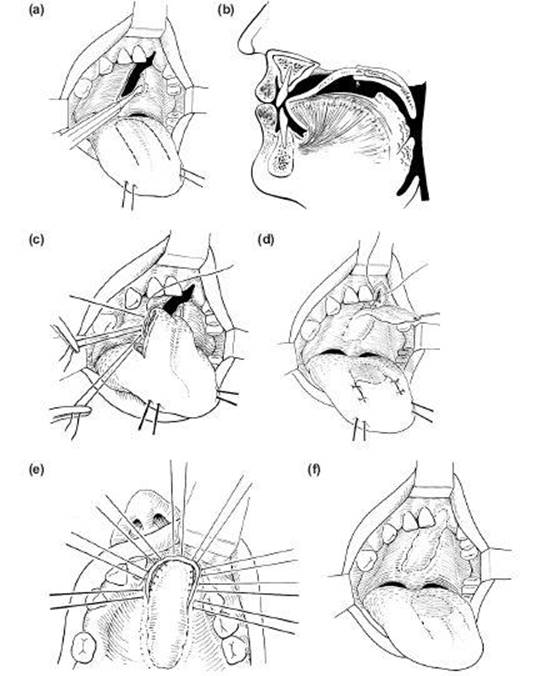
Figures 11.15 The anteriorly based dorsal tongue — stage 1 (a-c) and stage 2 (d-f).
3. The tongue flap is set into the palatal mucosa shelf margins, with the raw submucosal surfaces in contact and the papillated lingual mucosa facing upward towards the nose (Figure 11.15b). This is done with a series of 5/0 vicryl mattress sutures. These are left untied and clamped with mosquito forceps to allow freedom of access until the maximum number of sutures is inserted (Figure 11.15c). They are now carefully tied with a triple knot and cut short. There is no need to close the nasal layer at this stage.
4. The flap may be rested by inserting loose intermaxillary tie wires through eyelets around the teeth in upper and lower dental arches.
5. Three weeks later the base is divided and the flap (with its raw surface now re-epithelialised) trimmed and set in anteriorly in the same way as was the tip (Figure 11.15d). If the anaesthetist anticipates difficulty in intubation, the flap can be incised under local anaesthetic just prior to the intubation procedure. Ideally this should be done in the operating theatre. Excess flap is sutured back on to the de-epithelialised donor site, which heals spontaneously with minimal defect (Figures 11.15e and 11.15f).
6. If a cancellous bone graft is inserted, the nasal mucosal layer is raised and closed with 4/0 vicryl (Ethicon Ltd, Edinburgh, UK).
Note: This technique, which provides an easy and reliable means of inserting the flap margin, is possible because of the rapid epithelialisation of the raw muscle on the undersurface of the flap. Furthermore, it takes on the normal mucosal character instead of remaining a patch of tongue on the palate.
Extraoral Flaps
If intraoral tissue is not sufficient for the largest fistulae a microvascu- lar transfer of a free radial skin flap or free radial fascial flap can be combined with local mucosal turn-over flaps to close the nasal layer together with bone to fill any bony defects of the alveolus and hard palate.
Residual Oronasal Fistulas in the Soft Palate
Oronasal fistulas in the soft palate require correction if there is a loss of oral pressure during speech. The best approach in the presence of poor speech is a complete re-repair of the soft palate. This improves the function of the velopharyngeal mechanism and speech improves as a consequence.
Residual Nasolabial Fistulae
If left until alveolar bone grafting there will be less overall scarring. Presurgical orthodontic expansion gives good access to the whole cleft. The fistula is excised and good nasal layer should be reconstructed as described above in the alveolar bone graft section. The interpositional bone graft improves the success of the closure.
Orthodontic Considerations
The objectives of presurgical orthodontic treatment for the cleft patient are not the same as non-cleft patients. The most obvious differences are;
i) Management of the dental gap in the cleft region.
In the unilateral case with a full dentition on the non-cleft side, closure of the space in the cleft gap may not be aesthetic, whereas in the bilateral case where both maxillary lateral incisors are missing, a satisfactory aesthetic result can be achieved by bilaterally closing the space. However, closure of the spaces will change tooth contacts and may make intercuspation difficult to achieve.
Orthodontic alignment following the alveolar bone graft will optimise the bone support for the teeth. It also aligns the tooth roots to produce the best possible incisor and canine crown angulation thereby facilitating a range of restorative options for replacing the missing lateral incisor.
ii) Transverse dento-alveolar collapse.
Achieving sufficient maxillary expansion and transverse stability is a great challenge. Orthodontic expansion of the dental arch must be within a reasonable expectation of stability. Dental relapse disturbs the surgical result in both the antero-posterior and lateral dimensions. Permanent transverse retention may be needed to overcome rigid palatal scarring.
With significant transverse deficiency surgical widening at the time of the maxillary advance may be considered but a posterior cross-bite is preferable to the creation of a fistula or losing segments due to ischaemic necrosis.
Orthognathic Surgery
Orthognathic correction should be delayed until facial skeletal growth is complete. Other congenital defects, such as congenital heart disease must be identified early.
Specific Problems in Cleft Patients
· The Class III skeletal problem affects the paranasal, nasal, infraorbital, and zygomatic regions in the anteroposterior and lateral planes, and may even cause exorbitism with poor eyelid support.
· The associated malocclusion frequently includes anterior open bites and posterior cross bites which impair eating, speech and the long-term health of the teeth and their supporting bone.
· The deformity also impairs nasal breathing and drainage, olfac- tion and hearing.
· Dental development may also be delayed in both arches but is most evident in the cleft segment and may compromise the presurgical orthodontics.
· The repaired alveolar cleft is a potential site for fracture at the time of the down-fracture.
· If the maxillary alveolus has not been reconstructed, alignment of the alveolus can be incorporated into the orthognathic procedure. However it complicates the planning of the surgery and increases the potential morbidity. Segmental osteotomies are less stable than one-piece maxillary osteotomies.
· Previous surgery produces scarring of the labial and buccal vestibule, the palate and behind the maxillary tuberosities. This presents problems with the surgical incisions, mobilisation and postoperative closure of the surgical wound.
· A pharyngeal flap may make advancement of the maxilla difficult and will need to be divided. The patient has to be informed well in advance.
· Earlier distraction osteogenesis is an option for management of the maxilla if the patient has gross skeletal deformity (see later).
Preparation of the Patient for Surgery
The preparation of the patient and parents starts earlier than in the non-cleft population. Families with cleft lip and palate children get considerable support from self-help organisations. Despite this these deformities have profound psychological effects and the support of a clinical psychologist is often helpful.
Dental Care and Preparation
Oral hygiene instruction, dietary advice, periodontal and restorative treatment should be initiated before pre-surgical orthodontic preparation. The early loss of teeth has catastrophic consequences for any future orthodontic, orthognathic and restorative dental treatment.
Treatment Planning
The basic facial and orthognathic evaluation is the same as the non-cleft case with important refinements.
a) Lip-incisor relationship.
As in the non-cleft case, the lip to maxillary incisor relationship is extremely important. The major surgical moves are predominantly in the maxilla and with a tight, previously scarred upper lip, small skeletal moves have a pronounced effect on the incisor exposure. Surgical and orthodontic changes in incisor angu- lation will have a similar effect.
b) Asymmetries.
Both dental and skeletal asymmetries are dominant features, often with compensatory asymmetries in the mandible. Where possible, preoperative orthodontic management will make the surgical correction technically easier. If dental asymmetries are to be corrected after surgery, space will need to be maintained.
c) Preoperative speech assessment and counselling.
Ideally all cleft patients should have a full preoperative speech assessment with nasoendoscopy and videofluoroscopy. The patient with adequate velopharyngeal function preoperatively generally maintains function, unless the maxillary advance is large. Patients with borderline velopharyngeal function are at risk of developing hypernasality postoperatively. These patients need to be identified and followed up for evaluation and corrective treatment.
The Choice of Operation
Maxillary Hypoplasia
· The LeFort I osteotomy will give acceptable results at the occlusal level with antero-posterior advancement and vertical lengthening.
· Transverse maxillary widening can be accomplished by a para-median osteotomy of the hard palate on the non-cleft side within the constraints discussed above.
· Patients with severe hypoplasia of the infraorbital and malar regions can be improved by the high LeFort I level osteotomy. Graft augmentation either at the same time or as a secondary procedure combined with a rhinoplasty may be necessary.
· The modified LeFort II or Kufner LeFort III osteotomy, do not give accurate control of movement in asymmetrical cases.
· Nasal airway obstruction may arise from a deviated nasal septum narrowing of the nares, hypertrophied turbinates, nasal polyps and posterior choanal constriction from sub-periosteal bone and asymmetrical vomer flaps.
· Pharyngeal obstruction can be caused by hypertrophied adenoidal tissue or pharyngeal flaps.
· The management of these problems is an essential part of the orthognathic procedure. Paradoxically the adenoid mass may contribute to velopharyngeal function and its removal may precipitate velopharyngeal inadequacy.
Implications for the Mandible and/or Chin
· Although many cleft patients may also have a latent mandibu- lar hypoplasia, there is invariably a relative mandibular prog- nathism. Functional, aesthetic and surgical considerations may need a mandibular setback. The maxillary surgical limitations are severe palatal scarring, borderline velopharyngeal insufficiency or a tight inferiorly based pharyngoplasty flap.
· During maxillary advancement and inferior positioning, the anterior maxilla is differentially positioned more inferiorly. This will produce a posterior open bite deformity unless a mandibular ramus procedure is undertaken simultaneously. Differential down grafting of the anterior maxilla also results in a counter clockwise rotation of the mandible which may make the chin retrogenic. This can be corrected by a simultaneous augmentation genioplasty.
Maxillary Advancement in the Previously Bone Grafted Maxilla
At the time of orthognathic surgery all oro-nasal fistulae should have been closed and the dentoalveolar arcade should be intact. Presurgical orthodontics will have aligned and coordinated the dental arches. In these ideal circumstances the osteotomy technique is similar to a non-cleft patient undergoing maxillary surgery. However, infection, bone and soft tissue necrosis, delayed healing, loss of teeth and relapse all occur with greater frequency.
Special Considerations — The Osteotomy Cuts and the Down-Fracture
· In most cases a standard vestibular incision taken higher in the labial sulcus gives good access posteriorly and ensures a good vascular supply buccally. Care must be taken to preserve the parotid duct.
· Subperiosteal dissection is carried out with elevation of the soft tissues to the infraorbital nerves superiorly and to the pterygo-maxillary fissures on both sides. The nasal mucosa is elevated bilaterally from the nasal floor.
· In bilateral cases, where the blood supply to the premaxillary region is compromised due to gross scarring from previous surgery, a full labial incision and down fracture may be unwise and a tunnelling approach is preferable from a small vertical incision in the mid line to give access to the premaxillary bone to enable full mobilisation of the maxilla.
Ancillary Surgical Manoeuvres
Segmental Maxillary Surgery
· If vertical steps are present in the maxillary arch, orthodontic segmental levelling is undertaken and the maxilla expanded prior to surgery. However with severe displacement and gross arch collapse this may not be achievable. Segmental distraction osteogenesis may be an appropriate alternative.
· Although surgically moving segments vertically avoids intrusive and extrusive orthodontic mechanics and may be more stable long term it is the most difficult of the three options.
· Surgical expansion, segmental alignment and levelling require interdental osteotomy cuts for which a minimum of a 3 mm of interdental space needs to opened by the orthodontist by tipping the roots away from the osteotomy site or bodily opening up a gap prior to surgery. Endodontic and periodontal complications will follow without careful presurgical planning.
· The palatal and interdental cuts are performed from above, following the down-fracture. A limited vertical tunnelling approach laterally facilitates access to the buccal cortical plate which is divided with a fine bur but the interdental cut is completed with a narrow 5 mm Osteotome. Ideally orthodontic bands rather than bonded brackets should be placed on the teeth adjacent to the interdental osteotomy site as bonded appliances do not withstand the forces needed to mobilise the maxilla in segmental cleft surgery.
· A large rectangular arch wire with surgical hooks should be wired to the orthodontic bands to aid fixation. A heavy supplemental arch wire fitted into distal tubes is required to help locate and stabilise the occlusal relations of the segments, with the help of a wafer in addition to the bone plate osteosynthesis. This can be a chrome cobalt or a high impact acrylic intermediate wafer. The wafer can be left in situ for two weeks post-operatively to supplement the fixation.
Airway Considerations
· Whilst the maxilla is down fractured contouring of the inner aspects of the nose can be achieved easily and time should be taken to bur out any bony excesses in the nostril on the cleft side.
· Asymmetries in the piriform region can be corrected which may interfere with the repositioning of the maxilla or distort the nose. The mucosa of the nostril floor can also be repaired at this stage.
· With a unilateral cleft the septum is usually deviated towards the non-cleft side inferiorly with a bowing towards the cleft side. A septoplasty may be necessary to correct the aesthetic and functional problems. The subnasal approach after the down-fracture provides excellent access to the cartilaginous septum, the vomer and the perpendicular plate of the ethmoids.
· Partial or complete inferior turbinectomies may be indicated if they are enlarged and cause nasal obstruction. Submucosal turbinectomies can be performed under direct vision through an incision in the nasal mucoperiosteum.
· Antral and nasal polyps can be removed at the time of down fracture.
· Pharyngeal flaps raise additional concerns for the anaesthetist and surgeon. The pharyngeal flap that has a broad base or small portals may make intubation difficult and restrict the nasal airway postoperatively. The flap will need to be divided several weeks preoperatively and the patient's speech and language reassessed postoperatively. Inferiorly based flaps may restrict maxillary advancement but at the time of down fracture access to the flap is relatively good and the flap may be lengthened. Superiorly based flaps are less restrictive on maxillary advancement and can also be lengthened at the time of maxillary advancement. Soft palate re-repair or a repeat pharyngeal flap should be considered carefully as they may further impair the maxillary vascular supply.
· Bone grafting — cortico-cancellous bone grafts should be used to fill the voids created by any inferior positioning of the maxilla as this will improve the stability of the osteotomy postoperatively. Bone grafts should also be shaped and placed to address any specific cosmetic deficiencies and asymmetries. These bone grafts can be tailored to meet the individual requirements of the patient and rigidly fixed to the surface of the maxilla and zygomas with mini screws or wire.
· Mucosal asymmetries of the lip may be corrected by using asymmetric V to Y closures of the labial mucosa. Final lip correction should be left until postsurgical orthodontic refinement of the occlusion including any minor changes in the incisor position, or cosmetic dental treatment have been completed.
Postoperative Manoeuvres
Intermaxillary elastics to orthodontic archwires may be used to assist in providing proprioceptive input in guiding the jaws into occlusion but should not be used in an attempt to recover a situation where the skeletal elements are incorrectly related. The prolonged use of elastic traction should be avoided as there is a risk of a bony non-union of the maxilla.
As a prophylactic measure, extraoral elastic traction using a face mask can be used in patients who are considered particularly at risk of relapse either due to scarring or who have had large surgical moves anteriorly and inferiorly. The value of this is uncertain (Figures 11.16a and 11.16b).

Figures 11.16 After maxillary surgical advancement, extraoral elastic traction support may be useful in a patient at risk of relapse.
Effects on Speech
Maxillary advancement increases the velopharyngeal distance so that postoperatively, patients are at risk of developing velopharyngeal incompetence. The soft palate mechanism in non-cleft patients has considerable reserve capacity and can adapt to an increase in length. The repaired cleft soft palate does not have this capacity to adapt especially after major advances. The patient with borderline velopharyngeal incompetence preoperatively is likely to develop worsening of their speech postoperatively.
Lip and Nose Changes with Maxillary Surgery (See also the Rhinoplasty Chapter)
• Mismanagement of the soft tissues during closure of the labial vestibular incision may cause shortening and thinning of the upper lip.
The V to Y closure of a maxillary vestibule incision may increase the vermilion show in patients with a thin upper lip.
• Maxillary advancement widens the alar base, increases the projection and elevation of the nasal tip and the width of the nares.
Various surgical manoeuvres can be used to prevent these unwelcome side effects. These include an alar base cinch suture, recontouring the bony piriform aperture either by trimming and/or asymmetric bone grafting and alar base resections.
Achieving Stability
Stability after orthognathic surgery is unpredictable due to scarring. The factors that increase stability include:
· Meticulous orthodontic preparation and quality of the occlusion achieved.
· Avoiding segmental procedures and unfavourable surgical moves.
· Surgical overcorrection where possible. The cleft maxilla usually requires a least a 9 mm advancement.
· Ensuring that all adhesions are divided so that the maxilla can be advanced passively into the planned position. If this is not possible then a compromise position must be planned and if necessary incorporate a mandibular setback.
· Alveolar bone grafting.
· Bone grafting for inferior repositioning of the maxilla.
· Internal rigid fixation for all moves.
Skeletal Relapse
Most relapse occurs within the first few months. Where the relapse is significant, the options depend upon the occlusal relationship. If the occlusion has compensated for the skeletal relapse, then masking procedures such as onlay bone grafts may be an option.
If the occlusion cannot be recovered through postoperative orthodontics, then further skeletal surgery must be considered but with no guarantee that the osteotomy will not relapse again. Maxillary distraction may be a reasonable option in the management of relapse.
Dentoalveolar Relapse
Transverse dentoalveolar relapse is a problem following large orthodontic or surgical palatal expansions. Such patients may require permanent palatal retention. However it is better to accept a planned posterior cross bite than put the maxilla in an unstable position, as relapse at one site may undermine the stability of the whole maxilla.
Mid Face Distraction Osteogenesis
Indications
For the majority of patients, conventional orthognathic surgery gives excellent results that are stable and aesthetically pleasing. However there are some situations when distraction should be considered:
Severe Maxillary Deficiency and Complex
Three-Dimensional Deficiency
· With gross maxillary hypoplasia and a severe degree of scarring, the degree of advancement may be beyond the expected limits of stability of a conventional osteotomy. Distraction of the maxilla is preferable to a surgical compromise such as a mandibular setback.
· If the deformity is complex particularly in the upper mid face then a higher level osteotomy with distraction often gives a better result than a modified LeFort I with masking onlay bone grafts or modified LeFort II and LeFort III osteotomies that are difficult to perform and can give unsightly steps particularly over the radix of the nose.
· Slow expansion of the maxilla may produce a more stable increase in the width of the maxilla and face than surgical repositioning or presurgical orthodontics.
· Relapse surgery for distraction is less than a repeat osteotomy and full mobilisation with down fracture is not needed. One is less likely to run into poor vasculature problems in the re-operation site. By slowly advancing the maxilla the resistant forces may be overcome more easily.
Stability and Effects on Speech
Some claim that distraction produces less disturbance of speech with reduced incidence of velopharyngeal incompetence. The potential advantage of an increase in soft tissue following distraction also is helpful for the closure of large fistulae.
Disadvantages
· The procedure takes longer than conventional surgery and involves at least two stages.
· The control of the movement vectors in maxillary distraction is difficult and less precise than an osteotomy.
· Simultaneous mandibular procedures may be necessary and must be coordinated with the maxillary distraction to overcome a prolonged period without a functioning occlusion.
Method and Choice of Distraction Device
· The surgery is similar to conventional orthognathic surgery but instead of the maxilla being placed into the surgical wafer at the end of the procedure and fixed with plates, a distractor is applied.
· The choice of distractor is determined by the desired direction and distance the maxilla needs to be moved.
Internal Distractors
Are partially buried and give excellent control over vectors, but require
· adequate bone on both sides of the osteotomy cuts to fix them,
· extensive sub-periosteal stripping that may impair new bone formation, and
· a patient with good manual dexterity to turn the appliance either inside the mouth or externally in the temple region.
Extra-Oral Distractors
Are easier to activate, but
· give less control over the vectors of distraction,
· do not control the posterior maxilla well, and
· require a frame that is a disadvantage particularly if in place for the duration of the stabilisation phase.
LeFort I Distraction (Figures 11.17a–11.17e)
LeFort I distraction is performed by carrying out a standard or modified higher level LeFort I osteotomy cuts. If any of the previously described ancillary manoeuvres are needed then a maxillary down-fracture is incorporated into the procedure before the distractor is applied. External distractors are connected to the maxilla either with cap splints, or pre-formed arch bars, or directly to plates fixed to the bone or both. This depends on the desired moves and the need to control vectors during the distraction procedure. Controlling the vector can be difficult as often the distractor position is determined by the lip and nose and a compromise may have to be made.

Figure 11.17 An external distraction frame used for maxillary advancement.
LeFort II Distraction (Figures 11.18a–11.18g)
For patients with severe maxillary hypoplasia a higher level of distraction is needed to improve the mid face aesthetics. This may need to be performed in combination with a mandibular sagittal split osteotomy to improve the mandibular plane angle and to allow for the elongation of the maxilla in the vertical dimension. Further wires are attached to the hypoplastic malar bones to guide their distraction forwards. Slow distraction at this level seems to give a better shape to the nose than a standard LeFort II advancement that would normally require bone grafting and which can lead to steps and irregularities.

Figure 11.18 Simulataneous differential distraction of the maxilla at two or more levels may produce a better balanced facial contour.
LeFort III (Kufner) Distraction
If there is significant orbital rim hypoplasia then distraction at the LeFort III level may be useful, particularly as bone grafts in this area are difficult to contour and produce disappointing results in the short term and are notoriously unstable in the long term.