
· Single Jaw Deformities
Mandibular prognathism
Mandibular asymmetry
Mandibular retrognathism
The chin
Mandibular incisor proclination
Maxillary hypoplasia
Nasomaxillary hypoplasia
Malar-maxillary hypoplasia
Maxillary prognathism
· Bimaxillary Deformities
Gross mandibular prognathism
The deep overbite
Bimaxillary proclination
The long face
The open bite (apertognathia)
The large tongue
The short face
Maxillary asymmetry
· Unfortunately, the diagnosis of a facial deformity does not always suggest an operative solution. There may be a choice of procedures or the complexity requires several simultaneous osteotomies. This chapter considers both single jaw and bimaxillary deformities. As will be seen, there is usually an overlap and what appears to be a major single jaw problem invariably requires a bimaxillary solution.
· It is also impossible to classify all cases under one treatment group. For instance, a patient with a long face may have an open bite. Both treatment sections in this chapter should therefore be consulted.
· Although it is possible to describe horizontal and vertical deformities separately, they are surgically interdependent, in that a vertical osteotomy will produce a horizontal change and vice versa.
Timing
The choice of age for any orthognathic procedure can be difficult. The optimum age is when facial growth has finished. This is approximately 16 years for girls and 18 years for boys. Later maturation of the face can undo the benefit of a well-intentioned osteotomy. This is particularly true if the prognathic mandible is treated too early. The only exception is the rare unilateral condylar hyperplasia which may require ablation of the articular growth cartilage during adolescence to prevent a major degree of secondary deformity. As all young patients with jaw deformities require orthodontic treatment, this provides a period of scrutiny to monitor continued growth with study models and lateral skull radiographs, at yearly intervals. Wrist radiographs when considering abnormal facial growth and sequential technetium-99m bone scans are unhelpful.
Presurgical orthodontic treatment not only simplifies the operative procedure but also improves the occlusal and profile outcome. However a decision must be made if surgery is to be the ultimate treatment of choice. The orthodontic decompensation for surgery for a jaw disproportion will be different from the pure orthodontic compensatory management to conceal the deformity, and will start later to reduce the period in appliance retention. Therefore, please read Chapter 4 (Orthodontic Preparation).
The neglected details of planning and data transfer and fixation are to be found in Chapters 7 and 8 and those for each operation are described in Chapter 9.
Single Jaw Deformities
Mandibular Prognathism
This is characterised by elongation of the mandible producing a negative overjet, with compensatory retroclination of the lower incisors, and proclination of the upper incisors. Both the dentition and jaws show a marked Class III relationship. Some patients also have an increased lower facial height which is automatically reduced when the mandible is displaced backwards, up an inclined occlusal plane (Figure 10.1).
Beware of seeing all negative overjets as cases of mandibular prognathism. With a mild mandibular protrusion in a man, the preferred aesthetic solution is often a forward movement of the maxilla, leaving a “strong chin”. This profile correction may be predicted by padding out the upper lip with cotton wool or wax. The same cephalometric values in a female usually require a mandibular setback for aesthetic harmony. The occlusal correction is identical in both cases.
Most prognathous mandibles are associated with a degree of maxillary retrognathism with the need for a bimaxillary correction. This becomes clear after presurgical orthodontics with incisor decompensation (see below, Bimaxillary Deformities).


Figure 10.1 Mandibular prognathism requiring moderate orthodontic decompensation of the incisors followed by a sagittal split pushback. (a), (b) and (e) Preoperative. (c), (d) and (f) Postoperative.
Treatment
Presurgical orthodontics will be required to correct arch size discrepancy, overcrowding and to decompensate the incisors. Posterior displacement of the mandible can be achieved by a:
sagittal split osteotomy,
and less commonly,
oblique subcondylar (subsigmoid) osteotomy
a) extraoral,
b) intraoral (buccal approach), and
c) intraoral (medial approach).
Mandibular Asymmetry (Unilateral Hyperplasia and Hypoplasia of the Mandible)
Introduction
There are two distinct types of asymmetrical overgrowth, but hybrid forms are occasionally found with both abnormalities merged on one side or even one of each deformity on opposite sides. Each deformity is frequently attributed to condylar hyperplasia. However, in both types the increased dimension arises beyond the accepted localised area of condylar growth.
Unilateral hypoplasias will be treated in the same manner as mandibular retrognathism, except when part of a hemifacial microsomia deformity, which will require additional attention to the difficult problem of soft tissue deficiency.
Beware of diagnosing asymmetry where a malocclusion is really causing a unilateral displacement of the mandible on closure.
Hemimandibular Elongation
This asymmetry presents with an increased ascending ramus width and length of the body on the affected side, with deviation of the dental and jaw midline to the contralateral side and a crossbite (Figure 10.2). The condylar head may be minimally enlarged compared with the normal side but the neck is elongated. The occlusal plane is undisturbed. Surgical correction should be delayed until the end of adolescent growth particualrly as some cases “creep on” to the end of the second decade.
Treatment
Presurgical Orthodontics
Insufficient maxillary intercanine width to accommodate the lower arch is not uncommon. Surgery should therefore be preceded by maxillary expansion. Where there is a gross discrepancy between the arches the maxillary arch may be expanded with a quadhelix appliance, which increases the width from behind forwards over a period of three to five months. However in such cases, tipping of the molars may relapse postoperatively and produce an anterior open bite. For this reason with large discrepancies surgical expansion of the maxilla may be the treatment of choice or distraction osteogenesis with a bone borne expansion appliance.


Figure 10.2 Left hemi-mandibular elongation with prognathism and deviation of the midline to the right, corrected by a bilateral sagittal split osteotomy. (a), (b) and (e) Preoperative. (c), (d) and (f)Postoperative.
Surgery
Asymmetry, with or without prognathism, can be corrected by a bilateral ramus osteotomy, such as the sagittal split, which shortens the affected side and allows rotation at the contralateral angle.
Although correction of the bony deformity produces a marked improvement in appearance by eliminating both the unilateral deviation and prognathism, there is often a persistent asymmetry of the face in movement.
Recurrent growth creates a difficult decision and will require a careful high condylar shave preserving the meniscus.
Hemimandibular Hyperplasia
This type of mandibular asymmetry often starts dramatically with the pubertal growth spurt, although it is detectable earlier. Other cases appear to develop insidiously during adolescence. Another enigma is the principal site of overgrowth. Although often considered to be a condylar hyperplasia, there is, in addition to the considerably enlarged condylar head and ascending ramus, a convex downward growth of the lower border of the mandibular body which extends as far forward as the midline. Initially this creates an ipsilateral lateral open bite followed by secondary maxillary alveolar growth. When all mandibular growth is complete, there is an overall hemimandibular hyperplasia and an occlusal cant down to the affected side but no deviation of the midline (Figure 10.3). The inferior dental neurovascular bundle is carried downwards with this growth. This seems to be associated with hyperplasia of the associated mylohyoid muscle in the same way as masseteric hyperplasia produces an enlarged square gonial angle. Excess growth appears to cease in most cases at the end of puberty. It is interesting to see the ipsilateral antral floor is also lower due to remodelling following the alveolar downgrowth.

Figure 10.3 (a) to (e) This left hemi-mandibular hyperplasia dramatically occurred over 6 months at the onset of puberty. There is no horizontal displacement of the lower midline despite the increase in vertical dimensions producing a lateral open bite.
Treatment
Early
When seen early, the aim of surgery is to reduce ramus height before the secondary alveolar growth creates a permanent asymmetry with an oblique cant of the occlusal plane. It is tempting to remove part or all of the condyle to ablate the growth centre, i.e. a partial condylectomy. However, not only does the excess growth take place throughout the hemimandible beyond the influence of the condylar growth area, but it has usually finished by the time the deformity is diagnosed. Therefore, at this stage, surgical damage to the joint mechanism would seem unwarranted. A simple approach is a subsigmoid osteotomy, either intraorally or extraorally, to bring the teeth into occlusion. Later the increased depth of the body of the mandible can be corrected with trimming of the lower border and this can be done extraorally through a skin crease incision (see below) or if access permits, intraorally. However the displaced neurovascular bundle must be protected.
Late
Where compensatory alveolar growth has taken place, bringing the separated buccal segment teeth into occlusion, the most economical correction is simply reducing the lower border convexity. This improves the facial appearance and corrects the obliquity of the mouth, but not the occlusal plane (Figure 10.4). However, if desired, the downward tilt of the occlusal plane can be corrected with a bimaxillary procedure elevating the maxilla with a Le Fort I osteotomy (see Maxillary Asymmetry) and the mandible must then be adjusted to this horizontal occlusal plane, either by a sagittal split or subcondylar osteotomy. Finally, the convex lower border will still need to be trimmed. This is sometimes possible intraorally but is more easily achieved in conjunction with an external subcondylar osteotomy through the same skin incision.
Rarely, when all growth seems to have ceased and the deformity has been corrected, the condylar cartilage may suddenly spring to life again. This justifies a condylar cartilage trimming procedure with careful preservation of the meniscus.


Figure 10.4 Lower border cortical split to expose and preserve the neurovascular bundle prior to trimming the excess depth of mandible. (a) The outer cortical plate is removed. (b) If the neurovascular bundle is found within the hyperplastic lower border, it is dissected from its canal and retracted prior to resection of the inner cortical plate (c) and (d). An adult left-sided hemimandibular hyperplasia where the lateral open bite has closed spontaneously leaving an ipsilateral downward slope of the occlusal plane. The external deformity has been corrected by trimming the lower border of the mandible through an external approach. (e) and (f) Preoperative. (g) to (i)Postoperative.
Trimming the convex mandibular lower border (Figure 10.4).
1. An aesthetic incision is made in a low skin increase, or where a crease might be anticipated. The mandible is exposed subperiosteally.
2. The lower border excess is outlined with bur holes, using the normal side for comparison (Figure 10.4a).
3. These holes are then joined together, cutting only through the outer cortex so as not to damage the inferior dental neurovascular bundle, which is invariably near the lower border.
4. A similar cortical bur cut is then made along the lower and posterior border and the excess outer cortex can then be split off with an osteotome, which is inserted in the lower cut, and rotated (Figure 10.4b).
5. This allows the neurovascular bundle to be exposed by carefully trimming off its overlying shell of compact bone.
6. The bundle is retracted and the excess lingual plate is trimmed off and the margins smoothed (Figures 10.4c and 10.4d). The neurovascular bundle is then left loosely sutured above the new lower border.
7. The wound is drained and closed in layers after loosely suturing the neurovascular bundle into the deep aspects of the wound. The skin is sutured with a continuous subcuticular 3/0 Prolene suture.
Figures 10.4e-10.4i shows such a case.
Condylar Hypoplasia
Occasionally it can be difficult to decide whether the asymmetry is the result of unilateral overgrowth or contralateral deficiency. Most unilateral hypoplasias appear to follow neonatal or childhood condylar damage with preservation of the meniscus. In addition to deviation of the chin to the affected side, the condyle is usually short, flattened or deformed. An exaggerated antegonial notch is present on the affected side. As the deficiency in ramus height gives rise to a secondary restriction in maxillary growth, the asymmetry is also reflected in the transverse occlusal plane. This is tilted downwards towards the normal side. Loss of the meniscus through a fracture displacement or destruction by infection or juvenile arthritis may lead to joint ankylosis and an even greater asymmetry due to the lack of functional stimulation to the growing mandible. Such cases require reconstruction of the joint with a costochondral graft (see Chapter 13).
Treatment
Moderate degrees of hypoplasia may be treated like an asymmetrical hyperplasia, with a bilateral sagittal split osteotomy. This will lengthen the affected side and provide a rotation adjustment on the normal side. However, the maxillary occlusal plane has to be levelled first. In adolescence this can be achieved orthodontically after the mandibular surgery by creating a lateral open bite intraoperatively with a unilateral thickened occlusal wafer or splint. The lateral space to be created may be estimated by examining the models mounted with a face-bow on an anatomical articulator. In most cases, a little excess is desirable. Following the sagittal split osteotomy the buccal teeth are brought into occlusion orthodontically (Figure 10.5).
With a large unilateral deficiency, or where there has been previous ramus surgery, the downward and forward mandibular reconstruction can only be achieved with an inverted L osteotomy and interpositional bone graft or distraction osteogenesis (see Chapter 9). Again, the maxillary occlusal plane will also require correction. If the patient is an adult, a Le Fort I osteotomy will be necessary to level the transverse occlusal tilt, and precedes the mandibular correction as part of a bimaxillary operation (see also Maxillary Asymmetry).

Figure 10.5 Post-traumatic right condylar hypoplasia treated with an inverted L bone graft to increase ramus height and correct the midline deviation. Postoperative orthodontics is used to achieve a horizontal occlusal plane. (a)and (b) Preoperative. (c) and (d) Postoperative.
Mandibular Retrognathism or Hypoplasia
The retrognathic mandible is either too small, i.e. a short Go-Pg, or set too far back with an increased saddle angle (NSAr) or a combination of both.
These cases may be classified as mild to marked skeletal Class II division 1 malocclusions. However, as with unilateral hypoplasias, there are both congenital and acquired forms of this deformity. The more severe, “bird face” deformity can be inherited, or acquired in utero as in the congenital Robin syndrome. One of the common features of this inherited form is a beak-shaped nose, which may also require reduction. In all cases the lower lip and tongue produce a secondary deformity of the maxilla, with dentoalveolar proclination and a narrow arch.
The severe acquired form follows bilateral loss of the condylar growth centres and is usually due to childhood trauma, in which case the condyles are small with no neck, and stigma of a submental scar may be found (Figure 10.6). Occasionally, the patient may have suffered juvenile rheumatoid arthritis (Still's disease).
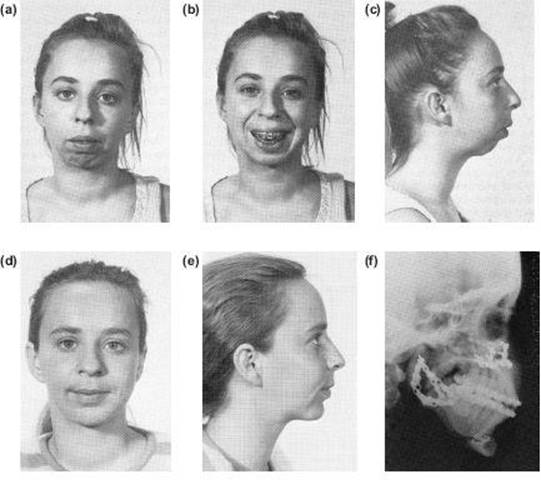
Figure 10.6 Marked retrognathia and an anterior open bite due to bilateral condylar damage in childhood (a), (b) and (c). Correction by a combination of a Le Fort I posterior impaction to close the open bite, and a bilateral inverted L advancement with interpositional bone grafts. The augmentation genioplasty was carried out simultaneously (d), (e) and (f).
Ankylosis only occurs when the meniscus is also displaced or destroyed, allowing the condyle to proliferate against the surface of the condylar fossa. In such cases the lack of function leads to a greater loss of mandibular development. The management of temporomandibular joint ankylosis will be discussed in Chapter 13.
Clinically there is an increased overjet which is usually exaggerated by the lower lip being trapped behind the upper incisors, increasing their proclination and spacing (Figure 10.7). Externally this is seen as an everted lower lip exaggerating the labiomental groove.


Figure 10.7 Surgical correction of mandibular retrognathism by a sagittal split advancement, after orthodontic incisor retroclination and levelling of the occlusal plane. Note to dramatic improvement of the lower lip contour as well as the skeletal profile. (a) to (c) Preoperative and preorthodontic therapy. (d) to (f) Postorthodontic therapy and surgery.
With unopposed occlusal drift (overeruption) of the lower incisors, the overbite is also increased.
The reduced lower facial height is a secondary aesthetic defect which may be self-correcting with the forward repositioning of the mandible.
A simple means of visualising the surgical correction is to study the face and profile before and after protruding the mandible. Before protrusion the chin will be set back and there will be a relatively low anterior facial height. With forward movement, not only does the profile improve but there is also an aesthetic gain from the increased lower facial height as the mandible moves downwards and forwards on the occlusal plane.
Treatment
The Occlusion
1. As will be seen clinically and on the study models, the over erupted lower incisors will prevent the mandible being moved forward into a satisfactory relationship without a lateral open bite. In adults this lateral open bite will not be self-corrected by postoperative compensatory eruption of the molars and premolars. Some means of levelling the occlusal plane orthodontically pre-or postoperatively, or surgically will be necessary. Orthodontic depression of the incisors with the associated eruption of the posterior segments may not be possible to achieve preoperatively in adults without the lower incisors being proclined through the alveolar labial cortex.
The choices are:
a) Decompensation of the incisors and a forward osteotomy of the mandible to an overcorrected edge to edge incisor relationship, giving a three-point contact occlusion, i.e. incisors and distal molars, followed by orthodontic closure of the lateral open bites. However, this is only possible if there is sufficient interdental space in the buccal segments to allow the premolars and molars to erupt from the perimeter of a curve into the shorter horizontal straight line.
b) Separate orthodontic levelling of the canine and incisors, and the buccal segments. This will be followed by a lower anterior mandibulotomy setdown carried out at the same time as the mandibular lengthening procedure. This has the advantage of providing an additional supplement to the lower facial height. Figure 10.8 shows the increase in lower facial height and improved lip and chin profile after forward repositioning of the mandible with a lower incisor setdown achieved by an anterior mandibulotomy.


Figure 10.8 An anterior mandibulotomy combined with a forward osteotomy not only flattens the occlusal plane but also increases the chin depth. (a) Shows the preoperative profile in occlusion and (b) with the mandible postured forwards stimulating the surgical advancement. (c) to (e) The preoperative occlusion and radiographs before orthodontics and (f) after levelling the incisor and buccal segments independently. (g) to (k) Postoperative results. (k) The immediate postoperative orthopantomogram which shows the mandibulotomy cuts and set down.
In all cases, preoperative orthodontic decompensation, coordination of the arches and closure of any spaces, is essential preparation for surgery (Figure 10.7). This may reveal an unsatisfactory upper lip incisor relationship requiring a Le Fort I impaction.
Lengthening the Mandible and the Chin
Most marked Class II division 1 cases require not only a forward repositioning of the mandible to an overcorrected edge to edge incisor relationship by a sagittal split but also a sliding augmentation genioplasty. Always resist the temptation to wait and see if a genioplasty is also required — it is! (Figure 10.9).
The Chin
As described earlier there are aesthetic and ethnic variations in the profile. In most cases the chin point, i.e. the soft tissue pogonion (Pg), should lie within 6 mm of a vertical drawn downwards from subnasale at right angles to the Frankfort horizontal plane (Figure 10.10). Retrogenia is a receding chin and must be differentiated from the more common retrognathia, where the mandible is set too far back and is too short. The increased overjet of retrognathia is not usually found in pure retrogenia.
The chin depth (anterior inferior dentoalveolar height) from the incisor edge to the bony menton is 40 2 mm for women and 44 2 mm for men. This usually equals the distance of the lower lip margin to the soft tissue menton. Chin depth is often overlooked and may also require augmentation or reduction.

Figure 10.9 Severe “bird face” retrognathism corrected with a forward sagittal split osteotomy and genioplasty followed by a rhinoplasty. (a) Preoperative (b) postoperative, and (c) diagrammatic representation of change.
Unfortunately these estimations will be complicated by changes brought about by other osteotomies. For instance:
· after a Le Fort I elevation the chin will advance with the forward autorotation of the mandible, simultaneously reducing the apparent chin depth;
· forward movements of the mandible will have a predictable effect on the chin point (Po), but will simultaneously increase the lower facial height as the mandible moves down the occlusal plane;
· with backward correction of a prognathous mandible the distalisation of the chin is usually desirable, but occasionally it may require a paradoxical augmentation foreward slide;

Figure 10.10 The vertical and horizontal parameters of the chin in relation to the vertical from the Frankfort mandibular plane (see text).
· bimaxillary osteotomies will also influence the chin profile if the occlusal plane is altered. By increasing the occlusal plane angle, the chin will rotate backwards and downwards. With a decreased occlusal plane, the chin will rotate forwards and become more prominent.
In all these cases a planning tracing on which the mandibular outline may be moved in the anticipated direction will enable the outcome to be predicted. Only in this way can any supplementary surgical addition or subtraction of the chin be confirmed.
Figure 10.11 shows the result of augmentation with a sliding genioplasty. Reduction and augmentation of chin depth will be discussed with the Long Face, and the Short Face.
Lower Lip Sag: A Warning
With some cases of augmentation genioplasty, especially when carried out with a Le Fort I elevation (upward impaction), the lower incisor occlusal plane rises above the lower lip line. Poor adaptation of the soft tissue and mentalis function leaves an unsightly display of lower incisor and gingival margin (Figure 10.12). This may be avoided by

Figure 10.11 Retrogenia treated with a sliding genioplasty. (a) and (b) Preoperative. (c) and (d) Postoperative.
1. Extensive undermining of the soft tissues of the neck to accommodate the advanced chin,

Figure 10.12 Lower lip sag following augmentation genioplasty. (a) at rest. (b) smiling.
2. Careful suturing of the divided origin of the mentalis to the depths of the periosteal aspect of the degloved chin.
3. External elevation by an adhesive pressure dressing for a week, followed by active “upward” lip exercises by the patient to restore upward muscle tone.
Mandibular Incisor Proclination
Proclination of the lower incisors with a normal jaw-base relationship is an uncommon deformity. The incisors are usually spaced, suggesting the tongue as the cause of the problem.
Treatment (see Figure 10.13)
· Where orthodontic retraction is not practicable, the first premolars can be extracted and the canine-incisor segment brought backwards with a Kole subapical (labial segmental) osteotomy.
· If the tongue looks large, reduce it with the osteotomy. If there is any doubt, warn the patient that should incisor proclination relapse occur, tongue reduction may be necessary (see also Bimaxillary Proclination).

Figure 10.13 Segmental setback of lower incisors and canines. (a) to (c) Preoperative. (d) to (f) Postoperative.
The Maxilla
Maxillary Hypoplasia
· Although one would expect to recognise a maxillary deficiency, many cases are diagnosed and operated on as a mandibular prognathism. The result is a flat face, which is more noticeable in a man than a woman. This is particularly likely to occur if the SNA is artificially high, i.e. more than 82°, due to a high sella or a short cranial base, i.e. a short SN.
· Cleft cases require special consideration. One important factor is the misconception that the cleft hypoplastic maxilla is associated with an enlarged mandible. Cleft patients often have a small mandible, which rarely may be elongated with the maxilla advancement for an ideal correction of the profile.
Treatment
The treatment of choice is a Le Fort I osteotomy with a forward movement of 3, 6, or 9 mm. depending on the degree of deficiency. (Figure 10.14). In addition to correcting the occlusion, the maxillary forward movement will elevate the nasal tip but does not usually decrease the nasolabial angle. A narrow intercanine width will have to be increased orthodontically (Figure 10.14) or surgically at operation after the down-fracture (Figure 10.15).
Where there is marked hypoplasia of the inferior orbital margins a Le Fort II osteotomy is necessary or a high Le Fort I with a bone onlay (see below). However, with a good nose the Kufner modification of the Le Fort III osteotomy produces an advancement of the malar bones and infraorbital margins (see Malar-maxillary Hypoplasia).


Figure 10.14 Maxillary retrusion corrected by a Le Fort I advancement. This was facilitated by preoperative upper arch expansion with a quadhelix appliance. (a) to (d) Preoperative. (e) to (g) Postoperative.

Figure 10.15 Planning model for surgical expansion of maxillary arch.
Major movements, i.e. more than 9 mm, require carefully sited plates with bone grafting of the osteotomy gaps. However, where significant movements appear necessary, especially in non-cleft cases, a bimaxillary procedure is needed. This will divide the distance between the two jaws (see Bimaxillary Deformities).
Nasomaxillary Hypoplasia
With nasomaxillary hypoplasia, especially with a deficiency of the infraorbital margins, a Le Fort II osteotomy is required. There may be a noticeable band of white sclera below the limbus of the iris, and in profile there is some degree of pseudoproptosis, i.e. the globe protrudes more than 2-3 mm beyond the infraorbital margin. Figure 10.16 shows the result of a combined Le Fort II advancement and mandibular pushback.


Figure 10.16 Nasomaxillary hypoplasia and mandibular prognathism corrected with a Le Fort II advancement and mandibular setback. (a), (b) and (e) Preoperative. (c), (d) and (f) Postoperative.
Malar-Maxillary Hypoplasia
The presentation is very similar to the previous case, requiring a Le Fort II correction, except that the nose is either good or prominent. Here, the treatment of choice is:
i) A malar-maxillary advancement, leaving the nose undisturbed. This procedure is the Kufner modification of the Le Fort III osteotomy (Figure 10.17).
ii) The alternative solution is a Le Fort I advancement with simultaneous alloplastic malar onlays.
iii) The Kufner osteotomy followed by distraction osteogenesis.

Figure 10.17 Malar-maxillary hypoplasia and mandibular prognathism corrected by a Kufner modification of the Le Fort III osteotomy and a mandibular setback. (a) and (b) Preoperative. (c) and (d)Postoperative.
Maxillary Protrusion
Patients with this deformity are usually severe Class II division 1 cases that have had failed orthodontics or refuse orthodontic treatment. As they also present with deep overbite problems, they are discussed in detail in the next section. Occasionally the uncomplicated maxillary prognathism may be treated with an anterior segmental osteotomy (Wassmund/Wunderer). This is usually an adult patient who is unwilling to undergo orthodontic treatment (Figure 10.18). The canine-incisor segment is set back after extraction of the first premolars. A midline split is necessary to maintain a natural dentoalveolar arch. Where premolar extractions have shortened the buccal segments the best approach to achieve optimum aesthetics and occlusion is to correct with a Le Fort I setback.


Figure 10.18 Maxillary prognathism with increased overjet and proclined incisors corrected with an anterior segmental setback. (a), (c) and (e) Preoperative. (b), (d), (f) and (g) Postoperative.
Bimaxillary Deformities
There is a natural temptation to treat most deformities with an operation on one jaw, but this often produces an acceptable occlusion and a poor profile. Where a single jaw procedure requires a large dentoalveolar displacement of 6 mm or more, one should always reconsider the case as a bimaxillary deformity. By dividing the displacement into two complementary components, a stable result with a better profile will be achieved.
Figure 10.19 shows how a small maxilla, with an SNA of 72° and a large negative overjet (SNB = 90°), has been “successfully” treated with a large mandibular pushback. Unfortunately, this has created a flat mid-face with an obtuse nasolabial angle. The surgery of choice should have been a combination of a forward Le Fort I and a mandibular setback procedure (see below). Furthermore, before this is done, orthodontic decompensation of the incisors with arch coordination, provides a considerably better postoperative dental occlusion and profile. Incisor decompensation always reveals the true discrepancy between the upper and lower arches and facilitates greater surgical movement and the best profile.


Figure 10.19 Marked mandibular prognathism treated with a pushback osteotomy but no orthodontic decompensation produced a satisfactory occlusion, but an unsatisfactory flat profile. (a), (b) and (e)Preoperative. (c), (d) and (f) Postoperative.
With all bimaxillary osteotomies, care should be taken to maintain or achieve a normal occlusal plane which is 8±4° to the Frankfort plane. This will ensure:
· a good chin profile
· optimum function, and
· occlusal stability.
Gross Mandibular Prognathism
As stated all cases of gross mandibular prognathism have an element of maxillary hypoplasia (Figure 10.19) which should be defined in order to plan an advancement in addition to the mandibular setback. This can only be achieved by presurgical orthodontic treatment decompensating the incisors and arch coordination.
The surgery is done as one combined procedure in the following way.
1. The sagittal split osteotomy cuts are carried out as far as, but not including, the ramus split.
2. The maxillary osteotomy, which is usually a Le Fort I, is completed and positioned with an intermediate occlusal wafer designed to relate the forward movement of the repositioned maxilla to the unchanged mandible. Bone plates provide stable fixation both during and after the mandibular surgery.
3. The mandibular osteotomy is completed and repositioned distally to the planned overcorrected postosteotomy occlusion with the maxilla.

Figure 10.20 Combination of maxillary hypoplasia and mandibular prognathism treated with a Le Fort I advancement and an intraoral subcondylar pushback. Note how the prominence of the nose dimishes with the corrected facial drape. (a) and (b) Preoperative. (c) and (d) Postoperative.
Operating time can be reduced by using one of the intraoral subsigmoid osteotomies. The operative sequence, including a subsigmoid osteotomy, is as follows (see Figure 10.20):
i) A medial (or lateral) intraoral subsigmoid osteotomy is performed, cutting only the posterior border of the mandible.
ii) The maxillary osteotomy is carried out and repositioned with the intermediate wafer designed to relate the postosteotomy maxillary position with the unchanged mandible.
iii) The intraoral subsigmoid osteotomy is completed and the final occlusal relationship determined and fixed with elastics.
Unfortunately this loses all the advantages of internal fixation with the elimination of intermaxillary fixation and immediate rehabilitation.
The Deep Overbite
Patients with a deep overbite are neglected because they do not usually complain of an aesthetic deformity. Their problem consists of incisor attrition damaging the opposing mucosal surface, leading to bone and tooth loss. The lower incisor over eruption also leads to premature loss with the onset of periodontal disease. Conventional solutions are an overlay or bite guard, or extractions with the provision of a denture. Orthodontics and orthognathic surgery can readily eliminate these problems without a prosthesis and with preservation of the dentition.
The patients fall into the two Angle Class II groups, each with subgroups.
Class II Division 1
Here the damage is on the palatal aspect of the upper incisors, leading to increased proclination and separation with progressive bone loss.
Treatment
1. With a poor profile, consisting of a retrognathic mandible, reduced lower facial height and the lower lip trapped behind the upper incisors (Figure 10.21), treatment comprises orthodontic decompensation of the incisors followed by a combination of a lower anterior dentoalveolar setdown with an anterior mandibulotomy, and a sagittal split osteotomy to bring the whole mandible forward to an overcorrected edge to edge incisor relationship.


Figure 10.21 A forward sagittal split osteotomy combined with an anterior segmental setdown to correct a marked Class II, division 1 skeletal disproportion. The spaced proclined maxillary incisors were aligned preoperatively. (a), (c) and (e) Preoperative. (b), (d) and (f) Postoperative.
If a satisfactory upper incisor lip relationships cannot be corrected orthodontically it will also be necessary to elevate the maxilla with a Le Fort I osteotomy. The operative sequence will be:
a) The sagittal split cuts, but without splitting.
b) The maxillary Le Fort I impaction osteotomy with rigid fixation.
c) The lower anterior segmental setdown with an anterior mandibulotomy. A Kole subapical osteotomy is more challenging and reduces the chin depth which may not be aesthetically desirable.
d) Completion of the sagittal split and anterior movement to an overcorrected edge to edge incisor relationship. Relapse is a natural tendency and is avoided by the forward overcorrection.
The Class II Division 2
Here the incisor trauma affects both the buccal and palatal gingivae leading to loss of the lower incisor bony support and secondary periodontal disease. Cases may be divided into two groups:
1. Uncommon patients with a satisfactory profile and upper incisor inclination. Relief of the traumatic occlusion may be achieved by a lower segmental setdown alone. For stability, an edge-to-edge relationship must be established (Figure 10.22).


Figure 10.22 Elimination of a deep class II division 2 overbite by a lower segmental setdown. (a) to (c) Preoperative. (d) Immediate postoperative. (e) Note the lower incisor eruption and imbrication two years after operation. (f) The final restoration with fixed bridgework.
2. The majority of cases have retroclined upper incisors and orthodontic proclination must precede the surgery. This converts the case into a Class II division 1 problem over a period of 18 months. It is then treated surgically, as described above for the poor profile Class II division 1 deep overbite, i.e. (a) the upper lip-incisor relationship correction, (b) a lower anterior setdown, and (c) a forward slide mandibular osteotomy (Figure 10.23).


Figure 10.23 Class II, division 2 deep overbite with marked periodontal breakdown due to gingival trauma and poor oral hygiene. (a) to (c) Preoperative. Models show orthodontic “conversion” to Class II, division 1, (d) and (e), which was then treated surgically with a lower segmental setdown and a mandibular advancement. (f) to (h) Postoperative. Note the increase in the postoperative lower facial height seen on the profile, and the marked change in the interincisal occlusion.
The Long Face Syndrome (“Vertical Maxillary and Chin Excess”)
Although the mean facial heights for males and females are quoted as 130 mm and 120 mm respectively, the standard deviation of 8 mm, i.e. a range of 32 mm, indicates a very wide normal variation. However, in terms of vertical facial aesthetics, the most important diagnostic factors are:
1. labial competence at rest,
2. the upper lip-incisor relationship, and
3. the upper/lower facial proportions.
The soft tissue profile can be roughly divided into thirds (see Figure 1.3) from hairline to nasion, nasion to subnasale, i.e. the junction of philtrum and columella, and then to the lower border of the chin. The lower facial height can also be subdivided into a third and two thirds by the line of labial contact, the one third being the upper lip, which is 20 ± 2 mm in females and 22 ± 2 mm in males. However for surgical planning, the best guide is the underlying skeletal ratio of 45:55 between the upper facial height (N to ANS) and the lower facial height (ANS to Me) (see Figure 1.4).
Patients with long faces exhibit a variety of growth disturbances which are principally, but not exclusively, in the vertical plane (Figure 10.24). It is obviously important to identify the true vertical maxillary excess (VME) case. Clinically this will present as labial incompetence with a poor incisor-lip relationship, i.e. an excess of incisor showing at rest. This will be exaggerated on smiling, revealing excess gingiva. Be sure that such a discrepancy is not due to a short upper lip. If this is misinterpreted as VME and treated exclusively with a superior maxillary impaction, the end result will be a short mid face. Therefore any maxillary impaction must be proportional to lip length. The longer the lip length, the greater the upward impaction and vice versa. Standard cephalometry will help to clarify the skeletal proportions, and a template such as the Jacobson or Bolton Standard will also show whether there are discrepancies in the levels of the maxillary (palatal) and occlusal planes.
This will reveal an increased alveolar depth with (a) a normal maxillary plane, whereas the rest have (b) a low, or (c) posteroinferior tilted maxillary planes with or without alveolar overgrowth.
Many VME cases also have a degree of vertical chin excess (VCE). In men, the anterior inferior dentoalveolar height measured from lower incisor tip to bony menton is 44 ± 4 mm and in women 40 ± 4mm. Note that this is remarkably similar to the lower lip margin to soft tissue menton depth.
An important 25% of patients with a long face have a normal maxilla but vertical chin excess, or an anterior open bite (or both).
The four basic varieties of a long face are shown in Figure 10.24 where the shaded areas indicate skeletal excess. Each form of vertical maxillary excess may co-exist with vertical chin excess.

Figure 10.24 The four basic varieties of a long face. The shaded areas indicate skeletal excess. Each form of vertical maxillary excess may co-exist with a vertical chin excess. (a) Vertical maxillary excess. (b)A low maxilla. (c)A tilted maxillary oclussal plane producing an anterior open bite. (d) A short upper lip simulating vertical maxillary excess. All VME is treated by a Le Fort I impaction, which allows a forward autorotation of the mandible. This will eliminate minor degrees of vertical chin excess. (e) Here impaction creates a prognathous mandible requiring a push back. (f) (g) and (h) A forward mandibular movement with an augmentation genioplasty.
a) Vertical maxillary excess with vertical chin excess.
b) A low maxilla with plus vertical chin excess.
c) A postero-inferior tilted maxillary occlusal plane producing an anterior open bite (plus vertical chin excess).
d) A short upper lip simulates vertical maxillary excess which may be exaggerated by vertical chin excess.
The surgical management of VME cases is the reduction of maxillary height with a Le Fort I vertical impaction, which is determined by the upper lip-incisor relationship. It is essential to measure the unaesthetic tooth excess at rest with dividers and a ruler and record it in the planning notes. Remember any maxillary impaction will tend to shorten the upper lip by up to 25% and some overcorrection is therefore desirable
Treatment Planning
As maxillary elevation produces a forward rotation of the mandible it reduces chin depth. It is also necessary to decide whether the final occlusion and profile will be satisfactory or will also require a mandibular osteotomy. The two simple ways of making a decision are (a) by a planning tracing and (b) by precise model surgery using an anatomical articulator. The study models will also indicate whether the dental arches match or require modification by orthodontic therapy or additional segmental surgery.
a) Draw the repositioned maxilla on the lateral skull tracing and, with dividers, rotate from the lower incisor tip around the centre of the condyle into the new occlusion. In this way it is possible to see if on autorotation, the mandible will
1. find a satisfactory anteroposterior occlusion (Figures 10.24a-10.24d),
2. require a setback because of an acquired prognathic relationship (Figures 10.24e and 10.24f), or
3. require a forward mandibular slide and genioplasty to improve the incisor relationship and profile (Figures 10.24g and 10.24h).
Minor discrepancies (< 3mm) in the postoperative occlusion can be resolved by a forward or backward movement of the maxilla which must be planned on the articulator to provide the appropriate intermediate wafer. This will confine the surgery to one jaw. However most cases need a mandibular osteotomy. P.T.O.
Figures 10.25a and 10.25b show a moderate degree of vertical maxillary excess with incompetent upper lip and marked incisor exposure. The maxillary impaction corrected the vertical height, labial contact and autorotation improved the chin profile.
The combination of vertical maxillary excess with a vertical chin excess requires careful consideration especially with a degree of mandibular retrognathism.
The correction requires a Le Fort I elevation, together with a mandibular advancement and a combination of vertical chin reduction with an anterior advancement genioplasty (Figures 10.26a to 10.26h).
Vertical Chin Excess (VCE)
If this is not great and is associated with VME, treat the maxilla and leave the chin alone as the forward autorotation of the mandible or an associated mandibular setback procedure invariably reduces the vertical chin profile.
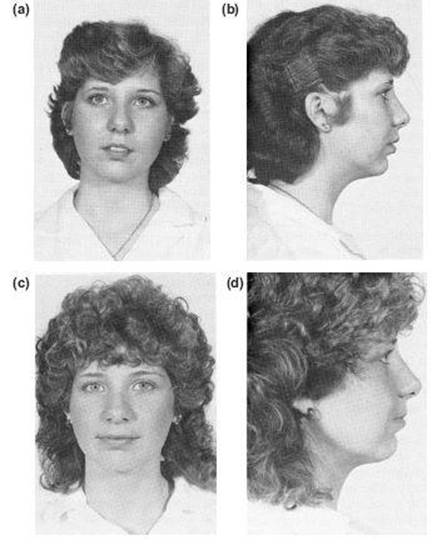
Figure 10.25 (a) and (b) Moderate vertical maxillary excess with incompetent long upper lip and marked incisor exposure. Maxillary impaction corrected the vertical height, labial contact and autorotation improved the chin profile.
If VCE is significant or is the principal cause of the long face, a wedge reduction genioplasty is the treatment of choice (Figure 10.27). Do warn all patients that the excess facial soft tissue may take 6-12 months to remodel after a large maxillary elevation.

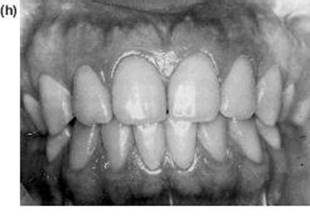
Figure 10.26 Vertical maxillary excess with a vertical chin excess but mandibular retrognathism. Hence the correction requires a Le Fort I elevation, together with a mandibular advancement and a vertical chin reduction but with an anterior augmentation genioplasty. (a) to (c) and (g) Preoperative. (d) to (f) and (h) Postoperative.
Long faces with an anterior open bite are discussed in the next section.
Bimaxillary Proclination
Bimaxillary proclination is often well within the acceptable aesthetic norm for Africans and Asians. Whereas the mean interincisal angle for Caucasians is 135°, this falls to 125° for these racial groups. Therefore the need for correction will not only depend on the cephalometric analysis but also the patient's aesthetic expectations.
The more problematic presentation is a bimaxillary proclination in combination with an anterior open bite and incompetent lips which is discussed later (see Figure 10.31).
Treatment
Where the dental bases are normally related and the vertical facial proportions acceptable, the treatment of choice is orthodontic retroclination with fixed appliance therapy closing any interincisal spacing. If the patient will not accept this, the alternative management consists of upper and lower anterior segmental osteotomies utilising space from the extraction of all four first premolars.

Figure 10.27 (a) Vertical chin excess is treated by a wedge reduction genioplasty preserving the lower border. (b) to (d) Preoperative vertical maxillary excess combined with a vertical chin excess which is camouflaged with a beard. The vertical chin excess was reduced by the removal of a wedge of bone, in addition to a mandibular pushback. The Le Fort I elevation corrected the vertical maxillary excess. (e) to (g) Postoperative.
If the deformity includes an anterior open bite this can be closed surgically but if related to an enlarged tongue, a tongue reduction is carried out at the same time (see Figure 10.31). Unfortunately the all-surgical solution may create two problems.
i) Model surgery may show that with markedly proclined incisors the rotation required to correct the interincisal angle will produce distally inclined upper canines, and in the lower alveolus a step defect between the canines and second premolars. This is an obvious indication for orthodontics rather than a surgical correction.
ii) Anterior segmental osteotomies in patients with an increased facial height and an excessive upper incisor show can be very unsatisfactory. If there is initially an excess of dentoalveolar exposure on smiling, this will be exaggerated by segmental surgery without a Le Fort I upward impaction. This problem will be reviewed in the next section.
The Open Bite Deformity (Apertognathia)
Of all the dentofacial deformities the anterior open bite can be the most challenging. Relapse is well recognised but has become less of a problem with the Le Fort I osteotomy with its segmental modifications and rigid fixation.
Open bite is commonly classified as dental (acquired) or skeletal (congenital). This classification is not wholly reliable.
The dental open bite has been considered an acquired deformity because it primarily affects the anterior teeth and is usually attributed to childhood habits such as thumb sucking, with perpetuation of the gap by a tongue thrust to close an inadequate lip seal. However, not all so called dental open bites can be associated with such habits and not infrequently the incompetent lip seal is due to an increased lower facial height . In other words, the problem, although localised, can be a congenital skeletal deformity or rarely secondary to an enlarged tongue (see Figure 10.32). The principal diagnostic feature of the true acquired open bite is a normal maxillary-mandibular plane angle of 27±5°.
The Skeletal Open Bite
The skeletal open bite has an increased maxillary-mandibular plane angle (>35°) and may be localised or extend posteriorly into the molar region (see Figure 10.33).
A similar deformity may arise from a loss of ramus height due to a variety of causes, including bilateral condylar fractures, degenerative arthopathies, idiopathic condylysis or following resorptive condylar remodelling in neuromuscular disturbances of the face.
There are two principal types of skeletal open bite with important surgical implications.
i) Class II (Figure 10.28). Here the mandible appears to be rotated backwards and may be small. The maxillary occlusal plane is usually tilted upwards and forwards with an increased posterior superior dentoalveolar height. Some patients also appear to have a reduced anterior maxillary dentoalveolar height. The overall appearance is that of a skeletal Class II jaw relationship with a long lower face.

Figure 10.28 (a) Any attempt to correct a marked class I or class II anterior open bite with a ramus osteotomy which stretches the ‘pterygomasseteric sling' will lead to a relapse. (b) The arrow indicates the strong musculofascial relapsing force. (c) A Le Fort I elevation with a posterior upward rotation allows the entire mandible to autorotate forwards and close the open bite within musculofascial constraints of the posterior facial height.
ii) Class III (Figure 10.29). Here the mandible is large with a normal maxilla. The posterior inferior facial height is in excess of 44% of the total posterior facial height. The overall appearance is a skeletal Class III with a long lower face.
Therefore a more useful open bite classification would be:
1. Dentoalveolar open bite: where the deformity is a localised dentoalveolar defect with normal facial proportions.
a) Congenital.
b) Acquired, e.g. sucking habits, alveolar trauma, enlarged tongue (including lymphangioma, haemangioma), and neuromuscular disturbances.
1. Skeletal open bite: where the dentoalveolar separation may be localised or extensive and is associated with an increased lower facial height and maxillary-mandibular plane angle. The two principal groups are:

Figure 10.29 (a) and (b) The rare pure Class III open bite with a large ascending ramus may be corrected by a mandibular pushback procedure without relapse. Here, with the increased posterior inferior facial height (i.e. in excess of 44% of the total posterior facial height (S-Go) the pushback and rotation osteotomy do not stretch the “pterygomasseteric sling”. See Case Figure 10.35 (p. 301).

Figure 10.30 (a) and (b) An anterior (dentoalveolar) open bite with appropriate orthodontic preparation can be closed with bimaxillary anterior segmental osteotomies. The preoperative dentoalveolar open bite is treated by levelling of the upper incisors orthodontically and raising the lower incisors surgically. See Figure 10.31.
(a) Congenital.
Class I, II or III.
(b) Acquired.
Bilateral condylar fractures, malunited untreated maxillary fractures, destructive arthopathies, idiopathic condylysis, condylar remodelling due to muscular dysfunction, acromegaly.
The Dento-Alveolar Open Bite
Treatment
Open bite deformities restricted to the anterior dentoalveolar segment with a normal facial height and proportions, can be successfully corrected with either orthodontics or segmental surgery, rotating the upper incisors downwards (Wassmund) and elevating the lower incisor segment (Kole) (Figure 10.31). However, this will only be successful if, on completion
a) the lip seal is competent and relaxed;
b) there is no excessive display of the upper incisors especially on smiling; and
c) the tongue is not enlarged.
The choice of surgery will be determined by the height of the gap and the length of the upper lip. Minor degrees of incisor open bite may be corrected with a maxillary anterior segmental osteotomy (Wassmund/Wunderer). Where the separation is larger it is necessary to close part of the gap with an additional lower segmental osteotomy (Kole) (Figure 10.31). The lower incisor segment may be rotated or elevated with an interpositional graft. The graft material may be rib or iliac crest, or an alloplastic material such as hydroxyapatite.


Figure 10.31 Dental anterior open bite treated with a combination of orthodontics and surgery.
However be sure that
i) its closure would not expose more than 4 mm of tooth below the upper lip margin and would therefore be better treated as a skeletal open bite incorporating a Le Fort I impaction.
ii) the patient does not require a tongue reduction, The treatment of a large tongue combined with an anterior open bite is shown in Figure 10.32.

Figure 10.32 The combination of large tongue and anterior open bite treated by tongue reduction and segmental surgery. (a) to (d) Preoperative. (b) The tongue-incisor relationship with the molars in occlusion. (f) to (h)Postoperative.
The Skeletal Open Bite: Classes I and II
Attempts to treat these cases with operations on the mandible alone invariably gave rise to relapse, regardless of the procedure and the period of fixation (see Figures 10.28 and 10.32).
The anatomical problem is that of rotating a retroplaced mandible upwards and forwards around the fulcrum created by the second or third molar teeth. This overextends the pterygomasseteric musculofascial sling. Unfortunately no surgical ingenuity can beat this restraining force (Figure 10.33). If however the maxillary occlusal plane is normal, minor to moderate degrees of open bite can be treated with a sagittal split osteotomy and robust rigid fixation.
Treatment
The aims of the surgery are to produce a normal maxillary occlusal plane by reducing the posterior facial height with a Le Fort I impaction. This allows the mandible to rotate forwards and close the open bite. As always the starting point is the upper incisor-lip relationship. If it is satisfactory and the articulated study models show that the maxillary occlusal plane will occlude with the autorotated mandibular teeth, surgery may be limited to a Le Fort I osteotomy with removal of a posterior maxillary wedge This wedge will equal the anterior open bite as measured in millimetres between the incisal edges (Figure 10.34).
Where there is an element of vertical maxillary excess identified clinically by an increased anterior alveolus and incisor exposure, then a differential Le Fort I vertical impaction osteotomy designed to include the remove of bone both posteriorly and anteriorly, but with more from the back than front.
Variations
1. Where both occlusal planes have exaggerated curves of Spee they will require flattening either orthodontically or surgically. Orthodontic levelling of the maxillary and mandibular occlusal planes is done with fixed appliances, but in severe cases it is impossible to produce matching occlusal tables. In this case the incisor and canines are levelled independently of the buccal segments requiring segmental surgery to achieve flat interdigitating occlusal planes. The surgical protocol will be:

Figure 10.33 An attempt was made to close this skeletal Class I open bite (a) and (b) with a sagittal split osteotomy, interosseous wiring and arch bar intermaxillary fixation. The postoperative illustrations (c)and (d) show the arch bars after the removal of the IMF. Note that the relapsing force was able to extrude several incisor teeth despite the intermaxillary fixation.


Figure 10.34 Long face with incompetent lips, narrow alar width and anterior open bite corrected with a posterior Le Fort I elevation. (a) to (d) Preoperative. (e) to (h) Postoperative.
i) In the maxilla, an anterior segmental section is carried out between the canine and premolars from above after the down-fracture. This allows a downward rotation of the incisor segment flattening the maxillary occlusal plane.
ii) The maxilla is then elevated as a whole.
iii) In the mandible a segmental elevation or anterior mandibulotomy may also be necessary (Figure 10.35).
2. The maxillary arch may have to be widened orthodontically or surgically to accommodate the lower dentition. In the latter case a midline section from above is required.
3. Where Class II retrognathism is marked, the maxillary elevation is carried out with a forward movement of the mandible by a sagittal split osteotomy with an augmentation genioplasty.


Figure 10.35 Orthodontic preparation was not possible for this patient with diphenyl hydantoin gingival hyperplasia, vertical maxillary excess, an anterior open bite and a marked curve of Spee. Therefore a Le Fort I elevation was combined with an anterior segmental osteotomy to level the occlusal plane and correct the incision lip relationship. The mandible autorotated to close the open bite. (a) to (c)Preoperative. (d) to (f) Postoperative.
The Skeletal Open Bite Class III
Treatment
1. a) Where there is no VME and the maxillary occlusal plane is normally inclined, but the mandibular ramus and body length are increased (which can be confirmed by the posterior lower facial height being in excess of 44% of the total posterior facial height), a sagittal split osteotomy is performed to displace the mandibular body upwards and backwards to occlude with the maxillary teeth (Figures 10.29 and 10.36). Bicortical screws or well placed buccal bone plates will provide end result stability.
b) Where there is an associated degree of maxillary retrusion this can be corrected by a Le Fort I forward movement which will reduce the open bite and mandibular setback.
2. In the more common, mixed case, consisting of a prognathous mandible with a VME, a Le Fort I elevation of the maxilla will be essential. This will increase the degree of mandibular prognathism and therefore the pushback (Figure 10.37).

Figure 10.36 An non-decompensated Class III skeletal open bite which was treated only by a mandibular setback and trimming of the chin point. (a) to (c) Preoperative. (d) to (f) Postoperative.


Figure 10.37 A non-decompensated combination of vertical maxillary excess, mandibular prognathism and an open bite (a) to (d). This was corrected by a Le Fort I elevation and a mandibular setback (e) to (h). Note the postoperative facial soft tissue excess which has remodelled over the subsequent 4 years; (i) shows the stable result 4 years later.
The Large Tongue
This is an area of some uncertainty. Most of the tongue lies in the oropharynx, where it is paradoxically called the posterior “third”. The anterior two-thirds is a very adaptive and mobile organ which cannot be easily assessed anatomically or functionally. Tongue reduction was formerly carried out on theoretical grounds to prevent a relapse following the reduction in oral volume by a body ostectomy procedure for prognathism. The custom ceased with the introduction of the sagittal split osteotomy with its increased stability because it was assumed that the tongue moved backwards with the mandible. As tongue position is determined by the hyoid bone, which is not affected by this operation, surgical tongue reduction was correctly discarded for the wrong reason.
However, some patients do present with proclined incisors, a localised anterior open bite and a clinically large tongue. The management of such a case should be as follows:
1. Reduce the tongue at the same operation as the open bite segmental osteotomies. With careful haemostasis, antiodema steroidal cover, and careful postoperative nursing, this presents no great problem.
Or, if in doubt:
2. Carry out the osteotomies but warn the patient that if a relapse becomes obvious, particularly with recurrent proclination of the lower incisors, then a tongue reduction will be necessary. The relapse can then be corrected orthodontically.
The Short Face
This is uncommon in non-cleft patients and, as usual, can present in three forms:
1. Where the shortage is essentially in the lower face. This is the marked Class II division 1 mandible with a small anterior dentoalveolar height and an everted lower lip. The mid-face is normal or acceptable (Figure 10.8).
2. Where there is a decrease in middle facial height, occasionally with a small alveolar process and small teeth in both jaws (Figure 10.38). As cleft patients present with additional problems, they will be dealt with separately in Chapter 11.
3. A combination of both.
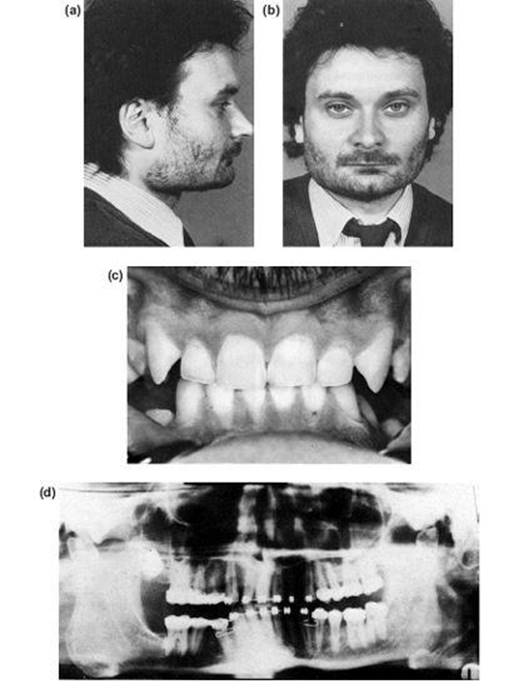


Figure 10.38 (a) to (m) A short face with vertical maxillary deficiency and also a marked lack of mandibular vertical height. This is an acquired developmental defect due to prolonged wearing of a Milwaukee brace to correct scoliosis in childhood. Preoperative (a) to (d). Presurgical orthodontics levelled the incisor and buccal occlusal planes independently. The maxilla has been lowered by a Le Fort I osteotomy with split rib interpositional grafts fixed with bone plates. The mandible has been advanced to correct the retrognathism. The underdeveloped anterior inferior dentoalveolar height has been corrected by a combination of a segmental mandibulotomy set down with a Proplast interpositional graft. The mandibulotomy also flattens the occlusal place (e) to (i). Genioplasty section before (j) and after insertion of a alloplast wedge (k). Preoperative (l) and postoperative (m) lateral skull radiographs.
Treatment
1. Lower face deficiency
There is usually over-eruption of the incisors, producing a marked curve of Spee. Therefore the choice is between:
i) a) Preoperative orthodontic levelling of the occlusal plane.
b) A mandibular advancement. Bone can also be inserted as a vertical augmentation sandwich genioplasty (Figure 10.38).
ii) a) Orthodontic levelling of the occlusal plane at two levels.
b) An anterior mandibulotomy which will flatten the occlusal plane and simultaneously increase the lower facial height.
c) A mandibular advancement (Figure 10.8).
2. Mid-face deficiency
Treatment is by a Le Fort I osteotomy with an interpositional bone graft to lower the maxilla (Figure 10.39).


Figure 10.39 A short face due to a maxillary vertical deficiency with dentoalveolar hypoplasia. The maxilla was set down 1cm with iliac crest interpositional bone grafts and the mandible repositioned with sagittal split osteotomy. (a) to (c) Preoperative. (d) to (f) Postoperative.
Preoperatively an estimate must be made of the required increase in facial height. This may be determined clinically by inserting wax wafers of increasing thickness between the teeth until the desired profile “in occlusion” with the lips at rest is achieved. Add 25% to give the immediate postoperative vertical separation of the jaws and height of the interpositional graft. This is measured and recorded.
Operative Procedure
1. The cuts of the sagittal split are made but not separated.
2. A Le Fort I osteotomy is carried out, with the maxilla well separated from the pterygoid plates. The maxilla is then wired temporarily to the unchanged mandible using an intermediate wafer.
3. Using dividers and ruler to confirm the planned separation (i.e. increased facial height) measured from the canine tips to the inner canthi, bone plates are screwed to the upper border of the maxillary osteotomy, and then the split rib or iliac crest cancellous bone blocks are wedged between the bone cuts and secured with screws. Face the medullary surface of the split rib outwards against the periosteum to ensure the best opportunity for graft vascularisation (see Bone Grafts).
4. Intermaxillary fixation is released, the mandible is split and fixed using the final wafer.
5. The throat pack is removed and the nasopharynx and hypopharynx carefully aspirated.
Maxillary Asymmetry
Maxillary asymmetry may be:
i) Primary and associated with deformity of the whole facial skeleton. In mild disturbances it can be difficult to decide whether one side is reduced in height or the other increased. However, in primary deformities, in addition to the coronal tilt in the occlusal plane, there is usually a cant in the orbital plane.
ii) The late presentation of a secondary maxillary alveolar response to the lateral open bite in a unilateral mandibular hyperplasia. Fibrous dysplasia of the maxilla and slowly-growing benign tumours will also present in the same way.
Treatment
· Minor degrees of orbital asymmetry are acceptable and therefore the surgery only consists of levelling the occlusal plane by a Le Fort I osteotomy, removing bone on the long side.
· If the difference in height is split between the two sides the coronal ipsilateral upward rotation, creates a horizontal deficiency on the short side. This deficiency may be closed by inserting the removed bone fragments into the defect stabilised with screws and plates. A sagittal split or subsigmoid osteotomy will be required to rotate the mandible into occlusion with the repositioned maxilla (Figure 10.40).

Figure 10.40 Maxillary asymmetry with a marked slope of the occlusal plane. This was corrected by bimaxillary osteotomies rotating the maxilla upwards on the right side, and bringing the mandible into occlusion with a bilateral sagittal split both jaws. A fillet of bone should be removed on the inner aspect of the right ascending ramus to allow it to rise in the coronal plane and occlude with the maxilla. (a)and (b) Preoperative. (c) and (d)Postoperative.
· With a unilateral maxillary fibrous dysplasia, a Le Fort I downfracture allows the solid dysplastic tissue to be radically removed from orbital floor to antral floor, leaving the periosteum to regenerate the facial antral wall.
Encapsulated tumours, such as ossifying fibromas, may be removed in the same way.