
The standard radiographic views which are fundamental to orthognathic surgery planning consist of a panoramic screening radiograph, for example, an orthopantomogram, and a lateral skull radiograph taken in a cephalostat. In addition the posteroanterior skull radiograph may be used in cases where there is clinical evidence of asymmetry. More detailed radiographs, for example, long cone periapical views or an upper standard occlusal radiograph may be taken for clarification of specific areas of pathology. It is not uncommon for surgical patients to have previously undergone some form of orthodontic treatment and therefore it is important to ensure that the roots of the teeth are perfectly sound.
The Need
Cephalometric analysis is helpful in establishing the relations of:
1. The maxilla and the mandible to the base of the skull.
2. The maxilla to the mandible.
3. The maxillary teeth to the maxilla.
4. The mandibular teeth to the mandible.
5. The upper incisors to the lower incisors.
In order for these measurements and relationships to be meaningful it is important that the radiograph is taken in a standardised centric relation position (retruded contact position) with the patient's Frankfort Plane (the line from the lower border of the orbital rim to the upper border of the cephalostat ear post) horizontal. It is also important to ensure that the soft tissues are at rest when the radiograph is recorded.
Modern radiological guidelines require that intensifying screens should be used and that the radiographic beam has undergone appropriate collimation so as to avoid excessive exposure of structures considered unnecessary in the planning process.
Ethical approval is also required for repeated radiographs used for research purposes.
The Tracing
A sheet of clear, matt acetate paper is fixed securely with adhesive tape to the lateral skull radiograph placed on a horizontal viewing box. The radiographic image is enhanced by tracing in a darkened room with any peripheral light from the viewing box masked off. Many operators will have their preferred landmarks and analyses but the following outlines and points are commonly registered (Figure 2.1).
Outlines:
1. The soft tissue profile including glabella, nasion, nasal tip, upper lip, lower lip and the soft tissue chin.
2. The inner outline of the sella turcica, the anterior aspect of the nasal bones together with the frontonasal suture and the outline of the lower bony margin of the orbit.
3. The maxillary outline, upper incisors and upper first molar.
4. The mandibular outline with the mandibular incisors and first molar and articulare. As a result of superimposition it is often difficult to identify the head of the condyle but it is easy to register the articulare where the posterior margin of the ramus crosses the cranial base. In general, where bilateral landmarks present two images, the average of the two should be drawn. The exceptions to this are those cases where there is an obvious asymmetry of the mandible, which has resulted in two distinct lower borders to the mandible. From the point of view of measurement, it is normal practice to take the lower border which conforms to the normal side of the face, as assessed clinically.
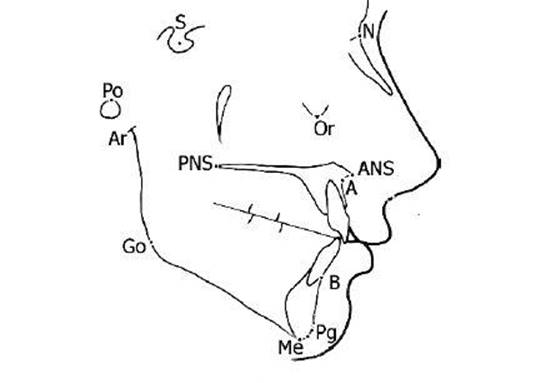
Figure 2.1 Cephalometric outlines and landmarks: A, point A; ANS, anterior nasal spine; Ar, articulare; B, point B; Go, gonion; Me, menton; N, nasion; Or, orbitale; PNS, posterior nasal spine; Pg, pogonion; Po, porion; S, sella.
Points:
· S Sella: The centre of the sella turcica determined by visual inspection.
· N Nasion: The anterior point of the frontonasal suture.
· ANS. Anterior nasal spine: Where the tip of the anterior nasal spine deviates markedly upwards or downwards, it is taken as the mid-point of the upper and lower spine outlines where it is 2 mm wide.
· PNS. Posterior nasal spine.
· Point A. The deepest midline point on the maxillary alveolus outlined between the anterior nasal spine and the maxillary alveolar crest.
· Point B. The deepest midline point between the mandibular alveolar crest and pogonion.
· Me Menton: The most inferior point on the lower border of the bony symphysis.
· Pg Pogonion: The most anterior point on the bony symphysis.
· Go Gonion: Is determined by bisecting the angle formed by tangents to the lower and posterior borders of the mandible. It is the point where the bisector cuts the angle of the mandible.
· Ar Articulare: The intersection of the posterior border of the ramus and the temporal bone.
· Co Condylion: The superior point on the condylar head.
· Or Orbitale: The most inferior point on the orbital margin.
· Po Porion: The upper margin of the bony external auditory meatus. The upper margin of the condylar head (Co) may also be used as it is often more easily determined.
· UMC. The tip of the mesio-buccal cusp of the upper first permanent molar.
· LMC. The tip of the mesio-buccal cusp of the lower first permanent molar.
· UIA. The tip of the post prominent maxillary incisor root apex.
· UIE. The most prominent maxillary incisor crown edge.
· LIE. The most prominent mandibular incisor crown edge.
· LIA. The tip of the most prominent mandibular incisor root apex.
The following lines are then drawn (Figure 2.2):
· S-N (the anterior cranial base).
· S-Ar.

Figure 2.2 The planes and angles. Using the cephalometric points the following planes are constructed; SN plane (SN), mandibular plane (MP), maxillary plane (MxP) and Frankfort plane (FP). The long axes of the maxillary and mandibular incisors are considered relative to the maxillary and mandibular planes respectively. The important cephalometric angles can be readily derived from these points and planes. For key, see Table 2.1.
· N-A.
· N-B.
· Or-Po (the Frankfort plane-FP).
· ANS-PNS (the maxillary plane-MxP).
· Me-Go (mandibular plane-MP).
· Long axes of the upper (UI) and lower (LI) incisors.
· The occlusal plane (OP) is drawn through the outline of the buccal segment teeth, including the premolars. However, it may be difficult to determine the outline of the molars due to superimposition. Therefore for simplicity, the tips of the upper and lower mesial cusps (UMC and LMC) and the upper and lower distal cusps only are drawn.
The Analysis
The accuracy when undertaking a cephalometric tracing of a radiograph by hand and its analysis only permits linear and angular measurements to be expressed to the nearest whole millimetre or degree. The values obtained can then be compared with the population normal values to determine the patient's problems (Tables 2.1-2.3). It is important to appreciate that they will vary with age, sex and ethnic origin. Table 2.1 presents the mean angular cephalometric values based on a Caucasian population. As can be seen from these tables, there is considerable variation for all values.
Although cephalometric analysis is helpful in providing information for diagnosis and treatment planning, it has to be borne in mind that the ultimate goal is not necessarily to achieve ideal values near to the mean but to produce a proportional and harmonious facial structure. To that end, where there are discrepancies between clinical observation and cephalometric values, the analysis of the clinical presentation is always more important.


These figures may be used for Negro and Oriental patients instead of those in Table 2.1 but should be regarded as a broad guide, rather than an exact ideal, bearing in mind that numbers in some surveys are small and may be the average of a wide range. Because of natural incisor proclination, the aesthetic nasolabial angles are invariably acute, i.e. significantly less than the Caucasian range.
Vertical Values
Vertical cephalometric analysis is of great value in orthognathic planning.
Linear
The total anterior face height (TAFH) is the sum of the upper anterior face height (UAFH), measured from nasion to the maxillary plane, and the lower anterior face height (LAFH), maxillary plane to menton. The lower anterior face height is usually 55 2% of the total anterior face height.
Posterior face height is similarly measured from sella to gonion using the maxillary plane to divide the upper posterior face height (UPFH) from the lower posterior face height (LPFH). The lower posterior face height being approximately 43 1% of the total posterior face height (Figure 2.3).
The anterior dentoalveolar heights are measured from the incisal edges of the upper and lower incisors (UIE and LIE) to the maxillary plane and mandibular plane respectively. It should be noted that these measurements reflect the components of the lower face height. In other words, if the lower anterior face height value is high, then the upper and lower anterior dentoalveolar heights (UADH and LADH) will also be increased, except in some cases of anterior open bite.
The upper and lower posterior dentoalveolar heights (UPDH and LPDH) can be recorded from the tips of the mesial cusps of the upper and lower molars (UMC and LMC) to the maxillary and mandibular planes respectively.

Figure 2.3 Linear measurements for the vertical dimensions. See Table 2.2 for details.
Angular
The relationship of the anterior and posterior face heights is reflected by the angles between the skull base and the maxillary and mandibular planes.
The angle of the maxillary to the mandibular plane (MxP/MP) is normally 27 4. This angle is important because as with the posterior face height measurement, it reflects the surgically important pterygomasseteric sling length (muscle, fascia and ligaments). For instance, a patient with a high angle, i.e. greater than 35, tends to have a relatively short posterior face height and therefore posterior musculo-ligamentous height. Any attempt to stretch this posterior connective tissue by rotating the anterior body of the mandible upwards, in an anticlockwise direction, around a fulcrum produced by the posterior molar occlusion, is doomed to failure and will lead to early surgical relapse.
Anteroposterior Relationships
In clinical practice anteroposterior lengths are rarely measured or used to relate the jaws to each other. It has become conventional to study the angular relationship of the jaws to the cranial base (SN). Orientation to the Frankfort plane is also used to compare these structures. However, in extremes of skeletal variation some angular measurements may be misleading. A typical example is the problem of SNA and SNB to analyse the anteroposterior relationship of the maxilla to the mandible (Figure 2.4). In the normal Class I patient, SNA is 81° with a standard deviation of 3°, and the normal maxillary-mandibular relationship (ANB) is 3°. An increased ANB angle suggests a Class II relationship, whereas a negative ANB angle suggests a Class III case. However, variations in the positions of N will influence both the SNA and SNB. For example, with a shorter anterior cranial base length (SN) increasing SNA by 10° alters the ANB angle to 7° giving the impression of a skeletal Class II jaw relationship (Figure 2.4). These variations, due to an “abnormal” SNA, may be corrected by subtracting 0.5° from the ANB angle for every degree by which SNA exceeds the normal value of 81°. In the above example, applying the conversion would reduce the apparent ANB angle from 7° to 2°. Conversely, where the SNA is below the normal value of 81°, 0.5° should be added to the ANB angle for every degree that SNA is below the normal figure. This conversion is only possible providing the SN/MxP values are within the normal range of 8° 3°. If the SN/MxP value is outside this range then alternate analyses of the anteroposterior skeletal pattern should be employed as detailed in cephalometric specific texts.

Figure 2.4 Cephalometric idiosyncrasies. The tracing shows how variations in skull base length (SN) can influence the angular values relating to A point and B point. With SNA 81° and SNB 78°, ANB is 3° indicating a Class I skeletal pattern (continuous line). With an unchanged jaw relationship, a shorter skull base SN (from N1 to N2) changes the SNA and SNB angles, i.e. SNA 91°, SNB 74° and ANB becomes 7°, suggesting a Class II skeletal pattern (broken line).
Analysis of the Incisor Angulations to the Maxillary and
Mandibular Bases
Skeletal deformity with its disturbed muscular skeletal pattern will lead to changes in the angles of the upper incisor to the maxillary plane (UI/MxP) and the lower incisor to the mandibular plane (LI/MP) adding a degree of secondary deformity (dental compensation) to any underlying skeletal discrepancy (Figure 2.5). Thus with a mandibular prognathism the lower incisors tend to be retroclined and the maxillary incisors proclined. In some severe Class II deformities the lower lip may become trapped behind the maxillary incisors with the effect that the upper incisors may actually procline, whilst the lower incisors may be retroclined. This “compensation” requires correction, i.e decompensation, as part of the overall treatment plan.

Figure 2.5 Dental compensation in a Class III case with proclination of the maxillary incisors and retroclination of the mandibular incisor teeth. See also Figures 4.8 and 4.9.
The Surgical Application of Cephalometry
Caution must be used in the interpretation of precise linear measurements such as the anterior face height. Measurements from different samples can vary by as much as 10 mm. This problem is diminished when the components are expressed as a percentage. In addition, too many measurements may cause confusion, defeating the purpose of the analysis. However, the exercise is an important means of studying the clinical problem. The geometry can also be checked by the use of diagnostic templates.
Various templates to be matched to the patient for age and sex have been developed from population studies. The Bolton (“unisex”) template, provides a simple means of diagnosis when superimposed over the cranial base and calvarium of the patient's lateral skull radiograph or tracing (Figure 2.6a). The Jacobson templates are alternatives, which provide racial separation (Figure 2.6b). This direct method of diagnosis may be particularly attractive to those who find cephalometrics confusing. However, a template should not be considered in any way a treatment goal but rather an aid in establishing the exact areas of discrepancy.
Computerised Cephalometrics
Many computer software packages are now available which with direct digitisation of radiographs, store the data as co-ordinates. Computerised cephalometrics have the advantage that any number of identical copies of the computerised tracing can be produced, and superimpositions can be achieved readily by incorporating normal template tracings into the data bank. But they also have the disadvantage of removing the “personal touch”. Many operators still prefer undertaking a hand tracing as it gives a greater appreciation of any difficulties of a particular case, identified during the planning process. Computerised cephalometrics are discussed in detail in Chapter 3.
Posteroanterior Radiograph Tracings
The major use of posteroanterior skull radiograph tracings is for the identification of facial asymmetries. By constructing a series of horizontal and vertical reference planes the exact extent of the asymmetry can be readily demonstrated (Figure 2.7).

Figure 2.6 (a) Bolton standard template. (b) Jacobson proportional template.

Figure 2.7 (a) Posteroanterior cephalogram used in the assessment of facial asymmetry. Vertical (b) and horizontal (c) reference lines give an indication of the site of the asymmetry. See text for details.
In the vertical plane it is normal to draw a median reference line passing through the centre of the nasal bones, through the majority of the nasal septum (unless there is gross deviation) and this line when extended inferiorly should coincide with the midline of the upper central incisors, midline of the lower central incisors and the midpoint of the chin. Two more vertical reference planes should then be drawn, parallel to the median reference line, and forming a tangent to the most lateral point of the contour of the maxillary tuberosity region. Moving further laterally, additional vertical lines should be drawn, again parallel to the median reference line, and passing as a tangent to the most lateral point of the gonial angle region on both sides of the face. As such the face has been divided up into four vertical segments which should be of equal transverse width.
A second series of lines is then drawn in the horizontal plane. The horizontal reference plane should be taken as a line which passes as a tangent to the lower border of the infra-orbital margins, and ideally this should intersect the median vertical plane at a right angle. The second and third lines, should link both inferior borders of the right and left tuberosities and the gonial angles respectively, revealing any horizontal discrepancies. Finally, lines drawn across the incisal edges of the upper and lower incisors represent the upper and lower occlusal planes as seen in the PA view.
Through a combination of these vertical and horizontal reference lines the exact source of bony and dental asymmetries can be identified. This form of analysis is particularly useful in identifying the presence and extent of any cants to the occlusal plane but is dependent on an accurately positioned cephalogram.
Orthopantomogram Tracing
Tracing of the orthopantomogram is not undertaken as part of routine assessment. However, when considering asymmetries in the lower border of the mandible a full tracing of the radiograph may prove useful. An example of a tracing is seen in Figure 2.8 where a tracing of the normal side of the radiograph has been superimposed on the abnormal side using the occlusal plane as a guide. The discrepancy of the mandibular borders can be seen readily (Figure 2.8b). In marked cases of mandibular asymmetry, a procedure to reduce the lower border of the mandible may be considered. This tracing can give information as to the extent of the bone to be removed and whether or not the inferior dental nerve is likely to need repositioning. The advent of CADCAM milling machines linked to three-dimensional CT scans have largely superseded this method of planning, however, tracing the orthopantomogram provides a simple approach when such techniques are unavailable.

Figure 2.8 (a) Orthopantomogram tracing of a patient with hemimandibular hyperplasia. (b) The “normal” side tracing has been superimposed over the “abnormal” side, using the occlusal plane as a reference, indicating the extent of bone removal necessary to achieve a symmetrical lower border to the mandible and that repositioning of the dentoalveolar nerve would be required.