
Although the basic cephalometric methodology has remained unchanged for many years the application of information technology, to store, display and manipulate cephalometric images has evolved so that;
i) Analysis is significantly faster and more reliable when compared to manual measurement.
ii) Reformation of data enables the simulation of treatment alternatives.
These benefits are seen with direct digital imaging in which the X-ray beam is recorded by photoelectric sensors, such as charged coupled devices, or by a storage phosphor emulsion which is scanned and read by a laser diode (light source). These images require a reduced radiation exposure and can be read as a soft copy on a monitor or a hard copy printed out on transparency film or paper. Indirect digital imaging methods include copying the backlit radiograph film with a digital camera or by computer entry with a flatbed scanner. Both systems provide multiple advantages such as ease of storage, manipulation and enhancement, duplication and the possibility of automated landmark identification.
Regardless of the method used to produce the digital image, the data storage and display are very different from conventional film. Images on a monitor display are composed of a matrix of discrete units called picture elements or pixels. The spatial resolution or clarity of the image is directly proportional to the number of pixels. More pixels mean a sharper image but it also requires the manipulation and storage of more information. The contrast of a digital radiograph is determined by the number of shades of grey which can be displayed. This is known as the bit depth which is determined by the means (algorithm) used to process the image. For example, in a 6-bit image each pixel will have 64 possible values, ranging from black (0) to white (63). An 8-bit image would be able to show 256 shades of grey and 12-bit images can show 1024 shades. Most dental radiology applications use 8-bit images but newer technologies are available that allow for 12-and 16-bit images.
A limiting factor when viewing digital images is the monitor itself. Typical monitors have 72-96 pixels per inch (ppi) display resolution and are capable of 625 digital (raster) lines. The full potential of any image with higher resolution can only be displayed with clarity after being printed as a hard copy. For digital images equal to film quality, a monitor capable of displaying 2048 raster lines would be needed. In addition to being expensive, it is difficult for computers to refresh (handle) this number of lines without creating a “flicker” in the image.
Digital images are further limited by the monitor's contrast capabilities. Analogue films have an almost infinite or continuous greyscale. As stated, most dental digital images are viewed with only 256 shades of grey. The problem is compounded by the fact that digital images are often displayed more brightly than with analogue film which tends to reduce the already inferior greyscale resolution. It is important to bear in mind that the number of shades of grey or bit depth needed is dependent on what is being diagnosed from the image.
Once the spatial resolution and contrast have been optimised, the capacity of the human eye becomes the limiting factor. The smallest detail the human eye can resolve is approximately 0.1 mm by 0.1 mm. Therefore, we are unable to appreciate more detail in any image with a smaller pixel size. Conversely, images with pixels of a much larger size, for example 0.7 mm by 0.7 mm, may seem blurred (Figure 3.1). A pixel size of 0.1 mm should be equal to X-ray film when identifying landmarks on cephalometric radiographs.
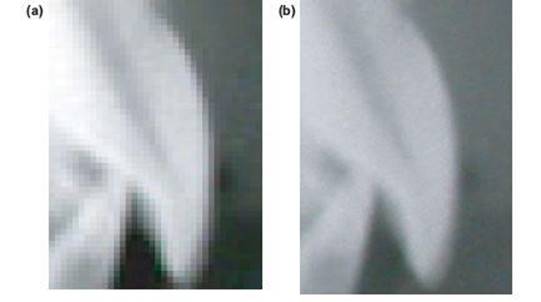
Figure 3.1 These digital images are identical except for spatial resolution. (a) The left image has a pixel dimension of 0.084 × 0.084 which is at the limit the human eye can resolve. (b) The pixel dimension of the image on the right is 0.35 × 0.35. Note the fuzzy appearance with loss of definition.
Digital imaging technology is becoming the standard of care. The advantages of storage, portability, ease of duplication, manipulation and communication outweigh the disadvantages. However, with these advantages come responsibilities. The ease of data manipulation opens the opportunity for record tampering. The ease of duplication and portability create problems of confidentiality. The DICOM (digital imaging and communication in medicine) Standards have been developed to attain compatibility and to ensure workflow efficiency between imaging systems and other information systems. The standards also address security in record transmission and storage as well as record “locking” or digital signatures. The dedicated clinician must be vigilant of changes in hardware, software and responsibilities for their use.
Treatment Planning with Digital Images
Orthognathic treatment planning requires some method of predicting the anticipated outcome. In clinical practice this has been based on experience and intuition. Digital simulation is based on a tracing prepared from landmarks identified on a standardised lateral cephalometric radiograph. The dental and skeletal structures are moved to correct the malocclusion and the predicted soft tissue response is based on data collected from a retrospective analysis of previous treatment tempered with clinical experience. This process helps the clinician to anticipate and understand the dental and surgical movements needed (Figure 3.2). The simulation gives the patient and family a glimpse of the aesthetic change. Various terms have been given to this process including VTO (visualised treatment objective) and STO (surgical treatment objective). These simulations are almost always limited to a profile view due to the lack of data and the technical limitations associated with PA cephalometry. Surface laser scans and photogrammetry provide alternative techniques to overcome this limitation.
Although acetate tracings are adequate for most clinicians, patients may view them as arcane. To improve patient understanding efforts have been made to incorporate a photographic likeness into the process. Initially, this was limited to a photographic montage created by rearranging cut-outs of profile photographs. The computer has streamlined the process so that cephalometric data can be digitally entered, stored and recalled for analysis or manipulation. The graphic reproduction of tracings is done using a plotter which is basically a computer driven felt-tip marker. Early software programmes were limited to the analysis of cephalometric landmarks which had been entered or “digitised” into the computer memory. Software engineering has produced programmes which allow repositioning of anatomical structures and treatment simulations. Although technologically refined it is very important to remember that the result is no better than the data used to predict the soft tissue response.

Figure 3.2 Simulation tracings can be done by hand on acetate or are computer generated. (a) The preoperative cephalometric tracing is altered to simulate the mandibular advancement (b). (c) The superimposition graphically demonstrates the amount of movement needed for correction.
Patient Education
The breakthrough in treatment simulation for patient education came with the ability to manipulate patient's photographs, video images or slides which were “rasterised” (converted from analogue to digital form) prior to being linked to the cephalometric tracing. Although the result was still limited to a profile view, both patient and clinician had a representation which was much closer to a credible likeness.
Patients need to have the nature of their problem presented in a language they can understand. For both educational and a medicolegal reasons, those involved must understand the risk versus benefit of any treatment involving a change in appearance. Facial appearance is invariably the primary motivator for those seeking surgical correction but it may not necessarily be the principal underlying reason.
Some have voiced concerns regarding the use of digital imaging in patient communication suggesting the possibility of legal action if the treatment outcome does not approximate to the simulation. For this reason most vendors have a disclaimer on any printed copy of the image. Although there is no history of litigation related to disappointment over failure of the actual outcome to match treatment simulation, the need for good communication is paramount when patients have mild or moderate rather than severe aesthetic problems. These patients are in a borderline area where the alternatives could range from no treatment to surgical correction, with extractions and orthodontic compensation being a “compromise” option. It is generally easier for the patient and family to accept a surgical treatment plan when there is a severe dentofacial deformity. It is the middle-ground cases which require the greatest communication skills on the part of the orthodontist and surgeon to enable patients and or parents to select the management that best suits their needs.
The decision is crucial as the objectives for orthodontic compensation are the opposite to those for orthodontic preparation prior to orthognathic surgery. For example, the anterior teeth are compensated for the orthodontic solution but decompensated prior to surgery. Furthermore the extraction patterns differ between compensation and surgical preparation. The approach to levelling mechanics and space closure is also different with each option. Since it is difficult if not impossible to cope with a “change of heart” patient, all the information required to choose between the treatment options must be presented prior to the start of treatment. Digital treatment simulation is a valuable tool in making this decision. Treatment simulation may also be used immediately prior to surgery in the context of the final surgical planning.
Interactive Programmes
Digital imaging technology offers several options for planning and patient education. Interactive programmes are useful during the preliminary consultations. This type of software employs a mixture of still photographs, graphic art and multimedia which demonstrates specific problems and their potential solutions. The clinician can easily demonstrate the difference between orthodontic compensation and surgical correction using the illustrations from the programme (Figure 3.3). The artist's representations of treatment outcome can be stylised to demonstrate the trends in facial change seen with each option. If there is continued interest on the part of the patient and or family, full diagnostic records can be taken for analysis prior to developing an orthodontic/orthognathic problem list and the treatment simulation using the patient's data.
Simulation Programmes
Although the data entry approach varies among programmes, the following steps are common to each:
· The standard photographic series is directly entered with a digital camera or scanned into the computer from photographs or slides.
· The lateral cephalometric radiograph is imported into the programme via direct digital radiography or scanning with a transparency adapter.
· The conventional cephalometric analysis follows on-screen digitising the requisite landmarks for the protocol. Radiographs of marginal quality can be enhanced with a variety of graphic tools.
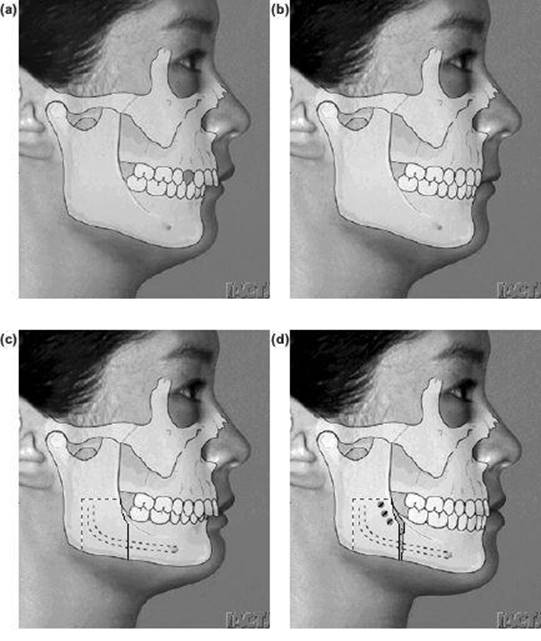
Figure 3.3 This multimedia programme demonstrates the contrast between correcting mandibular deficiency with orthodontic camouflage versus orthognathic surgery. Images (a) and (b) show extraction of the upper first premolars with subsequent retraction of the incisors and upper lip. Images (c) and (d) demonstrate the changes seen with surgical lengthening of the mandible. (courtesy of InterActive Communication & Training, 3300 Cahaba Road, Suite 101 Birmingham, AL 35253, USA).
· The resulting cephalometric tracing is manipulated to achieve “best fit” and superimposed on the profile photograph (Figure 3.4).
· Orthodontic and surgical movements can now be simulated using the linked image-tracing combination (Figures 3.4 and 3.5).

Figure 3.4 (a) Digital treatment simulation requires linking of the profile image with the tracing digitised from the lateral cephalometric film. The process is facilitated by having the head and soft tissue posture as identical as possible. The image-tracing pair (b) is manipulated with the software to simulate the surgical advancement of the mandible. The final simulation (c) is a close approximation of the actual outcome (d). All software programmes have difficulty creating the natural contours of the lips and mentolabial fold.
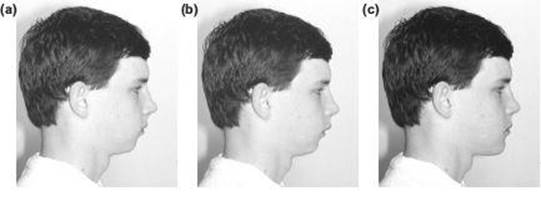
Figure 3.5 Treatment simulation software has been used to alter this patient's pretreatment image (a) to portray the outcome of orthodontic camouflage (b) versus surgical mandibular advancement (c).Compared to cephalometric tracings, these images are more easily understood by patients and their family.
· The soft tissue response from specific dental and skeletal movements is modelled by computer algorithms based on retrospective data from long-term studies of stability and treatment outcome.
Limitations
· Simulation is no better than the data on which it is based and which may be flawed by small sample size and heterogeneity, treatment instability, and errors in surgical management.
· Mean values are used to develop linear ratios which determine soft tissue movements relative to a skeletal landmark. The assumption is that the soft tissue response is a fixed percentage of skeletal movement, regardless of the extent of skeletal change. This approach fails to account for local variations due to muscle tone, soft tissue compression and tissue redundancy.
· Studies have shown that most programmes now produce reasonable simulations when the surgical movements are moderate, limited to the sagittal plane, and involve patients with competent lips and little eversion.
· These same programmes have difficulty with simulations involving vertical movements in patients with increased lip separation or a deep labiomental fold with lip redundancy.
· A second source of variability is the sophistication of the technique for linking the cephalometric tracing and profile photograph. Factors influencing this variability include the number and location of the landmarks on the soft tissue profile; and the ability to adjust for differences in the radiographic and photographic scales.
· The recognised differences in orientation between the radiograph and profile photograph invariably need some adjustment in linking.
· Finally, most programmes have image refinement tools which allow the clinician to adjust the simulation's soft tissue response according to personal experience with certain surgical movements. These adjustments introduce potential sources of inaccuracy but are often needed to correct the predicted lip posture.