
Introduction
The most commonly used fixation methods for orthognathic surgery are the following.
External Fixation.
· Fixed orthodontic appliances, with occlusal wafers.
· Fixed orthodontic appliances with supplementary arch wires and tubes.
· Arch bars—either prefabricated flexible, wrought wire, or cast cobalt chromium.
· Cortical screws and intermaxillary fixation.
· Eyelet wires.
· Cast metal splints.
Internal Fixation.
· Miniature titanium bone plates and cortical screws.
· Bicortical screws.
· Bioresorbable fixation plates and screws.
Most surgeons find orthodontic fixed appliance archwires with or without the addition of hooks are the most versatile and reliable method for intra-and postoperative fixation, especially when used with carefully constructed occlusal wafers. Where there has been no recent orthodontic treatment, a cortical screw placed in the buccal alveolus in each quadrant or some form of arch bar is essential for intraoperative fixation. Eyelet wires are a simple substitute but are less convenient to work with. Cast metal splints have become less popular because of the clinical and laboratory complexity and are usually confined to the unstable components of a cleft case.
With the use of miniature titanium plates and screws, wire osteosynthesis is almost outdated except where plate systems are not available. However precise temporary intermaxillary fixation (IMF) is very important to secure the mobilised segments of the maxilla and the mandible whilst applying the internal fixation plates and screws.
Bicortical bone screws or buccal plates in mandibular procedures have totally revolutionised postoperative rehabilitation by dispensing with prolonged intermaxillary fixation. Whatever the method of fixation, it should be decided upon early so that there is adequate time for fixation appliances to be carefully designed, made and if appropriate, tried for accuracy of fit. If the arch bars are the method of choice, theatre time may be saved by fixation on the teeth preoperatively under local anaesthesia, with or without intravenous sedation.
The material and design of the fixation appliance must be capable of maintaining the bone fragments in the planned position until union has occurred. This is particularly important in a cleft osteotomy.
Fixed Orthodontic Appliances
Most patients require presurgical fixed appliance orthodontic treatment, these may be modified for intermaxillary fixation and segmental stabilisation with the help of rectangular wire attachments and hooks (Figure 8.1).

Figure 8.1 Orthodontic brackets, wires and hooks for fixation. Note the 1 mm maxillary supplemental arch wire to augment the internal fixation used to localise a divided dentoalveolar segment.
The attachment must fit well and be cemented securely to avoid dislodgement during surgery and intermaxillary fixation. The heavy rectangular wire in Edgewise brackets gives good stabilisation for fixation, and if required can be improved with the addition of crimpable steel hooks or soldered brass wires. Unfortunately it can be tedious when the hooks ensnare swabs. With segmental surgery, intra-and postoperative dentoalveolar stabilisation is essential to avoid any rotation around the internal plate fixation. Although this can be an archwire shaped on the sectioned and repositioned model used for surgical planning and which can be fitted intraoperatively by an orthodontist, it is more convenient to:
· section the arch wire at operation to facilitate the osteotomy,
· localise the segments with a wafer, and then
· stabilise them by ligation to a heavy 1 mm supplemental arch wire inserted into tubes fitted on the molar bands (Figure 8.1). On the upper molars these can be the headgear tubes but in the lower arch bands with double tubes are required.
Advantages
· Orthodontic fixation does not require laboratory facilities.
· With a rectangular arch wire every type of movement can be controlled.
· It is invaluable for intraoperative immobilisation whilst applying the plates and screws for “rigid fixation”.
Disadvantages
· Direct bonded attachments are occasionally lost because the cementation fails.
· It is advisable to remove any lingual attachments which may have been present during the orthodontic treatment.
Cortical Screws
These may be specifically designed for IMF and are inserted through a stab wound into the dense basal bone between the canine and first premolars. Either wire or postoperative elastics may be applied to immobilise the occlusion.
This technique is only applicable when both arches are intact.
Arch Bars
Prefabricated Flexible
A prefabricated form (Erich — Dentaurum, Pforzheim, FRG) is made of semi-rigid stainless steel (Figure 8.2). It can be easily contoured to the arch form and ligated with stainless steel wires passed around the arch bar and the necks of the adjacent teeth. Cleats for intermaxillary fixation are also an integral part of the design. Stainless steel wire (0.5 mm) which has been prestretched by 10% is used to ligate the arch bar to the teeth, starting in the midline and working backwards.

Figure 8.2 Prefabricated Erich arch bar and wrought wire used for making custom-made arch bars.
Advantages
· These are useful where orthodontic treatment has not been used.
· No technical assistance is required for this type of fixation, and the bars can be easily adapted into the desired shape.
· Arch bars can be placed before the operation, under local anaesthesia supplemented with intravenous sedation. This reduces the time spent in the operating room.
· The occlusion can always be checked and at the end of the fixation period the arch bars can easily be removed without an anaesthetic.
Disadvantages
· An adequate number of suitable teeth are required to get rigid and reliable fixation.
· They may not be suitable in osteotomies where there are many crowns and bridges.
Wrought Wire Arch Bar
These arch bars are a very satisfactory method of fixation, especially in segmental procedures.
Casts of the patient's teeth are obtained. If any segmental movement of the jaws is involved, the segments are sectioned and reassembled in the required position. The arch bar is constructed from nickel silver 1/8 inch (3.00 mm x 1.5 mm diameter) oval or 2 mm half-round wire and is shaped to fit as close as possible to the tooth surfaces and into the interdental spaces (Figures 8.3 a and 8.3b).
The extreme ends of the bar are bent to fit around the distal aspect of the last tooth on each side. Cleats (hooks), tubes and locking plate attachments, if required, can be soldered to the bar. The bar is trimmed and polished in the usual way. Notches or grooves are made to stop ligature wires slipping. These arch bars are ligated to the teeth with 0.5 mm stainless steel wire which has been prestretched by 10% of its original length. If no segmental movement is involved, the arch bars can be wired to the dental arch preoperatively.
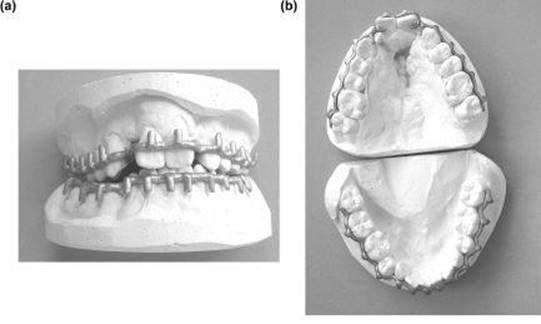
Figure 8.3 (a) and (b) Custom-made wrought arch bars with soldered cleats.
Advantages
· This method of fixation requires no casting facilities.
· There is no occlusal coverage and interference.
· They can be easily removed without too much discomfort to the patient.
Disadvantages
· This method may permit rotational movement in segmental surgical procedures without additional internal rigid fixation.
Cast Cobalt Chromium
If properly designed and manufactured, this type of arch bar has many advantages, whilst at the same time avoiding any interference with the occlusion. Cobalt chromium is the metal of choice because of its high tensile strength and so arch bars of this material are reliable and not bulky.
The casts are mounted on an articulator, sectioned and positioned in the planned position. Although it is advisable to prepare the wax pattern as close to the cervical margins of the teeth as possible, it is essential to avoid any contact with the gingival margin in the interdental area so as to leave space to pass and tie the 0.5 mm wire ligatures. The wax pattern also must not be formed close to the incisal edges to avoid interference with the postoperative occlusion. An arch bar made too close to the occlusal surface will be displaced gingivally when tightening the ligature wires. Intermaxillary fixation is achieved with two cleats placed on the buccal and labial segments on each bar. Each cleat should be opposite the one on the opposing arch. This can be precisely designed as capstan cleats (Figure 8.4) which are very helpful in stabilising the repositioned mobilised jaws in the planned position. Grooves must be provided to accommodate the interdental ligatures. The arch bar is cast using the “lift off” technique, and in segmental cases it is cast in the postoperative position.
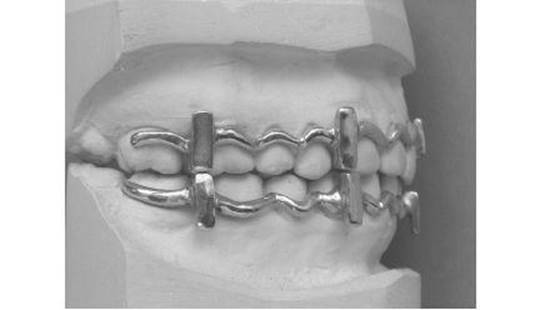
Figure 8.4 Cast chrome cobalt arch bars with matching cleats to confirm accurate localisation.
Advantages
· These arch bars provide reliable and precise fixation without any occlusal interference and with minimum discomfort to the patient.
· The facilities and skills for their construction are usually readily available in maxillofacial laboratories.
Disadvantages
· Casting facilities and skilled technical help are required. In common with any other arch bar they need to be ligated to the teeth with 0.5 mm soft stainless steel wires.
Ligating Arch Bars
A simple 0.5 mm wire ligature around the tooth and arch bar is unsatisfactory and the addition of a loop around the bar creating a figure of eight between tooth and bar produces stable anchorage (Figure 8.5).

Figure 8.5 Ligation of custom-made arch bar with 0.5 mm stretched stainless steel wire.
Eyelet Wires
Are used primarily in the immobilisation of jaw fractures because of the simplicity of their fabrication and application. However, they are valuable for intraoperative immobilisation with rigid fixation.
Wire of 0.5 mm is preferable to 0.35 mm as it is sturdier and easier to pass through tight contact points and gingiva without getting lost. Three metres of wire can be stretched 10% between heavy artery forceps and then cut into lengths of approximately 12 cm. Each is grasped at both ends by heavy forceps and the centre placed against a headless nail (2 mm diameter) fixed in a suitable surface, or a bur shank in a vice. The wire is firmly bent around the nail and then twisted twice to produce the eye. The eyelet wire is then removed and the ends are cut at 450 and trimmed (Figure 8.6).
Advantages
· The wires can be easily prepared and applied preoperatively with no technical support or dental casts (models).
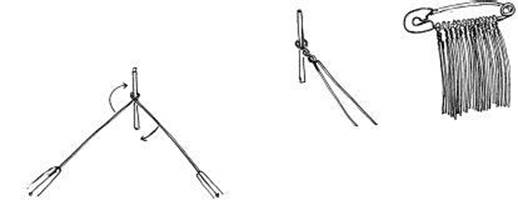
Figure 8.6 Making eyelet wires from 0.5 mm stretched stainless steel wire.
· They are ideal for temporary intermaxillary fixation when rigid fixation, i.e. plates and screws are being used.
Disadvantages
· This is a time-consuming procedure where an adequate number of suitably shaped teeth are essential.
· The use of eyelet wires on crowns and bridgework intraoperatively, can produce embarrassing displacement.
· Even when used with a wafer they will not stabilise small segments.
Occlusal Wafers (See Chapter 7, Figures 7.16–7.17)
As a final step in the presurgical planning, occlusal wafers are fabricated on the articulator mounted casts to establish the intermediate and postoperative positions. After surgery, the occlusal wafer can also provide a solid interdigitation of the teeth, especially in cases of mandibular advancement where the goal is a “3-point landing”. It is therefore possible to defer any final orthodontic refinement of the occlusion or the replacement of crowns and bridgework until comfortable bone union has taken place.
When the dental arch is sectioned and the segments repositioned, the wafer establishes the planned position whilst securing the osteotomy site with screws and or bone plates. However the occlusal wafer alone will not prevent rotation of the dento-alveolar segments, which must be secured with an orthodontic archwire, an arch bar or a sectional splint despite the internal rigid fixation.
Internal Fixation
Transosseous Wiring
This is a simple traditional method of holding bone fragments together. For the mandible with its rigid cortical plates, 0.5 mm stretched, soft stainless steel wire is satisfactory. However, a finer 0.35 mm wire is essential for maxillary osteotomies to avoid pulling through the thin bone margins of the drill holes. Although the bone plate has superceded transosseous wiring there are occasions when wires can be an invaluable salvage technique.
Miniature Bone Plates and Cortical Screws
Titanium bone plates and screws,1 are an excellent means of internal fixation. The introduction of L-and Y-shape plates should eliminate apical damage when screwing into the maxillary alveolar segment. The screw holes must be prepared with a slow, well-cooled matching drill, or a tapering tungsten carbide fissure bur (No. 101). High speeds and heavy hand pressure amplify eccentric rotation and produce a large, charred useless hole, especially in the thin maxillary wall. There are broader salvage screws available to rescue such situations. Plates provide greater security against relapse especially in cleft cases. In non-cleft osteotomies, the use of buccal plates in the maxilla and mandible or 9-13 mm bicortical screws for sagittal split osteotomies have made postoperative intermaxillary fixation unnecessary. This has dramatically simplified postoperative nursing and patient rehabilitation. Unfortunately, some plates when superficially placed submucosally give rise to irritation or become infected and have to be removed. However, when inserted with slow, gentle carefully cooled drilling of the bone, long-term incorporation is the rule rather than the exception.
Bioresorbable Fixation Plates and Screws
Resorbable fixation systems2 may have the potential for avoiding the possibility of a secondary procedure to remove plates. These are mainly produced from two alpha hydroxyl acids; polylactic and polyglycolic acids which resorb approximately in a year to lactic acid, carbon dioxide and water. Some may take up to 3 years. The ideal bioresorbable system should facilitate fixation with sufficient initial strength to stabilise bone segments and allow uneventful bone healing. It should be biocompatible and degrade predictably and completely after osteosynthesis has restored adequate intrinsic bone strength. They must be easy to use and cost effective.
At the moment most of designs are not suitable for the mandible to return to early masticatory function, as they can lose their strength within six weeks.
Cast Metal Cap Splints (See Figures 8.7a and 8.7b)
In procedures for gross facial deformity where prolonged fixation is required, metal cap splints still prove to be more reliable than any other method. Many variations exist. For repositioning of dentoalveolar fragments, the splint can be made
i) in separate parts and joined together with precision locks and connecting bars;

Figure 8.7 (a) and (b) A combination of a custom-made arch bar and open occlusal metal splint.
ii) as a one-piece open cast splint can be constructed on the surgical planning cast and fitted both as a template and fixation at the operation; or
iii) the splints can be secured to the mandible with circumferential wires during the operative procedure.
Advantages
· Teeth which are subjected to traction over long periods of time tend to migrate and extrude if not locked into a single unit by a rigid appliance.
· Important when few teeth are widely distributed.
· Excellent immobilisation can be achieved for a long period without causing discomfort or damage to the periodontal structures.
· The laboratory preparation of segments with locking plates and connecting bars in a planned position can reduce time spent in the operating theatre.
Disadvantages
· Splints require accurate impression techniques.
· Requires a skilled technician and maxillofacial laboratory facilities.
· Require adequate time for their construction, although this should not be an important factor when orthognathic operations can be planned weeks beforehand.
· Due to the thickness of metal between the occlusal surfaces of the teeth there is a slight error of occlusion after cap splints have been used. This resolves spontaneously or rarely requires postoperative orthodontic treatment.
The Design
They should fit as closely as possible against the gingival margins. To reduce the construction time and ensure uniform strength, everything that can be cast, such as hooks and rings, should be included in the wax pattern rather than be formed and soldered on at a later stage. The wax pattern should be smooth to reduce finishing time to a minimum. Given good organisation, the most complicated upper and lower splints can be produced in 6 hours. The use of cleats (hooks) tends to be the most popular method for intermaxillary fixation. Where accurate movements and positioning of the jaws is required, precisely matching capstan cleats can give superior results. The most useful design is the open cap splint where its open occlusal surfaces allow the escape of excess cement. This facilitates full seating and enables an accurate occlusion to be visualised at operation.
Splints should be cemented preoperatively and scrupulous care taken to remove residual cement from the occlusal surfaces, gingival margins, under cleats and from within locking plate recesses and screw holes.
Lines must be marked on the splints preoperatively to correspond to the facial midline. This can be of crucial importance in the operating theatre in establishing the desired fixation of two mobilised jaws in a bimaxillary procedure.
Also, where necessary, grooves for circumferential wires are incorporated into the design. The locking plates must be marked to indicate their position on the splint by engraving with small matching cuts on the top and soldered base of the locking plate.
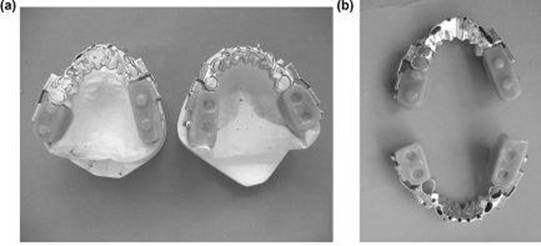
Figure 8.8 (a) and (b) Metal splints with posterior bite blocks for edentulous areas.
Locking Plates (See Figures 8.9a and 8.9b)
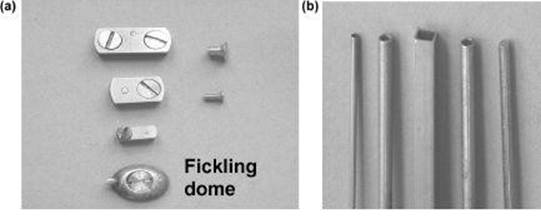
Figure 8.9 (a) Locking plates and screws for metal splint attachments. (b) Tubes and rods for splint attachments.
These are made of nickel silver. They can be purchased prefabricated and are in two sizes: a small, single screw type and a double screw, larger size with either 6 or 8 BA (British Association) screw sizes. They may also be specially fabricated in the laboratory from 1-5 mm thick strips of nickel silver. All locking plates provide a base for additional intra and extraoral attachments such as connecting bars.
Fickling Domes
This type of locking plate is cast in silver at the same time as the splint. A recess is built in the splint for the Fickling dome at the wax-up stage. After casting, holes are drilled in the dome and splint recess and then tapped to accept a screw of an appropriate size.
Screws
These are also constructed from nickel silver and are available in the following sizes: 4 BA, 6 BA, 8 BA and 10 BA, the highest number being the smallest size. Screws are normally supplied with countersunk heads. The most common choice is a 6 BA but smaller screws may be necessary if crown size is small.
Connecting Bars
These are used where the splints are made in sections and are joined together after surgery. The most suitable size of rod has an oval section (3 x 2 mm). This size is rigid enough to give excellent stability and yet at the same time is sufficiently malleable to be shaped into almost any desired form. They may also be cast in silver for any special need. Projecting bars are rarely used now with internal fixation.
Replacing Teeth
Where upper incisor teeth are missing the patient's appearance can be markedly improved during the fixation period by adding an acrylic tooth bearing flange to the splint by means of a pin and tube system.
1 Gebruder Martin GmbH & Co. KG, Tuttlingen, Germany; Leibinger (QS Leibinger, Muhllheim-Stetten, Germany), Albert Waeschle, Germany.
2 Gebruder Martin GmbH & Co. KG, Tuttlingen, Germany; Albert Waeschle, Germany. Inion Ltd, Tampere, Finland.