
This chapter provides basic preoperative, intraoperative and postoperative instructions for surgical procedures and a section on Distraction Osteogenesis. At first sight these may appear adequate for the correction of all deformities. However, in practice most cases have a complexity requiring the integration of several procedures, as described in Chapter 10.
General Preoperative Considerations
Informed consent is essential. Patients should be given an accurate although reassuring description of the immediate postoperative period. The possibility of prolonged neurapraxia of the mental or infraorbital nerves must be stressed and recorded. They should be given details of postoperative regimens for feeding and oral hygiene and also be asked to bring to hospital a child's small soft and medium toothbrush. All this is best done as a handout.
The patient must be fit, with a normal haemoglobin concentration. A chest film is probably only necessary where a rib graft is required as a base line should there be any postoperative problem. The nasal airway must be bilaterally patent. Enlarged tonsils may create postoperative oropharyngeal obstruction when swollen, especially with maxillary osteotomies.
Emotionally unstable patients are usually unsuitable for surgery and find intermaxillary fixation intolerable. However this is rarely a problem with rigid fixation.
Preoperative Investigations
1. Haemoglobin, full blood count and blood film.
2. Urinalysis.
3. Blood group and transfusion antibody screening.
4. For major procedures especially when a bone graft is taken, cross-matching blood should be arranged at the last preoperative visit.
5. Sickling test, hepatitis B surface antigen (HBsAg) and HIV screening where appropriate.
6. Chest radiograph, if indicated by the medical history or procedure.
Blood Replacement
Loss of blood can be significantly reduced with hypotensive anaesthesia and antifibrinolytic medication. Mandibular procedures rarely require transfusion, however it is good practice to group the patient's blood and screen for transfusion antibodies but hold the serum for emergency cross-matching. With the increased concern about cross-infection, autologous blood is now being used in some centres for elective surgery.
Antibiotics
Preoperatively
Microbiologists advocate minimal regimes for non-infected surgery. The following alternatives are reasonable choices.
· Amoxicillin 1G intravenously at induction followed by 500 mg intravenously 3 hours postoperatively is recommended. However there is anecdotal evidence that continuing the antibiotic orally 500 mg 8-hourly for the traditional 3 days reduces the low incidence of postoperative infection at the sagittal split site. But this may be prevented by using mandibular vacuum drains after the osteotomy rather than more antibiotics.
· Metronidazole can be given as a 1g rectal suppository pre- and postoperatively. This is more convenient than a 500 mg slow intravenous infusion, to be followed by 400 mg orally 12-hourly for 2-3 days.
· Clindamycin 300 mg intravenously at induction and 150 mg iv. 3 hours postoperatively. This can be extended to 300 mg 6-hourly orally for 2-3 days.
Antibiotics are not required more than 3 days postoperatively unless there is evidence of wound infection or a persistent pyrexia.
Antioedema
Preoperatively
Dexamethasone 8 mg is given intravenously with the anaesthetic induction agents and repeated 12 hours later.
Postoperatively
Dexamethasone 8 mg is given i.v. or i.m. 12-hourly on postoperative day 1, followed by 4-5 mg 12-hourly on day 2.
Operating Considerations
1. The patient must be anaesthetised via a nasal endotracheal tube centrally secured across the forehead. A simple low profile connector between the endotracheal and anaesthetic tubing is essential. A 12 FG nasogastric tube for postoperative aspiration should also be passed prior to the operation. Some anaesthetists will also pass a fine-bore feeding tube at the same time.
2. Clean the face and mouth with an aqueous antiseptic such as chlorhexidine or povidone-iodine.
3. Drape so that the orbital margins may be exposed for orientation. Cover the nasal tube and eyes with an adhesive drape (Steridrape — 3M, US; Opsite — Smith and Nephew, UK) (Figure 9.1).
4. If a bone graft is being taken, strip the patient, clean the hip or chest twice with iodine detergent and square drape the area with towels; cover and seal the site with a Steridrape or Opsite.
5. Check bipolar diathermy is in place. The anaesthetic machine is best placed with a long hose at the lower end of the table on the opposite side to the graft site. If used, the compressed air cylinder can also be conveniently placed at the foot end of the table so that the air drill hose may pass upwards along the long axis of the patient to the head end. This is avoided by the use of an electric drill.
6. Tilt the feet down and the head up. Lubricate the lips initially and repeatedly with 1% hydrocortisone ointment.
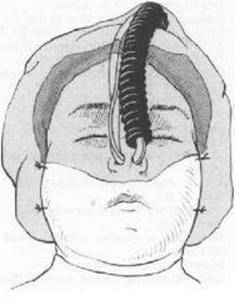
Figure 9.1
Instruments
The following list gives the basic osteotomy instrumentation. Most of the instruments are shown in Figures 9.2a–9.2d.
1. Ward's cheek retractor
2. Prognathism channel retractors (x2)
3. Chin holding retractor
4. Cairn's malleable retractor 17 mm
5. Cairn's malleable retractor 11 mm
6. Lac's tongue depressor — child
7. Lac's tongue depressor — adult
8. Kilner cheek retractors — insulated (x2)
9. Forked retractor 70 x 12 mm
10. Langenbeck retractors 44 x 13 mm (x2)
11. Langenbeck retractors 23 x 7 mm (x2)
12. Allis tissue forceps, 4 in 5 teeth, 15 cm (x2)
13. Halstead Mosquito artery forceps, curved 12.5 cm (x10)
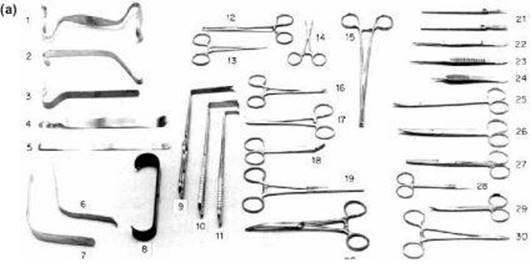
Figure 9.2 (a)
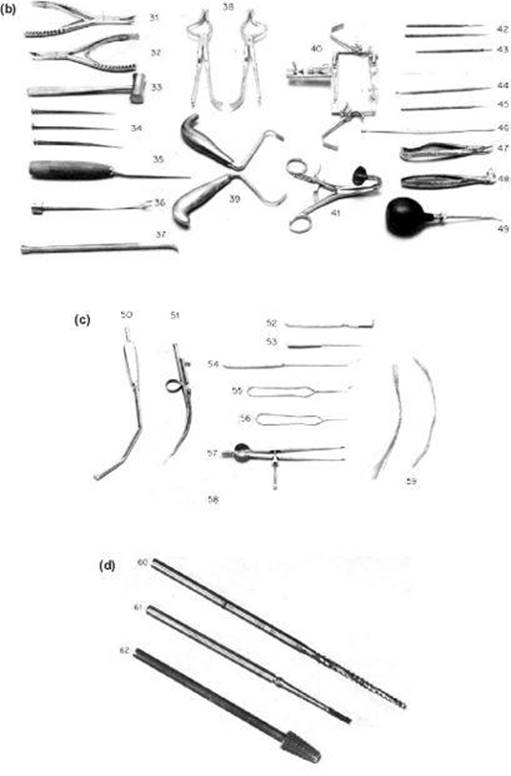
Figure 9.2 (b), (c), (d)
14. Bachaus towel clips (x10)
15. Rampley spongeholders 24 cm (x3)
16. Dunhill artery forceps 13 cm (x10)
17. Lawson Tait artery forceps (x2)
18. Universal wire and plate shears 12 cm (x2)
19. Kocher artery forceps, straight 1 in 2 teeth 18 cm
20. Kocher artery forceps, curved 1 in 2 teeth 18 cm
21. Barron scalpel handles with No. 5 and 10 blades (x2)
22. McIndoe dissecting forceps 15 cm
23. Gillies dissecting forceps, toothed 15 cm
24. Adson dissecting forceps, toothed
25. Mclndoe scissors T/C edge 18 cm
26. Mayo scissors T/C 17 cm
27. Blunt-ended scissors 15 cm
28. Iris scissors T/C 12 cm
29. Strabismus scissors T/C 11.5 cm marked with black tape
30. Crilewood needleholders T/C jaws 15 cm (x2)
31. Luer Jansen bone rongeur 19 cm
32. McIndoe bone cutting forceps 19 cm
33. Small mallet
34. French osteotomes 5 mm, 7 mm and 11 mm
35. Osteotomes ½ (13 mm) with round handle (x2)
36. Obwegeser nasal septal chisel
37. Pterygoid chisel
38. Rowes disimpaction forceps — right and left
39. Tessier maxillary mobilisers — right and left
40. Dingham mouth gag. Frame with cheek retractor, 3 blades S, M, L (not shown)
41. Featherstone or other self retaining mouth gag
42. Kilner skin hooks 15 cm (x2)
43. Mapping pen (with nib)
44. Mitchell trimmer
45. Dental probe No. 6
46. Howarth's nasal raspatories (periosteal elevators) (x2)
47. Dental extraction forceps 76 N
48. Dental extraction forceps 74 N
49. Chip syringes (x2)
50. Yankauer suction tube
51. Self-clearing suction tube
52. Farabeouf rougine curved 11mm
53. Flat screwdriver
54. Obwegeser mandibular awl
55. Kelsey Fry bone awl — curved
56. Kelsey Fry bone awl — straight
57. Caliper
58. Ruler
59. 0.50mm and 0.35mm stainless steel tie wires (x25)
60. Long shanked Lindemann surgical bur (Meissinger)
61. Tungsten carbide surgical bur (Ash)
62. Cone shaped acrylic bur
There are an infinite number of refinements such as a coronoid stripper and coronoid forceps, and many types of periosteal elevator.
Not shown are: surgical handpieces for drills and oscillating and sagittal saws or arm miniature titanium bone plating set with transfacial trocar, canullae and retractor.
Note: To ensure a harmonious operation, check the radiographs, study models with the patient the day before and the instruments, especially burs, drills and wafers preoperatively. A pre-admission checklist can be invaluable.
Postoperative Care
Immediate
The patient is nursed at 45 for comfort and access. A nasopharyngeal airway is left in situ overnight, with strict instructions to staff to suck out the nasopharynx every 30 minutes with a fine catheter passed through the tube. Ideally it should be humidified to prevent crusting. Some anaesthetists prefer to leave the endotracheal tube in situ overnight. However, it is doubtful whether suction of blood and mucus from the entire length of the tube to maintain the airway can always be guaranteed. Oxygen (40%) in air is usually administered by face mask at approximately 5 litres/min.
Hourly aspiration of accumulated blood, oral and gastric secretions, and bile from the stomach help to eliminate vomiting. As most patients are fit prior to the procedure, dedicated nursing supervision with half-hourly observations is required rather than intensive care.
Analgesics
Pain experience is variable and surprisingly often absent. However repeated moderate doses of a subcutaneous or intravenous opiate, such as morphine 10 mg p.r.n. x 4 doses each 24 hours (more useful than 10 mg 4-hourly), with an antiemetic such as metoclopromide 10 mg, should be prescribed. Control is better and the analgesic dose lower when morphine is given 1 mg/ml by a Patient Controlled Administration “pump” system. This may be administered as morphine 50 mg in 50 ml normal saline into a drip or by a separate cannula.
The infiltration of the long-acting local analgesic 0.5% (5 mg/ml) bupivacaine hydrochloride (Marcain) with adrenaline (1:200 000) is said to reduce postoperative pain experience in addition to its intraoperative analgesic and vasoconstrictor effects. It is interesting to note that this reduced pain experience extends beyond the possible action of the drug. Up to 2 mg/kg may be used in any operative procedure.
First Postoperative Day
Check in particular:
1. Airway and chest clinically and if not clear, radiographically. All patients benefit from chest physiotherapy.
2. Fluid balance, i.e. blood and fluid replacement should approximate to blood and fluid loss. Note the urinary output and ensure the patient's bladder has been emptied, especially as transient retention may follow narcotic analgesics. Remember the loss via gastric aspiration, vomiting and the drains. Two litres of compound sodium lactate intravenous infusion (Hartmann's solution) should suffice in addition to blood replacement.
3. Occlusion and elastic fixation if used.
4. Cutaneous sensation and facial motor function.
5. Drug regimen. Antibiotics should be given intravenously or rectally, and analgesics and antiemetics intravenously. However, many patients will tolerate soluble analgesics orally or by nasogastric tube on a regular as required basis. A rectal non-steroidal anti-inflammatory analgesic, such as flurbiprofen 150 mg 12-hourly, is also useful to avoid continuous opiate analgesia.
6. Nutrition. During the first 24 hours continue the Hartmann's solution, 2 litres i.v., but try 100 ml/h water by mouth, then tea or orange juice, etc. as soon as the patient can tolerate feeding, using a syringe and quill, feeding cup or straw. If this is not possible use a fine-bore (Clinifeed — Roussel, UK) nasogastric tube which should be passed preoperatively to permit feeding until the patient can accept fluid and calories by mouth. If a fine-bore tube is not available, the standard Ryle's tube (12 or 14 FG) may be used. (See also Chapter 9 for postoperative feeding regimen.)
7. Oral hygiene with Chlorhexidine 0.2% solution is commenced.
Second Postoperative Day
Repeat the above but change from intravenous to an oral or nasogastric regimen, increasing the feed to a full diet.
Note: Oral fluids may be difficult for some patients up to 3 days after major procedures, especially those involving the chin, producing difficult lip control.
Discharge from hospital is determined by the nature of the procedure, the individual, and the care available at home. Most patients can be discharged on the second or third postoperative day, and on discharge should have adequate simple analgesics and instructions on oral hygiene, especially the use of a small tooth brush with chlorhexidine gluconate gel or mouthwash. Advice on a blended diet and the provision of a diet sheet is also important.
Follow-Up
The occlusion may be checked weekly or fortnightly. It is reassuring for the surgeon to assist maximal intercuspation with the final wafer and elastics. However wafers are uncomfortable and difficult to keep clean and are probably unnecessary. Soluble sutures should be left or removed when they are accessible and are a source of irritation. Patients require reassurance that impaired labial or infraorbital sensation will return to normal within 6 months and that excess soft tissue will also remodel and disappear over this period.
The Operative Procedures
The Obwegeser Sagittal Split Osteotomy
Indications
This versatile operation may be used for placing the mandible backwards or forwards, but should not be used for an anterior open bite without a simultaneous maxillary impaction to reduce the posterior upper facial height.
Technique
The operation for a backward correction will be described first.
1. The jaws must be supported as widely apart as possible by a self-retaining gag which gives better access than a prop (Figure 9.3a).
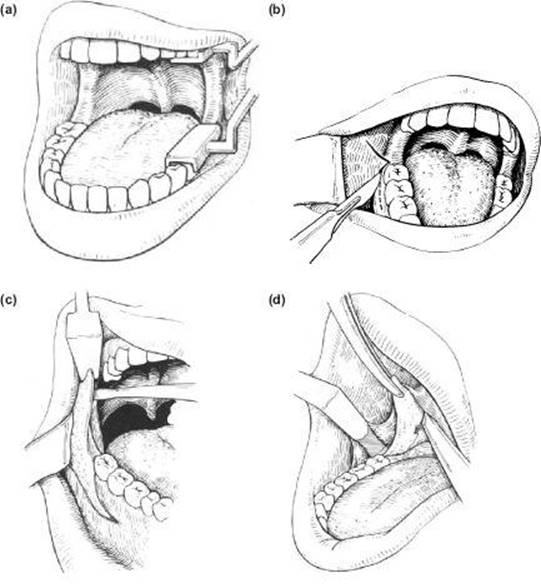
Figure 9.3 (a), (b), (c), (d)
2. The tissues on the lingual and buccal aspect of the ascending ramus and adjacent body of the mandible are infiltrated generously with a vasoconstrictor containing local anaesthetic, e.g. 0.5% bupivacaine with 1:200 000 adrenaline.
3. The incision is a buccally based triangular flap with the apex at the back of the last standing molar (Figure 9.3b). The anterior limb should leave a generous skirt of alveolar mucoperosteum attached to the gingival margin of the first molar to assist suturing (Figure 9.3c).
4. The buccal periosteum is widely elevated, exposing the outer surface of the body and ramus of the mandible. This can be facilitated by using the forefinger, stretching and incising the periosteal layer to produce a buccal space which helps retraction of the tissues with a channel retractor and also provides good operative access for the insertion of bone plates. Techniques recommending limited exposure are difficult to understand (Figure 9.3d).
Raise the lingual flap, with a Howarth periostal elevator, detaching the mucoperiosteum downwards and forwards from the anterior aspect of the ascending ramus to the distolingual aspect of the last molar. The inferior extent of the periosteal reflection needs to be no deeper than the mylohyoid ridge.
5. Dissect up the anterior aspect of the ramus, detaching the temporalis tendon with the sharp end of the Howarth elevator or a forked coronoid stripper. By inserting the Obwegeser coronoid retractor half way up and applying strong traction, the exposed tendon can be gradually stripped off with the elevator so that the retractor may be eventually seated comfortably on the coronoid tip. This degree of elevation greatly helps the access to the lingual aspect of the ramus (Figure 9.3c). The application of a heavy pair of curved Kocher's or coronoid forceps to the coronoid will now dispense with the forked retractor and provide a comfortable and secure alternative for the assistant.
6. Carefully raise the lingual periosteum to the level of the sigmoid notch and follow its margin until the condylar neck is reached; then smoothly detach the tissues downwards until the lingula is reached. Care will avoid troublesome venous bleeding, which usually ceases after the channel retractor (or a reversed bent Lacs retractor) is inserted with its tip passed behind the condylar neck.
7. The horizontal cut should be made as low as possible close to the lingula where the cortices are always separated by adequate cancellous bone. The higher the cut the less chance there is of splitting the ramus cleanly. Improved access is obtained by rotating the flat or channel retractor 45 to the vertical plane so that it lies parallel to the neurovascular bundle (Figure 9.3e).
8. The cut is made through the cortex of the bone with a long-shanked, medium-sized tapering fissure bur (Ash, Meissinger, Busch) and should be extended beyond the concave inner surface to the distal aspect of the ramus as the Hunsuck modification does not always work! With maxillary impactions parallel medial cuts allow a fillet of cortex to be removed. This allows the mandible to follow the maxillary vertical displacement (Figure 9.3f).
9. The buccal channel retractor is now placed vertically opposite the mid-point of the second molar with its tip below the lower border of the mandible (Figure 9.3g).
10. Access is remarkably improved by taking out the gag and all other instruments bringing the teeth into occlusion. A line of bur holes is made parallel to the external oblique ridge, which is continued onto the lateral surface of the mandible following the lateral bony prominence as it curves down on the buccal surface towards the lower border (Figure 9.3h).
11. This ensures an accurate line when they are joined together, and produces a natural continuous, lingual-buccal cortical cut. It is important to emphasise the cuts through the cortex proximally at the junction of the medial (lingual) and mid section and also antero-inferiorly through the thick cortex of the lower border to a depth of 2 mm.
If the mandibular osteotomy is part of a bimaxillary procedure the cuts are done bilaterally, tonsil swabs inserted, and the maxillary osteotomy carried out and fixed with the intermediate wafer against the unchanged mandible.
12. The split is traditionally done with two ½ inch osteotomes which must have thick round handles enabling a firm twisting action to be used without the glove slipping. However a more controlled division can be achieved with a narrow 5 mm. osteotome tapped first distally below the horizontal medial bur line “feeling” the inner surface of the outer cortical plate. This is repeated at least twice with an identical osteotome obliquely downwards and backwards through the buccal cut, and then downwards just within the line of the external oblique ridge which seems to be a natural plane of cleavage (Figure 9.3i). This bone dissecting manoeuvre may produce an instant and clean split. If not the ½ inch osteotome is gently tapped into the anterior cortical cut until firm, and rotated slowly but continually until the cancellous bone begins to split. The cortical split is generated by rotating anticlockwise on the right side and clockwise on the left. Slow separation permits the neurovascular bundle to be identified if exposed and dissected from the outer fragment where it may be adherent. If a single osteotome is used, it should then moved from the anterior buccal end of the cut to the superomedial end (Figure 9.3j). The two segments must be completely separated by inserting a finger into the depths of the osteotomy cut to vigorously detach all muscular and periosteal restraints. Where the mandible is narrow or the fragments refuse to separate on twisting, the fine 5 mm osteotome can be used as just described to divide the bone by gently tapping it through to the lower and posterior borders on the inner aspect of the buccal cortex. However such resistance suggests that the cortical bur cuts are inadequate and should be repeated.
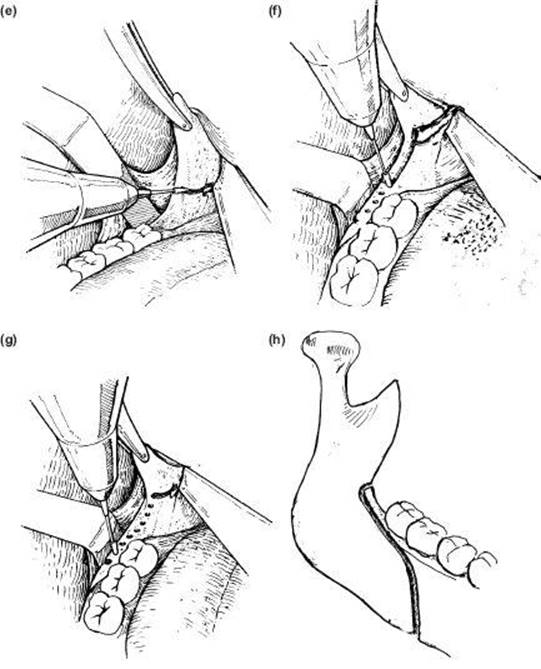
Figure 9.3 (e), (f), (g), (h)
13. The estimated setback has been measured on the study models. This amount of buccal plate is held firmly in Kocher or Dingman bone-holding forceps and cut off with a Lindemann fissure bur protecting the underlying inferior dental bundle with a flat retractor (Figure 9.3k). A horizontal fillet of bone may have to be trimmed with an acrylic bar from the upper margin of the inner cut on the ascending ramus to allow a good fit, especially in cases where the maxilla has been elevated — and the mandible has to rise to maintain the occlusion.
14. The forward correction requires the buccal cortical cut to be made at the mesial aspect of the second molar. After the split, no bone is removed.
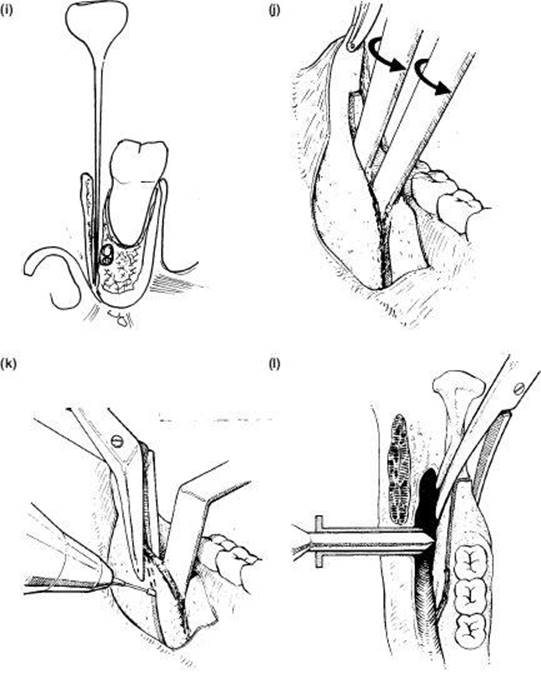
Figure 9.3 (i), (j), (k), (l)
15. Internal fixation requires accurate, firm intraoperative intermaxillary fixation which is applied after the osteotomy cuts have been completed.
16. A transfacial trocar, cannula and retractor are essential for bicortical screws. A short stab wound (5 mm) is made through the skin, a finger's breadth above the lower border of the mandible just anterior to the masseter muscle. Fine mosquito forceps are pushed through the tissues to enter the wound in the mouth, opened and closed, rotated through 90, and opened again to create an entry for the canulla.
17. The trocar and cannular sleeve are then firmly pushed through to reach the buccal plate (Figure 9.3l). The trocar is removed and the cannula is attached to the extra and intraoral arms of the retractor. The design varies with the manufacturer. The cannula has a projection which helps to immobilise the buccal plate if a bone clamp is not used (Figure 9.3m).
18. The antero-posterior position of the proximal fragment (ascending ramus) is crucial Light self-retaining bone-holding or Allis forceps are used to grip the proximal fragment which is pushed back for mandibular advancements and pulled forwards for push backs. It should also be rotated downwards to lower the buccal plate just below the upper margin of the retromolar lingual cortical surface. This maintains the contour of the gonial angle which can be lost if the proximal fragment is inadvertently allowed to rotate forwards (Figure 9.3n).
The two bone plates can then be stabilised by clamping them with an Allis until the screws have been inserted or with experience the tip of the cannula can so be used to hold them in place.
19. If there is sufficient bone beneath the neurovascular bundle the first screw hole may be drilled with the special long-shanked twist drill at this level. The drill should be applied gently as the shank is fragile and does not take kindly to torsion. A sense of give is felt when each plate is penetrated. The lingual side should be protected.
20. Screws 9-13 mm are usually adequate for bicortical fixation and are inserted with a screwholding screwdriver, which should be ready mounted to use the moment the hole is drilled. Two further screws are inserted above the bundle behind the last standing molar (Figure 9.3o). When the opposite side is complete the intermaxillary fixation is released.
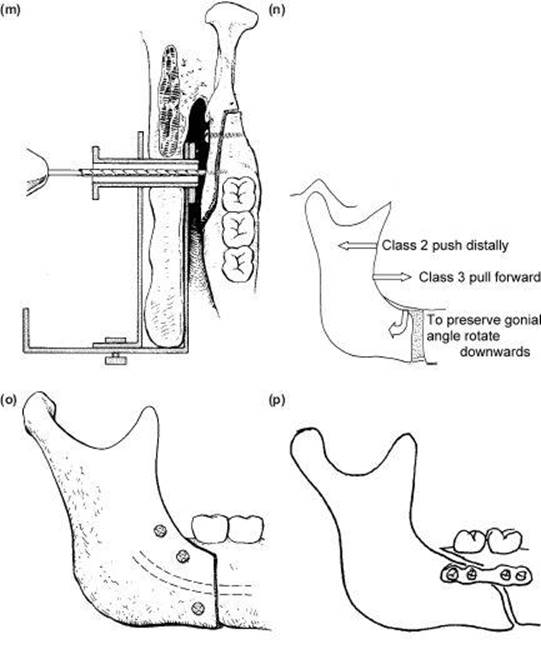
Figure 9.3 (m), (n), (o), (p)
21. The stab wounds are closed with 6/0 prolene.
22. An alternative and simpler technique of intraosseous fixation is the application of a buccal titanium plate bridging the osteotomy gap and fixed intraorally with 5 mm moncortical screws (Figure 9.3p).
23. Vacuum drains are inserted in the buccal pouches bilaterally, sutured to the skin and attached to separate bottles. There are those who do not use drains despite evidence that the subperiosteal sump gives rise to morbidity and infection without this standard practice.
24. The intra oral wounds are carefully closed with a 3/0 polyglycollate suture.
25. When all bleeding has been controlled the throat pack is removed and the pharynx carefully sucked out.
26. The wafer may be left suspended to the maxillary arch wire, but intermaxillary fixation with elastics is unnecessary and the patient is returned to the recovery area.
27. The use of the wafer and postoperative training elastics for 2 weeks is uncomfortable for the patient of no proven value except for providing comfort for the surgeon.
Additional Notes
· As varying degrees of relapse invariably take place, especially with large movements, the planning should be based on a relaxed supine centric relation squash bite, as close as possible to the operating position. In addition overcorrection should be built into the model surgery. This should be an edge to edge incisor relationship for forward mandibular movements and a class 2 div1 relationship for mandibular setbacks.
· With major facial deformities, such as a hemifacial microsomia, the neurovascular bundle often lies superficially adjacent to the buccal cortex and can be easily severed whilst carrying out the buccal cut. With such a mandible, an extraoral subsigmoid osteotomy is recommended for vertical lengthening or an inverted L osteotomy with a bone graft for forward movements.
· Despite careful intraoperative intermaxillary fixation and a perfect immediate postoperative occlusion, occlusal discrepancies can still mysteriously appear from 24 hours to 14 days later. The cause may be postoperative condylar recoil, intracapsular oedema or lack of muscle adaptation. This usually remits and the use of training elastics is probably unnecessary.
· If the preoperative arch co-ordination is imperfect and requires restorative or orthodontic correction, it is essential to construct a final wafer which will ensure that the midlines and incisor overjet are correct and the arch alignment is symmetrical. The underlying malocclusion can then be corrected as required.
The Subsigmoid (Subcondylar) Osteotomy
Indications
Although formerly a very popular operation and easier to perform than the sagittal split, the subsigmoid osteotomy is less versatile. It also requires elastic intermaxillary fixation unless secure plating is achieved. It can be carried out intraorally or through an external skin-crease incision, leaving a discrete scar.
The subsigmoid osteotomy is not an operation for lengthening the body of the mandible but it is useful where the mandible is narrow as in a congenital deformity, or atrophic in the older edentulous patient with unerupted wisdom teeth, when it can be used for setting back the body or lengthening or shortening the ascending ramus.
Extraoral Subsigmoid Osteotomy
Technique (Figure 9.4)
1. A 5 cm submandibular or retromandibular incision is marked with a pen and infiltrated with 4 ml local anaesthetic containing 1:80,000 adrenaline. This is made in a skin crease two fingers' breadth below the mandibular border to avoid the marginal (mandibular) branch of the facial nerve. A lower crease requires a larger incision (Figure 9.4a). Note: Never mark an incision with the head rotated: this will produce unexpected changes in the surface anatomy.
2. The skin, fat and platysma are divided with a No.15 blade. The flap margins are undermined with MacIndoe scissors or the knife to increase the elasticity of the wound margins which are carefully retracted with cat's paw retractors.
3. The deep fascia is identified, picked up with fine-tooth dissecting forceps and divided widely beyond the ends of the flap incision with a knife or scissors. Deep veins, usually the posterior facial, can be identified, divided and tied with 3/0 polyglycollate.
4. Access through the submandibular incision requires the identification of the mandibular branch of the facial nerve which lies under the deep fascia just below the lower border of the mandible. As it passes upwards on to the face it crosses the facial artery and vein. This important motor nerve may be protected by identifying the facial artery and vein as they emerge between the submandibular salivary gland and lower border of the mandible. Use scissors or Spencer Wells forceps to separate the tissues, and divide and tie these vessels, then retract and suture the distal ends upwards over the lower border of the mandible. This will carry the marginal branch of the facial nerve with them.
5. The muscle and periosteum can now be incised along the lower border with a knife and stripped upwards to the sigmoid notch and coronoid process. The Obwegeser channel or Robertson ramus retractor may be hooked over the notch to expose the ramus (Figure 9.4b).
6. A small buccal prominence is a reasonably accurate landmark of the lingula area, so a cut downwards and behind this from the midpoint of the sigmoid notch to the beginning of the curve of the angle avoids the inferior dental neurovascular bundle. This may be done with a fissure bur or reciprocating saw. A flat retractor should be placed on the medial aspect of the ramus to protect the soft tissues.
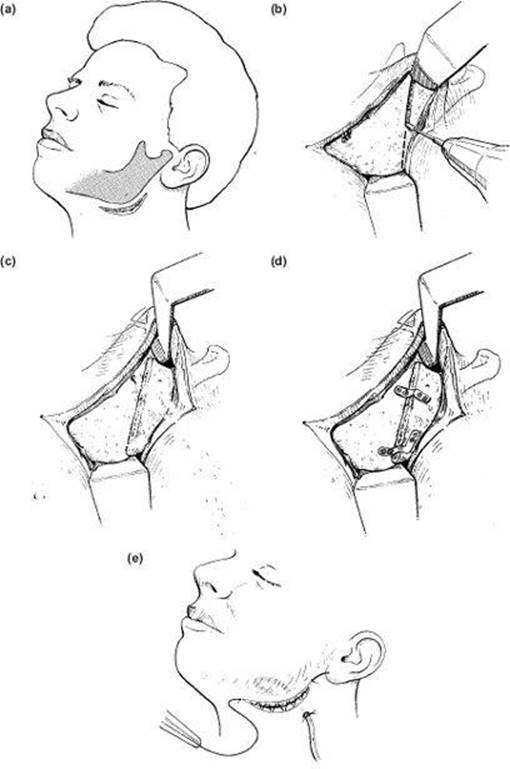
Figure 9.4 (a), (b), (c), (d), (e)
7. Once separated, the inner cortex of the narrow fragment and the outer cortex of the main segment may be bevelled with an acrylic bur to ensure good opposition.
8. For large distal displacements, i.e. greater than 0.7 cm, it is necessary to do a coronoidectomy to remove the restraining influence of the temporalis muscle (Figure 9.4c).
9. A saline-soaked tonsil swab is inserted in the wound and the procedure repeated on the opposite side.
10. With the appropriate wafer the intermaxillary wires are applied, with the teeth held in occlusion.
11. As rigid fixation is being used the cut should be as vertical as possible in order to leave a substantial posterior border. After putting on intermaxillary fixation the larger, i.e. distal, fragment should be trimmed to allow close approximation of the osteotomy margins. An L or T-shaped plate with six holes is then fashioned and screwed into the lateral aspects of the posterior and inferior borders of the mandible to bridge the bone cut firmly.
12. Vacuum drains are placed bilaterally overlying the bone surface and sutured firmly to the skin as soon as the introducer has been pulled through; ensure that at least 2 cm of non-perforated drain lies within the wound (Figure 9.4d).
13. The wound is closed by suturing the muscle and periosteum with 3/0 polyglycollate on a 22 mm half-round needle. The fas-cia/platysma layer and subcutaneous tissue are similarly closed, with the knots buried by suturing from deep to superficial. For a fine scar, the skin should be closed with a 3/0 continuous subcuticular monofilament [Prolene, Ethilon (Ethicon Ltd., Edinburgh, UK) or nylon] suture on a straight needle. This can also be done with a half-round non-cutting needle. Alternatively, wound closure may be achieved with 5/0 Prolene or Ethilon interrupted sutures, or even adhesive Steri-strips (3M, US) if subcutaneous closure is satisfactory.
14. The throat pack is removed.
Intraoral Subcondylar Osteotomy
This is a relatively simple procedure and is a rapid way of treating minor displacements of the mandible, i.e. less than 7 mm, which may involve a backward or a rotational correction for asymmetry. Major movements should be accompanied by a coronoidectomy or even a horizontal ramus osteotomy because of the restraining influence of the temporalis muscle.
However neither have the great advantage of dispensing with intermaxillary fixation. The best application of the intraoral procedure is a means of salvaging a sagittal split that has not separated the condyle from the body of the mandible.
Technique
Buccal Ramus Approach (Figure 9.5).
Infiltrate the tissues on the buccal aspect of the ascending ramus with a vasoconstrictor (Figure 9.5a).
1. A buccal-based triangular incision is made with a No.15 blade with the apex behind the last molar tooth, the upper limb stopping at the external oblique ridge halfway up the ascending ramus (Figure 9.5b).
2. The flap is elevated subperiosteally as widely as possible, using the Howarth periosteal elevator and then the forefinger to stretch the periosteum and create a generous pouch. A J-shaped periosteal elevator is useful in freeing the muscular attachment at the posterior and inferior borders. The sigmoid notch, condylar neck and angle of the mandible should be readily palpated.
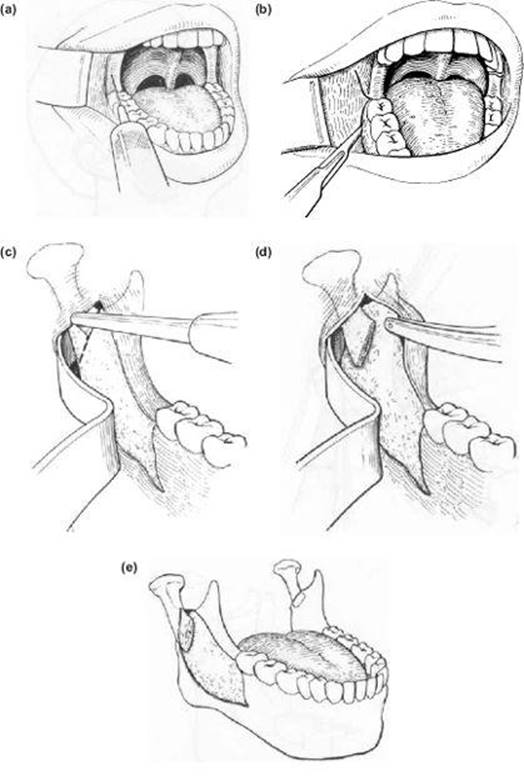
Figure 9.5 (a), (b), (c), (d), (e)
3. The Merrill or similar retractor is inserted so that the curved distal flange may be firmly placed behind the posterior border of the ascending ramus (Figure 9.5c).
4. The sigmoid notch may then be visualised and a 1.5 cm right-angled oscillating saw is used to cut downwards and backwards to 1 cm below the mid-point of the posterior border, i.e. where the condylar neck has narrowed and fused with the flat ascending ramus. It is essential to use a sharp-edged saw. Some operators prefer a blade which is 70 to the long axis of the saw.
5. Once separated, the condylar component is displaced buccally with the Howarth elevator. When both sides have been completed the mandible is displaced backwards between them (Figures 9.5d and 9.5e).
6. A vacuum drain is inserted into the wound prior to closure.
7. As this procedure does not lend itself to internal fixation elastic intermaxillary fixation is necessary.
Medial Ramus Approach (Figure 9.6)
This procedure is useful to salvage a failed sagittal split.
1. The basic exposure is almost exactly the same as for the sagittal split technique except that only minimal stripping is required on the buccal surface of the mandible. However, with the curved Kocher's forceps in place abovethe coronoid process and the ramus channel retractor inserted just above the level of the lingula and hooked behind the posterior border of the ascending ramus, an excellent view of the sigmoid notch and posterior border is achieved form the contralateral side of the patient (Figure 9.6a).
2. With a long-shanked fissure bur and oblique cut is made through the thick posterior ramus border as low as possible, passing forwards and upwards into the sigmoid notch (Figure 9.6b).
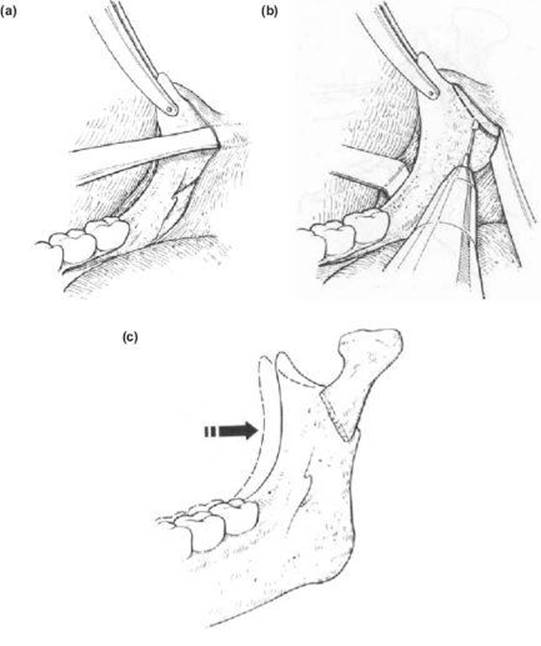
Figure 9.6 (a), (b), (c)
3. Separation of the osteotomy may be completed with a 5 mm osteotome. The small condylar fragment is then manipulated medially with the channel retractor and a perio-steal elevator into the hollow medial surface of the ramus (Figure 9.6c).
4. This is repeated on the contralateral side and the mandible is placed into the planned occlusion.
5. The wounds are closed.
6. Again this procedure requires elastic intermaxillary fixation.
Note: Occasionally access is restricted where the medial aspect of the ramus is broad and concave, in which case an alternative osteotomy should be undertaken.
Body Osteotomies
This procedure is done intraorally, usually in the molar-premolar region. However, it shortens the alveolus and has not got the elegance or versatility of the sagittal split or subsigmoid procedures and requires more careful planning. For these reasons it is not considered here. The anterior mandibulotomy, in which the section is made anterior to the mental foramen, is a useful variant of this operation.
The Inverted L Osteotomy
Indications
This operation is valuable when there is a need to increase both the ramus height and body length at the same time, especially when the sagittal split osteotomy is not possible. Such cases are usually gross congenital mandibular hypoplasia or, occasionally, acquired hypoplasia following condylar fractures or when previous surgery has disturbed the bony anatomy. The operation differs in concept from the sagittal split procedure in that a bone graft is inserted to make up the deficiency.
Technique
1. The surgical approach is exactly the same as for the extraoral subsigmoid osteotomy (steps 1-6 and see Figure 9.4) except that the bone cut is made from the anterior border of the ascending ramus, passing distally, to behind the estimated position of the lingula then downwards to the lower border anterior to the angle, i.e. to the antegonial notch (Figure 9.7a).
2. With bilateral deformities the approach is repeated on the opposite side.
3. The mandible is then temporarily fixed into occlusion. Where the maxilla is normal this presents no problems. However, if there is a deformity of the maxilla this must be corrected before the inverted L and fixed with bone plates.
Mobilising the small mandible into the desired anterior position can be difficult and is facilitated by drilling a hole bilaterally in the lower border of the mandible just anterior to the osteotomy cut and passing a 0.5 mm traction wire to be attached to heavy forceps. When anterior traction is applied, explore the deep tissues medial to the mandible with a finger to find any restraining bands of periosteum, muscle or ligament. These must be vigorously divided with the finger to ensure stability.
4. With the proximal condylar fragment confirmed to be in the fossa, the gap created can be measured, and a template formed with sterile paper or card.
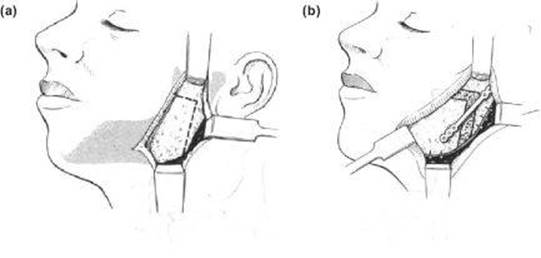
Figure 9.7 (a), (b)
5. An interpositional graft is now obtained. The ideal source is cortico-cancellous bone from the iliac crest. A solid cancellous graft can be used but the incorporation of one cortex provides reassuring stability. Some surgeons use split rib for the gap. Two miniature bone plates provide excellent rigidity and form (Figure 9.7b).
6. A vacuum drain is inserted and the wound is closed in layers.
7. The intermaxillary fixation is released and the pack removed.
Note: Any mandible which requires lengthening with an inverted L osteotomy also requires an augmentation genioplasty.
The Lower Labial Segmental Osteotomy (Kole Subapical Osteotomy)
Indications
Although this operation may be used to move the dentoalveolar segment in almost any direction permitted by the angulation of the teeth, it should not be used as an alternative to presurgical orthodontics and is less useful and more difficult than the anterior mandibulotomy If carried out as a single procedure, intermaxillary fixation is not required. The alveolar segments can be secured with bone plates plus:
1. An arch bar, the best being a cast chrome cobalt bar designed on the surgical planning model.
2. An orthodontic arch wire fitted intraoperatively or more readily a heavy (1 mm) supplemental arch wire fitted into distal buccal tubes and ligated to the segment and the adjacent teeth. The segments are localised by a postoperative wafer and bone plates below, which are not enough without the dental control to prevent displacement.
3. Three-part cast German silver splints with locking plates and connecting bars (but this is labour intensive and requires a skilled technician).
Where preoperative extractions are not carried out, orthodontic tooth movement is required to ensure space to facilitate the surgical cut without root damage.
Technique
Downward and posterior movements (Figure 9.8)
1. A premolar is carefully extracted bilaterally to create space for a distal movement. For vertical movements without extractions it is imperative to confirm that there is sufficient bone between the roots of the teeth. The orthodontist can achieve increased separation with a fixed appliance.
2. Whichever incision is used (see below), extend the lips, dry the mucosa, and mark it out with a pen and Bonney's blue.
3. The procedure is done with a curved incision starting below the papilla distal to the site of the vertical bone cut (Figure 9.8a) at the reflection of the sulcus mucosa. The blade is then taken very superficially through the mucosa along the inner aspect of the lip anterior to the sulcus, returning in an arc of a circle to the equivalent point on the opposite side. Finger dissection with a gauze swab will reveal the three terminal branches of the mental nerve. These must be exposed by dissecting backwards to the foramen with scissors. The anterior labial section of the incision can now be deepened with a blade obliquely downwards to bone approximately halfway between the gingival margin and lower border of the mandible. This skirt of mucosa facilitates suturing and also provides a good seal if bone chips are being inserted.
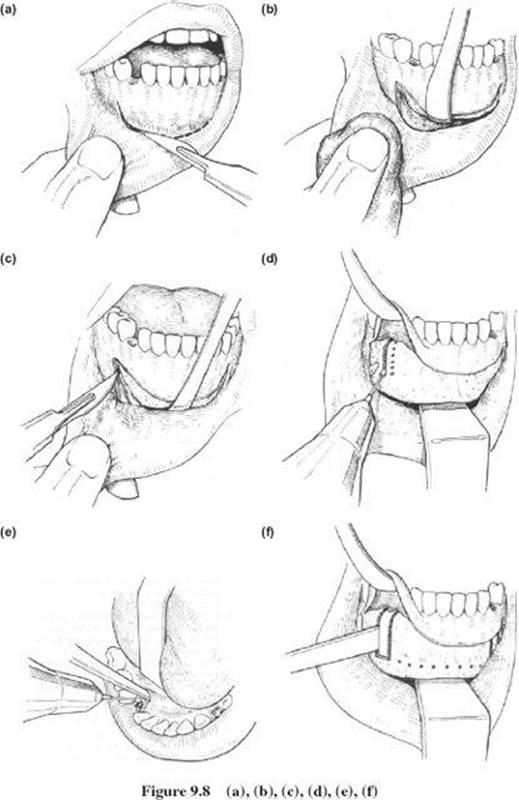
Figure 9.8 (a), (b), (c), (d), (e), (f)
4. The mucoperiosteum is then elevated distally revealing the mental nerve at its origin. At this stage, the periosteum above and behind the foramen may be elevated and incised without fear of damaging the nerve (Figure 9.8b). If the cone of periosteum around the nerve is now carefully incised with a sharp blade and the mental nerve dissected free, it becomes considerably more extensible and therefore easier to retract.
5. Using an elevator the anterior periosteum overlying the chin is then peeled firmly down to the lower border of the mandible where a Lack's or special chin (Awty, Obwegeser) retractor may be inserted to hold the flap and support the mandible (Figure 9.8c).
6. Incise along the gingival sulcus around the premolars and canines to facilitate elevation of the attached gingival flaps which will be widely undermined to form a bridge maintaining continuity of the gingiva.
7. The vertical bone cuts may be made with a narrow tungsten carbide fissure or an oscillating sagittal saw blade. If the first or second premolar has been extracted to enable the alveolar segment to be pushed backwards, the appropriate amount of bone is removed as a vertical strip (Figure 9.8d).
8. If no teeth are to be extracted the buccal cut can be made with a fine fissure bur through the outer cortex only. Then, after detaching the lingual mucoperiosteum, a cut is made vertically from above through the inner cortex. The Howarth periosteal elevator is held in situ to protect the mucosa (Figure 9.8e). The section is then completed between the teeth with a fine 3 mm osteotome (Figure 9.8f).
9. The horizontal cut may be completed with a bur or oscillating saw and must be placed well below the canine apices. It is useful to estimate the level of the canine apices from radiographs and the cortical contour and mark them with a bur hole on both sides. Where bone is removed for a setdown it is safer to make the upper cut first, marking it out with a series of bur holes (Figure 9.8g).
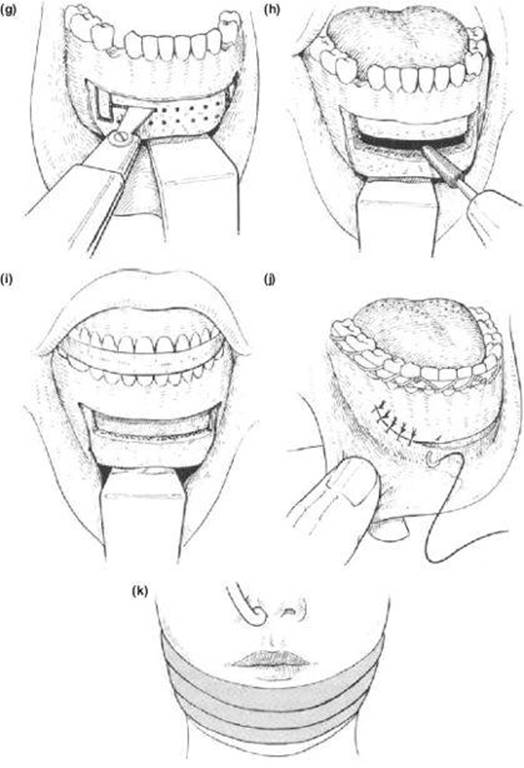
Figure 9.8 (g), (h), (i), (j), (k)
10. If there is insufficient room below the apices to remove adequate bone for the setdown, an anterior mandibulotomy must be performed. Furthermore in most situations this is a better procedure than the Kole. Save all fragments of bone in a blood-soaked swab to fill any residual dead space left after moving the segments.
11. Sometimes the mobilised segment which is pedicled on the genial muscles cannot be satisfactorily seated, in which case carefully trim off all cortical spurs, especially at the angular margins, with a well-cooled, narrow tapering acrylic bur (Figures 9.8h and 9.8i).
12. Accurate dentoalveolar localisation can be achieved by an acrylic wafer with an arch bar, heavy arch wire, or an open cast silver splint, all previously prepared on the lower model after model surgery. The splint is secured with circum-mandibular wires. The osteotomy is secured with bone plates.
13. The muscle and periosteum are closed with 3/0 polyglycollate and the mucosa is closed with a combination of simple and vertical mattress sutures (Figure 9.8j). A 2.5 cm elastic adhesive pressure dressing applied over the labiomental skin crease helps to reduce dead space and haematoma (Figure 9.8k).
Forward Movement
Occasionally a forward segmental movement is useful for correcting a Class II, division 1 deep overbite and overjet, where a sagittal split has been declined. This may be modified to include one or more of the premolars on the mobilised anterior segment, in which case the mental nerve is released from within the canal by removing the overlying cortex distally with a bur, by cutting two parallel grooves from the upper and lower edges of the mental foramen. The intervening bone can be carefully removed with a Mitchell's trimmer. The exposed neurovascular bundle is then retracted by an elastic or nylon tape held in a pair of mosquito forceps. Once the alveolar segment has been mobilised forwards and fixed by plates or a wafer and arch bars, the vertical gaps are packed with bone chips from the iliac crest and covered with a buccal mucosal flap rotated over the alveolar crest to be carefully sutured to the lingual mucosa with horizontal mattress sutures.
Upward Movement
The osteotomy is as previously described except that the space created at the subapical area by the upward movement is packed with cancellous bone chips.
The Anterior Mandibulotomy
Indications and Technique
This is anatomically a better operation than the Kole subapical procedure especially in patients with a short lower face, with little bone between the incisor apices and the lower border of the mandible and those with a deficient chin. In the former an adequate setdown cannot be achieved without damaging the apices or leaving a precariously thin strut of cortical bone. These problems can be overcome in two ways:
1. Take the vertical osteotomy cuts of the Kole down through the lower border to produce a three-part osteotomy of the mandible (Figure 9.9a). This enables a setdown which maintains or improves the lower facial height.
2. Combine the oblique advancement genioplasty cut with the two vertical segmental cuts, producing a four-part mandibuloto-genioplasty (Figure 9.9b). The anterior incisor segment is then set down and fixed as planned and will displace the genioplasty segment downwards and also allow advancement. These are not only simple solutions to anatomical difficulty but also increase the anterior inferior dentoalveolar height and improve the lower facial proportion. However, as the mandible has been completely divided bilaterally, dentoalveolar localisation is done with a deep wafer, an arch bar or supplemental archwire in distal tubes and the lower level by bone plates.
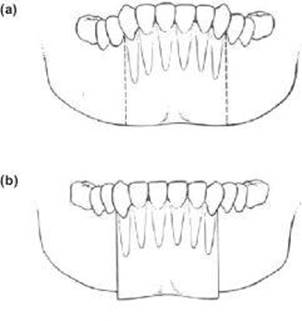
Figure 9.9 (a), (b)
Note: Do ensure that the osteotomy cuts at the lower border feel and look smooth prior to closure.
Genioplasty or Mentoplasty
Indications
Augmentation or reduction of the chin may be done for an isolated deficiency or combined with other osteotomies. This is discussed in detail in Chapter 10.
Augmentation is most easily achieved with a sliding genioplasty (Figure 9.10a). A short lower face with a reduced lower anterior dentoalveolar height can also be simultaneously corrected with an inter-positional bone or alloplast sandwich filling. If, however, an incisor setdown is also required to flatten the lower occlusal plane, the anterior mandibulotomy (see above), which is a combination of a segmental osteotomy and genioplasty, should be used (Figure 9.10a).
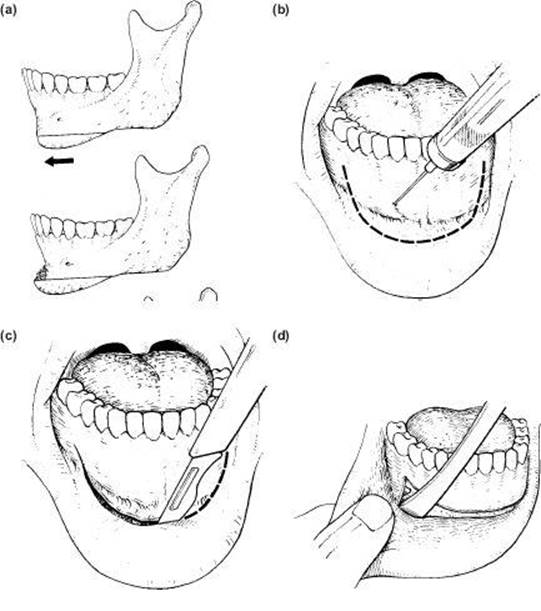
Figure 9.10 (a), (b), (c), (d)
The Augmentation Genioplasty
Technique
1. Mark a U-shaped incision with Bonney's blue from 46 to 36. Start just below the attached gingiva and cross the sulcus on to the labial mucosa anterior to the canine teeth (Figure 9.10b).
2. Infiltrate the sulcus with local anaesthetic containing 1:200 000 adrenaline. The incision is made very superficially from the first molar in the unattached mucosa. This is widened anteriorly by bringing the incision out on to the inner aspect of the lip. As the knife reaches the medial aspect of the canine area the tissues may be incised down to bone but is again brought to the surface at the opposite canine. It is imperative to leave a generous skirt of unattached mucosa on the gingival side to facilitate suturing (Figure 9.10c).
3. A dry gauze swab used to displace the tissues of the divided superficial incision will reduce bleeding and also bring the three branches of the mental nerve into view. These should be further exposed by dissecting backwards with fine scissors to the mental foramen. Then incise through the periosteum with a knife in a forward arc from behind, above and in front of the nerves as they emerge from the foramen.
4. The soft tissues may then be reflected with a periosteal elevator inferiorly to deglove the mandible (Figure 9.10d). This must be done firmly and will be facilitated by carefully incising the periosteum around the origin of the mental nerves. The soft tissues can then be retracted from the lower border of the mandible with a Lack's or genioplasty retractor (Awty, Obwegeser) (Figure 9.10e).
5. It is important that the chin periosteum and overlying fascia are now vigorously stretched with the finger, incising widely any tight bands, to make a pocket to accommodate the increased bony prominence. A damp swab should be inserted in this pocket to confirm that the overlying skin looks untethered.
6. When cutting the bone the mental nerves must be retracted with an elastic or nylon tape and also protected with a Howarth periosteal elevator or miniature Langenbeck retractor. The bone cut should commence at the lower border below the second pre-molar and come obliquely forwards and upwards on both sides. As usual, the choice lies between a tungsten carbide fissure bur or an oscillating sagittal saw, but must be carried through to divide the lingual cortex. The separation is done with a fine osteotome. It may be possible to cut two fine horizontal slices of bone which help to elongate and correct a severe retrogenia (Figure 9.10f). Leave the bone pedicled on the vascular digastric muscle behind improves the healing process. There is an approximate 15% loss of contour using this technique; this may rise to 30% if the muscle pedicle is divided.
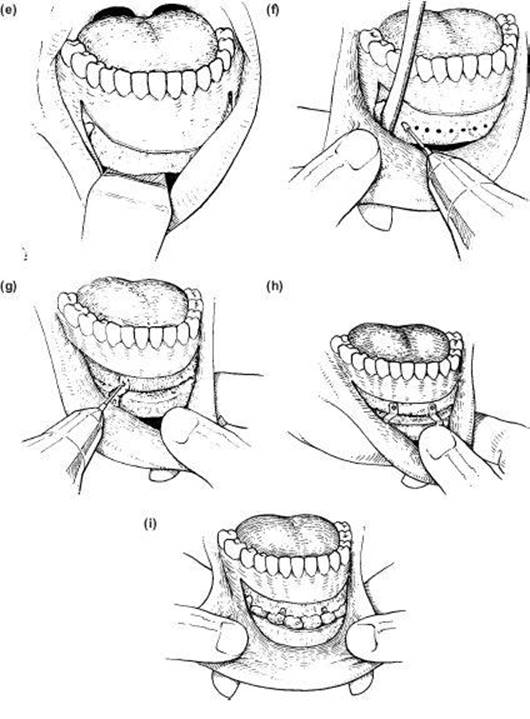
Figure 9.10 (e), (f), (g), (h), (i)
7. A bone shelf is now created by attaching the anteriorly displaced lower border to the buccal cortex above with plates (Figures 9.10g and 9.10h). Two plates are fashioned into a three-part step with the horizontal “tread” representing a generously estimated forward move. The plates are screwed into place on the facial cortex above the section with two 5 mm screws avoiding the apices. The chin fragment is then firmly brought forward with bone holding forceps and secured with screws to the plate. Cancellous bone chips removed from the iliac crest through a short incision (the Flint Technique), fill dead space, enhance contour and promote union with large advancements (Figure 9.10i).
An interpositional graft of bone or hydroxyapatite can be inserted at this stage to increase the lower facial height with severe deficiencies.
8. By placing the original incision well out on the labial surface, sound closure may be achieved in two layers, i.e. muscle then mucosa (Figure 9.10j).
9. An elastic adhesive pressure dressing is applied to the face to lift and compress the soft tissues overlying the enhanced chin. This prevents subsequent lip sag due to separation of the divided mentalis muscle.
The Reduction Genioplasty
In cases of progenia a simple technique is to deglove the chin and sculpt off the excess bone with fissure and acrylic burs. However, it is necessary to retain the concavity at the junction of the alveolus and basal bone, for the overlying labiomental fold is aesthetically important.
With the “deep mandible” (vertical chin excess) due to a markedly increased lower anterior dentoalveolar height, an intermediate wedge of bone is removed after completing the standard genioplasty oblique section (see Vertical Maxillary Excess,) but this has to be a significant wedge to make a difference externally (Figures 9.10j and 9.10k). Try not to apicect the canines. As for all genioplasty procedures, make sure the osteotomy cuts at the lower border look and feel smooth before wound closure.

Figure 9.10 (j), (k)
Maxillary Osteotomies
The anterior segmental osteotomies, as described by Wassmund and modified by Wunderer, and the posterior segmental osteotomy of Schuchardt are rarely used compared to the more versatile Le Fort I.
Anterior dentoalveolar osteotomy (Wassmund/Wunderer)
Indications
Reduction of the overjet or localised anterior open bite. This is a simple operation but rarely achieves more than orthodontics.
Limitations
Where the upper lip is short or the dentoalveolar exposure is excessive this procedure will leave an unacceptable amount of upper incisor showing. In such cases a Le Fort I osteotomy with a vertical impaction sbould be the basis of the prescription. Also, if the maxillary first premolars have already been extracted for orthodontic reasons with forward movement of the buccal segment teeth, further extractions would leave only canines and molars. In such cases a Le Fort I osteotomy with distal movement is recommended to preserve a functional buccal occlusion.
Technique (Figure 9.11)
1. Local anaesthetic with a vasoconstrictor is infiltrated buccally and palatally on both sides (Figure 9.11a).
2. Either a first of second premolar is extracted and the gingival attachment incised from the first molar to the lateral incisor.
3. An inverted L incision is made above the apex of the tooth to be extracted, i.e. site of vertical bone cut. The gingiva is not incised but remains as a soft tissue bridge, after being carefully elevated from the alveolus from above downwards (Figure 9.11b).
4. A mucoperiosteal flap is raised forwards with the Howarth periosteal elevator, exposing the canine apex, and then extended into the pyriform fossa margin (Figure 9.11c).
5. The periosteal elevator is carefully turned through 100 and inserted submucosally along the lateral wall of the nose to protect the nasal mucosa (Figure 9.11d).
6. Bone is cut with a tapering fissure bur from the pyriform fossa margin distally, parallel to and slightly above the nasal floor, then vertically downwards into the socket of the extracted tooth, i.e. a vertical fillet is outlined. The buccal gingiva is protected by the periosteal elevator (Figures 9.11e and 9.11f).
7. The palatal mucosa may be elevated and tunnelled, but this is unnecessary. A transpalatal incision planned to rest on uncut bone provides better access. This may cross from canine to canine and then be reflected backwards to expose the palatal bone. The greater palatine vessels should be tied or oversewn with polyglycollate to arrest bleeding from the posterior flap (Figures 9.11g and 9.11h).
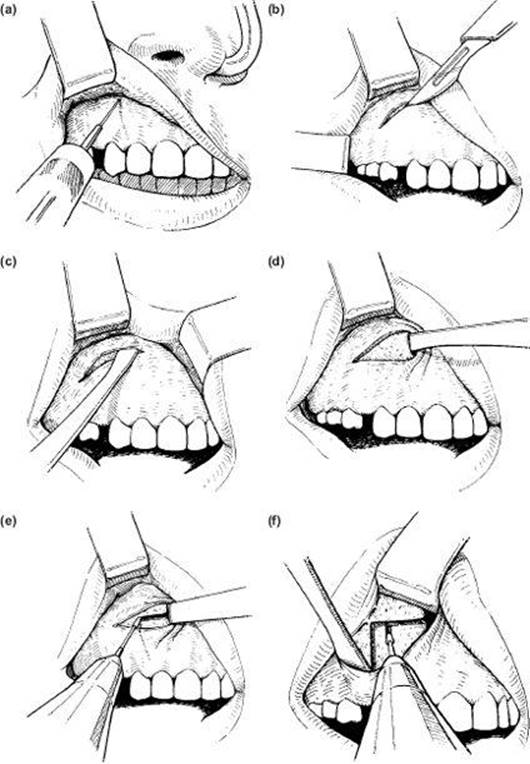
Figure 9.11 (a), (b), (c), (d), (e), (f)
8. The predetermined strip of palatal bone is then removed under direct vision, together with any remaining buccal plate (Figure 9.11i).
9. The buccal cuts are then made on the contralateral side.
10. Using a notched nasal septum chisel the septum is separated from the anterior fragment. This is done through a short vertical incision overlying the anterior nasal spine retracting the margins with miniature Langenbeck retractors (cat's paw) (Figure 9.11j).
11. The alveolar segment is now mobilised and repositioned. Judicious trimming with an acrylic bur, avoiding exposure of root surface, is often required to seat the segment.
12. Modifications:
a) The intercanine width of the arch may be expanded by dividing the anterior segment in the midline through the anterior vertical incision. Start with a fine fissure bur but complete the interdental division with a narrow osteotome. This should be done before the final mobilisation (Figures 9.11k and 9.11l).
b) Elevation of the anterior segment without distal movement can be achieved by omitting the premolar extractions and removing only the overlying cortical bone. If using burs, the buccal and palatal alveolar cortices are cut and a thin 3 mm osteotome is used for the interradicular separation. Some surgeons prefer an oscillating saw.
c) The segment can only be elevated by careful submucosal trimming of the nasal septum and by cutting a V-shaped trough in the upper surface with a narrow cone-shaped acrylic bur or a large rosehead (Figure 9.11m).
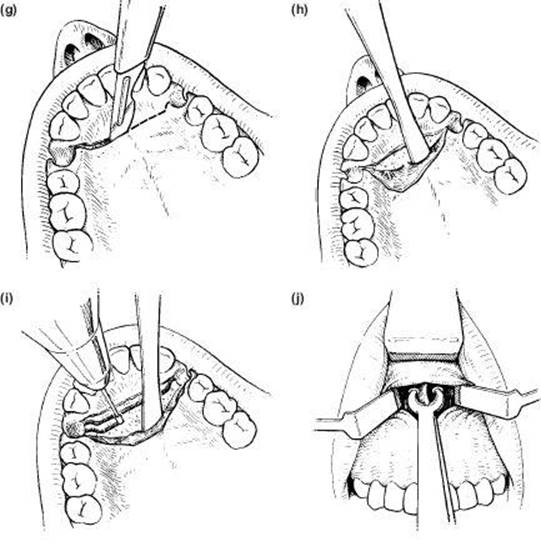
Figure 9.11 (g), (h), (i), (j)
13. The final position may be confirmed with a clear acrylic splint (wafer) covering the palatal, incisal and occlusal surfaces constructed on the surgical planning model.
14. L shaped bone plates are then bent to shape and fixed with screws.
15. The splint can be wired through a series of interdental holes to the teeth to provide definitive fixation, after the flaps have been sutured. Alternative means of fixation are using a wafer for localisation and a wrought arch bar, or preformed orthodontic arch wire and brackets (see Chapter 8).

Figure 9.11 (k), (l), (m)
16. A compression dressing of 2.5 cm elastic adhesive tape over the lip helps reduce the swelling.
The Le Fort I Osteotomy
Indications
This is a versatile operation which can be adapted to move the whole maxillary dentoalveolar component in any direction; forwards, backwards, superiorly and inferiorly. Additional modifications can be added by segmental division from above after a down-fracture.
Remember that measured movements of the maxilla are not reflected completely by the overlying lip. The lip will be displaced only half the distance of most anterior movements. However the aesthetic outcome depends mostly on achieving a Class I incisor relationship. Approximately a quarter of an upward impaction will also be lost by elevation of the lip. Therefore, always overcorrect when planning the soft tissue changes.
Technique (Figure 9.12)
1. Infiltrate the entire buccal sulcus with local anaesthetic and a vaso-constrictor (Figure 9.12a).
2. Incise firmly down to bone with a No. 15 blade from the distal aspect of the first molar around to the opposite side. The incision must leave a generous skirt of unattached mucosa on the alveolar side for suturing (Figure 9.12b).
3. Firm upward pressure with a swab will help reflect the soft tissues and periosteum as well as drying the bone surface (Figure 9.12c).
4. With a Howarth periosteal elevator carefully extend the periosteal reflection distally behind the tuberosity and then insert the curved end of a Lack's retractor behind the maxilla until it contacts the pterygoid buttress (Figures 9.12d and 9.12e).
5. Continue the reflection forwards and upwards to identify the inferior orbital foramen and neurovascular bundle, then to the margin of the pyriform fossa of the nose. Insert the Howarth's elevator submucosally distally along the lateral nasal wall to the posterior end of the hard palate; this will protect the nasal lining (Figures 9.12f to 9.12h).
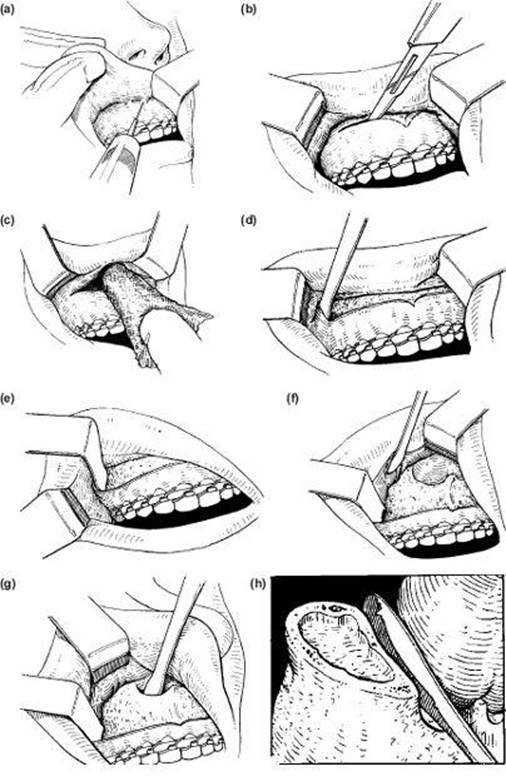
Figure 9.12 (a), (b), (c), (d), (e), (f), (g), (h)
6. Bone is best cut with a reciprocating sagittal saw. A tapering fissure bur is also adequate but may produce a ragged margin (Figure 9.12i).
7. The osteotomy cut is extended from the pterygomaxillary fissure behind, forwards to the margin of the pyriform fossa approximately 15 mm above the gingival margin to clear the tooth apices, especially the canine. The cut is deepened posteriorly to section the distal and medial wall of the antrum, and also anteriorly where the medial and lateral walls of the antrum meet to form the thick triangular bony canine buttress.
A useful variation is to fashion a step-shaped osteotomy (Figure 9.12j). Start as high as possible at the pyriform fossa margin and make a horizontal cut distally, parallel to the intended direction of maxillary movement. On reaching the zygomatic buttress cut downwards, i.e. at right angles, for 5 mm, then again turn distally through to the pterygoid plates in the usual way. This technique has the advantages of allowing more precise measurements and movements and enables the use of a horizontal miniature bone plate overlying the vertical component of the step, and so avoiding the apices of the molar teeth.
8. If the maxilla is to be elevated, make two cuts the appropriate distance apart, e.g. 2-4-6 mm, and remove the intervening strip of bone.
9. The curved pterygoid osteotome is then inserted horizontally between tuberosity and pterygoid plates and angled so that the cutting edge is tapped anteromedially with a light mallet; it may be felt protruding under the palatal mucosa with a forefinger when through the bone suture (Figure 9.12j).
10. This procedure is repeated on the opposite side.
11. The nasal septum is divided with a notched septum chisel. The Obwegeser septum chisel has a well-designed cutting protected end which prevents the chisel from straying away from the base of the septum (Figure 9.12k). Some nasal septum chisels may perforate or sever the nasotracheal tube, which produces a sudden burst of bloody bubbles. This may be prevented by passing a protective finger to the back of the soft palate.
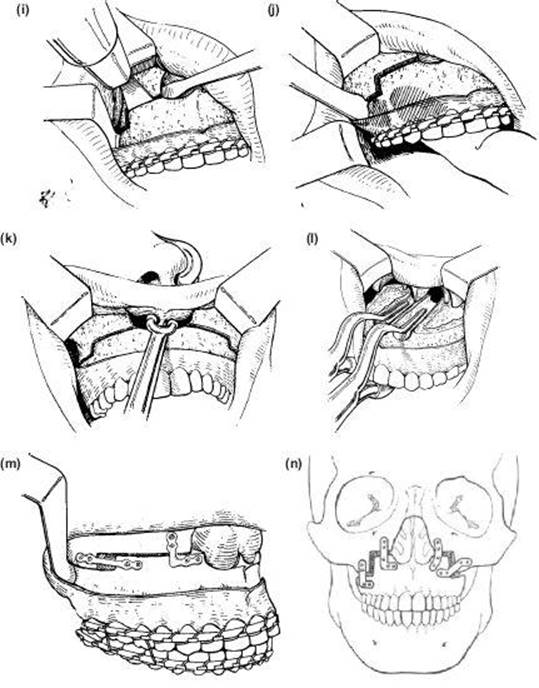
Figure 9.12 (i), (j), (k), (l), (m), (n)
12. The maxilla may now be fractured downwards with firm digital pressure or Rowe's disimpaction forceps. Any restraining points are divided with bone shears, saw or bur. It is imperative that the tooth-bearing component is made completely mobile, leaving it loosely pedicled on the soft palate (Figure 9.12l). If the greater palatine neurovascular bundle, which can be seen or felt at the back, restricts forward movement, it can be divided with a forefinger. Upward displacement is usually prevented by the nasal septum at the back and the posterior wall of the antrum. Both need to be generously trimmed with bone rongeurs. Occasionally with upward or distal movements it is necessary to section the pterygoid buttress with an osteotome, and displace it backwards to enable repositioning of the maxilla satisfactorily.
13. At this stage the management will depend on the direction of the correction.
Forward movements with an unoperated mandible. The dentoalveolar segment is placed in the planned occlusal position with temporary intermaxillary fixation. Malleable miniature bone plates are contoured and fitted across the posterior and anterior bony buttresses and screwed into place. An L-shaped plate will avoid the apices of the canine anteriorly, and a horizontal plate across the vertical cut of the posterior step osteotomy similarly preserves the molar roots (Figure 9.12m).
14. With large forward movements (e.g. >9 mm), improved stability may also be obtained by inserting cancellous bone blocks anteriorly between the inner aspect of the lower maxillary wall and outer aspect of the upper wall. These are secured by plates.
15. Always drill slowly with the appropriate drill or a tapering tungsten carbide fissure bur to ensure a firm bite by the screws. Rapid cutting, especially with a slightly eccentric rotation, will create a large, burnt hole. Use 5, 7 or 9 mm screws, depending on the thickness of the maxillary wall. Rescue screws are invaluable to replace loose ones.
16. With bimaxillary osteotomies the maxillary dentoalveolar segment is positioned with an intermediate occlusal wafer designed to relate its postoperative position to the unchanged mandible. By putting on temporary intermaxillary function with 0.35 mm wires, the mandible can be used to rotate the maxilla up into a stable position whilst the bone plates are placed.
17. Although at this stage it may be possible to check the lip-incisor relationship and maxillary midline by carefully displacing the anaesthetic tube to release the nose this is not reliable compared to a precise planning process and an accurate wafer.
18. Superior positioning simply requires the removal of a bone strip of appropriate width. However, the septum must also be generously reduced and, if necessary, a V-shaped groove made on the superior surface of the downfractured palate. Remember that, with a nasotracheal tube in place, the nose and septum are artificially elevated after the palate has been separated; this may give a false impression of adequate clearance. Inadequate septal reduction will either displace the maxilla, producing an asymmetrical malocclusion, or distort the nose itself. If ignored, both will require surgical correction. With any significant elevation, remove the inferior tubinates to prevent nasal airway obstruction. This is easily done through the anterior nares with a pair of heavy straight scissors, or from below after incising and opening the nasal mucosa.
19. Segmental division can be carried out from above with a tungsten carbide fissure bur and fine osteotome or an oscillating sagittal saw. Care must be taken to preserve the mucosa of the hard palate beneath, which maintains the blood supply of the anterior segment. The buccal mucosa is protected by a Howarth periosteal elevator (Figures 9.12n and 9.12o).
20. A transverse anterior cut between the canine and first premolar is useful for levelling the occlusal plane in an anterior open-bite case with an exaggerated curve of Spee. As with all dentoalveolar osteotomies, the buccal and palate cortex are cut with a fine bur, but even if a space has been created by orthodontics or an extraction, the alveolar section must be done with a fine osteotome to avoid damaging the roots of the adjacent teeth (Figure 9.12p).
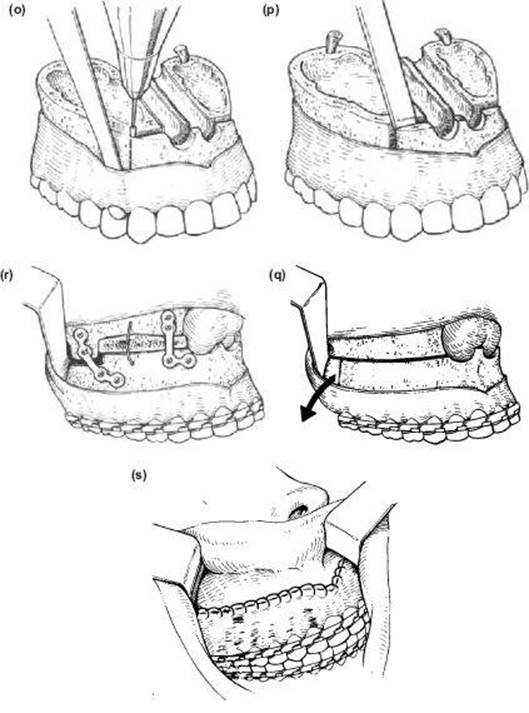
Figure 9.12 (o), (p), (q), (r), (s)
21. A complete midline section will enable the arch to be expanded posteriorly. Again, the anterior interincisor division must be done with a fine osteotome. Careful elevation of the underlying palatal mucoperiosteum through the palatal section from above will allow the outward expansion. If a palatal tear occurs in the midline, lateral (Langenbeck) relieving incisions will facilitate closure with a 4/0 Prolene mattress sutures.
22. All segmental procedures require dual fixation. The segmental components are first related with a well fitting wafer and fixation is secured with bone plates (Figure 9.12q). In addition the dental arch is accurately secured with a supplemental 1 mm arch wire which has been prepared with the model surgery.
23. The maxilla may be lowered by placing contoured/bent split rib overlying the cut margins of the gap in the lateral maxillary wall. Place the cancellous surface outwards to contact the vascular soft tissues. Always overcorrect by 25%. This procedure will produce a downward and posterior rotation of the mandible requiring a sagittal split. Transosseous fixation with miniature bone plates gives adequate stability (Figure 9.12r). (See also The Short Face.)
24. Posterior displacement can be achieved by removing a triangular wedge of tuberosity sectioned through the third molar region. The tooth will, of course, be removed prior to this tuberositectomy. It is also necessary to divide the pterygoid buttresses at their midpoint with an osteotome and displace them backwards (Figure 9.12s).
25. The wounds are sutured; but no drains are required.
The Posterior Dentoalveolar Segmental Osteotomy of Schuchardt
Indications
With the development of the Le Fort I downfracture technique allowing segmental procedures under direct vision, this operation has become obsolete.
Le Fort II Osteotomy Indications
Nasomaxillary hypoplasia, especially where there is a deficiency at the infraorbital margins giving the appearance of a pseudo-proptosis. The operation will accentuate a prominent nasal bridge, and so with a good nose a more suitable alternative operation is the Kufner modification of the Le Fort III osteotomy (see below).
The anatomical maxilla, together with the nasal bones and most of the septum, can be advanced and rotated downwards in the sagittal plane (Figure 9.13a). It is impossible to elevate the maxilla at the back with this operation and so the procedure is much less versatile than the Le Fort I osteotomy.
Technique
1. See the general preparation for bimaxillary procedures.
2. Prepare and drape the face, exposing the orbital margins and frontal area. Use a flexible armoured nasoendotracheal tube to give adaptable positioning of the anaesthetic hose. The nasal anaesthetic tube should be decontaminated with antiseptic and covered with an adhesive drape (Steridrape, Opsite) to allow the surgeon access to the frontal area.
3. Insert protective coneal shells and suture the eyelids. Also suture the towels to the margins of the operative area to prevent exposure of the adjacent non-sterile surface. Hair has a habit of crawling onto the operating surface and should be fixed by brushing it away from the face with undiluted scrub detergent on a sterile scrubbing brush before towelling.
4. Mark the blephoroplasty (subciliary) and frontal incisions with a pen then infiltrate with a local anaesthetic-adrenaline (1.200,000) mixture (Figure 9.13b). A transconjunctival incision may be used as a more aesthetic approach by those who are experienced with the procedure, The coronal incision is a lot of work for a limited exposure.
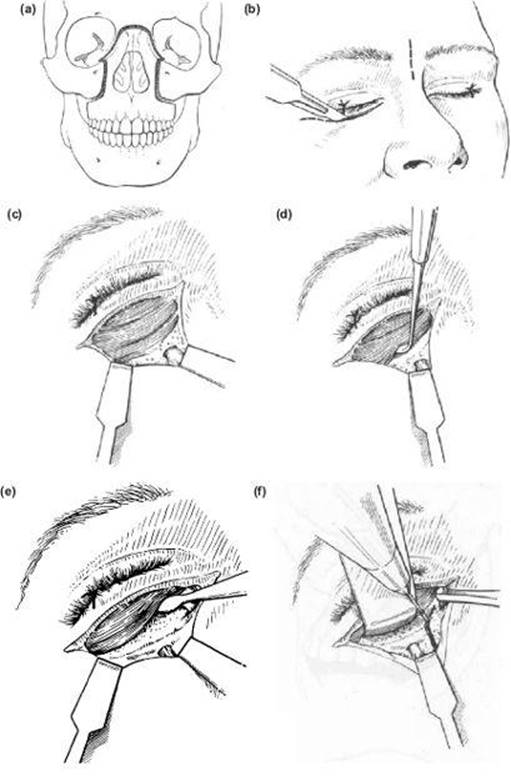
Figure 9.13 (a), (b), (c), (d), (e), (f)
5. If the operation is part of a bimaxillary procedure with:
a) an Obwegeser osteotomy: carry out this operation up to the splitting procedure, which is left until the maxilla has been repositioned;
b) an intraoral subsigmoid osteotomy: carry out the soft tissue surgery exposing the rami but leave the osteotomy until after the maxilla has been repositioned.
6. The blepharoplasty incision should leave no detectable scar, although occasionally there is a minor degree of ectropion, which usually resolves. The incision is made 2-3 mm below and parallel to the eyelid margin until below the outer canthus. The skin is carefully elevated with a hook or fine forceps and then, with a sharp No. 15 blade, incise obliquely downwards through the orbicularis muscle, avoiding the orbital septum, i.e. outside and parallel to the fascial layer of the lower eyelid. Any breach in the septum is announced by a bubbling protrusion of fat which should be ignored. Later the defect can be repaired with a 4/0 resorbable suture. When the bony orbital margin is palpated, a round-ended copper strip or Lack's retractor is useful to retract the orbital contents whilst a firm clean incision through the periosteum is made.
7. Carefully raise the lower margin of the periosteum along the orbital margin and inferiorly down to the infraorbital foramen. This requires the detachment of the levator labii superioris alaeque nasi and the lower head of the orbicularis oculi, neither of which are recognisable (Figure 9.13c). Now extend the periosteal elevation upwards over the infraorbital margin with the spoon edge of a Mitchell's trimmer or a narrow, sharp, periosteal elevator such as a Freer or MacDonald, taking care not to breach the periosteum and release orbital fat. Elevate along the orbital floor posteriorly and then medially, supporting the orbital contents with an orbital floor retractor (Figure 9.13d).
8. Medially, the inferior orbital margin becomes narrow and sharp and is the so-called anterior lacrimal crest. Behind are the lacrimal sac and the nasolacrimal duct. Just lateral to the lacrimal sac one encounters a fine fibrovascular band which must be sacrificed in order to find the margin of the bony lacrimal fossa. The sac can be readily mobilised with a narrow dissector, first around the anterior, lateral and distal aspect, then medially around the back of the sac (Figure 9.13e). Finally extend the periosteal elevation up the frontal process of the maxilla towards the frontomaxillary suture.
It is worth continuing the elevation at this stage, both upwards on to the down-facing convexity of the glabella and as far medially as possible on to the nasal bones. As the medial palpebral ligament is attached to the anterior lacrimal crest and the adjoining frontal process of the maxilla, this is also detached without disturbing the globe suspension.
9. The only remaining periosteal elevation is now inferiorly, passing medially and laterally to the infraorbital neurovascular bundle.
10. With a tapering tungsten carbide fissure bur cut through the inferior orbital margin, vertically downwards halfway between the nasolacrimal duct medially and the infraorbital bundle laterally. The orbital fascia and contents should be elevated and protected with a narrow, round-ended copper strip, Lac's retractor or orbital floor retractor. Extend the cut posteriorly along the orbital floor until it is distal to the lacrimal duct.
11. Now extend the cut medially behind the nasolacrimal duct, which is retracted with an elastic or nylon tape and protected with the narrow dissector (Figure 9.13f), and then continue the bur cut from the medial side of the duct (Figure 9.13g).
12. A vertical midline incision over the glabella is made down through the periosteum to bone. The tissues are firmly elevated widely, exposing the frontomaxillary suture and then passing inferiorly and laterally in the direction of the suture line into the orbit behind the lacrimal fossa.
Using a Howarth periosteal elevator as a retractor and a tapering fissure bur, a horizontal cut is made below and parallel to the frontomaxillary suture. This suture is often the landmark of the floor of the anterior cranial fossa. The bur cut is extended posteroinferiorly into the lateral wall or the orbit behind the lacrimal sac (Figure 9.13h).
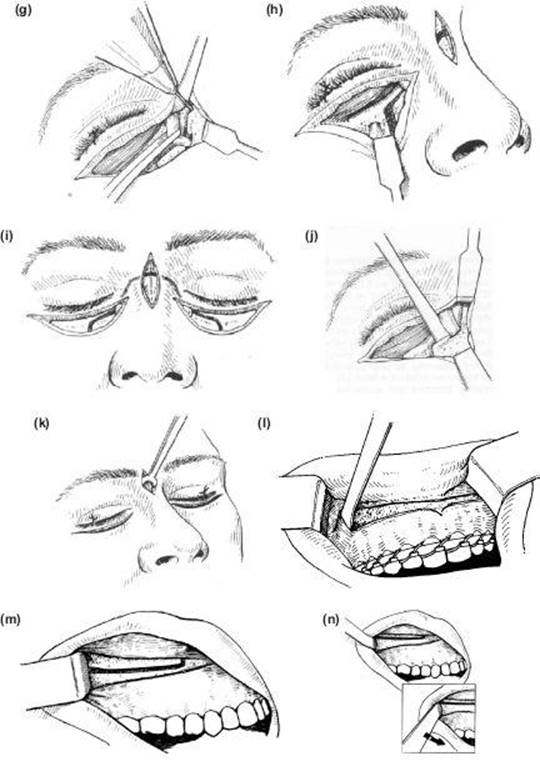
Figure 9.13 (g), (h), (i), (j), (k), (l), (m)
13. The two bur cuts may now be joined behind the lacrimal sac with a narrow osteotome inserted from the lateral side through the infraorbital incisions (Figure 9.13i).
14. This is repeated on the contralateral side.
15. The nasal septum is now divided through the vertical incision over the glabella. The Obwegeser nasal septum osteotome, with its convexity upwards, is inserted through the nasal bridge osteotomy cut. Once the septum can be felt firmly between the fork-like margins of the cutting edge, the osteotome is tapped diagonally downwards towards the posterior end of the hard palate, where it may be felt by the assistant's forefinger (Figure 9.13j).
16. The buccal sulcus is now infiltrated with local anaesthetic and vasoconstrictor solution and the incision made above the mucosal reflection from the distal aspect of the first molar around to the contralateral side (Figure 9.13k). This is reflected upwards with a dry swab and then periosteal elevator to reveal both the infraor-bital neurovascular bundles and the lower ends of the osteotomy cuts medially (Figure 9.13l). The cut is extended downwards and backwards across the zygomatic buttress with a long tapering fissure bur or reciprocating sagittal saw (Figure 9.13m).
17. A flat bladed Lac's retractor will have been placed behind the posterior wall of the maxilla. As with the Le Fort I osteotomy, the cuts must be continued across to the posterior and medial wall of the antrum. Finally, the tuberosity is detached from the pterygoid plates with the curved pterygoid osteotome (Figure 9.13n).

Figure 9.13 (o)
18. Mobilisation requires firm, bilateral, extraoral traction both downwards and forwards with the Rowe maxillary disimpaction forceps and then intraoral forward displacement with the Tessier maxillary retractors (Figure 9.13o). It is necessary to insert a broad osteotome in horizontally in the cut through the zygomatic buttress and carefully rotate it to mobilise the back of the maxilla. This part of the operation must be done with vigour if it is to succeed. With marked resistance the bone cut may need to be revised with a narrow osteotome. Gross haemorrhage can usually be controlled with hot gauze packs and tranexamic acid 1 g i.v.
19. Either during this procedure or at this stage, iliac crest bone is obtained to provide cancellous sheets to fill the osteotomy cuts. Always take too much rather than too little for a Le Fort II osteotomy.
20. The freely mobilised maxilla is repositioned and localised by relating it directly to the mandible, if it is not to be operated on, or with the intermediate wafer. Temporary intermaxillary tie wires are placed.
21. The cancellous bone is wedged between the osteotomy margins and secured with low profile plates. An inverted Y is useful at the nasal bridge. With a grossly deficient bridge a pocket can be made downwards with small blunt scissors to the nasal tip to accommodate a cortical bone strut. Minature bone plates are readily inserted inferiorly and given excellent fixation.
22. With a bimaxillary case, the temporary intermaxillary fixation is removed in order to complete the mandibular osteotomy. Insert bilateral suction drains, remove the pack and suck out the pharynx and localise the final occlusion.
23. Carefully close the skin incisions with 3/0 subcutaneous polyglycollate and 5/0 subcuticular Prolene sutures.
The Kufner Modification of the LeFort III Osteotomy
Le Fort III procedures are outside the scope of this textbook as they are more appropriate for severe craniofacial deformities. However, a useful operation for malar-maxillary advancement is the Kufner modification of the Le Fort III osteotomy. This is particularly important when the nose is prominent. As can be seen from Figure 9.14, access and therefore the instrumentation are identical to the Le Fort II procedure.
However the malar maxillary advancement may now be corrected more effectively by distraction osteogenesis.
Indications
This operation can be used for patients with mild to moderate zygomatixomaxillary hypoplasia but with a normal nose. Gross malar and infraorbital augmentation is more easily achieved with a high Le Fort I osteotomy or distraction osteogenesis.
Technique
Follow the stages described for the Le Fort II osteotomy (steps 1-8) without mobilising the lacrimal sac.
1. Elevate the periosteum and facial tissues from the orbital margin downwards and medially on the anterior surface of the maxilla until the nasal pyriform fossa margin in reached.
2. Elevate the orbital periosteum distally and laterally to expose the anterior end of the inferior orbital fissure and the lateral orbital margin.
3. Extension of the blepharoplasty incision laterally will now give surprisingly good access to the malar bone itself, which must be exposed completely.
4. The bone cuts are made (Figure 9.14) with a tapering fissure bur. This is often easier from above the patient. Take care not to damage the infraorbital neurovascular bundle which can be seen through the thin orbital floor.
5. Take the lateral osteotomy cut horizontally through the base of the lateral orbital margin. Then make a vertical cut through the zygomatic bone two-thirds of the way back from the orbital margin. This will create an inverted L-shaped separation, giving excellent access for placing a corticocancellous graft and for plating (Figure 9.14 inset).
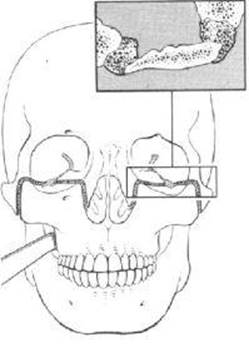
Figure 9.14
6. Extend the medial cuts down into the pyriform margin. Repeat on the contralateral side.
7. The nasal septum and pterygoid plates are separated intraorally, as in the Le Fort I operation.
8. If distraction osteogenesis is not being used, mobilisation is carried out extraorally from above and behind the head (“slowly but strongly”) with the Rowe's disimpaction forceps. Both a forward tilting and transverse rotation are required to achieve a completely mobile skeletal block. Intraoral traction with Tessier's maxillary retractors is also important.
9. Temporary intermaxillary fixation is applied, using an intermediate wafer in a bimaxillary case. The bone grafts are inserted at the osteotomy sites. The most important one is the malar cut, which is wedged open as shown in Figure 9.14 and fixed with bone plates.
10. All sharp bony margins are carefully masked with spare can-cellous bone or smoothed with an acrylic bur.
11. At this stage the intermaxillary fixation is removed and, where necessary, the mandibular osteotomy completed, drains inserted and the intraoral wounds sutured.
12. The pharynx is sucked out and the pack removed.
13. The blepharoplasty wounds are closed after the insertion of miniature vacuum drains, with subcuticular 5/0 Prolene sutures.
Tongue Reduction
Indications
The enlarged tongue is an uncommon cause of anterior open bite and osteotomy failure. If it appears to be large and the incisor teeth are proclined and separated, surgical reduction is indicated and can be carried out prior to orthodontics or with segmental osteotomies.
Where there is any doubt, the patient should be informed that it may be necessary some time after the dental alignment or osteotomy, and the case is carefully followed up at 3-monthly intervals to prevent any gross relapse. This will take the form of recurrent proclination and separation of the incisors. Once this is obvious, reduction should be carried out and any dental relapse can be corrected orthodontically. The tongue should always be reduced in length and width, which can be achieved by a keyhole excision.
Technique (Figure 9.15)
1. Draw the tongue forwards with a towel clip or two heavy silk stay sutures and generously outline the tissue to be removed with a pen and Bonney's Blue.
a) The full thickness wedge will determine the reduction in length and width at the tip (Figure 9.15a).
b) A centrally placed ellipse overlapping the anterior wedge will reduce bulk and width, but will minimally increase the length. L = reduction in length. W = reduction in width (Figure 9.15b).
2. Infiltrate well with 0.5% bupivacaine and 1:200 000 adrenaline.
3. With a large blade (No. 20), first excise the anterior wedge, carefully arresting all bleeding points with mosquitoes and bipolar diathermy. Allis forceps or two heavy gauge traction sutures can be used for immobilising the tongue while the central ellipse is excised with a triangular cross-section. Again careful haemostasis is important.

Figure 9.15 (a), (b), (c)
4. The tongue is sutured with 3/0 polyglycollate starting at the tip and working backwards with vertical mattress sutures from the depth to the mucosal suface. Simple sutures are then placed between each of the mattress sutures from behind working forward and continuing on to the ventral surface. (Figure 9.15c)
5. The combination of careful haemostasis and anti-oedema steroids (8 mg dexamethasone, 12-hourly, x 3) should prevent any gross swelling and obstruction.
6. Generous analgesia and nasogastric nutrition will be required for at least 3 days.
7. Postoperative speech therapy is useful to re-establish comfortable diction.
Bone Grafts
Indications
Bone may be required for an augmentation genioplasty and for the extensive maxillary osteotomies. It is used as cancellous bone chips or mush, cancellous bone slices or corticocancellous blocks. In order of value one can use:
1. Fresh autogenous bone, which is actively osteogenic and provides the best union.
2. Decalcified lyophilised bone (either autogenous or allogenous bank bone) as a satisfactory space filler which induces good union but is much improved when supplemented with autogenous cancellous mush.
3. Deep frozen or lyophilised whole autogenous bone, which may be rated only as satisfactory.
There is, of course, an increased risk of secondary infection and greater loss with the stored non-vital tissues.
Where fresh bone is employed, minimal storage outside the body is obviously desirable and the operation should therefore be planned to harvest the graft when it is needed. It should be kept in a blood-soaked swab. Immersion in saline and the application of antibiotic powders devitalise the fresh bone.
Iliac Crest
Technique (Figure 9.16)
Appropriate shaving and cleansing should be carried out on the ward.
1. In orthognathic surgery only portions of the iliac crest are required; therefore operate on the side which is most convenient. For right-handed surgeons, the left hip can be simultaneously approached by an assistant. A substantial sandbag should be placed under the buttock (ischium) to elevate the iliac crest.
2. Prepare the hip widely and carefully with a detergent-iodine solution. Square drape with 4 towels that are stitched into place with a heavy black silk (2/0) on a straight or 30 mm curved cutting needle, cover and seal the area with an adhesive drape, i.e. Opsite, Steridrape.
Note: Ensure the anterior superior iliac spine is at the inferomedial corner of the operative area and that the crest can be palpated along its whole length to the posterosuperior corner.
3. Clean and drape the head end for the osteotomy, and then cover the the patient with a large sheet, which can be rotated downwards to reveal the donor site when ready without repreparation. The operator and assistant should change their gloves and gowns between mouth and hip.
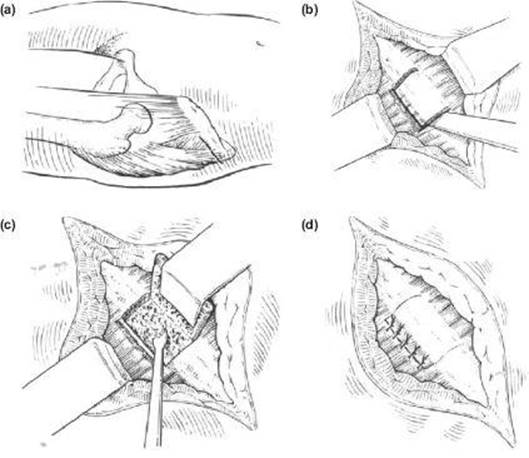
Figure 9.16 (a), (b), (c), (d)
4. For particulate cancellous bone/cancellous mush (the Flint technique).
a) The assistant, standing on the contralateral side, pulls the skin medially so that the incision on to the iliac crest will ultimately fall below the bony surface (Figure 9.16a).
b) A short incision of 6 cm is made down to the iliac crest with a No. 20 blade and the margins retracted. Diathermy will be required for bleeding points and the wound is enlarged.
c) Once the periosteum-covered bone surface has been defined with a swab and knife, a 2.5 cm osteotome is used to outline a lid 5 cm wide on the superior and lateral aspects of the crest (Figure 9.16b).
d) This lid is elevated on its medial musculoperiosteal hinge and cancellous bone is removed using gouges and Volkmann spoon. The bone should be placed into a dry receiver and covered with a blood-soaked swab until used. Soaking fresh bone in saline kills the osteoblasts (Figure 9.16c).
e) The lid may be sutured into place with 1/0 polyglycollate, which is also used to oppose the muscle and for deep subcutaneous closure (Figure 9.16d). A continuous subcuticular 3/0 Prolene suture on a straight needle is used for the skin.
5. For blocks and sheets.
a) A 10 cm incision is made down to periosteum. Undermining the skin margins will give improved access. Dissection with a fresh blade will now define the periosteum-covered iliac crest.
b) A long lid (12 cm) may be outlined with an osteotome and lifted, pedicled on the inner periosteum and muscle in the same manner as described above, and block cut from the bone beneath. By outlining a rectangle on the outer surface of the ilium with the osteotome, a lateral cortical flap may also be rotated downwards, allowing sheets of cancellous bone to be cut from the centre. Some prefer to cut a medial cortical flap in order not to disturb the origin of the gluteal fascia and muscles (Figures 9.17a and 9.17b).
c) The cortical lids are replaced and sutured with 1/0 polyglycollate
Note: It is easier to reflect the surface periosteum with a Farabeuf periosteal elevator and simply cut out cortico cancellous blocks as required.
d) The muscle layer is closed with a 2/0 suture and a vacuum drain inserted. This ensures a marked reduction in haematoma formation and postoperative morbidity. The drain must be carefully sutured to the skin before wound closure, ensuring 2 cm of non-perforated tube within the tissues.

Figure 9.17 (a), (b), (c)
e) Close the skin with a subcutaneous resorbable suture and then a continuous subcuticular 3/0 Prolene or polyglycollate and Steri-strips (Figure 9.17c). If possible, cover the wound immediately with a sterile adhesive dressing (Demacel) and then complete the osteotomy.
The drain is left in until it stops draining. The Prolene skin suture is removed after 10 days; the polyglycollate suture may be left to dissolve.
Rib (Figure 9.18a)
Rib is easier to remove than iliac crest, with considerably less morbidity for the patient, but provides less bone both qualitatively and quantitatively.
Rib may be split with an fine osteotome, separating the outer and inner cortices which are rendered pliable with Tessier rib forceps or a pair of straight extraction forceps. These strips can be laid over maxillary osteotomy cuts with the cortex facing “outwards” against the vascular soft tissues.
Technique
1. As with the hip, the chest wall must be carefully prepared with a detergent-iodine solution, dried, towelled and sealed with an adhesive drape.
2. Incisions must be planned to fall in the crease of the lower border of pectoralis major or beneath the breast. This may be done accurately using a marker pen, with the patient sitting upright, before the operation. A 6 cm incision with a No. 10 blade, once undermined, gives generous access to the 5th and 6th ribs. Coagulate bleeding vessels then incise the muscle layer, down to but not including the periosteum, with a cutting diathermy needle (Figure 9.18b).
3. The rib periosteum is incised with a fresh blade along its mid axis and then at right angles to this cut. Peel off the superficial periosteum, then carefully expose both rib margins (Figure 9.18c). The undersurface is then stripped with a curved rib rasperator (Figure 9.18d) as widely as possible and rib cutting shears are applied to cut the rib with the guillotine blade facing away from the graft to gain maximal length. It is then firmly grasped and carefully pealed off the underlying periosteum.
4. If the inner periosteum and pleura are torn, the lungs should be inflated by the anaesthetist as the defect is sutured with 3/0 Prolene or polyglycollate with a round-bodied needle. The periosteum is then closed with a continuous suture. The muscle layer and subcutaneous tissues are closed with the same needle, and the skin with a continuous subcuticular 3/0 Prolene or polyglycollate suture (Figure 9.18e). A drain is not necessary. Cover with an adhesive dressing (e.g. Opsite), and drape a towel over the area and continue with the osteotomy.

Figure 9.18 (a), (b), (c), (d), (e)
5. The costochondral graft; a minor modification is required for a costochondral graft. A 6 cm length of rib is exposed adjacent to the costal cartilage, but the medial right angle division of the periosteum is placed so as to leave a periosteal bridge between bony rib and cartilage. The lateral bone end is cut as above and the cartilage carefully incised with a No. 15 blade protecting the undersurface with a Howarth periosteal elevator. The cartilage is then trimmed to a round condylar like surface and the graft carefully stored until used.
6. A postoperative chest X-ray is essential the following day. Not uncommonly an effusion may result, especially where large quantities of rib have been taken. However, with antibiotic cover and physiotherapy no intervention will be required. The treatment of a pneumothorax is dealt with in Chapter 14.
Distraction Osteogenesis
Introduction
Distraction osteogenesis is the alternative to some conventional orthognathic procedures but is already too complex to cover in a short section of this book. The Hyrax screw appliance which is still used for expanding a narrow hard palate was probably the first distraction osteogenesis procedure and was used as a tooth borne appliance both with and without an osteotomy in the 1920s. At the time the expansion was considered to be a separation of the midline palatal suture than a stimulation of new bone formation. The problem with this tooth borne appliance is that compression of the abutment teeth, against the buccal perimeter of their periodontal membranes activates the release of bone resorbing factors, so that the teeth not only tip outwardly but also lose their overlying buccal plate. This has been overcome by bone borne expansion appliances for both the maxilla and mandible, and now many well designed distraction protocols have become established in the field of craniofacial surgery, to be used in maxillary, mandibular and dentoalveolar deficiencies.
Distraction osteogenesis is designed to lengthen and create new bone by stretching the callus of an osteotomy site. Following an appropriately designed osteotomy, carefully controlled tensile forces are gradually applied to the callus increasing the regenerative immature bone laid down between the cut ends. Over time, the bone remodels into mature bone and the surrounding soft tissues adapt to their new content and length. This remarkable process is made possible by the extensibility of the skin, fascia and muscle in response to gradual elongating traction. Muscle fibres have been shown to add on sarcomeres in response to carefully controlled extension.
The Cell Biology
Preosteoblasts, osteoblasts and fibroblasts are sensitive to mechanical deformation such as the tensile stress of osteodistraction and respond by the release of a complex soup of cellular factors. These include osteogenic cytokines transforming growth factor (TGF P1), bone morphogenic proteins (BMPs) including BMP 2 and 4 and angiogenic factors such as basic fibroblast growth factor (BFGF). In addition osteoclastogenesis is also upregulated by the release of tumour necrosis factor-alpha (TNFa), RANKL (receptor activator for nuclear factor kappa B ligand) and interleukin (IL1P) which recruit and activate osteoclasts. Both of the remodelling processes are upregulated but the balance between bone formation and resorption is probably determined by the rate of separation and ischaemia in the callus. This overall increased activity may explain why teeth moved into the consolidating callus (osteoid) undergo marked root resorption indicating increased osteoclast/cementoclast activity at this stage. The maturation process of the osteoid to bone takes place during the retention phase.
The Clinical Technique
This is divided into the following phases.
1. Osteotomy.
2. Period of latency. In the craniofacial region this is usually about 4-5 days to allow callus formation and primary wound healing.
3. Distraction phase. This is carried out at a constant rate (1-2 mm per day) until the desired length or volume of bone has been created. Despite this slow rate of distraction the procedure can be painful at each turn for up to 20 minutes duration and adequate analgesia is recommended on a daily basis before the procedure.
4. Retention phase. Retention of the distracted bone is necessary to allow for calcification and remodelling of the osteoid. In the craniofacial region this will usually be a minimum of 6-8 weeks but may be longer.
The Procedure
Early reports on craniofacial distraction mention corticotomies rather than osteotomies. While a corticotomy in young children with soft bone may suffice to allow mobilisation of the bone fragments, it is essential to carry out a complete osteotomy in adolescents and adults. Most distraction in adults in the craniofacial region is carried out at the rate of 1 mm per day. Rates of less than 0.5 mm a day may result in ankylosis and rates of more than 3 mm a day may result in non-union. Children may tolerate faster rates of distraction than 1 mm a day with the production of good quality distraction bone, however the more gradual the distraction rate the more predictable is the generation of vascular distraction bone. Therefore a distraction rate of a 0.5 mm twice a day or a 0.25 mm four times a day is more satisfactory than a single movement of 1 mm a day.
The Vector of Distraction
The vector or direction of distraction will determine where the length and volume of bone is obtained. The resolution of the optimum vector may be estimated using plain radiographs or more accurately 3D modelling computer programmes which simulate virtual surgery and distraction of the case preoperatively. Simulated distraction can also be carried out for the more complicated cases prior to surgery with stereolithic models. The many distractors available can be intraoral or extraoral and experienced supervision is essential.
Types of Distractor
The first cases were carried out using external distractions only. External distractors in the oral and facial area besides being visible and bulky, have the disadvantage of producing visible scars where the fixation pins enter the skin as they move during the distraction phase (Figures 9.19a and 9.19b). Internal distractors were subsequently developed and there are now many types of both external and internal available to suit most deformities. Multidirectional distractors allow for one or more osteotomies to be carried out simultaneously and the bone distracted in more than one direction.
In general, internal distractors are more readily accepted by patients. There are now a number of slimline internal distractors with a variety of designs and sizes to accommodate most clinical situations (Figures 9.20a and 9.20b).
Some indications for distraction include:
· craniofacial abnormalities, e.g. Crouzons;
· hemifacial microsomia;
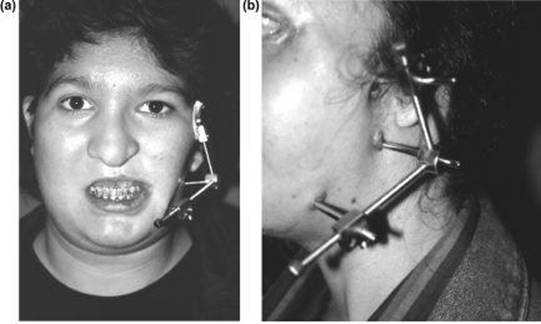
Figure 9.19 (a), (b)
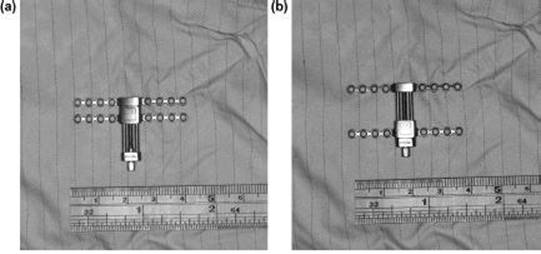
Figure 9.20 (a), (b)
· maxillary hypoplasias due to previous cleft palate surgery;
· palatal and mandibular expansion;
· dentoalveolar hypoplasia for implant insertion;
· tumour/trauma reconstruction; and
· TMJ ankylosis.
Some of the applications of the technique are illustrated by the following cases and also in Chapter 11 on cleft lip and palate deformity.
The Hypoplastic Mandible
The common management of a severely hypoplastic mandible is an inverted L advancement osteotomy with a ramus bone graft and an augmentation genioplasty. The L or horizontal osteotomy of the ascending ramus with internal distraction osteogenesis is a simpler and assured way of achieving the same correction.
Case 1. This patient presented with a mandibular hypoplasia and rudimentary condyles. The cause of the lack of condylar development was unknown but could have been early childhood trauma. The patient was seen at 15 years where the degree of hypoplasia was becoming more apparent with increasing facial growth (Figures 9.21a and 9.21b)
Radiographs demonstrate a mandible which is both short in ramus height and body length (Figures 9.21c and 9.21d).
The maxilla was also deficient, especially in posterior height presumably secondary to the mandibular hypoplasia, but it was decided to treat only the mandible at this stage. Bilateral horizontal osteotomies of the mandibular ascending rami were carried out above the level of the lingulae. The choice of this site would allow subsequent conventional sagittal osteotomies to be carried out should the need arise when the patient was mature. Distractors with universal joint mechanisms were used (KLS Martin) (Figures 9.21e and 9.21f).
An oblique vector was chosen to provide both a downward and forward direction of distraction. This increased the vertical ramus height bilaterally and at the same time achieved forward projection of the mandible. The immediate postoperarative OPG shows the distractor closed. The apparent osteotomy line below the distractor is an oropharyngeal shadow artefact, the true oseotomy line is above the distractor and less evident (Figure 9.21g).
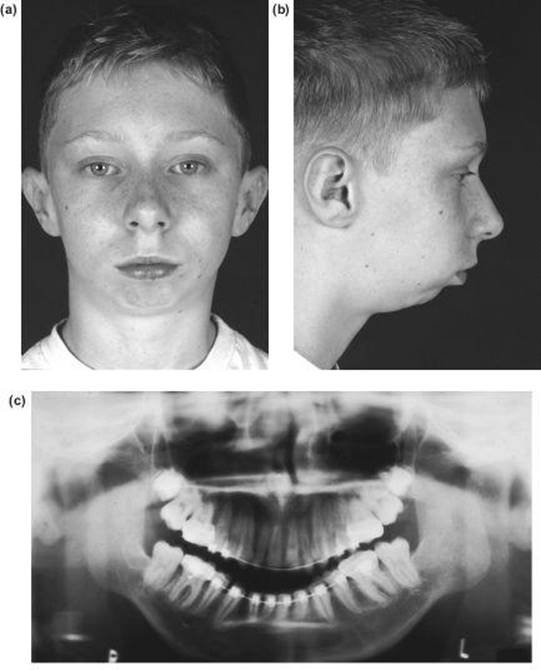
Figure 9.21 (a), (b), (c)
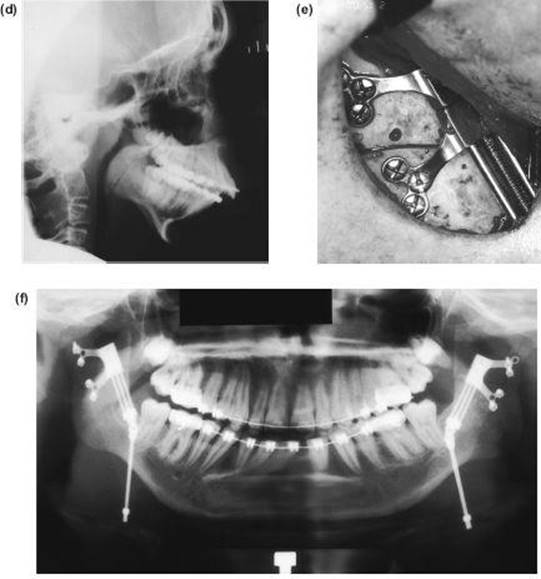
Figure 9.21 (d), (e), (f)
Following a post-osteotomy latency of 5 days, distraction was commenced at the rate of 1 mm per day (0.5 mm, 12-hourly). Distraction was continued for 15 days. At the end of 15 days the distractors were maintained in situ for a period of 8 weeks before surgical removal. Figures 9.21h and 9.21i show the postoperative X-ray appearance with the distractors fully extended and the clinically improved lower facial height and mandibular profile (Figures 9.21jand 9.21k).
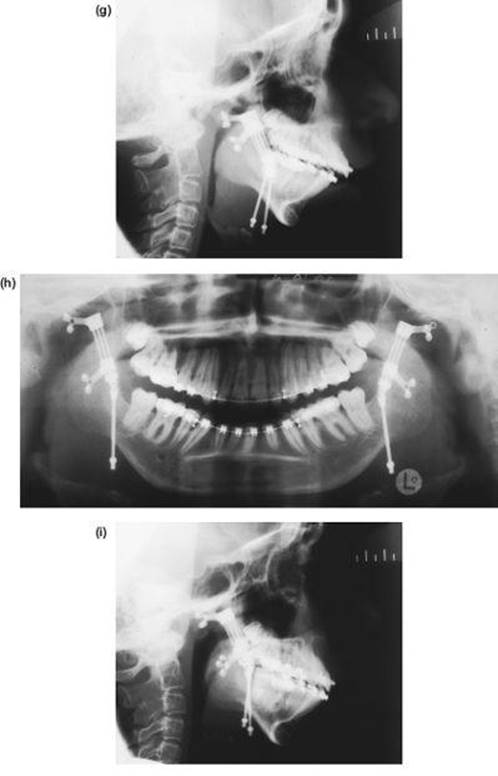
Figure 9.21 (g), (h), (i)
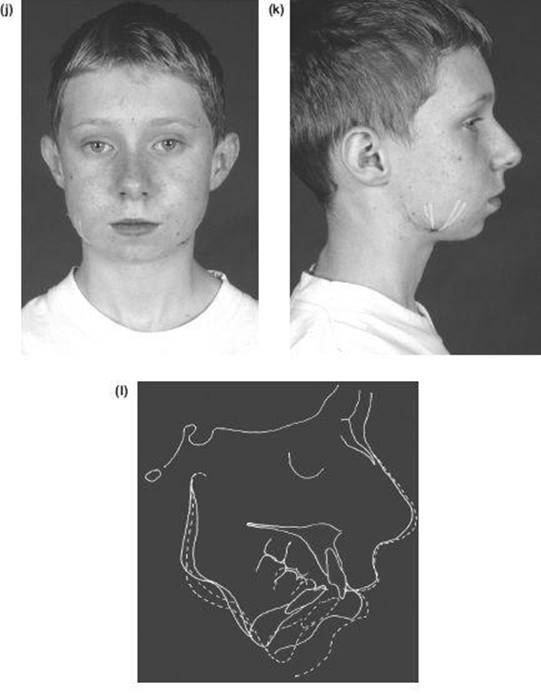
Figure 9.21 (j), (k), (l)
The cephalometric tracing (Figure 9.21l) shows that the vertical ramus height had increased 8 mm and the forward projection of the mandible increased by approximately 11 mm. The final pictures (Figures 9.21m and 9.21n) show the patient after an additional advancement genioplasty. It is worth noting that all short mandibles require a supplementary genioplasty after a lengthening procedure.
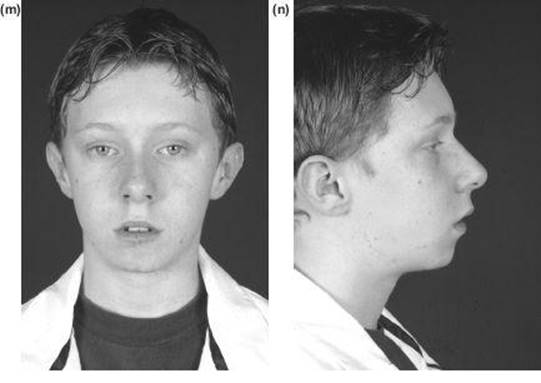
Figure 9.21 (m), (n)
Temporomandibular Joint Ankylosis
(See Also Chapter 11)
The established treatment is to divide the condylar fusion at the base of skull, create an arthroplasty with a costochondral graft growth centre and a temporalis myofascial interpositional membrane, and perform bilateral coronoidotomies or coronoidectomies as tempo-ralis myotomies to release the restraining muscular contractures. Distraction osteogenesis has the potential to make up the growth deficiency and provide the lost ramus height and mandibular length in a more predictable way.
Case 2. This patient presented with ankylosis of the right temporomandibular joint present since childhood and presumed to be due to middle ear infection. She had an opening of only 4-5 mm interincisally. The ankylosed right side showed the characteristic straight contour with reduced dimensions compared to the contralateral side with its distorted deviation towards the ankylosis (Figures 9.22a and 9.22b).
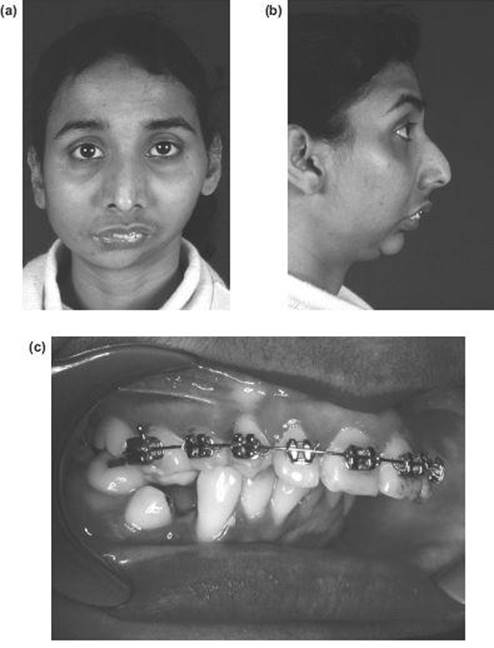
Figure 9.22 (a), (b), (c)

Figure 9.22 (d), (e), (f)
There was a complete crossbite of the buccal teeth on the unaffected side, and with the limited opening it was not possible to access the lower teeth on the left side to place an orthodontic appliance (Figures 9.22c and 9.22d). The inverted mushroomlike ankylosed condyle may be seen on the OPG (Figure 9.22e). The degree of hypoplasia of the mandible is best appreciated on the axial views of the 3 dimensional CT scan. (Figures 9.22f to 9.22h).
A simple osteotomy was first performed on the right side at the angle of the mandible preserving the inferior dental bundle. Because of the limited opening, access required an extraoral approach and the impacted third molar was removed at the same time. The vector chosen was parallel to the lower border and a 15 mm distractor (Liebinger & Co.) was activated after a latent period of 5 days. Figures 9.22iand j show the patient's radiographs at the beginning and end of the distraction phase. Figures 9.22k and 9.22l show the distractor in situ, with an increased symmetrical appearance and chin projection. Figures 9.22m and 9.22n demonstrates the improved occlusal relationship. As the opening was now 20 mm it was possible to place an orthodontic appliance on the lower teeth as the buccal segment on the left side was no longer in crossbite.
A second phase of distraction using bilateral internal distractors was carried out 3 months later to correct the marked Class II relationship. It was now possible to place the second phase distractors from an intraoral route. The distractor on the right hand side was placed with a vector parallel to the lower border of the mandible, and the left hand distractor was placed with an oblique vector to increase mandibular height and take the posterior teeth out of premature contact. Distraction was continued for 15 days bilaterally at a rate of 1 mm per day following the latent period. Figures 9.22o and 9.22p show the OPGs before and after distraction.
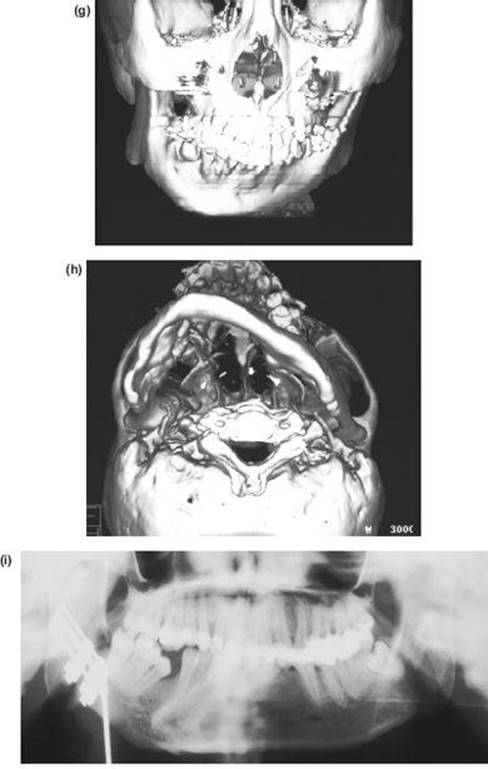
Figure 9.22 (g), (h), (i)
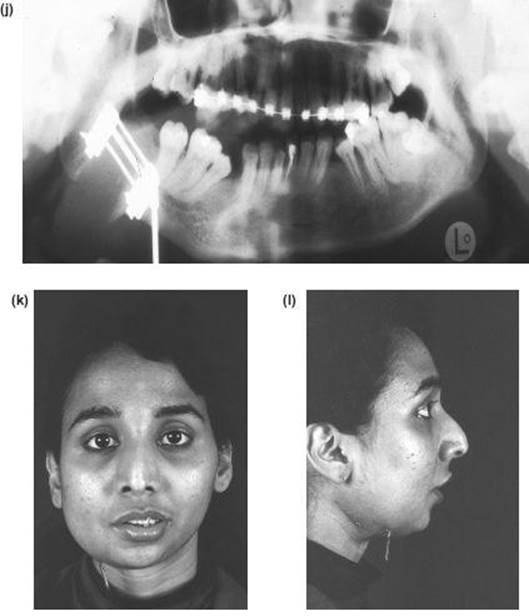
Figure 9.22 (j), (k), (l)
At the end of this period, the patient had an overcorrected edge to edge incisor occlusion to accommodate relapse, and an interincisal opening of 22 mm (Figures 9.22q and 9.22r). The final post orthodontic views are Figures 9.22sto 9.22u.
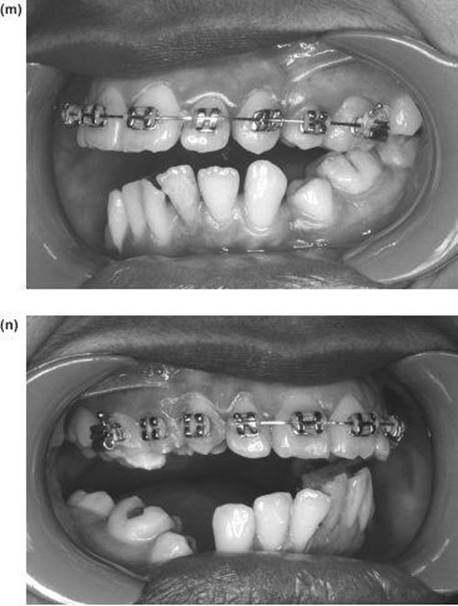
Figure 9.22 (m), (n)
Comment
An obvious question in this case is how has the jaw opening improved? The final opening of 22 mm is greater than can be expected from the innate elasticity of a fused craniomandibular complex. Placement of the second distractor confirmed complete healing of the first osteotomy site, hence a degree of pseudarthrosis may have formed in the second osteotomy sites. Ideally, division of the joint ankylosis but conserving the residual condyle to create an arthroplasty, and coronoidectomies/otomies should be done at the same time as a vertical subsigmoid distraction osteotomy, with the placement of internal distractors. However this case shows the significant correction possible with only a combination of distraction and orthodontics.
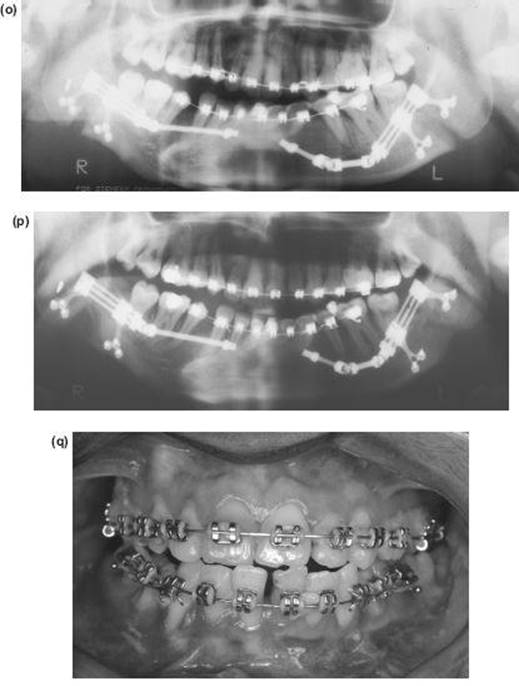
Figure 9.22 (o), (p), (q)

Figure 9.22 (r), (s), (t), (u)
Maxillary Hypoplasia Due to Cleft Surgery
Early surgery for the repair of the cleft palate can damage the mid face growth potential giving rise to marked hypoplasia which with scarring of the integument renders conventional surgical advancement difficult and subject to relapse. Distraction osteogenesis requires a limited osteotomy and the gradual controlled traction can overcome the restraint of the scar tissue.

Figure 9.23 (a), (b), (c)
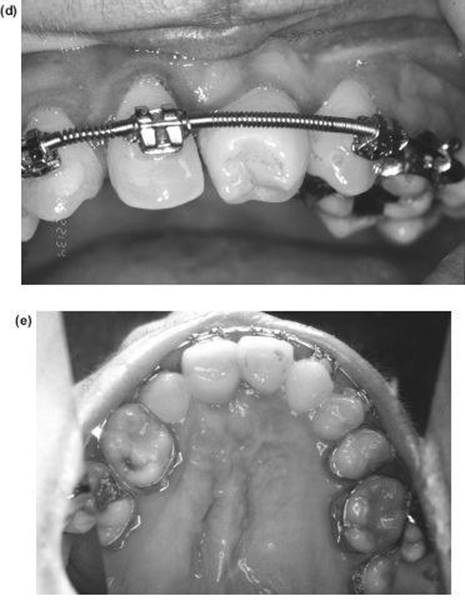
Figure 9.23 (d), (e)
Case 3. This patient had a severe maxillary hypoplasia secondary to a cleft lip and palate deformity, with nasal hypoplasia due to absence of much of the septum (Figures 9.23a and 9.23b). There was also mild mandibular elongation. Dental radiographs confirmed the absence of both the upper central and lateral incisor on the cleft side. As orthodontic extractions were necessary in the lower arch one of the lower second premolars was transplanted into the upper left central incisor alveolar region. Figures 9.23c to 9.23e show the presurgical orthodontics, and the transplanted premolar contoured to simulate a central incisor.
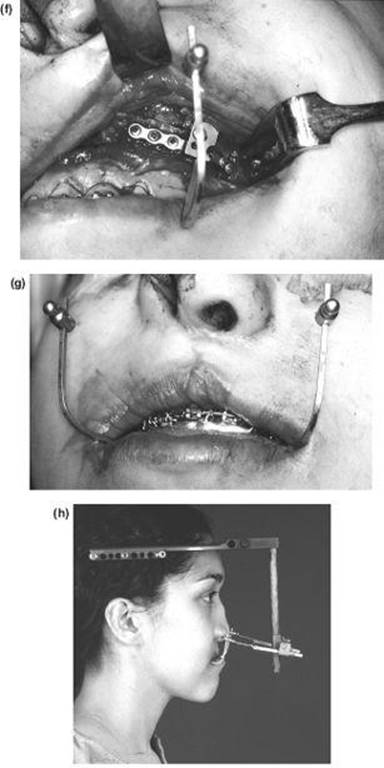
Figure 9.23 (f), (g), (h)
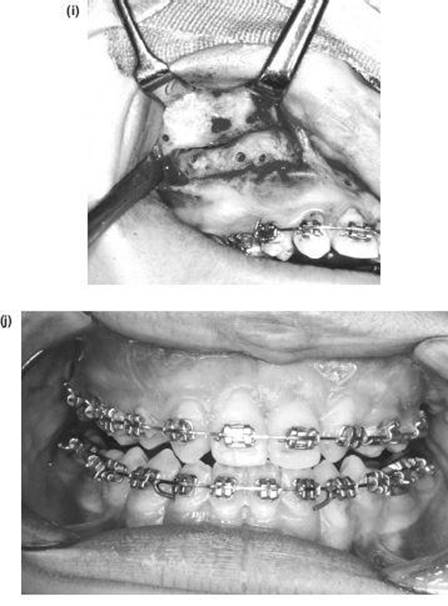
Figure 9.23 (i), (j)
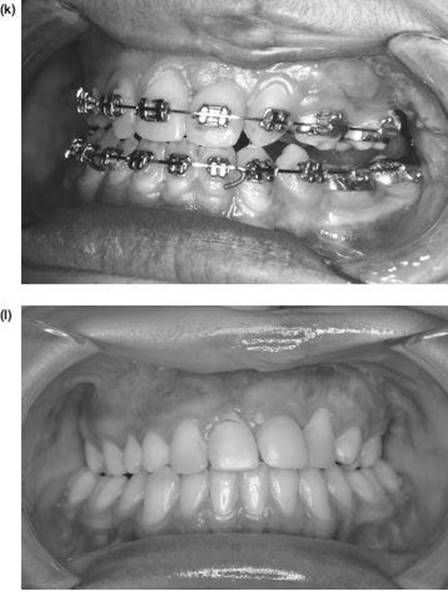
Figure 9.23 (k), (l)
A Le Fort I osteotomy was carried out with mobilisation, and an external halo distraction system was placed (Figures 9.23f and 9.23g) (Martin MLS/Red System). Following a latent period of 5 days, maxillary distraction was commenced at the rate of 1 mm a day and was continued for approximately 19 days. The halo (Figure 9.23h) was removed after a consolidation period of 6 weeks. At the time of removal very good bone regeneration at the osteotomy site was noted (Figure 9.23i). Clinical photographs demonstrate the occlusion, full face and profile at the end of distraction (Figures 9.23j to 9.23o).
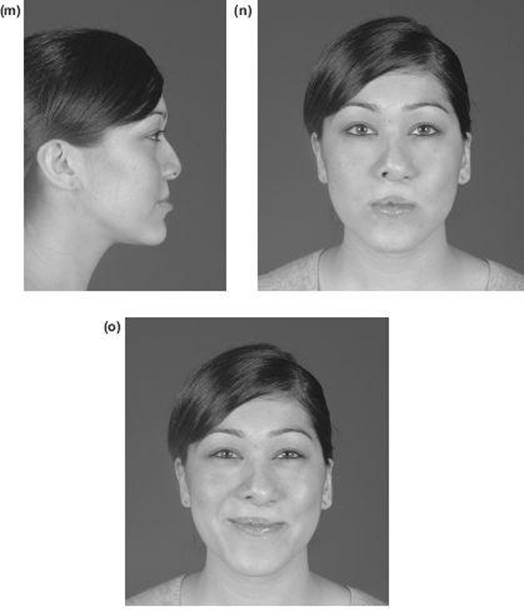
Figure 9.23 (m), (n), (o)
The patient subsequently had a rhinoplasty and a 5 mm mandibular pushback approximately 9 months after the end of maxillary distraction.
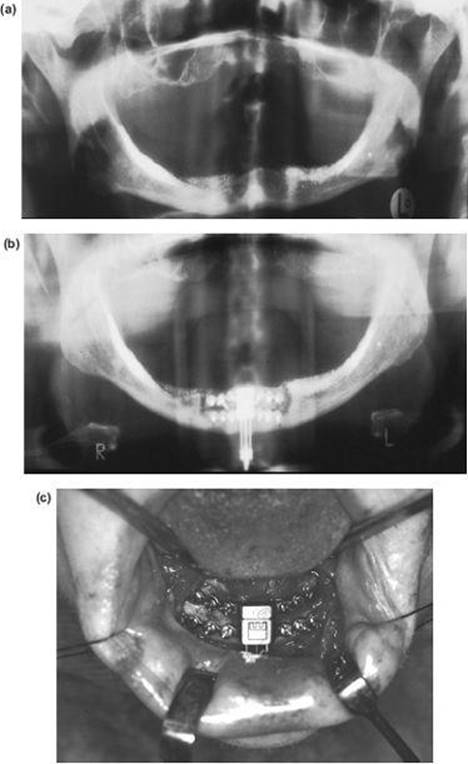
Figure 9.24 (a), (b), (c)
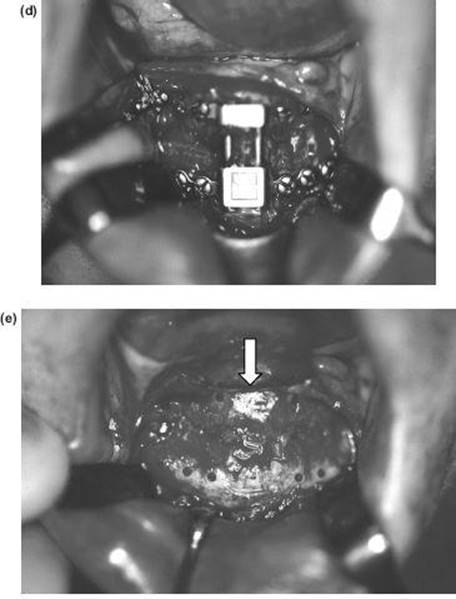
Figure 9.24 (d), (e)
Dento-Alveolar Distraction
Augmentation of the alveolus by onlay grafting is often difficult. It will provide increased width but not height, and in very atrophic cases it is subject to failure due to mucosal dehiscence leading to the loss of the graft material. Figure 9.24a shows the orthopantomograph
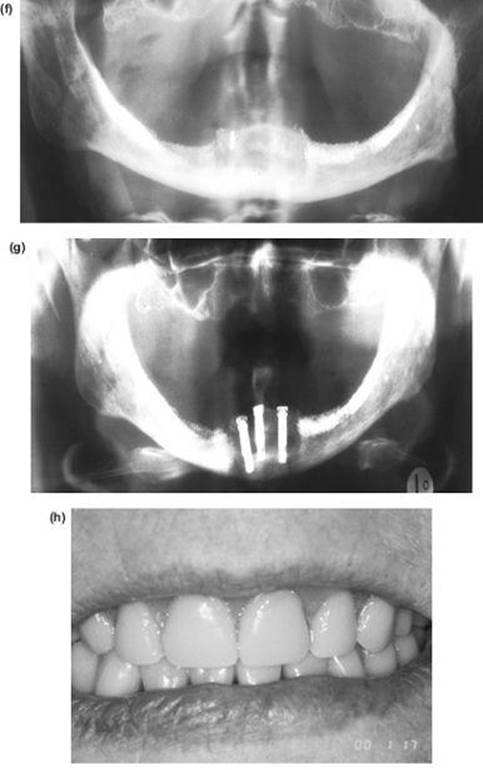
Figure 9.24 (f), (g), (h)
of an atrophic sharp ridge in the mandibular incisor region which made the wearing of a denture intolerably painful and unstable. Figures 9.24b and 9.24c show the alveolar osteotomy and the distractor in position. Figures 9.24d and 9.24e show the height of the distraction and the increased postdistraction bulk of bone both in height and width, completely eliminating the tender knife edge ridge. Figures 9.24fand 9.24g show radiographs of the distracted area and the insertion of three implants to support and stabilise the lower denture (Figure 9.24h).
Summary
Distraction osteogenesis can achieve multidimensional bone formation in situations where grafting is unsuitable or has failed. With rapidly improving mechanics the procedure is becoming more patient friendly and cost effective.