Joanna S. Zeiger
Terri H. Beaty
Oral clefts include cleft lip (CL), cleft palate (CP), and cleft lip and palate (CLP); and collectively these constitute a heterogeneous group of nonfatal birth defects known to be multifactorial in origin, in that both genes and environmental factors contribute to their etiology (Mitchell et al., 2001). It is possible to reduce heterogeneity in a sample of oral cleft cases by eliminating infants with recognized malformation syndromes (genetic or teratogenic) that can include oral clefts and infants with multiple anomalies that may not fall into any recognized malformation syndrome. Even so, isolated, nonsyndromic oral clefts represent a complex and heterogeneous group of birth defects where there is strong evidence of an etiologic role for both genetic and environmental factors. It is imperative, therefore, to design studies of oral clefts so that the effects of both genes and environmental factors, as well as their possible interaction, are considered. A variety of study designs are available, each with its own advantages and limitations. Here, we review how these different study designs can be used to test for gene-environment interaction and then describe published studies of oral clefts which incorporate gene-environment interactions to one degree or another.
In epidemiologic studies, interaction occurs when the joint effect of two risk factors is greater (synergism) or less than a simple combination of their individual effects (Rothman, 1986). In the context of gene-environment interaction, the isolated effects of a genotype (or of an allele) and of some observed environmental exposure fail to predict the effect seen when both are present. While interactions are commonly described as synergistic effects, it is important to realize that a number of patterns of risk in the presence of the gene alone, environment alone, and both are possible, including negative or protective effects (Khoury et al., 1993). Ottman (1996) described five “biologically plausible” models of relationships between genotype, environmental exposure, and disease risk. These models include situations where (1) the genotype increases expression of the risk factor, which can act on its own; (2) the high-risk genotype exacerbates the effect of the risk factor, but the genotype has no effect in unexposed individuals; (3) the exposure exacerbates the effect of a high-risk genotype, but there is no effect in exposed individuals without this genotype; (4) both exposure and the high-risk genotype are needed to alter risk; and (5) both the exposure and the genotype affect disease risk separately, but the risk is higher (or lower) when they occur simultaneously.
The marginal effects of the gene or the environment may or may not be apparent when interaction exists. A number of epidemiologic study designs can be used to test for gene-environment interaction, as discussed below, and several of these have been used to demonstrate gene-environment interaction in studies of oral clefts.
Methods for Identifying Gene-Environment Interaction
It is possible to model gene-environment interaction in formal genetic analysis by considering genotype-specific effects of covariates on the risk of having an oral cleft (where the covariate represents some observable environmental factor), but this has significant limitations. In particular, information about the covariate will be needed for all family members (affected and unaffected), not just on the proband who brings the family into the study. When the covariate is something simple like gender (which does influence risk for oral clefts), this may be possible; but in utero environmental exposures, such as maternal smoking, will be difficult to collect on older relatives. Thus, analysis of extended pedigrees is rarely used to detect gene-environment interaction. Rather, retrospective epidemiologic designs are commonly extended to incorporate genetic information and used to test for gene-environment interactions (Weinberg and Umbach, 2000).
The most common epidemiologic design used to detect gene-environment interaction is the case-control design. Cases with the birth defect of interest are compared to controls with no known birth defects or with a birth defect other than the one under study. Cases and controls are genotyped for the markers of interest, and environmental exposure information is collected, typically by direct interview of parents.
This retrospective design allows broad inferences under two conditions: (1) when it is population-based, i.e., when the sampled cases are representative of all infants with oral clefts and the controls are representative of all infants without oral clefts, and (2) these two samples are sufficiently comparable to conclude that differences in either gene frequencies or environmental exposures could reflect causality. It is important to remember, however, that when a genetic marker is used in any case-control study, a statistically significant association could represent direct causality (i.e., the genetic marker could be part of the causal path-way) or indirect causality (i.e., the marker could be in linkage disequilibrium with a causal allele at some unobserved susceptibility locus).
A critical weakness of the case-control design for testing for association between genetic markers and case or control status (and thus the possibility of gene-environment interaction) is the distinct possibility of confounding due to population stratification. Confounding arises when the sample of cases and controls consists of genetically distinct subgroups that vary in both disease frequency and marker allele frequency. Such heterogeneity among unrecognized subgroups can, under the right circumstances, create a completely spurious statistical association, a phenomenon known as Simpson's paradox. The resulting bias in estimates of any odds ratio (OR) due to confounding can be substantial (Witte et al., 1999), although Wacholder et al. (2000) argued that observed differences in marker allele frequencies across most European populations are too modest to justify such concern.
|
TABLE 23.1. Contrasts Needed to Test for Gene-Environment Interaction in a Case-Control Study |
||||||||||||||||||||||||
|
||||||||||||||||||||||||
When testing for gene-environment interaction in the case-control design, the standard 2×2 table comparing exposure to case or control status expands to consider all combinations of genetic and environmental factors (Yang and Khoury, 1997), as shown in Table 23.1.
From this table, three distinct ORs can be constructed: (1) the effect of the genotype (G) in the absence of the environmental exposure (E) [G+E- vs. G-E-, ORg = (a2*d)/(b2*c)], (2) the effect of exposure in the absence of the genotype [G-E+ vs. G-E-, ORge = (a3*d)/(b3*c)], and (3)their interaction [G+E+ vs. G-E-, ORge = (a1*d)/(b1*c)]. If gene-environment interaction is present, ORge will not be a simple function of ORe and ORg, under either an additive or a multiplicative model. Under an additive model, the null hypothesis of no interaction would imply (ORg + ORe) — ORge = 1 (i.e., ORge = ORg + ORe); while under a multiplicative model, the null hypothesis would be ORge/(ORe * ORg) = 1 (i.e., ORge = ORg * ORe).
An alternative method to look at the joint effects of genotype and environment in the context of a case- control design is multiple logistic regression (Umbach and Weinberg, 1997). An interaction term is added to the standard predictive model that tests for the marginal effects of genotype (x1) and environment ((x2)). This interaction term is generated by multiplying the outcomes of the two variables of interest, (x1) and (x2) [e.g., transforming growth factor-a (TGFA) genotype and smoking] to create a new variable ((x1) (x2)):

A model testing for interaction between TGFA genotype and maternal smoking would look like the following:

This logistic model tests not only for the independent effects of smoking and TGFA genotype but also for the effect of smoking in the presence of the high-risk genotype (Pagano and Gauvreau, 1993).
The three ORs presented in Table 23.1 along with the prevalence of the genotype, the prevalence of exposure to the environmental factors, and the number of controls recruited per case combine to determine statistical power. A number of reports have presented methods to estimate statistical power and the minimum sample sizes needed to achieve predetermined levels of power in case-control designs (Hwang et al., 1994; Khoury et al., 1995; Foppa and Speigelman, 1997; Garcia-Closas and Lubin, 1999). The assumptions made in each study differ, however, so subsequent calculations of minimum sample size often vary.
One key assumption of all of these tests for gene-environment interaction is the independence of the genotype and exposure. While this assumption is by no means guaranteed, it seems reasonable for many situations involving birth defects. A more subtle possibility is that the prevalence of a genotype and exposure to an environmental factor could vary across unrecognized subgroups sufficiently to create a correlation between genotype and exposure in the total sample (Weinberg and Umbach, 2000).
A variation on the case-control design is the case-only design, which can be used to test for gene-environment interaction (Khoury and Flanders, 1996; Yang et al., 1997). Paradoxically, this approach can be more statistically efficient than the traditional case-control design but faces its own strict limitations. Piegorsch et al. (1994) showed that case-only designs can actually provide greater statistical efficiency in testing for interaction within the framework of a log-linear model and should thus be more powerful at detecting gene-environment interaction. The gain in efficiency occurs primarily because case-only designs do not consider the variance contributed by controls. However, it is impossible to test for isolated effects of either genotype or environmental factors in case-only designs. Furthermore, the case-only approach relies strictly on the assumption of independence in the distribution of genotypes and environmental exposure and on a multiplicative model.
Family-based case-control studies offer an alternative to either case-only or traditional case-control designs since they avoid the pitfall of confounding by matching a control to the genetic background of the case (Andrieu and Goldstein, 1998). When, e.g., the control is an unaffected sib or cousin, the potential for confounding is minimized; but use of related controls represents “overmatching” and, thus, will reduce statistical power to detect isolated genetic and environmental effects. Witte et al. (1999) noted that sib controls are more closely matched for genetic factors than are cousin controls and, thus, minimize the possibility of confounding but provide less statistical power to detect genetic effects due to overmatching. Furthermore, full sibs will be closely matched for shared maternal environmental factors. In addition to this loss of power, the practical issue of availability of a sib or a cousin must be considered. Given today's relatively small family sizes, not all oral cleft cases will have a sib or first cousin available. For example, Beaty et al. (1997) found that almost 40% of all case infants were firstborn and had no sib.
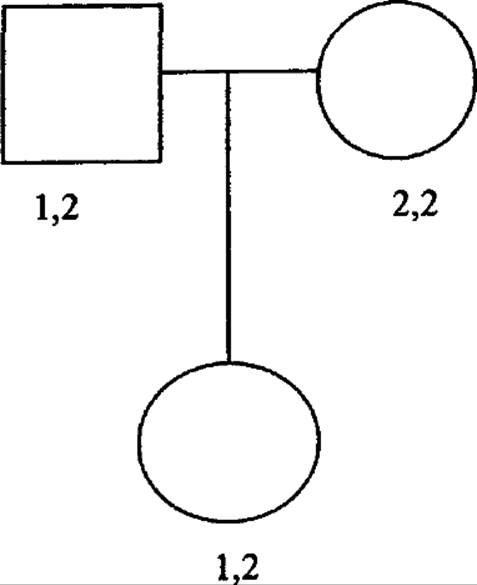
A more intriguing family-based study design, which traces its roots back to work by Falk and Rubinstein (1987), has generated much interest (Schaid, 1998). This approach has been variously termed the “case-parent trio” design, the “case-parental control” or the “triad” design. The case-parent trio is comprised of the case and two parents and involves comparing the genes observed in the case with those present in the parental mating type, thus eliminating the requirement of a separate individual as a control. Spielman et al. (1993) proposed an allelic version of this design called the transmission disequilibrium test (TDT). As demonstrated in Figure 23.1, the father with alleles 1 and 2 transmitted allele 1 and did not transmit allele 2 to the child. The mother, whose genotype was 2,2 transmitted one allele 2 to the child but not the other allele 2. The subsequent genotype of the child was 1,2 (where the three alternative genotypes were 1,2; 2,2; and 2,2).
|
|
|
FIG. 23.1. Pedigree illustrating transmitted vs. nontransmitted alleles. |
The case-parent trio design (in either an allelic or a genotypic form) allows tests for deviation from expected transmission of marker alleles (or genotypes) to the affected child and represents a composite null hypothesis that there is neither linkage nor association (i.e., no disequilibrium due to linkage) between the observed marker locus and an unobserved trait locus. The original TDT, e.g., constructs a 2 × 2 table comparing alleles transmitted and not trasmitted to the affected child and uses McNemar's x2 statistic to test for deviation from the expected 50% transmission of any one marker allele from a heterozygous parent (as shown in Table 23.2).
|
TABLE 23.2. Allelic Transmission Disequilibrium Test (TDT) |
||||||||||||||
|
||||||||||||||
The null hypothesis implies both no disequilibrium due to linkage (i.e., the target allele MI is not associated with the high-risk allele at the trait locus in the population) and that the marker is not linked to the trait locus; thus, transmission of the marker allele to the affected child has a 50% probability from a heterozygous parent, i.e., b = c under the null hypothesis. While this is a valid test of linkage (Speilman and Ewens, 1996) in the presence of disequilibrium, it could well miss a linked susceptibility locus if two-locus Hardy-Weinberg equilibrium existed (so there would be no association between alleles at the marker and trait loci).
Maestri et al. (1997) expanded the allelic TDT to test for gene-environment interaction and oral clefts using conditional logistic regression models to include covariates. An interaction term was created by obtaining the product of the indicator variable for the target al lele and an observed environmental risk factor variable. Covariates were then added to the original logistic model individually, and the likelihood ratio test was used to calculate the impact of the exposure on the odds of transmission to the case.
Umbach and Weinberg (2000) have criticized this allelic approach as too narrow. An alternative approach is to compare the observed genotype of the case to the three possible genotypes from the parental mating type (Schaid, 1998). Again, logistic regression models can be used to predict the log-odds of being the affected infant as a function of marker genotypes and then expand these models to include gene-environment or even gene-gene interaction.
As Lake et al. (2000) noted, the original case-parent trio design was developed for the composite null hypothesis of no linkage or no linkage disequilibrium; however, a related approach is to test for linkage disequilibrium (association) given prior evidence of linkage. In this situation, the alternative hypothesis is the same, i.e., that both linkage and linkage disequilibrium exist. Generalized test statistics for both of these null hypotheses have been developed for nuclear family designs and for case-parent trios (Laird et al., 2000). A summary of study designs to test for gene-environment interaction is presented in Table 23.3.
|
TABLE 23.3. Study Designs to Test for Gene-Environment Interaction |
|||||||||||||||
|
Studies Examining Gene-Environment Interaction and Oral Clefts
It is very important to investigate possible gene-environment interaction because, if present, it opens up the option of effective intervention programs to prevent birth defects through modification of the environmental risk factor alone. There are several examples of potential gene-environment interaction in studies of oral clefts; however, the observed associations are modest and somewhat inconsistent across studies (Table 23.4). The single most widely studied genetic marker is the TGFA gene, although several other candidate genes have been examined. Environmental exposures examined to date include modifiable risk factors such as smoking and alcohol consumption and dietary factors such as vitamin supplementation.
|
TABLE 23.4. Studies of Oral Clefts that Tested for Gene-Environment Interactions |
||||||||||||||||||||||||||||||||||||||||||||||||||||||||||||||||||||||||
|
||||||||||||||||||||||||||||||||||||||||||||||||||||||||||||||||||||||||
Hwang et al. (1995) first studied the association between the Taq1 site marker in the TGFA gene and isolated oral clefts. Both cases and controls were ascertained from the Birth Defects Registry Information System, a passive birth defect registry maintained by the Maryland Department of Health and Mental Hygiene. Hwang et al. (1995) used these data in a retrospective case-control study design to examine whether there was an association between the rarer C2 allele at the Taq1 site in the TGFA gene and oral clefts. Cases with isolated oral clefts were compared to controls with an isolated, noncleft defect. They showed (1) a slight but nonsignificant increase in the number of CP only infants carrying the rare C2 allele compared to the birth defects control group and (2) a significantly increased risk of CP among infants carrying the C2 allele if the mother smoked [OR = 5.5, 95% confidence interval (CI) = 2.1-14.6], thus suggesting gene-environment interaction between the infant's genotype at this TGFA locus and maternal smoking.
Shaw et al. (1996) confirmed these findings in a population-based case-control study from California, in which control infants had no birth defect. Mothers who smoked more than 20 cigarettes/day showed an increased risk for having a child with CP or CL with or without CP (CL/P); this risk increased when the infant carried the rare C2 allele.
Christensen et al. (1999) performed a large population-based case-control study in Denmark. This study had the advantages of a high participation rate, a homogeneous population, and exposure information on smoking collected soon after the birth of the child. Controls were non-malformed infants born at the same hospital as the case infant. Twenty-five percent of all CL/P cases (n= 233), CP cases(n= 83), and controls(n= 316) carried the rare Taq1 allele. There was a slight increased risk of having a CL/P infant among mothers who smoked during pregnancy (OR = 1.40, 95% CI 0.99-2.00); however, these authors found no evidence of interaction between TGFA genotype of the infant and maternal smoking. Romitti et al. (1999) also failed to find any evidence of gene-environment interaction between this rare C2 allele at the Taq1 site and maternal smoking during pregnancy in a study of 366 cases (161 with CL/P and 64 with CP) and 393 controls from Iowa. Thus, the evidence for gene-environment interaction between TGFA and maternal smoking remains ambiguous.
Shaw et al. (1998) found evidence for an interaction between this same TGFA marker and nutrient intake. Cleft cases (n= 731) and non-malformed controls(n= 734) were obtained from a population-based case-control study performed in California. Cases included 348 with CL/P, 141 with CP, 99 with CL/P and other anomalies, 74 with CP and other anomalies, and 69 with some known syndrome. Women who reported taking multivitamins containing folic acid during the periconceptual period were at reduced risk for delivering a child with an oral cleft; i.e., there was a marginal protective effect of vitamin use. There were no increased risks for oral clefts when considering the rare Taq1 allele alone, however. Gene-environment interaction was suggested since there was an increased risk for having a child with an oral cleft if the mother did not use multivitamins during the periconceptual period and the infant carried the rare C2 allele at TGFA. This risk was highest for CL/P (OR = 3.0, 95% CI 1.4-6.6).
In the above-mentioned Iowa study, Romitti et al. (1999) examined three candidate genes (TGFA, MSX1, TGFB3) and two environmental factors (smoking, alcohol) to determine their combined effects on oral clefts. Cases (n= 60 CP, n= 154 CL/P) were identified through the Iowa Birth Defects Registry from 1987 through 1994, and controls (n= 373) were selected from all Iowa births during this same time period. No marginal allelic effects for markers at any of these candidate genes were observed. Small increases in risk were seen among CP infants if the mother smoked more than 10 cigarettes/day (OR = 2.3, 95% CI 1.1-4.6), but these risks were even higher if the infant carried allelic variants at the MSX1 or TGFB3 gene. Increases in risk for CL/P were also observed if the mother consumed alcohol (OR = 2.8, 95% CI 1.2-6.6), and this risk was magnified if the infant carried an allelic variant at the MSX1 site. As mentioned above, there was no evidence of gene-smoking interaction for either type of cleft phenotype at the TGFA locus in this Iowa study.
Shaw et al. (1998) tested for an association between the C677T mutation in the methyltetrahydrofolate reductase (MTHFR) gene, maternal multivitamin use, and risk of CL/P. Cases (n= 310) and controls(n= 383) were obtained from a cohort of California births from 1987 through 1989. There was no increased risk for CL/P among infants carrying the mutant T allele. In addition, there was no evidence for an interaction between infant's genotype at the MTHFR locus and maternal multivitamin use affecting risk of CL/P.
In a review of different methodologies to test for gene-environment interaction, Yang and Khoury (1997) utilized the data from Hwang et al. (1995) to illustrate the case-only design. Using the standard case-control method, Hwang et al. (1995) found an OR of interaction for CP, maternal smoking, and TGFA geno-type of 5.5 (95% CI 2.1-14.6). This is quite comparable to the OR of 5.1 (95% CI 1.5-18.5) computed by Yang and Khoury (1997) using only cases. However, when reanalyzing the data from Shaw et al. (1996), which also examined the effects of maternal smoking and TGFA on oral clefts, we found less agreement between these two designs. For CP, Shaw et al. (1996) found an OR of interaction of 9.0 (95% CI 1.4-61.9), which was quite different from the case-only OR of 2.92 (95% CI 0.64-13.34). Likewise, for CL/P, Shaw et al. (1996) found an OR of interaction of 6.1 (95% CI 1.1-36.6), which deviated considerably from the case-only OR of 2.01 (95% CI 0.60-6.55). Schmidt and Schaid (1999) suggested that case-only analysis to test for gene-environment interaction may lead to underestimated ORs in some circumstances.
Although Lidral et al. (1998) incorporated TDT analysis into their Iowa study, Maestri et al. (1997) performed one of the few studies using case-parent trios to test explicitly for gene-environment interaction. Using 160 case-parent trios from Maryland, they utilized conditional logistic regression models to extend the traditional allelic TDT to include an interaction term for gene-environment interaction. Markers at TGFA (D2S443), TGFB3 (D14S61), BCL3, and KARA were genotyped; and information about maternal smoking was included as an environmental exposure. There was some evidence of increased transmission of allele 4 among smoking mothers for the TGFA marker D2S443. In addition, the TGFB3 marker D14S61 showed increased transmission of allele 6 only among smoking mothers. Both of these results raise the possibility that gene-environment interaction at several loci may contribute to risk of oral clefts.
Discussion
Despite their sometimes ambiguous results, it is evident from the preceding examples that genetic factors and environmental factors do play a role in the etiology of oral clefts, both independently and jointly. When studying complex diseases, such as birth defects, it is important to explore the effects of both genetic and environmental factors and whether they interact, not only to better understand the etiology of oral clefts but also to identify when modifiable environmental factors may increase risk. Such situations present a real opportunity for intervention. Several different methods and study designs exist to examine gene-environment interaction, ranging from family-based studies to traditional epidemiologic studies incorporating data on genetic markers. The choice of study design depends both on the availability of subjects and on the hypothesis being tested, but the etiology of oral clefts will not be fully understood without serious consideration of both genes and environmental factors, as well as their interaction.
References
Andrieu, N, Goldstein, AM (1998). Epidemiologic and genetic approaches in the study of gene-environment interaction: an overview of available methods. Epidemiol Rev 20: 137–147.
Beaty, TH, Maestri, NE, Hetmanski, JB, et al. (1997). Testing for gene-environment interaction among oral cleft cases born in Maryland in 1992–1996. Cleft Palate Craniofac J 34: 447–454.
Christensen, K, Olson, J, Norgaard-Pedersen, B, et al. (1999). Oral clefts, transforming growth factor alpha gene variants, and maternal smoking: a population-based case-control study in Denmark, 1991–1994. Am J Epidemiol 149: 248–255.
Falk, CT, Rubinstein, P (1987). Haplotype relative risks: an easy reliable way to construct a proper control sample for risk calculations. Am J Hum Genet 51: 227–233.
Foppa, I, Speigelman, D (1997). Power and sample size calculations for case-control studies of gene-environment interactions with a polytomous exposure variable. Am J Epidemiol 146: 596–604.
Garcia-Closas, M, Lubin, JH (1999). Power and sample size calculations in case-control studies of gene-environment interactions: comments on different approaches. Am J Epidemiol 149: 689–692.
Hwang, SJ, Beaty, TH, Liang, KY, et al. (1994). Minimum sample size estimation to detect gene-environment interaction in casecontrol designs. Am J Epidemiol 140: 1029–1037.
Hwang, SJ, Beaty, TH, Panny, SR, et al. (1995). Association study of transforming growth factor alpha (TGF-a) Taq1 polymorphism and oral clefts: indication of gene-environment interaction in a population-based sample of infants with birth defects. Am J Epidemiol 141: 629–636.
Khoury, MJ, Beaty, TH, Cohen, BH (1993). Fundamentals of Genetic Epidemiology. New York: Oxford University Press.
Khoury, MJ, Beaty, TH, Hwang, SJ (1995). Detection of gene-environment interaction in case-control studies of birth defects: how big a sample size? Teratology 51: 336–343.
Khoury, MJ, Flanders, WD (1996). Non-traditional epidemiologic approaches in the analysis of gene-environment interaction: case-control studies with no controls. Am J Epidemiol 144: 207–213.
Laird, NM, Horvath, S, Xu, X (2000). Implementing a unified approach to family based tests of association. Genet Epidemiol Suppl 19: S36-S42.
Lake, SL, Blacker, D, Laird, NM (2000). Family based tests of association in the presence of linkage. Am J Hum Genet 67: 1515–1525.
Lidral, AC, Romitti, PA, Basart, AM, et al. (1998). Association of MSX1 and TGFB3 with nonsyndromic clefting in humans. Am J Hum Genet 63: 557–568.
Maestri, NE, Beaty, TH, Hetmanski, J, et al. (1997). Application of transmission disequilibrium tests to nonsyndromic oral clefts: Including candidate genes and environmental exposures in the models. Am J Med Genet 73: 337–344.
Mitchell, LE, Beaty, TH, Lidral, AC, et al. (2001). Guidelines for the design and analysis of studies on non-syndromic cleft lip and cleft palate in humans. Summary report from a workshop of the International Consortium for Oral Clefts Genetics. Cleft Palate Craniofac J (in press).
Ottman, R (1996). Gene-environment interaction: definitions and study designs. Prev Med 25: 764–770.
Pagano, M, Gauvreau, K (1993). Principles of Biostatistics. Belmont, CA: Duxbury Press.
Piegorsch, WW, Weinberg, CR, Taylor, JA (1994). Non-hierarchial logistic models and case-only designs for assessing susceptibility in population-based case-control studies. Stat Med 13: 153–162.
Romitti, PA, Lidral, AC, Munger, RG, et al. (1999). Candidate genes for nonsyndromic cleft lip and palate and maternal cigarette smoking and alcohol consumption: evaluation of genotype-environment interactions from a population-based case-control study of orofacial clefts. Teratology 59: 39–50.
Rothman, KJ (1986). Modern Epidemiology. Boston: Little, Brown.
Schaid, DJ (1998). Transmission disequilibrium, family controls, and great expectations. Am J Hum Genet 63: 935–941.
Schmidt, S, Schaid, DJ (1999). Potential misinterpretation of the caseonly study to assess gene-environment interaction. Am J Epidemiol 150: 878–885.
Shaw, GM, Wasserman, CR, Lammer, EJ, et al. (1996). Orofacial clefts, parental cigarette smoking, and transforming growth factor-alpha gene variants. Am J Hum Genet 58: 551–561.
Shaw, GM, Wasserman, CR, Murray, JC, Lammer, EJ (1998). Infant TGF-alpha genotype, orofacial clefts, and maternal periconceptional multivitamin use. Cleft Palate Craniofac J 35: 366–370.
Speilman, RS, Ewens, WJ (1996). The TDT and other family-based tests for linkage disequilibrium and association. Am J Hum Genet 59: 983–989.
Spielman, RS, McGinnis, RE, Ewens, WJ (1993). Transmission test for linkage equilibrium: the insulin gene region and insulindependent diabetes mellitus. Am J Hum Genet 52: 506–516.
Umbach, DM, Weinberg, CR (1997). Designing and analysing case- control studies to exploit independence of genotype and exposure. Stat Med 16: 1731–1743.
Umbach, DM, Weinberg, CR (2000). The use of case-parent triads to study joint effects of genotype and exposure. Am J Hum Genet 66: 251–261.
Wacholder, S, Rothman, N, Caporaso, N (2000). Population stratification in epidemiologic studies of common genetic variants and cancer. J Natl Cancer Inst 19: 1151–1158.
Witte, JS, Gauderman, WJ, Thomas, DG (1999). Asymptotic bias and efficiency in case-control studies of candidate genes and gene-environment interactions: basic family designs. Am J Epidemiol 149: 693–705.
Yang, Q, Khoury, MJ (1997). Evolving methods in genetic epidemiology. III. Gene-environment interaction in epidemiologic research. Epidemiol Rev 19: 33–43.
Yang, Q, Khoury, MJ, Flanders, WD (1997). Sample size requirements in case-only designs to detect gene-environment interaction. Am J Epidemiol 146: 713–720.