
Every man has a right to his opinion, but no man has a right to be wrong in his facts.
- Bernard Baruch
Let's face it. Trying to lose weight is tough. If it were simple, you wouldn't be reading this book, right? On the other hand, for most of us, gaining weight is very easy. The reasons are as varied as are our personalities, but suffice it to say that readily available, high-calorie foods and a sedentary lifestyle lead the list of causes for obesity. Most of us eat way too much of the wrong things, and we get little or no exercise. The answer to the obesity epidemic is simple. You've heard it a million times: "Eat less, make better food choices, and get some exercise."
I have yet to meet an obese person who hasn't tried to follow that advice. Most have been on every available diet program, usually more than once. They have learned that to be successful takes tremendous discipline, which must be maintained over an extended period of time. That is especially true for those trying to lose large amounts of weight. Not surprisingly, most people are unable to sustain such an effort beyond just a few weeks or perhaps a couple of months, despite their best intentions.
Virtually all diets call for the individual to control not only what kind of food they eat but also to minimize the size of their portions. Such dietary restrictions almost always lead to hunger, and, sooner or later, it's profound hunger that becomes the undoing of the diet. When your stomach is growling and you can't think of anything but what you might find in the pantry or the refrigerator, willpower is simply not enough. Most people abandon their diet, not because they aren't getting results, but because they feel like they are starving. Once they are "off the wagon" the result is fairly predictable. The weight lost is quickly regained, plus a few extra pounds. Eventually another diet comes along, another commitment is made: "This time I know I can do it." The cycle of gaining and losing and regaining weight, called "yo-yoing," tends to be repeated over and over. Interestingly, "yo-yo" dieting also tends to slow down a person's overall metabolic rate, making future weight loss even more difficult.
The Physical and Psychological Links to Obesity
G. Dick Miller, Psychologist
I talked about the shift in attitudes from food as a necessity to something we have a relationship with. But there's also a physiological component, an evolution that's happened over the years. Psychologist Carl Jung said we have this collective unconscious-generations of attitudes, behaviors, and beliefs that now have become biology. With eating it plays out like this. We've had an abundance of food, and our children are now born with more fat cells. These cells create cravings, and they get priority treatment. As a consequence, our brains are bombarded, through the relationship between our hypothalamus gland and the fat cells, with demands for more and more chow.
I've seen this evolution and felt powerless to stop it. Early in my practice, I worked with weight-loss clients. But after a while it became obvious to me why I wasn't successful with people who came to me for weight management. Once someone was heavy enough that their metabolism changed, given everything against them, it was over. That's why the failure rate with diets is 95 percent. No matter how much I worked to help someone change their thinking and develop new coping skills, I couldn't keep them out of the environment long enough to get them to change. People need about nine months for their new thinking to take hold and their body chemistry to change. And I could not recommend the gastric bypass because I knew the mortality rate and the risk to the bypass patient's internal organs. Consequently, I stopped accepting weight management clients.
That is, until I found out about the AGB. The band is the best "library card" I've ever seen to get someone into the place where they can change. As Dr. Sewell says, the band is a tool. But it can be circumvented. AGB patients can make ice cream a beverage. And they'll do just that if they don't change their thinking and learn a new set of coping skills.
It is the change in our relationship with and our thinking about food that makes weight management work. If we change our thinking, we'll change our lifestyles and we'll change our results. The AGB is the first step in the process.
It is obvious that dieting has become big business. Whenever someone comes on television with their story of how they lost 30 or 40 pounds in six to eight weeks, it is always followed by the phrase "and so can you!" Americans spend more than $30 billion each year on diets and dietary products, yet dieting failures are the rule, not the exception. Such failures frequently lead to feelings of guilt and even depression, which can result in eating binges and even more weight gain. The negative effects on self-esteem are often compounded by all the publicity surrounding the so-called success stories. The fact is that, after numerous failures, some people just give up dieting and resign themselves to a life of being uncomfortably overweight.
So what about exercise? Without a doubt most Americans don't get enough exercise. Our everyday lives have been made much easier by the multitude of modern conveniences we take for granted. They have taken away much of what used to be required physical effort. Certainly, some people still have physically demanding jobs, but for many others it is now possible to work from home, shop from home, and, most important, even order dinner delivered. For those times when we do get out of the house we typically jump in the car and drive, even if we are going only a couple of blocks. The result is we use up very few calories as we go through our usual daily activities. Combine this lack of exercise with immediately available, high-calorie foods, brought to your door or picked up at the convenient drive-through, and the recipe for fattening America is complete.
Intuitively, almost everyone understands they need to get some exercise if they expect to shed those excess pounds. Witness the fact that over the past 30 years Americans have joined health and fitness clubs and hired personal trainers in record numbers. We have purchased countless pieces of home exercise equipment in an effort to make it easier and more convenient to get some exercise. But, during that same time, we have become increasingly overweight as a society.
The problem is that physically demanding activities are simply not part of our normal day-to-day life. They represent "extra" activities, which have no direct financial or social benefit for those who are chasing the American Dream. For many of us, exercise is an activity that takes up valuable time-time we don't have to spare. Hours spent working out can't be used to pick up the laundry or help the kids with their homework. That time isn't available to make a sales call, or clear out the paperwork piling up on the desk, or return that growing list of e-mail messages. How many times have you said, "I don't have time; I'll start tomorrow. I promise"?
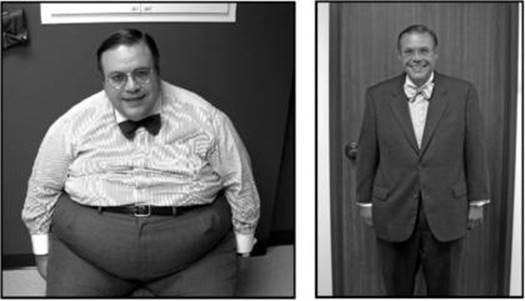
Don's Story
(Left) Don, pre-op, 385 pounds.
(Right) Don, two years post-op, 182 pounds.
I'm a lifetime fatty. As a cub scout, I had a 32-inch waist. I spent my entire adult life weighing between 300 and 400 pounds. I fly a lot and often first class. I was flying first class on an international trip and had to move to coach where I could get the arm rest up so I could use two seats. If I ever write a book about my weight loss, I plan to call it, "Too Fat for First Class."
I've lost 100 pounds or more on five different occasions. For example, I got involved in Overeaters Anonymous (OA) and lost 165 pounds-went from 320 to 156. I tried a liquid protein diet and lost 100 pounds. I did both Atkins and OA and made it from 435 down to 280.
I'm a researcher by trade. About the time Al Roker's gastric bypass hit the news I started researching weight-loss surgery. I checked out over 500 websites. I went to six public seminars and interviewed four surgeons.
My decision was motivated by three issues: geography, recovery time (because of my hectic schedule), and, most important, the reputation of the surgeon. I found Dr. Sewell through one of the guys in my Rotary club and began to explore his reputation with other doctors I knew. What a lot of people don't realize is that other surgeons who come across cases they feel are too risky to handle turn those cases over to Dr. Sewell. One doctor said to me that for laparoscopic surgery what you want is a great cutter, and Dr. Sewell is a great cutter.
I got my band on February 3, 2003. Pre-op I weighed in at 385. I've currently lost over 200 pounds. There have been some stumbles along the way. Dr. Sewell's never been real happy with me, because I've used a calorie methodology, meaning I try to keep my calorie intake low. So I didn't have that first adjustment for four to five months. I see the band as a device that keeps me from overeating. I've never had any real hunger pains. But I know Dr. Sewell would prefer I let the band do some of the work and that I lose more slowly.
Statistically, 50 percent of the people who go through weight-loss surgery end up having some type of plastic surgery. I'm into body sculpting. On March 4, 2004, I had a nine-hour surgery in which the plastic surgeon took off a strip of skin 12 inches wide all the way around my middle. I went in at 201 pounds expecting to weigh a lot less than 200 when I came out. But I was dehydrated, so they ended up giving me 14 liters of fluid and I came out weighing 225. However, after healing, I lost 8 inches off my waist, so I made it into a size 38 pant. I was in a size 48 pre-op. I've had less extensive plastic surgery since then, including operations to take care of the other hanging skin areas on my legs, chest, neck, and so forth. It looks like I'll have four plastic surgeries all together before I'm done.
I have a couple of observations about my weight loss. One is I'm cold all the time. When you get on the Internet, you hear that complaint often from people who have lost a lot of weight. I talked to a neurologist about it, and she said it will take my body a couple of years to adjust to the new me. I also notice that my weight fluctuates. My lowest weight was 182 pounds, but I tend to be somewhere between that and 210, depending on how hard I work on my food choices. Right now I'm at 208.
I also feel that my interpersonal relationships were based on weight and that my personality was shaped by it. I'm a pure "Type A" personality, and I felt I spent my life compensating. I was the fat man, so I had to prove myself. Now everyone says I'm easier to live with. I'm softer, more mellow. I do know I like myself more.
One more thing I want to add is that my income has more than doubled since I lost the weight. There are fat bigots out there and prejudice. When I lost the weight, I generated a lot of successful energy from relationships without expending any extra effort. The weight is no longer an encumbrance.
Consequently, my income, which was already extremely good, is just blowing out. I have more than recovered the money I spent on the band and plastic surgeries with my increased income, meaning that the surgeries have more than paid for themselves. Now that I'm a normal looking corporate type, I realize how much the weight was holding me back. I removed a major barrier to my career advancement when I got banded, and I feel terrific about that. So the way I see it, the band has a strong potential economic payoff.
For those who are extremely overweight, exercise can present an entirely different set of problems. Someone who is carrying around an extra 75 pounds or more may find that physical activity of any type is difficult or impossible because of pain or immobility. That is particularly true as obese people grow older. The chronic burden of obesity on the back, hips, knees, ankles, and feet frequently results in significant pain with even limited exercise. Even if their joints don't hurt, just gathering the energy to get started in a regular exercise program can present a major obstacle. Exercising is not an option for those who become short of breath just walking from the car into the house.
For those who can participate in a regular exercise program, the results are frequently far less than what they expected. Increasing physical activity alone often doesn't lead to sustainable weight loss. It must be combined with a reasonable dietary plan. The irony is that exercising may actually have the effect of increasing a person's appetite. Hunger becomes a particularly difficult problem following a workout, and it is easy to rationalize an extra snack or a large order of fries as a fitting reward for all the hard work. However, the truth is that a candy bar or a milkshake contains more calories than most people can burn off walking for an hour on a treadmill.
Pat's Story
My internist, who'd been my doctor since 1980, said, "I'm going to fire you as a patient." He proceeded to tell me that my diabetes had progressed to the place where he estimated I had only a year to live. He then said, "You haven't listened to me in 25 years, and I'm not going to sit here and watch myself lose you."
I was shocked. We'd been friends, and I could tell he was upset, too. I asked for more time, and he repeated that he'd already given me a quarter of a century. So I asked for another three months.
I left his office knowing I had to do something about my weight. But what to do? I went to another doctor about cysts and tumors in my breasts, and I asked him about the gastric bypass. He thought it was an "abortion to your body." I told him the internist was going to quit me. He mentioned the band and Dr. Sewell. I talked to my daughter-in-law, who was a nursing student at Texas Christian University (TCU), and she also gave me Dr. Sewell's contact information. I called, found out about a free informational seminar he was having, and drove two hours with my husband to attend.
At the seminar I decided to do this, and my husband was on board. Dr. Sewell had a patient there who was delightful, a young, attractive, vivacious person. I asked her, "Can you have Coke°?" and she said, "Yes, if you let it go flat." Someone asked if she could have a big steak, and I thought she was very honest when she said no. But you know, I have found, while those things were important to me then, they're not important anymore.
I was turned down by my insurance three times, but I kept fighting. I was going to get a band and would have paid for it myself. As it turns out, I was on the pre-op diet two months and doing very well-really losing. So I said to myself, "Why am I doing surgery if I'm losing on the pre-op diet?" Then I answered myself, "Because I'll gain it back if I put a cracker in my mouth." I went back to my internist during the pre-op diet, and since I'd lost weight, he said he'd stick it out for six more months.
I'm 5 feet, 4 inches, and started at 265 pounds. Now, two years out, I fluctuate between 125 and 130 pounds. I feel wonderful. I used to have headaches if I didn't eat, and I took massive doses of Advil°. Since the band surgery, I've taken Tylenol® only 10 times in two years. I had leg problems that have mostly disappeared. A year and a half ago I fell, pulled ligaments in my right leg, and was in the emergency room. My internist, who is still my doctor, by the way, said, "Do you realize with the fall you took, had you not lost weight, you'd be in a wheel chair for the rest of your life?" I don't even limp now, and I was in physical therapy for six weeks.
It's like I can't say enough. What can you say about people who saved your life? Someone asked me when I was going to have the band removed, and I said, "Never." I'll tell anyone about the band who'll stand still long enough to listen. In fact, sometimes I find myself chasing someone down the hall at work, saying, "There's just one more thing."
Despite all the problems that plague dieting and exercise, those two activities remain the basis for any sustainable weight-loss program. It is mandatory to control both the amount and the types of foods that are consumed to ensure adequate nutrition while decreasing total weight. Likewise, regular physical exercise not only improves the function of heart and lungs, it also increases the body's basal metabolic rate. That means people who work out regularly burn more calories, even at rest, than those who don't exercise.
Given all the positive things that can come from a good diet and a regular exercise program, it would seem that everyone should be eager to participateand most of us are-but only to a point. Right or wrong, we live in a society based on immediate gratification and increasing creature comforts. When viewed in that context, dieting is often seen as simply depriving ourselves of what we want and deserve, and exercising just for the sake of working up a sweat is not any fun. As a result, participation in dieting and exercise is for many only a half-hearted effort. What we are really looking for is an immediate effect with minimal inconvenience and a guaranteed result. That is the way we have been programmed to think, but it isn't the way our bodies work. In the next few chapters we'll explore more of this "quick fix" concept for treating obesity, and why such options often fail.