
The trouble with people is not that they don't know but that they know so much that ain't so.
-Josh Billings, Josh Billings's Encyclopedia of Wit and Wisdom
There is an old saying: "You are what you eat." But, obviously, if all you eat is vegetables, you don't become a vegetable. Everything we eat undergoes a complex process inside our bodies called digestion, which is a fundamental part of sustaining life. In order to understand the problem of obesity and also how various weight-loss operations work, it is important to have a basic knowledge of how our digestive system works.
All of the building blocks and vital sources of energy our bodies use are contained within the food we eat. Digestion can be summed up as the process of changing food both physically and chemically, all the way down to the molecular level. The hamburger you had for lunch must be broken down into its molecular components before any of it can be absorbed into your bloodstream. It is only then that the carbohydrates, fats, and proteins we ingest can actually be used by the body.
The digestive system breaks down proteins into amino acids, carbohydrates into simple sugars, and fats into fatty acids and other molecules such as cholesterol and triglycerides. These basic building blocks are then used either as sources of energy or as structural elements for growing new tissues, repairing injured areas, or restoring parts that wear out naturally. Anything not needed to meet immediate needs is eventually converted into fat and stored in various areas throughout the body for future use.
The Digestive System
The human digestive system is composed of two basic parts, as shown in the figure below. The main component is the long tube that begins at the mouth and ends at the anus and is called the alimentary tract. The rest of the system is composed of organs that add various chemicals essential for digestion into the alimentary tract. These include the salivary glands, the liver, and the pancreas.
The system seems fairly simple. You put food in one end, and eventually the waste material comes out the other. However, what goes on in between is one of the true wonders of life. Whether the individual is a world-class athlete or a newborn baby, a manual laborer or a grandmother in a rocking chair, each body requires the same nutrients and gets them in the same way We eat to live.
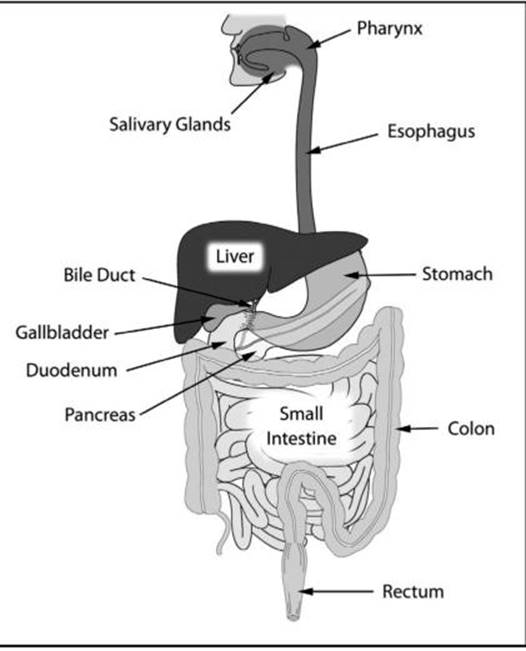
The digestive system is composed of two basic parts: the alimentary tract, which is the tube from the mouth to the anus, and a number of organs that add various chemicals for digestion.
Mechanical Digestion
The voluntary process of eating initiates a complex cascade of events that occur automatically. You might think this process doesn't begin until you put food into your mouth, but actually the body begins preparing well in advance. Just the sight, smell, or even the thought of food triggers higher levels of saliva production in your mouth, along with an increase in the movements and acid production of the stomach. That is where terms such as "mouth watering" and "stomach growling" come from. The digestive system is gearing up for what is to come, both chemically and mechanically.
The foods we eat come in a variety of different shapes, sizes, textures, consistencies, and flavors, to say nothing of the actual nutritional value. A glass of milk and a T-bone steak couldn't be more physically different, yet they contain many of the same proteins, fats, and carbohydrates. As a liquid, milk doesn't really require any mechanical digestion, or movement on the part of our body to aid in digestion. Even a newborn can digest mother's milk. But to digest a big chunk of steak, it must be mechanically changed.
Typically we start the process of mechanical digestion by cutting large pieces of solid food into smaller, bite-size pieces. While it is possible to digest a large chunk of food without chewing it, that is very inefficient. Cutting solid foods into smaller pieces greatly improves the effectiveness of the digestive process.
Chewing is an important part of mechanical digestion for several reasons. Our teeth are designed to tear and grind pieces of food into increasingly smaller particles, which can be more easily swallowed. Chewing also mixes the food with saliva, which is produced by several glands inside the mouth. Saliva acts as a lubricant that makes the food easier to swallow, and it also contains some digestive enzymes called amylase. These enzymes begin the process of chemically altering some carbohydrates, even before you swallow them.
There is a lot of truth to what your mother told you: "Slow down and chew your food." We always seem to be in a hurry, and it takes time to chew many foods adequately. In fact, eating too fast, taking large bites, and not chewing adequately are all eating habits associated with obesity.
But mechanical digestion does not stop with chewing. When you swallow, the food passes from the back of your throat down into the stomach through a tube called the esophagus. The stomach is a large pouch that can easily hold a liter or more of food and fluid. It produces a highly concentrated solution of hydrochloric acid, capable of breaking down the structure of even the toughest foods we ingest.
Mechanical digestion in the stomach is not limited to the effects of acid. The stomach acts like a big mixer, mechanically transforming the food into a thick paste. It literally grinds the food using rhythmic contractions of the muscles of the stomach wall, known as peristalsis. This type of "milking" action occurs naturally throughout the GI tract and is how food is propelled along. At the bottom of the stomach there is a muscular valve, called the pylorus, which prevents food from passing out of the stomach until it is about the consistency of oatmeal. The pylorus remains closed as the rhythmic contractions of the stomach muscles turn it into a "mixer." Once the food has been combined with the acid and ground into mush, it is ready to be released by the pylorus into the small intestine, where the remaining chemical processes of digestion take place.
The Liver, Pancreas, and Chemical Digestion
The process of changing complex substances like a piece of chicken or an apple-into tiny, submicroscopic molecules that can be absorbed into the bloodstream takes more than just chewing, swallowing, and letting the stomach grind for a while. It is really beyond the scope of this book to explain all of the various chemical reactions required to complete the task of digesting a meal. However, the principle to remember is the need for bile and digestive enzymes to break apart large, complex molecules into their smaller component parts.
Most of the things we eat are easily dissolved in water and can be thoroughly mixed in the stomach, but, as we all know, "oil and water don't mix." Even though our food is mixed thoroughly inside the stomach, fatty foods tend to collect as separate oily globs within the otherwise watery fluid as it passes out of the stomach. Before fatty foods can be digested, these oily collections must be broken into tiny particles, or globules. That process is called emulsification, and the key to emulsification of fatty foods is bile. Produced by the liver, bile is added to the food as it passes into the first part of the small intestine, known as the duodenum.
Bile helps to break down large fat globs more or less the same way that soap seems to eliminate grease when you wash the dishes. It breaks down the natural surface that exists between oil and water. The fatty material is converted into tiny droplets, which are more evenly mixed in with other food particles in the surrounding watery fluid.
Getting bile from the liver into the intestine involves a system of tubes, called bile ducts. The gallbladder is a small pouch located under the liver that acts as a temporary storage area for bile. As the stomach fills up with food, a hormone called cholecystokinin is released into the bloodstream. This hormone stimulates the gallbladder to contract, literally squeezing bile out of the gallbladder, through the main bile duct and into the intestine. In this way a large amount of bile can be added to the food precisely when it is needed most.
Unfortunately, the gallbladder is a frequent source of problems, including gallstones. These are actually just crystallized bile, and when they occur they often require the surgical removal of the gallbladder. Since the gallbladder is merely a storage container, removing it does not prevent bile from being added to the food, but the system does not work as efficiently as it normally would. Generally that is not a problem unless you eat a large, fatty meal. Without a gallbladder to add large amounts of bile all at once, some of the fatty material may pass through the intestine without being completely digested. These undigested fats are irritating to the lower intestines, causing diarrhea or abdominal cramping. That is why people who have had their gallbladder removed are generally told to avoid really fatty meals.
The mechanical actions of chewing and the mixing of food with acid inside the stomach, as well as the action of bile on fats, are each important, but the real digestive process occurs on a molecular basis. The chemical changes that break down our food require a group of highly specialized molecules called digestive enzymes. It is these enzymes that make it possible for the food we take into our mouths to make it ultimately into our bloodstream for general distribution throughout the body. For purposes of simplification, there are three main categories of enzymes. Each category is named for the type of material that it helps to digest. Amylase is the enzyme that works on starches and other carbohydrates, converting them into simple sugars. Lipase works on lipids, or fatty substances, breaking them down to fatty acids, cholesterol, and other absorbable fats. Protease breaks complex protein molecules into their building blocks, known as amino acids.
The salivary enzymes were mentioned earlier in the mechanical section, but they are also part of the chemical digestion process. Saliva contains the enzyme amylase, which begins the process of chemically breaking down carbohydrates. The amount of amylase in the saliva is relatively small, especially compared with the amount produced by the pancreas. The majority of amylase and virtually all of the lipase involved with digestion are produced by the pancreas and are added, along with bile from the liver, directly to the food as it passes out of the stomach. If it were not for pancreatic enzymes, we simply could not digest even the most basic foods.
Since both bile from the liver and enzymes from the pancreas are not added to the food until the first part of the small intestine, known as the duodenum, chemical digestion doesn't really begin until the food reaches this point in the alimentary tract. The precise location where pancreas enzymes and bile are added to the food we eat is important, as it pertains to obesity surgery, because a person's anatomy can be surgically altered, greatly affecting the overall digestive process. In other words, by rearranging the digestive system the surgeon can actually change a person's ability to digest and absorb certain foods.
Unlike amylase and lipase, protease enzymes are for the most part produced by the cells that line the inside of the small intestine. These powerful chemicals can quickly turn the protein in a steak into amino acid molecules small enough to be absorbed directly into the bloodstream.
Absorption and Conversion
Once food has been mechanically and chemically broken down into its basic components, the final part of the digestive process involves getting those tiny molecules of simple sugars, fatty acids, amino acids, vitamins, and minerals out of the intestine and into the bloodstream. All this occurs in the small intestine. It is about 18 feet long and about an inch to an inch and a half in diameter. But the lining of the intestine, the actual surface area where the absorption of nutrients occurs, is many times larger than it appears. That is because of the presence of millions of tiny fingerlike projections called villae that blanket the inside of the intestine.
Each villus contains a tiny network of capillaries capable of absorbing molecular nutrients directly into the bloodstream. Larger fatty molecules are absorbed into the villus and then are taken up by a tiny one-way channel called a lacteal, which eventually connects with the bloodstream via the lymphatic system. This process of absorption is very efficient at taking up virtually all available nutrients, in no small part because of the presence of millions of villae, which greatly increase the total available surface area in which nutrients can be absorbed.
Some molecules that are absorbed into the bloodstream, such as ammonia, must be chemically altered before they make their way into the main circulatory system. Otherwise they will cause serious toxic reactions, particularly in the brain. To avoid this situation, all the blood from the intestinal tract first passes through the liver for detoxification. The liver also performs a variety of chemical reactions that change absorbed nutrients into material that is usable by other tissues in the body.
Immediately after eating, the amount of the simple sugar, glucose, present in the bloodstream exceeds the amount needed by the cells. The liver converts much of this simple sugar back into a more complex molecule called glycogen, which is then stored in the liver. As the available glucose in the bloodstream gets used up, the liver can quickly convert these glycogen stores back into glucose for use as a cellular energy source. This system helps to avoid major fluctuations in the availability of glucose during periods between meals. However, if sugar and fat intake consistently exceeds the needs of the body, the glycogen stores continue to build up inside the liver and can lead to what is frequently referred to as a "fatty liver." Over time this can even interfere with the normal functions of the liver.
When the total amount of nutrients taken into the body consistently exceeds the material and energy needs, the body turns the excess into long-term storage in the form of fat. This includes all forms of excess nutrients, including even pure protein. Do not be fooled into thinking that fat comes only from sugar and starchy or fatty foods. Within the liver, chemical reactions occur that can turn excess amino acids into glucose, which is then converted into fat.
The medical term for stored fat is adipose tissue, and it can be found in nearly every part of the body. The exact location and distribution of major fat stores depends on age, gender, genetics, and, of course, how much excess fat there is. Major deposits of adipose tissue can create "apple" and "pear" shaped bodies, round faces, prominent abdomens, and all the other outward appearances we associate with obesity. If the amount of nutrients taken in is less than the body needs, these fat stores can be mobilized, and the contour of the body will change.
It is important to realize that not all adipose tissue occurs in areas of the body that can be easily seen. Fatty deposits also occur around major organs inside the body. These so-called visceral fat deposits, especially those around the heart, can actually interfere with the normal function of the organ.
The bottom line is that a healthy diet is one that meets the needs of the body without consistently exceeding those needs. Excessive intake always leads to excessive stores of fat, and that is likely the reason you are reading this book, right?
Waste Management
Not everything we eat is nutritious. That is true even for those people who claim to eat only healthful foods that are high in nutritional value. Some stuff is just not digestible and therefore passes through the intestine without being absorbed. We often refer to that kind of material as roughage, and a certain amount of it is good for us. Everything we eat moves through the small intestine, and anything that is not absorbed passes into the large intestine for eventual evacuation.
The job of the large intestine, also called the colon, is simply to concentrate the leftover material by absorbing most of the water out of it. This occurs as the waste moves through the 5 or 6 feet of colon and is eventually passed out of the body as feces by way of the anus.
If it weren't for a certain amount of roughage, the waste would end up being very small, creating small and firm stools. To move that type of fecal material along requires the colon to generate pressures that are much higher than normal. Over time those high pressures become the main cause of a common condition known as diverticulitis. So, having some roughage in your diet is clearly a good thing.
Summary
Eating a meal is one of the simplest and most basic of all human activities, but the process of digestion is actually quite complicated. The things we eat must be broken down into their basic molecular components. Then they are absorbed into the body, detoxified, and chemically changed by the liver into building blocks and energy sources the body can use. Any nutrients absorbed through the intestine but not used immediately are stored as fat for future use. Everything that is not absorbed is discharged as waste. Thank goodness the process is automatic.
Now that you've seen the basic components and processes of the digestive system, it's time to take a look at various types of weight-loss surgery, how those modifications work, and what the trade-offs are in terms of risks and benefits.