
Past and Present
Yet it is equally clear that knowledge of what is does not open the door directly to what should be.
-Albert Einstein, Ideas and Opinions
To put it mildly, obesity is a very complex problem, but everyone seems to be looking for a simple solution. I've had a number of people say to me, "Just wire my mouth shut, Doc." Or they'll ask, "Can you just sew up my stomach so I can't eat anything?" Interesting ideas, but as we learned in the last chapter on how the digestive system works, the fact is, you've got to eat. Every human being must have nutrition; it's part of living. It is also inconceivable that one single treatment, even surgery, could successfully change a lifetime of overeating.
Bariatric surgery is a relatively recent addition to modern medicine and is still evolving today. Within the last half-century or so, a number of different operations have been developed specifically to treat overweight patients. Each successive procedure has gone through a number of changes and refinements, trying to balance safety and effectiveness.
The word "bariatrics" comes from the Greek word baros, which means "weight." We've all heard meteorologists talk about "barometric pressure," which is basically the weight of the atmosphere on any given area of the earth's surface. In medical terminology, bariatrics is defined as the study and treatment of the problem of excess body weight.
Obesity as a Disease
Before getting into specific weight-loss surgery procedures, there is a major question that has yet to be satisfactorily answered regarding obesity. Is it a condition, or is it a disease? While physicians have always recognized the problem and its harmful effects on their patients' health, until recently it was a widely held opinion that obesity was more of a social disorder than a medical condition. For that reason it has been largely ignored by the mainstream medical community. This belief was supported by the notion that there were no effective treatments.
As the obesity epidemic has continued to spread, however, the problem has come under increasing scientific scrutiny, and several major medical organizations such as the World Heath Organization and the National Institutes of Health have acknowledged obesity as a disease. However, this designation continues to be questioned, especially by the health insurance industry As it turns out, this is an extremely important debate, given the fact that health insurance policies cover only proven treatments for recognized diseases. Obviously, if obesity becomes universally accepted as a true disease, the health insurance industry's financial exposure is potentially huge.
Over the last several years it has been very interesting to hear patients explain why they are seeking bariatric surgery. More often than not their statements involve improving their health. Sometimes they are even more specific, suggesting that they have been diagnosed with diabetes or high blood pressure and that has made them realize the effect their weight is having on their overall health. What I find most interesting is how frequently patients tell me that the idea of looking into surgery as a treatment for a lifetime of obesity was theirs, not their doctor's. That is in part because the medical profession has had virtually nothing to offer morbidly obese patients other than surgery, and many internists and family physicians do not consider surgery a reasonable option. On the other hand, more acceptable medical treatments are invariably prescribed for conditions that are clearly secondary to obesity. Diabetes, hypertension, sleep apnea, back pain, and knee and hip arthritis are all treated with a pill or other treatments, while their primary cause, obesity, goes virtually unmentioned.
Historically, other widely misunderstood conditions have taken a long time to reach disease status. Among them are many psychiatric problems, such as schizophrenia and bipolar disorder, and neurological conditions such as Alzheimer's disease. Part of the recognition process of these disorders as diseases has been the development of medical treatments, even if the treatments were not very effective.
The absence of any specific medical treatment for obesity, combined with a built-in bias that suggests obesity is actually the result of personal laziness or lack of discipline, creates a setting in which obesity as a disease is still being debated. The outcome of this debate has far-reaching consequences, because obesity has reached epidemic status, and providing surgical treatment would prove extremely costly to insurers. What can't be debated is the devastating effects obesity has on the individual's health. In recent years medical treatments for obesity have been increasing. Let's take a look at these treatments.
Drugs Used to Treat Obesity
While the condition of obesity has been around forever, it wasn't until about 50 years ago that it began to be recognized as a major health risk in the United States. As the problem continued to grow, public demand for a solution also increased. Health clubs that stress the need for exercise became a national phenomenon in the 1970s and continue to be extremely popular today. But for people who are truly morbidly obese, the results of exercise alone have been disappointing, to say the least.
Numerous appetite suppressants and metabolic stimulants have been introduced over the years, including drugs such as Meridia® and Phenteramine®. While these drugs have enjoyed some success in helping those who need to lose a few pounds, they have been disappointing when the problem is morbid obesity. Perhaps the most successful of these drugs was Fen-phen, which was a combination of Fenfluramine® and Phentermine®. Both of these appetite suppressants had been around for many years, but they were not used in combination until the early 1990s. Shortly after Fen-phen was introduced, it was being prescribed by many physicians for their obese patients. In some cases the results were dramatic. Patients swore by Fen-phen because it significantly suppressed their appetite. But in 1997, Fen-phen and another similar drug, Redux®, were taken off the market after being linked to the development of a type of valvular heart disease thought to be life threatening. Unfortunately, no other drugs before or since have yielded the same level of weight loss.
There is another drug, Xenical®, which works in an entirely different way. It binds up ingested fat inside the intestine, preventing it from being absorbed. The idea sounds good, because it seems to indicate that you can eat anything you want and the fat will just go right on through. But again, there are potential nutritional side effects, because certain fatty acids and essential fat-soluble vitamins are also bound up and can not be absorbed into the body. Also, it is important to remember that not all calories come from fat. Absorption of simple sugars, complex carbohydrates, and protein are not affected by Xenical®, so it is still possible to gain weight when taking this medication.
A variety of over-the-counter appetite suppressants and metabolic stimulants have also been touted for their potential to cause weight loss. If only their claims were true, the problem of obesity would simply disappear. The list of medical and semimedical options continues to get longer but with minimal effect on the growing epidemic.
Surgical Treatments
In the 1960s, a few surgeons began experimenting with various operations designed to achieve significant weight loss. These surgeons were generally criticized by the medical community as a whole. Such "experimental" treatments were considered illogical, inappropriate, and dangerous. Despite this criticism, over the last half-century many different surgical procedures have been developed and performed to achieve weight loss. They have ranged from literally wiring the patient's jaws shut, to placing a large balloon inside the stomach to take up space. Liposuction and other plastic surgery procedures that physically remove fat have also been touted as effective means of achieving weight loss. Many of these procedures offer little in the way of success and have been advocated by only a handful of surgeons. Some were not much more than passing novelties and as such do not deserve anything beyond a casual mention.
Other procedures were more widely adopted within the surgical community. These bariatric operations fall into one of two basic categories: restrictive and malabsorptive. Restrictive bariatric operations limit the amount of food that can be eaten, while malabsorptive procedures interfere with the absorption of nutrients by the intestine. Some procedures employ both elements to some degree. Each type of procedure has its own set of benefits as well as its own set of problems.
Jejuno-Ileal Bypass (also known as the JI Bypass or Intestinal Bypass)
One of the most commonly performed bariatric operations in the 1960s and 1970s was the jejuno-ileal bypass. It was also commonly called the intestinal bypass. The procedure simply shortened the small intestine from its usual length of about 18 feet to only about 4 feet. The concept was to minimize the absorption of food, regardless of how much the individual ate.
The small intestine is composed of three parts: the duodenum, the jejunum, and the ileum. The duodenum is the first part of the small intestine and is about 1 foot long. The second part is called the jejunum and constitutes approximately half of the small intestine. The remainder of the small bowel is called the ileum, which extends from the midway point to the end, where the small bowel empties into the colon.
Each part of the small intestine absorbs different nutrients. Certain things that are absorbed in the jejunum are not absorbed in the ileum, and vice versa. In particular, some vitamins and bile salts are absorbed only in the very last part of the small intestine, called the "terminal" ileum. Armed with this knowledge, when surgeons performed any procedure to shorten the small intestine, they tried to maintain at least part of both the jejunum and the terminal ileum; thus the name of the procedure: jejuno-ileal bypass.
Following JI bypass, patients typically experienced significant and rapid weight loss. Many patients praised this operation as the "cure" for their obesity. However, as time went by, a large number of patients developed serious side effects as a result of this rearrangement of their intestines. Problems included dehydration, kidney stones, uncontrollable diarrhea, anemia, malnutrition, various vitamin deficiencies, and even liver failure. Eventually deaths began to be reported as a result of what came to be known as the JI bypass "short-gut" syndrome.
The increasing frequency and severity of major complications resulting from JI bypass only added to the general perception among physicians and surgeons that obesity was anything but a surgical disease. Those who actually performed bariatric surgery were more or less shunned by the majority of the surgical community. Even so, many of these early pioneers were convinced that the answer to the numerous complications of JI bypass rested solely in their ability to leave behind precisely the right amount of each part of the intestine. For more than a decade arguments raged over the exact number of centimeters of jejunum as well as the length of terminal ileum that should be left behind to cause the desired weight loss while avoiding nutritional complications.
Ultimately, by the end of the 1970s, the JI bypass had fallen completely out of favor and was replaced by somewhat safer procedures, performed on the stomach and designed to simply restrict food intake. Logically these became known as gastric restrictive procedures.
Gastric Restrictive Procedures
In the second half of nineteenth century a German surgeon named Theodor Billroth became widely recognized as the father of gastric surgery. He developed many of the techniques that are still used today for removing parts of the stomach, and reconnecting it to the small intestine. Prior to the mid 1970s there were no medications like the ones we have today, which are capable of suppressing the stomach's ability to produce acid. As a consequence stomach ulcers were a common and often serious problem frequently treated by surgery to remove large parts of the stomach. In those days ulcer operations constituted a major part of virtually every surgeon's practice. These procedures have been performed not only as treatment for ulcer disease but also as treatment for stomach cancer in more or less the same way for over 100 years.
Since the very early years of gastric surgery, it was recognized that after these procedures many patients experienced significant weight loss. In fact, that was considered one of the more serious and undesirable side effects. The stomach normally can hold a quart or more of food and fluid. Naturally, if a significant part of the stomach is removed, or bypassed, it will have a significant impact on the amount of food the individual is able to eat at any given time. For many patients, a smaller stomach created real problems just maintaining adequate nutrition. But for those who were morbidly obese to start with, having a major gastric procedure was just what they needed to lose weight. Ultimately, these experiences led surgeons to begin using these operations solely for the purpose of achieving weight loss.
In the 1960s, surgical stapling devices became available and were a major technological innovation, especially for stomach operations. They made these operations quicker and easier because they divided the stomach and at the same time sealed the edges closed with staples instead of sutures. This made cutting out portions of the stomach faster than the more traditional techniques, and offered better control of bleeding and potential postoperative infections. Eventually staplers were designed simply to seal tissues like the stomach closed, without actually dividing them. Surgeons soon learned to modify these devices to perform a simple weight-loss procedure, which became known as "gastric stapling." A few of the staples could be removed from the middle of the stapler so that when placed across the upper part of the stomach, the device would essentially create two compartments with a small opening between them.
The amount of food the patient could eat was restricted, because the upper part of the stomach was purposefully made small so that it would fill up with only a very small meal. Eventually, food makes its way out through the small opening into the rest of the stomach to be digested. This procedure enjoyed considerable acceptance among bariatric surgeons because it appeared to work fairly well and offered much lower risk than the JI bypass.
Gastric stapling does cause considerable weight loss, but the results simply don't last. The problem is that the opening between the two parts of the stomach tends to stretch out over time. This allows patients to eat larger and larger meals because the food moves quickly from the upper compartment into the lower compartment. As a result, most patients tend to put back the weight they lost within just a few years. In an attempt to address this problem, the vertical banded gastroplasty was developed.
Vertical Banded Gastroplasty
Eventually, the gastric stapling procedure was modified to help eliminate the problem of stretching of the opening between the two parts of the stomach. The staple line was oriented more up and down rather than across the stomach, and the opening between the two parts of the stomach was encircled with a ring that would not allow it to stretch. The ring was made of steel wire that was wrapped in silicone to prevent the wire from cutting through the stomach wall. Once this permanent band was in place, it maintained the size of the opening between the two parts of the stomach. This procedure became known as the vertical banded gastroplasty, or VBG. For much of the 1980s it was the most commonly performed bariatric procedure.
Many of those who performed the VBG once again believed they had found the answer" to the problem of morbid obesity. Patients were losing weight rapidly, and the risk seemed to be relatively low. But on closer inspection the longterm results were like those of previous operations-less than optimal. Although the banded opening could not stretch, the upper stomach pouch often became stretched. This dilated stomach allowed patients to eat more, and they gained much of their weight back. Likewise, staple failure was a frequent problem because patients would overeat, and the pressure inside the upper stomach pouch would eventually cause some of the staples to come loose. Loose staples meant that new paths were created for food to pass through to the lower stomach compartment. The end result was that patients were able to eat more, with predictable results. There were also other concerns with procedures like stomach stapling and VBG.
Nutritional Concerns
Despite the frequent long-term failures with both stomach stapling and VBG, these procedures continued to be performed, largely because they were much safer than JI bypass. Both procedures maintained all of the normal absorption of nutrients in the small intestine. As long as the patient ate a balanced diet, the problems of malnutrition, vitamin deficiencies, and anemia could be avoided. This sounds simple enough, but it requires a great deal of effort to undo years of dietary indiscretion and overindulgence and develop better nutritional awareness. Likewise, patients with small upper stomach compartments and intact staples often found it hard to follow the postoperative eating guidelines, which included eating smaller meals and thoroughly chewing all foods.
Since the procedures were so restrictive, many patients switched over to eating things that would go through easily. Liquids go down quite easily, so eating ice cream and drinking milkshakes or other high-calorie liquids was common. The problem is that most of these foods are high in calories yet lack adequate nutritional balance. They are typically short on protein and high in carbohydrates and fat. After a few years, many patients reported they had gained back much of the weight, and were also experiencing hair loss and muscle wasting.
Gastric Bypass (or Roux-en-Y)
From the late 1970s and into the 1980s, vertical banded gastroplasty was the darling of the bariatric surgical community. However, as late failures began to mount up, an operation began to be used that was based more on the surgical resections that Billroth had pioneered a century before. The Roux-en-Y gastric bypass that is commonly used today to treat morbid obesity was a modification of what is known as a subtotal gastrectomy, a procedure in which most of the stomach is removed. This operation was one that was commonly used in the treatment of ulcer disease for the previous four or five decades. The difference between the subtotal gastrectomy and a gastric bypass lies in the fact that in the latter the bulk of the stomach is not actually removed; it is merely bypassed. The word "Roux-en-Y" is a surgical term used to describe how the small intestine is connected to the small stomach pouch.
To perform a Roux-en-Y gastric bypass, the surgeon first divides the stomach, creating a very small stomach pouch just below the esophagus. The intestine is then divided near the beginning of the jejunum. The lower end of the divided intestine is brought up to the small stomach pouch and sutured or stapled to it. This allows food to pass directly into the intestine, bypassing the rest of the stomach. To complete the procedure the surgeon needs to reconnect the upper end of the divided intestine back into the small intestine downstream.
Following the Roux-en-Y reconstruction of the upper intestinal tract, the stomach is not the only area being bypassed. As we learned in the last chapter, bile and pancreas enzymes are both added to the intestine in the duodenum. Since food is also being diverted around the duodenum, these important chemicals are not available to help digest fats and carbohydrates until after the food gets down to the point where the two parts of the intestine are rejoined.
One of the biggest arguments among bariatric surgeons involves just exactly how long the segment of intestine should be that extends from the stomach down to where the small intestine is reconnected. This is commonly called the small bowel limb, or the bypass limb. The pancreatic enzymes and bile enter back into the main stream of the intestine at this point, and only then can they begin to digest the food. So it would only seem logical that the longer the small bowel limb, the shorter the intestine that remains available to absorb nutrients. But the fact is that unless the limb is extremely long, it has very little impact on digestion. We have much more intestine than we actually need, and unless the length is extremely short, as in the JI bypass, absorption of nutrients is usually not significantly impaired.
When performing a Roux-en-Y gastric bypass, the size of the stomach pouch is very important. If it is too big, the patient is able to eat too much and will fail to lose weight. If it is too small, the patient may have difficulty maintaining adequate nutrition. But as was the case with the VBG, it is important to recognize that the stomach is quite stretchable, and with time the pouch is likely to stretch out. So, in general it is a good idea to start out too small rather than too big.
The size of the opening made between the stomach and the small intestine is also very important. If the surgeon makes it too big, the food just goes right through, and the patient never gets a sense of satisfaction. As with the stomach stapling procedure, it is not uncommon for this opening to stretch over time, leading to late weight gain.
Another complication can occur as a result of this new connection between the stomach and intestine. It is fairly common for the opening to become very narrow. This is due to excess scar tissue or acute inflammation caused by ulcerations at the site of connection. The latter usually occurs within a few weeks after the surgery, while narrowing caused by scar tissue may not show up for years. In both cases the opening may be dilated, but if the narrowed opening cannot be stretched enough it may require reoperation to enlarge it.
Despite these and other problems, the Roux-en-Y gastric bypass is still the most commonly performed technique used in bariatric surgery today. There have been a number of modifications, including one in which the stomach is simply stapled closed and not actually divided, followed by connection of a Roux-en-Y limb up to the upper gastric segment. As you might expect, the problem with this option is once again the failure of staples, allowing food to pass through.
Another modification avoids constructing the Roux-en-Y altogether. A loop of the intestine is simply brought up to the stomach and connected to the pouch. This procedure frequently leads to a variety of problems including ulcers and chronic abdominal pain as pressure builds up inside the intestinal loop. Generally speaking, these procedures are being performed by only a few surgeons and are not considered mainstream bariatric procedures.
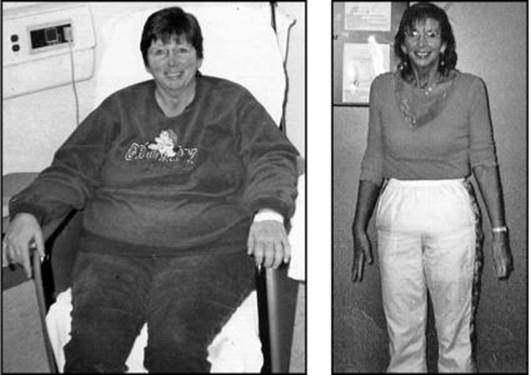
Kathy's Story
(Left) Kathy, pre-op, 373 pounds.
(Right) Kathy, nineteen months post-op, 145 pounds.
I had every major health problem. I was diabetic, had a hiatal hernia, high cholesterol, high blood pressure, sleep apnea, arthritis in my knees and elbows, and more. I took 15 pills a day to survive, and I couldn't even walk up steps. I started at 373 pounds, and I'm 5 feet, 8 inches tall. My doctor told me to get 150 pounds off or I wouldn't see my next birthday. I was in tears. I was about to have my first grandchild, and I didn't know if I would even get to hold her.
I did Weight Watchers°, TOPS, the cabbage diet, and more. I'd say there wasn't a diet I wasn't familiar with. I got to the point where I'd go on a diet, lose 20 pounds, and no one could even tell. Of course, then I'd put back on double.
I opted for the gastric bypass. I didn't know about the band, but looking back I probably wouldn't have chosen it anyway. I looked on the Internet into gastric bypass and everyone was having complications down the line, so everything I read was against it. And when I told people, all my family and friends were against it, including my husband and my doctor. But the way I looked at it, I was going to die anyway, so what did I have to lose? If I had it, at least I could say I was trying.
I found out, I couldn't just go out and have bypass surgery. A doctor had to recommend it for my insurance to pay. So I took my husband, who was having a headache problem and doesn't speak much English, to a doctor who speaks fluent Spanish. While we were there I asked the doctor about bypass surgery, and he said he thought it was a good idea. He said he'd seen remarkable things with the bypass, and I'd be a good candidate. My husband was better about it then. The doctor wrote me a full-page recommendation about how obesity affected my health. He asked me questions, but I could tell he knew the story. I told him how I couldn't fit into a booth in a restaurant or an airplane seat, couldn't ride in an amusement park ride, and all the usual stuff.
I went to three different doctors' seminars, so I felt I knew exactly what was going to happen. But the barrier was still insurance. We submitted to insurance and they denied it. We resubmitted and they said okay, but I found out they were going to stop paying for it as of the end of the year. I had surgery on December 21, just 10 days before the cutoff date. I went home December 22 and went back to work the next day. I work at the phone company, so I didn't really take any time off. I had to work Christmas Eve and Christmas Day, too, because I would have lost all my holiday pay if I hadn't.
After surgery I stuck to the liquid diet, then went to pureed foods. I never had much of an appetite after the surgery. I eat to stay healthy, not because I'm hungry. I eat because I have to eat to keep my bones healthy, and to keep my hair. From the very day I came home from the hospital, I started exercising. I started walking around the block a couple of times, and worked up to 2 miles, then up to 10 miles a day. On my lunch hour, I work out at Curves®. I also started riding a bicycle instead of walking, and I kept going to Curves®.
Nineteen months out from my surgery, I weigh 145 pounds. I lost 25 pounds the first week after I had my surgery. I lost 10 to 15 pounds a week after that. I probably leveled off about a month or so ago. I don't actually have much hanging skin except on the inside of my thighs. Some plastic surgeons say you cannot get rid of the loose skin without surgery, but that wasn't true for me. I worked out and firmed up a lot.
I'm at 145 now, and the charts say I'm underweight and should be between 150 and 177. My cholesterol and everything is perfect. My blood pressure is down, and my blood sugar is great. I had follow-ups with my surgeon every three months. But he said I don't have to go back to him unless I fall under 150 pounds and that happened, so I did see him again. But he didn't have much to say about my weight. I did meet with a dietician a couple of times before the surgery and in the hospital. And I have a number for her, but I haven't talked with her since I was in the hospital.
I have experienced dumping syndrome a couple of times. If you do it once you don't want to do it again. What I ate ran right through me, and I didn't have any way to stop it. I don't eat sweets like chocolate. I also have had several episodes when I felt like I was having a heart attack. It felt like something was stuck in my chest and I couldn't get it to go up or down. I've thrown up a couple of times since my surgery, and it's more like foam that comes out. It hurts to throw up.
I've always been outgoing, but I notice people treat me differently. I feel a lot better about everything now. I know other people have had a lot of trouble with the bypass, but I think the difference between me and someone else is I followed the exercise program exactly the right way.
Biliopancreatic Diversion
There is a variation of the Roux-en-Y gastric bypass called the biliopancreatic diversion (BPD), which significantly shortens the functional intestine. In this procedure the small bowel limb is reconnected down near the end of the ileum. This operation combines both the restriction of a small pouch and the malabsorption effects of a short intestine. The weight loss following such procedures is often dramatic, but not surprisingly, patients have some of the same complications that were seen with the JI bypass.
Another similar modification of this operation is the biliopancreatic diversion with duodenal switch (BPD-DS). In this procedure the size of the stomach is reduced by performing what is called a sleeve gastrectomy, which converts the stomach into a long tube. The remaining portion of the stomach pouch is actually removed, the rationale being that many of the hormones that cause hunger are produced in this large stomach pouch. The duodenum is divided and the outlet of the stomach is connected to the small intestine, allowing the food to bypass the bile and digestive enzymes from the pancreas. The remaining part of the small intestine containing this "biliopancreatic" fluid, which is required to allow digestion of fats and carbohydrates, is reconnected well downstream, near the end of the ileum.
Both of these procedures are usually reserved for patients who are extremely heavy, with a body mass index (BMI) over 80; a category often referred to as "super obese." As you might imagine these extremely complex operations, performed on extremely obese patients, carry a significant risk of a variety of complications.
In an effort to reduce the risk, some surgeons have elected to perform the BPD-DS as two separate operations. The first procedure is the sleeve gastrectomy. That is then followed several months later with the rearrangement of the small intestine. Many patients tend to lose a substantial amount of weight following the creation of a gastric sleeve, and this can significantly reduce the risk of their second procedure. Some surgeons have recently started using the gastric sleeve procedure alone as a purely restrictive weight-loss operation for patients who are not good candidates for other procedures, or who want to avoid the higher-risk gastric bypass. The early results with the gastric sleeve are promising, but for those patients in the super obese category, it is generally recommended they proceed with the rearrangement of the small intestine procedure six months to a year after the gastric sleeve procedure.
Results of Roux-en-Y Gastric Bypass
The Roux-en-Y gastric bypass procedure and its variations are often called the "gold standard" for bariatric procedures because the weight loss is predictable and rapid. When done properly, weight loss after a gastric bypass can be 5, 6, or even as much as 10 pounds a week.
Rapid weight loss is really appealing to a patient who wants a "quick fix," even though he or she has spent a lifetime becoming overweight. Once patients make up their minds that they want to do something, they tend to believe that "faster" is "better." That's not necessarily true, and, in fact, very rapid weight loss is often accompanied by serious nutritional problems. What amounts to a crash diet can lead to inadequate intake of protein, certain vitamins, and essential fatty acids, as well as important minerals and other nutrients. This can constitute a big problem, especially if allowed to continue over an extended period of time.
One of the inherent problems with any procedure that bypasses the bulk of the stomach is a form of vitamin deficiency that shows up as anemia. Vitamin B-12 plays an important roll in the process of making red blood cells, which carry oxygen to the body. B-12 is also very important to ensure normal nerve function. A critical process actually occurs within the stomach that influences the absorption of Vitamin B-i 2. When the bulk of the stomach is bypassed, patients tend to develop anemia because they have trouble absorbing this essential vitamin even if they are taking in iron-rich foods or iron supplements. Anybody who has a gastric bypass needs to be getting B-i 2 regularly, to avoid anemia as well as serious neurological problems.
The most serious potential problems associated with gastric bypass are related to the fact that when the stomach is divided, it requires reconnection of some type to the intestinal tract. This new connection needs to heal without leaking, and even in the most skilled hands there is always the possibility of a leak. If the liquid contents within the stomach leak out into the abdominal cavity, it will likely result in a serious and sometimes life-threatening infection, especially if not diagnosed right away.
Among the other complications of the various bypass and stapling surgeries is the development of an incisional hernia. If the wound doesn't heal completely the edges of the muscle can separate, creating a defect in the abdominal wall called an incisional hernia. This can occur in any patient, but for those with diabetes or who smoke cigarettes the risk is quite high because both conditions interfere with wound healing. Overall, about 20 percent of patients who undergo bariatric procedures using open abdominal incisions end up with hernias, which ultimately require additional surgery to repair.
As bariatric surgery became a more acceptable treatment option, more and more surgeons began to perform these procedures. Many have been forced to reconsider that decision after experiencing one or more serious operative complications as well as rising liability insurance premiums. Today bariatric surgery still bears some of the stigma of being too risky. Some have also suggested that it is being performed by surgeons more concerned about money than the health and well-being of the patient. While there are probably some surgeons who fall into that category, for the most part bariatric surgeons are extremely conscientious and make every effort to provide their patients with safe and effective options for this difficult disease.
Laparoscopic Surgery
In the 1980s the first laparoscopic gallbladder operation was performed by the German surgeon Eric Muhe. Gynecologists had used this technique for many years to perform tubal ligations to sterilize women and even removed ovaries without making a large abdominal incision. The first laparoscopic gallbladder operation performed in the United States was performed by J. Barry McKernan in 1988. While others soon followed, this technique was initially criticized by most surgeons, much like bariatric surgery.
Eventually more surgeons and, most important, the public in general realized that laparoscopic surgery offered many benefits including smaller incisions, less pain, and faster recovery. This minimally invasive technique rapidly evolved, and within a few years it was used to take out appendices, repair hernias, and even remove spleens and parts of the colon. It became apparent that with the proper set of technical skills virtually any intra-abdominal procedure could be performed using the laparoscopic technique. Eventually a few experienced surgeons even began performing gastric bypasses using the laparoscopic technique, thus avoiding most of the complications related to the big, open incision.
At about the same time the National Institutes of Health (NIH), a part of the U.S. Department of Health and Human Services and the primary federal agency for conducting and supporting medical research, published a consensus paper on obesity. That paper essentially defined morbid obesity as a serious medical problem associated with diabetes, high blood pressure, and many other significant health threats. They went on to suggest that surgery had been shown to be the only truly effective long-term treatment for the problem of morbid obesity. The paper said that only 5 percent of people who go on a diet lose their weight and keep it off, while a high percentage of people who have surgery to lose weight are successful at keeping their weight off.
The combination of this rising awareness about obesity as a serious health risk and the ability to perform laparoscopic gastric bypass created a major increase in the number of these procedures by the mid-1990s. A significant factor in the rise of laparoscopic gastric bypass was its obvious marketability. Laparoscopy obviously provides major advantages to the patient in terms of lowered pain, increased comfort, and shortened recovery time. These advantages were enthusiastically promoted, and the public was quick to recognize the benefits.
Unfortunately, the majority of the surgical community was still in the early phase of developing laparoscopic skills when this procedure first started becoming popular. By the late 1990s, a number of surgeons started offering these very complicated procedures to the public, and some had not yet developed the necessary laparoscopic skills or experience to perform these procedures. Complications-especially leaks from the point where the small intestine and the stomach are sewn together-are more difficult to recognize when working in the laparoscopic environment, so many procedures that were started as laparoscopic operations were ultimately converted to open operations. Even as late as 2005, the majority of gastric bypass procedures were still being performed through large open incisions despite all of the hype and marketing of the laparoscopic technique.
Without question, the laparoscopic gastric bypass has become the procedure of choice in most bariatric surgical practices, but many patients remain cautious about the risks and the permanence of rearranging the anatomy of the stomach. In recent years, laparoscopic surgery has given rise to another option that is rapidly challenging gastric bypass because of its relative safety and effectiveness. The adjustable gastric band (AGB) is a procedure ideally suited to laparoscopic surgical techniques.
The Problem with Any Surgical "Solution"
Unfortunately, many patients approach weight-loss surgery of any kind with the attitude that they are now "fixed." They have this opinion because in most surgical cases for other problems, the procedure does in fact provide the solution. Bariatric surgery and the AGB are the exceptions.
With any bariatric operation, there has always been a need for careful follow-up and nutritional counseling. Regrettably, in the past some surgeons offered their patients very little other than periodic examinations during the first few months after surgery. In part this was because they really couldn't do anything surgically to assist the patient once the procedure was over. All they could offer was a referral to a dietitian or nutritionist for counseling.
What has further compounded the problem is that not many dietitians are experienced in dealing with the special needs of bariatric patients. Often these professionals are not particularly supportive of the patient's decision to have the procedure in the first place. Some dietitians put the blame for failure back on the patient's poor food choices, their lack of exercise, or on the operation itself.
A fair number of bariatric surgical patients have simply been sent back to their internist or family physician to manage their various medical problems. Physicians who are unfamiliar with these procedures often criticize the patient's decision to have bariatric surgery as illogical or inappropriate. That is unfortunate, since many of these patients are already living with the stigma of "having to resort to surgery." The perception of such treatments by some in the medical community is that they are only necessary for people who have "character defects" such as a lack of willpower or laziness. (Does this sound familiar?)
Over the last several years, bariatric surgeons have gradually begun to recognize the true importance of careful long-term follow-up after weight-loss surgery to help patients deal with the psychological and dietary aspects of obesity surgery. The critical importance of appropriate exercise and lifestyle changes also began to receive more emphasis in the overall management of obesity.
Having said this, it is very important to point out from the outset that AGB is more of a behavior-modification tool than it is a true bariatric procedure in the traditional sense. The keys to success include more than just the laparoscopic procedure to place the band. Regular follow-up with appropriate adjustments to the band, support from other band patients, and nutritional and psychological support and counseling are all components to help bring about the variety of lifestyle changes for success with the AGB. The remainder of this book is dedicated to this procedure and the important nonsurgical elements that make up a comprehensive AGB program.