Mark S. Cooper
Immediate Concerns
Major Problems
The most important adrenal problem affecting the intensivist is impaired production of adrenal steroids. Individuals with impaired capacity to produce adrenal steroids can become critically ill with illnesses that are otherwise trivial and are unlikely to improve in the absence of steroid replacement. Critically ill patients may also develop adrenal insufficiency in the course of an intensive care unit (ICU) admission secondary to the effects of the underlying disease, or its treatment, on either the pituitary or adrenal gland. Furthermore, it has been suggested that conditions such as septic shock and acute respiratory distress syndrome (ARDS) might frequently be associated with a relative deficiency of adrenal steroids and, thus, patients with these conditions might benefit from steroid treatment, even in the absence of pre-existing adrenal disease. Other adrenal problems present rarely in the critical care setting; however, unrecognized pheochromocytoma can present as either severe hypertension or circulatory collapse on removal of the tumor.
Stress Points
1. The most important hormones synthesized by the adrenal gland are cortisol (the main glucocorticoid) and aldosterone (the main mineralocorticoid). Cortisol production is regulated by adrenocorticotropin hormone (ACTH) secretion whereas aldosterone secretion is primarily regulated by the renin–angiotensin system.
2. Corticosteroid insufficiency (hypoadrenalism) is the most important clinical problem involving the adrenal gland in the ICU setting. It can occur as a result of diseases that directly affect the adrenal gland (primary adrenal insufficiency) or those that impair ACTH production from the pituitary (secondary adrenal insufficiency). Corticosteroid insufficiency can be difficult to recognize since its clinical features are similar to those of other severe illnesses, and some features are masked by ICU interventions. Unrecognized, corticosteroid insufficiency is associated with a high mortality. The clinical findings associated with adrenal insufficiency are shown in Table 164.1.
3. The diagnosis of adrenal insufficiency is difficult in critically ill patients due to the insensitivity of clinical features and the dramatic and variable changes that occur normally in the hypothalamic-pituitary-adrenal (HPA) axis during severe illness. The interpretation of biochemical tests is difficult and will depend on the clinical context. Where there is uncertainty, empiric glucocorticoid replacement is indicated.
4. When the possibility of adrenal insufficiency during critical illness has been raised, definitive testing to determine whether it is present, persistent, and its nature—e.g., pituitary versus adrenal—will be needed, but only when the patient's condition has improved so as to safely allow the studies.
Essential Diagnostic Tests and Procedures
1. The symptoms, physical signs, and laboratory findings traditionally associated with hypoadrenalism are not sufficiently sensitive to be reliable in making the diagnosis of adrenal insufficiency. Rather, these may suggest the need for biochemical testing.
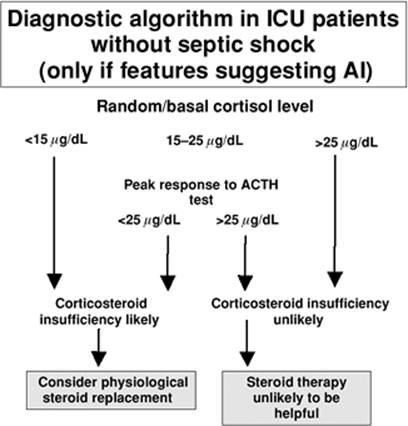
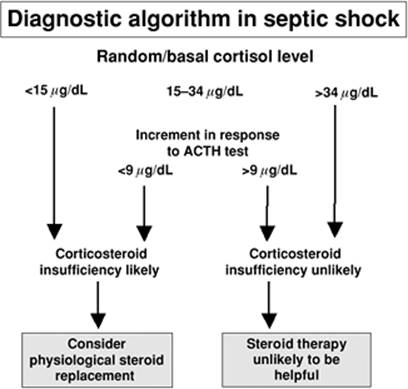
2. The diagnosis will usually be made on either a random serum cortisol level, the level of cortisol achieved after a short ACTH test, or (in the specific situation of septic shock) a poor increment in cortisol across a short ACTH test (Figs. 164.1 and 164.2).
Initial Therapy
For critically ill individuals with known or suspected structural defects in the HPA axis, treatment should be with 100 mg hydrocortisone every 6 hours. With improvement, this dose can be progressively reduced to replacement doses (typically 20 mg hydrocortisone a.m. and 10 mg p.m.). Patients with adrenal disease will also require fludrocortisone when the daily hydrocortisone dose drops below 50 mg per day. In septic shock, the recommended replacement dose for patients with suspected relative adrenal insufficiency is 50 mg hydrocortisone every 8 hours.
Physiology of the Adrenal Gland
The adrenal gland is composed of a cortex and a medulla. The adrenal cortex is the site of synthesis of adrenal corticosteroids, whereas the medulla synthesizes catecholamines (primarily adrenaline). The cortex is structurally and functionally divided into layers (zones) that secrete mineralocorticoids, glucocorticoids, and adrenal androgens. Adrenal hormones are synthesized rapidly from cholesterol with very little hormone being stored within the gland.
|
Table 164.1 Clinical Findings in Adrenal Insufficiency |
||||
|
Adrenal Hormones
The main hormones synthesized by the adrenal cortex are aldosterone (the main mineralocorticoid), cortisol (the main glucocorticoid), and dehydroepiandrosterone (the main adrenal androgen). In conjunction with cortisol, aldosterone regulates salt and water balance. The main action of aldosterone is to increase sodium resorption within the distal nephron; it also regulates sodium excretion from the skin (in sweat), the pancreas, and the colon. Cortisol action affects almost all tissues in the body. These actions are important in maintaining homeostasis under resting conditions and also during stress. Many of these actions are evident only in states of glucocorticoid deficiency or excess. Cortisol levels in the circulation have a pronounced diurnal rhythm, being high in the morning and very low in the late evening. Cortisol in the circulation is heavily bound to serum proteins—corticosteroid-binding globulin (CBG) and albumin—such that only a small fraction is available in a tissue in free form (1). Adrenal androgens are the most abundantly produced adrenal steroids, but their clinical significance is minor compared to the other adrenal steroids, and they are not routinely substituted in patients with adrenal insufficiency.
|
|
|
Figure 164.1. The combination of basal values and peak responses to ACTH tests is intended to avoid missing corticosteroid insufficiency of either central or adrenal origin. |
|
|
|
Figure 164.2. An adequate basal response is required to rule out central causes of corticosteroid insufficiency whereas an adequate increment has been reported to be needed to exclude relative adrenal insufficiency. The use of an incremental response outside of the setting of septic shock is not recommended. (Adapted from Cooper MS, Stewart, PM. Corticosteroid insufficiency in acutely ill patients. N Engl J Med. 2003;348:727–734.) |
Adrenaline is the main catecholamine secreted from the adrenal medulla. Although this hormone may modify some aspects of the stress response, the relative normality of individuals who have had both adrenal medullas removed suggests that this action is of limited importance in most situations. The focus of this chapter will therefore be on the adrenal cortex.
Regulation of Adrenal Hormone Synthesis
Glucocorticoids and mineralocorticoids are regulated differently. Cortisol is synthesized in response to ACTH, which is released from the anterior pituitary. ACTH release is controlled by hypothalamic corticotrophin-releasing hormone (CRH) secretion. Central activation of the HPA axis occurs with all physiologic stressors and also entrains the diurnal rhythm of cortisol secretion. ACTH has an important trophic action on the adrenal cortex, and continued ACTH secretion is essential to maintain the structural integrity of the cortex and the capacity to generate cortisol. Impairment of ACTH secretion leads to a prolonged reduction in the capacity of the adrenal to respond to exogenous ACTH. This is most evident in pituitary disease but is also seen commonly in patients who take supraphysiologic doses of therapeutic glucocorticoids on a prolonged basis since these drugs inhibit ACTH secretion through negative feedback.
During severe illness, factors such as hypotension, pain, anxiety, and endotoxin substantially increase ACTH and cortisol secretion. The level of CBG also decreases rapidly due to a combination of reduced synthesis and increased breakdown (1). These combined effects lead to increased cortisol levels and a higher proportion of bioactive cortisol to protein-bound cortisol. These factors increase cortisol levels within target tissues.
Although the synthesis of the early precursors for aldosterone synthesis are under control of ACTH, the rate-limiting step is regulated by angiotensin II. The activity of the renin–angiotensin system is thus the most important factor in regulating aldosterone synthesis. This explains why aldosterone secretion is still maintained in patients with pituitary disease and consequent ACTH deficiency (2). Although aldosterone secretion does increase during the early phase of critical illness, its importance is probably minor because cortisol, when present at high levels, has a substantial mineralocorticoid effect.
Glucocorticoid Action
The range of actions of glucocorticoids is vast. These actions are sometimes apparent only when glucocorticoid levels are very low or high. Most of the side effects of therapeutic glucocorticoids result from an exaggeration of the physiologic effects that are normally protective during short-term stress.
Metabolic Effects
Glucocorticoids strongly influence most of the metabolic pathways involved in energy homeostasis. Glucocorticoids induce enzymes responsible for hepatic gluconeogenesis and antagonize the anabolic actions of insulin on glycogen deposition. Glucocorticoids also increase the production of fuels for gluconeogenesis by stimulating muscle amino acid generation and adipose tissue fatty acid synthesis. These combined effects ensure that glucose is readily available as a fuel, an effect likely to be of importance for immune cells and in damaged tissues. When prolonged, however, these effects result in adverse outcomes. Increased gluconeogenesis increases the risk of glucose intolerance and frank diabetes mellitus. Continued breakdown of protein leads to myopathy, skin thinning, easy bruising, and poor wound healing. Increased peripheral lipolysis leads to loss of fat on limbs but accumulation of central fat.
Cardiovascular Effects
Glucocorticoids have important effects on salt and water balance, which are likely to be an important part of the stress response protecting against hemorrhage or sepsis. Glucocorticoids contribute to renal sodium reabsorption, even though the dominant regulatory pathway is via aldosterone, and also have a major impact on the capacity to excrete water through the kidney. A deficiency of glucocorticoids can induce a state of excessive water retention and hyponatremia that is clinically indistinguishable from the syndrome of inappropriate antidiuretic hormone secretion (SIADH). The reason for the high prevalence of hypotension and circulatory collapse during adrenal insufficiency is the permissive effect glucocorticoids have on the vascular action of catecholamines. In the absence of glucocorticoids, the vasculature can become insensitive to the pressor effects of catecholamines; this feature is an important clue to the presence of corticosteroid insufficiency.
Immunologic Effects
Glucocorticoids have a broad spectrum of effects on inflammation and the immune system, including an impact on the development, migration, and survival of leukocytes, and a reduction of the synthesis of proinflammatory cytokines by immune cells and blockade of tissue production of eicosanoids such as prostaglandins and leukotrienes. While excessive glucocorticoid action can lead to immunosuppression, glucocorticoid deficiency states are also associated with impaired resistance to microbial infection.
Other Effects
In addition to those effects noted above, glucocorticoids also have a wide range of other clinical actions. For example, a common problem seen with the administration of glucocorticoids is a disturbance of bone metabolism leading to osteoporosis and fractures. The hormone may also induce a range of neuropsychiatric symptoms ranging from sleep disturbance to frank psychosis.
Corticosteroid Insufficiency
Corticosteroid insufficiency can occur with diseases or interventions that involve the adrenal gland directly (primary adrenal insufficiency), or secondary to reduced stimulation by ACTH of an otherwise normal adrenal gland due to hypothalamic or pituitary disease (secondary adrenal insufficiency). Glucocorticoid replacement is similar in the two conditions, but important clinical features may differ; biochemical testing will provide different results depending on setting, and the pattern of deficiency of other hormones will be different. In septic shock, it has been suggested that a relative deficiency of corticosteroids either at the tissue level or within the circulation might occur, and that low-dose corticosteroid treatment may improve outcome; this remains, however, an area of great debate (1,3,4).
Causes of Corticosteroid Insufficiency
In outpatient endocrine practice, the differential diagnosis of hypoadrenalism is wide, with the most common causes of primary hypoadrenalism in the United States being autoimmune adrenalitis and that of secondary hypoadrenalism being partial or complete hypopituitarism. On the other hand, worldwide, the most common cause of permanent hypoadrenalism is tuberculous adrenalitis. By contrast, in the general population, adrenal insufficiency is most frequently encountered in patients who have developed hypoadrenalism secondary to recent oral glucocorticoid usage.
During critical illness, reversible adrenal insufficiency may develop secondary to many factors, including the use of anesthetic agents and antibiotics, central nervous system (CNS) disease, and adrenal insults that may comprise hemorrhage, infection, and hypoperfusion (Table 164.1) (3,5,6). Increased proinflammatory cytokine production during sepsis can also induce systemic glucocorticoid resistance such that normal adrenal responses may be insufficient to control systemic inflammation. The term, relative adrenal insufficiency, has been used to describe this situation (4,6). Adrenal insufficiency can profoundly influence the chances of survival from critical illness, as demonstrated by the increased mortality associated with prolonged etomidate administration when this agent was used as an ICU sedative. The effect was due to the drug's potent action to inhibit the enzyme systems needed to synthesize cortisol, especially 11-β-hydroxylase (7,8).
An underappreciated problem is secondary hypoadrenalism due to recent exogenous glucocorticoid therapy. Such therapy suppresses the HPA axis, with consequent adrenal atrophy that may last for months after cessation of glucocorticoid treatment. Adrenal atrophy and subsequent deficiency depends on both the dose and duration of treatment but should be anticipated in any subject taking (or having recently stopped) more than 30 mg hydrocortisone per day (7.5 mg prednisolone, 0.75 mg dexamethasone) for greater than 3 weeks. In such subjects, hypoadrenalism may be precipitated by failure to give adequate glucocorticoid replacement for intercurrent stress.
Clinical Presentation
Adrenal insufficiency may present with either the classical symptoms of this syndrome, symptoms related to other hormone deficiencies, or symptoms relating to the underlying cause of adrenal insufficiency. It may also present with few specific features. The clinical presentation of adrenal insufficiency also differs greatly between the endocrine outpatient setting and the intensive care unit, as might be expected. In an outpatient setting, clinical features depend on rate of onset and severity of adrenal deficiency. The onset may be insidious, with presenting symptoms such as weakness, weight loss, nausea, abdominal pain, arthralgia, and postural syncope, and the diagnosis being made only with the development of an acute crisis during an intercurrent illness. Acute adrenal insufficiency (addisonian crisis) is a medical emergency manifesting as hypotension and circulatory failure. Anorexia, nausea, vomiting, diarrhea, and abdominal pain may occur, and fever and hypoglycemia may be present. Skin pigmentation usually differentiates primary from secondary hypoadrenalism, reflecting the persistently high circulating ACTH concentrations in the former condition. In autoimmune Addison disease, there may be associated vitiligo. In secondary adrenal insufficiency due to hypopituitarism, the presentation may relate to symptom complexes due to deficiency of hormones other than ACTH, notably leuteinizing hormone (LH)/follicle-stimulating hormone (FSH)—presenting with infertility, oligomenorrhea/amenorrhea, and/or poor libido—and thyroid-stimulating hormone (TSH)—presenting with weight gain and cold intolerance. Rarely, presentation may be more acute in patients with pituitary apoplexy.
In critically ill patients, these features may be masked, and the only signs may be hemodynamic instability despite adequate fluid resuscitation, usually with a hyperdynamic circulation and decreased systemic vascular resistance, or ongoing evidence of inflammation without an obvious source or response to empiric treatment.
Biochemical Diagnosis
The biochemical diagnosis of hypoadrenalism can be straightforward in an outpatient setting but is often much more difficult in the critical care unit. In established primary hypoadrenalism, hyponatremia is present in 90% of cases and hyperkalemia in 65%. Hyperkalemia occurs due to aldosterone deficiency, and is therefore usually absent in secondary hypoadrenalism. Hyponatremia may be depletional in addisonian crisis, but elevated vasopressin levels can cause dilutional hyponatremia in secondary adrenal insufficiency. Usually, free thyroxine concentrations are low or normal, but TSH values are frequently elevated. This is a direct effect of glucocorticoid deficiency and reverses with glucocorticoid replacement. Thyroxine levels may also be low in secondary hypoadrenalism. Thyroid hormone administration without glucocorticoids in these situations can precipitate adrenal insufficiency and should be avoided. Eosinophilia may be seen and can occasionally alert the astute clinician to the diagnosis (9).
Clinical suspicion of hypoadrenalism should be confirmed biochemically and, in the outpatient setting, there is a general consensus on the appropriate way to diagnose adrenal insufficiency; in the critical care unit setting, this is a bit more of a problem. Although a low 0900 hour—or even random—cortisol level may be highly suggestive of hypoadrenalism, the marked diurnal variation in serum cortisol levels and response of the serum cortisol level to stress generally require that stimulation tests be used. The gold standard stimulation test is the insulin tolerance test (ITT), which assesses the integrity of the whole HPA axis (10,11). However, it cannot be performed in patients with ischemic heart disease, epilepsy, or severe cortisol deficiency (an 0900 hour cortisol less than 7 µg/dL). In normal subjects, peak plasma cortisol exceeds 18 µg/dL. However, the cortisol response to hypoglycemia can be reliably predicted by the ACTH stimulation test—a safer, quicker, and less expensive study. The ACTH stimulation test involves intramuscular or intravenous administration of 250 µg tetracosactin (Synacthen, Cosyntropin; 1-24 ACTH) (12). In critically ill patients, the intravenous (IV) route is preferred due to the reduced reliability of intramuscular (IM) absorption. In outpatient endocrine practice, plasma cortisol levels are measured at 0 and 30 minutes post-ACTH infusion, and a normal response is defined by peak plasma cortisol greater than 20 µg/dL. In critically ill patients, an additional sample 60 minutes after baseline is often used, with the peak value defined as the higher of the 30- and 60-minute values. The use of the 60-minute sample is not standard practice when basing decisions on peak levels but is reasonable when an increment is being used, e.g., septic shock (as described below). The peak value is unaffected by the time of day, but the basal value varies with the diurnal rhythm, so the incremental response in this setting should not be used as a measure of adrenal function. The test can still be performed in patients who have recently commenced corticosteroid replacement therapy with dexamethasone, as it does not cross-react in the cortisol assay. In primary adrenal insufficiency, ACTH levels are disproportionately elevated relative to plasma cortisol. Since the cortisol response is dependent on endogenous ACTH trophic drive to the adrenal cortex, impaired pituitary ACTH secretion will result in an impaired cortisol response. The ACTH test should, therefore, not be used after a recent pituitary insult (surgery, apoplexy), as it may take 2 to 3 weeks for the adrenal cortex to readjust to the reduced level of ACTH secretion (13). A low-dose (1 µg) ACTH stimulation test has been proposed, with the suggestion that it may be more sensitive than the 250-µg test; at this time, it is not widely used (14).
In patients found to have abnormal responses to the 250-µg study, further tests will usually be required to determine the cause, for example, studies for adrenal autoantibodies, abdominal imaging for primary adrenal failure, and/or pituitary MRI and other anterior pituitary function tests for secondary adrenal failure.
In a critically ill patient, the testing regimen is more complex and more difficult, thus making it—at this juncture—perhaps technically impossible to robustly diagnose adrenal insufficiency. This is largely due to the dramatic and variable changes at all levels of the HPA axis, the difficulty of performing dynamic tests in critically ill patients, and the complex pathogenesis and heterogeneity of clinical causes (6). Consequently, no test has proven reliable in the diagnosis of adrenal insufficiency (1,6). Since cortisol levels are normally elevated during critical illness, random cortisol levels below 20 µg/dL might be considered suggestive of adrenal insufficiency. Cortisol responses during stress, however, are usually much higher than those seen during the short ACTH test, and thus higher cutoff levels have been proposed (15). The use of the short ACTH is controversial in critical illness but remains the test that is most useful to intensivists. In patients with suspected primary adrenal insufficiency, the peak value obtained during an ACTH test should be at least 20 µg/dL, but in patients with hypotension or sepsis, it would be reasonable to expect values to exceed 25 µg/dL. This test, however, has clear limitations when hypoadrenalism occurs secondary to recent hypothalamic or pituitary insults, and thus should not be relied on in patients with possible recent-onset secondary adrenal insufficiency.
A general scheme for investigating adrenal insufficiency in critical illness, combining basal and stimulated tests, is given in Figure 164.1. Specifically, in vasopressor-dependent septic shock, the incremental response post-ACTH administration—in contrast to that in noncritically ill patients—may have prognostic implications, with a limited increment (less than 9 µg/dL) being associated with increased mortality (16). Furthermore, there is some evidence that glucocorticoid supplementation improves mortality in this setting (17). A scheme for investigating adrenal insufficiency in septic shock is given in Figure 164.2. It is currently unclear which critically ill patients should be investigated for adrenal insufficiency, but there should always be a clear indication to undergo testing. It seems reasonable to assess HPA-axis function using the acute ACTH test in critically ill patients with severe inflammation, those previously treated with glucocorticoids, and those with clinical or biochemical features suggestive of adrenal insufficiency. In these complex cases, testing may be required on more than one occasion in any individual. Clinical improvement with hydrocortisone replacement is good evidence for adrenal insufficiency when the diagnosis is uncertain.
|
Table 164.2 Relative potency of glucocorticoids and approximate dose equivalents when used for glucocorticoid replacement |
||||||||||||||||||||||||
|
||||||||||||||||||||||||
Management
In addition to measurement of plasma electrolytes and blood glucose, samples for ACTH and cortisol should be taken before initiating corticosteroid therapy. If the patient is not critically ill, an ACTH stimulation test can be performed. In critically ill patients, intravenous hydrocortisone should be given in a dose of 100 mg every 6 hours either as a bolus dose or a continuous infusion. This additional corticosteroid is given to try to mimic the normal production of adrenal steroid during severe illness. Hydrocortisone is the pharmaceutical name for cortisol (the difference in name when measured by assay or when given as a drug is purely historical). Hydrocortisone is used in preference to other glucocorticoids, e.g., prednisone, prednisolone, methylprednisolone, or dexamethasone, because it is a physiologic replacement and because in previous trials of septic shock, use of the other glucocorticoids did not improve survival. In the patient suffering from shock, intravenous 0.9% saline solution should be given initially; adding 5% dextrose to this solution may be required if hypoglycemia is present. Subsequent saline and dextrose therapy will depend on clinical and biochemical monitoring. Clinical improvement, especially in blood pressure, should be evident within 6 hours if the diagnosis is correct. It is important to recognize and treat any precipitating condition, such as infection.
After 24 hours, the hydrocortisone dose can be reduced, usually to 50 mg every 6 hours and subsequently, if possible, to oral hydrocortisone, 40 mg in the morning and 20 mg at 1800 hours. This can then be rapidly reduced to standard replacement doses of 20 mg on wakening and 10 mg at 1800 hours. Although synthetic glucocorticoids have been used in adrenal replacement—their relative potencies and dose equivalents are given in Table 164.2—they have no advantage over hydrocortisone and are more frequently associated with adverse effects with long-term use. Mineralocorticoid replacement is not required during high-dose hydrocortisone therapy, but patients with adrenal disease will also require fludrocortisone when daily hydrocortisone dose drops below 50 mg per day.
In septic shock, the recommended replacement is 50 mg of hydrocortisone every 8 hours. This lower dose reflects the following facts: (a) most people treated with replacement glucocorticoids have only relative adrenal insufficiency; (b) the clearance of hydrocortisone appears to be reduced in septic shock compared to other conditions; and (c) this is the dose that has been most widely studied in clinical trials (17,18,19). This dose does lead to supraphysiologic levels of hydrocortisone in the circulation, but it is unclear whether this is important either in terms of leading to adverse effects or in accounting for any benefit through overcoming tissue resistance to corticosteroids. In the largest trial that examined glucocorticoid replacement in septic shock, fludrocortisone was given orally for 1 week in addition to glucocorticoids (17). On the basis of the mineralocorticoid activity of hydrocortisone and experience in patients with Addison disease, it is unlikely that fludrocortisone accounts for any of the benefits of low-dose corticosteroid supplementation, and thus would not normally be needed in the acute setting. When relative adrenal insufficiency has been diagnosed during a critical illness, this relative deficiency is most often transient. Nonetheless, low doses of corticosteroids should continue until definite testing has been carried out after resolution of illness.
Adrenal Hormone Excess (Cushing Syndrome)
States of endogenous corticosteroid excess are rare. Cushing disease is due to an ACTH-secreting pituitary adenoma and has an incidence of approximately 1 per million of population. Endogenous Cushing syndrome is otherwise from a cortisol-secreting adrenal adenoma or ectopic ACTH secretion, often from a benign or malignant pulmonary tumor. The diagnosis of Cushing disease/syndrome and the determination of the site of the lesion are difficult to make, involving dynamic suppression tests, imaging, and venous sampling (20). It is unlikely that states of endogenous cortisol excess will present initially to critical care physicians, so their management is outside the scope of this chapter.
Much more common is iatrogenic Cushing syndrome caused by therapeutic glucocorticoids. Patients with this disorder are likely to have the classic features of Cushing syndrome—namely, central obesity, myopathy, skin fragility, glucose intolerance, osteoporosis, and hypertension—but the main clinical issue in this situation is to ensure that a physiologic replacement dose of steroid is maintained during intercurrent stress. In any patient on long-term oral steroid doses above 5 to 7.5 mg prednisolone or its equivalent, intravenous steroid replacement should be administered if the patient is unable to continue the oral dose, since it is likely that he or she will have a variable degree of adrenal atrophy secondary to prolonged ACTH suppression.
Other Adrenal Diseases
Hyperaldosteronism
Other adrenal diseases are uncommon or do not present significant problems in the critical care setting. Primary hyperaldosteronism was previously thought to be uncommon, but is increasingly recognized as a major cause of hypertension. This form of mineralocorticoid-mediated hypertension is associated with hypokalemia and a raised aldosterone-to-renin ratio (21). The use of this ratio has increased the number of diagnoses of primary hyperaldosteronism, mainly due to an increased incidence of bilateral adrenal hyperplasia. Treatment is with surgery or with long-term spironolactone.
Pheochromocytoma
Pheochromocytoma is an adrenal medullary tumor that secretes excessive amounts of catecholamines (22). This tumor is rare and sporadic, but is a common feature of some inherited endocrine syndromes such as multiple endocrine neoplasia type 2, von Hippel-Lindau, and neurofibromatosis. The symptoms of pheochromocytoma are vague and include palpitations, sweating, headaches, and overwhelming anxiety in association with sustained or paroxysmal hypertension. Although hypertensive crisis is a risk, especially during handling of the tumor or with administration of beta-blockers, sustained catecholamine release leads to vasoconstriction and contraction of the intravascular volume. Removal of the tumor can lead to a dramatic reduction in blood pressure due to vasodilatation. These effects may be prevented by preoperative treatment, initially with increasing doses of an alpha-blocker such as phenoxybenzamine and followed, if needed, by a beta-blocker. If postural hypotension develops, volume replacement with IV normal saline is indicated.
Adrenal Function Tests
The following section describes important common biochemical tests for evaluating patients with adrenal disease.
Serum Cortisol
Procedure
Serum is collected for a standard radioimmunoassay or ELISA (enzyme-linked immunosorbent assay). It is important to note the time of collection, because cortisol levels vary throughout the day.
|
Normal Values |
|
|
Unstressed patient: |
0800 value usually 5 to 25 µg/dL. |
|
During critical illness: |
Random value less than 7 µg/dL strongly suggests adrenal insufficiency (AI). |
Comments
Serum cortisol levels normally vary in a circadian pattern, with peak levels in the early morning and nadirs late at night. During critical illness, this diurnal rhythm is lost and cortisol levels increase broadly with the degree of stress. Basal cortisol levels alone are not very useful in the evaluation of adrenal disease, but are the only useful test in recent-onset secondary AI. Refinements on serum cortisol measurement include estimation of serum-free cortisol, taking into account CBG and albumin levels (23), but these assays are not widely available or tested thoroughly in critical care settings.
Short ACTH Stimulation Test
Procedure
Serum samples are obtained just before and 30 (and/or 60) minutes after an IV injection of 250 µg of tetracosactin (Synacthen, Cosyntropin, 1-24 ACTH).
|
Interpretation |
|
|
Unstressed patient: |
Peak cortisol value less than 20 µg/dL suggests AI |
|
During critical illness: |
Peak cortisol less than 20 µg/dL suggests AI (patients without sepsis or hypotension) |
Comments
The diagnosis of AI in the ICU usually depends on the short ACTH stimulation test, but its interpretation is difficult and depends on clinical context. Peak cortisol values of either 20 or 25 µg/dL have been proposed and should be used depending on the severity of the illness. In septic shock, the use of the increment has been proposed for diagnosing relative adrenal insufficiency and may identify patients likely to benefit from glucocorticoid replacement; however, it should not be used outside this setting without evidence. The test does not differentiate between primary and secondary hypoadrenalism, and is unreliable in recent-onset secondary AI.
Insulin Tolerance Test
Procedure
An intravenous cannula is inserted, and 0.1 to 0.15 U/kg regular insulin given IV, with measurement of plasma cortisol at 0, 30, 45, 60, 90, and 120 minutes. Adequate hypoglycemia—blood glucose less than 40 mg/dL (2.2 mmol/L) with signs of neuroglycopenia, e.g., sweating and tachycardia—is essential.
|
Interpretation |
|
|
Peak cortisol greater than 18 µg/dL rules out deficiency. |
|
Comments
Contraindicated in patients with epilepsy, ischemic heart disease, and in patients with serum cortisol levels less than 7 µg/dL. Unsuitable for use in the critical care setting.
References
1. Arafah BM. Hypothalamic pituitary adrenal function during critical illness: limitations of current assessment methods. J Clin Endocrinol Metab. 2006;91:3725–3745.
2. Cooper MS, Stewart PM. Diagnosis and treatment of ACTH deficiency. Rev Endocr Metab Disord. 2005;6:47–54.
3. Annane D. Glucocorticoids in the treatment of severe sepsis and septic shock. Curr Opin Crit Care. 2005;11:449–453.
4. Beishuizen A, Thijs LG. Relative adrenal failure in intensive care: an identifiable problem requiring treatment? Best Pract Res Clin Endocrinol Metab. 2001;15:513–531.
5. Burchard K. A review of the adrenal cortex and severe inflammation: quest of the “eucorticoid” state. J Trauma. 2001;51:800–814.
6. Cooper MS, Stewart PM. Corticosteroid insufficiency in acutely ill patients. N Engl J Med. 2003;348:727–734.
7. Watt I, Ledingham IM. Mortality amongst multiple trauma patients admitted to an intensive therapy unit. Anaesthesia. 1984;39:973–981.
8. Jackson WL Jr. Should we use etomidate as an induction agent for endotracheal intubation in patients with septic shock?: a critical appraisal. Chest. 2005;127:1031–1038.
9. Beishuizen A, Vermes I, Hylkema BS, et al. Relative eosinophilia and functional adrenal insufficiency in critically ill patients. Lancet. 1999;353:1675–1676.
10. Stewart PM, Corrie J, Seckl JR, et al. A rational approach for assessing the hypothalamo-pituitary-adrenal axis. Lancet. 1988;1:1208–1210.
11. Galloway PJ, McNeill E, Paterson WF, et al. Safety of the insulin tolerance test. Arch Dis Child. 2002;87:354–356.
12. Dickstein G, Shechner C, Nicholson WE, et al. Adrenocorticotropin stimulation test: effects of basal cortisol level, time of day, and suggested new sensitive low dose test. J Clin Endocrinol Metab. 1991;72:773–778.
13. Clark PM, Neylon I, Raggatt PR, et al. Defining the normal cortisol response to the short Synacthen test: implications for the investigation of hypothalamic-pituitary disorders. Clin Endocrinol (Oxf). 1998;49:287–292.
14. Abdu TA, Elhadd TA, Neary R, et al. Comparison of the low dose short Synacthen test (1 microg), the conventional dose short Synacthen test (250 microg), and the insulin tolerance test for assessment of the hypothalamo-pituitary-adrenal axis in patients with pituitary disease. J Clin Endocrinol Metab. 1999;84:838–843.
15. Marik PE, Zaloga GP. Adrenal insufficiency during septic shock. Crit Care Med. 2003;31:141–145.
16. Annane D, Sebille V, Troche G, et al. A 3-level prognostic classification in septic shock based on cortisol levels and cortisol response to corticotropin. JAMA. 2000;283:1038–1045.
17. Annane D, Sebille V, Charpentier C, et al. Effect of treatment with low doses of hydrocortisone and fludrocortisone on mortality in patients with septic shock. JAMA. 2002;288:862–871.
18. Briegel J, Forst H, Haller M, et al. Stress doses of hydrocortisone reverse hyperdynamic septic shock: a prospective, randomized, double-blind, single-center study. Crit Care Med. 1999;27:723–732.
19. Bollaert PE, Charpentier C, Levy B, et al. Reversal of late septic shock with supraphysiologic doses of hydrocortisone. Crit Care Med. 1998;26:645–650.
20. Newell-Price J, Bertagna X, Grossman AB, et al. Cushing's syndrome. Lancet. 2006;367:1605–1617.
21. Mulatero P, Dluhy RG, Giacchetti G, et al. Diagnosis of primary aldosteronism: from screening to subtype differentiation. Trends Endocrinol Metab. 2005;16:114–119.
22. Lenders JW, Eisenhofer G, Mannelli M, et al. Phaeochromocytoma. Lancet. 2005;366:665–675.
23. Hamrahian AH, Oseni TS, Arafah BM. Measurements of serum free cortisol in critically ill patients. N Engl J Med.2004;350:1629–1638.