
Emmanuel Weyne1 and Maarten Albersen1
(1)
Department of Urology and Andrology, University Hospitals Leuven, Leuven, Belgium
Maarten Albersen
Email: maartenalbersen@hotmail.com
What Do the Guidelines Say?
The EAU guidelines on male sexual dysfunction were last updated in March 2013, now almost 2 years ago. Since no major changes have been pushed through in the evaluation and treatment of erectile dysfunction (ED) in the last 2 years, these recommendations remain valid and will be further commented on in this chapter. In line with the structure of this chapter, the main recommendations of the EAU expert panel include the following.
Background and Epidemiology
ED is a highly prevalent condition, especially in the aging male. ED is linked to various other diseases out of which, importantly, cardiovascular disease. While not included in this table, ED is further associated to lower urinary tract symptoms, which has important treatment implications in men suffering from both conditions.
|
LE |
|
|
Erection is a neuro-vasculo-tissular phenomenon under hormonal control. |
2b |
|
ED is common worldwide. |
2b |
|
ED shares risk factors with cardiovascular disease. |
2b |
|
Lifestyle modification (intensive exercise and decrease in BMI) can improve erectile function. |
1b |
|
ED is a symptom, not a disease. Some patients may not be properly evaluated or receive treatment for an underlying disease or condition that may be causing ED. |
4 |
|
ED is common after radical prostatectomy, irrespective of the surgical technique used. |
2b |
|
ED is common after external radiotherapy and brachytherapy. |
2b |
Clinical Practice: Diagnostic Evaluation
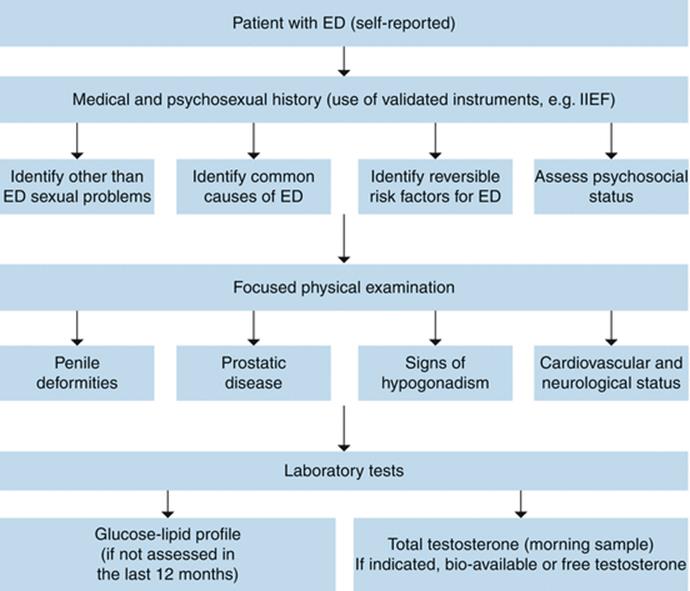
The diagnostic workup of ED patients consists not only of the identification of potential reversible causes for the ED but also includes an examination directed toward identifying underlying and comorbid conditions (diabetes, hypogonadism, prostatic diseases, and neurological or cardiovascular impairments) which should be treated separately.
Clinical Practice: Diagnostic Evaluation, Cardiovascular Risk Assessment
Patients who present with ED have a high prevalence of cardiovascular disease. ED precedes cardiovascular incidents by approximately 3 years and therefore the diagnosis of ED should trigger a cardiovascular risk assessment, which helps to triage those patients who need cardiologists’ evaluation before continuation of ED assessments and treatment.

Clinical Practice: Diagnostic Evaluation Summary
|
LE |
GR |
|
|
Clinical use of validated questionnaire related to ED may help to assess all sexual function domains and the effect of a specific treatment modality. |
3 |
B |
|
Physical examination is needed in the initial assessment of men with ED to identify underlying medical conditions that may be associated with ED. |
4 |
B |
|
Routine laboratory tests, including glucose-lipid profile and total testosterone, are required to identify and treat any reversible risk factors and lifestyle factors that can be modified. |
4 |
B |
|
Specific diagnostic tests are indicated by only a few conditions. |
4 |
B |
Clinical Practice: Treatment Summary
As a general rule of thumb, every patient presenting with ED can receive PDE5-inhibitors. Failure to respond to PDE5 inhibitors should trigger a discussion on correct use and further evaluation toward why this therapy is insufficient. Generally, vacuum devices, intracavernous injection therapy, and intraurethral applications of alprostadil either in pellet form or in cream form are second choices if there is no response to initial oral therapy or whenever there are contraindications for PDE5 inhibitors use. The issue of penile rehabilitation strategies after radical pelvic surgery is debatable and whether or not treatment should be given as soon as possible after surgery does, in the opinion of the authors, does not warrant a grade A recommendation. This will be further discussed in this chapter. An excellent review on this issue is included in the suggested reading section at the end of this chapter. Low-intensity focused linear shockwave therapy is shortly discussed in the guidelines but evidence is limited and therefore this option was not included in the general treatment recommendation table.
|
LE |
GR |
|
|
Lifestyle changes and risk factor modification must precede or accompany ED treatment. |
1a |
A |
|
Pro-erectile treatments have to be given at the earliest opportunity after RP. |
1b |
A |
|
When a curable cause of ED is found, it must be treated first. |
1b |
B |
|
PDE5Is are first-line therapy. |
1a |
A |
|
Inadequate/incorrect prescription and poor patient education are the main causes of a lack of response to PDE5Is. |
3 |
B |
|
A VED can be used in patients with a stable relationship. |
4 |
C |
|
Intracavernous injection is second-line therapy. |
1b |
B |
|
Penile implant is third-line therapy. |
4 |
C |
Background
Erectile dysfunction (ED) was defined by the NIH Consensus Development Panel on Impotence as the persistent inability to attain and maintain an erection sufficient for sexual intercourse. While premature ejaculation is probably the most prevalent, ED is without a doubt the most studied male sexual dysfunction and a highly prevalent sexual complaint in men presenting to their healthcare providers. Notwithstanding variations in definitions and methodology, various large-scale studies substantiate the high global prevalence of ED.
Epidemiology
The Massachusetts Male Aging Study (MMAS) is a prospective observational longitudinal study of health in randomly selected men. It investigates the effects of aging on male sexual health, among other domains. This landmark study reported a combined prevalence of minimal, moderate, and complete ED of no less than 52 % in US men. The prevalence of complete ED tripled from 5 to 15 % between subject ages 40 and 70 years. In the European Male Ageing Study (EMAS), a collaborative effort of eight European centers investigating the effects of aging on general and sexual health in a male population aged 40–79 with a mean age of 60 years old, about one-third of the entire EMAS sample reported ED. The prevalence of ED was higher in the older age groups, peaking at 64 % in men over 70 years of age. However, it appears from the results of the EMAS study that although patients in older age groups are more frequently affected by the disease, they tend to be less bothered with the presence of ED. With the rapidly expanding aging population and the increase in life expectancy, an increase in the prevalence of ED is expected in the years to come. It is estimated that in 10 years, about one in ten men of the worldwide population will be older than 65 years of age. By then, the number of men suffering from ED will reach 322 million worldwide.
Comorbid Conditions and ED as a Harbinger of Cardiovascular Disease
While ED does not pose direct threat to physical health, it can have dramatic effects on personal sense of well-being and has a significant impact on the quality of life of patients and their sexual partners. Besides this impact, ED is also an independent predictor of cardiovascular morbidity and mortality. It is frequently postulated that “the penis is the antenna of the heart,” and as such, the complaint of ED should always trigger further questioning and investigation to identify underlying cardiovascular disease or other comorbidities. These other comorbidities are often related to the cardiovascular risk profile and include diabetes mellitus, metabolic syndrome, and smoking. Iatrogenic ED is not uncommon and can be the result of pelvic surgical procedures or the use of various medications. Besides these underlying issues, it is of particular importance to the readers of this book to be aware that community-based, preclinical and clinical data demonstrate a strong and consistent association between LUTS and ED, suggesting that elderly men with LUTS should be evaluated for ED and vice versa. Therefore ED merits consideration from both the primary care physician and the specialist as an important health concern in se and as a potential sentinel for serious health conditions. In this chapter we will discuss the pathophysiology of erectile dysfunction in men and the essentials in ED evaluation and ED treatment.
Prerequisites for Normal Erections and Pathophysiology of ED
Sex drive is the initiator of penile erection, and therefore, intact libido, mood, and psychosocial circumstances are capital to normal erectile function. Penile erection requires neural transmission of pro-erectile impulses, being the efficacious delivery of the neurotransmitter nitric oxide (NO) to the smooth muscle in the corpus cavernosum. Furthermore, an intact arterial blood supply is key to supply the cavernous erectile tissue with oxygenated blood. The end organ, the corpus cavernosum, should be in good health, containing healthy smooth muscle and being elastic to successfully expand and compress the subtunical venous plexus during the rigid phase of erection. Lastly, hormonal balance should be in order as testosterone is a key mediator of libido but also keeps the peripheral effectors, such as cavernous smooth muscle and cavernous nerves, in good shape. ED can develop as result of a failure in one of these systems or, as is commonly the case, a multilevel failure. ED is typically defined as neurogenic, vasculogenic, hormonal, anatomical/structural, drug induced, or psychogenic. A summary of prevalent causes of ED is given in Table 12.1.
Table 12.1
Comorbid conditions and causes for ED
|
Vasculogenic |
Cardiovascular disease; atherosclerosis |
|
Hypertension |
|
|
Diabetes mellitus |
|
|
Hyperlipidaemia |
|
|
Smoking |
|
|
Major surgery (retroperitoneum) |
|
|
Radiotherapy (retroperitoneum) |
|
|
Neurogenic – central causes |
Multiple sclerosis |
|
Multiple atrophy |
|
|
Parkinson’s disease |
|
|
Tumours |
|
|
Stroke |
|
|
Intravertebral disk disease |
|
|
Spinal cord disorders |
|
|
Neurogenic – peripheral causes |
Diabetes mellitus |
|
Alcoholism |
|
|
Uremia |
|
|
Polyneuropathy |
|
|
Surgery (pelvis or retroperitoneum, radical prostatectomy) |
|
|
Anatomical/structural |
Peyronie’s disease |
|
Penile fibrosis (following pelvic radiotherapy or pelvic surgery) |
|
|
Penile trauma (penile fracture) |
|
|
Congenital curvature of the penis |
|
|
Micropenis |
|
|
Hypospadias, epispadias |
|
|
Hormonal |
Primary hypogonadism (e.g., late-onset hypogonadism) |
|
Secondary hypogonadism/hypogonadotrophic hypogonadism (e.g., hyperprolactinemia) |
|
|
Hyper- and hypothyroidism |
|
|
Cushing’s disease |
|
|
Drug or substance induced |
Antihypertensives (thiazides and beta-blockers are most common) |
|
Antidepressants |
|
|
Antipsychotics |
|
|
Antiandrogens |
|
|
Antihistamines |
|
|
Recreational drugs/smoking |
|
|
Psychogenic |
Generalized type (e.g., lack of arousability and disorders of sexual intimacy) |
|
Situational type (e.g., partner-related or performance-related issues or due to distress) |
Clinical Practice: Diagnosis
History Taking
ED is often multifactorial in origin and is therefore best managed with a holistic approach that includes lifestyle modification, pharmacological management, and importantly counseling of both the patient and his partner. It is of particular importance to encourage open and honest communication between the patient and his partner. All of the above are best facilitated in the context of a trusting patient/provider relationship. Therefore it is critical to establish a comfortable and confidential atmosphere when addressing issues in sexuality with patients. It can be recommended to display literature in the consultation – and waiting rooms indicating a private and nonjudgmental approach toward sexual dysfunctions and more specifically ED. Cultural and ethical beliefs can be a hurdle in communication on sexual functioning and this should be taken into account when evaluating the ED patient.
The initial evaluation of ED should include a complete medical, psychosocial, and sexual history. A thorough medical assessment is mandatory in the evaluation of erectile complaints, with the aim of identifying comorbid or underlying diseases.
Cardiovascular Disease
In the Princeton III consensus, a leading document on the relationship between ED and cardiovascular disease, it is stated that:
· ED not only shares risk factors with cardiovascular disease but also is, in itself, an independent marker of increased cardiovascular risk (ACCF/AHA class Ia).
· ED is a marker of significantly increased risk of cardiovascular disease, coronary artery disease, stroke, and all-cause mortality.
Incident ED was found to be an independent marker of cardiovascular events (1.5× relative risk) and all-cause mortality (1.2× relative risk) additional to conventional risk factors (e.g., age, weight, hypertension, diabetes, hyperlipidemia, and cigarette smoking). Since ED commonly occurs in the presence of silent CAD, the complaint of ED should always trigger further questioning and clinical examinations aimed at the identification of underlying cardiovascular disease. Typically, a time window between ED onset and the occurrence of a coronary artery disease event is 2–5 years (class Ia); thus ED provides an excellent opportunity for cardiovascular risk reduction. It is thus evident that the ED patient is entitled to a thorough analysis of classical cardiovascular risk factors such as smoking, dyslipidemia, hypertension, and a positive family history for cardiovascular events. A cardiovascular anamnesis allows stratification of patients in low-cardiovascular-risk, intermediate-risk, and high-risk group and to identify those who need a cardiologist’s evaluation before resuming sexual activity (see the flow diagram in “what do the guidelines say”). Cardiovascular conditions and their risk categories are detailed in Table 12.2.
Table 12.2
Cardiovascular risk assessment in ED patients
|
Low-risk category |
Intermediate-risk category |
High-risk category |
|
Asymptomatic, <3 risk factors for CAD (excluding sex) |
≥3 risk factors for CAD (excluding sex) |
High-risk arrhythmias |
|
Mild, stable angina (evaluated and/or being treated) |
Moderate, stable angina |
Unstable or refractory angina |
|
Uncomplicated previous MI |
Recent MI (>2, <6 weeks) |
Recent MI (<2 weeks) |
|
LVD/CHF (NYHA class I) |
LVD/CHF (NYHA class II) |
LVD/CHF (NYHA class III/IV) |
|
Post-successful coronary revascularisation |
Non-cardiac sequelae of atherosclerotic disease (e.g., stroke, peripheral vascular disease) |
Hypertrophic obstructive and other cardiomyopathies |
|
Controlled hypertension |
Uncontrolled hypertension |
|
|
Mild valvular disease |
Moderate-to-severe valvular disease |
CAD coronary artery disease, CHF congestive heart failure, LVD left ventricular dysfunction, MI myocardial infarction, NYHA New York Heart Association
Other Comorbidities
A detailed history taking on overall health status and general well-being can provide clues for the presence of conditions concurrent with, and contributing to, ED. More specifically, signs and symptoms of possible underlying conditions such as depression, diabetes, late-onset hypogonadism, metabolic syndrome, and medication/surgically induced causes of ED should be assessed. Furthermore, since there is a clear relationship between LUTS and ED, an assessment of voiding function can be offered to patients presenting with ED. This can either or not be done with a questionnaire such as the international prostate symptom score (IPSS), as detailed elsewhere in this book. Information about the association between ED and tobacco use can be an important tool in helping patients decide to quit use of tobacco products. A thorough review of current medications may reveal agents that are known to cause or exacerbate ED (e.g., antidepressants, antiandrogens, thiazides, and β-blockers). It is also important to assess for use of nitrate donors, which are absolute contraindications for therapy with phosphodiesterase-5 (PDE5) inhibitors. The goal of history taking should not only be to understand the specific erectile condition but to also identify possible reversible or treatable underlying disorders.
Sexual History Taking and Questionnaires
An adequate sexual history should include information about current sexual relationships, the emotional status of the patient and the partner, and the exact nature of the particular sexual concerns unique to the couple. Issues of sexual orientation and gender identity should also be noted. Descriptive measures such as rigidity and duration of nocturnal erections, erections during masturbation, and erections following sexual arousal should be discussed, as they can give clues about the etiology of ED. The onset of the problem and any situational factors that ameliorate or exacerbate ED should be determined. In this regard, situational ED, sudden-onset ED, the persistent presence of nocturnal erections, and good erectile function during masturbation hint toward an important psychogenic component of the ED, whereas non-situational ED, ED with gradual onset, and loss of naturally occurring nocturnal erections are strong clues for a predominantly organic cause of the disease. Since a psychogenic component – such as performance anxiety – often superposes onto an organic cause, the distinction in real-life clinical practice may not always be this clear. Problems with arousal, ejaculation, and difficulty reaching orgasm should be discussed since these may be signs of concomitant sexual dysfunctions such as premature and retarded ejaculation or anejaculation and/or hypogonadism. The impact of ED and other sexual dysfunctions on both general well-being and sexual satisfaction should be discussed, as well as issues of partner interest in and satisfaction with sex. It is imperative that the healthcare provider taking the sexual history displays a nonjudgmental and open attitude toward the patient and his partner.
The use of validated questionnaires such as the International Index of Erectile Function (IIEF) can be useful as an “icebreaker” to initiate the conversation about ED. Numeric scores obtained from instruments such as this may also be helpful in assessing the severity of ED, in screening for other sexual dysfunctions, and in evaluating treatment outcome. These metrics, however, should not be regarded as a replacement for direct assessment of sexual history. The IIEF was developed by Raymond Rosen and coworkers and consists of 15 questions and is likely the most widely used self-reported inventory to provide a standardized measure of erectile function and assesses five separate domains at different stages of the male sexual response cycle: sexual desire (2), erectile function (6), orgasmic function (2), intercourse satisfaction (3) and overall satisfaction (2). The IIEF score was shown to have strong internal consistency and adequate test-retest reliability. A five-item short form of the IIEF has been developed and validated along with a diagnostic classification into ED severity scales. This short form, also called the Sexual Health Inventory for Men (SHIM), or the IIEF-5, provides a rapid solution for standardizing ED severity assessment in daily clinical practice.
Clinical Examination
General Considerations Before Starting Clinical Examination
For many patients a first sexual clinical examination can be experienced as embarrassing and confronting, whereas others see it as a potential reassurance and relief. Therefore it is important to perform the exam in the most comfortable setting possible. This will not only lead to more comfort for the patient but will also yield more consistent and reliable clinical findings. Think about how stress augments the adrenergic tonus and can confound clinical examination for ED, especially in young men with a psychogenic factor. Explaining to patients upfront the course of the examination is important, as well as stressing how this will help to find a diagnosis and eventual treatment. If the patient is too stressed and unable to relax, deferring the examination is a good option. So when doing a sexual physical examination, it should, again, be performed in a quiet environment with the necessary attention for the concerns of the patient toward the exam.
Physical Examination in the ED Patient
General Non-genital Exam
The physical exam starts with a brief overall health assessment. This should include length and weight measurement to calculate body mass index (BMI) (kg/m2). Waist circumference can serve as an alternative to counsel patients on risk of obesity and metabolic syndrome. Inquiring about pants size can easily follow this up. Blood pressure and heart rate must be measured if they have not been assessed in the previous 3–6 months. Palpation of peripheral pulsations and carotid auscultation can be performed. Physical proportions, pubic and general hair growth, pitch of the voice, and presence of gynaecomastia are assessed.
Neurologic Exam and Spinal Cord Reflexes
Tactile and pinprick sensation in the perineal and lower limb dermatomes can be assessed. Different reflexes can be tested to evaluate the integrity of the spinal cord when abnormalities are suspected but this is not advised routinely. The perianal reflex or anal wink is the reflexive contraction of the external anal sphincter upon stroking the skin around the anus (S2–S4). The bulbocavernosus reflex consists of (firmly) squeezing the glans penis, resulting in the contraction of the bulbocavernous muscle located between the scrotum and anal sphincter (S2–S3). This reflex can be provoked in 70 % of healthy men, but the general validity of the bulbocavernous reflex has been challenged. By the same maneuver the bulbo-anal reflex can be assessed when squeezing the glans provokes a contraction of the anal sphincter (S3–S4).
Genital Exam
Penis
The penis should be checked for abnormalities. Flaccid penile size is variable but ranges from 5 to 10 cm. There is no standardized technique for measuring penile length but there appears to be consensus that penile length should be measured on the dorsum of the penis. A good technique has been described by Wessells where the patient is evaluated in supine position. The glans is grasped and pulled to full stretch at 90° from the plane of the body. A rigid ruler can be used to press down on the fat pad to the pubic bone, and then the penis is measured dorsally to the corona or meatus depending on physician preference. The penis may seem smaller in obese men because it is partially buried in the prepubic fat (buried penis). A very short penis or micropenis can be seen in a number of genetic disorders with hypogonadotropic/hypergonadotropic hypogonadism or androgen resistance, e.g., Klinefelter and Kallmann syndromes. The glans should be inspected for any scars, ulcers, nodules, or sign of inflammation (balanitis). To inspect for urethral discharge, open the meatus by compressing the glans gently between index finger and thumb. The foreskin should be checked for phimosis, a condition in which the foreskin cannot be retracted over the glans. Sometimes a short frenulum (frenulum breve) is observed that can be bothersome for adolescents during intercourse and causes a ventral deviation of the glans in erect state. The penis should be palpated to detect fibrous plaques lying under the skin that indicate Peyronie’s disease. In most cases they can be found on the dorsum of the penis and are accompanied with a curvature during erection. Correct assessment of penile curvature can only be done during the rigid phase of erections. This implies that the physician either injects the penis with a vasoactive drug like alprostadil in the office or relies on pictures taken by the patient at home. While photographic images of the erect patients are most often sufficient, the examination of a pharmacological-induced erection can be helpful in the planning of (complex) surgery or for the detection of venous leak by duplex ultrasound.
Testes
Bilateral positioning of normal-sized testis in the scrotum should be confirmed. If one or more testes are absent, the patient has maldescended testis or cryptorchidism. In 90 % of the cases, the undescended testis can be palpated in the inguinal canal. Sometimes it can be difficult to distinguish an undescended testis from a retractile testis. In the latter case the normal testis is normally developed but is pulled up by the cremasteric reflex during clinical examination. Retractile testes are more common than truly undescended testes and do not require operation. These problems, however, are rarely primarily found in adult life. A normal testicular volume is between 12–20 ml and can be measured using an orchidometer or ultrasound. Small, firm testes can be found in Klinefelter syndrome. The testis should be palpated to look for nodules or masses. A painless testicular swelling can constitute of a hydrocele that is typically clear on transillumination.
Digital Rectal Exam
There is a strong relationship between LUTS due to BPH and sexual dysfunction. Therefore, it is suggested that men with LUTS should be evaluated for SD and vice versa. Furthermore it is not uncommon for medical treatment for BPH to cause ED, ejaculatory dysfunction, and sexual desire impairment. A rectal examination should be performed in every patient older than 40 years. Furthermore digital rectal examination is advised in all men who may be possible candidates for testosterone replacement therapy. DRE can assess the form and size of the prostate that is enlarged in BPH. The presence of noduli or a firm irregular zone warrants further investigations for prostate cancer.
Physical Exam in Patients with Suspected Hypoganidsm
The signs and symptoms of hypogonadism vary depending on age of onset, duration, and severity of testosterone deficiency. Prenatal or prepubertal onset leads to delayed or incomplete sexual development and absence of secondary sex characteristics: small genitalia, failure to achieve muscle mass in spite of vigorous exercise, lack of a beard, and failure of the voice to deepen. Furthermore an eunuchoid proportion can be seen in prepubertal hypogonadism; the lower body segment (floor to pubis) is more than 2 cm longer than upper body segment (pubis to crown) and the arm span is more than 5 cm longer than height. In adolescents the development of appropriate sexual maturation according to age can be assessed by the Tanner scale. Patients with Klinefelter syndrome typically have small firm testes. In patients with postpubertal onset, clinical examination reveals a loss of pubic and axillary hair growth, a decreased muscle mass and increased waist circumference, gynecomastia, and small or shrunken testes. Hyperprolectinemia due to a prolactinoma of the pituitary gland can be accompanied by galactorrhoea or visual field defects (bitemporal hemianopsia) in rare cases.
Laboratory Testing
Recommended laboratory tests include a complete blood count and measurements of fasting serum glucose, a lipid profile, and free and total testosterone, particularly in patients with signs of hypogonadism. Additional hormonal testing is only required when low testosterone levels are detected. Baseline PSA screening is advised in patients over 40 years of age or when ED is accompanied by lower urinary tract symptoms.
Specific Diagnostic Testing
Radiological testing, nocturnal penile rigidity testing, vascular and neurological functional testing, and penile Doppler ultrasound are available for further diagnostic workup of ED. These tests are not routinely indicated in the primary care setting but may be ordered by urologists or sexual medicine specialists in certain cases. Specifically in young men with primary ED, history-specific investigations such as intracavernosal injection of vasoactive drugs with color Doppler or duplex of the penile arteries may be helpful to rule out vascular etiology of ED, which may be correctable. Furthermore, color Doppler ultrasound and duplex sonography may assist in diagnosing venous leakage in specific clinical situations. Nocturnal penile tumescence (NPT) measurements have been used in the differential diagnosis of organic ED vs. psychogenic ED but nowadays have no role in the routine evaluation of ED.
Clinical Practice: Treatment
General Considerations before Starting Pharmacological Treatment
Both the patient’s and partner’s understanding of ED and results of the diagnostic tests should be reviewed before treatment is initiated so that a rational selection of treatment options and expectations can be provided. Current pharmacological treatments for ED do not “cure” ED but can generally be relied upon to greatly improve erectile function. Setting realistic treatment goals and granting permission and legitimacy to alternative means of sexual intimacy that do not rely on penetrative sexual intercourse should be a goal of therapy. Few ED patients will be able to regain full medically unassisted potency, but most should be able to experience restoration of satisfying sexual encounters, either with or without the use of pharmacotherapy.
Underlying reversible conditions (obesity, medical comorbidities, relationship issues) should be addressed and treated before or simultaneously with initiating specific ED-directed treatment. Lifestyle changes such as exercise and smoking cessation should be suggested where applicable. Referral to exercise physiologists, nutritionists, or personal trainers may be of some benefit in these situations. For the treatment algorithm in the EAU guidelines, please see the section “what do the guidelines say.”
Pharmacological Treatment: Phosphodiesterase Type 5 Inhibitors
PDE5-specific inhibitors (PDE5-inhibitors) are nonhydrolyzable analogs of cGMP and exert their beneficial effects on smooth muscle relaxation by binding and blocking the catalytic site of this enzyme. By inhibiting the degradation of cGMP, these drugs produce an intracellular accumulation of cGMP in smooth muscle cells lining the walls of the arteries and arterioles perfusing the spongy tissue in the corpus cavernosum, resulting in relaxation of these smooth muscle cells, increased blood flow, and penile tumescence only when there is a release of endogenous NO or, in other words, only during sexual stimulation or arousal.
In current treatment guidelines, PDE5-inhibitors are recommended as the preferred first-line pharmacotherapy for ED. Several trials have established on-demand efficacy rates of 60–70 % in the general population, and postmarketing data confirms excellent safety profiles of the four compounds currently available (sildenafil, vardenafil, tadalafil, and avanafil). The currently available drugs differ from each other in time to onset of action and duration of action (sildenafil and vardenafil up to 5 h, avanafil somewhat longer and with a rapid onset of action, and tadalafil up to 24–36 h). The choice of appropriate drug is based on patient and partner preference guided by physician advice.
Before initiation of treatment, patients should be informed that sexual stimulation is essential for the efficacy of the drugs. The most common reason for PDE5-inhibitor failure is incorrect usage and therefore this information can change the outcome of the therapy. In general, it is recommended to start with the highest dose available and lower the dose according to effects and side effects. The unique pharmacokinetic properties of tadalafil have led to the approval of this drug as a daily treatment for ED at 2.5- and 5-mg doses; this regimen may be best for patients who have frequent intercourse or those who desire to separate the act of taking the drug from sexual interactions. Furthermore, as detailed below, men with concomitant LUTS and ED are good candidates for daily dosing of PDE5-inhibitors as there is a good effect of these drugs on both complaints.
Phosphodiesterase 5 inhibitors are relatively contraindicated in patients with unstable angina pectoris, recent myocardial infarction, certain arrhythmias, and poorly controlled hypertension. As stated above, according to the Princeton III consencus, these patients should undergo cardiovascular examination and treatment for their heart-related condition before initiating ED treatment. Furthermore, patients treated with nitrates or nitrate donors should not take PDE5Is, and use of PDE5Is with certain α-blockers may result in postural hypotension.
The most common adverse events from PDE5 inhibitors include headache, facial and ocular hyperemia, nasal congestion, myalgia, dyspepsia, and back pain. Congestion and flushing are more common with sildenafil relative to the other PDE5 inhibitors, whereas myalgias and dyspepsia are more strongly associated with tadalafil and vardenafil, respectively.
Of the patients who do not experience an initial response to PDE5 inhibitors, a large proportion may be converted to responders through counselling on proper dosing technique and through dose escalation. Some others can be converted to responders by switching from an on-demand dosing to the daily regimen. Since the efficacy of PDE5 inhibitors depends on the integrity of the NO pathway and the endogenous bioavailability of NO, patients in whom this pathway is disturbed will benefit far less from PDE5 inhibitors compared with the “general” ED population. Disease states that diminish NO availability include denervation of the erectile tissue after radical prostatectomy, severe diabetes, and downregulation of NOS expression, as may be seen in atherosclerosis, metabolic syndrome, aging, and hypogonadism.
Pharmacological Treatment: Intracavernous Injection of Vasodilating Compounds
Before the advent of PDE5Is, intracavernous and intraurethral administration were the only nonsurgical treatment options for ED. Prostaglandin E1 or alprostadil is the most commonly used compound and exerts its effects independent of the NO-cGMP pathway, making this treatment an excellent option for patients who do not experience response to PDE5 inhibition. Intracavernous PGE1 therapy has relatively high rates of satisfaction if the patient is well counselled and knows what to expect. Papaverine is also available for intracavernous injection, although its role is limited to combination therapy (commonly referred to as bimix or trimix). Similarly, vasoactive intestinal polypeptide and phentolamine are, either or not combined, available in some countries for intracavernous injection therapy. Alprostadil is also available for intraurethral administration as a pellet (medicated urethral system for erection [MUSE]) and is currently being launched in cream to be applied in the urethral meatus.
Adverse events from these therapies include priapism, variable degrees of pain with injection in approximately half of patients, and penile fibrosis after long-term use. Each drug has their own adverse event profile, and therefore the drug of choice is tailored to the patient’s and physician’s preference and experience. A healthcare provider should be present to instruct patients on the proper technique of intracavernous drug administration, to determine an effective dose, and to monitor patients for side effects, especially prolonged erection. Patients are advised to consult their physician if they experience prolonged penile pain or an erection lasting up to or more than 4 h, because aspiration of cavernous blood may be necessary for penile decompression. Patient education and timely follow-up will likely decrease the occurrence of improper injection and treatment failure. Relative contraindications to injection therapy include a history of priapism or bleeding disorders. Before initiation of therapy, patients follow a short in-office training program. MUSE and meatal application of PGE1 cream have side effects in common with intracavernous PGE1, although they are less likely to cause priapism and may have marginal efficacy in many cases. Topical application of PGE1 and MUSE are both associated with urethral burning or pain and vaginal irritation in the partner, and condom use can therefore be considered.
The Vacuum Erection Device
For some patients this may be a primary option, for example, those not willing to use drugs or those who have contraindications. It is also a good option for patients who suffer from veno-occlusive dysfunction, who may not benefit from PDE5 inhibitors or injection therapy. This device creates negative pressure around the penis, thereby initiating passive engorgement of the sinusoidal spaces and creating an erection. Maintenance of erection is facilitated by application of a rubber cuff worn around the base of the penis. Although effective in up to 90 % of patients, the resulting cold and congested penile erection renders this option unattractive to many, especially younger patients. Some patients will prefer the purchase of the VED as this is a one-time investment, whereas this is not the case for pharmacological treatments. Side effects are relatively minor and include bruising, some discomfort, and ejaculatory obstruction. It is advised to limit the use of the constriction band to 30 min to avoid skin necrosis.
Surgery
Implantation of a penile prosthesis, which can be either inflatable or malleable, is indicated for men in whom pharmacologic therapy is not effective. Noninflatable penile prostheses have the advantages of lower cost, better mechanical reliability, and ease of use by the patient. On the other hand, inflatable devices resemble best the natural states of flaccidity and erection. Patient education about inflation and deflation techniques is not necessary. The surgical technique is quite straightforward and an absolute antiseptic approach is imperative. Implantation of a penile prosthesis has satisfaction rates of 70–90 %, but patients should be aware of the definitive and irreversible nature of this surgery; that is, when the patients is not satisfied or complications occur, after removal of the device, other therapeutic options are not effective anymore. Adverse events include mechanical failure after several years of use, 6–16 % at 5 years (depending on the type of device) and up to 50 % after a 10-year interval, infection (1–3 %), and, rarely, erosion. Patients should be aware that penile shortening is not uncommon. For the prevention of adverse outcomes, perioperative prevention of infections is key; therefore the patient should be free of urinary tract infection, and he should have no infections elsewhere. Wounds, cutaneous lesions, and dermatitis in the operative field should be healed before surgery, and antibiotics providing Gram-negative and Gram-positive coverage should be administered preoperatively and continued for 24–48 h postoperatively. Shaving and skin preparation is done immediately before surgery and a no-touch technique can be employed.
Other surgical options available for ED include penile revascularization and venous ligation. Outcomes of these surgeries in the general population of patients with ED are poor. These surgeries should be reserved for a select group of primarily young patients and should be performed in specialized centers only.
Specific Treatment Situations
Lower Urinary Tract Symptoms and ED
A strong and independent association between LUTS suggestive of BPH and ED has been widely evidenced in several clinical epidemiologic studies. They share pathophysiological mechanisms which may include microvascular disease impairing the function of pelvic innervation, (macro)vascular disease inducing chronic pelvic ischemia, increased andrenergic tonus, and decreased NO signalling. Although the efficacy of the most commonly used treatments for LUTS/BPH is well defined, the negative impact of these treatments on sexual function – in particular, on ED – has triggered the search for new treatment options. Tadalafil is now the most extensively investigated PDE5 inhibitor which has proven efficacy both on LUTS and ED, when administered in a daily fashion, in men displaying both these complaints. It is now recommended in the EAU guidelines that this option is to be considered in this specific patient population.
Premature Ejaculation and ED
It has been postulated by the expert panel on PE treatment of the international society for sexual medicine (ISSM) that in PE developing secondary to other conditions, the underlying condition should be treated first. Therefore, in patients who suffer from both these male sexual dysfunctions, ED should be treated first and then the effect on PE should be reevaluated.
Peyronie’s Disease and ED
When a penile plaque or curvature is diagnosed during the workup of ED, both conditions should be thoroughly discussed with the patient. In essence, ED is a problem associated with Peyronie’s disease and all typical treatment options for ED are acceptable. The efficacy of PDE5 inhibitors in Peyronie’s disease patients seems to be similar to that in “general” ED patients. Two phases of the disease can be distinguished. The first is the acute inflammatory phase, which may be associated with pain. The second is the fibrotic phase, identified by formation of hard palpable plaques that can be calcified, which results in disease stabilization. With time, penile curvature is expected to worsen in 30–50 % of patients or stabilize in 47–67 % of patients. Spontaneous improvement has been reported by only 3–13 % of patients and is more likely early in the disease. Pain tends to resolve with time in 90 % of men, usually during the first 12 months after disease onset. In the acute phase, no oral or local therapies are recommended as the results of the studies on conservative treatment for Peyronie’s disease are often contradictory because of several methodological problems that make it difficult to provide recommendations in everyday real life. In spite of this, many different treatments such as oral vitamin E and Pentoxifylline are used in everyday clinical practice. Daily dosing of PDE5 inhibitors has been shown in small unpublished series to have a beneficial effect both on ED and on PD severity and curvature. Results of studies in larger peer-reviewed series are awaited before any definitive conclusions can be made on this treatment. The role of conservative (nonsurgical) treatment in men with stable/chronic disease has not yet been adequately defined. Recently, local injection of collagenase, combined with manipulation of the plaque, has shown benefit in large-scale phase 2 and 3 trials which has led to the recent approval of collagenase for the treatment of Peyronie’s disease both in Europe and the USA. Other options include surgical options, which include tunical plication procedures, Nesbitt’s procedure, and plaque incision or excision and grafting. Grafting procedures have been associated with worsening of ED, and therefore, concurrent placement of an inflatable penile prosthesis should be considered in the patient with severe Peyronie’s disease curvature and ED. The main indication for surgery is Peyronie’s disease in which the curvature hinders sexual intercourse.
ED Following Radical Pelvic Surgery (Radical Prostatectomy)
(Temporary) denervation of the smooth muscle and endothelium in the penis is believed to have detrimental effects on the quality of the erectile tissues via the loss of spontaneous nocturnal and sexual activity-induced diurnal erectile activity. This renders the penis in a continuous flaccid state and exposes the tissues in the corpus cavernosum to a chronic state of relative hypoxia. This relative hypoxia is believed to result in apoptosis of endothelium and smooth muscle and subsequently fibrosis by activation of pro-fibrotic cytokines such as transforming growth factor beta. The concept of “penile rehabilitation” following radical prostatectomy was invented by Montorsi and colleagues and describes the theoretical benefits of penile oxygenation at regular intervals. Initially, a trial showed benefit of 3× weekly dosages of intracavernous vasoactive substances on recovery of spontaneous erectile function in a small cohort of patients. Initial studies testing the same concept with regular (daily) dosing of PDE5 inhibitors were positive on the effects of orally administered penile rehabilitation therapy, but the conclusions of these studies have to be interpreted with caution as a result of methodological flaws. Later, two large-scale randomized, double-blind, double-dummy designed studies comparing daily dosing with tadalafil of vardenafil with dosing on demand showed no beneficial effects of regular dosing, and primary endpoints of these studies were not reached. Thus, despite many well-designed studies attempting to demonstrate efficacy of rehabilitative approaches, there currently is not enough evidence to incorporate it into the standard of care in the post-prostatectomy patient to rehabilitate erectile function. On the other hand, no significant harm of rehabilitation has been demonstrated provided the patients understand the side effects and costs of the proposed treatment. It is generally assumed that penile rehabilitation should be initiated early after the surgery, and therefore it is essential to discuss the option of a penile rehabilitation regimen with the patient prior to the surgery. As there is no clear benefit of one strategy over another, it is up to the discretion of the patient, supported by objective information provided by the surgeon, what rehabilitation strategy is most appropriate in each individual situation. In addition, we do believe that appropriate counselling and sexual rehabilitation is essential after pelvic surgeries resulting in ED. However this “sexual rehabilitation” should consider not only penile rehabilitation (if desired) but also psychosexual counselling and guidance for the couple to get their sex life back on track, being it either or not with the use of penetrative sex.
Points of Interest
· ED is a prevalent condition and the most common sexual complaint in men consulting their healthcare provider.
· ED is related to various comorbid conditions including diabetes, hypogonadism, prostatic diseases, and neurological and cardiovascular impairments.
· ED is the antenna of the heart: ED precedes cardiovascular incidents by approximately 3 years. Therefore, every ED patient should get a cardiovascular risk assessment and, if necessary, a referral to the cardiologist for further examination.
· Evaluation of the ED patient should be holistic and include the partner. Primary focus is the symptom of ED but also identification of underlying diseases if present.
· Treatment of the ED patient starts with counseling and setting realistic expectations.
· A trial with phosphodiesterase type 5 inhibitors is the first choice in most patients and should be preceded by a discussion on correct usage and the need for sexual stimulation in order to have an effect.
· Second- and third-line options are intracavernous and intraurethral administration of vasoactive substances and implantation of a penile prosthesis.
· Primary ED, ED post-radical prostatectomy, ED in Peyronie’s disease, ED in patients with premature ejaculation, and ED in patients with lower urinary tract symptoms need specific adaptations in diagnostic and therapeutic approach.
Further Reading
Albersen M, et al. The future is today: emerging drugs for the treatment of erectile dysfunction. Expert Opin Emerg Drugs. 2010;15(3):467–80. A review on what to expect from the future therapies for ED.
Corona G, et al. EMAS Study Group. Age-related changes in general and sexual health in middle-aged and older men: results from the European Male Ageing Study (EMAS). J Sex Med. 2010;7(4 Pt 1):1362–80. One of the capital studies on the epidemiology of ED.
Fode M, et al. Penile rehabilitation after radical prostatectomy: what the evidence really says. BJU Int. 2013;112(7):998–1008. Mikkel Fode and coworkers critically revise the evidence for post-prostatectomy penile rehabilitation and conclude that better documentation for current penile rehabilitation and/or better rehabilitation protocols are needed: “One must be careful not to repeat the statement that penile rehabilitation improves erectile function after RP so many times that it becomes a truth even without the proper scientific backing.”
Lue TF. Erectile dysfunction. N Engl J Med. 2000;342(24):1802–13. Excellent review on all aspects of ED by one of the pioneers of ED research.
Nehra A, et al. The Princeton III Consensus recommendations for the management of erectile dysfunction and cardiovascular disease. Mayo Clin Proc. 2012;87(8):766–78. The Princeton III consensus: first emphasizing the use of exercise ability and stress testing to ensure that each man's cardiovascular health is consistent with the physical demands of sexual activity before prescribing treatment for ED, and second highlighting the link between ED and CVD, which may be asymptomatic and may benefit from cardiovascular risk reduction.