
Q. How common are UTIs in children?
A. During childhood, UTI occurs in about 3%-5% of girls and 1% of boys. The incidence of UTIs is higher in boys than girls in the first year. Uncircumcised males less than 1 year old are more likely to be affected than circumcised males. After 1 year of age, UTIs in females are more common.
Q. A 9-month-old boy presents with pyrexia and vomiting. He is very unwell. What microbiology specimens would you like collected?
A. Airway, breathing, circulation (ABC) and general assessment, including examination of the spine is done. A clean catch urine specimen is the most important. He would also need blood cultures taken.
Note: A clean catch urine sample means that the urethral meatus should be clean, and if possible urine collected should be from the middle of the stream. For girls, cleaning involves separating the labia and cleaning the area. For circumcised boys, the glans of the penis should be cleaned. For uncircumcised boys the foreskin is gently retracted (where possible) prior to cleaning. After cleaning, the child voids, with the parent ‘catching’ the urine in a clean specimen container after the first few drops are passed. In those who can void on command, the child can void over the toilet and a clean catch mid-stream voided urine specimen may be easily obtained. Although obtaining clean catch samples can be time consuming and messy, this technique has a high sensitivity and specificity for diagnosing UTIs.
Q. The urine of the infant discussed previously shows >500 white cells, CRP is 84. He responds to intravenous (IV) fluids and antibiotics. Is his infection typical?
A. According to the 2007 National Institute for Health and Care Excellence (NICE) guidelines on the management of UTI [5], an atypical UTI is one where any of the following apply:
Seriously ill
Poor urine flow
Abdominal or bladder mass
Raised creatinine
Septicaemia
Failure to respond to treatment with suitable antibiotics within 48 hours
Infection with non-E. coli organisms
By this definition the infant has an atypical urinary tract infection.
Q. What imaging is helpful?
A. A USS of the renal tract.
Q. The USS shows a large thick-walled bladder. On direct question his mother admits that he has always had a rather ‘dribbley’ stream. What conditions are you concerned about?
A. The possibilities are of bladder outlet obstruction (especially posterior urethral valves) or a neuropathic bladder.
Q. Is any more renal tract imaging appropriate?
A. According to the NICE guidelines [5], DMSA scan is the only other investigation required in someone who is between 6 months and 3 years of age with an atypical urinary infection. However, in those with a worrying history and an abnormal ultrasound further investigations may also be appropriate. The diagnostic test for PUVs is an MCUG, which must include good views of the urethra during voiding.
Me NICE guidelines on radiological imaging in children with UTIs are summarised in Table 6.2.
Table 6.2 Guidelines for imaging in paediatric UTI (adapted from NICE guidelines 2007)
|
UTI |
Age |
USS in acute infection |
USS in 6/52 |
DMSA in 4-6/12 |
MCUG* |
|
Responds well to antibiotics in <48 hours |
<6 months |
Yes |
|||
|
Responds well to antibiotics in <48 hours |
6 months - 3 years |
||||
|
Responds well to antibiotics in <48 hours |
>3 years |
||||
|
Atypical UTI |
<6 months |
Yes |
Yes |
Yes |
|
|
Atypical UTI |
6 months - 3 years |
Yes |
Yes |
Consider** |
|
|
Atypical UTI |
>3 years |
Yes |
|||
|
Recurrent UTI |
<6 months |
Yes |
Yes |
Yes |
|
|
Recurrent UTI |
6 months - 3 years |
Yes |
Yes |
Consider** |
|
|
Recurrent UTI |
>3 years |
Yes |
Yes |
* Some centres may prefer MAG3 (mercaptoacetyltriglycine) renogram with indirect cystogram in cases suspected to have vesicoureteric reflux.
** Consider MCUG if dilatation on ultrasound, poor urine flow, non-E. coii infection, family history of VUR
Q. A 7-month-old girl presents with pyelonephritis. She is admitted under the paediatricians and responds well to antibiotics. She has a USS before discharge which shows unilateral hydroureteronephrosis. What are the possible causes of unilateral hydroureteronephrosis?
A. An isolated hydroureteronephrosis raises the possibility of VUR, VUJ obstruction or megaureter.
Q. An MCUG has been organised by the paediatric team. me mother would like to know a little more about the test before it is performed. What would you tell her?
A. me test carries a risk of provoking a further UTI, so it should be covered with a short course of treatment dose antibiotics (e.g. trimethoprim).
Me test is performed in the radiology department by the radiology doctors and will involve exposure to x-rays. me girl will be catheterised urethrally. Contrast material, ‘a special dye that shows on x-ray’, is then injected into the bladder and x-rays are taken.
At the end of the test the catheter is taken out, and further x-rays taken as she urinates.
Me thing that most parents, and patients, dislike about the test is the catheterisation. Above the age of 1 year it becomes much more difficult to catheterise the child as the child will struggle more. An MCUG is not a test that should be requested lightly.
Q. ’the mother is very interested by what you say. me girl’s aunt has also attended the consultation, but is not as convinced. The aunt, who is an adult, had pyelonephritis last year and objects that no one made all of this fuss with her infection. Why is pyelonephritis in paediatrics taken so seriously?
A. Investigation of pyelonephritis in the past has had a high yield for detecting problems, with up to 30% of children having a significant underlying renal tract anomaly.
Pyelonephritis in infants is important. During the acute episode it carries its own morbidity. Additionally, following the acute episode, pyelonephritis may result in:
Scarring - Young kidneys are susceptible to damage from the combination of intra-renal reflux and infection. It is unusual for scarring to result in renal impairment unless this is extensive and severe. The importance of scarring is that it carries a significant long-term risk of hypertension.
Recurrence - Up to one-fifth of children with pyelonephritis will have a recurrence within a year.
Note: There was a concern that a significant proportion of children with end-stage renal disease were thought to have got there because of VUR with associated UTI. It is now thought that this may have been an overestimation, where children, born with poor dysplastic kidneys, were extensively investigated and a bit of VUR identified as the only culprit. It is also being recognised that many children more recently had been overinvestigated with a lower yield of significant pathology. These are perhaps the motivations behind the current NICE guidelines on the investigation of UTI.
Q. The MCUG is performed as shown in Figure 6.5. Describe the findings.

Figure 6.5 Micturating cystourethrogram in infant girl.
A. Bilateral vesico-ureteric reflux with at least moderate ureteric and pelvi-calyceal dilatation. Q. What functional imaging would be useful?
A. A DMSA scan would be very useful. Acutely during the infective episode it will show cortical defects and confirm a diagnosis if it is in doubt; although it is not often used for this indication. After the pyelonephritis has been treated it will show areas of permanent injury or scarring if performed 4-6 months afterwards (in addition to providing relative renal function).
Q. Her DMSA scan is shown in Figure 6.6. What does it show?
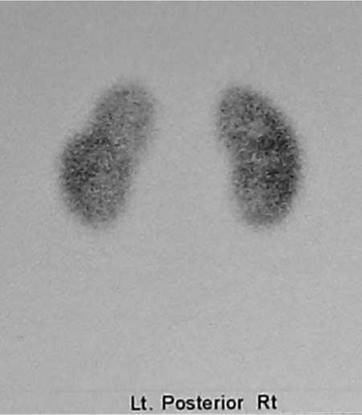
Figure 6.< A DMSA scan in infant girl.
A. ttere is a cortical defect in the mid to upper pole of the left kidney. Whether it is a scar depends on whether there has been a sufficient interval since the pyelonephritis; ideally at least 6 months.
Q. What is secondary reflux?
A. It is where the reflux is due to another clearly defined pathology, e.g. posterior urethral valves or neuropathic bladder. In secondary reflux treatment is targeted at the underlying condition.
Q. What is the International Reflux Study Committee grading of primary VUR and the rates of spontaneous resolution?
A. This grading is based upon the extent of retrograde filling and dilatation of the ureter, the renal pelvis and the calyces on a MCUG and is shown in Table 6.3.
Table 6.3 International Reflux Study Committee grading of VUR
|
Grade of VUR |
Characteristics |
Rate of spontaneous resolution (%) |
|
Grade |
Reflux does not reach the renal pelvis; varying degrees of ureteral dilatation |
90 |
|
Grade 2 |
Reflux reaches the renal pelvis; no dilatation of the collecting system; normal fornices |
80 |
|
Grade 3 |
Mild or moderate dilatation of the ureter; with or without tortuosity; moderate dilatation of the collecting system; normal or minimally deformed fornices |
50 |
|
Grade 4 |
Moderate dilatation of the ureter with or without tortuosity; moderate dilatation of the collecting system; blunt fornices, but impressions of the papillae still visible |
20 |
|
Grade 5 |
Gross dilatation and tortuosity of the ureter; marked dilatation of the collecting system; papillary impressions no longer visible; intraparenchymal reflux |
<10 |
Q. What are the broad management plans that could be offered for this girl’s primary VUR?
A. Medical or surgical management.
Q. What are the differences in outcome between surgical and medical management?
A. Several randomised controlled trials have compared ureteric re-implantation over conservative medical management. On all the most important outcome measures (frequency of UTI, scarring and GFR) there was no difference between the two treatments, except a lower incidence of febrile UTIs in the surgically treated group.
The 2010 Swedish reflux study compared the difference in outcome between surveillance, prophylaxis and endoscopic surgery. Girls on surveillance were more likely to develop UTI than those on prophylaxis or treated surgically. Compared to girls on surveillance, girls on prophylaxis are less likely to scar.
Q. What are the important elements of conservative/medical management?
A.
The most important part of this is educating the parents that if their child has a urinary tract infection, or unexplained pyrexia, that she should be assessed and treated promptly. This requires that urine is sent for culture and sensitivity and then appropriate treatment antibiotics are started. Early treatment of UTI will lessen the chance of longer-term scarring.
Maintain a good fluid intake.
Maintain a regular bowel habit and avoid constipation.
In an older child it is important that the child be encouraged to void frequently. The child should void during each break at school, and parents should encourage the child to void 3 hourly during the day when the child is at home.
Prophylactic antibiotics have been the mainstay of medical treatment for years. A recent meta-analysis [6] has found that antibiotics do not in fact prevent scars. They do however reduce the risk of pyrexial UTI by about a third, at the cost of an eightfold increase of subsequent breakthrough infections being resistant.
Q. What are the indications for surgical treatment?
A. The indications for intervention vary between surgeons. The most common reason for surgery is failure of medical management. This would include breakthrough infections, new renal scarring or difficulty adhering to medical management. Parental preference could be another reason for offering surgery. Sometimes surgery is offered for persisting or high-grade reflux.
Q. What surgical procedures are available?
A. Endoscopic - Cystoscopy is used to inject a bulking agent around the ureteric orifice.
Subtrigonal Teflon (PTFE) injection (STING) has become much less used after Teflon was discovered migrating to distant organs. The most common agent used now is dextranomer/ hyaluronic acid conjugate (Deflux), and success rates of well over 80% are quoted. Although it may require repeat treatments, its advantages are that it can be performed as a day case procedure with minimal morbidity.
Open surgical - There are several methods of re-implanting the ureter.
Intra-vesical re-implantation involves opening the bladder, mobilising the ureter and creating a sub-mucosal tunnel at least five times as long as the diameter of the ureter (Paquin’s rule). The easiest is a ‘Cohen’ cross-trigonal re-implantation (success rate of more than 95%); a ‘Leadbetter-Politano’ procedure re-implants the ureter into a higher and more medial position in the bladder.
The Lich-Gregoir procedure is an extra-vesical anti-reflux operation and involves burying the ureter in a tunnel of detrusor. The bladder mucosa is not opened in this procedure (and thus a catheter is not necessary post-operatively).
Laparoscopic/vesicoscopic - the previously described open operations are modified in the hands of adept laparoscopic surgeons.
Q. What is the definition of recurrent UTI?
A. Recurrent UTI is defined as (over a 1-year period or less):
Three or more episodes of UTI with cystitis (lower urinary tract infection)
Two or more episodes of UTI with acute pyelonephritis (upper urinary tract infection)
One episode of UTI with acute pyelonephritis plus one or more episodes of UTI with cystitis
Q. You see a 7-year-old girl in your clinic with recurrent episodes of cystitis associated with positive urine cultures. What history will you take?
A. In the absence of pyrexial episodes her problems are a real nuisance to her rather than a threat to her health. A similar assessment is made as for the child with incontinence:
Symptoms suggesting significant predisposing pathology - Straining to void, poor stream, frank haematuria and neurological symptoms indicate more detailed evaluation may be necessary.
Voiding history and frequency - Infrequent voiding is a common exacerbating factor; children do not like going to the bathroom to urinate, and the state of most school toilets adds a further disincentive.
Fluid intake - Adequate fluid intake is necessary (with avoidance of fizzy and coloured drinks).
Bowels - Constipation will make episodes of cystitis more likely.
Q. You examine her abdomen and find no masses, her perineum and genitals are unremarkable and she has a normal spine. Is there anything else worth checking?
A. Urine dipstick: to check for leucocytes and nitrites (assessed in the context of whether she has current UTI symptoms), glucose and protein.
Q. Her voiding history is a little vague. How can you find more information about her voiding?
A. A frequency-volume chart.
Q. Are any further investigations required?
A. A renal tract ultrasound is justifiable. It will show upper tract anomalies, bladder volume and residual urine volume.
Q. Ultrasound scan proves normal. What advice do you give to the parents on how to control her frequent episodes of infection?
A. Set up a good voiding habit. She may need to be prompted to void ‘by the clock’ every 3 hours when she is awake. This also translates into voiding during each break at school. Treating constipation is often effective.
There is some (although not strong) evidence for taking regular cranberry juice and bioactive yogurt. Prophylactic antibiotics - despite the above measures, if the child continues to have problematic infections, it may be worth considering a course of prophylactic antibiotics. Trimethoprim and nitrofurantoin are excreted in the urine and effective in this role whereas ampicillin and cephalosporins affect commensal bowel flora and so may not be as effective.
Persistence of infection may need a thorough bladder assessment and consideration to rule out reflux even in the absence of upper tract dilatation.
The unwell child
Q. A 2-month-old boy is brought into accident and emergency by his parents. He has had a circumcision in the community. There continues to be bleeding and his parents are concerned. Outline your management.
A. Assessment of whether he needs resuscitation takes priority over history and examination.
Q. How would you assess him?
A. The paediatric early warning score is a useful framework to assess a child. This will be integrated into a children’s observation chart. The following should be looked for:
Increased respiratory rate capillary refill time of more than 2 seconds (press on the sternum or forehead for 5 seconds and then release)
Tachycardia
Increased respiratory rate
Changing behaviour, e.g. drowsy, irritable, lethargy, confusion or reduced response to pain
Hypotension is late sign of hypovolaemia in a child
Note: Normal paediatric parameters in Table 6.4.
Table 6.4 Normal paediatric parameters by age group
|
Age (years) |
Respiratory rate (breaths/min) |
Systolic blood pressure (mm Hg) |
Pulse (beats/min) |
|
<i |
30-40 |
70-90 |
110-160 |
|
1-2 |
25-35 |
80-95 |
100-150 |
|
2-5 |
25-30 |
80-100 |
95-140 |
|
5-12 |
20-25 |
90-110 |
80-120 |
|
>12 |
15-20 |
100-120 |
60-100 |
Q. The child is hypovolaemic. How would you treat?
A. This should be done jointly with the paediatric team. Oxygen is given. Intravenous access is secured with large-bore intravenous cannula. This will allow blood samples for full blood count, clotting screen and group and save. Fluid resuscitation is with crystalloid (normal saline) or packed red cells.
Q. What volume of bolus should be given?
A. 10-20 mL/kg.
Q. How would you estimate this child’s circulating blood volume?
A. 75-85 mL/kg.
Q. Despite applying pressure and adrenaline soaked gauze the bleeding continues. What’s the next step?
A. The circumcision will require surgical exploration. This should be done in a setting with appropriate paediatric anaesthesia and high dependency care support.
Until appropriate surgical help is available, he needs a pressure dressing held together with adhesive tapes; temptation to remove any adherent swabs for repeated examination must be avoided.
Q. Paediatric anaesthesia is not available in your unit. The child will require transfer to another hospital. How should this be done?
A. An infant who has required fluid resuscitation for hypovolaemia will need careful transfer. It may be necessary to discuss the transfer with a paediatric intensive care unit retrieval team to ensure that the baby is safe during the journey.
Q. Later that evening as you are walking through the paediatric ward you are asked to prescribe intravenous maintenance fluids for another child. ^e child has an ileus, is otherwise well and on examination is normally euvolaemic. Which fluids would you prescribe and why?
A. Children are very vulnerable to hyponatraemia which may cause cerebral oedema,
permanent neurological deficit and even death. Children should not be prescribed hypotonic fluid (sodium chloride 0.45% or sodium chloride 0.18%). Dextrose is given for calories, glucose quickly moves into the intracellular space, so dextrose solutions are effectively hypo- osmolar (e.g. 0.45% saline with 5% dextrose risks hyponatraemia). Acceptable fluids are sodium chloride 0.9%, sodium chloride 0.9% with dextrose 5% or Hartmann’s solution.
If IV fluid is given for a short duration then potassium is not required. If fluid is given for more than 12 hours then potassium should also be given in ready-made bags, e.g. sodium chloride 0.9% plus dextrose 5% plus potassium 10 mmol/L.
Q. How much fluid should be given?
A. According to the child’s weight:
|
Weight (kg) |
Fluid rate |
|
Up to 10 kg |
4 mL/kg/h for the first 10 kg |
|
10 to 20 kg |
2 m^kg/h for the next 10 kg |
|
More than 20 kg |
1 m^kg/h for every kilogram over 20 kg |
For example for a 25 kg child give 40 + 20 + 5 = 65 mL/h.
Post-operatively and during acute illness with the response to stress, fluid requirement can be reduced to two-thirds of this.
References
1. Rickwood AM. Medical indications for circumcision. BJU Int 1999; 83, (Suppl 1): 45-51.
2. Gairdner D. The fate of the foreskin, a study of circumcision. Br Med J 1949; 2: 1433-1437.
3. Oster J. Further fate of the foreskin. Incidence of preputial adhesions, phimosis, and smegma among Danish schoolboys. Arch Dis Child 1968; 43: 200-203.
4. Dhillon HK. Prenatally diagnosed hydronephrosis: the Great Ormond Street experience. Br J Urol 1998; 81, (Suppl 2): 39-44.
5. www.nice.org.uk/ clinical guideline 54: Urinary tract infection in children. Accessed 2016.
6. Wang HH et al. Efficacy of antibiotic prophylaxis in children with vesicoureteral reflux: Systematic review and meta-analysis. J Urol 2015 Mar; 193(3): 963-969.
FURTHER READING
Thomas DFM, Duffy PG, Rickwood AMK (eds). Essentials of Paediatric Urology, 2nd edn. Boca Raton, FL: CRC Press.