
Q. A 65-year-old man is referred to you by his GP with moderate LUTS. He is primarily concerned that he may develop a ‘complete stoppage’. How would you assess and counsel him?
A. There are a number of risk factors which have been identified for acute urinary retention (AUR) in both community-based observational studies and in RCTs of drug treatment for BPH. These include age, reduced flow rate, prostate volume, PSA and a previous episode of urinary retention (Table 12.3).
Table 12.3 The important risk factors with respect to acute urinary retention (AUR) and their respective relative risk
|
Risk factor |
AUR relative risk |
|
IPSS >7 |
3.2 |
|
Qmax <12 mL/s |
3.9 |
|
Prostate volume >30 mL |
3.0 |
|
PSA > 1.4 |
2.0 |
|
Age >70 versus 40-49 |
10-11 |
Q. A 78-year-old man presents to accident and emergency with a painfully distended bladder and an inability to pass urine. How would you manage this patient?
A. I would take a concise history, examine the patient and then insert a urinary catheter. Having relieved his discomfort I would then arrange further investigations including urinalysis, FBC, U&E and ultrasound scan.
Q. Your investigations reveal a serum creatinine of 427 ^mol/L and ultrasound demonstrates bilateral hydronephrosis. What is your further management of this patient?
A. I would arrange for the patient to be admitted. I would ask the nurses to record hourly monitoring of pulse, blood pressure and urine output. I would ask to be informed if the patient produces more than 200 mL of urine per hour for 2 consecutive hours. I would ensure that his admission weight is recorded and request daily weighing to monitor for gross fluid shifts.
If there is evidence of post-obstructive diuresis then I would give replacement intravenous normal saline equivalent to 90% of the patient’s previous hour’s urine output (the amount of fluid replacement is variable - some would only replace 50% of the previous hour’s urine output). I would recheck the serum U&E to ensure that the creatinine is falling and that potassium levels remain within range. I would expect to continue intravenous fluid support for 24-48 hours.
Q. What is the mechanism behind post-obstructive diuresis?
A. There is both a physiological and pathological component to the diuresis. A physiological diuresis occurs because of the accumulation of fluid, electrolytes and waste products in the preceding period of renal failure. Relief of obstruction allows elimination of excess amounts of these substances to occur. Pathological diuresis occurs because of a number of factors which lead to tubular dysfunction and inappropriate salt and water handling by the kidney. These include the following:
1. Defective generation of medullary solute gradient secondary to j re-absorption of NaCl by thick ascending LOH j reabsorption of urea by collecting tubule
2. Inability to maintain medullary solute gradient secondary to t medullary blood flow (solute washout)
3. t endogenous production of ANP (+ other natriuretic peptides)
4. Poor response of collecting duct to ADH
Q. Draw a graph to show the recovery of glomerular filtration rate (GFR) following the relief of obstruction.
A. This is illustrated in Figure 12.4. As the GFR continues to recover for up to 3 months thus plasma creatinine will continue to decrease over this period.
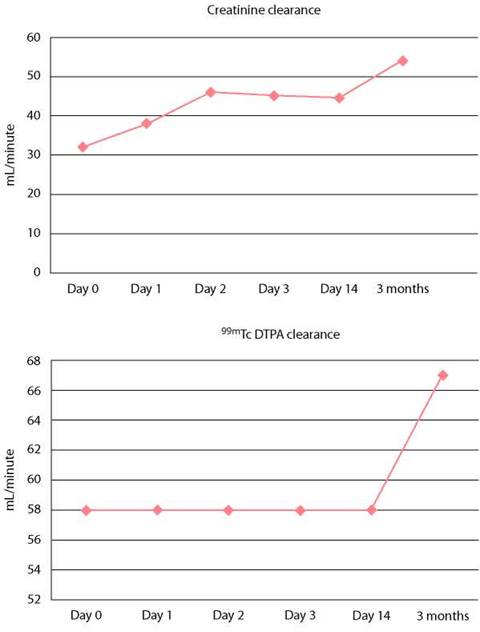
Figure 12.4 Changes in creatinine clearance and 99mTc DTPA clearance following relief of obstruction. Both are estimates of glomerular filtration rate.
Q. If creatinine clearance and 99mTc DTPA (diethylene-triamine-penta-acetic acid) clearance are both indicators of glomerular filtration rate, then why does creatinine clearance improve more quickly?
A. Creatinine is excreted by the tubules of the kidney as well as through glomerular filtration. Following relief of bilateral ureteric obstruction in this case tubular function recovers in the first 14 days but full recovery of glomerular function may take up to 3 months. The return of tubular function increases creatinine clearance and allows serum creatinine to fall but this does not reflect a real change in GFR.
Note: Creatinine clearance estimates the GFR and can be measured over 12-24 hours by the equation UV/P where U is the urinary concentration of creatinine, V is volume of urine produced over a timed interval and P is the plasma concentration of creatinine. About 80% of creatinine clearance is due to GFR and 20% is due to renal tubular secretion. Thus creatinine clearance is an overestimate of actual GFR (becomes important in very poor renal function when tubular secretion may be responsible for a relatively greater proportion of the creatinine clearance).
References
1. Abrams P. New words for old: Lower urinary tract symptoms for ‘prostatism’. BMJ 1994; 308: 929-930.
2. Barry MJ et al. The American Urological Association symptom index for benign prostatic hyperplasia. The Measurement Committee of the American Urological Association. J Urol 1992; 148: 1549-1557.
3. Jacobsen SJ et al. Natural history of prostatism: Risk factors for acute urinary retention. J Urol 1997; 158: 481-487.
4. Jacobsen SJ et al. Natural history of prostatism: Longitudinal changes in voiding symptoms in community dwelling men. J Urol 1996; 155: 595-600.
5. Abrams PH et al. The results of prostatectomy: A symptomatic and urodynamic analysis of 152 patients. J Urol 1979; 121: 640-642.
6. Berry SJ et al. The development of human benign prostatic hyperplasia with age. J Urol 1984; 132: 474-479.
7. Garraway WM et al. High prevalence of benign prostatic hypertrophy in the community. Lancet 1991; 338: 469-471.
8. Emberton M et al. Response to daily 10 mg alfuzosin predicts acute urinary retention and benign prostatic hyperplasia related surgery in men with lower urinary tract symptoms. J Urol 2006; 176: 1051-1056.
9. Emberton M. Definition of at-risk patients: Dynamic variables. BJU Int 2006; 97(Suppl 2): 12-15.
10. Mishra VC et al. Does intraprostatic inflammation have a role in the pathogenesis and progression of benign prostatic hyperplasia? BJU Int 2007; 100: 327-331.
11. Brown CT et al. Self management for men with lower urinary tract symptoms: randomised controlled trial. BMJ 2007; 334: 25.
12. Roehrborn CG et al. Serum prostate-specific antigen concentration is a powerful predictor of acute urinary retention and need for surgery in men with clinical benign prostatic hyperplasia. PLESS Study Group. Urology 1999; 53: 473-480.
13. Roehrborn CG et al. Efficacy and tolerability of the dual 5-alpha-reductase inhibitor, dutasteride, in the treatment of benign prostatic hyperplasia in African-American men. Prostate Cancer Prostatic Dis 2006; 9: 432-438.
14. Lepor H et al. The efficacy of terazosin, finasteride, or both in benign prostatic hyperplasia. Veterans Affairs Cooperative Studies Benign Prostatic Hyperplasia Study Group. N Engl J Med 1996; 335: 533-539.
15. McConnell JD et al. The long-term effect of doxazosin, finasteride, and combination therapy on the clinical progression of benign prostatic hyperplasia. N Engl J Med 2003; 349: 2387-2398.
16. Roehrborn CG et al. The effects of dutasteride, tamsulosin and combination therapy on lower urinary tract symptoms in men with benign prostatic hyperplasia and prostatic enlargement: 2-year results from the CombAT study. J Urol 2008; 179: 616-621.
17. Speakman MJ et al. Guideline for the primary care management of male lower urinary tract symptoms. BJU Int 2004; 93: 985-990.
18. Elmansy HM et al. Holmium laser enucleation of the prostate: Long-term durability of clinical outcomes and complication rates during 10 years of followup. J Urol 2011; 186: 1972-1976.
19. National Institute for Health and Care Excellence (NICE). UroLift for treating lower urinary tract symptoms of benign prostatic hyperplasia. Medical technologies guidance [MTG26]; September 2015. https://www.nice.org.uk/guidance/mtg26/resources/urolift-for-treating- lower-urinary-tract-symptoms-of-benign-prostatic-hyperplasia-64371938204869.
20. National Institute for Health and Care Excellence (NICE). The TURis system for transurethral resection of the prostate. Medical technologies guidance; February 25, 2015. https://www.nice.org.uk/guidance/mtg23/resources/ the-turis-system-for-transurethral-resection-of-the-prostate-64371933166021.