
Jas S Kalsi, Suks Minhas and Asif Muneer
Q. A 65-year-old male has noticed a progressive deterioration in his erections over a 1-year period. He is now avoiding sexual relationships with his wife. His wife is very concerned and asks him to see his GP. The GP tells him not to worry as it is a normal part of the ageing process. After a further 6 months as things continue to get worse, he decides to see another partner in the same practice who refers him to see a urologist. How do you define erectile dysfunction?
A. Erectile dysfunction is defined as the inability to achieve or maintain an erection sufficient for satisfactory sexual performance.
Q. Can you describe the different phases of a penile erection?
A. There are five distinct phases of erection that have been demonstrated:
0 - Flaccid
1 - Latent
2 - Tumescence
3 - Full erection
4 - Rigid erection
5 - Detumescence (initial, slow and fast phases)
Q. Can you explain the physiological process of penile erection?
A. Penile erection is the result of a complex and delicate interplay between several biochemical, vascular, neurological, physical and psychological pathways. The cavernous smooth muscle and the smooth muscles in the arteriolar and arterial walls, play a key role in erectile function. In the flaccid state, the smooth muscle is tonically contracted, allowing only a small amount of arterial flow into the cavernous spaces. Sexual stimulation triggers the release of neurotransmitters from the cavernous nerve terminals, resulting in smooth muscle relaxation and triggering the following events:
1. Dilatation of the arterioles and arteries by increased blood flow in both the diastolic and the systolic phases
2. Trapping of the incoming blood by the expanding sinusoids
3. Compression of the subtunical venular plexuses between the tunica albuginea and the peripheral sinusoids, which reduces the venous outflow
4. Stretching of the tunica to its capacity, which encloses the emissary veins between the inner circular and the outer longitudinal layers and further decreases the venous outflow to a minimum
5. An increase in intracavernous pressure (maintained at around 100 mm Hg), which raises the penis from the dependent position to the erect state (the full-erection phase)
6. A further pressure increase (to several hundred mm Hg) with contraction of the ischiocavernosus muscles (rigid-erection phase)
Q. What mechanisms allow the penis to achieve a full rigid erection?
A. During the full-erection phase, partial compression of the deep dorsal and circumflex veins between Buck’s fascia and the engorged corpora cavernosa contribute to glanular tumescence. In the rigid-erection phase, the ischiocavernosus and bulbocavernosus muscles forcefully compress the spongiosum and penile veins, which results in further engorgement and increased pressure in the glans and spongiosum.
Q. Can you describe the arterial supply of the penis?
A. The main source of blood supply to the penis is from the internal pudendal artery. However, accessory arteries may arise from the external iliac, obturator, vesical and femoral arteries. The internal pudendal artery becomes the common penile artery after giving off a branch to the perineum.
The three branches of the penile artery are the cavernous, dorsal and the bulbourethral:
1. Cavernous artery - Involved in tumescence of the corpus cavernosum. Gives off a number of helicine arteries, which supply the trabecular erectile tissue and the sinusoids. These helicine arteries are contracted and tortuous in the flaccid state and become dilated and straight during erection.
2. Dorsal artery - Provides engorgement of the glans penis during erection.
3. Bulbourethral artery - Blood supply to the bulb and corpus spongiosum.
Distally, the three branches join to form a vascular anastomosis in and around the glans penis.
Q. Can you describe the venous drainage of the penis?
A. The venous drainage from the three corpora originates in tiny venules leading from the peripheral sinusoids immediately beneath the tunica albuginea. These venules travel in the trabeculae between the tunica and the peripheral sinusoids to form the subtunical venular plexus before exiting as the emissary veins.
Outside the tunica albuginea, the venous drainage is dependent on the area of drainage as follows:
Skin and subcutaneous tissue - Multiple superficial veins run subcutaneously and unite near the root of the penis to form the superficial dorsal vein(s), which in turn usually drains into the saphenous veins.
Emissary veins from the corpus cavernosum and spongiosum - These drain dorsally to the deep dorsal vein, laterally to the circumflex vein, and ventrally to the periurethral veins. Beginning at the coronal sulcus, the prominent deep dorsal vein is the main venous drainage of the glans penis, corpus spongiosum and distal two-thirds of the corpora cavernosa. It runs behind the symphysis pubis to join the periprostatic venous plexus. Emissary veins draining the proximal corpora cavernosa - Form cavernous and crural veins. These veins join the periurethral veins from the urethral bulb to form the internal pudendal veins.
Q. Why should men with erectile dysfunction (ED) be investigated?
A. The correct assessment of men presenting with ED can identify undiagnosed conditions as well as being a risk factor for other disease processes:
Diabetes (ED may be the first symptom in up to 20%)
Occult cardiac disease (ED in an otherwise asymptomatic man may be a marker for underlying coronary artery disease). The lead time for this is up to 3 years.
Dyslipidaemia
Presence of hypogonadism
Identifying co-existing lower urinary tract symptoms
Q. What questions will you ask in the history?
A. I would see the patient ideally in a specialist andrology or sexual dysfunction clinic in the presence of the partner if possible. A full sexual history should be taken. First, I would confirm from the history that the problem is genuinely ED (see above definition), as opposed to ejaculatory dysfunction or penile curvature. I would then ascertain the following points in the history:
Was onset of ED sudden or gradual?
Are early morning erections still present?
Is the ED situational (does it vary depending on partner or with masturbation)?
Severity (objectively assessed using a validated IIEF-5 questionnaire)
Successful response to any treatment options
Assessment of the patient’s (and partner’s) needs and expectations
Q. How would you assess the severity of the condition?
A. I would use a validated questionnaire such as the International Index of Erectile Function (IIEF) or the validated shorter version, the IIEF-5 (SHIM). These are helpful in assessing the domains of sexual function as well as the impact of treatments and interventions. The questionnaire relates to the previous 6 months (see Table 13.1).
The overall score allows the severity to be assessed objectively as follows:
|
1-7 |
Severe ED |
|
8-11 |
Moderate ED |
|
12-16 |
Mild to moderate ED |
|
17-21 |
Mild ED |
|
22-25 |
No ED |
Table 13. International Index of Erectile Function-5 (IIEF-5) questionnaire
|
1. How do you rate your confidence that you could get and keep an erection? |
Very low |
Low |
Moderate |
High |
Very high |
|
|
1 |
2 |
3 |
4 |
5 |
||
|
2. When you had erections with sexual stimulation, how often were your erections hard enough for penetration (entering your partner)? |
No sexual activity |
Almost never/ never |
A few times (much less than half the time) |
Sometimes (about half the time) |
Most times (much more than half the time) |
Almost always/ always |
|
0 |
і |
2 |
3 |
4 |
5 |
|
|
3. During sexual intercourse, how often were you able to maintain your erection after you had penetrated (entered) your partner? |
Did not attempt intercourse |
Almost never/ never |
A few times (much less than half the time) |
Sometimes (about half the time) |
Most times (much more than half the time) |
Almost always/ always |
|
0 |
1 |
2 |
3 |
4 |
5 |
|
|
4. During sexual intercourse, how difficult was it to maintain your erection to completion of intercourse? |
Did not attempt intercourse |
Extremely difficult |
Very difficult |
Difficult |
Slightly difficult |
Not difficult |
|
0 |
і |
2 |
3 |
4 |
5 |
|
|
5. When you attempted sexual intercourse, how often was it satisfactory for you? |
Did not attempt intercourse |
Almost never/ never |
A few times (much less than half the time) |
Sometimes (about half the time) |
Most times (much more than half the time) |
Almost always/ always |
|
0 |
1 |
2 |
3 |
4 |
5 |
Q. What would you assess on a physical examination?
A. A focused physical examination should be performed on every patient presenting with ED. This should include an emphasis on the neurological, cardiovascular and genital tract. Height, weight, body mass index and blood pressure should be recorded.
In particular it is important to examine for:
Thyroid evaluation, pulmonary status, and cardiac rhythm
Abdominal exam with mid waist circumference recorded
Penile exam (assess for penile plaques, penile lesions and foreskin problems)
Testis exam (note size, consistencies and irregularities)
If indicated rectal exam (sphincter tone, prostate size evaluation particularly if co-existent LUTS)
Q. Would you perform any other tests?
A. The routine tests that I would usually perform are:
Urinalysis
Fasting blood glucose
Fasting lipids
Total testosterone (if low or borderline then perform luteinizing hormone [LH], follicle- stimulating hormone [FSH] and sex hormone binding globulin [SHBG])
Prostate-specific antigen (if there is an abnormality with the prostate gland and after appropriate counselling especially in age >50)
Prolactin
Q. This particular patient is a non-insulin-dependent diabetic with a gradual onset of ED and has an IIEF-5 score of 8. All blood tests other than fasting glucose are normal. How would you manage this patient?
A. I would identify and treat any reversible causes of ED such as poorly controlled diabetes.
I would also initiate lifestyle changes (including exercise and weight loss) and seek to modify any associated risk factors (stop smoking). If this fails to improve his erections then I would offer him a trial of an oral PDE-5 inhibitor provided that there are no contraindications.
Q. How do PDE-5 inhibitors work? Can you draw a diagram to illustrate this?
A. Nitric oxide (NO) enters the smooth muscle cell, where it activates the soluble form of the enzyme-soluble guanylate cyclase (sGC). Soluble GC catalyses the conversion of guanosine triphosphate (GTP) to the active intracellular second messenger cyclic guanosine monophosphate (cGMP). In turn cGMP leads to activation of a number of intracellular events, which eventually brings about penile smooth muscle relaxation (Figure 13.1) mainly via a reduction in intracellular calcium. The action of cGMP is terminated by its metabolism to GMP by phosphodiesterase type 5 (PDE-5). Drugs inhibiting the action of PDE-5 (PDE-5 inhibitors) facilitate NO-induced smooth muscle relaxation within the penis by causing an accumulation in intracellular cGMP.
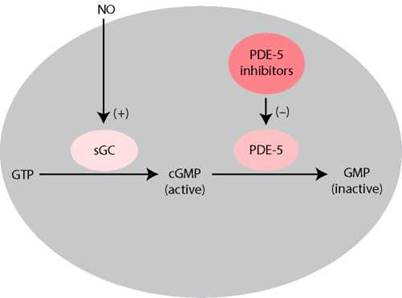
Figure 13.1 The mechanism of action of PDE-5 inhibitors.
Q. Which PDE-5 inhibitors are you aware of?
A. There are a number of PDE-5 inhibitors available including sildenafil (Viagra), tadalafil (Cialis), vardenafil (Levitra) and avanafil (Spedra).
Q. What are the differences between them?
A. The major difference is that sildenafil and vardenafil are relatively short-acting drugs, having a half-life of approximately 4-5 hours, whereas tadalafil has a significantly longer half-life of 17.5 hours. Furthermore, tadalafil is not known to have reduced bioavailability with fatty foods. Tadalafil is also available as a 5 mg daily dose which is the only PDE-5 inhibitor approved for daily dosing and for treating male lower urinary tract symptoms. Avanafil may work within 15 minutes.
Q. How would you counsel a patient and initiate therapy with a PDE-5 inhibitor?
A. First, I would ensure that there are no contraindications to treatment with oral PDE-5 inhibitors. In my practice, the specific choice of which medication is given as first line is patient driven. First, it depends on whether the couple wishes to have more spontaneity in which tadalafil would be the best option. Sometimes patients tolerate a particular PDE-5 inhibitor due to a better side-effect profile. I would then explain that my patient will need to take the medication at least eight times at the maximum dose of the drug, at least 1 hour before sex (Table 13.2), ideally on an empty stomach together with sexual stimulation before it is deemed a pharmacological failure. A full explanation of the potential side effects is also required (Table 13.2). Having informed him of all these factors, the final choice is made by the patient.
Table 13.2 The characteristics of the different PDE-5 inhibitors
|
Sildenafil |
Vardenafil |
Tadalafil |
|
|
Onset of action |
15 min to 1 hour |
15 min to 1 hour |
15 min to 2 hours |
|
Half-life |
3-5 hours |
4-5 hours |
17.5 hours |
|
Bioavailability |
40% |
15% |
Not tested |
|
Food effect |
Reduced absorption with fatty foods |
Reduced absorption with fatty foods |
None |
|
Dosages |
25, 50, 100 mg |
5, 10, 20 mg |
5, 10, 20 mg |
|
Side effects |
Headache, dyspepsia, facial flushing, blurred/blue vision, rare cases of backache, myalgia |
Headache, dyspepsia, facial flushing, rare cases of backache, myalgia, and blurred/blue vision |
Headache, dyspepsia, facial flushing, backache, myalgia, rare cases of blurred/blue vision |
|
Contraindications |
Nitrates |
Nitrates, antiarrhythmics |
Nitrates |
Q. What are the common side effects associated with PDE-5 inhibitors?
A. All PDE-5 inhibitors produce side effects that are usually associated with peripheral vasodilatation, including nasal congestion, facial flushing, headache and dyspepsia. Tadalafil has been linked to back pain in up to 10% of cases although the side-effect profile is much better for the lower 5 mg dose. Vardenafil has been shown to slightly prolong the QT interval. Optical neuropathies have been reported however, the actual incidence of optical neuropathy is rare.
Q. This same patient has recently been started on antihypertensive medication by his GP.
He feels that this has made his ED worse. Which other medications are known to be associated with ED?
A. Diuretics and antihypertensives are known to be associated with ED. Other medications also associated with ED include antidepressants, antianxiety and antiepileptic drugs, antihistamines, non-steroidal anti-inflammatory drugs, medication for Parkinson’s disease, antiarrhythmics, histamine H2-receptor antagonists, muscle relaxants, hormone treatment for prostate cancer and chemotherapies.
Q. Unfortunately despite maximum doses of the PDE-5 inhibitor he does not get a satisfactory response. How would you now manage this patient?
A. I would explain to him that approximately 25% of patients do not respond to PDE-5 inhibitors. I would also ensure re-education on the effects of modifiable factors, such as dose, timing of medication, alcohol consumption, adequate sexual arousal and interaction with fatty foods. If he has tried a short-acting PDE-5 inhibitor then it may be worthwhile switching to the longer-acting tadalafil at the maximum dose to enable more spontaneity as a proportion of patients benefit from switching. If the investigations show low or borderline total testosterone, then combination treatment with testosterone replacement and a PDE-5 inhibitor may help some individuals. In patients who are hypogonadal, testosterone replacement may result in a general improvement in sexual function, improved erection and enhanced responsiveness to PDE-5 inhibitors but ensure that they are aware of the risks of testosterone treatment including the effects on spermatogenesis.
Q. Despite trying these options he still does not get satisfactory erections. What alternative treatment options are available?
A. If patients do not benefit from PDE-5 inhibitors or they are contraindicated, then second-line treatment options should be considered which include the following:
Alprostadil intraurethral suppositories (MUSE) - A non-injectable prostaglandin pellet, which improves vascular flow by causing vasodilatation by increasing levels of cyclic AMP; a newer way of delivering Alprostadil is gel formulation (Vitaros) at 300 mcg. Intracavernosal injections - Local injections of one or a combination of alprostadil, papaverine and phentolamine.
Vacuum constriction devices - Effective in most patients and can be purchased with or without a prescription.
Low-intensity shockwave therapy - This improves endothelial function and allows neovascularisation. Success may be achieved in up to 70% of cases but may need to be repeated.
If the second-line treatment options fail then third-line therapy includes the following: Penile prostheses - Surgically placed non-inflatable (semirigid/malleable) or inflatable devices.
Penile revascularisation surgery - Reserved for patients having suffered from pelvic trauma or proven arteriogenic impairment.
Q. Which specialist investigations for ED are you aware of and when are they used?
A. Specialist investigations include nocturnal penile tumescence studies, cavernosometry or cavernosography and Duplex ultrasound. Most patients do not need further investigations. However, some patients wish to know the aetiology of the ED and in others specialist investigations are required. These include the following:
Young patients who have always had difficulty in obtaining and/or sustaining an erection
Patients with a history of trauma
Where an abnormality of the testes or penis is found on examination
Patients unresponsive to medical therapies who may desire surgical treatment for ED
Q. What is shown in Figure 13.2? How does it work and what is it used for?
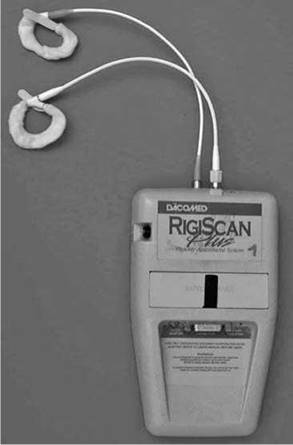
Figure 13.2
A. Figure 13.2 is a Rigiscan device (used to provide a nocturnal penile tumescence [NPT] trace). It comprises two transducer rings which are placed around the tip and base of the penis, respectively. ttey are used to measure the number, duration and rigidity of nocturnal erections. Nocturnal and early morning erections are a normal physiological event in all men and are associated with the REM pattern of sleep. This test is used to differentiate organic from psychogenic causes of ED.
Q. What does Figure 13.3 show?
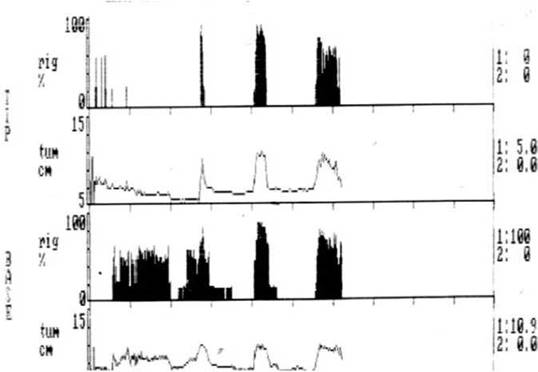
Figure 13.3
A. Figure 13.3 demonstrates a normal NPT trace. A normal trace shows greater than 60% rigidity at the tip for >10 minutes.
Q. What is the role for penile Doppler as an investigation for ED? What are the normal blood flow parameters?
A. This radiological investigation is used if there is a suspicion of a vasculogenic cause for ED.
It requires an intracavernosal injection of a prostaglandin (PGE1) to induce an erection. The blood flow is then measured and a diagnosis of arteriogenic or veno-occlusive dysfunction or mixed vasculogenic ED can be made. The normal values for the peak systolic velocity are >25-30 cm/s. A peak systolic velocity lower than this is compatible with arteriogenic ED. If the end diastolic velocity >5 cm/s then this may indicate veno-occlusive dysfunction as the normal end diastolic velocity should be <10 cm/s.
Q. What is the test shown in Figure 13.4 and how is it performed?
A. Figure 13.4 is a cavernosogram. Cavernosography requires an artificial erection followed by the injection of contrast into the penis. Simultaneous imaging and blood flow parameters are measured and the flow required to maintain the erection is measured to identify any venous leaks. This particular image demonstrates a venous leak although the clinical entity of venous leak is still controversial.
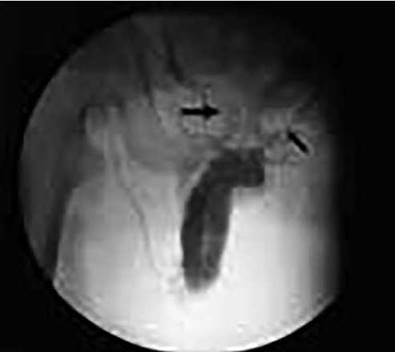
Figure 13.4
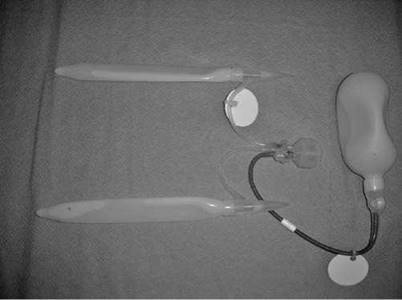
Figure 13.5
Q. What is shown in Figure 13.5? Explain how it works.
A. Figure 13.5 is a three-piece inflatable penile implant. This consists of a reservoir which is placed in the retropubic space and is filled with saline, a pump placed in the scrotum and a pair of cylinders which are placed within the corpora of the penis. The pump in the scrotum allows fluid to flow from the reservoir to the cylinders which increase in girth and become rigid (inflation). A small release button on the pump is pressed to allow deflation of the cylinders by allowing fluid to pass back from the cylinders to the reservoir. Penile prostheses should be offered to all patients who are unwilling or unable to consider, fail to respond to, or are unable to continue with pharmacological treatment or vacuum erection devices.
All patients and their partners should be fully counselled pre-operatively and shown the different types of implants and how to handle the pump. It often helps to speak to a patient advocate. Penile prostheses are particularly suitable for those patients with severe end- stage organic ED, especially if the cause is Peyronie’s disease (severe curvature with erectile dysfunction or significant ‘hour-glass’ deformity) or those with post-priapism fibrosis.
Q. What are the possible complications of penile prosthesis surgery?
A. The long-term risks include infection (<4%), erosion (<5%) and mechanical failure (4%) which may need re-operation. A small number of patients may develop a glans droop which can be corrected at a later date by performing a glanspexy. The initial cost is high but manufacturers do offer a 10 year or lifetime guarantee for mechanical failure. The risks of surgery are higher in patients who are diabetic, have spinal cord injury or are on corticosteroids or immunosuppressives.
Q. What are the long-term success rates?
A. The long-term success and satisfaction rates are reported to be over 90% for both the patient and the partner. These high success rates are due to the improved mechanical reliability of the newer prostheses and careful pre-operative counselling and patient selection [1]. The advantages of penile prosthesis surgery include long-term efficacy with a high satisfaction rate, no need for pharmacotherapy and the improved ability to lead a normal sexual life.