
Q. A 22-year-old male attends clinic with a 1-year history of worsening inability to ejaculate. He is otherwise well other than having had a road traffic accident 3 years ago. How would you investigate him?
A. After taking a full history and examining him I would like to know how severe his spinal injuries are and whether he has a spinal level injury. In particular I would like to ask him specifically about his bowel and bladder function.
Q. What do you think is wrong with him?
A. I suspect that he has anejaculation. I would confirm this with a semen analysis which would show complete absence of antegrade ejaculation and the absence of fructose and sperm in a post-orgasmic urine analysis.
Q. What are the most common causes of this problem?
A. The most common causes are spinal cord injury, followed by retroperitoneal lymph node dissection. Some patients have psychological causes for their problem and this should be suspected in patients who are suddenly unable to ejaculate, those who can still masturbate to completion and if no other causes of ejaculatory dysfunction can be identified.
Q. What is this instrument? And what is it used for?
A. Figure 13.8 shows a Seager electro-ejaculator. It may be used to perform electro-ejaculation on spinal cord injured patients.
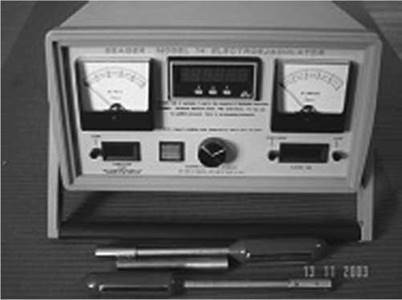
Figure 13.8
Q. How is electro-ejaculation performed? What precautions should be taken?
A. Electro-ejaculation involves the use of a rectal probe to stimulate the perirectal, periprostatic sympathetic nerves electrically. Patients without a spinal cord injury or those with low or incomplete spinal cord lesions require general anesthesia. During electro-ejaculation, spinal cord-injured patients with lesions above T6 or a history of autonomic dysreflexia should have blood pressure monitored frequently for signs of autonomic dysreflexia and severe hypertension.
Q. When electro-ejaculation is performed, what is the quality of the sperm retrieved?
A. Sperm obtained from electro-ejaculation has been shown to be of a poorer quality with poor motility and impaired fertilizing capacity. As a result, low pregnancy rates have been reported in patients undergoing electro-ejaculation and subsequent intrauterine insemination.
Q. Are there any other available options for patients who do not wish to have electro-ejaculation?
A. In infertile men with anejaculation, sperm retrieval can be performing using a PESA technique. The sperm can then be used for either intrauterine insemination (pregnancy rate of 73.1%) or IVF (pregnancy rate of 71.4%).