
Q. Outline the main complications of chronic renal failure.
A. The main complications affecting patients symptomatically are fluid overload, anaemia, renal osteodystrophy, pericarditis, anaemia and the effects of cardiovascular disease. Hypertension, dyslipidaemia and the metabolic complications of acidosis and hyperkalaemia are factors that can lead to progression of these complications.
Q. Describe what you see in Figure 14.6. What is the composition of this solution?
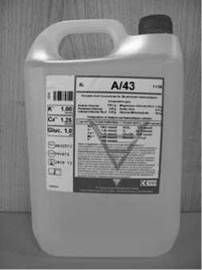
Figure 14.6
A. Figure 14.6 shows a dialysate solution. It consists of water, sodium (132-155 mmol/L), potassium (0-4 mmol/L, i.e. sub-physiological), calcium, magnesium, chloride, bicarbonate (or acetate - as a buffer) and glucose. The pH lies between 7.1 and 7.3.
Q. What is the device shown in Figure 14.7? What are the principal differences between haemodialysis and haemofiltration?
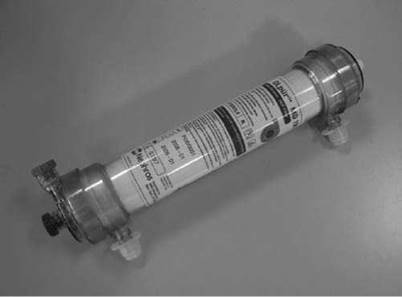
Figure 14.7
A. This device is a haemodiafiltration (HDF) filter. HDF is a process that combines dialysis and haemofiltration.
Haemodialysis works by two main mechanisms, principally the diffusion of solutes across a semi-permeable filter (made of modified cellulose or synthetic material) and second the principle of ultrafiltration, which is caused by the convective flow of solutes and liquids.
The negative pressure to allow this is produced via the outlet pump of the dialysis machine. Haemofiltration does not use a dialysate solution, and relies on a hydrostatic pressure gradient alone to produce ultrafiltration. Fluid is replaced either before or after filtration. Haemodynamic stability of patients is thought to be better maintained by utilising filtration alone rather than diffusion.
Q. How may permanent venous access be created, and what are the complications?
A. Permanent access is provided principally via either radial or brachial fistulae. The arteries are anastamosed to the cephalic vein. Brachial fistulae are associated with a higher risk of ‘steal’ syndrome due to The higher flow rates. Alter natively the arteries and veins may be linked with a ‘bridging graft’.
Common complications include thrombosis of the fistula or graft, stenosis (usually occurring at or distal to the fistula or graft), ischaemia of the digits, infection (of grafts), aneurysm/ pseudoaneurysm formation, superior vena cava obstruction or extravasation into limbs.
Q. What are the principles of peritoneal dialysis? What are the different types of peritoneal dialysis? What complications may occur?
A. Peritoneal dialysis uses the peritoneum as the ‘dialysis membrane’, and dialysis fluid is instilled into the peritoneal cavity. Solutes move via diffusion down a concentration gradient, and fluid transfers occur via osmosis, ‘dragging’ some molecules with it.
Peritoneal dialysis can be divided into two main systems: continuous ambulatory peritoneal dialysis (CAPD) and automated peritoneal dialysis (APD). CAPD originally used glass bottles that had to be disconnected and reconnected. This was superseded by a method using plastic bags, the disadvantage of this being that the patient had a plastic bag continuously attached to him or her. Modern methods rely on a ‘two-bag’ system with a ‘Y’ connector; this is associated with lower rates of peritonitis and allows the patient to be free from a bag while not performing fluid exchanges. Typically patients exchange 2 litres of solution four times in 24 hours. The solution consists of sodium, potassium, calcium, magnesium, lactate and bicarbonate. The pH is low (approximately 5.5). The tonicity of the fluid is increased by the addition of either dextrose, icodextrin (a glucose polymer produced from the hydrolysis of starch) or amino acids. APD is not dissimilar but facilitates an automated system whereby fast exchanges can be performed overnight.
Access to the peritoneal cavity is via a semi-permanent catheter, such as the Tenckhoff catheter. This uses a ‘double-cuff’ method to reduce the chance of infection. Catheters are placed using the Seldinger technique under local anaesthesia, or placed surgically either open or laparoscopically.
Complications associated with peritoneal dialysis may occur at the time of insertion of the catheter, and include visceral injury (bladder and bowel), haemorrhage, leak or infection. General complications of peritoneal dialysis include local infections around the catheter (ultimately tunnel infection). One of the most serious complications is peritonitis. Although potentially fatal, this is often treatable by administering antibiotics intraperitoneally. An uncommon complication is sclerosing peritonitis, where the peritoneum becomes sclerosed and fibrosed. Filtration is greatly affected. The aetiology is ultimately unknown but is associated with long-term peritoneal dialysis usage and recurrent infections. An even rarer complication is sclerosing encapsulating peritonitis, which results in bowel obstruction and intestinal failure.