
PART 3 The Intermediate Series of Asanas (Postures)
FIRST CONNECTIVE SECTION
BACKBEND SEQUENCE
Shalabhasana
LOCUST POSTURE
Drishti Nose
OVERVIEW: With Shalabhasana, the group of eight intermediate backbends begins. Apart from Mayurasana, which functions very similarly, Shalabhasana is the only backbend that is fully active; in other words, we use only the back extensors to get into the posture and do not counteract this with the opposite action. In all other backbends, we work against the strength of our arms and legs to deepen the backbend. Here we work only against gravity. For this reason, Shalabhasana is the first of the backbends. Its purpose is not to encourage flexibility but to awaken and strengthen the back extensor muscles for the backbends that follow. Strong back extensors are essential in the leg-behind-head postures and arm balances that follow the backbend sequence.
Vinyasa Count
We reached Downward Dog when exhaling in vinyasa twenty of Krounchasana. As the initial vinyasa of Shalabhasana is accompanied by an exhalation, we perform an additional inhalation in Downward Dog to link the two postures together.
Vinyasa Four
Exhaling, lower into Chaturanga Dandasana. Please note that we pick up the vinyasa count here at vinyasa four rather than vinyasa seven. We do so in the next four postures, all of which we enter by lying on the belly. This also means that if you do a full vinyasa practice (coming to standing between all postures and thus linking them with a Surya Namaskara A–like movement), you would simply lie down fromChaturanga Dandasana in vinyasa four and transit through Upward and Downward Dog only on exiting the posture. If you are following the half-vinyasa format (jumping back between the right and left sides of a posture but not coming to standing after completing a posture), which is the form of practice commonly done today, no difference will be apparent when entering a posture from vinyasa four.
At the end of the exhalation, lie down on your belly with your arms next to your trunk, palms facing up and fingers pointing toward the feet. Make sure that you keep your bandhas firmly engaged when lying on your belly; otherwise energy (prana) will flow out into the ground. This happens because the Earth is receptive, and energy flows from the higher to the lower potential. For the same reason, the yogi usually turns both hands and feet upward to the sky to receive prana.
Vinyasa Five
With the commencement of the inhalation, lift your legs and torso off the floor and point (plantar flex) your feet. Gaze toward the tip of your nose and avoid taking your head too far back. Let your neck harmoniously continue an arch with the rest of your spine. With few strong muscles in the front, the neck is the part of the spine most susceptible to hyperextension (overstretching backward). Hyperextension of the neck can result in headaches and wrist, shoulder, and other pains.
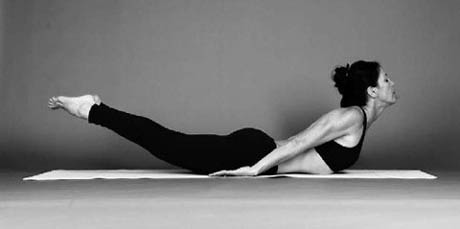
Shalabhasanan A
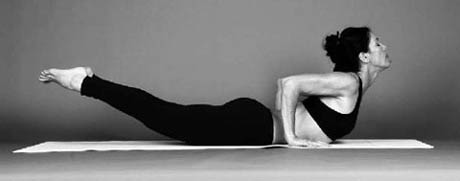
Shalabhasanan B
Keep your legs straight by engaging the quadriceps muscles, but use your glutei and your hamstrings to lift your feet as high as possible without bending your legs.
Lift your chest as high as you can by engaging erector spinae and quadratus lumborum. Roll the shoulders down the back, using latissimus dorsi (see Ashtanga Yoga: Practice and Philosophy, p. 26), and lift them away from the floor, using your rhomboids (see p. 73). Keep the lower abdomen firm and draw a significant portion of your breath up into your chest. This is essential in all backbending postures, as otherwise the chest will stay dormant and will not open.
Exhaling, lower down; place your hands next to your waist, palms facing down, fingers pointing forward. Place your hands far enough back so that your forearms are perpendicular to the floor, as inChaturanga Dandasana.
Inhaling, lift your chest, head, and legs off the floor again and repeat all previous instructions. Put renewed emphasis on lifting the chest and drawing the shoulder blades down the back. Without moving your hands, draw them back toward your feet. This action helps to engage the latissimus dorsi and lower trapezius muscles and keep the shoulder blades anchored down, preventing an overactivation of the upper trapezius muscle. Shalabhasana A and B are covered under one heading, as they do not have an individual vinyasa count.
Vinyasa Six
Inhale into Upward Dog.
Vinyasa Seven
Exhale into Downward Dog.