
PART 3 The Intermediate Series of Asanas (Postures)
FIRST CONNECTIVE SECTION
BACKBEND SEQUENCE
Bhekasana
FROG POSTURE
Drishti Nose
OVERVIEW: Bhekasana’s purpose is to lengthen the quadriceps. Note that the focus during the unfolding backbend series will slowly move from the thighs, which are targeted in Bhekasana, upward to the psoas, which is mainly stretched in Dhanurasana and Ushtrasana, to finally arrive at the upper chest area with Kapotasana.
Vinyasa Count
Vinyasa Four
Exhaling, lower into Chaturanga Dandasana. At the end of the exhale, lie down on your belly and bend your legs so that your feet come close to your buttocks. Place your hands on the tops of your feet, palms facing down and fingers pointing forward, in the same position as in the second phase of Shalabhasana. Your soles and palms will now face downward and your toes and fingers forward toward your head. If you cannot get into this position, your limitation is likely to be stiffness either of the quadriceps, preventing you from flexing your knees enough, or of the pectoralis minor, preventing you from rolling your shoulders back enough to place your hands up on your feet with your palms facing down; more likely it is a combination of both. You may warm up and stretch both muscles outside of and prior to yourvinyasa practice by means of the research postures suggested on pages 110–11.
Vinyasa Five
Press your feet down toward the floor and, inhaling, lift your chest off the floor, repeating with your torso the action performed in Shalabhasana B.
Draw your shoulder blades down your back, breathe deeply into your chest, and look toward your nose. The main purpose of the posture is to lengthen the quadriceps in anticipation of more difficult backbends. Focus first on getting your heels and feet down to the floor, and once that is achieved, work on lifting your chest high. You will get ample opportunity to work on opening the chest in the later postures.
Keep your femurs (thighbones) in a neutral position while you work your feet down to the floor to stretch centrally through the quadriceps. While you work your feet down to touch the floor on the outsides of your thighs, there is the tendency to internally rotate the femurs. You can recognize that situation when your soles and heels face inward (toward your thighs) and the tops of your feet face outward. If this is the case, externally rotate the femurs so that the heels face straight down. Remember that this posture is like a double Triang Mukha Ekapada Pashimottanasana done face down. As in that posture, we need to externally rotate the femurs here as well.
Attempt to keep your thighbones parallel, so that the knees are not wider apart than the width of the hip joints. If you widen the legs more, you will emphasize the stretch of the vastus lateralis, the outermost head of the quadriceps. There is no need to touch the knees together. This may place undue strain on the knees.
If you feel knee pain when performing Bhekasana, a slight misarticulation of the femur or the tibia is most likely the cause. Come up to sitting, flex your knee joint, and then perform a kicking movement (in a sensible fashion). When you come close to 180 degrees of leg extension, relax the thigh muscles so that the momentum “gapes” the knee joint slightly. This means that for a short period the interjoint space will be increased. The ligaments will now pull the bones back together, which usually results in a more precise articulation. If you still experience pain, there is likely to be an underlying knee problem or a misalignment of the pelvis, and it is advisable not to go deep into Bhekasana. Address the problem by performing Virasana (see Ashtanga Yoga: Practice and Philosophy, p. 57) on a pile of blankets and decrease the height gradually over days. If necessary, have the alignment of the pelvis checked and corrected by a qualified musculoskeletal professional.
When done correctly and sensibly, Bhekasana, Virasana, and Supta Virasana all tend to improve the tracking of the patella. A maltracking patella is often caused by a mis-tone among the three vasti, a condition that is often alleviated by performing the three postures just described.13
During the posture, focus on stabilizing the lower abdomen and lifting the heart out to the front, thus lengthening out through the low back. Look toward the nose, and take five breaths in Bhekasana.
ACTIVE RELEASE TECHNIQUE: Engaging the quadriceps, press the back of your feet up against the resistance of your arms as if you were trying to straighten your legs. This will distribute the stretch evenly over the entire belly of the quadriceps.

Bhekasana
BEGINNER’S VERSION: If you find it challenging to go straight into the full version of Bhekasana, warm up your legs one at a time. Rest on your left elbow and lift your chest. Bend your right leg and, using your right hand, press your foot down toward the floor. You can use your arm more effectively now, since your chest is lifted while propped up on your left arm. As you press your foot down, gently rotate your femur in both directions to stretch various portions of the quadriceps. Use the active release method by pressing your foot up against the resistance of your hand. Once you have reached your maximum stretch, repeat on the left.
Once you have become proficient in Bhekasana, omit the beginner’s version and go straight into the full posture.
WARM-UP AND RESEARCH POSTURE:
1. First lie in Supta Virasana to stretch the quadriceps. Then, with elbows pressing into the floor, lift your hips as high off the floor as you can. Breathe into the quadriceps and perform the preceding active release, using the resistance of the floor against your feet instead of your hands.
2. Your ability to perform Bhekasana might be impeded by a tight pectoralis minor. Try out the following passive stretch: Stand upright facing a wall and place your palm against the wall. Then turn your chest away from the wall while the entire length of the arm stays in direct contact with the wall. Check that you feel the stretch in your pectoralis minor rather than hyperextending your elbow. This passive horizontal abduction will improve your shoulder flexibility.

Releasing the quadriceps
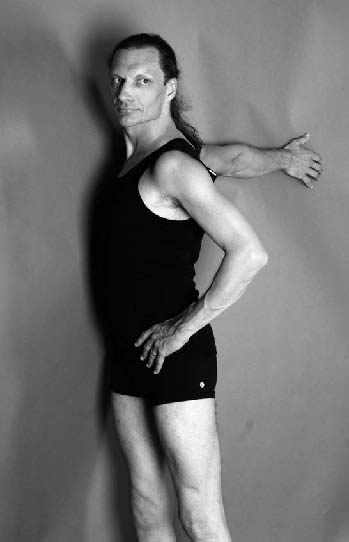
Stretching the pectoralis minor
Exhaling, let go of your feet and straighten your legs, placing the feet down flexed and hip-width apart. Place your palms down next to your waist.
PASSIVE STRETCHING
The efficacy of passive stretching is due to muscle creep. Muscle creep is a phenomenon that happens when a constant load is applied to a muscle over time, causing the muscle to lengthen, or “creep.” A stretch must be held for at least twelve minutes for muscle creep to take place; otherwise, the natural elastic recoil properties of the muscle tissue will cause the muscle to return to its original length. This return to normal is called hysteresis and involves the adaptive remodeling of muscles and their connective tissues. To get the most results from a stretch in the shortest amount of time, apply some resisted contraction to the stretch; this requires contracting the muscle group that you’re stretching. For example, in exercise 2 above, you would press your hand into the wall for six seconds, then relax your arm, leaving your hand where it was. Then you would move more deeply into the stretch, pressing your hand into the wall for twenty seconds or five slow breaths. You would repeat this until you couldn’t move any further into the stretch, an indication that the muscles had lengthened as much as they were going to for that day. This type of stretching is called “proprioceptive neuromuscular facilitation” (PNF) and has various forms. PNF relies on the proprioceptive properties (those that do not rely on visual clues) within the muscles to relax or inhibit the muscle. This achieves a more effective stretch.
Vinyasa Six
Inhaling, lift into Upward Dog.
Vinyasa Seven
Exhaling, move into Downward Dog.