
PART 3 The Intermediate Series of Asanas (Postures)
SECOND CONNECTIVE SECTION
LEG-BEHIND-HEAD SEQUENCE
Dvipada Shirshasana
TWO-LEGS-BEHIND-THE-HEAD POSTURE
Drishti Nose
OVERVIEW: Dvipada Shirshasana is the most difficult leg-behind-head posture in the series. With the left leg placed into position first, the asana balances Supta Vajrasana, where the right leg is placed first.
PREREQUISITE: Performance of all vinyasas of Ekapada Shirshasana, particularly vinyasa ten. Dvipada Shirshasana is much more difficult than Ekapada Shirshasana. If you do not find yourself relatively at ease in Ekapada Shirshasana, don’t attempt Dvipada Shirshasana.
CONTRAINDICATIONS: Forward head-posture, acute sacroiliac-joint injuries, twisted pelvis, weak low back, weak neck muscles, and weak abdominal muscles. Also see the sidebar below, “Taking Responsibility.”
Vinyasa Count
Vinyasa Seven
Inhaling, jump both legs around your arms in the same fashion that you enter Bhujapidasana in the Primary Series. As stated in Ekapada Shirshasana, by the time we are practicing the Intermediate Series, we need to be capable of jumping straight into this transitory posture without touching our feet down.
Keep the left leg on your left arm, and extend the right leg straight in front of you. Put first the left leg behind the head and then the right leg on top of the left one.
Vinyasa Eight
Place the left leg behind your head by laterally rotating your thigh, using all the steps and precautions described in Ekapada Shirshasana. The further you manage to get the leg down behind your neck, the easier it will be to carry the additional weight of the second leg. It will be impossible to carry both legs on the back of your head, whereas to carry them on or below C7 will be quite comfortable.
Hold the first leg in position by taking your head back, and place your left hand on the floor in front of you to keep your balance. Bend up your right leg, laterally rotating your thigh and, using your right hand, take your ankle or, flexibility permitting, your calf closer to the knee.
Exhaling, bend forward somewhat and lift your right leg behind your shoulder and then your right ankle behind the left ankle. Keep sufficient tension in your neck so that your left leg does not slip from behind your head. You may allow that in the initial stages of practicing the posture, but Dvipada Shirshasana is not properly executed until both legs are secured behind the head and stay there for the full breath count.
TAKING RESPONSIBILITY
If your low back tends to be unstable, on days when you are not sure whether you will be able to maintain the integrity of your spine due to weakness, practice only Yoganidrasana (yogic sleep posture, the next posture in the series) and leave out the more taxing Dvipada Shirshasana. Yes, true, the sequence is not to be changed, but Patanjali’s dictum in sutra II.16, “heyam duhkham anagatam,” means that we need to avoid creating future suffering. If you intuitively feel that the performance of a particular posture on a particular day will be detrimental, then take the responsibility of your body into your own hands and do not perform it (particularly if you are an experienced practitioner). You may have heard that yoga looks at the body as a temple. How will you worship the Divine in this temple if you have defiled it through an injury because you wanted to live up to some ideal? It is your body — take responsibility for it! The human spine is the gross equivalent of the central energy channel of the subtle body, which is nothing but the royal pathway of the ascent of Shakti, which again is the manifestation of the Mother Goddess. Do not practice yoga to an extent that you damage your spine. Practice mindfully!
When you feel stronger, do Yoganidrasana first and then Dvipada Shirshasana. Once you are completely recovered, perform Dvipada Shirshasana before Yoganidrasana.
LEFT LEG FIRST
In Supta Kurmasana in the Primary Series, the left leg is placed first, and that order is also followed in the next posture in this series, Yoganidrasana. In general, whenever both legs are placed behind the head, the left leg is brought into position first, followed by the right.23
This is at odds with the arrangement in lotus postures such as Padmasana and Supta Vajrasana, wherein the right leg is brought into half-lotus before the left leg. As described in the sidebar on page 125, the reason we place the legs in this order and not the other way around is to accommodate the asymmetry of the abdominal cavity. Placing the right leg into lotus first leads to a purification of the liver and spleen, whereas the reversal of this order does not have this effect, according to Yoga Shastra.
Similarly, the placing of the left leg first into Dvipada Shirshasana accommodates the asymmetry of the thoracic cavity, which would not be affected if the order of the legs were reversed. Placing the left leg first into Dvipada Shirshasana particularly purifies and strengthens the heart, but the lungs also benefit from it.
There has been speculation that the reversed order of placement of the legs in leg-behind-head postures like Dvipada Shirshasana and Yoganidrasana would balance the lotus postures like Supta Vajrasana and Karandavasana. Although at first glance there doesn’t seem to be much evidence of a balancing relationship between leg-behind-head postures and lotus postures, I have noticed over many years of teaching that those students who practice the entire Intermediate Series or the entire Primary Series do not seem susceptible to twisted pelvises. However, this problem repeatedly occurs among students who add on the Intermediate Series up to Supta Vajrasana and stay stuck for a long time either at Supta Vajrasana or at Ekapada Shirshasana.24 In other words, they could not yet get the balancing effect of Dvipada Shirshasana.
Of course, doing Dvipada Shirshasana before you are ready is not the solution, as this could lead to all sorts of other problems. If you develop the problem of a twisted pelvis at this point, then and only then may you start to practice some of the lotus postures with your left leg first. A way of doing that would be to practice Supta Vajrasana, Urdhva Padmasana, Pindasana, Matsyasana,Padmasana, Yoga Mudra, and Utpluthi with the left leg first every other day, or to let your teacher pick which ones to do left side first.
You may be able to resume placing the right leg first once you start performing Dvipada Shirshasana and Yoganidrasana and experience their balancing effect.
Drawing both legs as far down the back as possible ensures that your shoulders carry part of their weight rather than all of it pressing onto your cervical spine. Once proficient in the posture, point (plantar flex) both feet. In the initial stages, you might prefer to use flexion (dorsiflexion) of the feet; this makes it easier to hook the second foot onto the first. In the final version of the posture, however, the feet are to be plantar flexed.
Once both legs are securely in place behind the neck, engage your back extensors and straighten up as much as you can. Lift your chest and drop your pubic bone. Find your point of balance on your sit bones and place both hands into Anjali Mudra (prayer position). Take your head back as far as possible, which will let your legs slide further down, and look toward your nose. If you find it difficult to take your head back, place the tips of your index and middle fingers against your chin to support the action with your hands.
Take five deep breaths into your chest.
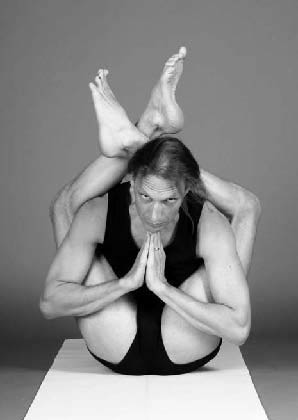
Dvidpada Shirshasana A
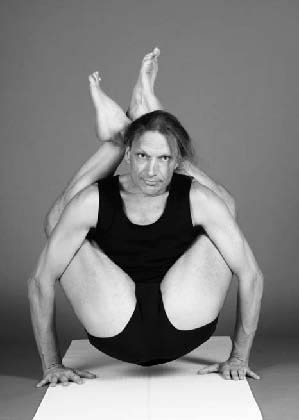
Dvidpada Shirshasana B
Vinyasa Nine
Place both hands on the floor in front of you, and, inhaling, straighten your arms and lift your sit bones off the floor. Try to keep your feet pointed and breathe deeply into your chest. Take five breaths and gaze upward. This posture is considerably easier than vinyasa eight. The spine here is suspended from the shoulders, whereas in vinyasa eight you have to support your spine in an upright position against the force of gravity.
Use the combined effort of your back extensors and trunk flexors to draw your sit bones down to the floor as the crown of the head extends upward, thus putting your spine into traction. Although putting the spine into traction initially seems impossible, it is the key to effective leg-behind-head postures because it increases the space between the vertebrae and thus improves the flow of spinal energy (kundalini).
ACTIVE RELEASE TECHNIQUE: Please note that this method is only for established practitioners. Medially rotate your femurs and attempt to straighten your legs. Superficially this will take you out of the posture, but if your support structure is sound enough to keep your legs in position, it will take you deeper into the posture by increasing the lateral rotation of your femurs and increasing the hamstring stretch aspect of the posture.
At the end of the last exhalation, bend your head forward slightly and sweep both legs off your neck. Inhaling, straighten your legs, keeping them on your arms.
Vinyasa Ten
Exhaling, jump back into Chaturanga Dandasana.
Vinyasa Eleven
Inhaling, lift into Upward Dog.
Vinyasa Twelve
Exhaling, move into Downward Dog.