
PART 3 The Intermediate Series of Asanas (Postures)
THIRD CONNECTIVE SECTION
ARM-BALANCE SEQUENCE
Nakrasana
CROCODILE POSTURE
Drishti Nose
OVERVIEW: This movement, where the body is held close to the floor supported by all fours, resembles the movement of the crocodile. The same movement is performed in African dance, where it also is associated with the crocodile.
Vinyasa Count
Again we start from standing in Samasthiti.
Vinyasa One
Inhaling, raise your arms and look up.
Vinyasa Two
Exhaling, fold forward, placing your hands on either side of your feet.
Vinyasa Three
Inhaling, straighten your arms, flatten out your back, and look up.
These first three vinyasas are identical with those of Surya Namaskara A.
Vinyasa Four
Exhaling, jump back into Chaturanga Dandasana but keep your feet together.
Vinyasa Five
Inhaling, push off with all fours simultaneously and hop forward, landing on the exhalation. Repeat four more times, each time moving further forward. Use the next five breaths to hop backward over the floor until you arrive in the same position that you started in.
The forward movement is easily achieved by plantar flexing your feet and pulling your hands across the floor toward your hips while becoming airborne. Both actions performed simultaneously will create forward propulsion. The lifting-off action, although done instinctually if the strength required is available, is more complex. You need to push your hands with high velocity into the floor, rapidly flexing your humeri (arm bones). This is a movement that is often employed in martial arts, such as boxing, karate, and so on. At the same time powerfully engage your hip flexors and push your feet into the floor. It is similar to the movement you would use to kick a ball, only it is performed with both legs simultaneously, while your body is horizontal. You need to synchronize your arm and leg movements to lift off effectively.
ADDRESSING DIFFICULTIES IN NAKRASANA: Strictly speaking, Nakrasana is the only posture in this series in which power is exercised, if we accept the definition that power equals strength multiplied by velocity. Other movements might exercise strength, but they are not rapid enough to exercise power.26 For this reason, Nakrasana can pose a formidable challenge for some students.
If you cannot lift up at all after trying for a reasonable amount of time, isolate both movements and train them separately. You can train the arm movement by standing upright in front of a wall, facing it. Start with a distance of about two feet (sixty centimeters) and let your body fall toward the wall. Prior to impact, which at this distance would be quite mild, forcefully extend your arms and push your body away from the wall back to an upright position. Do this about ten to twenty times in quick succession. Once you find this exercise easy, extend your distance from the wall. At one yard’s (one meter’s) distance your arms will have to work much more.
A similar exercise benefit would derive from throwing a basketball against a wall from a short distance and catching it on the rebound. Do about forty fast repetitions. A more serious approach would be to take a weight, such as a medicine ball, in both hands and forcefully throw it away from you.27 Don’t choose a weight that is too heavy. It is the velocity of the movement that counts. And yes, be careful where you throw the weight.
THE TWO TYPES OF MUSCLE FIBERS AND YOGA
Muscles are made up of different types of fibers. Type 1 fibers are also called “slow-twitch” fibers because they do exactly that. Their contraction velocity is approximately one-tenth that of type 2, or “fast-twitch,” muscle fibers; they produce less maximum force. Different muscles have a different proportion of type 1 versus type 2 fibers. For example, stabilizing muscles, which need to work a little all the time and provide tone, are made up of slow-twitch fibers. Conversely, a muscle like the biceps, which works only when we need to use it, is primarily composed of fast-twitch muscle fibers. Most muscles will have a combination of both fast- and slow-twitch fibers. Additionally, different people have different proportions of slow- and fast-twitch muscle fibers in their muscles. Muscle fibers, however, do adapt on the basis of the functional demands that are placed upon them. This means that power is a muscle characteristic that can be trained.
As almost all movements in yoga are slow, yogis don’t exercise fast-twitch muscles enough. Similarly, they do not exercise power enough but focus excessively on strength and flexibility. As a result they often become very unbalanced toward the slow-twitch/strength and flexibility end of the spectrum. This is most common in extremely flexible females with low muscle tension. After decades of yoga, they often find they must move on to forms of exercise that are more based on power and fast-twitch. To prevent this imbalance from unfolding, yoginis must emphasize postures like Nakrasana that develop fast-twitch muscles and power. Without this understanding, those who find Nakrasana “too hard” are unlikely to invest the necessary passion to learn to perform it properly.
You can simulate the leg movement by lying on your back and forcefully lifting one leg at a time off the floor. Make sure to fully brace your abdomen (strongly contract all layers of the abdominal muscles but principally the transverse abdominis) to protect your low back. Lift each leg only 20–25 degrees maximum, as this is the amount you move your leg in the posture to lift yourself off the floor, and do about twenty repetitions on each side.
Together with the previous three postures, Nakrasana can exacerbate an already existing shoulder injury. Our tendency is to overuse the muscles on the anterior surface of the thorax, particularly pectoralis minor and major, to the detriment of those on the posterior, the lower trapezius, rhomboid, and latissimus dorsi. Avoid that by strongly drawing your shoulder blades down the back and drawing them in toward the spine. This amounts to lifting the heart and puffing out the chest in the posture. If you have an existing shoulder problem, you may insulate your shoulder joint from impact in this posture and stabilize it by strongly squeezing your elbows in against the rib cage.
Synchronize your movements with the breath. Utilize the lifting quality of a deep inhalation to lift off the floor in Nakrasana and expel the air forcefully upon descent. Let the movement follow the rhythm of the breath and not vice versa. If necessary, experiment with taking a few rapid, forceful breaths first, and once their resonance frequency is established in the body add the vigorous, powerful movement of the extremities to arrive at the forward and backward lunging movement.
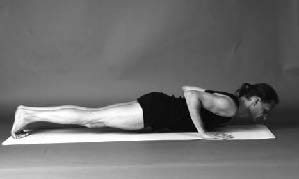
Nakrasana on floor

Nakrasana suspended
Vinyasa Six
Inhaling, move into Upward Dog.
Vinyasa Seven
Exhaling, move into Downward Dog.
Vinyasa Eight
Inhaling, jump forward to standing and look up. This vinyasa is identical with vinyasa three of Surya Namaskara A.
Vinyasa Nine
Exhaling, bend forward, placing your hands on either side of the feet with your fingertips in line with your toes. This vinyasa is identical with vinyasa two of Surya Namaskara A.
Inhaling, come up to Samasthiti. This is the concluding posture of Surya Namaskara A.
25 Remember that raising your arms above your head is called “flexing” the humerus and that extending the humerus is defined as “returning” from flexion.
26 The term power is used here strictly in a physical sense. The development of a “powerful personality” runs counter to the tenets of yoga.
27 The throwing of weight is used as a training in martial arts, where not strength but strength times velocity counts. Do not try to catch the weight once it falls. The catching of a heavy falling object is the classic cause of a glenoid labrum tear, one of the slowest to heal injuries of the passive stabilization system.