
PART 3 The Intermediate Series of Asanas (Postures)
THIRD CONNECTIVE SECTION
ARM-BALANCE SEQUENCE
Mayurasana
PEACOCK POSTURE
Drishti Nose
OVERVIEW: Mayurasana combines the features of an arm balance and an active backbend; it is essentially Shalabhasana balancing on your arms. Fully engaging your back extensors and shoulder stabilizers is essential for performing this posture effectively and safely. The posture is thought to cure abdominal diseases, reflecting the belief that the peacock can transform and neutralize poisons.
Vinyasa Count
We begin this and the next two postures with vinyasa one in Samasthiti. Exhaling, hop your feet hip-width apart and bend forward.
Vinyasa One
Place your hands between your feet, palms facing down and fingers pointing backward. Inhaling, straighten your back and look up.
Vinyasa Two
Exhaling, fold forward.
Vinyasa Three
Inhaling, raise your chest again and look up, arriving in the same position as vinyasa one.
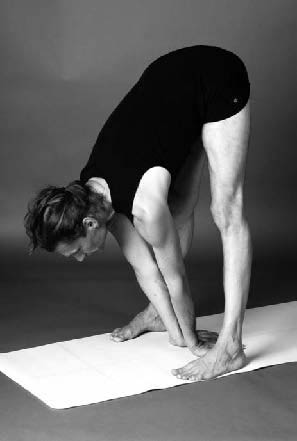
Mayurasana, vinyasa one
Vinyasa Four
Exhaling, hop back as if entering Chaturanga Dandasana. Bend your elbows in transit and bring them as close together as possible; ideally they will touch each other. Failure to do so means you will need to adduct the humeri (arm bones) the whole time, which means engaging the pectoralis major muscle. The weight of the chest will tend to drive the arms apart unless you can place your chest on top of your arms rather than in between them.
To enter Mayurasana the forearms must be firmly planted onto the chest and abdomen. This will give you the advantage of not having to flex the rib cage at the outset of the posture, which will make it easier later on to lift your chest and shoulders away from the floor. Those whose center of gravity is lower down, often females and people with long legs, need to make the thorax hyperkyphotic to place their elbows as low down as possible against the contracted rectus abdominis muscle. This contraction acts as armor for the abdominal organs and provides a stable platform on which to mount the arms. Bend your elbows to form a right angle between your upper arms and forearms. Consciously engage and co-contract all stabilizers of the shoulder girdle and joints before you raise your weight into the air.

Mayurasana, vinyasa two
Vinyasa Five
Inhaling, shift your center of gravity forward, engage your back extensors, and lift up into what looks like a suspended Shalabhasana. Shifting your weight forward in this position means partially extending your elbows. The lower down the center of gravity in your body (when standing), the more you have to lift your chest forward in Mayurasana and extend your elbows to lift your feet off the floor. Bring your feet together and point them.
If you find it difficult to lift up, keep your head down and lift your feet only for five breaths. Once you have mastered this, lift your head by shifting your weight further forward.
If you still encounter problems, consider the following possible reasons and solutions.
1. Make sure that your elbows don’t come apart; this will make it much harder to lift. Strongly engaging pectoralis major will ensure that the elbows stay together.
2. On hot days, your elbows may slip because you are sweating. In this case, place fabric between your elbows and abdomen to provide traction.
3. Excess adipose tissue on thighs and buttocks will make you “bottom heavy” and thus you will have to lunge forward by extending your elbows more. This will make the posture much more difficult. If this is the case, dispose of excess adipose tissue.
4. Difficulties in lifting up can be caused by weakness of the back extensors, but the latissimus dorsi, gluteus maximus, and hamstrings contribute to the lifting as well. Practice Shalabhasana to strengthen these muscles.
5. Shifting your weight forward on slowly extending elbows requires considerable strength of arms and shoulders. If lacking here, practice jumping through from Downward Dog to Dandasana. Perform this movement with great passion, very slowly, gliding through Lollasana without touching down, into a suspended Dandasana, while still inhaling. Lower down only once, and commence exhalation.
6. The abdominals need to provide a strong base to balance on. They are also important as antagonists of the back extensors. To strengthen your abdominals, hold Navasana longer and put more emphasis on clearing the floor when jumping through and jumping back.
Once you find Mayurasana easy, lift as high as you can and straighten your legs. Make sure that your shoulders don’t round and collapse down toward the floor. To do so would court an imbalance of your shoulder muscles, as the more forward and down your shoulders are, the more emphasis will be shifted toward the pectoralis muscles that already bear the brunt of this posture. For a more holistic approach to using your shoulders, lift them away from the floor. This is achieved by drawing the shoulder blades down the back and in toward the spine, using latissimus dorsi, rhomboids, and lower trapezius. Also, make sure that your shoulder blades do not have a winged appearance in this posture. To prevent this, suck the medial borders of the scapulae into the chest by engaging serratus anterior and subscapularis.
To take the posture further, engage your erector spinae even more and arch up into a suspended Shalabhasana. This is the only posture apart from Shalabhasana in which we fully engage erector spinae. Contrary to common perception, the full engagement of erector spinae, although a back extensor, prevents backbending by drawing the spinous processes toward each other, thus shortening the back. As the erector spinae is therefore shunned by the astute yogi in most backbends, we should engage it in Mayurasana to its maximum capacity.
Look toward your nose and stay for five breaths. Exhaling, lower your feet.
WARM-UP AND RESEARCH POSTURE: Shalabhasana with arms extended overhead; if that’s not enough, lie on your belly, place your feet under a sofa, and raise a barbell with your arms.
Vinyasa Six
Inhaling, place your feet on the floor and lift into what resembles an Upward Dog with your hands still in Mayurasana position.
Vinyasa Seven
Exhale into a Downward Dog–like position, apart from keeping your hands in place.
Vinyasa Eight
Inhaling, jump forward to standing, repeating vinyasa three of Mayurasana.

Mayurasana
Vinyasa Nine
Exhaling, bend forward, repeating vinyasa two of Mayurasana.
Inhaling, come up and hop your feet together, returning to Samasthiti.