
PART 3 The Intermediate Series of Asanas (Postures)
FOURTH CONNECTIVE SECTION
Baddha Hasta Shirshasana
BOUND HANDS HEADSTAND
Drishti Nose
OVERVIEW: See Mukta Hasta Shirshasana
Vinyasa Count — A Version
Vinyasa Seven
Inhaling, hop forward and land on your knees.
Exhaling, place your head and arms into the regular headstand position that is part of the cool-down sequence at the end of each series. Adjust the width of the elbows first by reaching with your hands around the opposite elbow. Then interlock your fingers and bring your wrists apart.31 Place the back of your head against your hands and the highest point of the head down on the floor, remembering that the majority of students will balance too far on the forehead and thus create tension in the neck. Of course, you can also balance too far on the back of the head, a much less common error. This in time may lead to a flattening of the natural lordotic curve of the neck or even reverse the curvature (reducing the shock-absorbing quality of the cervical spine). If you are in doubt, the position needs to be assessed by a qualified teacher.
Straighten your legs and walk your feet in as far as possible, without rounding your back.
Vinyasa Eight
Inhaling, slowly lift your straight legs together up into headstand. Follow all the instructions given for the previous headstand.
Engage all the muscles of your shoulder girdle and your arms firmly to balance.
Take five breaths and look toward your nose.
The posture up to here will prove no challenge, as you are practicing it daily already. The only trick is to shift your hands quickly enough from the present position into the three-point-headstand position. You need to make sure that your hands are only loosely interlocked and that there is little or no weight on them just before you pull out.
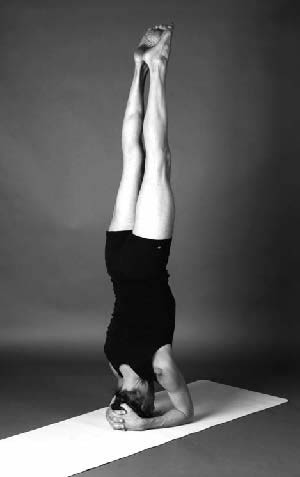
Baddha Hasta Shirshasana A
On the last inhalation, hook the breath into the bandhas and become as light as possible. When you are most buoyant, quickly move your hands into a three-point-headstand position (as in Mukta Hasta Shirshasana A), shift your weight toward your hands, and press them powerfully into the floor.
Vinyasa Nine
Exhaling, drop into Chaturanga Dandasana, as in the previous versions.
Vinyasa Ten
Inhaling, move into Upward Dog.
Vinyasa Eleven
Exhaling, move into Downward Dog.
Vinyasa Count — B Version
Vinyasa Seven
Inhaling, hop forward and land on your knees.
Exhaling, place your head and arms in exactly the same positions as in the previous posture. This time, however, after you place your head in the correct position, reach with your hands around your elbows and keep them clasped. The key to the position is the correct distance from the crown of your head to the line going through both elbows. It needs to be exactly the same as in your daily headstand.
Straighten your legs and walk your feet in as far as possible, without rounding your back.
Vinyasa Eight
Inhaling, slowly lift your straight legs together up into headstand. Follow all the instructions given for the previous headstand, trying as usual to carry most of the weight with your arms.
Take five breaths and look toward your nose.
The transition out of this posture is easier than that out of the previous one.
On the last inhalation, hook the breath into the bandhas and become as light as possible. When you are most buoyant, quickly move your hands into a three-point-headstand position (as in Mukta Hasta Shirshasana A), shift your weight toward your hands, and press them powerfully into the floor.
Vinyasa Nine
Exhaling, drop into Chaturanga Dandasana, as in the previous versions.
Vinyasa Ten
Inhaling, move into Upward Dog.
Vinyasa Eleven
Exhaling, move into Downward Dog.
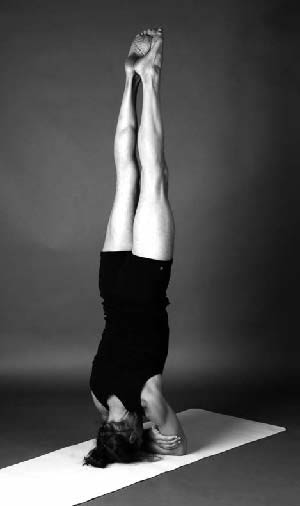
Baddha Hasta Shirshasana B
Vinyasa Count — C Version
Vinyasa Seven
Inhaling, hop forward and land on your knees.
Exhaling, place your head and arms in exactly the same positions as in Baddha Hasta Shirshasana A. This time, however, after you place your head in the correct position, let go of your hands and place your forearms parallel to each other, in a forearm-balance position. Again, the key to the position is the correct distance from the crown of your head to the line going through both elbows. It needs to be exactly the same as in your daily headstand. If you deviate from this ideal line in either direction, you will find it difficult to lift up into the posture.
Straighten your legs and walk your feet in as far as possible, without rounding your back.
Vinyasa Eight
Inhaling, slowly lift your straight legs together up into headstand. You will need considerable hamstring flexibility to do so, but resist the temptation to solve the problem by bending your legs. You will be rewarded with an increase in core stability if you perform the posture properly.
Follow all the instructions given for the previous headstands, trying as usual to carry a lot of weight with your arms. This posture is very similar to Pincha Mayurasana, with the difference that here your head touches the floor lightly. Externally rotate the humeri to prevent the wrists from moving together and the elbows from moving apart. The inability to perform this action is usually caused by a chronically short and tight infraspinatus muscle (for an illustration of the infraspinatus, see Ashtanga Yoga: Practice and Philosophy, p. 31). In this case massage and/or trigger point (see p. 77) this muscle daily; to a certain extent you can do this yourself. A shortened infraspinatus is usually part of a general mis-tone and imbalance of the shoulder girdle. This needs to be addressed before you attempt advanced arm balances, as those postures would exacerbate an existing imbalance. To address shoulder imbalance, see the section on the shoulder joint (pp. 71–77).
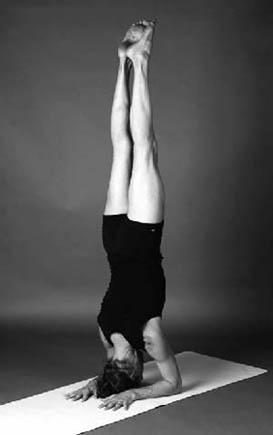
Baddha Hasta Shirshasana C
Take five breaths and look toward your nose.
The transition out of this posture is the easiest out of all Baddha Hasta Shirshasanas.
On the last inhalation, hook the breath into the bandhas and become as light as possible. When you are most buoyant, quickly move your hands into a three-point-headstand position (as in Mukta Hasta Shirshasana A), shift your weight toward your hands, and press them powerfully into the floor.
Vinyasa Nine
Exhaling, drop into Chaturanga Dandasana.
Vinyasa Ten
Inhaling, move into Upward Dog.
Vinyasa Eleven
Exhaling, move into Downward Dog.
Vinyasa Count — D Version
Vinyasa Seven
Inhaling, hop forward and land on your knees.
Exhaling, place your head and arms in exactly the same positions as in the Baddha Hasta Shirshasana A. This time, however, after you place your head in the correct position, let go of your hands and place your palms on your back, so that you are balancing only on your head and your elbows. Rather than placing your hands on your trapezius muscle close to your neck, try to place them as far out on your shoulders as possible. Inability to do so is usually caused by stiff shoulders.
Also here, the key to the position is the correct distance from the crown of the head to the line going through both elbows. It needs to be exactly the same as in your daily headstand.
Straighten your legs and walk your feet in as far as possible, without rounding your back.
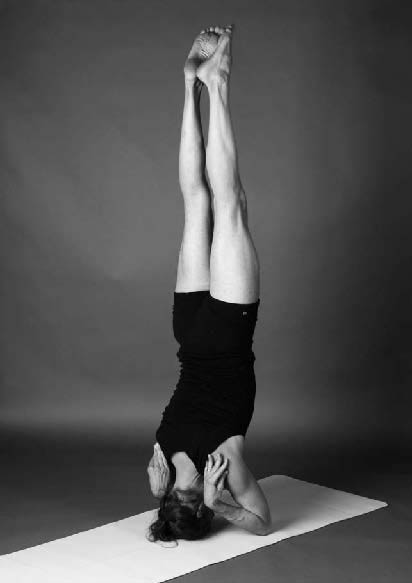
Baddha Hasta Shirshasana D
Vinyasa Eight
Inhaling, slowly lift your straight legs together up into headstand. The lifting is actually easier than in the previous version.
Follow all the instructions given for the previous headstands, trying as usual to carry a lot of weight with your arms. It is especially important here to draw the shoulder blades up to the ceiling.
Take five breaths and look toward your nose.
The transition is performed in the same way as in the previous postures.
Vinyasa Nine
Exhaling, drop into Chaturanga Dandasana.
Vinyasa Ten
Inhaling, move into Upward Dog.
Vinyasa Eleven
Exhaling, move into Downward Dog.
Vinyasa Twelve
Inhaling, jump through to Dandasana.
Exhaling, lie down.
28 “Jalandhara Bandha position” refers to a position that externally looks identical to Jalandhara Bandha. However, the significant internal action of swallowing and consequently locking the throat for breath retention, done in Jalandhara Bandha, does not occur here.
29 Anatomically, the term leg refers only to the part of the lower extremity from the knee to the ankle joint. The part above the knee joint is referred to as thigh.
30 The other likely cause would be if you let the crease of your elbow face outward in Ardha Matsyendrasana.
31 Unless you use the short humeri/long neck version described in Ashtanga Yoga: Practice and Philosophy, p. 122.