

Now that you have mastered core stability, it is time to put the body to work and strengthen it.
Core strength is the balanced development of both the deep and superficial muscles that stabilize, align, and move the trunk of the body. Although these muscles play various roles in the body, their major function is to provide support for your spine. If your core is weak, you are more susceptible to injury—a weak core places strain on your spine and your entire body. Core strengthening stabilizes the muscles of your midsection, including the hips and pelvis, so movements such as running or walking are improved, making it easier to perform activities.
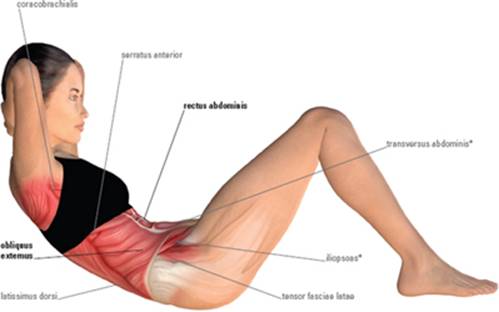
BASIC CRUNCH
CORE STRENGTH
 Lie supine on the floor with your knees bent, and clasp your hands behind your head.

 Keeping your elbows wide, engage the abdominals, and lift your upper torso to achieve a crunching movement.
 Slowly return to the starting position. Repeat fifteen times for two sets.

DO IT RIGHT
LOOK FOR
• Your shoulders and abdominals to initiate the movement.
• Your pelvis to remain in neutral position during the crunching motion.
• Your chin to be tucked slightly, directing your gaze toward the inner thighs.
AVOID
• Pulling from the neck.
• Tilting your hips toward the floor.
BEST FOR
• rectus abdominis
• obliquus internus
• obliquus externus
• transversus abdominis
QUICK GUIDE
TARGET
• Abdominals
BENEFITS
• Strengthens the torso
• Improves pelvic and core stability
NOT ADVISABLE IF YOU HAVE
• Back pain
• Neck pain
ANNOTATION KEY
Bold text indicates active muscles
Gray text indicates stabilizing muscles
* indicates deep muscles

MODIFICATION
More difficult: Begin by lying supine on the floor with your legs outstretched, and your arms over your head. Without lifting your legs, lift your arms and torso in a controlled movement. Continue to curl forward and grasp your feet.

CROSSOVER CRUNCH
CORE STRENGTH
Bring your hands behind your head, lifting your legs off the floor into a tabletop position.
Roll up with your torso, reaching your right elbow to your left knee and extending the right leg in front of you. Imagine pulling your shoulder blades off the floor and twisting from your ribs and oblique muscles.

Alternate sides. Repeat sequence six times.

DO IT RIGHT
LOOK FOR
• Your neck to remain long and your chin to remain away from your chest.
• Both hips to remain stable on the floor.
AVOID
• Pulling with your hands, bringing your chin toward your chest, or arching your back.
• Moving the active elbow faster than your shoulder.
BEST FOR
• rectus abdominis
• transversus abdominis
• obliquus externus
• obliquus internus
• rectus femoris
• vastus medialis
• sartorius
• tensor fasciae latae
QUICK GUIDE
TARGET
• Torso stability
• Abdominals
BENEFITS
• Stabilizes core
• Strengthens abdominals
NOT ADVISABLE IF YOU HAVE
• Neck issues
• Lower-back pain
ANNOTATION KEY
Bold text indicates active muscles
Gray text indicates stabilizing muscles
* indicates deep muscles

MODIFICATION
Easier: Begin with both feet on the floor. Place the outside of one foot on top of your thigh near your knee. Reach your opposite elbow toward the knee of your raised leg. After six repetitions, repeat on the other side.

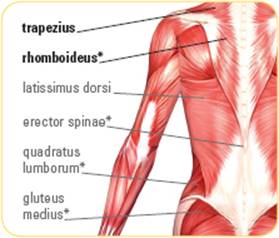
LATERAL LOW LUNGE
CORE STRENGTH
Stand upright with your hips and arms outstretched in front of you, parallel to the floor.

Step out to the left. Squat down on your right leg, bending at your hips, while maintaining a neutral spine. Begin to extend your left leg, keeping both feet flat on the floor.
Bend your right knee until your thigh is parallel to the floor, and your left leg is fully extended.
 Keeping your arms parallel to the ground, squeeze your buttocks and press off your right leg to return to the starting position, and repeat. Repeat sequence ten times on each side.

DO IT RIGHT
LOOK FOR
• Your spine to remain neutral as you bend your hips.
• Your shoulders and neck to remain relaxed.
• Your knee to align with the toe of your bent leg.
• The gluteal muscles to be tight as you bend.
AVOID
• Craning your neck as you perform the movement.
• Lifting your feet off the floor.
• Arching or extending your back.
BEST FOR
• adductor longus
• adductor magnus
• semitendinosus
• semimembranosus
• biceps femoris
• sartorius
• vastus medialis
• vastus lateralis
• vastus intermedius
• rectus femoris
• gluteus maximus
• gluteus medius
• rectus abdominis
QUICK GUIDE
TARGET
• Gluteal and thigh muscles
BENEFITS
• Strengthens the pelvic, trunk, and knee stabilizers
NOT ADVISABLE IF YOU HAVE
• Sharp knee pain
• Back pain
• Trouble bearing weight on one leg
ANNOTATION KEY
Bold text indicates active muscles
Gray text indicates stabilizing muscles
* indicates deep muscles

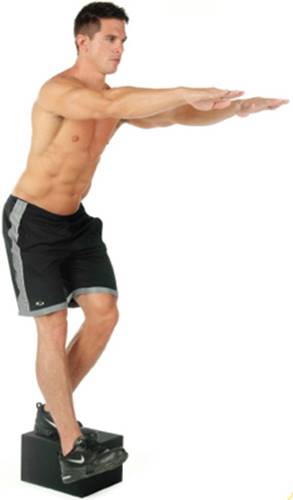
STEP-DOWN
CORE STRENGTH
Standing up straight on a firm step or block, plant your left foot firmly close to the edge, and allow the right foot to hang off the side. Flex the toes of your right foot.

Lift your arms out in front of you for balance, keeping them parallel to the floor. Lower your torso as you bend at your hips and knees, dropping your right leg toward the floor.
Without rotating your torso or knee, press upward through your left leg to return to the starting position. Repeat fifteen times for two sets on each leg.
DO IT RIGHT
LOOK FOR
• Your bent knee to align with your second toe—your knee should not rotate inward.
• Your knees and hips to move simultaneously as you bend.
• Your hips to remain behind your foot, leaning your torso forward as you lower into the bend.
AVOID
• Craning your neck.
• Placing weight on the foot being lowered to the floor—only allow a touch.
BEST FOR
• vastus medialis
• vastus lateralis
• vastus intermedius
• rectus femoris
• gluteus maximus
• gluteus medius
• semitendinosus
• semimembranosus
• biceps femoris
QUICK GUIDE
TARGET
• Quadriceps
• Gluteal muscles
BENEFITS
• Strengthens pelvic and knee stabilizers
NOT ADVISABLE IF YOU HAVE
• Ankle pain
• Sharp knee pain
• Sharp lower-back pain
ANNOTATION KEY
Bold text indicates active muscles
Gray text indicates stabilizing muscles
* indicates deep muscles


TENDON STRETCH
CORE STRENGTH
Standing with your feet together and parallel, extend your arms in front of your body for stability. With your feet planted firmly on the floor, curl your toes upward.

Draw in your abdominal muscles, and bend into a squat. Keep your heels planted on the floor and your chest as upright as possible, resisting the urge to bend too far forward.
Exhale, returning to the original position. Imagine pressing into the floor as you rise, creating your body’s own resistance in your leg muscles. Repeat five to six times.

DO IT RIGHT
LOOK FOR
• Your chest to remain upright.
• Your abdominals to be pulled in toward your spine.
• Your toes to curl upward throughout the movement.
AVOID
• Allowing your heels to come off the floor.
• Rising to the standing position too quickly.
BEST FOR
• tibialis anterior
• gastrocnemius
• soleus
• gluteus maximus
• biceps femoris
• rectus femoris
• adductor hallucis
• vastus medialis
QUICK GUIDE
TARGET
• Arches of feet
• Calf muscles
BENEFITS
• Lengthens and strengthens calf muscles
• Improves balance
NOT ADVISABLE IF YOU HAVE
• Foot pain
ANNOTATION KEY
Bold text indicates active muscles
Gray text indicates stabilizing muscles
* indicates deep muscles

ABDOMINAL KICK
CORE STRENGTH
 Pull your right knee toward your chest and straighten your left leg, raising it about 45 degrees from the floor.
 Place your right hand on your right ankle, and your left hand on your right knee (this maintains proper alignment of leg).

 Switch your legs two times, switching your hand placement simultaneously.

 Switch your legs two more times, keeping your hands in their proper placement. Repeat four to six times.

DO IT RIGHT
LOOK FOR
• Your outside hand to be placed on the ankle of your bent leg, and your inside hand to be placed on your bent knee.
• The top of your sternum to be lifted forward.
AVOID
• Allowing your lower back to rise up off the floor; use your abdominals to stabilize core while switching legs.
BEST FOR
• rectus abdominis
• transversus abdominis
• obliquus internus
• biceps femoris
• triceps brachii
• biceps brachii
• tibialis anterior
• tensor fasciae latae
QUICK GUIDE
TARGET
• Torso stability
• Abdominals
BENEFITS
• Stabilizes core while extremities are in motion
• Strengthens abdominals
NOT ADVISABLE IF YOU HAVE
• Neck issues
• Lower-back pain
ANNOTATION KEY
Bold text indicates active muscles
Gray text indicates stabilizing muscles
* indicates deep muscles

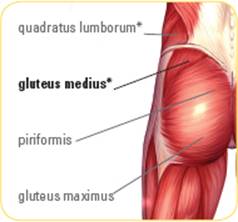
POWER SQUAT
CORE STRENGTH
Stand straight, holding a weighted ball in front of your torso.
Shift your weight to your left foot, and bend your right knee, lifting your right foot toward your buttocks. Bend your elbows and draw the ball toward the outside of your right ear.

Maintaining a neutral spine, bend at your hips and knee. Lower your torso toward your left side, bringing the ball toward your right ankle.
Press into your left leg and straighten your knee and torso, returning to the starting position. Repeat fifteen times for two sets on each leg.

DO IT RIGHT
LOOK FOR
• The ball to create an arc in the air.
• Your hips and knees to be aligned throughout the movement.
• Your shoulders and neck to remain relaxed.
AVOID
• Allowing your knee to extend beyond your toes as you bend and rotate.
• Moving your foot from its starting position.
• Flexing your spine.
BEST FOR
• semitendinosus
• semimembranosus
• biceps femoris
• vastus medialis
• vastus lateralis
• rectus femoris
• gluteus maximus
• gluteus medius
• piriformis
• erector spinae
• tibialis anterior
• tibialis posterior
• soleus
• gastrocnemius
• deltoideus
• infraspinatus
• supraspinatus
• teres minor
QUICK GUIDE
TARGET
• Stabilizers of the body
• Gluteal and thigh strength
BENEFITS
• Improves balance
• Improves pelvic, trunk, and knee stabilization
• Promotes stronger movement patterns
NOT ADVISABLE IF YOU HAVE
• Sharp knee pain
• Lower-back pain
• Shoulder pain
ANNOTATION KEY
Bold text indicates active muscles
Gray text indicates stabilizing muscles
* indicates deep muscles


LEMON SQUEEZER
CORE STRENGTH
Lie supine on the floor. Lift your legs, head, neck, and shoulders slightly off the floor, being careful not to arch your lower back. Your arms should be raised and parallel to the floor.

Pulling your knees in toward your chest, reach your arms forward to your ankles, so that your torso lifts completely off the floor.
Slowly open up, lengthening your legs and lowering your torso back to the starting position.
Repeat the motion without completely lying down on the mat. Repeat fifteen times for two sets.

DO IT RIGHT
LOOK FOR
• The chin to remain tucked.
• Your thigh muscles to be firm throughout the exercise.
AVOID
• Allowing your shoulders to lift up toward your ears.
BEST FOR
• rectus abdominis
• obliquus internus
• obliquus externus
• transversus abdominis
• tensor fasciae latae
• vastus intermedius
• rectus femoris
• vastus medialis
• iliacus
• piriformis
• iliacus
QUICK GUIDE
TARGET
• Abdominals
BENEFITS
• Increases abdominal endurance
• Strengthens hip flexors
NOT ADVISABLE IF YOU HAVE
• Lower-back pain
ANNOTATION KEY
Bold text indicates active muscles
Gray text indicates stabilizing muscles
* indicates deep muscles
V-UP
CORE STRENGTH
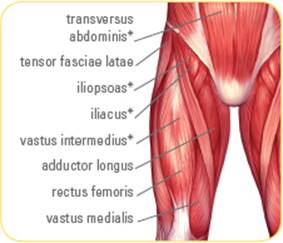
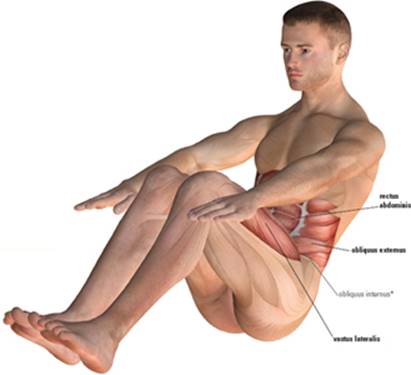
Lie on your back with your legs raised at an angle between 45 and 90 degrees.
Inhale, reaching your arms toward the ceiling as you lift your head and shoulders off the floor.

Exhale, and, while rolling through the spine, lift your rib cage off the floor to just before the sit bones.

Inhale, and reach your arms toward your toes while maintaining a C curve in your back. Exhale, and roll down the spine by articulating one vertebra at a time. Return to the starting position.

DO IT RIGHT
LOOK FOR
• Articulation through the spine on the way up and on the way down.
• Your neck to remain elongated and relaxed, minimizing the tension in your upper spine.
AVOID
• Using momentum to carry you through the exercise. Use your abdominal muscles to lift your legs and torso.
BEST FOR
• rectus abdominis
• tensor fasciae latae
• rectus femoris
• vastus lateralis
• vastus medialis
• vastus intermedius
• adductor longus
• pectineus
• brachialis
QUICK GUIDE
TARGET
• Abdominals
BENEFITS
• Strengthens the abdominals while mobilizing the spine
NOT ADVISABLE IF YOU HAVE
• Advanced osteoporosis
• A herniated disk
• Lower-back pain
ANNOTATION KEY
Bold text indicates active muscles
Gray text indicates stabilizing muscles
* indicates deep muscles

RUSSIAN TWIST
CORE STRENGTH
Sit with your knees bent and your feet flat on the floor. Lift up through your torso. Raise your arms parallel to the floor so that your hands are outstretched above your knees.

Rotate your upper body to the right, reaching toward the floor with your hands.
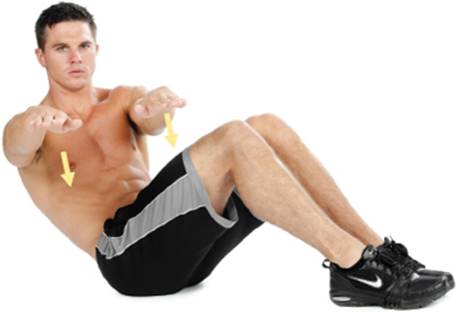
Pass through the center and rotate to the left. Repeat ten times on each side.

DO IT RIGHT
LOOK FOR
• Your feet to remain planted on the floor as you twist.
• Your knees to be squeezed together.
• Your neck and shoulders to remain relaxed.
AVOID
• Shifting your feet or knees to the sides as you twist.
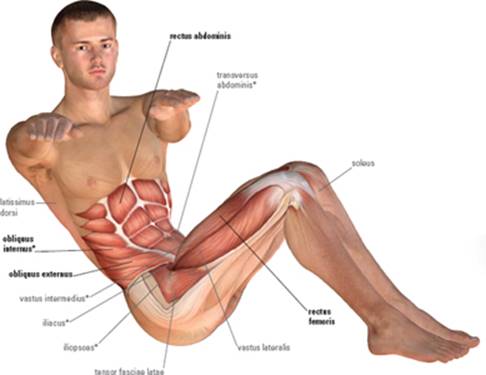
BEST FOR
• rectus abdominis
• obliquus internus
• obliquus externus
• transversus abdominis
• vastus intermedius
• rectus femoris
• iliacus
• iliopsoas
QUICK GUIDE
TARGET
• Abdominals
• Hip flexors
• Quadriceps
BENEFITS
• Increases abdominal endurance
• Strengthens hip flexors
ANNOTATION KEY
Bold text indicates active muscles
Gray text indicates stabilizing muscles
* indicates deep muscles
MODIFICATION
More difficult: Lift your feet off the floor, and rotate your torso from side to side, pulling your knees in and out as you twist.

PLANK KNEE PULL-IN
CORE STRENGTH
Start in the plank position, with your shoulders directly over your hands, your torso straight.

Draw your left knee into your chest, flexing the foot while rocking your body forward over your hands. You should come up on the toes of your right foot.
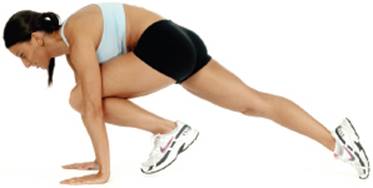
Extend your left knee backward, rocking the body back, and shifting your weight onto your heel. With your head in between your hands, straighten your right leg and lift it toward the ceiling. Repeat ten times on each leg.

DO IT RIGHT
LOOK FOR
• Your shoulders to align over your hands and your toes to flex during the inward movement.
AVOID
• Bending the knee of the supporting leg.
BEST FOR
• rectus abdominis
• transversus abdominis
• sartorius
• obliquus externus
• rectus femoris
• tibialis anterior
QUICK GUIDE
TARGET
• Scapular and core stabilizers
• Calf and hamstring flexibility
NOT ADVISABLE IF YOU HAVE
• Sharp lower-back pain
• Wrist pain
• Ankle pain
ANNOTATION KEY
Bold text indicates active muscles
Gray text indicates stabilizing muscles
* indicates deep muscles


SIDE-LIFT BEND
CORE STRENGTH
Lie on your left side with your right arm placed behind your head and your left arm lying flat on top of your thigh. Tightly press your legs together.
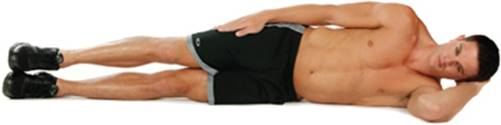
Tighten your abdominals and lift both legs off the floor.

Sliding your right hand down your outstretched leg, lift your head, and crunch your oblique muscles from your upper body and lower body simultaneously. Repeat ten times on each side.

DO IT RIGHT
LOOK FOR
• Your buttocks to be squeezed before lifting to better stabilize the pelvis.
• Your neck to be elongated.
• Your hand to slide down on the top leg as you crunch up.
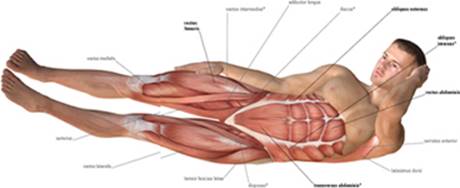
BEST FOR
• rectus abdominis
• transversus abdominis
• obliquus externus
• obliquus internus
QUICK GUIDE
TARGET
• Obliques
• Abdominals
BENEFITS
• Strengthens and stabilizes the body
NOT ADVISABLE IF YOU HAVE
• Lower-back pain
ANNOTATION KEY
Bold text indicates active muscles
Gray text indicates stabilizing muscles
* indicates deep muscles
THE TWIST
CORE STRENGTH
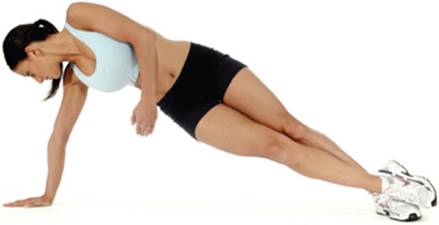
Start on your right side with your legs outstretched and pressed firmly together. Press your right hip into the floor, and use both hands to support your torso.

Position your right hand directly beneath your shoulder and press your body up into a side plank with side-arm balance.
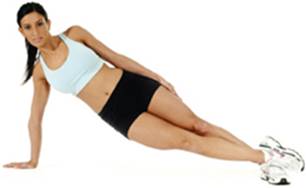
Drawing your navel into your spine, extend your left arm toward the ceiling.

Bring your left arm down and across your torso, rotating the upper body to the right. Hold for a count.
 Return to the starting position, with your hip on the floor and both hands supporting your torso. Repeat sequence four to six times, and then switch sides.
DO IT RIGHT
LOOK FOR
• Your limbs to be elongated as much as possible.
• Your shoulders to remain stable.
• Your hips to be lifted up high to reduce the weight on your upper body.
AVOID
• Allowing your shoulder to sink into its socket.
BEST FOR
• latissimus dorsi
• rectus abdominis
• obliquus internus
• obliquus externus
• transversus abdominis
• adductor magnus
• adductor longus
• deltoideus
QUICK GUIDE
TARGET
• Shoulders
• Abdominals
BENEFITS
• Provides a total-body workout
• Builds endurance
NOT ADVISABLE IF YOU HAVE
• Shoulder issues
• Back pain
• Wrist injury

HIP TWIST
CORE STRENGTH
Begin by sitting on the floor with your arms behind your body, supporting your weight. Your legs should be parallel and raised to a high diagonal.
Engage your abdominals and shoulders for stabilization.

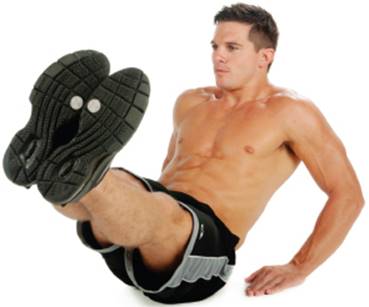
Start to bring both legs across the body to the right.
Continue to circle your legs across your body and down as low as pelvic stabilization can be maintained.
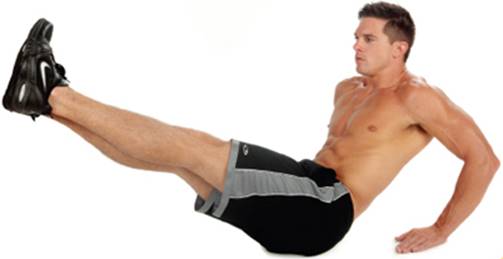
Return your legs to the starting position. Repeat two to six times in each direction.
DO IT RIGHT
LOOK FOR
• Your legs to be lengthened as you move from side to side.
• Your arms to push out of your shoulders to better engage your torso.
• Your neck to be elongated.
AVOID
• Tensing your neck and shoulder muscles.
BEST FOR
• tensor fasciae latae
• rectus femoris
• vastus lateralis
• biceps femoris
• gluteus maximus
• gluteus medius
• iliotibial band
• sartorius
• vastus medialis
• vastus intermedius
• adductor longus
QUICK GUIDE
TARGET
• Abdominals
BENEFITS
• Strengthens abdominals against gravity and weight of legs
NOT ADVISABLE IF YOU HAVE
• Back pain
• Hip instability
ANNOTATION KEY
Bold text indicates active muscles
Gray text indicates stabilizing muscles
* indicates deep muscles


KNEELING SIDE LIFT
CORE STRENGTH
Begin by kneeling on the floor, with your right leg outstretched to the side and the left leg lined up under the hips. Place both hands behind your head, with your elbows extended out to the sides.

 Begin leaning your torso to the left.

 Lift your right leg up off the floor, bringing it as high as your hips. Repeat sequence five to six times. Switch sides, and repeat the sequence with your left leg.

DO IT RIGHT
LOOK FOR
• Your torso to remain aligned to better balance the movement of your leg.
• Your neck to be relaxed and lengthened.
• Your leg to be elongated as much as possible.
AVOID
• Sinking into your neck or shoulders.
BEST FOR
• rectus abdominis
• transversus abdominis
• obliquus externus
• adductor longus
• iliopsoas
• iliacus
• gracilis
• biceps femoris
• vastus lateralis
QUICK GUIDE
TARGET
• Abductor muscles
• Abdominals
• Gluteal muscles
BENEFITS
• Trims the waistline
NOT ADVISABLE IF YOU HAVE
• Knee pain or injury
• Back pain
ANNOTATION KEY
Bold text indicates active muscles
Gray text indicates stabilizing muscles
* indicates deep muscles


KNEELING SIDE KICK
CORE STRENGTH
 Kneel with your right hand on the floor directly below your shoulder, with the fingers pointing outward. Place your left hand behind your head.

Lift your left leg to the height of your hip and straighten it, reaching out of your heel. Keep your whole body aligned in one plane so that there is no rotation.
Kick your left leg straight out in front of you, flexing your foot and trying not to move at your waist.

 Pull your left leg behind you, pointing your toes and keeping the leg at hip height. Repeat sequence ten times on each side.

DO IT RIGHT
LOOK FOR
• Your weight to bear on the palm of your hand to help maintain balance.
• Your neck to remain long and relaxed.
• Your body to align so that your shoulders, hips, and legs line up to better activate deep muscles.
AVOID
• Wobbling with movement of the leg—instead, make the movement smaller.
BEST FOR
• rectus abdominis
• transversus abdominis
• obliquus externus
• obliquus internus
• gluteus medius
• gluteus maximus
• adductor longus
• gracilis
• tensor fasciae latae
• sartorius
• rectus femoris
• iliacus
• iliopsoas
• vastus lateralis
QUICK GUIDE
TARGET
• Leg abductors
• Abdominals
NOT ADVISABLE IF YOU HAVE
• Wrist issues
• Severe back pain
• Shoulder issues
ANNOTATION KEY
Bold text indicates active muscles
Gray text indicates stabilizing muscles
* indicates deep muscles


ABDOMINAL HIP LIFT
CORE STRENGTH
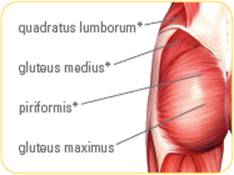
Lie down with your legs in the air and crossed at the ankles, knees straight. Place your arms on the floor, straight by your sides.

Pinching your legs together and squeezing your buttocks, press into the back of your arms to lift your hips upward.
Slowly return your hips to the floor. Repeat ten times, then switch with the opposite leg crossed in the front.

DO IT RIGHT
LOOK FOR
• Your legs to remain straight and firm throughout the exercise.
• Your neck and shoulders to be relaxed as you lift the hips.
AVOID
• Jerking your movements or using momentum to lift the hips.
BEST FOR
• rectus abdominis
• transversus abdominis
• vastus intermedius
• tensor fasciae latae
• gluteus maximus
• gluteus medius
• triceps brachii
• rectus femoris
• iliacus
• iliopsoas
QUICK GUIDE
TARGET
• Abdominals
• Triceps
BENEFITS
• Strengthens core and pelvic stabilizers
• Firms and tones lower abdominals
NOT ADVISABLE IF YOU HAVE
• Back pain
• Neck pain
• Shoulder pain

MODIFICATION
More difficult: Keeping your hips on the floor, raise your arms toward the ceiling. Reach toward your toes as you lift your shoulders off the floor.

HAND WALK-OUT
CORE STRENGTH
Stand straight, arms at your sides.

Bend forward from the waist, and place your hands on the floor in front of you, at a distance slightly wider than your feet. Keep your knees as straight as possible

Shift your weight to your hands, and slowly “walk” them forward, while keeping the knees straight, the hips up, and the spine straight.

Return by walking back toward the starting position and pushing your hips upward, folding the torso at the hips.

DO IT RIGHT
LOOK FOR
• Your spine and legs to remain straight.
• A controlled, steady movement.
AVOID
• Bending your knees.
• Allowing your spine to sag in the middle.
• Bending your elbows.
BEST FOR
• pectoralis major
• pectoralis minor
• coracobrachialis
• deltoideus anterior
• triceps brachii
• iliopsoas
• vastus lateralis
• vastus medialis
• vastus intermedius
• rectus femoris
• transversus abdominis
• serratus anterior
• erector spinae
• trapezius
• latissimus dorsi
• quadratus lumborum
• brachialis
• tibialis anterior
• flexor carpi radialis
• extensor digitorum
• extensor carpi radialis
• biceps brachii
QUICK GUIDE
TARGET
• Torso stability
• Abdominals
BENEFITS
• Stabilizes core
• Strengthens abdominals
NOT ADVISABLE IF YOU HAVE
• Shoulder issues
• Lower-back pain
ANNOTATION KEY
Bold text indicates active muscles
Gray text indicates stabilizing muscles
* indicates deep muscles


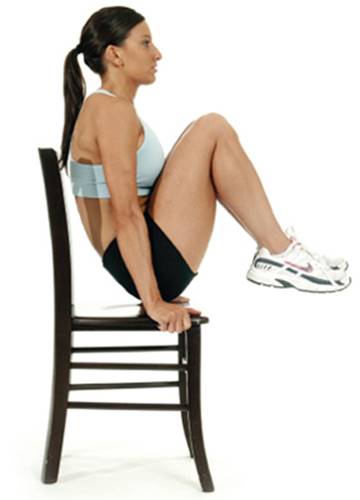
CHAIR ABDOMINAL CRUNCH
CORE STRENGTH
Sit on a chair with your hands grasping the sides of the seat and your arms straight.
Step forward so that your knees are bent but your buttocks are lifted off the chair. Your hips and knees should be bent to form 90-degree angles.

Tuck your tailbone toward the front of the chair, and bend your knees toward your chest. Bend your elbows simultaneously. At the bottom of the movement, extend your elbows and press through your shoulders.
Keeping your head in neutral position, press into the chair and lower your legs to return to the starting position. Repeat fifteen times for two sets.
DO IT RIGHT
LOOK FOR
• Your spine to be neutral as you progress through the motion.
• Your knees to align over your ankles.
• Your body to remain close to the chair.
AVOID
• Allowing your shoulders to lift up toward your ears.
BEST FOR
• triceps brachii
• deltoideus
• infraspinatus
• supraspinatus
• teres minor
• subscapularis
• iliacus
• iliopsoas
• gracilis
• rectus abdominis
• transversus abdominis
QUICK GUIDE
TARGET
• Shoulder stabilizers
• Triceps
BENEFITS
• Strengthens upper body
• Improves shoulder stability
NOT ADVISABLE IF YOU HAVE
• Shoulder pain
• Neck pain
ANNOTATION KEY
Bold text indicates active muscles
Gray text indicates stabilizing muscles
* indicates deep muscles


PUSH-UP HAND WALK-OVER
CORE STRENGTH
Start in a plank position with your left hand on the floor and your right on an elevated box or step between four and six inches high.
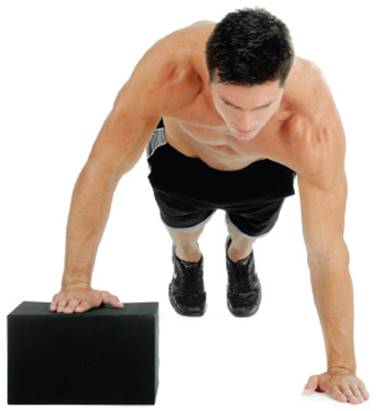
Keeping your torso rigid and your legs straight, bend your elbows into a push-up position.
Push back up, straightening your elbows to return to the starting position.

Lift your left hand off the floor, and place it beside your right on the top of the box.

 Lift your right hand off the box, placing it on the floor about one shoulder width to the right.
 Bend your elbows to perform another push-up, this time on the other side of the box.
 Return to the top of the box and repeat. Perform five push-ups on each side.

DO IT RIGHT
LOOK FOR
• Your hands to align under your shoulders.
AVOID
• Dipping your shoulders to one side.
• Shifting your hips as your hands “walk.”
• Craning your neck.
BEST FOR
• vastus medialis
• vastus lateralis
• vastus intermedius
• rectus femoris
• gluteus maximus
• pectoralis major
• pectoralis minor
• deltoideus
• triceps brachii
• rectus abdominis
• erector spinae
• trapezius
• latissimus dorsi
• quadratus lumborum
QUICK GUIDE
TARGET
• Total-body strengthening and stabilization
BENEFITS
• Strengthens the pelvic, trunk, and shoulder stabilizers
NOT ADVISABLE IF YOU HAVE
• Shoulder pain
• Back pain
• Neck pain
ANNOTATION KEY
Bold text indicates active muscles
Gray text indicates stabilizing muscles
* indicates deep muscles


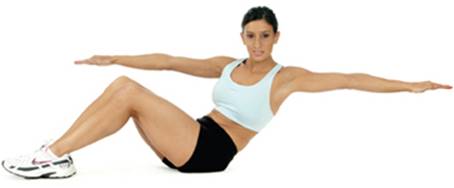
OBLIQUE ROLL-DOWN
CORE STRENGTH
Sit with your arms extended to the sides, parallel to the floor.
Contract your abdominals, drawing your navel to your spine and lengthening the spine upward.

Roll backward while simultaneously rotating your torso to one side.
Maintaining spinal flexion, rotate your torso back to the center.
Rotate to the other side, deepening the abdominal contraction.
Return back to the center, and repeat sequence four to six times on each side.
DO IT RIGHT
LOOK FOR
• Your arms to lengthen as you roll down to create opposition throughout the torso.
• Your neck to be relaxed and lengthened to prevent straining.
• Your spine to be articulated while rolling up and down.
AVOID
• Tensing your neck and shoulder muscles.
BEST FOR
• obliquus externus
• obliquus internus
• rectus abdominis
• transversus abdominis
QUICK GUIDE
TARGET
• Obliques
BENEFITS
• Targets the obliques and abdominals while challenging the ability to maintain the C curve
NOT ADVISABLE IF YOU HAVE
• A herniated disk
ANNOTATION KEY
Bold text indicates active muscles
Gray text indicates stabilizing muscles
* indicates deep muscles

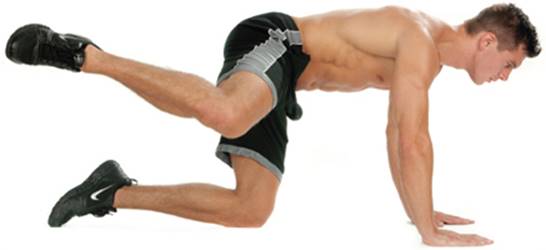
QUADRUPED LATERAL LIFT
CORE STRENGTH
Kneel on your hands and knees, your spine in neutral position.

Keep your weight centered and raise your right knee—still bent—out to the side.
Raise and lower your leg without moving your hips. Repeat ten times, and then switch legs.
DO IT RIGHT
LOOK FOR
• Your spine to remain neutral, so as to prevent the lower back from sagging.
• Your chin to remain tucked and your head in neutral.
• Your hands to press into the floor and out of the shoulders to keep the shoulders from sinking near the ears.
AVOID
• Lifting the hip as you lift your leg.
BEST FOR
• rectus abdominis
• obliquus internus
• obliquus externus
• transversus abdominis
• gluteus maximus
• gluteus medius
• tensor fasciae latae
QUICK GUIDE
TARGET
• Core
• Pelvic stabilizers
• Abductor leg muscles
BENEFITS
• Improves pelvic stability
• Strengthens hips and legs
NOT ADVISABLE IF YOU HAVE
• Sharp back pain
• Wrist pain
ANNOTATION KEY
Bold text indicates active muscles
Gray text indicates stabilizing muscles
* indicates deep muscles

STANDING KNEE CRUNCH
CORE STRENGTH
Standing tall with your left leg in front of the right, extend your hands up toward the ceiling, your arms straight.

Shift your weight onto your left foot, and raise your right knee to the height of your hips. Simultaneously go up on the toes of your left leg, while pulling your elbows down by your sides, your hands making fists. This creates the crunch.
Pause at the top of the movement, and then return to the starting position. Repeat the sequence with your right leg as the standing leg. Repeat ten times on each leg.

DO IT RIGHT
LOOK FOR
• Your standing leg to be straight as you raise up on your toes.
• Your shoulders to be relaxed as you pull your arms down for the crunch.
• The toes of your raised leg to flex.
AVOID
• Tilting forward as you switch legs.
BEST FOR
• rectus abdominis
• obliquus internus
• obliquus externus
• transversus abdominis
• gluteus maximus
• gluteus medius
• tensor fasciae latae
• piriformis
• iliacus
• iliopsoas
• gastrocnemius
• soleus
QUICK GUIDE
TARGET
• Pelvic and core stabilizers
• Abdominals
• Gluteal muscles
BENEFITS
• Strengthens core
• Strengthens calves and gluteal muscles
• Improves balance
NOT ADVISABLE IF YOU HAVE
• Knee pain
ANNOTATION KEY
Bold text indicates active muscles
Gray text indicates stabilizing muscles
* indicates deep muscles

