Sir Murray Halberg, a New Zealander, won the Olympic 5,000-meter run with a withered arm that was the result of an earlier sporting accident. Even people who lack arms are perfectly capable of running, and often do so very well. However, arms are a necessary part of a smooth running motion; each arm not only aids the balance of the runner, but also assists forward movement by acting as a counterbalance when the opposite leg drives away from the ground. To test this, try leading with your right hand and right leg at the same time—at best, it will feel unnatural; at worst, you will fall over! A further example is to watch a sprinter coming out of the blocks—a high knee lift accompanies exaggerated arm action for the first dozen strides, and then the arms continue to pump away for the rest of the sprint.
Distance runners would waste energy by driving the arms in this fashion; as economy of effort to save energy is all-important, so their arms hang fairly loosely, usually with elbows bent to 90 degrees or so with the hands relaxed beyond the wrist joints. Sprinters’ fingers are straight and more tense as they drive each stride, a marked difference, so arms have a serious part to play in successful running, though in distinctly different manners for the type of run being attempted.
The arms are attached to the body at the shoulder joint, which is a shallow ball and socket to permit maximum movement through as close to 360 degrees as possible. This is quite effective, although the disadvantage of such mobility is an unstable joint that can be easily damaged. The ligaments that hold the shoulder in place have to be elastic enough to allow movement, so the stability of the joint relies on the strength of the retaining muscles.
It may be helpful to have a reminder of Newton’s third law of motion: For every action, there is an equal and opposite reaction. If a muscle contracts and pulls the shoulder in one direction, then one or more other muscles will need to lengthen to allow this to happen. Strong muscles with good tone will tend to separate a joint if those opposing it are weak and undeveloped. This is never truer than with the shoulder joint.
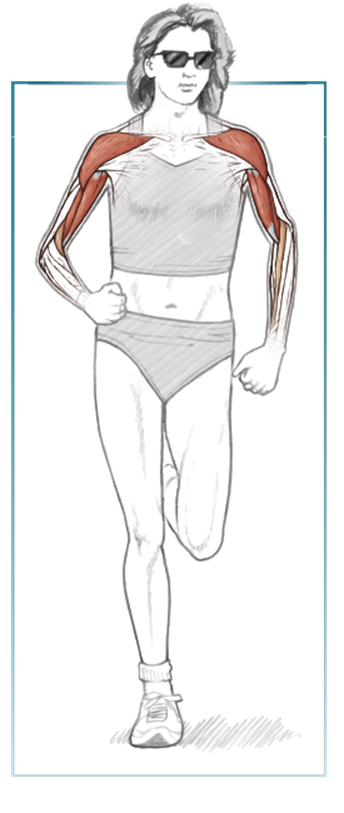
The ball of the shoulder joint, at the upper end of the humerus, is located in the shallow glenoid labrum, or cavity, itself a part of the winged scapula that surrounds the posterior portion of the upper chest. From the runner’s point of view, it is beneficial simply to know the muscles that maintain the position of the humeral head (figure 6.1) and which ones can be strengthened to improve running motion. The movement of the legs when they take large strides requires a similarly large movement of the arms backward and forward to balance the action. In sprinting especially, the arms and shoulders play a large part in propulsion, and a sprinter who is losing a race will often tense his or her shoulders as they go backward though the field. Anatomically, strong shoulders aid both strength and balance in the runner, so the exercises that follow are quite as important as those for the lower limbs. Tired arms and tense shoulders lead to a less fluent arm swing and a short stride that then uses unnecessary energy. The endurance that strength training of the upper limbs provides could make the hundredth of a second difference between success and a lifetime of disappointment.

Figure 6.1 Upper arm: (a) back and (b) front.
The outermost layer is formed by the triangular deltoid muscle. It arises from the clavicle, or collarbone, and part of the top of the scapula to cover the whole joint and be inserted into the middle of the humerus, where its contractions pull the arm out sideways into abduction. It opposes gravity. The complicated pattern of muscles underneath it have developed to enable movement in most planes. This matters little to runners, whose arms merely need to move no more than 45 degrees fore and aft, with minimal sideways movement. These muscles need to be strong rather than elastic. A complicated web holds the arm to the shoulder: The supraspinatus braces the head of the humerus; the infraspinatus, subscapularis, and teres major and minor form a rotator cuff both to connect together and stabilize the shoulder.
Below the shoulder are the biceps, triceps, and brachialis muscles. Their primary function is moving the elbow joint, but some fibers are attached around the shoulder, giving even greater stability to that joint.
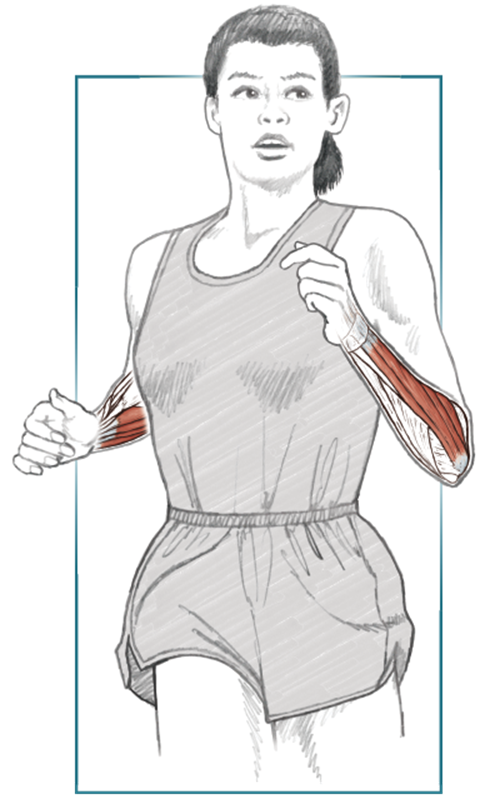
The extensor and flexor muscles of the forearm (figure 6.2) rotate the wrist inward and outward and also move the wrist and fingers. The flexors bend the joints in and the extensors open them out. More detailed knowledge of this anatomy is not the province of the runner, though their strength and flexibility undoubtedly are, so the exercises to promote this are all of relevance in increasing running speed.

Figure 6.2 Forearm: (a) front and (b) back.
Once again, any weakness will slow the runner, so the arms, particularly in power sprints, must have endurance equal to that of the legs. This explains why the physique of a sprinter’s upper limbs is not unlike that of a boxer. Evolution has led to the use of arms when running, first to help stabilize the body and then to keep it upright as each leg moves. You should study a steeplechase runner in slow-motion replay to view how the arms help the body prepare for each takeoff, flight, and landing over the hurdles. Second, strong upper limbs not only aid in the production of full power when sprinting but also help the shoulders relax. When the shoulders tense, the runner inevitably slows. In short, a sprinter without arm movement is not a sprinter!
One other point to bear in mind is that the legs are unable to run with full efficiency if the arms are not involved in the running action. The effect of this could be that strong legs want to speed up toward the end of a run, but are handicapped by upper limbs that have not been trained for the task. So when the arms fatigue, stride length and rate lessen and the runner slows.
Specific Training Guidelines
While performing biceps exercises, remember to keep your back straight; do not rock to help lift the weight. Choose a weight that does not hinder the smooth motion of the curl, and choose a lighter weight rather than a heavier weight to start. Also, keep your elbows fixed and close to your body, emphasizing the biceps and not the shoulders.
Most runners, if they do arm exercises at all, will emphasize the biceps exercises. We have emphasized the triceps to help balance the muscular strength of the arms. Both biceps and triceps exercises can be performed with smaller amounts of resistance. Since distance runners need to be able to swing their arms steadily in the later stages of a long run or race, not to suddenly produce power, the emphasis should be on a larger number of repetitions (18 to 24) because the emphasis is on muscular endurance. For mid-distance runners or sprinters, 8 to 12 repetitions of a heavier weight will suffice.
A good order for a sample arm workout would be the narrow-grip barbell curl, double-arm dumbbell kickback, and reverse wrist curl.
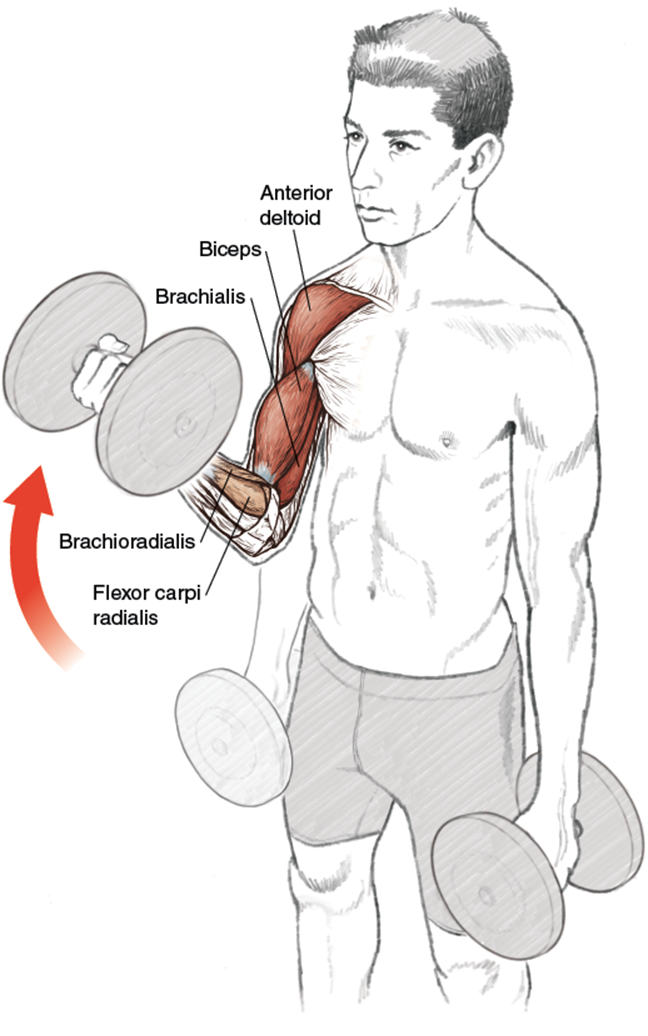
Alternating Standing Biceps Curl With Dumbbell

Safety Tip
This is a simple exercise that can go awry when too much weight is attempted. The ideal weight is heavy enough to provide resistance throughout each rep and set of reps, but not so heavy that poor form eventually occurs. Do not throw the weight by engaging your upper back muscles. The biceps dominates the movement.
Technique Tips
•The upper arm should be fixed at the elbow; as the dumbbell passes 90 degrees, the upper arm should not move with it.
•Look sideways into a mirror, noting whether the elbow is staying fixed and there is little or no swaying (to aid in focusing on using the biceps brachii).
Execution
1. Stand with feet shoulder-width apart and knees slightly bent. Arms should hang straight down from the shoulders, holding dumbbells with the palms inward.
2. In one smooth motion, concentrating on using the biceps and not the hand, curl one dumbbell upward, completing a full range of motion.
3. Using a slow, fluid movement, lower the dumbbell in the opposite direction of the curl. Feel the stretch as the dumbbell returns to its starting position. Repeat the exercise with the other arm.
Muscles Involved
Primary: biceps, brachialis, anterior deltoid
Secondary: brachioradialis, flexor carpi radialis
Running Focus
It seems odd that runners need to develop biceps strength. Most distance runners appear emaciated, with thin arms and legs; however, this does not mean that their biceps are not strong. Developing strength is different from adding mass. The biceps exercise, when performed with enough resistance to stimulate strength gains and done with higher repetitions in conjunction with a strenuous running program, will promote functional strength endurance without added mass. Because the goal of the arms, for a distance runner, is to balance the runner from side to side and counterbalance the movements of the legs, the biceps should not fatigue during a grueling training or racing session. Strength endurance is paramount, and performing 12 to 18 repetitions and multiple sets of this exercise will help develop this type of strength.
Variation
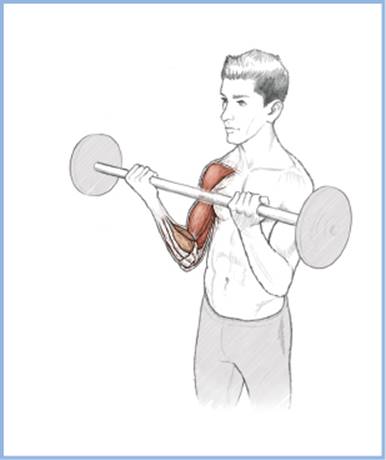
Barbell Curl With Variable-Width Grip
Barbell curls can be done with a normal shoulder-width grip, a narrow grip, or a wide grip. The narrow grip emphasizes the biceps brachii more than the other grips, while the wide grip incorporates the anterior deltoid (the large muscle encapsulating the shoulder). All three grips are appropriate, and a complete biceps workout can be completed by using just this exercise, incorporating one set of each grip.
Alternating Standing Hammer Curl


Safety Tip
Avoid throwing the weight. Focus on the contraction of the biceps.
Technique Tips
•The upper arm should be fixed at the elbow; as the dumbbell passes 90 degrees, the upper arm should not move with it.
•Look sideways into a mirror, noting whether the elbow is staying fixed and there is little or no swaying (to aid in focusing on using the biceps brachii).
Execution
1. Stand with feet shoulder-width apart. Arms hang straight down from the shoulders, holding dumbbells with the palms inward.
2. In one smooth motion, concentrating on using the biceps, not the hand, curl one dumbbell upward until it touches the shoulder, completing a full range of motion. The upper arm should be fixed at the elbow; as the dumbbell passes 90 degrees, the upper arm should not move with it.
3. Using a slow, fluid movement, lower the dumbbell in the opposite direction of the curl. Feel the stretch as the dumbbell returns to its starting position. Repeat the exercise with the other arm.
Muscles Involved
Primary: biceps, brachialis
Secondary: forearm extensors
Running Focus
Similar in execution to the biceps curl—only the hand position is changed—the hammer curl develops strength in the biceps and, to a lesser extent, the brachialis. Performed during the same strength-training session at the end of the biceps set, the hammer curl is a fatigue-inducing exercise that also promotes joint flexibility because of its resistance over a full range of motion.
Often, runners complain of sore biceps during and after a race of a shorter duration with more intense effort. Because of the increased force of the arm carriage, a greater demand is placed on the muscles of the upper arm. By performing the biceps exercises, runners can stave off the fatigue during a race and shorten recovery time between reps during a workout.

Variation
Seated Double-Arm Hammer Curl
While seated on the edge of a flat bench, feet flat on the floor, back erect, and arms hanging down with a dumbbell in each hand, palms inward, perform the hammer-curl motion with both arms simultaneously. This exercise involves the coordination of both arms, and may cause fatigue a little quicker than when alternating arms.
Dumbbell Lying Triceps Extension
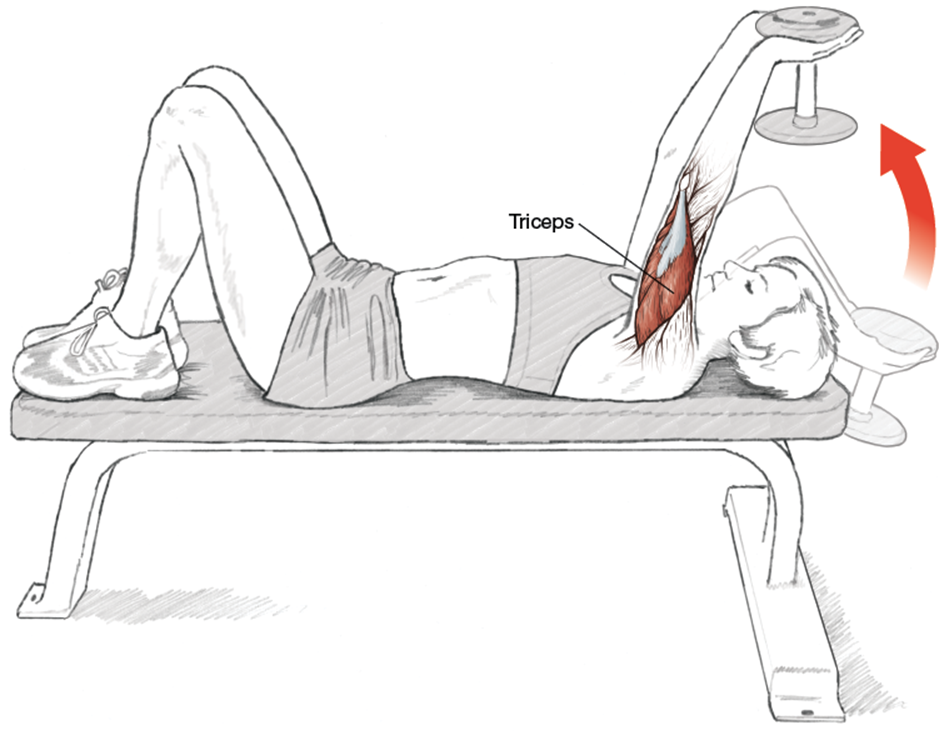
Safety Tip
Have a spotter place the weight in your hands and hold the weight in place until you begin the exercise. If there is not a spotter, begin the exercise with the arms in the extended position, and perform the negative (lowering the weight) action as the first movement.
Execution
1. Lie on a flat bench with both feet on the bench. The torso should be stable. Arms are bent 90 degrees at the elbow, shoulder-width apart. Hold a dumbbell of an appropriate weight with both hands, palms inward.
2. Extend the forearms to full extension.
3. Lower the arms to the initial position slowly, resisting the weight.
Muscles Involved
Primary: triceps
Running Focus
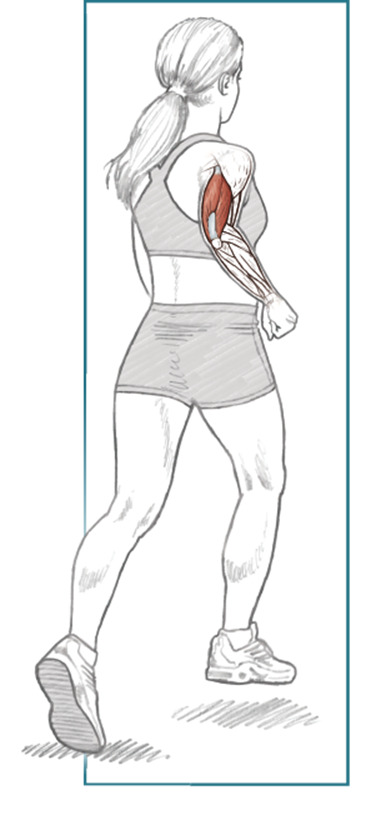
The introduction to this chapter emphasized the importance of the arms in balancing and counterbalancing during running. The triceps exercises listed in this section serve to balance the recommended biceps exercises, creating a well-developed and strengthened upper arm. The muscles of the forearm are involved as secondary movers. The only movement occurs at the elbow joint, precipitated by the engagement of the triceps.
Variation
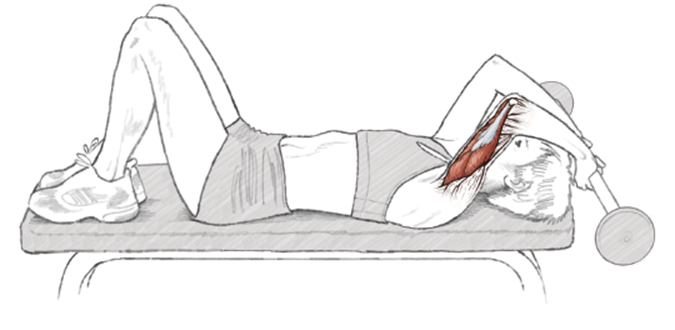
Barbell Lying Triceps Extension
Instead of using a dumbbell, using a barbell to perform the same exercise works well. Execute the exercise the same way, and follow the same safety instructions.
Single-Arm Dumbbell Kickback With Bench

Technique Tip
•It is important not to vary elbow position during the exercise. Keep the elbow tight to the body and fixed. Try to avoid dropping the shoulder to help push the weight backward.
Execution
1. Kneel on a flat bench with one leg. Keep the spine and torso in a straight line with your head. Establish a stable base of support with the non-weight-bearing hand pressed to the bench, and the opposite-side leg extended with the foot on the floor. The weight-bearing arm is bent at about a 90-degree angle with the palm inward.
2. Extend the forearm backward from the elbow, using the triceps muscles to instigate the movement in a slow, fluid fashion. Keep the elbow in a fixed position parallel to the torso, not higher. Exhale during this motion.
3. Upon straightening the arm, allow the weight to return the arm to 90 degrees by providing gentle resistance. Inhale during the return.
Muscles Involved
Primary: triceps
Secondary: infraspinatus, supraspinatus, deltoid, pectoralis major
Running Focus
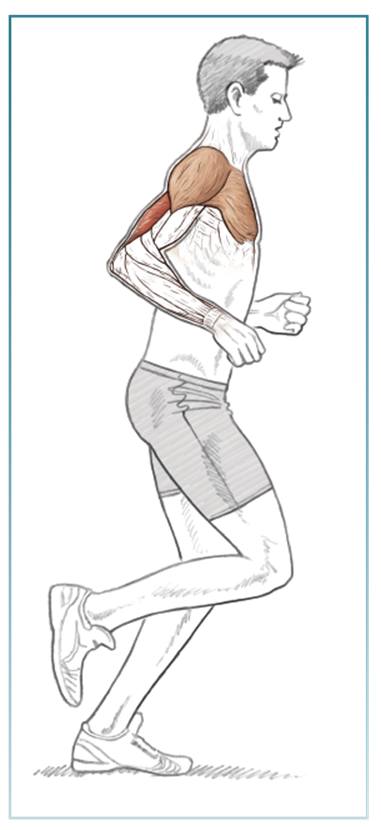
The dumbbell kickback is primarily a triceps exercise, but it recruits the infraspinatus and the supraspinatus muscles of the shoulder. Because the initiation of the arm swing during running takes place in the shoulder, strengthening the triceps and shoulder via this exercise helps ward off arm fatigue and bad posture, two energy-sapping scourges of good performance.
Variation
Double-Arm Dumbbell Kickback
The double-arm variation does not require a bench. From a standing position, bend over at the waist so your torso is close to parallel to the floor, feet shoulder-width apart, and grasp a dumbbell in each hand with the arms hanging downward. Perform the kickback movement with both arms simultaneously. The exercise uses the same muscles as the single-arm kickback using a bench, and will incorporate the core muscles of the abdomen and lower back to stabilize the body.

Machine Reverse Push-Down

Execution
1. Standing with your feet narrower than shoulder-width apart, grasp the short, straight bar attached to a cable (on a pulley attached to the machine) with palms upward (underhand grip). The forearms are extended at approximately 75 degrees to the elbows, which remain fixed at your sides throughout the exercise.
2. In a smooth, uninterrupted motion, push the forearms downward in full extension, keeping the elbows fixed in their original position and close to the body. Exhale throughout the motion.
3. Allow the weight to return to the original position by resisting the pull of the cable gradually and in a smooth manner. Inhale during this part of the exercise.
Muscles Involved
Primary: triceps, forearm extensors
Running Focus
The reverse push-down mainly works the triceps, but it has the added benefit of also working the forearm muscles because of the underhand grip. This exercise marks a nice transition from the triceps-dominated extension and kickback into the next exercises, wrist curls, which predominantly work the forearm muscles. The triceps muscles and the extensor muscles of the forearms will fatigue quickly during the exercise as they do during a shorter distance race (5 to 10K), when using the arms becomes a means of propelling the legs during surges and effecting a finishing push.

Wrist Curl and Reverse Wrist Curl
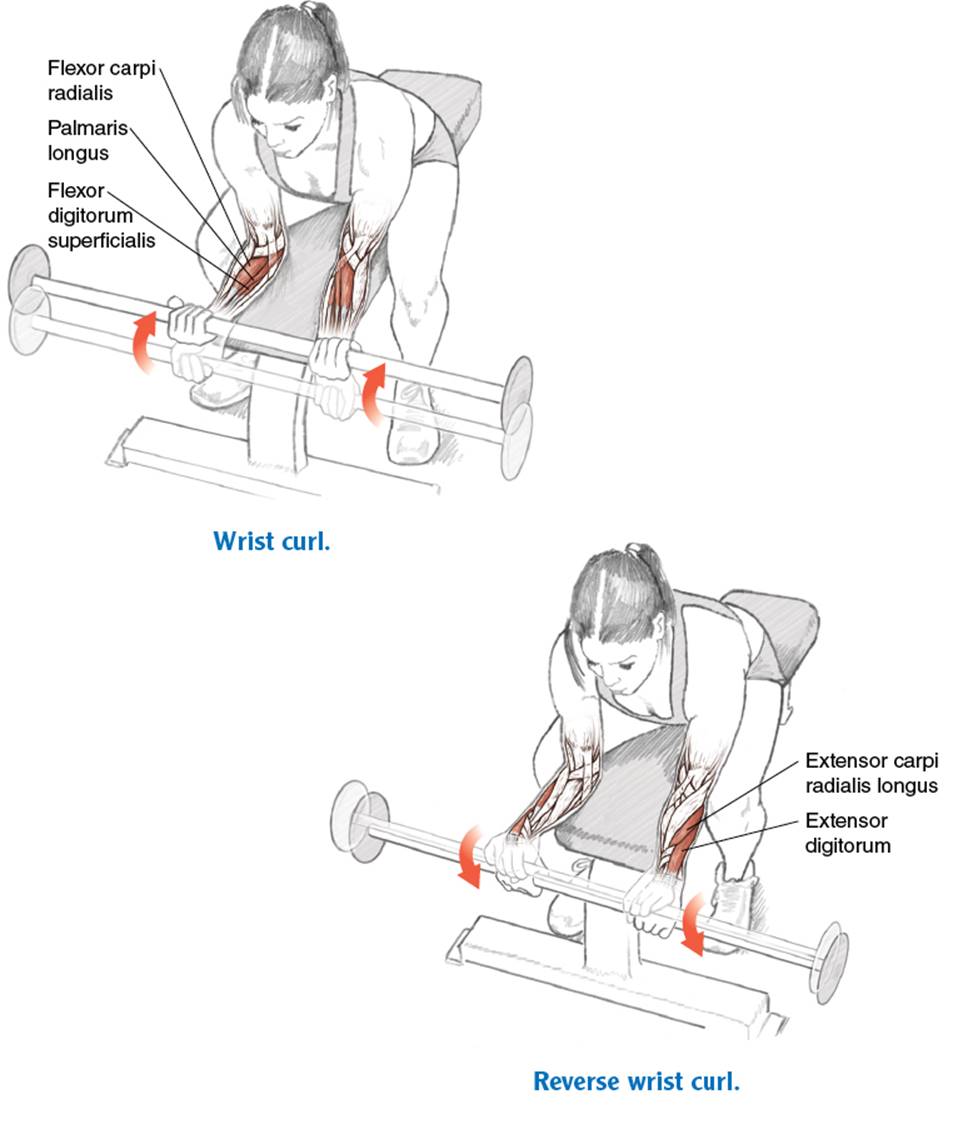
Technique Tips
•Focus on a full stretch of the muscles, but do not allow the barbell to snap down.
•If it is difficult to rest your forearms on the bench, you can rest them on your legs.
Execution for Wrist Curl
1. Lean forward on a flat bench with your forearms resting on the bench. The wrists and hands should extend off the bench. Palms should be facing up with a barbell of a light weight resting forward of the palms with the fingers gently closed around the bar.
2. Raise the barbell by raising your hands, involving only the muscles of the forearms and hands, through a full extension.
3. Return the weight to its original position, gradually resisting the barbell as it moves downward.
Execution for Reverse Wrist Curl
1. Lean forward on a flat bench with your forearms resting on the bench. The wrists and hands should extend off the bench. Palms should face downward with a barbell of a light weight gripped securely by the palms and fingers.
2. Raise the barbell by raising your hands, involving only the muscles of the forearms and hands, through a full extension.
3. Return the weight to its original position, gradually resisting the barbell as it moves downward.
Muscles Involved
Primary: forearm flexors, forearm extensors
Running Focus
After gradually incorporating the extensor and flexor muscles into the strength-training routine, use wrist curls and reverse wrist curls to emphasize these muscles. During the course of a four-hour marathon, each arm will swing approximately 22,000 times. Although the movement is initiated by the larger muscles of the shoulders, the upper arms and the forearms are involved in the arm carriage. Specifically, each forearm is held at approximately 90 degrees to the upper arm to counterbalance the action of the opposite-side leg. During the course of 22,000 arm swings and four hours of being held aloft (fighting gravity), fatigue is bound to set in, creating a chain reaction of biomechanical adjustments resulting in poor form and wasted energy.
By performing the strength-training exercises for the arms, this fatigue and its chain reaction of bad results can be mitigated, if not eliminated—hence, less wasted energy, and hopefully faster times and better performances.